
Traditional Manufacturing Processes Casting Forming Sheet metal processing
![Designing injection molds: mold in action [source: Lec notes, Prof T. Gutosky, MIT]](https://slidetodoc.com/presentation_image/511dc97ec27fd442e2a08e96c3020858/image-26.jpg "Designing injection molds: mold in action [source: Lec notes, Prof T. Gutosky, MIT]")
![Designing injection molds: typical features [source: www. idsa-mp. org]](https://slidetodoc.com/presentation_image/511dc97ec27fd442e2a08e96c3020858/image-27.jpg "Designing injection molds: typical features [source: www. idsa-mp. org]")

- Slides: 33
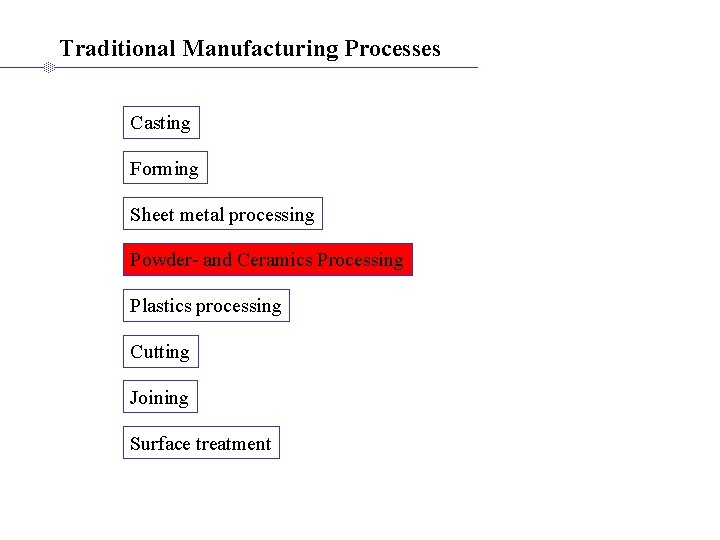
Traditional Manufacturing Processes Casting Forming Sheet metal processing Powder- and Ceramics Processing Plastics processing Cutting Joining Surface treatment
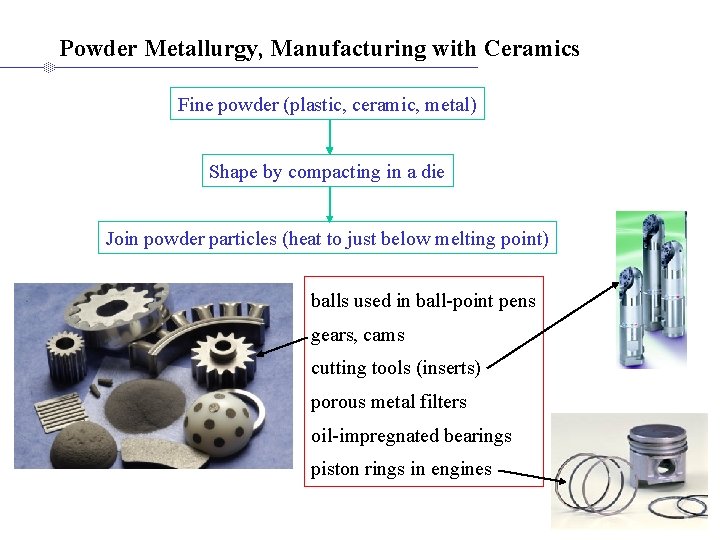
Powder Metallurgy, Manufacturing with Ceramics Fine powder (plastic, ceramic, metal) Shape by compacting in a die Join powder particles (heat to just below melting point) balls used in ball-point pens gears, cams cutting tools (inserts) porous metal filters oil-impregnated bearings piston rings in engines
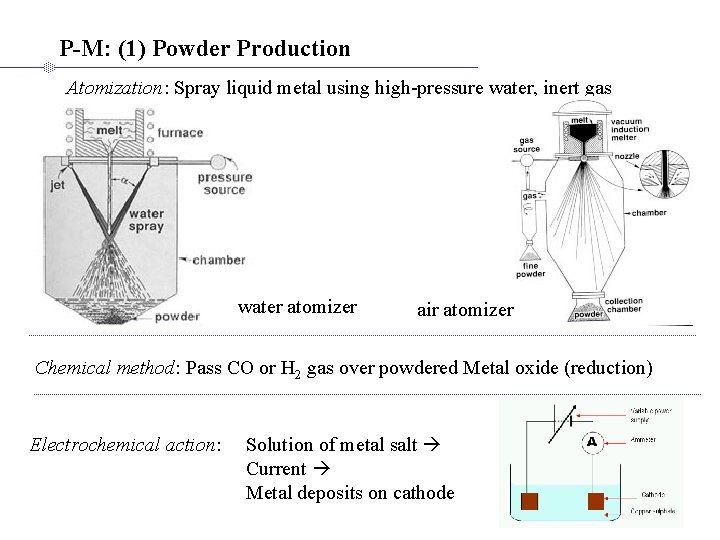
P-M: (1) Powder Production Atomization: Spray liquid metal using high-pressure water, inert gas water atomizer air atomizer Chemical method: Pass CO or H 2 gas over powdered Metal oxide (reduction) Electrochemical action: Solution of metal salt Current Metal deposits on cathode
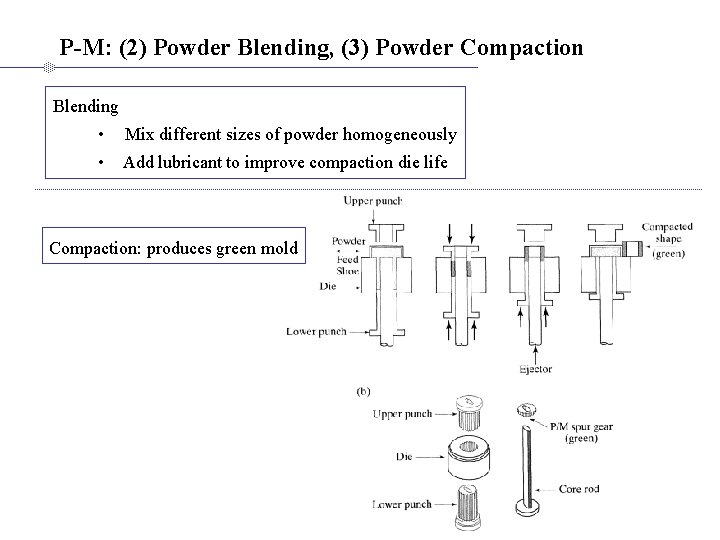
P-M: (2) Powder Blending, (3) Powder Compaction Blending • Mix different sizes of powder homogeneously • Add lubricant to improve compaction die life Compaction: produces green mold
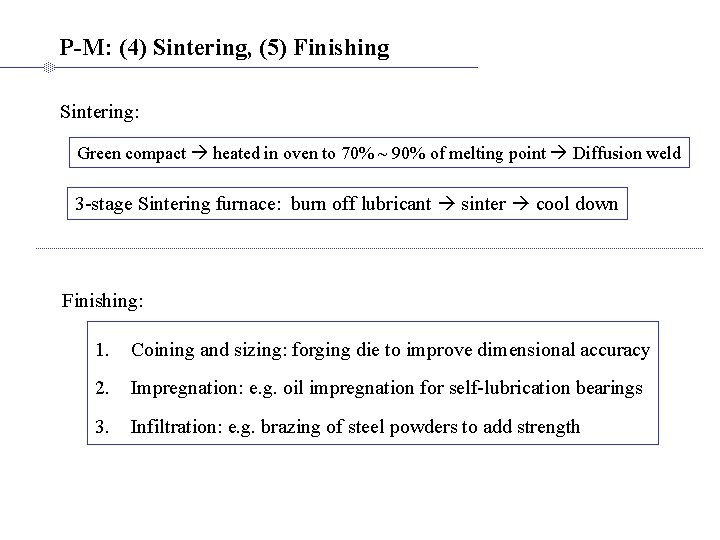
P-M: (4) Sintering, (5) Finishing Sintering: Green compact heated in oven to 70% ~ 90% of melting point Diffusion weld 3 -stage Sintering furnace: burn off lubricant sinter cool down Finishing: 1. Coining and sizing: forging die to improve dimensional accuracy 2. Impregnation: e. g. oil impregnation for self-lubrication bearings 3. Infiltration: e. g. brazing of steel powders to add strength
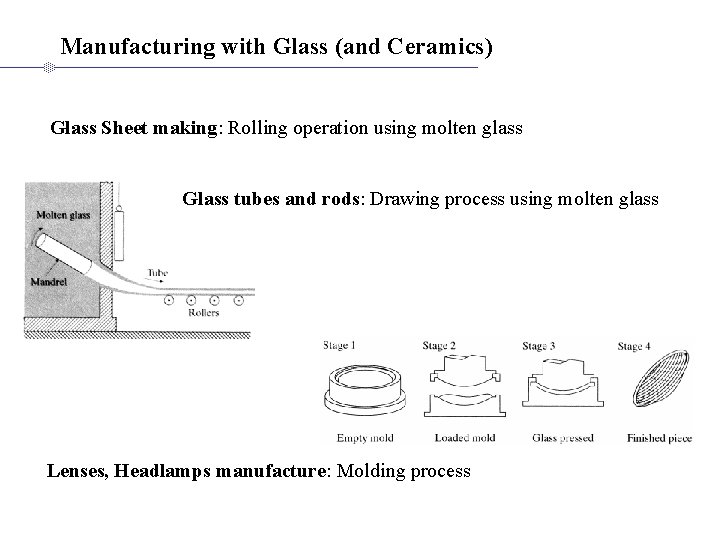
Manufacturing with Glass (and Ceramics) Glass Sheet making: Rolling operation using molten glass Glass tubes and rods: Drawing process using molten glass Lenses, Headlamps manufacture: Molding process
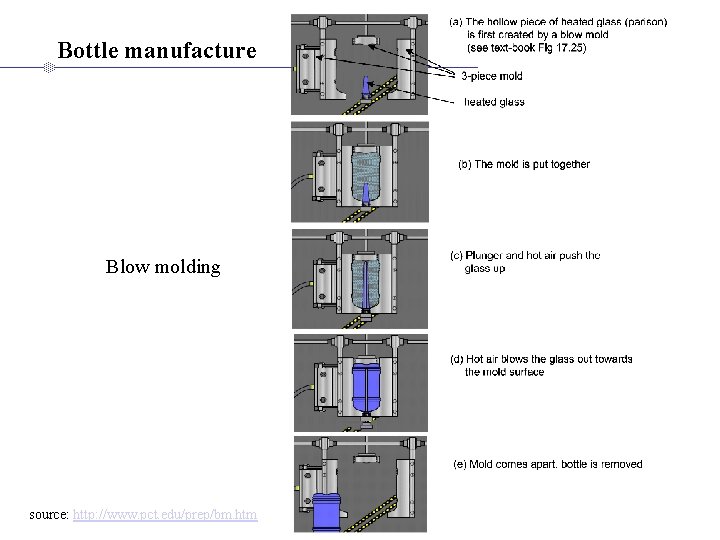
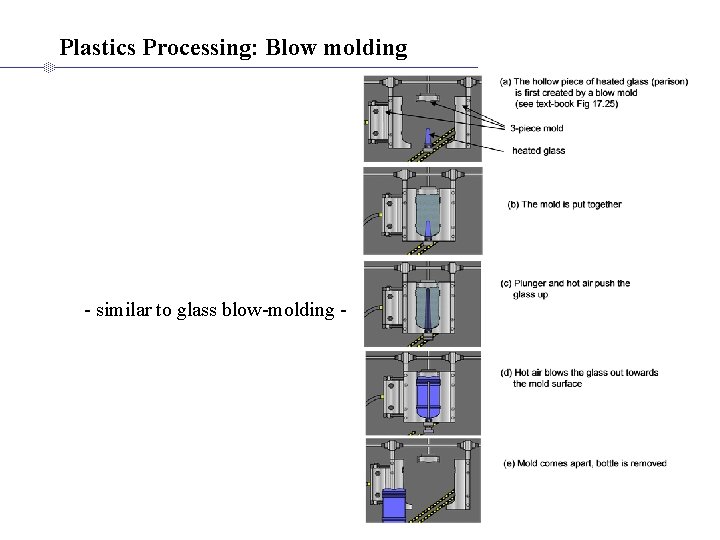
Bottle manufacture Blow molding source: http: //www. pct. edu/prep/bm. htm
Traditional Manufacturing Processes Casting Forming Sheet metal processing Powder- and Ceramics Processing Plastics processing Cutting Joining Surface treatment
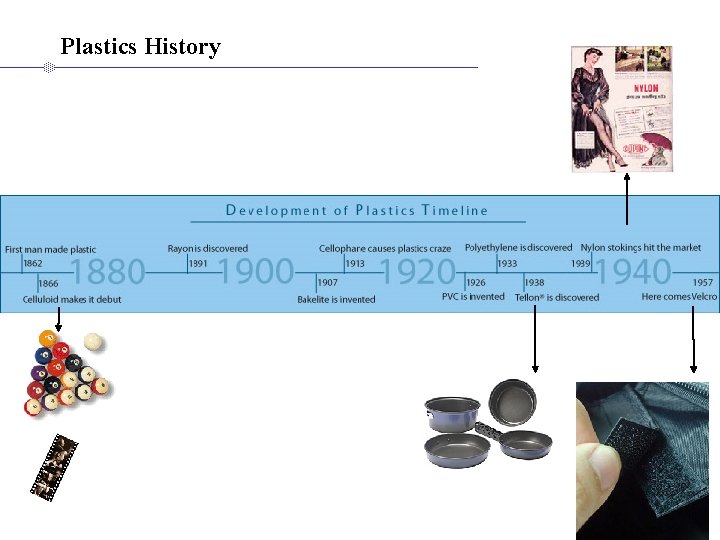
Plastics History
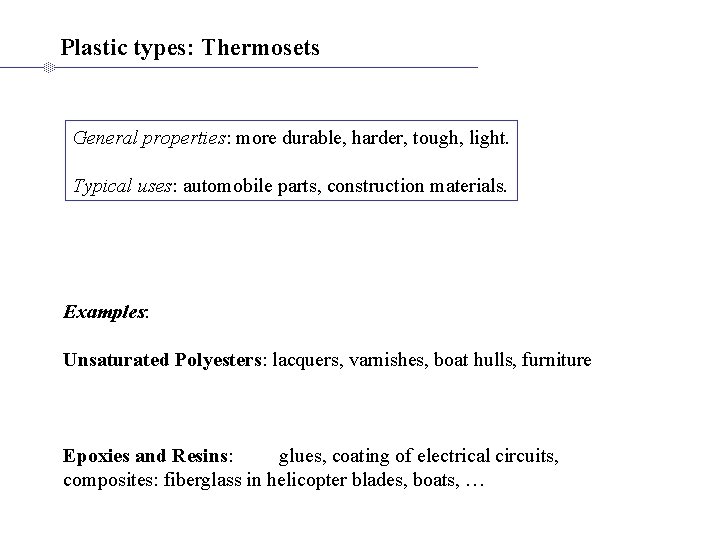
Plastic types: Thermosets General properties: more durable, harder, tough, light. Typical uses: automobile parts, construction materials. Examples: Unsaturated Polyesters: lacquers, varnishes, boat hulls, furniture Epoxies and Resins: glues, coating of electrical circuits, composites: fiberglass in helicopter blades, boats, …
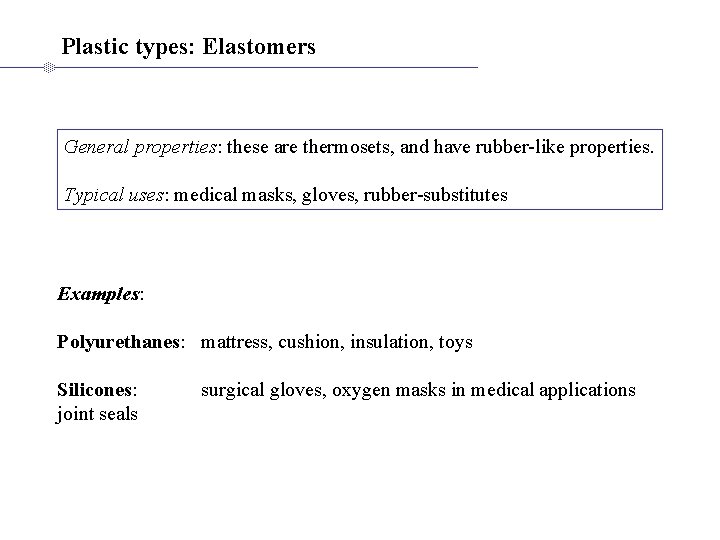
Plastic types: Elastomers General properties: these are thermosets, and have rubber-like properties. Typical uses: medical masks, gloves, rubber-substitutes Examples: Polyurethanes: mattress, cushion, insulation, toys Silicones: joint seals surgical gloves, oxygen masks in medical applications
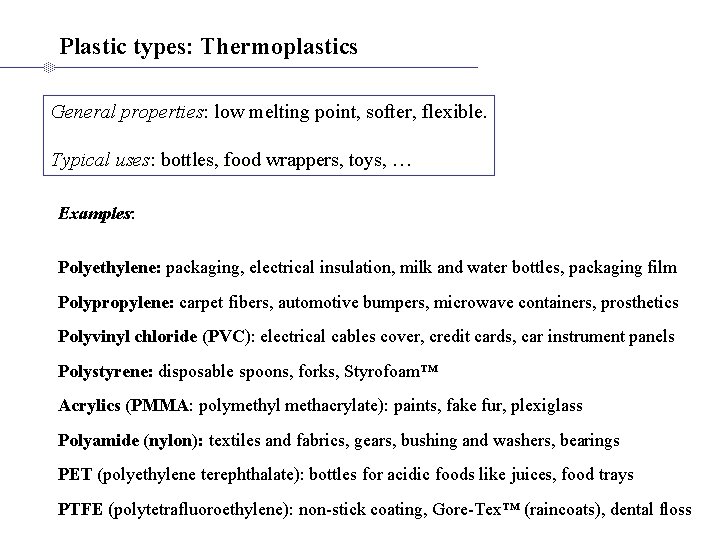
Plastic types: Thermoplastics General properties: low melting point, softer, flexible. Typical uses: bottles, food wrappers, toys, … Examples: Polyethylene: packaging, electrical insulation, milk and water bottles, packaging film Polypropylene: carpet fibers, automotive bumpers, microwave containers, prosthetics Polyvinyl chloride (PVC): electrical cables cover, credit cards, car instrument panels Polystyrene: disposable spoons, forks, Styrofoam™ Acrylics (PMMA: polymethyl methacrylate): paints, fake fur, plexiglass Polyamide (nylon): textiles and fabrics, gears, bushing and washers, bearings PET (polyethylene terephthalate): bottles for acidic foods like juices, food trays PTFE (polytetrafluoroethylene): non-stick coating, Gore-Tex™ (raincoats), dental floss
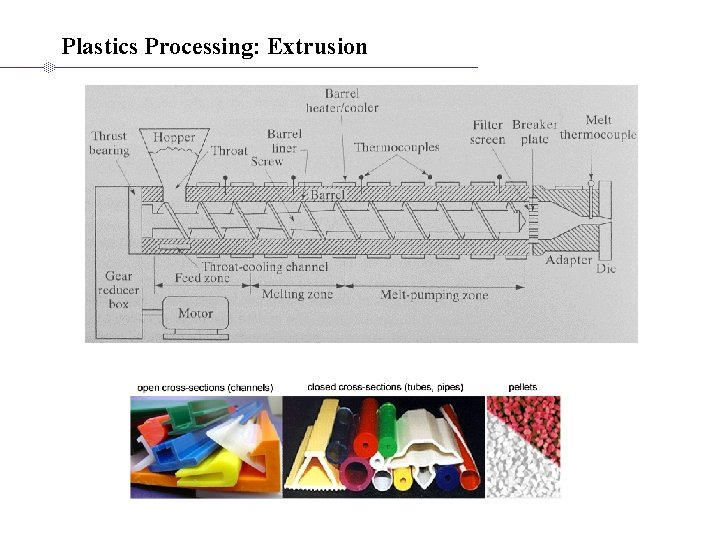
Plastics Processing: Extrusion
Plastics Processing: Blow molding - similar to glass blow-molding -
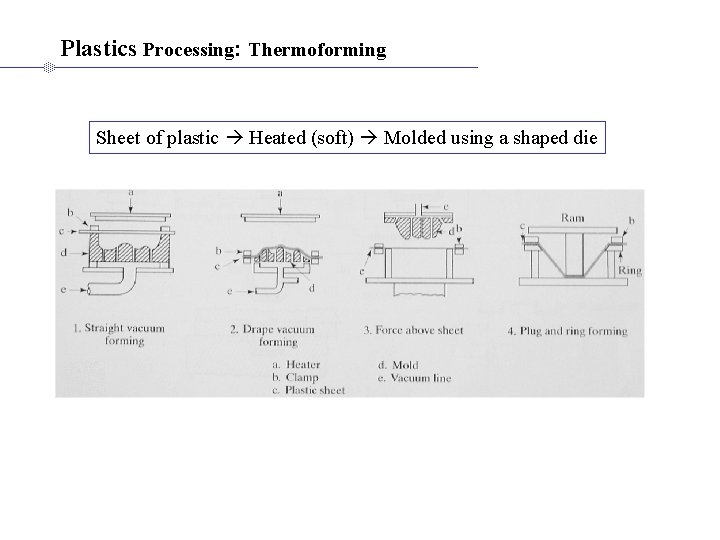
Plastics Processing: Thermoforming Sheet of plastic Heated (soft) Molded using a shaped die
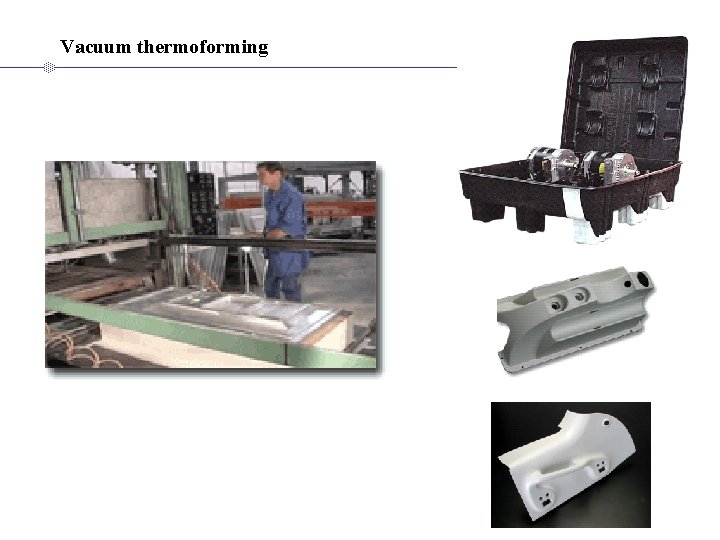
Vacuum thermoforming
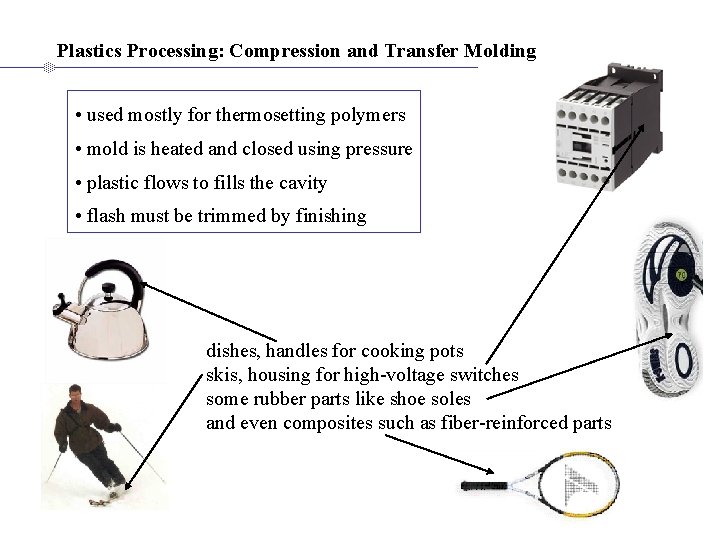
Plastics Processing: Compression and Transfer Molding • used mostly for thermosetting polymers • mold is heated and closed using pressure • plastic flows to fills the cavity • flash must be trimmed by finishing dishes, handles for cooking pots skis, housing for high-voltage switches some rubber parts like shoe soles and even composites such as fiber-reinforced parts
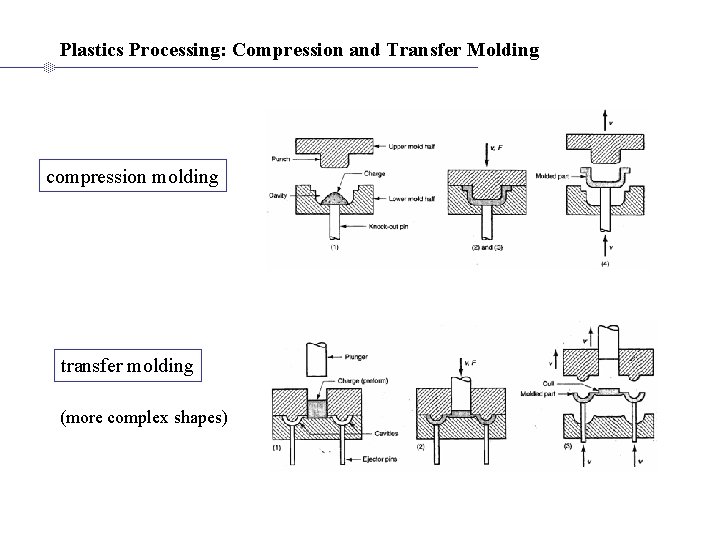
Plastics Processing: Compression and Transfer Molding compression molding transfer molding (more complex shapes)
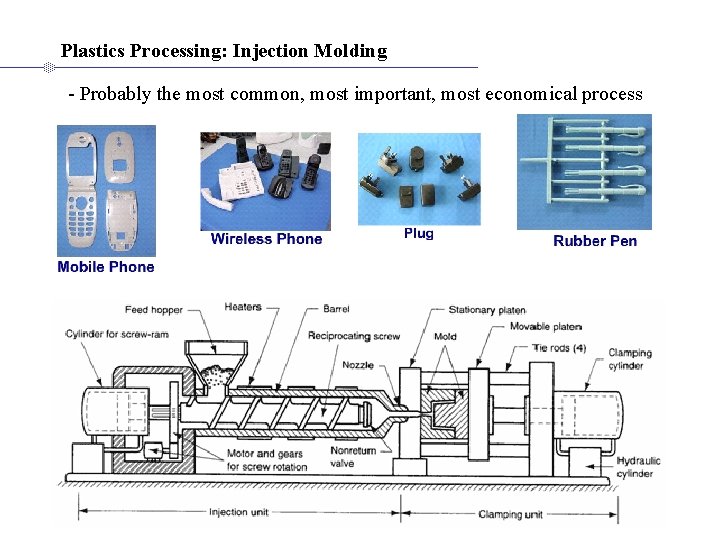
Plastics Processing: Injection Molding - Probably the most common, most important, most economical process
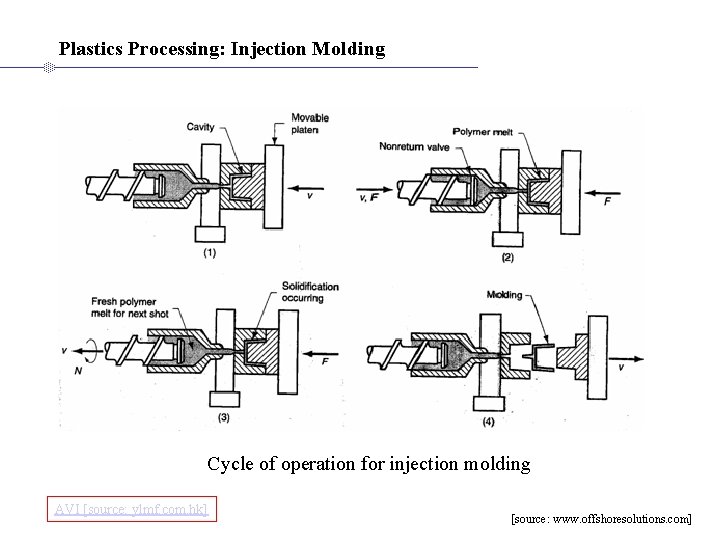
Plastics Processing: Injection Molding Cycle of operation for injection molding AVI [source: ylmf. com. hk] [source: www. offshoresolutions. com]
Injection Molding: geometry of the mold Basic components: mold pieces (define the geometry of the part), AND sprue, gates, runners, vents, ejection pins, cooling system
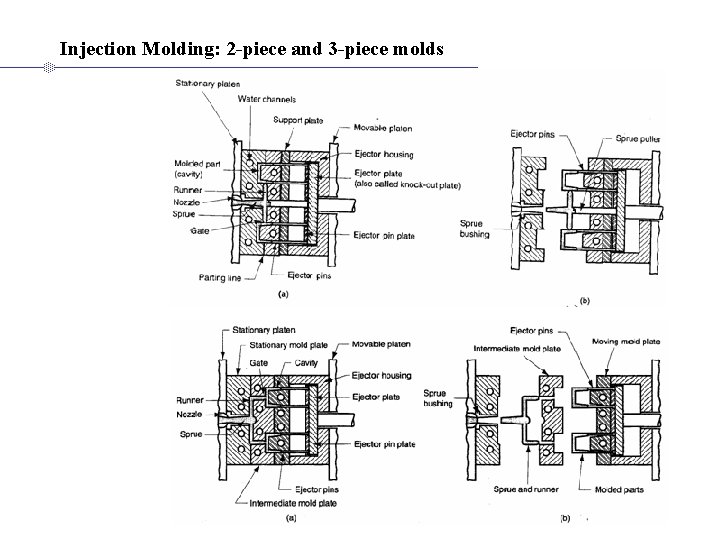
Injection Molding: 2 -piece and 3 -piece molds
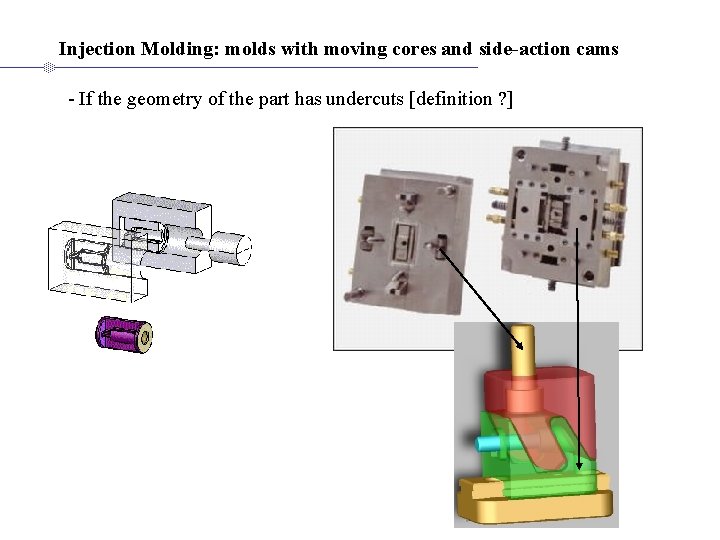
Injection Molding: molds with moving cores and side-action cams - If the geometry of the part has undercuts [definition ? ]
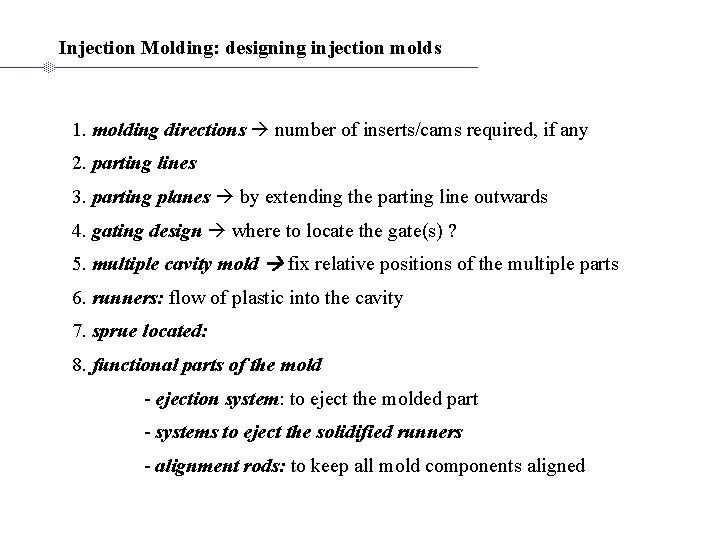
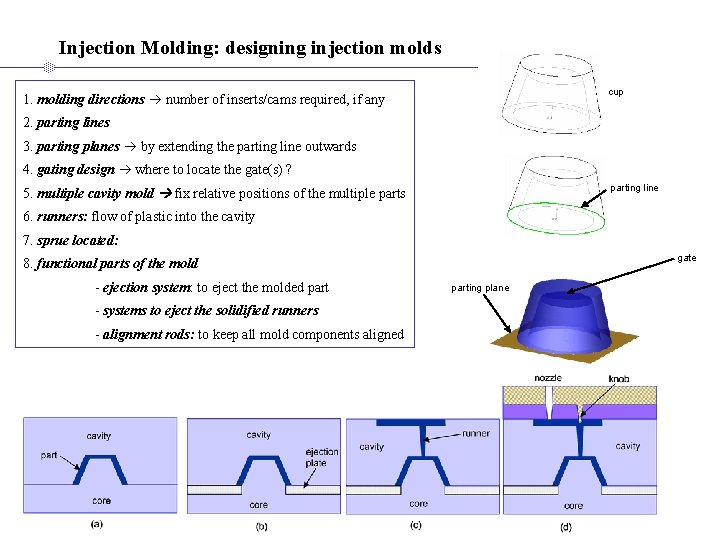
Injection Molding: designing injection molds 1. molding directions number of inserts/cams required, if any 2. parting lines 3. parting planes by extending the parting line outwards 4. gating design where to locate the gate(s) ? 5. multiple cavity mold fix relative positions of the multiple parts 6. runners: flow of plastic into the cavity 7. sprue located: 8. functional parts of the mold - ejection system: to eject the molded part - systems to eject the solidified runners - alignment rods: to keep all mold components aligned
Injection Molding: designing injection molds cup 1. molding directions number of inserts/cams required, if any 2. parting lines 3. parting planes by extending the parting line outwards 4. gating design where to locate the gate(s) ? parting line 5. multiple cavity mold fix relative positions of the multiple parts 6. runners: flow of plastic into the cavity 7. sprue located: gate 8. functional parts of the mold - ejection system: to eject the molded part - systems to eject the solidified runners - alignment rods: to keep all mold components aligned parting plane
Designing injection molds: mold in action [source: Lec notes, Prof T. Gutosky, MIT]
Designing injection molds: typical features [source: www. idsa-mp. org]
Designing injection molds: typical features
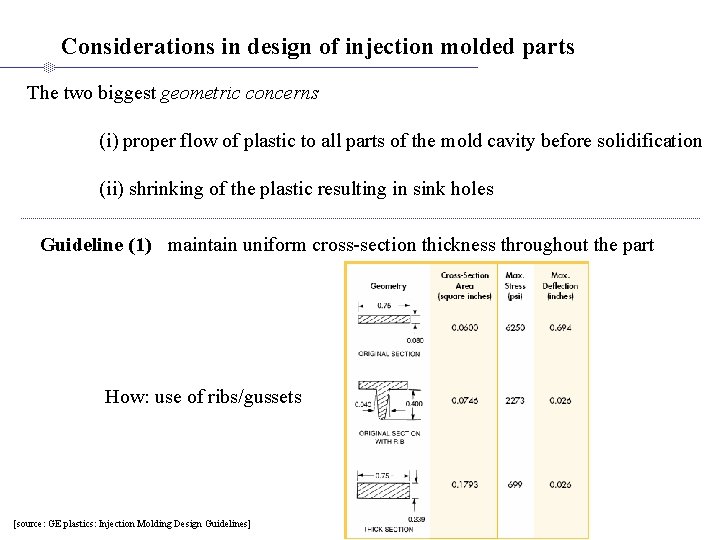
Considerations in design of injection molded parts The two biggest geometric concerns (i) proper flow of plastic to all parts of the mold cavity before solidification (ii) shrinking of the plastic resulting in sink holes Guideline (1) maintain uniform cross-section thickness throughout the part How: use of ribs/gussets [source: GE plastics: Injection Molding Design Guidelines]
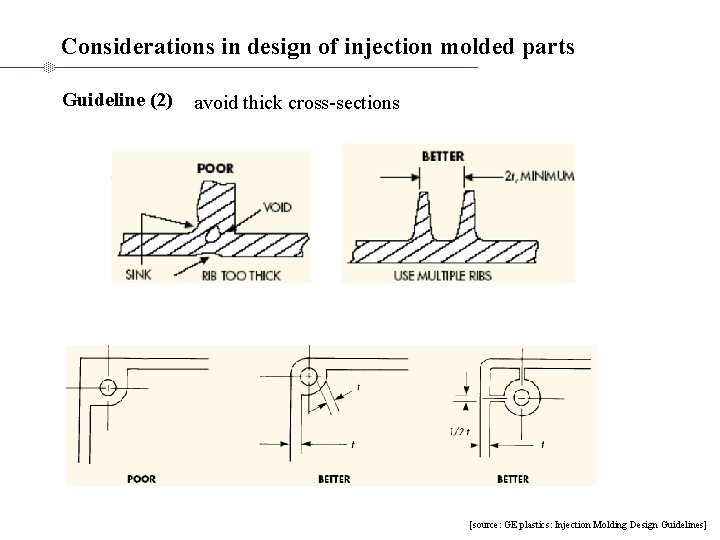
Considerations in design of injection molded parts Guideline (2) avoid thick cross-sections [source: GE plastics: Injection Molding Design Guidelines]
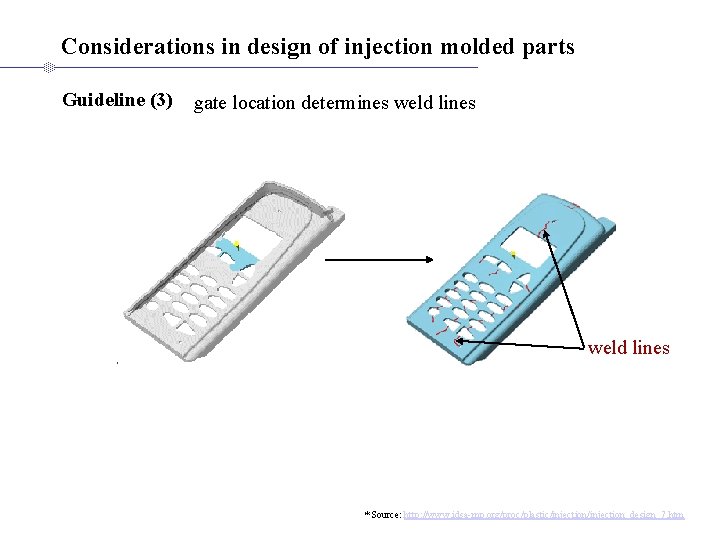
Considerations in design of injection molded parts Guideline (3) gate location determines weld lines * Source: http: //www. idsa-mp. org/proc/plastic/injection_design_7. htm
A Typical Plastics Molding Factory - Tooling plant (produces and tests the injection mold) - Molding plant (uses the mold to produce parts, assembles products, …) Website: http: //www. ylmf. com. hk
Summary Topics covered: Powder metallurgy and Plastics processing Further reading: Chapters 17, 19, Kalpakjian & Schmid