
Traditional Knowledge Systems for Management of Kaya Forests


- Slides: 19
Traditional Knowledge Systems for Management of Kaya Forests in Coast Region of Kenya D. Mutta, E Chagala-Odera, S Wairungu & S Nassoro KEFRI, TBA
Outline § § § Introduction Objectives Methodology Results & Discussion Conclusion Recommendations
Introduction § Kenya’s gazzetted closed forest 1. 4 m ha § 1. 7% total land area. § 1. 0% & 13. 0% monetary and nonmonetary economies § Threats: Illegal encroachment, excisions, short term political interests, resource use conflicts, archaic forest policies and legislation
Introduction cont’d § Use of traditional knowledge in forest management could stem the problem § TK provides food, medicine, spiritual fulfillment & natural forest management § Rio Declaration: indigenous people and their communities have vital role in environmental management and development § CBD Art 8 j, CCD, Statement of Principles for sustainable management of forests
TK & Sustainable Forest Management Traditional Approach § 3 million forest adjacent dwellers (5 Km) with developed TKS in Kenya § E. g. the Mijikenda among the Kaya forests sustainably managed since time immemorial § Kayas are sacred and it is hypothesized that their existence is owed directly to beliefs, culture and history of the Mijikenda ethnic groups
Natural Forest Mngt cont’d Conventional approach Top- Down system § Colonial history- gazettement (protect), ownership change, increased central governance. Forest Policy 1957, 1968, review § Kaya Forests: 1992 Forest reserves & National Monuments (Githitho, 1998) World Heritage sites § Ownership and control change § Forests getting depleted: encroachment § Need to understand the TK system and impact of formal governance GLOBAL PROJECT CHINA, INDIA, PANAMA, PERU
Study Objectives § Highlight the role of traditional knowledge system in the management of 3 Kaya forests § Analyse the traditional forest management approach to determine key principles, laws and institutions that sustained the Kaya forests to inform management
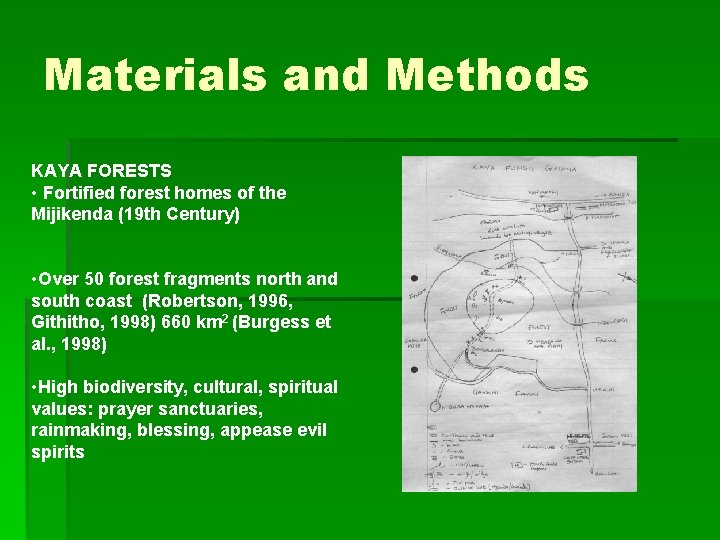
Materials and Methods KAYA FORESTS • Fortified forest homes of the Mijikenda (19 th Century) • Over 50 forest fragments north and south coast (Robertson, 1996, Githitho, 1998) 660 km 2 (Burgess et al. , 1998) • High biodiversity, cultural, spiritual values: prayer sanctuaries, rainmaking, blessing, appease evil spirits
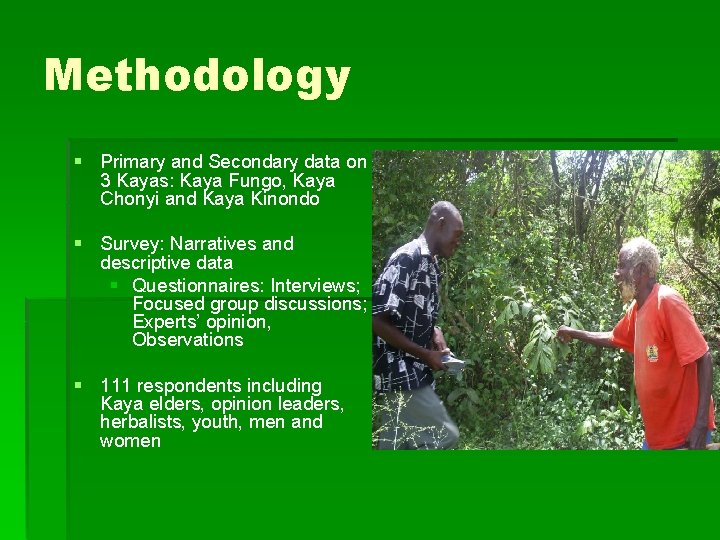
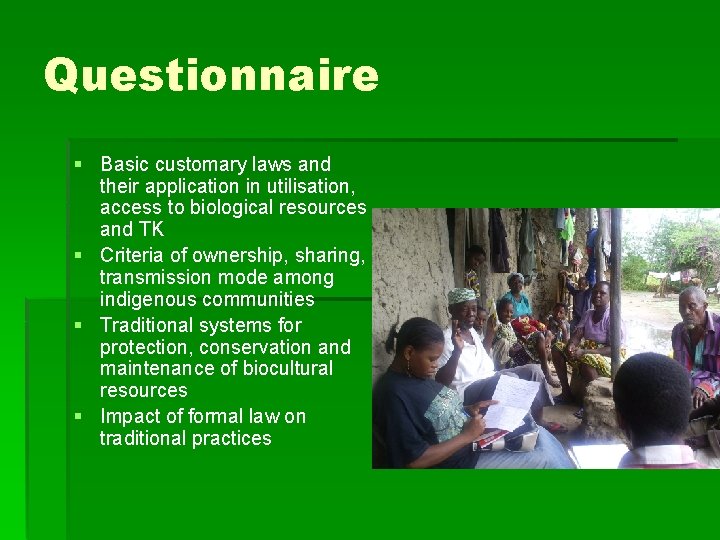
Methodology § Primary and Secondary data on 3 Kayas: Kaya Fungo, Kaya Chonyi and Kaya Kinondo § Survey: Narratives and descriptive data § Questionnaires: Interviews; Focused group discussions; Experts’ opinion, Observations § 111 respondents including Kaya elders, opinion leaders, herbalists, youth, men and women
Questionnaire § Basic customary laws and their application in utilisation, access to biological resources and TK § Criteria of ownership, sharing, transmission mode among indigenous communities § Traditional systems for protection, conservation and maintenance of biocultural resources § Impact of formal law on traditional practices
Results and Discussion § Mijikenda governed Kaya forests as a collective biocultural heritage (CBCH) § CBCH: knowledge, innovations and practices of indigenous communities held collectively and inextricably linked to traditional resources and territories, including diversity of species and ecosystems; cultural and spiritual values and customary laws shaped within socio-ecological context of communities § Literary, artistic, scientific works, song, dance, medicinal treatments and practices. § Orally transmitted, codified, often linked to cosmic forces
Traditional Governance § Traditional regime (Ngambi) was responsible for: § rule making and enforcement, § management, control and access to biological resources and traditional knowledge § Kaya forests were subjected to traditional rules and rituals organised and led by elders who communicated to the spirits § § 10 – 200 ha botanically diverse Protective premise, ethnobotanical use, spiritual use Collection processes controlled through PIC except for healers ‘Kadzama’
Principles of Customary Laws § Equilibrium: The guiding principle in application of customary laws. It’s the complementarity (between ecological niches) balance and harmony in both nature and society, respect for mother earth, gods. Belief in spiritual world for social harmony, hierarchy. Nonpartisan. § Reciprocity: What is received must be given back in equal measure. Principle of equity, provides basis for negotiation, sharing, exchange between individuals. e. g. rainmaking rituals, good harvest 7 seed grains. Entire knowledge sharing, generation inheritance. § Duality: Everything has an opposite which complements it; thus behaviour cannot be individualistic. Belief in existence of good and bad spirits. Spirits bless or curse.
Effect of Formal governance on traditional governance system § Relationship antagonistic due to competition for legitimacy and influence § State based legal systems predominated and marginalised community based legal system § Indigenous communities alienated from their heritage and their governance system at periphery § Traditional enforcement system invalidated
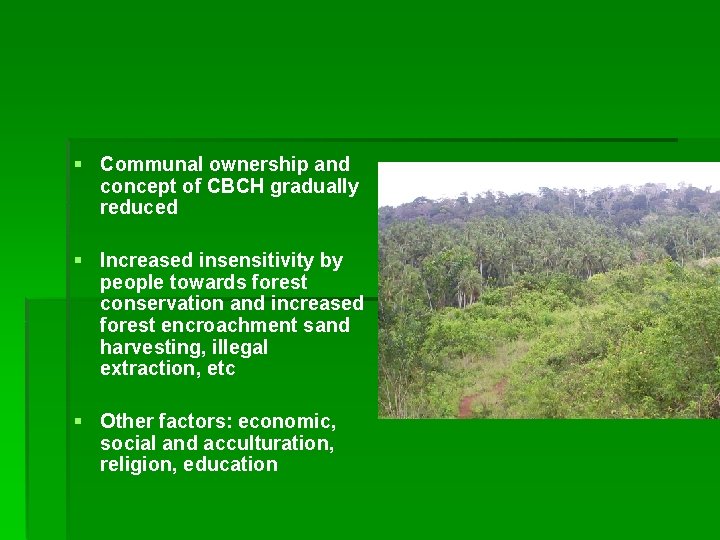
§ Communal ownership and concept of CBCH gradually reduced § Increased insensitivity by people towards forest conservation and increased forest encroachment sand harvesting, illegal extraction, etc § Other factors: economic, social and acculturation, religion, education
Conclusions § There are close linkages between spiritual beliefs, traditional knowledge, customary laws and landscapes and natural resources § Customary laws effectively conserved natural forests thro conservation norms & respect for spiritual world § Ngambi ensured that TK was sustained, harmony and integrity § The diminished role of Kaya elders has contributed to reduction of forests due to lack of respect, poor enforcement by formal governance
Recommendations § Rethinking conventional forest management strategies means recognizing key roles of indigenous people, their knowledge and social organization in forest management. § A participatory approach that brings forest managers and local communities together as partners offers best option for SFM § Strengthen traditional governance systems - give them space § Legal recognition, institutionalization and empowerment of Kaya elders, reinstate historic ownership & responsibility § Capacity building of traditional local communities in management § Integrate customary laws and principles into formal law PFM, Forest Act 2005
Acknowledgement § § IDRC, IIED KEFRI, ICIPE Kaya elders, local administration IUFRO
THANK YOU FOR YOUR ATTENTION