
Traditional image segmentation http opticalillusions wikia comwikiEmergence What
- Slides: 27
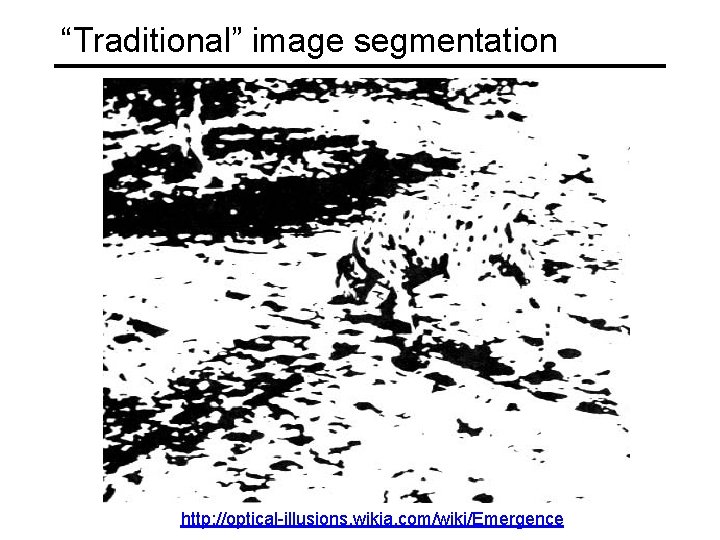
“Traditional” image segmentation http: //optical-illusions. wikia. com/wiki/Emergence
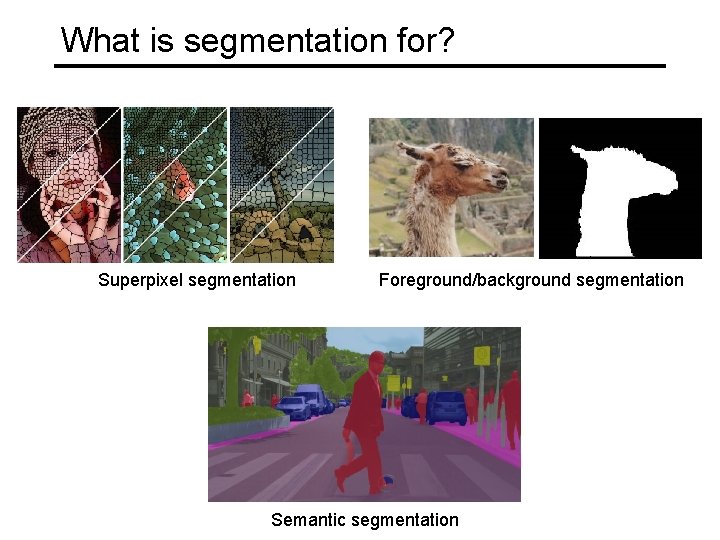
What is segmentation for? Superpixel segmentation Foreground/background segmentation Semantic segmentation
Outline • Bottom-up segmentation • • Superpixel segmentation Normalized cuts • Interactive segmentation • CRF energy functions, graph cut optimization • Supervised or top-down segmentation • • CRFs Deep networks (next time)
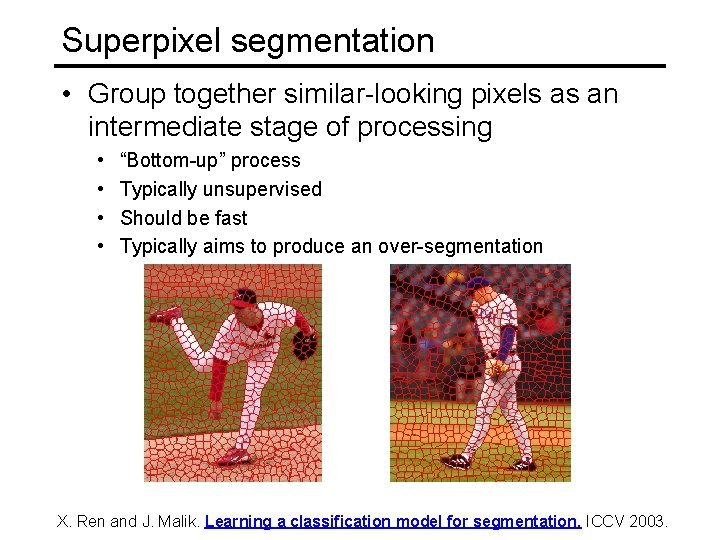
Superpixel segmentation • Group together similar-looking pixels as an intermediate stage of processing • • “Bottom-up” process Typically unsupervised Should be fast Typically aims to produce an over-segmentation X. Ren and J. Malik. Learning a classification model for segmentation. ICCV 2003.
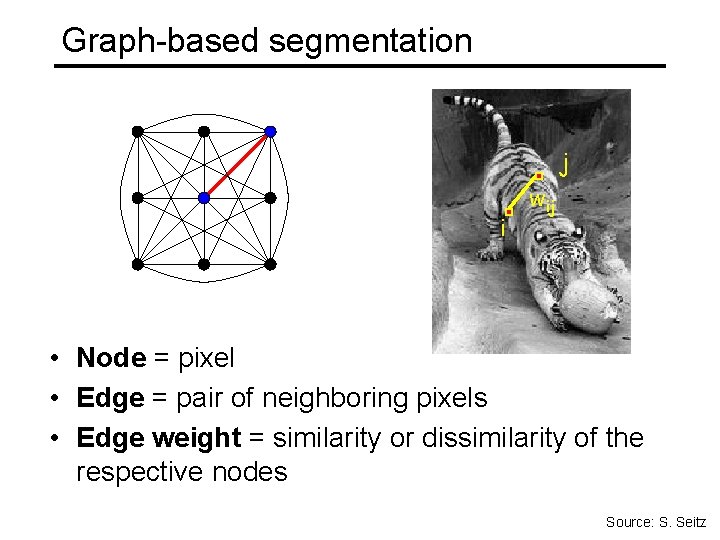
Graph-based segmentation j i wij • Node = pixel • Edge = pair of neighboring pixels • Edge weight = similarity or dissimilarity of the respective nodes Source: S. Seitz
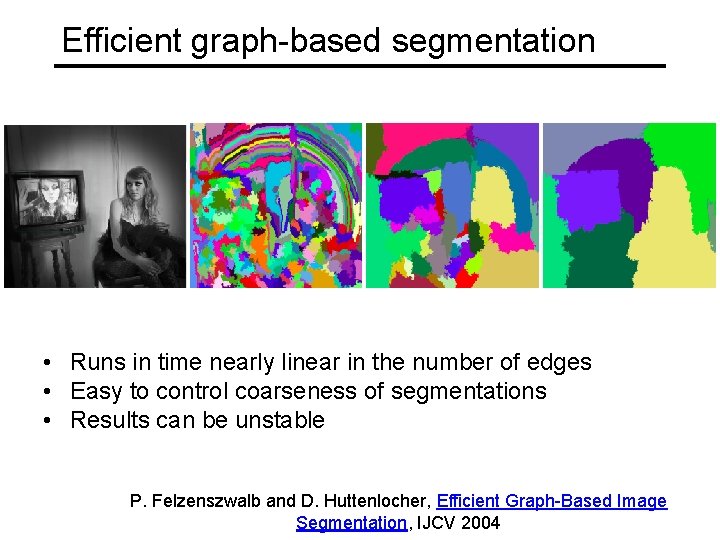
Efficient graph-based segmentation • Runs in time nearly linear in the number of edges • Easy to control coarseness of segmentations • Results can be unstable P. Felzenszwalb and D. Huttenlocher, Efficient Graph-Based Image Segmentation, IJCV 2004
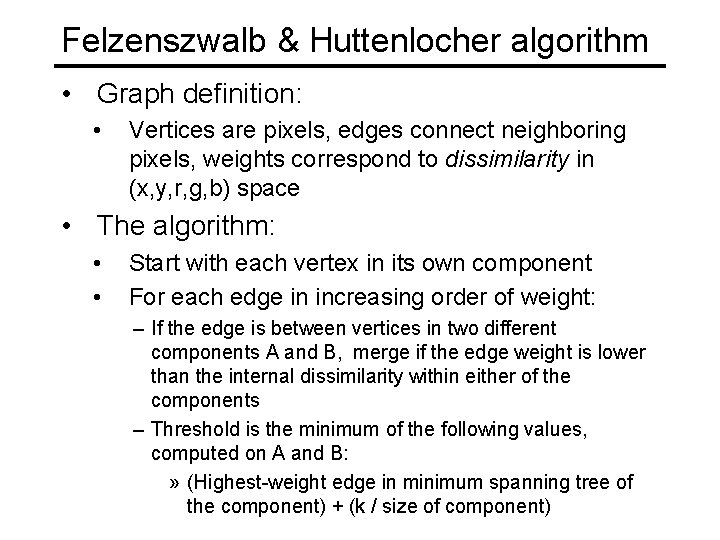
Felzenszwalb & Huttenlocher algorithm • Graph definition: • Vertices are pixels, edges connect neighboring pixels, weights correspond to dissimilarity in (x, y, r, g, b) space • The algorithm: • • Start with each vertex in its own component For each edge in increasing order of weight: – If the edge is between vertices in two different components A and B, merge if the edge weight is lower than the internal dissimilarity within either of the components – Threshold is the minimum of the following values, computed on A and B: » (Highest-weight edge in minimum spanning tree of the component) + (k / size of component)
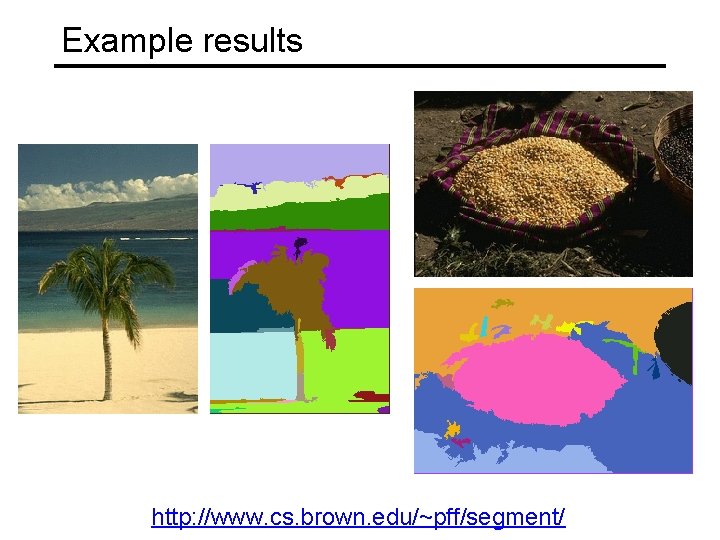
Example results http: //www. cs. brown. edu/~pff/segment/
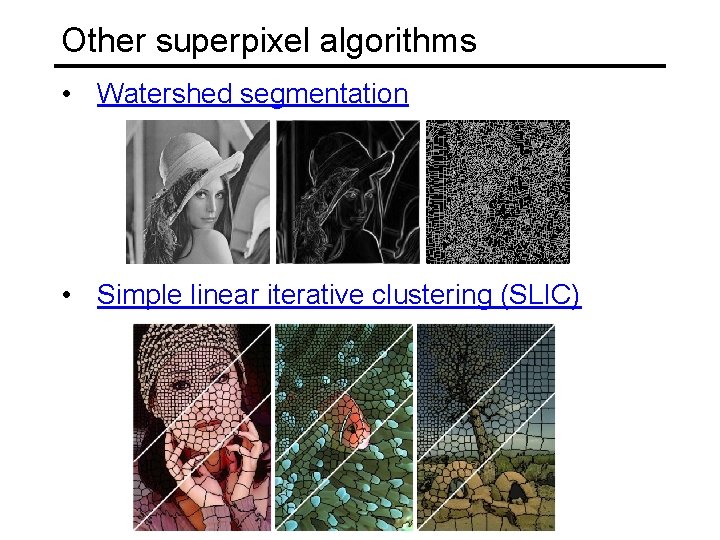
Other superpixel algorithms • Watershed segmentation • Simple linear iterative clustering (SLIC)
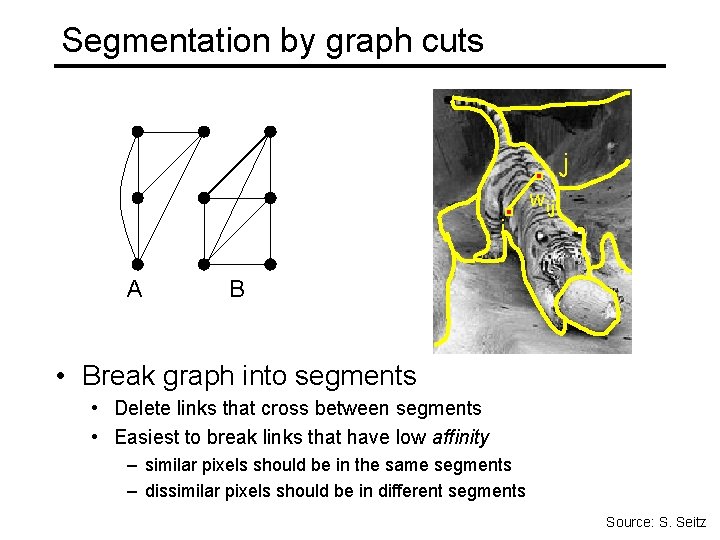
Segmentation by graph cuts j i A wij B • Break graph into segments • Delete links that cross between segments • Easiest to break links that have low affinity – similar pixels should be in the same segments – dissimilar pixels should be in different segments Source: S. Seitz
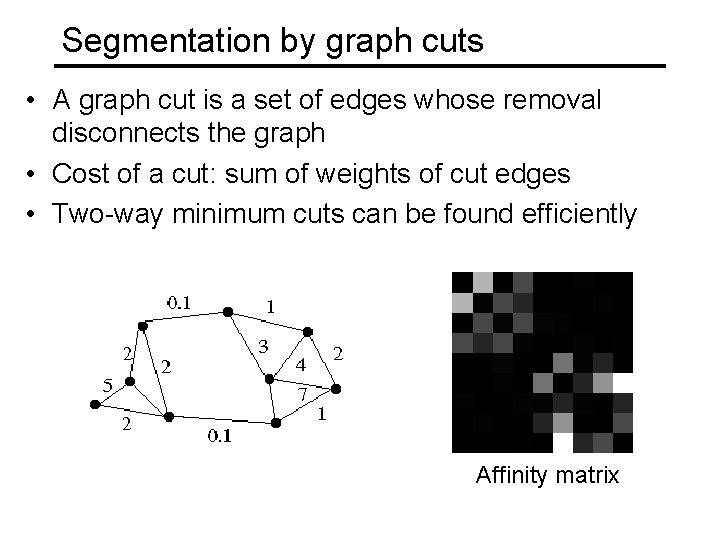
Segmentation by graph cuts • A graph cut is a set of edges whose removal disconnects the graph • Cost of a cut: sum of weights of cut edges • Two-way minimum cuts can be found efficiently Affinity matrix
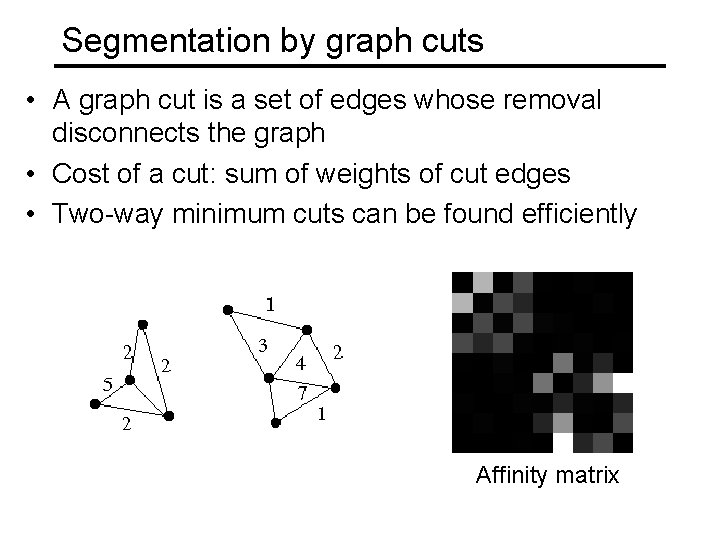
Segmentation by graph cuts • A graph cut is a set of edges whose removal disconnects the graph • Cost of a cut: sum of weights of cut edges • Two-way minimum cuts can be found efficiently Affinity matrix
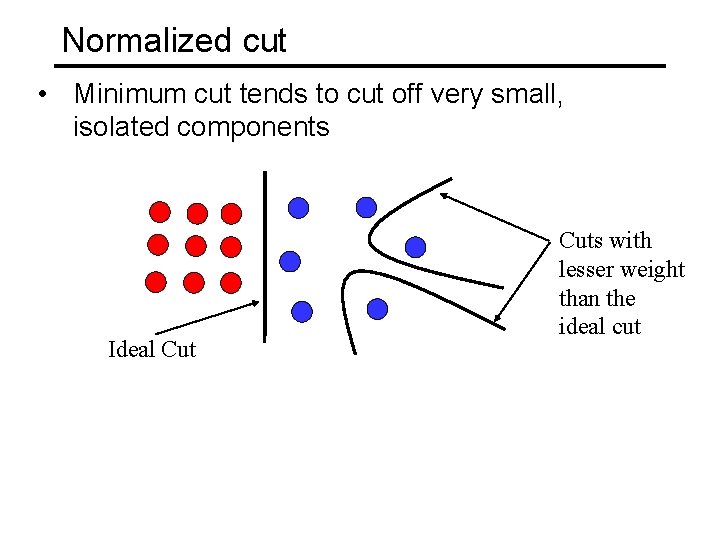
Normalized cut • Minimum cut tends to cut off very small, isolated components Ideal Cuts with lesser weight than the ideal cut
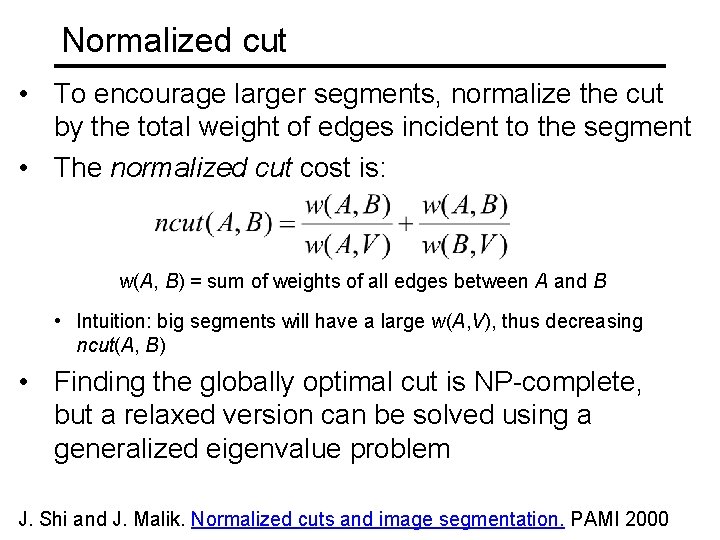
Normalized cut • To encourage larger segments, normalize the cut by the total weight of edges incident to the segment • The normalized cut cost is: w(A, B) = sum of weights of all edges between A and B • Intuition: big segments will have a large w(A, V), thus decreasing ncut(A, B) • Finding the globally optimal cut is NP-complete, but a relaxed version can be solved using a generalized eigenvalue problem J. Shi and J. Malik. Normalized cuts and image segmentation. PAMI 2000
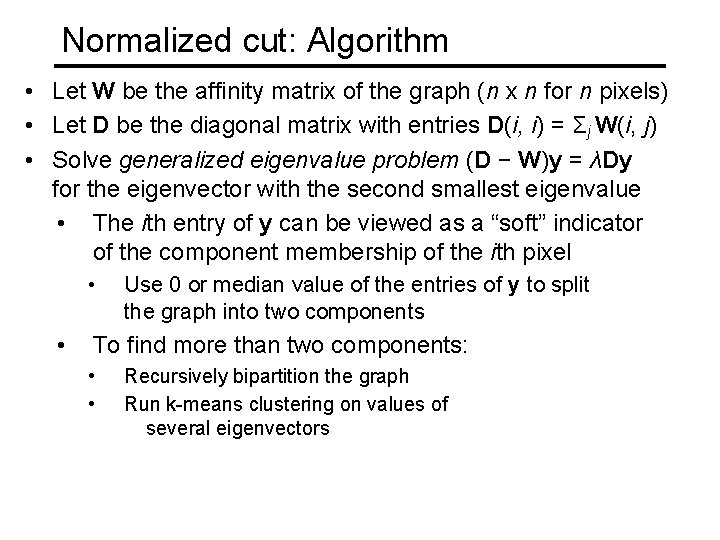
Normalized cut: Algorithm • Let W be the affinity matrix of the graph (n x n for n pixels) • Let D be the diagonal matrix with entries D(i, i) = Σj W(i, j) • Solve generalized eigenvalue problem (D − W)y = λDy for the eigenvector with the second smallest eigenvalue • The ith entry of y can be viewed as a “soft” indicator of the component membership of the ith pixel • • Use 0 or median value of the entries of y to split the graph into two components To find more than two components: • • Recursively bipartition the graph Run k-means clustering on values of several eigenvectors
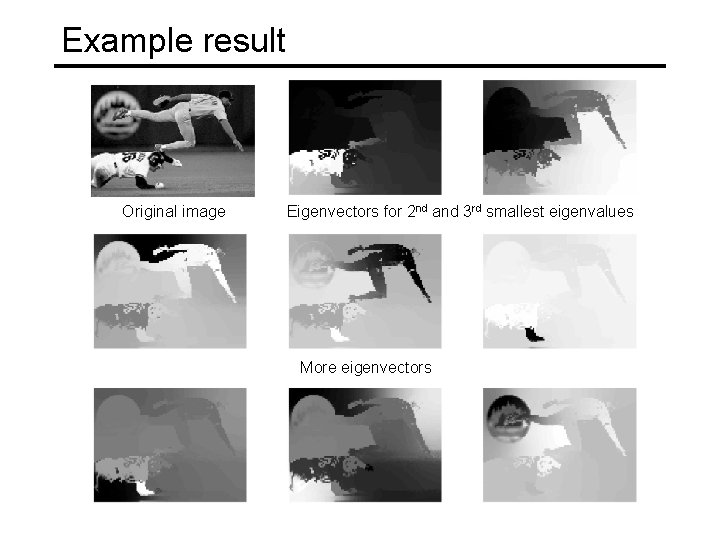
Example result Original image Eigenvectors for 2 nd and 3 rd smallest eigenvalues More eigenvectors
Normalized cuts: Pro and con • Pro • Generic framework, can be used with many different features and affinity formulations • Con • High storage requirement and time complexity: involves solving a generalized eigenvalue problem of size n x n, where n is the number of pixels
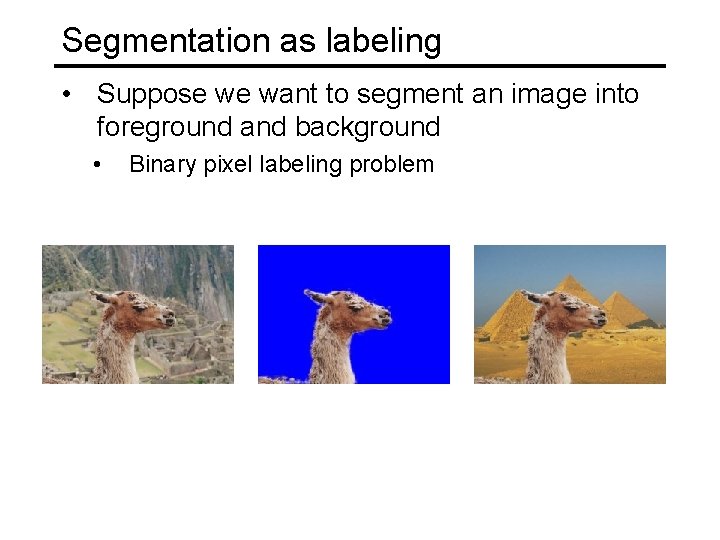
Segmentation as labeling • Suppose we want to segment an image into foreground and background • Binary pixel labeling problem
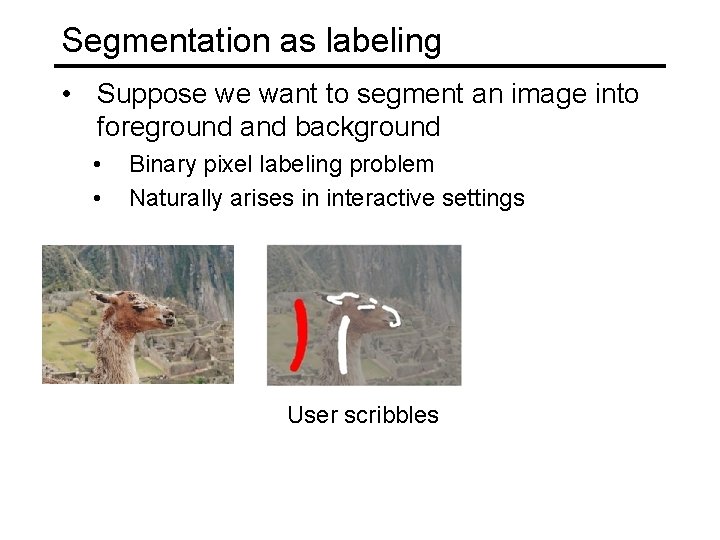
Segmentation as labeling • Suppose we want to segment an image into foreground and background • • Binary pixel labeling problem Naturally arises in interactive settings User scribbles
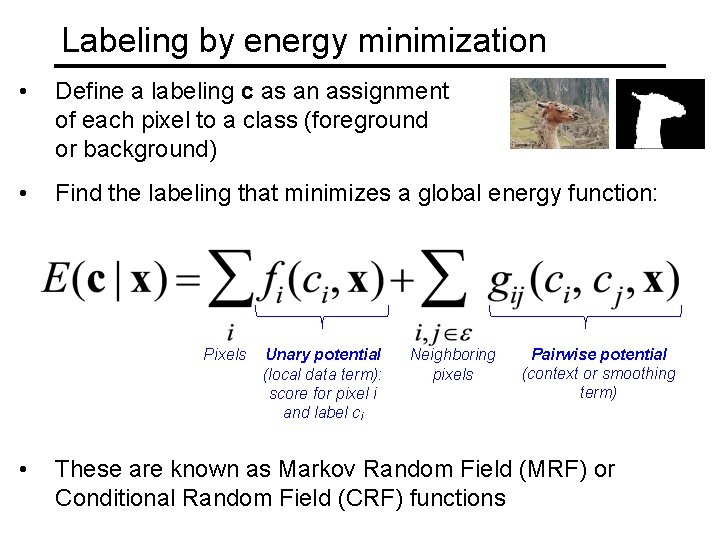
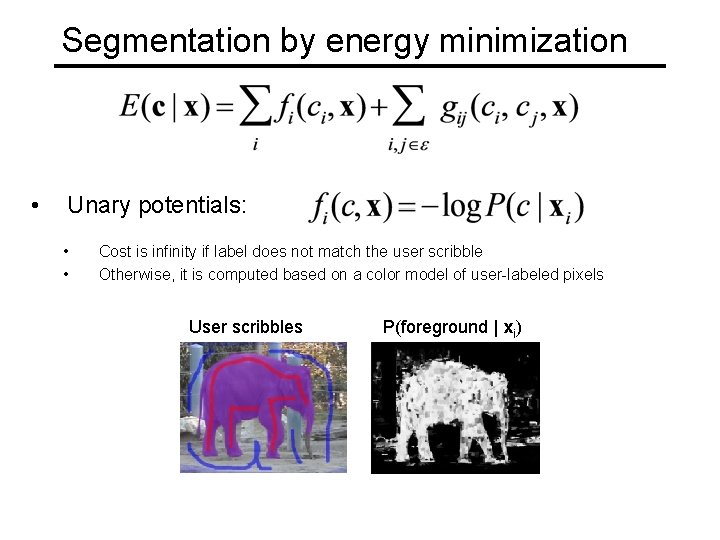
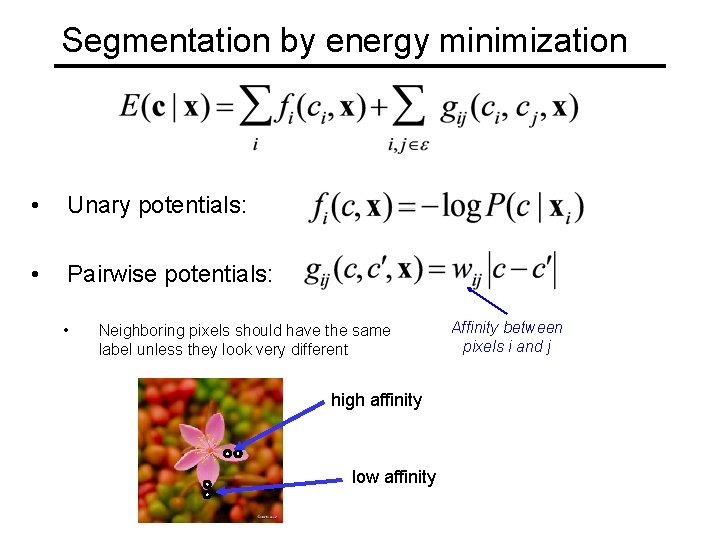
Labeling by energy minimization • Define a labeling c as an assignment of each pixel to a class (foreground or background) • Find the labeling that minimizes a global energy function: Pixels • Unary potential (local data term): score for pixel i and label ci Neighboring pixels Pairwise potential (context or smoothing term) These are known as Markov Random Field (MRF) or Conditional Random Field (CRF) functions
Segmentation by energy minimization • Unary potentials: • • Cost is infinity if label does not match the user scribble Otherwise, it is computed based on a color model of user-labeled pixels User scribbles P(foreground | xi)
Segmentation by energy minimization • Unary potentials: • Pairwise potentials: • Neighboring pixels should have the same label unless they look very different high affinity low affinity Affinity between pixels i and j
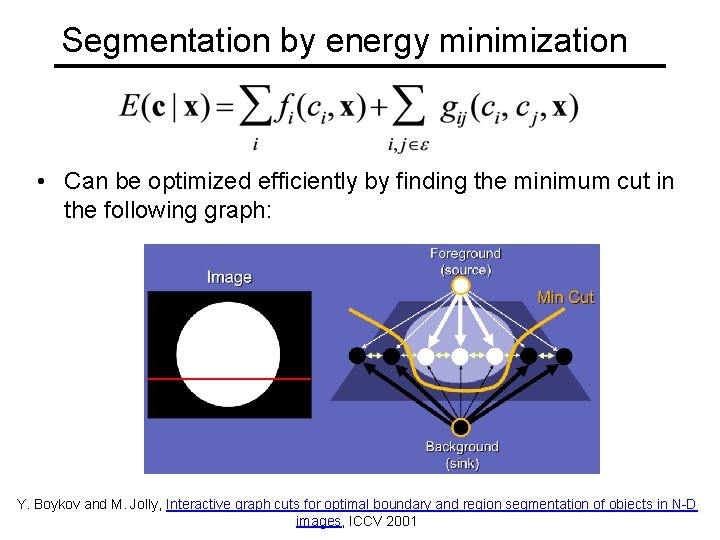
Segmentation by energy minimization • Can be optimized efficiently by finding the minimum cut in the following graph: Y. Boykov and M. Jolly, Interactive graph cuts for optimal boundary and region segmentation of objects in N-D images, ICCV 2001
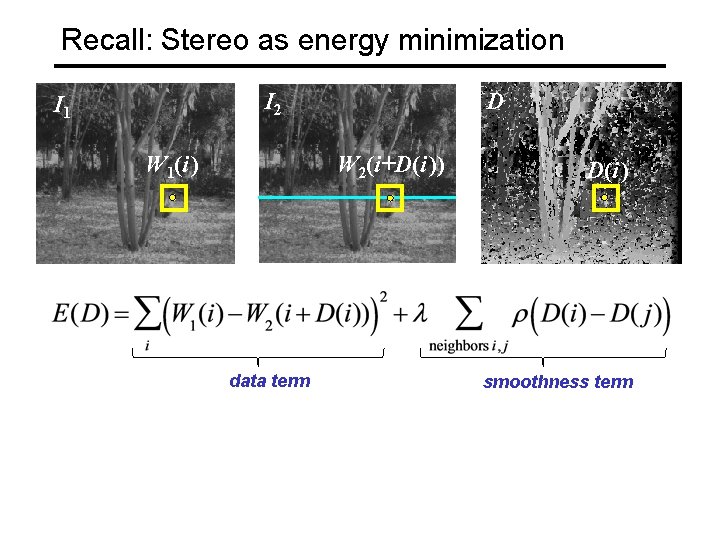
Recall: Stereo as energy minimization I 2 I 1 W 1(i ) D W 2(i+D(i )) data term D(i ) smoothness term
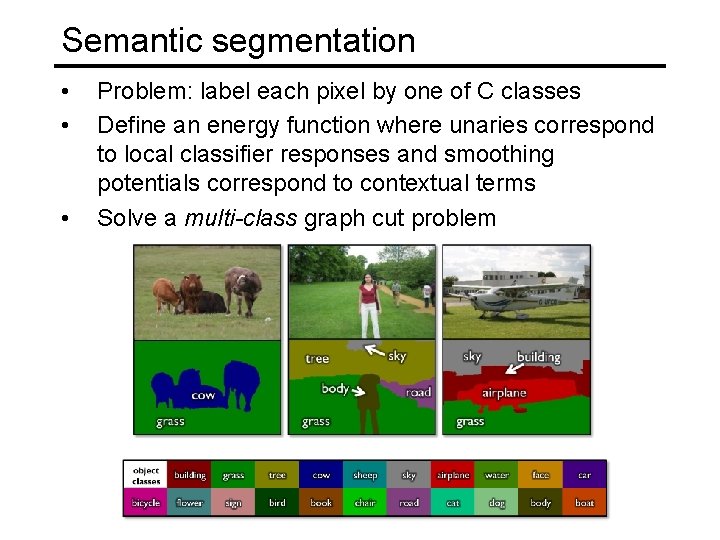
Semantic segmentation • • • Problem: label each pixel by one of C classes Define an energy function where unaries correspond to local classifier responses and smoothing potentials correspond to contextual terms Solve a multi-class graph cut problem
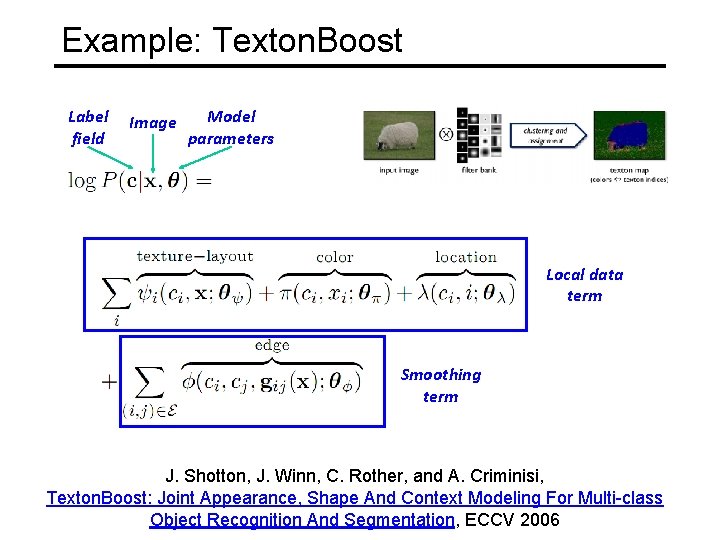
Example: Texton. Boost Label field Image Model parameters Local data term Smoothing term J. Shotton, J. Winn, C. Rother, and A. Criminisi, Texton. Boost: Joint Appearance, Shape And Context Modeling For Multi-class Object Recognition And Segmentation, ECCV 2006
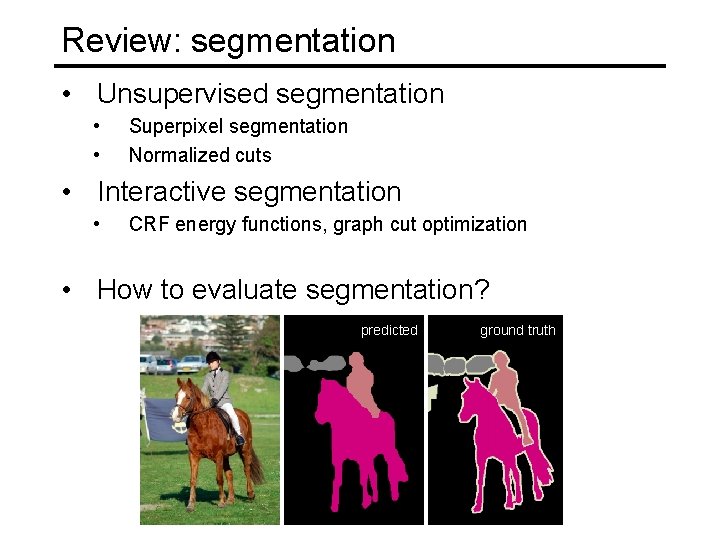
Review: segmentation • Unsupervised segmentation • • Superpixel segmentation Normalized cuts • Interactive segmentation • CRF energy functions, graph cut optimization • How to evaluate segmentation? predicted ground truth