
Traditional Chinese Architecture The buildings of a culture

Traditional Chinese Architecture The building(s) of a culture
(第一) Introduction: Continuity • Chinese architecture has developed over many thousands of years • The structural principles are largely unchanged, the main changes being only decorative details. • Since the Tang Dynasty, it has had a major influence on the architectural styles of Korea, Vietnam, and Japan.
(話) Some Telling Words The architecture of China is as old as Chinese civilization. From every source of information - literary, graphic, exemplary - there is strong evidence testifying to the fact that the Chinese have always employed an indigenous retained its principal characteristics from prehistoric times to the present day. system of construction that has Over [a] vast area from Chinese Turkistan to Japan, from Manchuria to the northern the same system of construction is prevalent; and this was the area of Chinese cultural influence. That this system of construction could perpetuate itself for more than four thousand years over such a vast territory and still remain a living architecture, retaining its principal characteristics in spite of repeated foreign invasions - military, intellectual, and spiritual - is a phenomenon comparable only to the continuity of the civilization of which it is [a] part. half of French Indochina, —Liang, Ssu-ch'eng, 1984
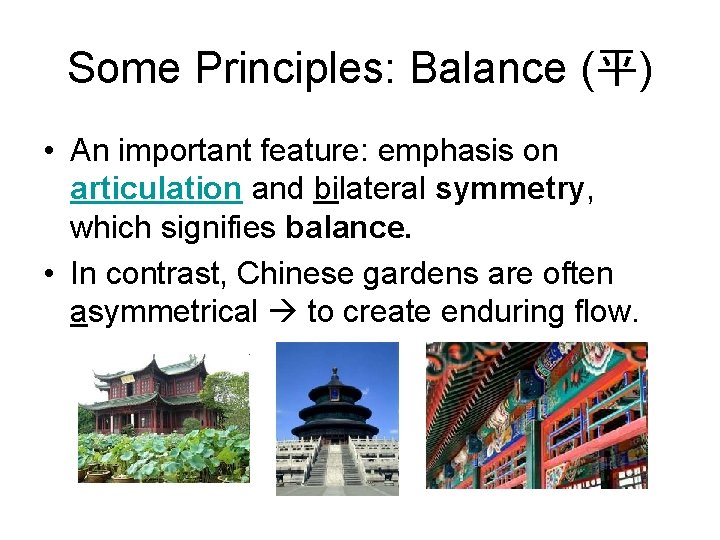
Some Principles: Balance (平) • An important feature: emphasis on articulation and bilateral symmetry, which signifies balance. • In contrast, Chinese gardens are often asymmetrical to create enduring flow.
East vs. West (東vs西) • Contemporary Western architectural practices: the building is surrounded by open area • Chinese architecture: buildings/complexes that take up an entire area, but encloses open spaces within itself. • Two forms: open courtyard (院) & "sky well" (天井). Many useful functions! • Courtyards: temperature regulation, venting air, exposure to S sun, protection from cold N winds • Southern Sky Wells: collect rain water from roof, restricting sunlight, vents for rising hot air, exchange of cool air from outside.
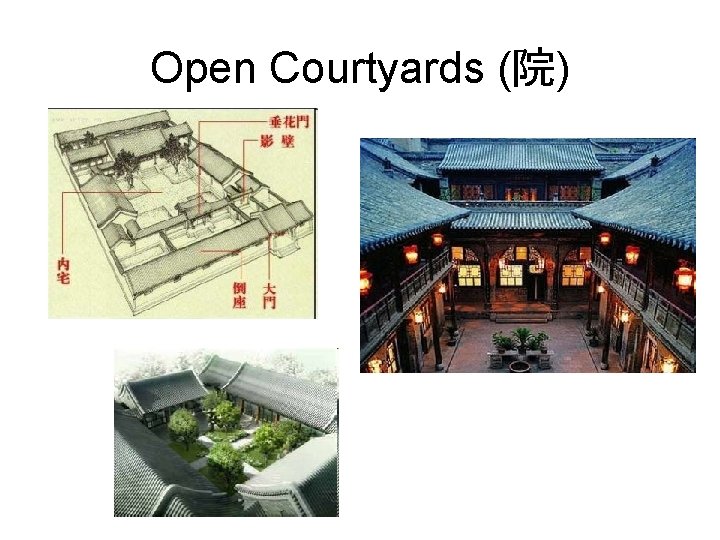
Open Courtyards (院)
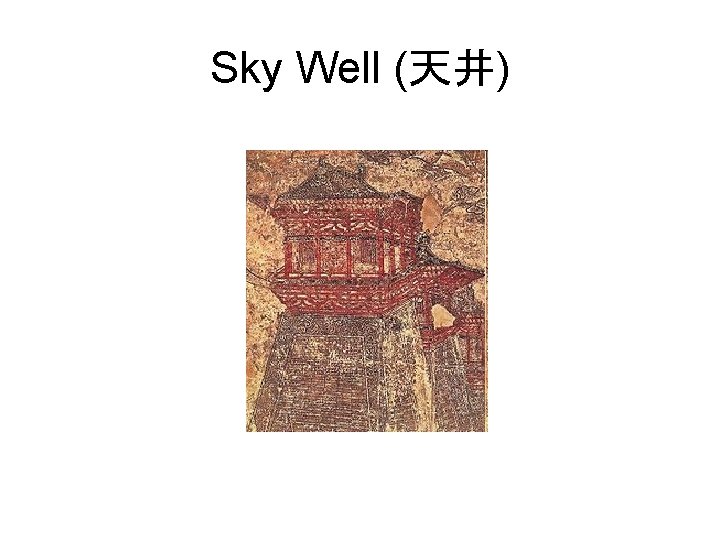
Sky Well (天井)

Horizontal Emphasis (E vs. W) • Classical Chinese buildings, esp. for wealthy, are built with an emphasis on breadth • VS. Western architecture: +emphasis on height • For example, the halls and palaces in the Forbidden City have low ceilings compared to stately buildings in the West, but their external appearances suggest the all-embracing nature of imperial China. *Exception: Religious pagoda
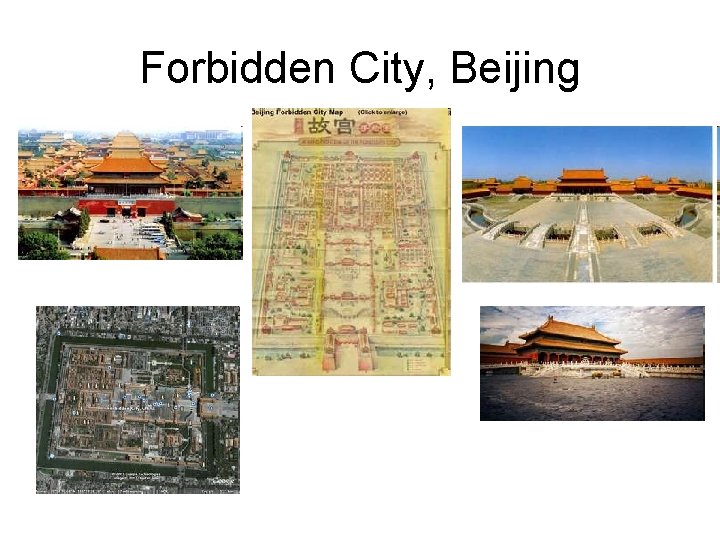
Forbidden City, Beijing

Hierarchical • Traditionally strict placement of buildings Importance of Buildings • Buildings with doors facing the front of the property are considered more important than those faces the sides. • Buildings facing away from the front of the property are the least important. Importance of People in Buildings • Buildings in the rear and more private parts of the property are held in higher esteem than buildings near the front, which are typically for servants.
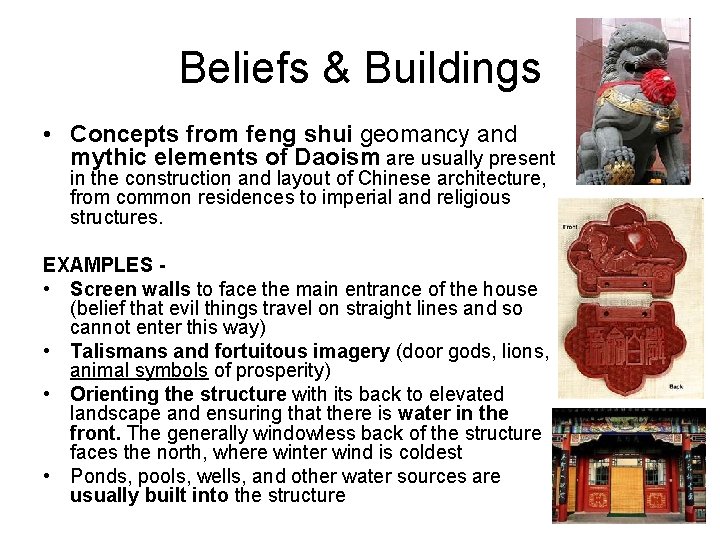
Beliefs & Buildings • Concepts from feng shui geomancy and mythic elements of Daoism are usually present in the construction and layout of Chinese architecture, from common residences to imperial and religious structures. EXAMPLES • Screen walls to face the main entrance of the house (belief that evil things travel on straight lines and so cannot enter this way) • Talismans and fortuitous imagery (door gods, lions, animal symbols of prosperity) • Orienting the structure with its back to elevated landscape and ensuring that there is water in the front. The generally windowless back of the structure faces the north, where winter wind is coldest • Ponds, pools, wells, and other water sources are usually built into the structure
Bibliography of Sources • Liang, Ssu-ch'eng, 1984, A pictorial history of Chinese architecture : a study of the development of its structural system and the evolution of its types, ed. by Wilma Fairbank, Cambridge (Mass. ): MIT Press. • Knapp, Ronald G. ; Spence, Jonathan; Ong, A. Chester (2006), Chinese Houses: The Architectural Heritage of a Nation, Tuttle Publishing.
- Slides: 12