
Tradition Structuralism Functionalism Gestalt psychology Behaviorism Psychoanalysis Asserted
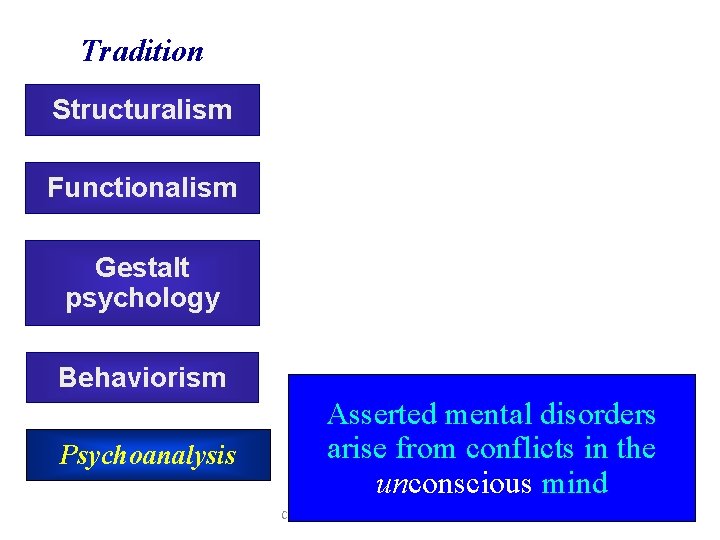
Tradition Structuralism Functionalism Gestalt psychology Behaviorism Psychoanalysis Asserted mental disorders arise from conflicts in the unconscious mind Copyright © Allyn & Bacon 2007
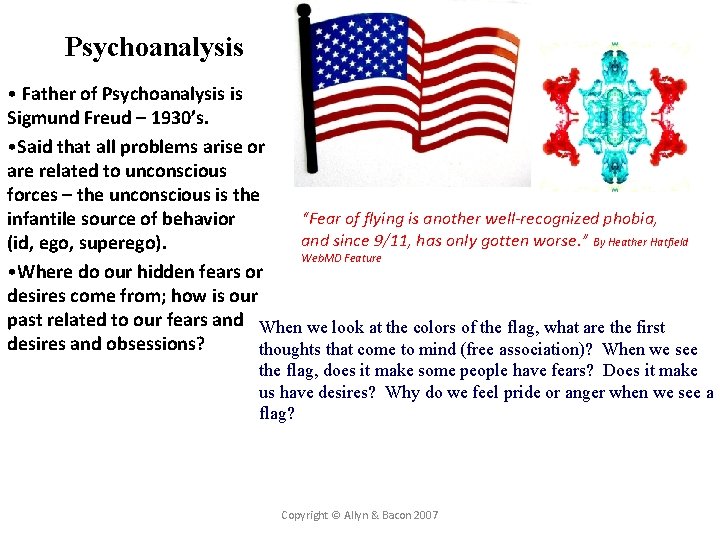
Psychoanalysis • Father of Psychoanalysis is Sigmund Freud – 1930’s. • Said that all problems arise or are related to unconscious forces – the unconscious is the “Fear of flying is another well-recognized phobia, infantile source of behavior and since 9/11, has only gotten worse. ” By Heather Hatfield (id, ego, superego). Web. MD Feature • Where do our hidden fears or desires come from; how is our past related to our fears and When we look at the colors of the flag, what are the first desires and obsessions? thoughts that come to mind (free association)? When we see the flag, does it make some people have fears? Does it make us have desires? Why do we feel pride or anger when we see a flag? Copyright © Allyn & Bacon 2007
Copyright © Allyn & Bacon 2007
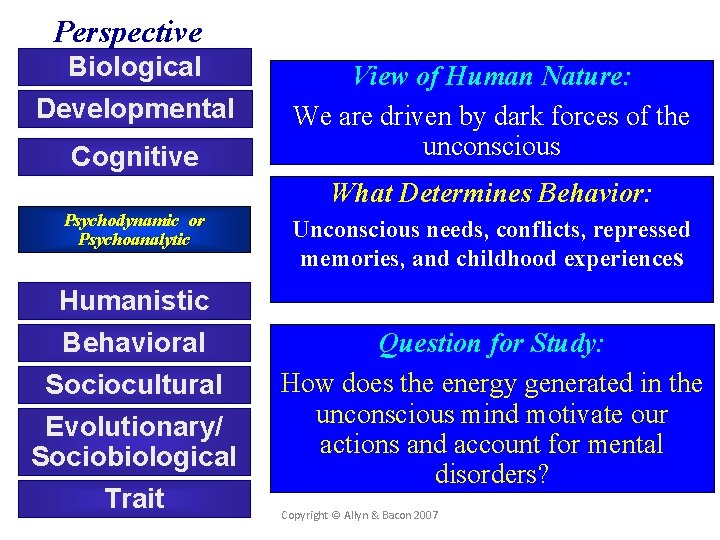
Perspective Biological Developmental Cognitive View of Human Nature: We are driven by dark forces of the unconscious What Determines Behavior: Psychodynamic or Psychoanalytic Humanistic Behavioral Sociocultural Evolutionary/ Sociobiological Trait Unconscious needs, conflicts, repressed memories, and childhood experiences Question for Study: How does the energy generated in the unconscious mind motivate our actions and account for mental disorders? Copyright © Allyn & Bacon 2007
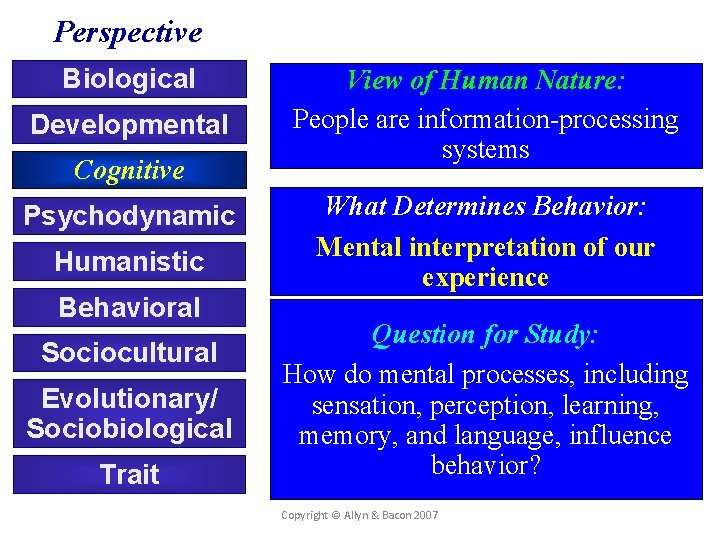
Perspective Biological Developmental Cognitive Psychodynamic Humanistic Behavioral Sociocultural Evolutionary/ Sociobiological Trait View of Human Nature: People are information-processing systems What Determines Behavior: Mental interpretation of our experience Question for Study: How do mental processes, including sensation, perception, learning, memory, and language, influence behavior? Copyright © Allyn & Bacon 2007

Copyright © Allyn & Bacon 2007
• What’s the Cognition ? COGNITIVE FLATULENCE. . . Copyright © Allyn & Bacon 2007
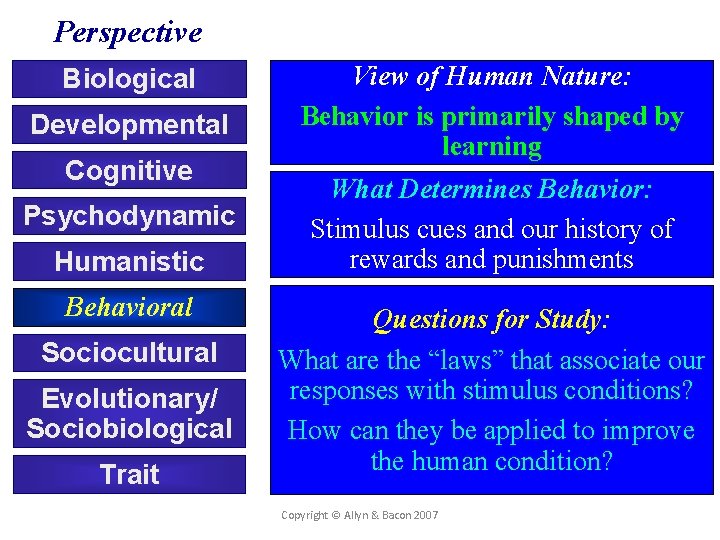
Perspective Biological Developmental Cognitive Psychodynamic Humanistic Behavioral Sociocultural Evolutionary/ Sociobiological Trait View of Human Nature: Behavior is primarily shaped by learning What Determines Behavior: Stimulus cues and our history of rewards and punishments Questions for Study: What are the “laws” that associate our responses with stimulus conditions? How can they be applied to improve the human condition? Copyright © Allyn & Bacon 2007
Behavior is Learned! Reward vs. Punishment

Copyright © Allyn & Bacon 2007
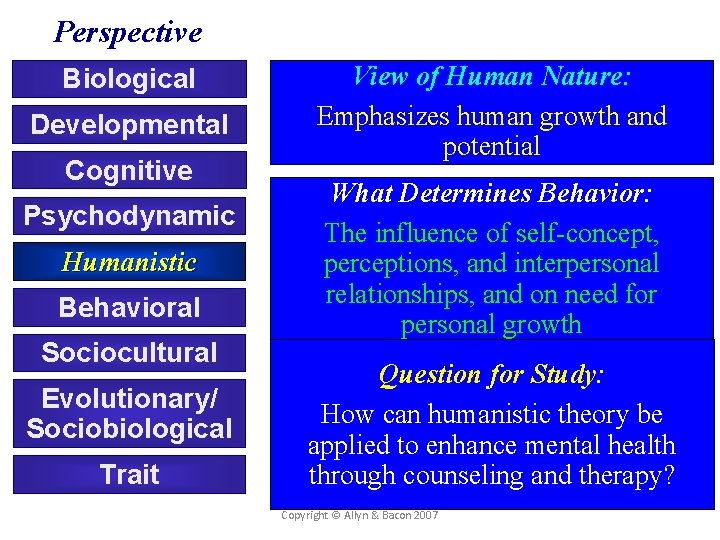
Perspective Biological Developmental Cognitive Psychodynamic Humanistic Behavioral Sociocultural Evolutionary/ Sociobiological Trait View of Human Nature: Emphasizes human growth and potential What Determines Behavior: The influence of self-concept, perceptions, and interpersonal relationships, and on need for personal growth Question for Study: How can humanistic theory be applied to enhance mental health through counseling and therapy? Copyright © Allyn & Bacon 2007
Copyright © Allyn & Bacon 2007
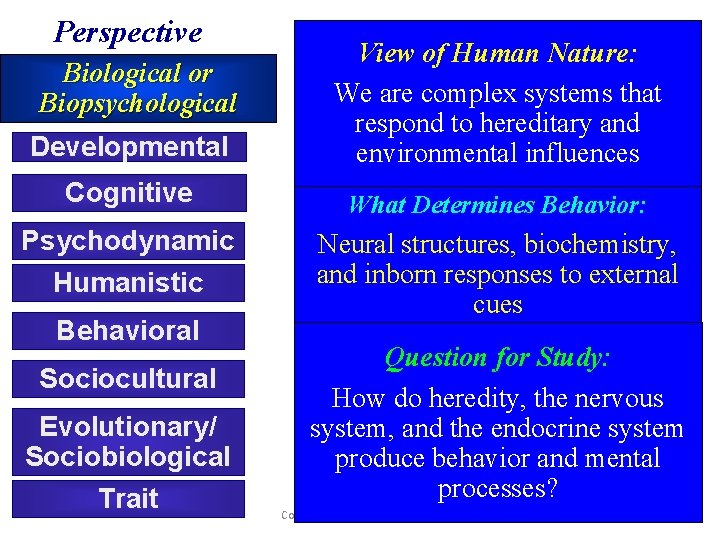
Perspective Developmental View of Human Nature: We are complex systems that respond to hereditary and environmental influences Cognitive What Determines Behavior: Psychodynamic Humanistic Neural structures, biochemistry, and inborn responses to external cues Biological or Biopsychological Behavioral Sociocultural Evolutionary/ Sociobiological Trait Question for Study: How do heredity, the nervous system, and the endocrine system produce behavior and mental processes? Copyright © Allyn & Bacon 2007
Copyright © Allyn & Bacon 2007
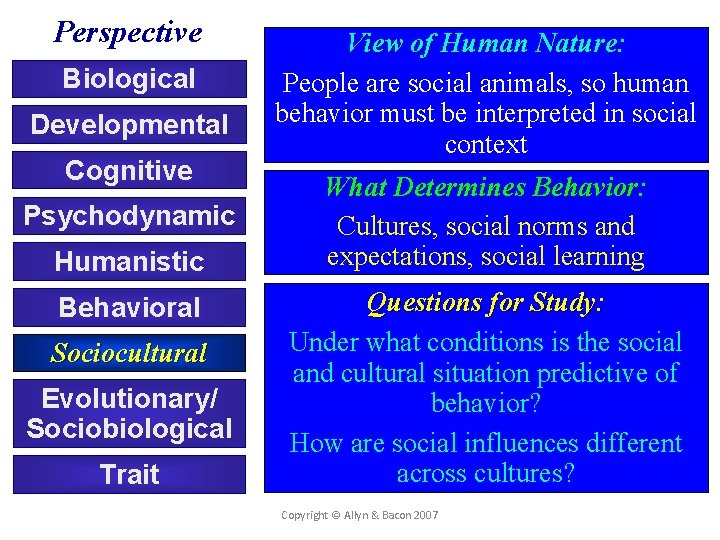
Perspective Biological Developmental Cognitive Psychodynamic Humanistic Behavioral Sociocultural Evolutionary/ Sociobiological Trait View of Human Nature: People are social animals, so human behavior must be interpreted in social context What Determines Behavior: Cultures, social norms and expectations, social learning Questions for Study: Under what conditions is the social and cultural situation predictive of behavior? How are social influences different across cultures? Copyright © Allyn & Bacon 2007

Copyright © Allyn & Bacon 2007
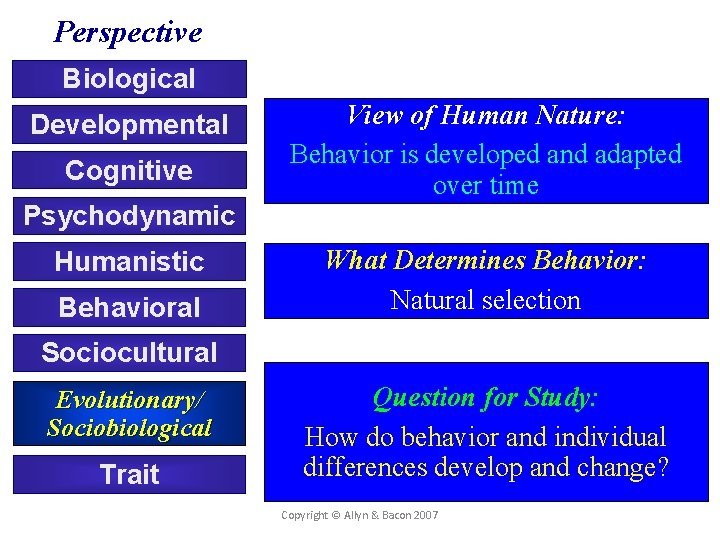
Perspective Biological Developmental Cognitive View of Human Nature: Behavior is developed and adapted over time Psychodynamic Humanistic Behavioral What Determines Behavior: Natural selection Sociocultural Evolutionary/ Sociobiological Trait Question for Study: How do behavior and individual differences develop and change? Copyright © Allyn & Bacon 2007
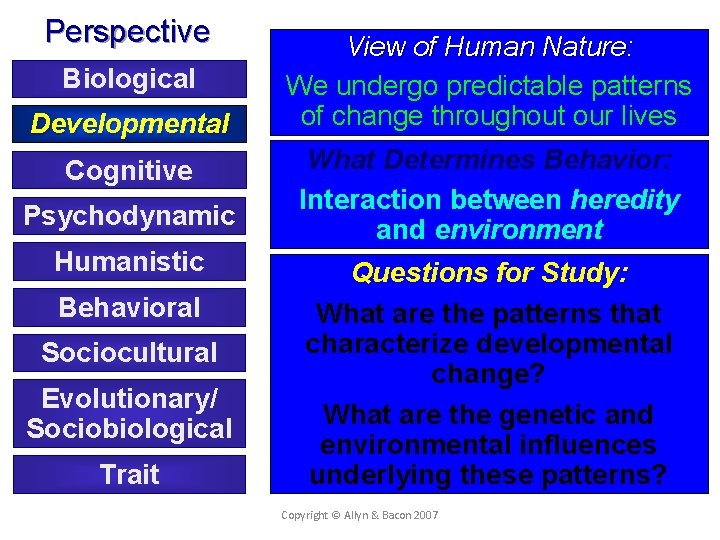
Perspective Biological Developmental Cognitive Psychodynamic Humanistic Behavioral Sociocultural Evolutionary/ Sociobiological Trait View of Human Nature: We undergo predictable patterns of change throughout our lives What Determines Behavior: Interaction between heredity and environment Questions for Study: What are the patterns that characterize developmental change? What are the genetic and environmental influences underlying these patterns? Copyright © Allyn & Bacon 2007
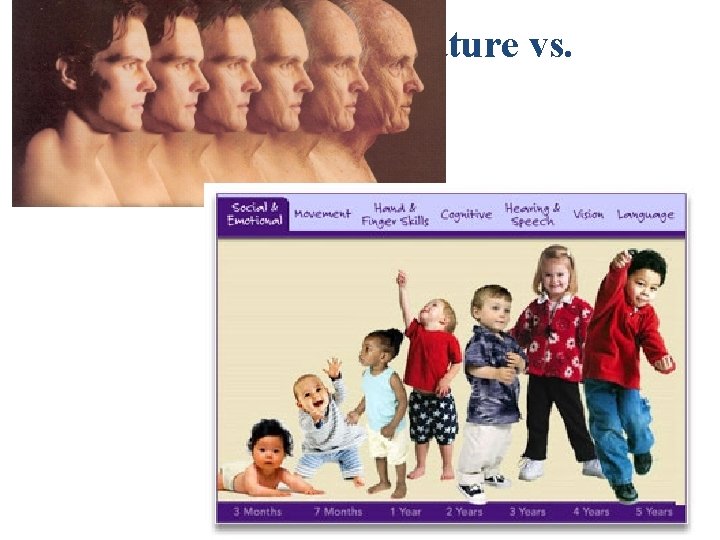
Nature vs. Nurture Copyright © Allyn & Bacon 2007
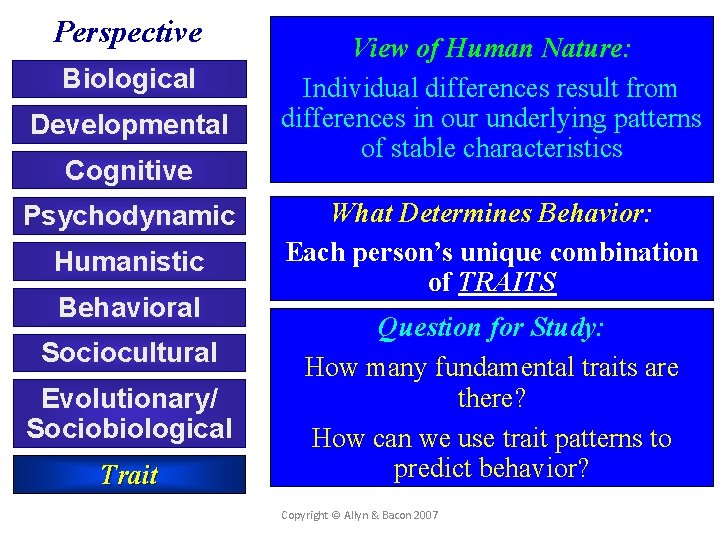
Perspective Biological Developmental Cognitive Psychodynamic Humanistic Behavioral Sociocultural Evolutionary/ Sociobiological Trait View of Human Nature: Individual differences result from differences in our underlying patterns of stable characteristics What Determines Behavior: Each person’s unique combination of TRAITS Question for Study: How many fundamental traits are there? How can we use trait patterns to predict behavior? Copyright © Allyn & Bacon 2007
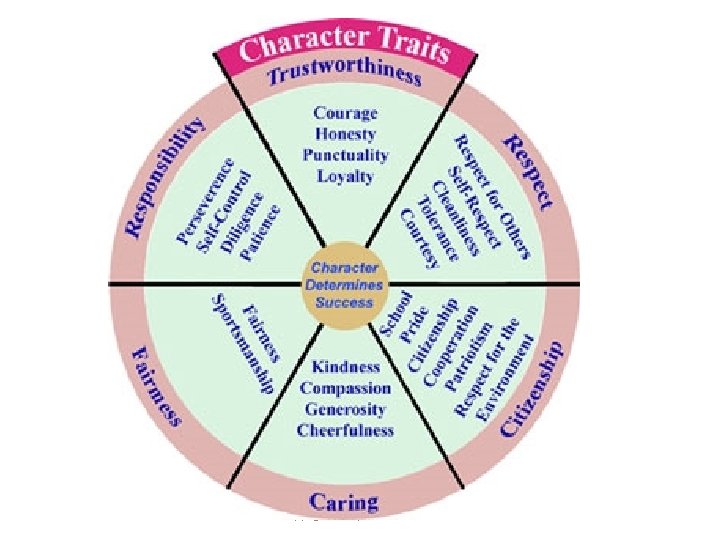
Copyright © Allyn & Bacon 2007
ECLECTIC Be sure you get the concept of “Eclectic” : Use of two or more psych approaches to explain different situations or develop your own theory of personality (therapy)
- Slides: 22