
Trading for Peace Achieving security and poverty reduction
- Slides: 19
Trading for Peace Achieving security and poverty reduction through trade in the Great Lakes area Nick Bates and Hilary Sunman ICEA, June 9 th DFID with USAID and COMESA Trading for Peace 1
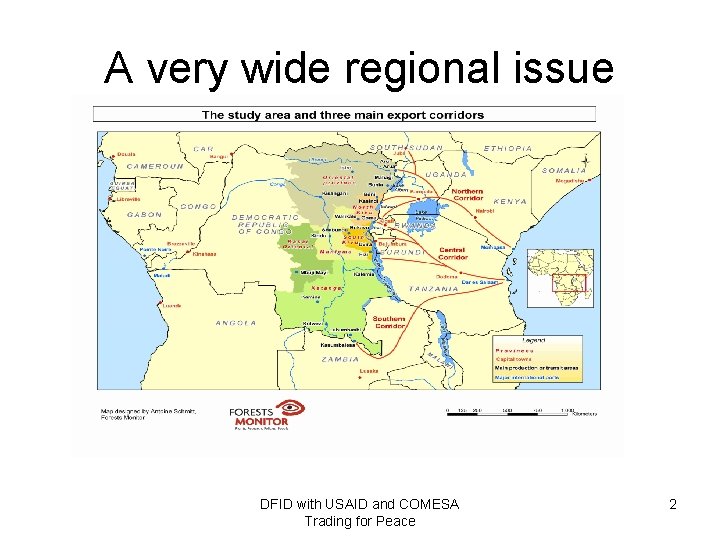
A very wide regional issue DFID with USAID and COMESA Trading for Peace 2
Context and Background • DRC rich in resources but decades of bad governance and war mean people have not benefited • Minerals and natural resources have a bad name ‘conflict resources’ - because of on-going trouble – and agriculture heavily destroyed • The control of resources strongly linked to ‘militarised elites’ – eg FDLR, 85 th non integrated brigade, Walikali • Yet: • Trade necessary, all basic foods imported so trade routes vital • Great potential for using resources for poverty reduction, • Trade is only way to realise value of the resources and so provides the means for poverty reduction despite problems DFID with USAID and COMESA Trading for Peace 3
What the research covered • DFID with USAID and COMESA recruited four research organisations : Pole, INICA, PACT and Forests Monitor Phase 1 To. R to: • Examine in detail trade in 6 main cross border corridors (see map) – mine/forest to market • Explain the nature of trade and how it works (eg the recorded/official trade, informal trade, and underlying reasons) • Recommend actions and policies to enable trade to support poverty reduction and peace DFID with USAID and COMESA Trading for Peace 4
Main crossing points for trade • Trade different at different border crossings – must have a regional approach • Detailed on the ground field research • Interviews with officials, traders, transporters, wholesalers on both sides of borders and capitals DFID with USAID and COMESA Trading for Peace 5
Principal conclusions • Trade is very informal, often fraudulent, but very important for DRC • Open economy and resilient; and trade in natural resources provides key means for growth, and incomes for DRC and citizens • Many goods – timber, minerals – also coffee, petroleum, and food imports, and there are major differences between commodities and corridors (eg Katanga vs Kivu) • But serious reforms are needed throughout as trade processes linked to deep corruption and lack of clear formal structures or enforcement • Improving trade and governance supports sustainable exploitation of natural resources • Key window of opportunity to strengthen relative peace and benefit from strong markets DFID with USAID and COMESA Trading for Peace 6
High levels of fraudulent trade • Data very weak for a range of reasons – corruption and low capacity/incentives • Actual value of exports likely to be at least 3 or 4 times the official level. Imports as well as exports • Well over 60% exports from DRC not formally recorded, all commodities, all corridors, regardless of neighbours’ practices • Trading patterns profoundly corrupt – consciously fraudulent, with under declaration by both officials and traders; collusion on tax evasion – but not all linked to conflict DFID with USAID and COMESA Trading for Peace 7
Recorded and estimated exports by commodity, 2005 • Copper – official exports 117, 300 tonnes, but imports to Zambia 223, 000 tonnes • Gold – total production estimated at 10 tonnes pa, but only 600 kg recorded as exported • Cassiterite – 17, 000 tonnes mined at Walikali but only 6, 750 tonnes recorded as exported • Timber – 25, 000 m 3 exports recorded but 5070, 000 m 3 imported to Uganda, Kenya • Petroleum imports – 16, 260 m 3 declared at Beni SEP, but actual import volume 25, 800 m 3 DFID with USAID and COMESA Trading for Peace 8
Informal, complex, constrained- but not chaotic! • Total informalisation of economy means structures like banking, finance very weak • Trade networks informal but sophisticated, direct links to China, Dubai – parallel exchange mkts etc • Operating outside formal legal frameworks – ‘alegal’ gives key role to middlemen (traders, bankers) • Appalling infrastructure imposes high costs, bottlenecks, penalises poorest, creates opportunities for tracasseries DFID with USAID and COMESA Trading for Peace 9
Underlying reasons • Heavy taxes and charges – both ‘formal’ and ‘informal’ • Multiplicity of state agencies (24 separate charges on minerals, example of cassiterite) • Avoidance of taxes at importing border (eg VAT at Rwanda 30 -50% - but shouldn’t be) • Poor communications and ignorance – by traders and officials • Too much regulation – not too little! • Tension between customary law and state regulations – scope for extortion DFID with USAID and COMESA Trading for Peace 10
Implications – does it matter? • Corruption means trading chains highly vulnerable to control by elites, militias • Regional impact – through fraudulent trade, corruption, parallel financial flows • Tax revenues lost to govts – local and central • Macro economic data base severely undermined • Lack of data and information means threat to environment • And wider economic impacts in DRC, poor business environment etc DFID with USAID and COMESA Trading for Peace 11
Approach – what’s to be done? • Natural resources exploitation vital in short term for poverty reduction • Importance of trade and business in post conflict situation – and links to regional growth • In other sectors insecurity, very short investment horizons inhibit eg agriculture, industry • Therefore broad approach – not just within the mining or forestry sectors • Four thematic areas: trade, livelihoods, economics, and governance • Cross cutting issues – weak capacity and insecurity – run through everything • Essential to work closely with neighbouring countries DFID with USAID and COMESA Trading for Peace 12
Phase 2: Trading for peace • Society/people in DRC and region will benefit (except for vested interests) • Virtuous circle is possible, and political opportunity with elected governments and regional stabilisation notwithstanding risks • Discussed with governments, and cross border points – broad acceptance of findingds and possibilities • Increasing formalisation of trade helps marginalise the less formal DFID with USAID and COMESA Trading for Peace 13
Ongoing activity Identify short term and long term programmes for implementation, eg – 5 cross border trade fora – support to traders, officials etc, information, trade fairs, training to help formalisation and discussion of issues – Research on financial flows, reducing corruption – Studies – eg energy sharing, one stop border crossing to improve trade (Goma-Gisenyi) – Ongoing discussions within DFID/FCO on setting further research and activity in context of stabilisation and regional growth DFID with USAID and COMESA Trading for Peace 14
Areas for intervention DFID with USAID and COMESA Trading for Peace 15
Trade • Strong markets - neighbouring countries (timber), international exports, imports of food and consumer goods • More formalised trade helps govt revenues • Communities in border areas (both sides) benefit from more open trading regime Need to: – Facilitate trade routes – imports and exports – Streamline systems, don’t add layers; beware too much regulation – Strengthen information and data at borders DFID with USAID and COMESA Trading for Peace 16
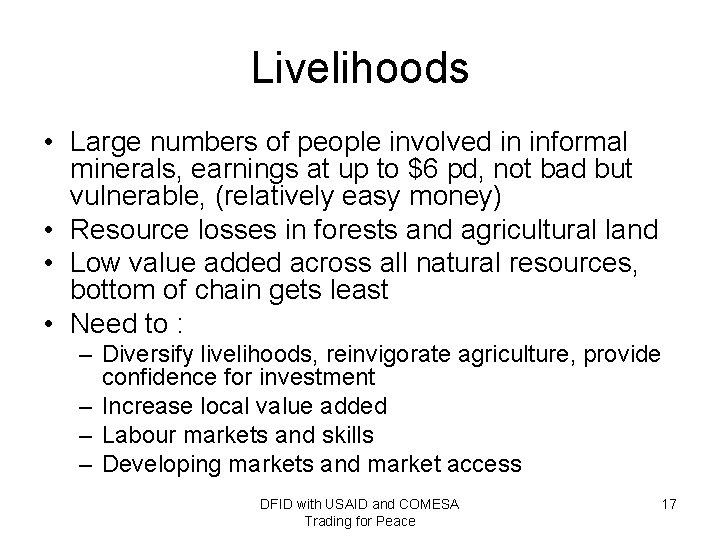
Livelihoods • Large numbers of people involved in informal minerals, earnings at up to $6 pd, not bad but vulnerable, (relatively easy money) • Resource losses in forests and agricultural land • Low value added across all natural resources, bottom of chain gets least • Need to : – Diversify livelihoods, reinvigorate agriculture, provide confidence for investment – Increase local value added – Labour markets and skills – Developing markets and market access DFID with USAID and COMESA Trading for Peace 17
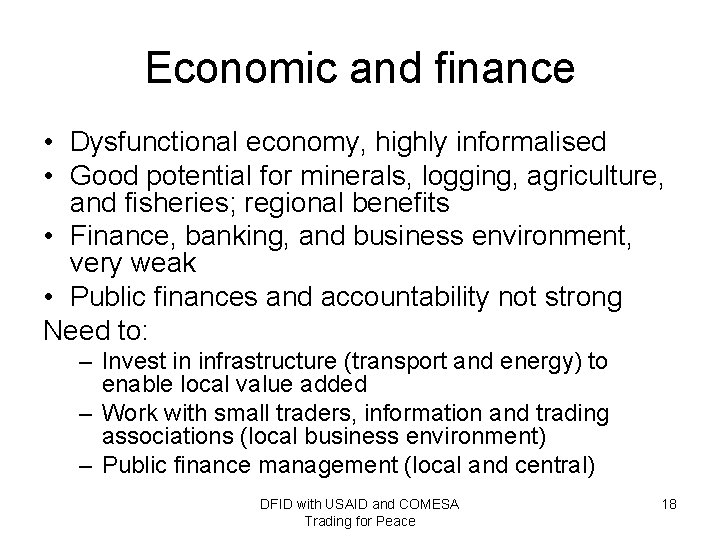
Economic and finance • Dysfunctional economy, highly informalised • Good potential for minerals, logging, agriculture, and fisheries; regional benefits • Finance, banking, and business environment, very weak • Public finances and accountability not strong Need to: – Invest in infrastructure (transport and energy) to enable local value added – Work with small traders, information and trading associations (local business environment) – Public finance management (local and central) DFID with USAID and COMESA Trading for Peace 18
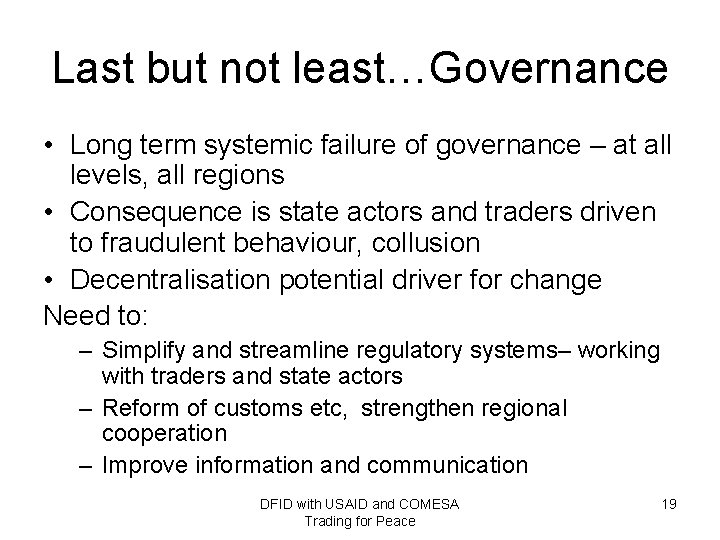
Last but not least…Governance • Long term systemic failure of governance – at all levels, all regions • Consequence is state actors and traders driven to fraudulent behaviour, collusion • Decentralisation potential driver for change Need to: – Simplify and streamline regulatory systems– working with traders and state actors – Reform of customs etc, strengthen regional cooperation – Improve information and communication DFID with USAID and COMESA Trading for Peace 19