
Trade Routes Silk Road Indian Ocean Trans Saharan


- Slides: 64
Trade Routes: Silk Road, Indian Ocean, Trans. Saharan The spread of economic activity, religion, and disease through trade
Essential Question: ► How were the Trans-Saharan Trade, Indian Ocean and Silk Routes similar? ► How were these trade routes different? ► Essay Q: Compare and Contrast the Trans. Saharan trade, Indian Ocean trade and Silk Routes.
Impact of Trade ► Brought wealth and access to foreign products and enabled people to concentrate their efforts on economic activities best suited to their regions ► Facilitated the spread of religious traditions beyond their original homelands ► Facilitated the transmission of disease
Checks for Understanding (CFU) ► Economic activity: What would an example of a commodity in West Africa that may have helped bring economic prosperity? ► Religion: Provide an example of a religion/religious philosophy that was spread by trade? ► Disease: What disease was spread as a result of trade? Which empire is primarily responsible for this outbreak?
Classical Civilizations ► Classical empires such as the Han, Kushan, Parthian, and Roman brought order and stability to large territories § They undertook massive construction projects to improve transportation infrastructure § The expanding size of the empires brought them within close proximity to or even bordering on each other As classical empires reduced the costs of long-distance trade, merchants began establishing an extensive network of trade routes that linked much of Eurasia and northern Africa ► Collectively, these routes are known as the “Silk Roads” because high-quality silk from China was one of the principal commodities exchanged over the roads ►
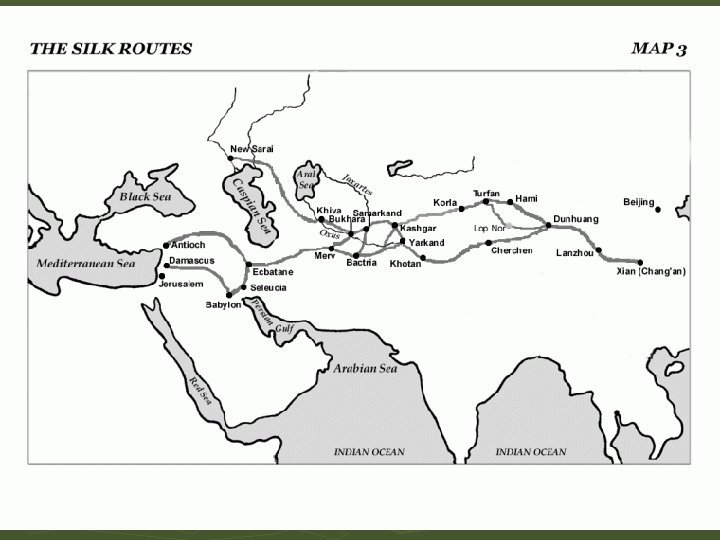
Where did it go? Linked China and the Holy Roman Empire § The two extreme ends of Eurasia ► Started in the Han capital of Chang’an and went west to the Taklamakan Desert § There the road split into two main branches that skirted the desert to the north and south ► ► In northern Iran, the route joined with roads to ports on the Caspian Sea and the Persian Gulf and proceeded to Palmyra (modern Syria) § There it met roads coming from Arabia and ports on the Red Sea ► The Silk Roads also provided access at ports like Guangzhou in southern China that led to maritime routes to India and Ceylon (modern-day Sri Lanka)
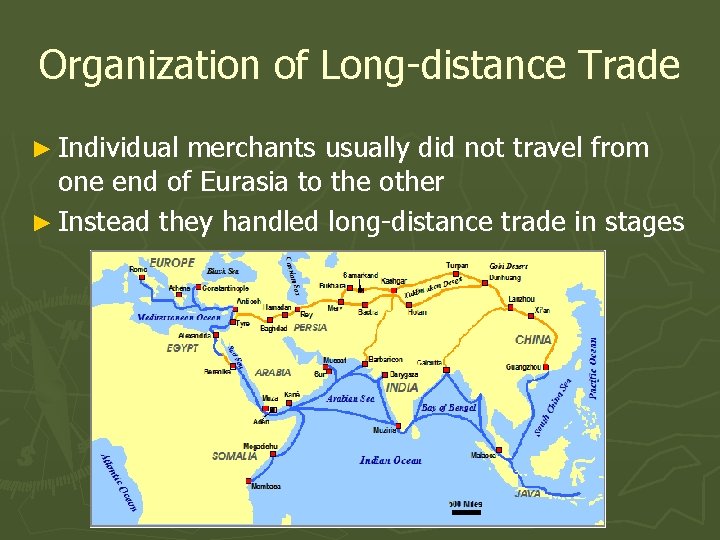
Organization of Long-distance Trade ► Individual merchants usually did not travel from one end of Eurasia to the other ► Instead they handled long-distance trade in stages
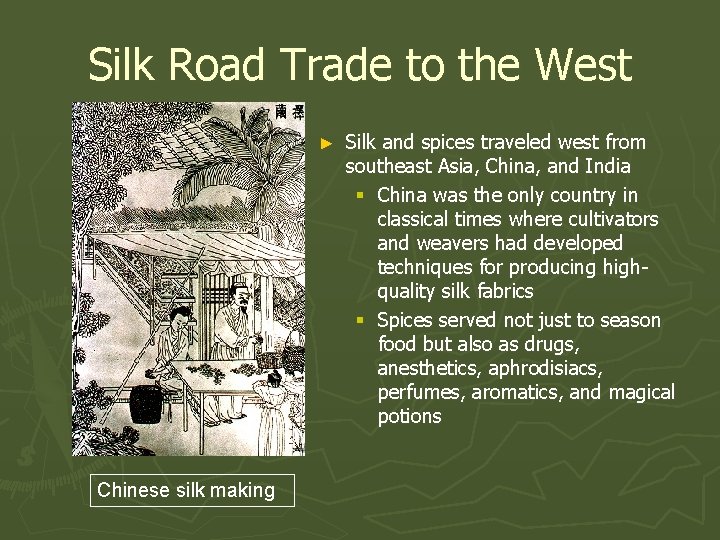
Silk Road Trade to the West ► Chinese silk making Silk and spices traveled west from southeast Asia, China, and India § China was the only country in classical times where cultivators and weavers had developed techniques for producing highquality silk fabrics § Spices served not just to season food but also as drugs, anesthetics, aphrodisiacs, perfumes, aromatics, and magical potions
Silk Road Trade to the East ► Central Asia produced large, strong horses and jade that was highly prized by Chinese stone carvers ► The Roman empire traded glassware, jewelry, works of art, decorative items, perfumes, bronze goods, wool and linen textiles, pottery, iron tools, olive oil, wine, and gold and silver bullion § Mediterranean merchants and manufacturers often imported raw materials such as uncut gemstones which they exported as finished products in the form of expensive jewelry and decorative items
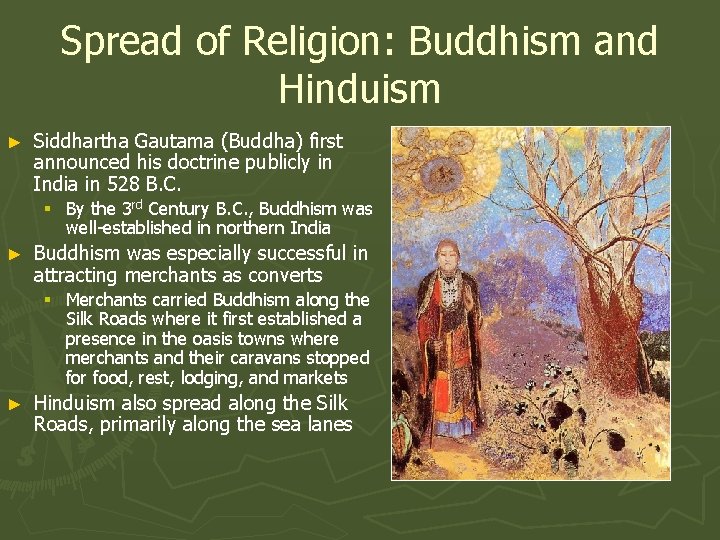
Spread of Religion: Buddhism and Hinduism ► Siddhartha Gautama (Buddha) first announced his doctrine publicly in India in 528 B. C. § By the 3 rd Century B. C. , Buddhism was well-established in northern India ► Buddhism was especially successful in attracting merchants as converts § Merchants carried Buddhism along the Silk Roads where it first established a presence in the oasis towns where merchants and their caravans stopped for food, rest, lodging, and markets ► Hinduism also spread along the Silk Roads, primarily along the sea lanes
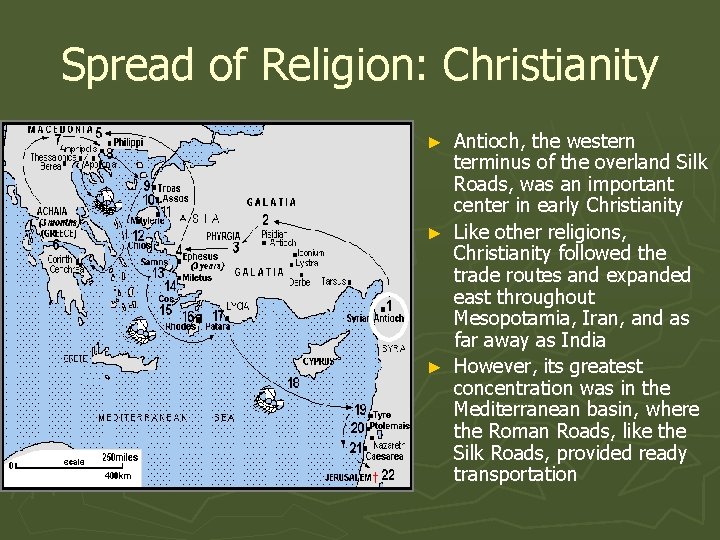
Spread of Religion: Christianity Antioch, the western terminus of the overland Silk Roads, was an important center in early Christianity ► Like other religions, Christianity followed the trade routes and expanded east throughout Mesopotamia, Iran, and as far away as India ► However, its greatest concentration was in the Mediterranean basin, where the Roman Roads, like the Silk Roads, provided ready transportation ►
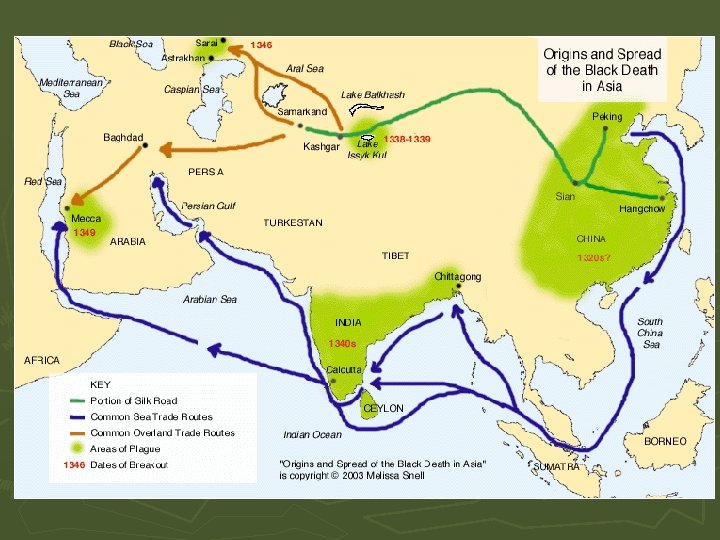
Disease: Bubonic Plague ► During the 1330 s plague erupted in southwestern China ► During the 1340 s, Mongols, merchants, and other travelers helped to spread the disease along trade routes to points west of China ► It thrived in the trading cities of central Asia where domestic animals and rodents provided abundant breeding grounds for fleas and the plague bacillus ► By 1346 it had reached the Black Sea ports of Caffa and Tana
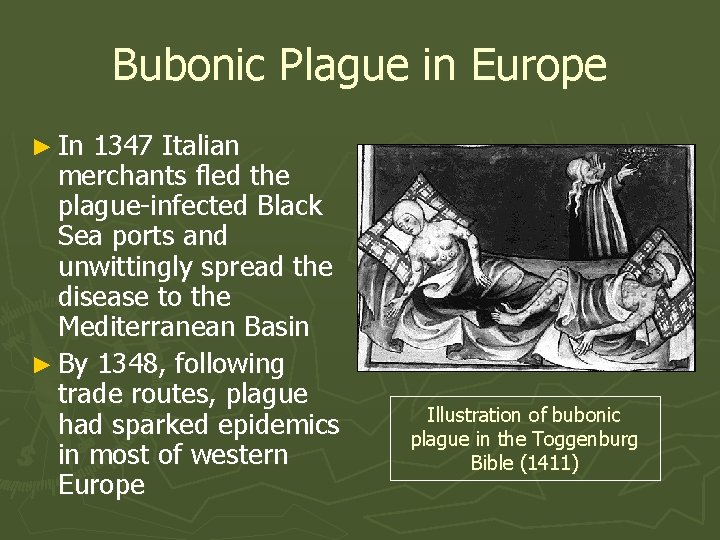
Bubonic Plague in Europe ► In 1347 Italian merchants fled the plague-infected Black Sea ports and unwittingly spread the disease to the Mediterranean Basin ► By 1348, following trade routes, plague had sparked epidemics in most of western Europe Illustration of bubonic plague in the Toggenburg Bible (1411)
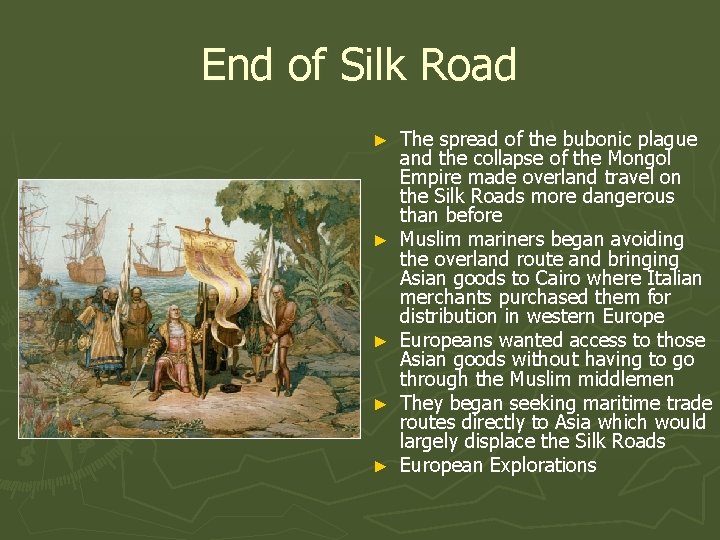
End of Silk Road ► ► ► The spread of the bubonic plague and the collapse of the Mongol Empire made overland travel on the Silk Roads more dangerous than before Muslim mariners began avoiding the overland route and bringing Asian goods to Cairo where Italian merchants purchased them for distribution in western Europeans wanted access to those Asian goods without having to go through the Muslim middlemen They began seeking maritime trade routes directly to Asia which would largely displace the Silk Roads European Explorations
CFU ► What were three main impacts of the Silk Trade Routes? ► Why end? did the Silk Trade Routes come to an ► Which religion has not been mentioned yet? Why do you think this is the case?
TOPIC 2. 3 Exchange in the Indian Ocean Unit 2: Networks of Exchange 1200 -1450
► THEMATIC ► As FOCUS: Economics Systems ECN societies develop, they affect and are affected by the ways that they produce, exchange, and consume goods and services.
LEARNING OBJECTIVE ► Unit 2: Learning Objective E ► Explain the causes of the growth of networks of exchange after 1200.
HISTORICAL DEVELOPMENTS ► KC-3. 1. I. A. ii Improved transportation technologies and commercial practices led to an increased volume of trade and expanded the geographical range of existing trade routes, including the Indian Ocean, promoting the growth of powerful new trading cities.
► KC-3. 1. I. C. ii The growth of interregional trade in luxury goods was encouraged by significant innovations in previously existing transportation and commercial technologies, including the use of the compass, the astrolabe, and larger ship designs.
► KC-3. 1. I. A. iii The Indian Ocean trading network fostered the growth of states.
► THEMATIC FOCUS Cultural Developments and Interactions CDI ► The development of ideas, beliefs, and religions illustrates how groups in society view themselves, and the interactions of societies and their beliefs often have political, social, and cultural implications.
LEARNING OBJECTIVE ► Unit 2: Learning Objective F ► Explain the effects of the growth of networks of exchange after 1200
HISTORICAL DEVELOPMENTS ► KC-3. 1. III. B In key places along important trade routes, merchants set up diasporic communities where they introduced their own cultural traditions into the indigenous cultures and, in turn, indigenous cultures influenced merchant cultures.
► KC-3. 2. II. A. iii Interregional contacts and conflicts between states and empires encouraged significant technological and cultural transfers, including during Chinese maritime activity led by Ming Admiral Zheng He.
► THEMATIC FOCUS Humans and the Environments ENV ► The environment shapes human societies, and as populations grow and change, these populations in turn shape their environments.
LEARNING OBJECTIVE ► Unit 2: Learning Objective G ► Explain the role of environmental factors in the development of networks of exchange in the period from c. 1200 to c. 1450.
Historical Develoments ► KC-3. 1. II. A. i The expansion and intensification of long-distance trade routes often depended on environmental knowledge, including advanced knowledge of the monsoon winds
Indian Ocean Trade: Monsoon Mariners ► The Indian Ocean trade increased between 1200 and 1500 ► It was stimulated by the prosperity of Latin Europe, Asian, and African states ► It was also stimulated in the fourteenth century, by the collapse of the overland trade routes
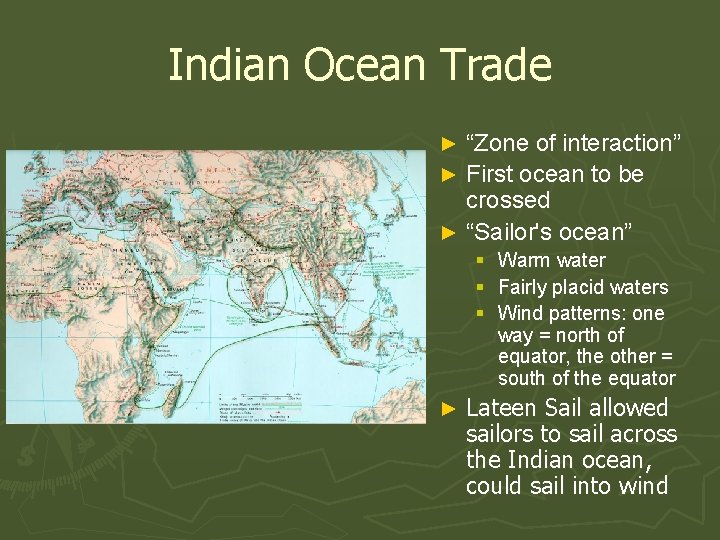
Indian Ocean Trade “Zone of interaction” ► First ocean to be crossed ► “Sailor's ocean” ► § § § ► Warm water Fairly placid waters Wind patterns: one way = north of equator, the other = south of the equator Lateen Sail allowed sailors to sail across the Indian ocean, could sail into wind
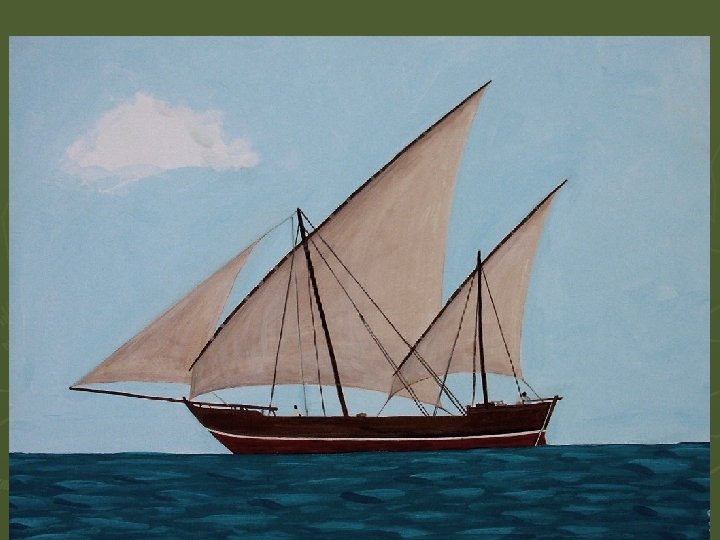
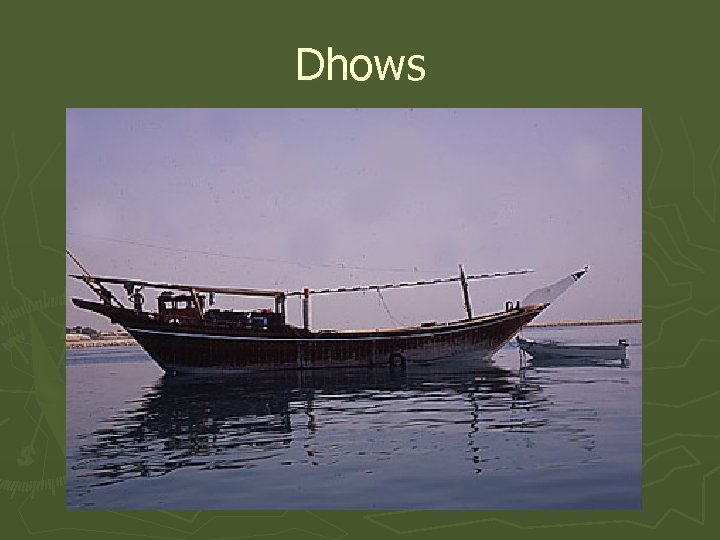
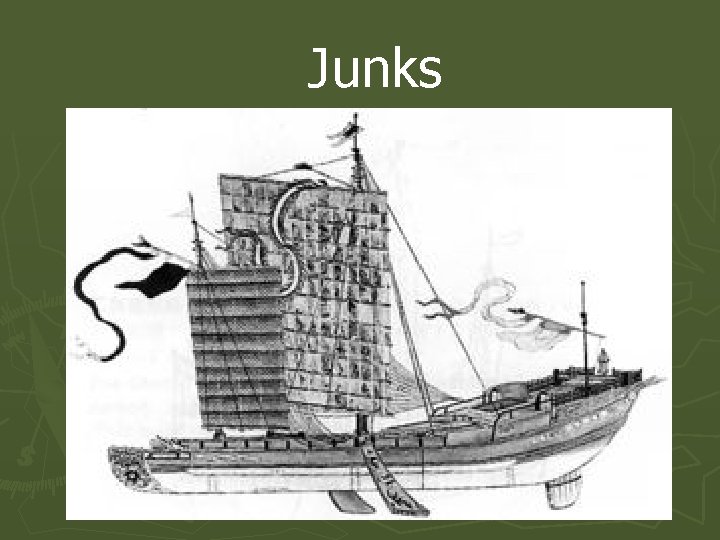
Indian Ocean Trade Cont. ► In the Red and ► Junks were Arabian Seas, trade technologically was carried on advanced vessels, dhows. From India having watertight on to Southeast compartments, Asia, junks up to twelve sails, dominated the trade and carrying routes cargoes of up to 1, 000 tons
Dhows
Junks
Indian Ocean Trade ► Junks were developed in China, but during the fifteenth century, junks were also built in Bengal and Southeast Asia and sailed with crews from those places ► The Indian Ocean trade was decentralized and cooperative, with various regions supplying particular goods
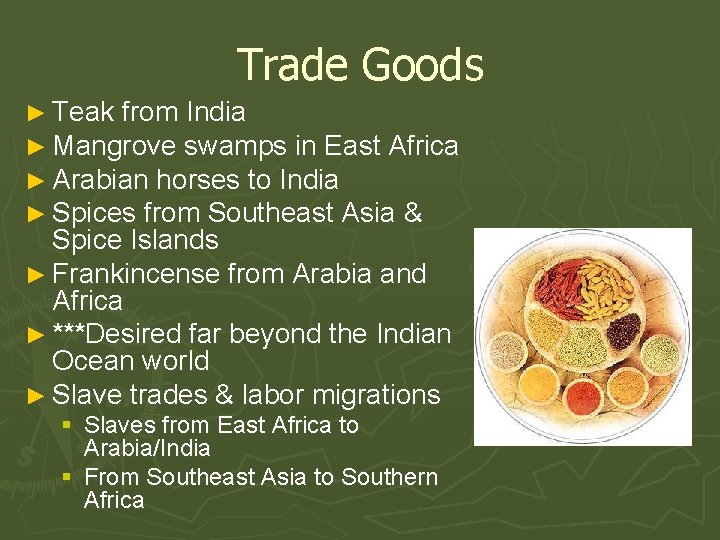
Trade Goods ► Teak from India ► Mangrove swamps in East Africa ► Arabian horses to India ► Spices from Southeast Asia & Spice Islands ► Frankincense from Arabia and Africa ► ***Desired far beyond the Indian Ocean world ► Slave trades & labor migrations § Slaves from East Africa to Arabia/India § From Southeast Asia to Southern Africa
Africa: The Swahili Coast and Zimbabwe ► By 1500, there were thirty or forty separate city-states along the East African coast participating in the Indian Ocean trade ► The people of these coastal cities, the “Swahili” people, all spoke an African language enriched with Arabic and Persian vocabulary.
Africa and Indian Ocean Trade ► Swahili cities, including Kilwa, were famous as exporters of gold that was mined in or around the inland kingdom whose capital was Great Zimbabwe. ► Great Zimbabwe’s economy rested on agriculture, cattle herding, and trade. ► The city declined due to an ecological crisis brought on by deforestation and overgrazing.
Arabia: Aden and the Red Sea ► Aden had enough rainfall to produce wheat for export and a location that made it a central transit point for trade from the Persian Gulf, East Africa, and Egypt ► Aden’s merchants prospered on this trade and built what appeared to travelers to be a wealthy and impressive city.
Indian Ocean trade cont. ► In general, a common interest in trade allowed the various peoples and religions of the Indian Ocean basin to live in peace ► Violence did sometimes break out, however, as when Christian Ethiopia fought with the Muslims of the Red Sea coast over control of trade.
India: Gujarat and the Malabar Coast ► The state of Gujarat prospered from the Indian Ocean trade, exporting cotton textiles and indigo in return for gold and silver ► Gujarat was not simply a commercial center; it was also a manufacturing center that produced textiles, leather goods, carpets, silk, and other commodities ► Gujarat’s overseas trade was dominated by Muslims, but Hindus also benefited.
Gujarat and Malabar Coast Continued… ► Calicut and other cities of the Malabar Coast exported cotton textiles and spices and served as clearing-houses for long-distance trade ► The cities of the Malabar Coast were unified in a loose confederation whose rulers were tolerant of other religious and ethnic groups.
Southeast Asia: The Rise of Malacca ► The Strait of Malacca is the principal passage from the Indian Ocean to the South China Sea ► In the fourteenth century a gang of Chinese pirates preyed upon the strait, nominally under the control of the Java-based kingdom of Majapahit
Malacca cont. ► In 1407, the forces of the Ming dynasty crushed the Chinese pirates ► The Muslim ruler of Malacca took advantage of this to exert his domination over the strait and to make Malacca into a major port and a center of trade.
Spread of Ideas ► Religion § Indian merchants brought by Brahmin priests § Muslim scholars brought by Arab merchants § Christian merchants brought by priests ► Trading Language § Swahili: mix of Arabic, Indian, and Bantu (African)
Indian Ocean Trade CFU ► What factor(s) led to rise of the Indian Ocean trade? ► What empires/countries/kingdoms participated in Indian Ocean Trade- please list 2 places and provide examples of what they traded. ► What other things were traded aside from goods?
TOPIC 2. 4 Trans. Saharan Trade Routes Unit 2: Networks of Exchange
THEMATIC FOCUS ► Technology ► Human and Innovation TEC adaptation and innovation have resulted in increased efficiency, comfort, and security, and technological advances have shaped human development and interactions with both intended and unintended consequences.
LEARNING OBJECTIVE ► Unit 2: Learning Objective H ► Explain the causes and effects of the growth of trans-Saharan trade.
Historical Developments ► KC-3. 1. II. A. ii The growth of interregional trade was encouraged by innovations in existing transportation technologies.
► KC-3. 1. I. A. iv Improved transportation technologies and commercial practices led to an increased volume of trade and expanded the geographical range of existing trade routes, including the trans-Saharan trade network.
THEMATIC FOCUS ► Governance GOV ► A variety of internal and external factors contribute to state formation, expansion, and decline. Governments maintain order through a variety of administrative institutions, policies, and procedures, and governments obtain, retain, and exercise power in different ways and for different purposes.
LEARNING OBJECTIVE ► Unit 2: Learning Objective I Explain how the expansion of empires influenced trade and communication over time.
Historical Developments ► KC-3. 1. I. E. ii The expansion of empires— including Mali in West Africa–facilitated Afro. Eurasian trade and communication as new people were drawn into the economies and trade networks.
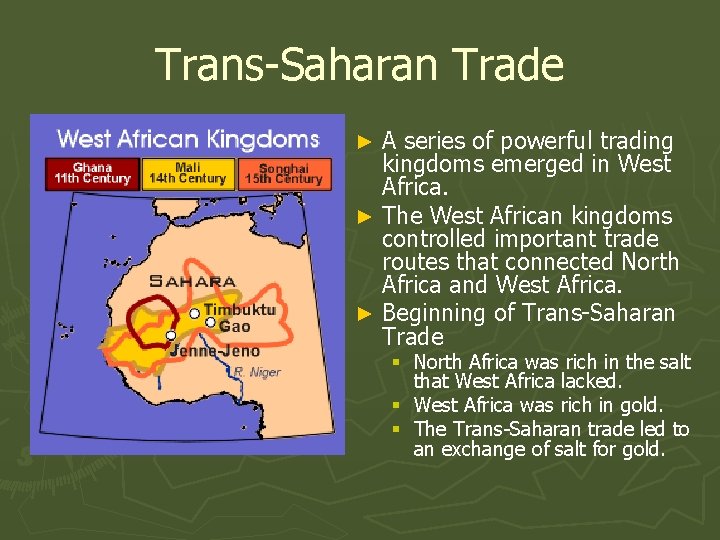
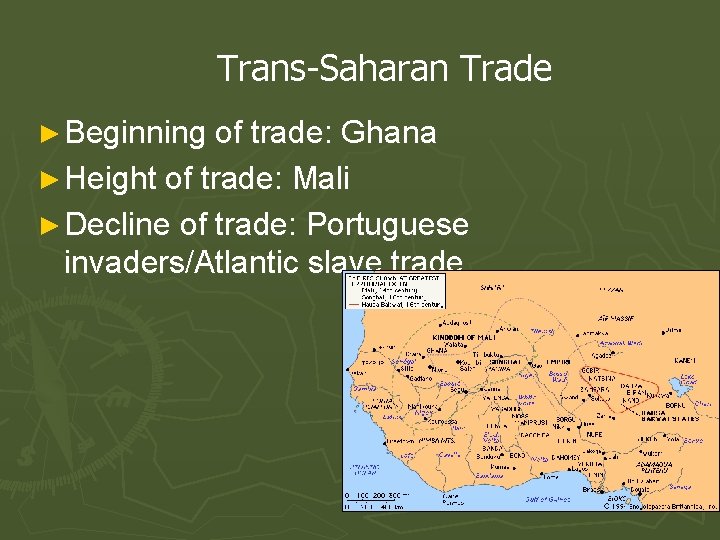
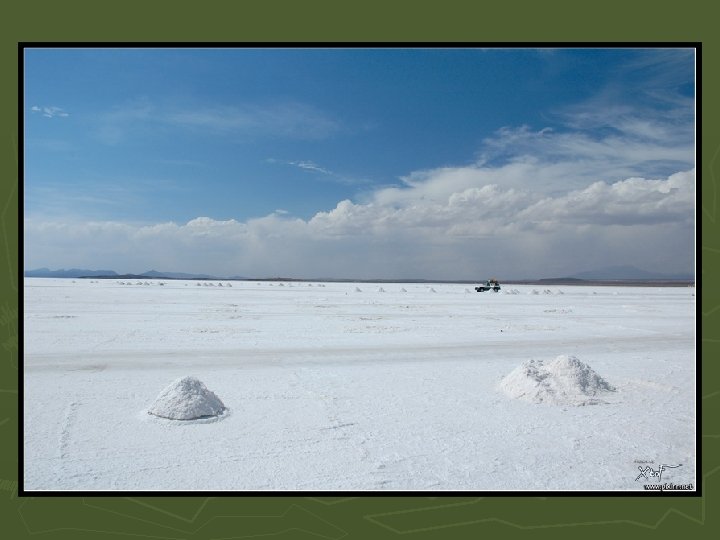
Trans-Saharan Trade A series of powerful trading kingdoms emerged in West Africa. ► The West African kingdoms controlled important trade routes that connected North Africa and West Africa. ► Beginning of Trans-Saharan Trade ► § North Africa was rich in the salt that West Africa lacked. § West Africa was rich in gold. § The Trans-Saharan trade led to an exchange of salt for gold.
Trans-Saharan Trade ► Began with Soninke Empire (Ghana) in the 5 th century ► Linked to Mediterranean Empires supplied gold and salt ► Used camels (Ibn Battuta, camel caravan size = 1, 000 -12, 000) ► Eventually sent slaves north
Trans-Saharan Trade ► Beginning of trade: Ghana ► Height of trade: Mali ► Decline of trade: Portuguese invaders/Atlantic slave trade
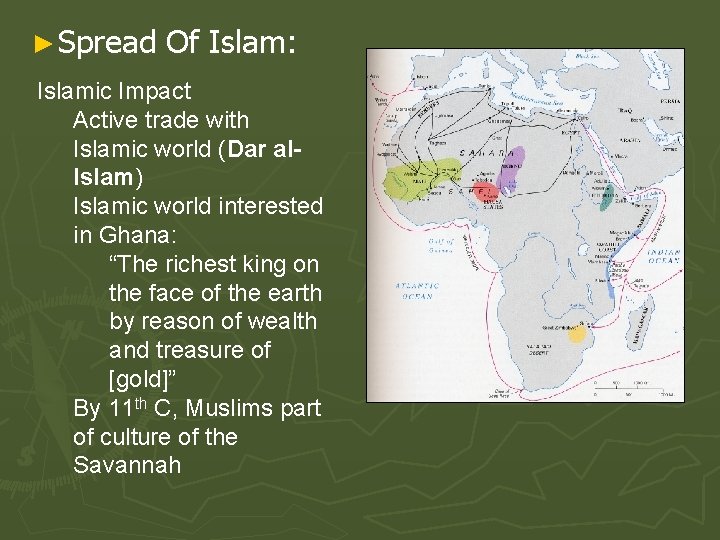
► Spread Of Islam: Islamic Impact Active trade with Islamic world (Dar al. Islam) Islamic world interested in Ghana: “The richest king on the face of the earth by reason of wealth and treasure of [gold]” By 11 th C, Muslims part of culture of the Savannah
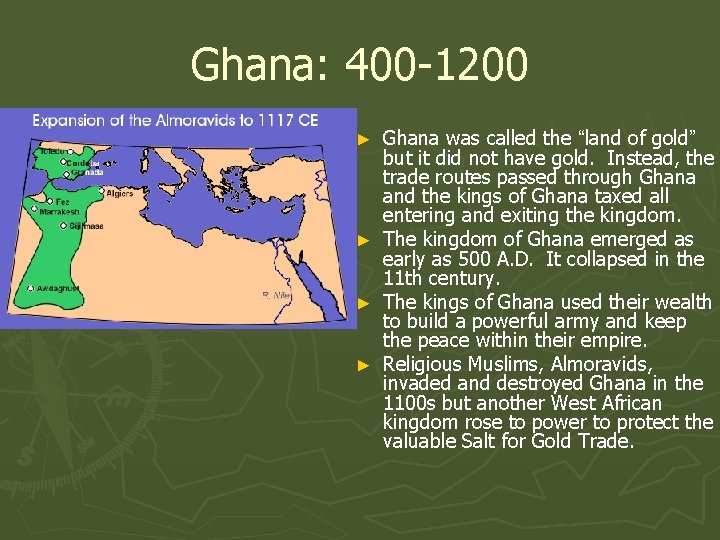
Ghana: 400 -1200 Ghana was called the “land of gold” but it did not have gold. Instead, the trade routes passed through Ghana and the kings of Ghana taxed all entering and exiting the kingdom. ► The kingdom of Ghana emerged as early as 500 A. D. It collapsed in the 11 th century. ► The kings of Ghana used their wealth to build a powerful army and keep the peace within their empire. ► Religious Muslims, Almoravids, invaded and destroyed Ghana in the 1100 s but another West African kingdom rose to power to protect the valuable Salt for Gold Trade. ►
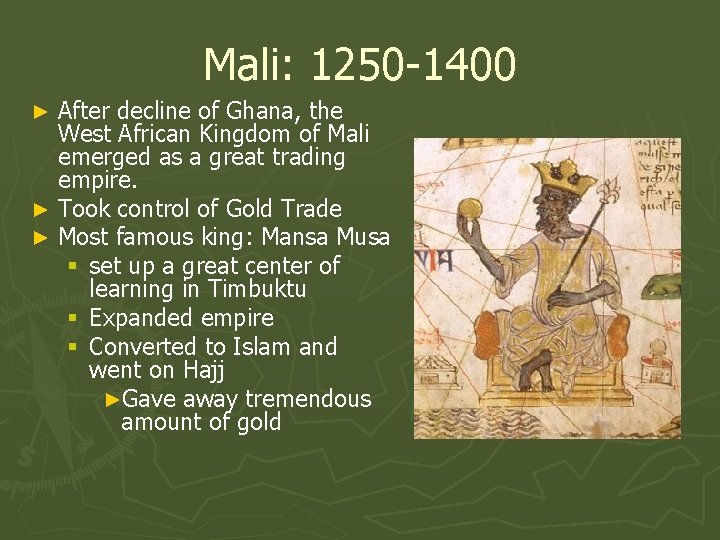
Mali: 1250 -1400 After decline of Ghana, the West African Kingdom of Mali emerged as a great trading empire. ► Took control of Gold Trade ► Most famous king: Mansa Musa § set up a great center of learning in Timbuktu § Expanded empire § Converted to Islam and went on Hajj ►Gave away tremendous amount of gold ►
Songhai: 1450 -1600 ► The West African kingdom of Songhai was the largest of the three trading kingdoms ► Muslim ► controlled the profitable Trans-Saharan trade ► Eventually, the kingdom of Songhai fell to invading armies from Morocco in 1591 (they had guns)