
Trade of Plumbing Phase 2 Module 3 Unit
Trade of Plumbing – Phase 2 Module 3 – Unit 1 Module 3: Domestic Heating/MMA Welding Unit 1 – Related Safety Duration – 10 Hours
Trade of Plumbing – Phase 2 Module 3 – Unit 1 In unit 1 we learn how to: _State the hazards and safety precautions associated with manual arc welding.
Trade of Plumbing – Phase 2 Module 3 – Unit 1 Key Learning Points _Rk H _Rk H _Rk Electric shock. Arc eye. Radiation. Hot metal, burns. Fatigue from oxygen depletion/lack of ventilation, welding in confined spaces etc. Skin cancer. Oxygen depletion and body fatigue. Safety precautions and personal protection equipment. Use of correct filters.
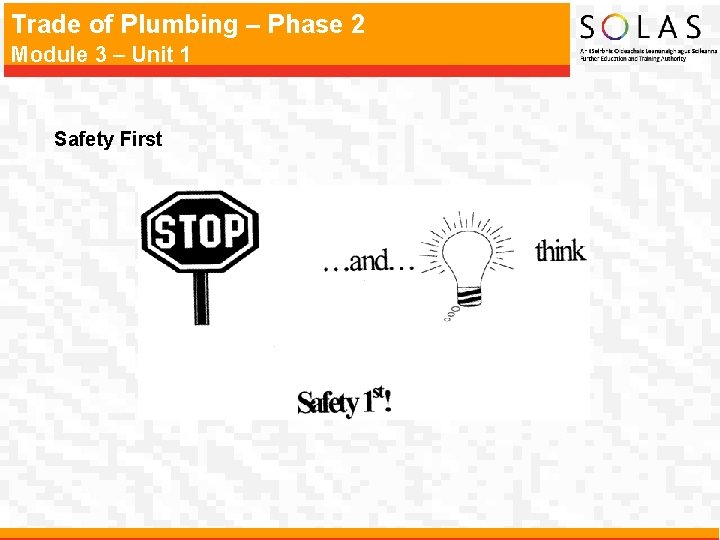
Trade of Plumbing – Phase 2 Module 3 – Unit 1 Safety First
Trade of Plumbing – Phase 2 Module 3 – Unit 1 Operator Protection _ No open-neck shirts; Ultra-violet rays will burn the skin. It is most definitely not similar to sun tanning. _ Regulation inflammable overalls only; Arc-welding produces large amounts of hot sparks which will set flammable clothing alight. _ No trainers/runners to be worn; The steel metal plate used are heavy and sharp. Wear steel toe-cap boots. _ Overalls not around waist; Sparks will set casual tops alight _ Always wear protective clothing; Arc-welding produces heat, glare, sparks, ultra-violet & infra-red rays and harmful fumes. Welding gauntlets must be worn at all times. Face masks are designed to deflect fumes and should therefore be held close to the face. Gas welding goggles will not afford protection for the face against the light intensity or the radiation and must not be used. Shade 11 EW filters are required in the face mask for manual metal arc welding. Always wear protective goggles when chipping slag.
Trade of Plumbing – Phase 2 Module 3 – Unit 1 Operator Protection. . continued _ Ensure adequate ventilation; Ventilation at source, when welding inside buildings, is a formal factory regulation and is there to protect the operator and others. Welding of some materials (i. e. galvanised steel) produces highly toxic fumes. _ Check your surroundings; Remember when you are welding behind a dark face mask you will be unaware of what is happening around you. Clear the surroundings of flammable material and ensure there is a fire extinguisher available. _ Examine all welding cables; Check for any loose connections that would cause arching thereby creating a hazard. Ensure your surroundings are dry and where possible stand on a timber “duck-board”. _ Never weld enclosed tanks; Tanks which have contained flammable material may still hold traces of the substance within the seams. _ Do not wells over Paint/Oils/Grease/Solvents; Striking the arc will prove difficult and toxic fumes will be produced
Trade of Plumbing – Phase 2 Module 3 – Unit 1 Protection for Others _Screen rays from others; Before welding, ensure others are protected from the light rays by erecting screens. Ultra-violet rays cause the condition known as “arc-eye” which is really conjunctivitis. If affected, the eyes should be thoroughly washed with an eye bath. If the condition persists, medical advice should be sought. _Safe removal of a victim; An individual who has been electrocuted could still be in contact with the power source and therefore should be removed with the use of non-conducting material to protect the rescuer. Onlookers to the welding process must be informed of the need to wear protective clothing.
Trade of Plumbing – Phase 2 Module 3 – Unit 1 General Protection Fire Extinguishers _Carbon tetrachloride. (C. T. C. ). Effective for all types of fires but not to be used adjacent to live high voltage. The gas is poisonous. Not to be used in confined spaces. _Carbon Dioxide (CO 2). May be used on electric motors, switchgear and transformers up to 10 KV. _Foam Suitable for oil fires but is a conductor and should not be used on live electrical equipment.
Trade of Plumbing – Phase 2 Module 3 – Unit 1 Access and Exits _Ensure adequate clear access is available to the work area in the event of injury. _Exits must be kept be free of obstacles. _When welding inside large vessels a safety harness must be worn.
- Slides: 9