
Trade of Plumbing Phase 2 Module 2 Unit
Trade of Plumbing – Phase 2 Module 2 – Unit 11 Module 2: Domestic Hot and Cold Water Services Unit 11 – Sanitary Appliances Duration – 11 Hours

Trade of Plumbing – Phase 2 Module 2 – Unit 11 In this module we learn how to: _ List the various types and applications of sanitary appliances. _ Describe the working principles of sanitary appliances. _ List the materials and design features of sanitary appliances. _ Install siphon and ballvalve in WC cistern. _ Fit taps and wastes in wash hand basins and baths.
Trade of Plumbing – Phase 2 Module 2 – Unit 11 Key Learning Points _Rk _Sc _Rk _Rk _Rk _Sk _P _P _P Various types and applications of sanitary appliance. Working principles of sanitary appliances. Principle of siphonic action. Automatic-flushing cisterns. Materials for sanitary appliances. Design features of sanitary appliances. Recommended fitting heights, brackets and supports for sanitary appliances. Traps and depth of water seal. Waste pipe connections. Installation of ballvalve, siphon, handle in WC cistern. Fitting taps and wastes to basins and baths. Good working practice. Problem solving. Working independently.
Trade of Plumbing – Phase 2 Module 2 – Unit 11 Sanitary Appliances Sanitary appliances are divided into two main groups: _ “Waste” appliances _ “Soil” appliances
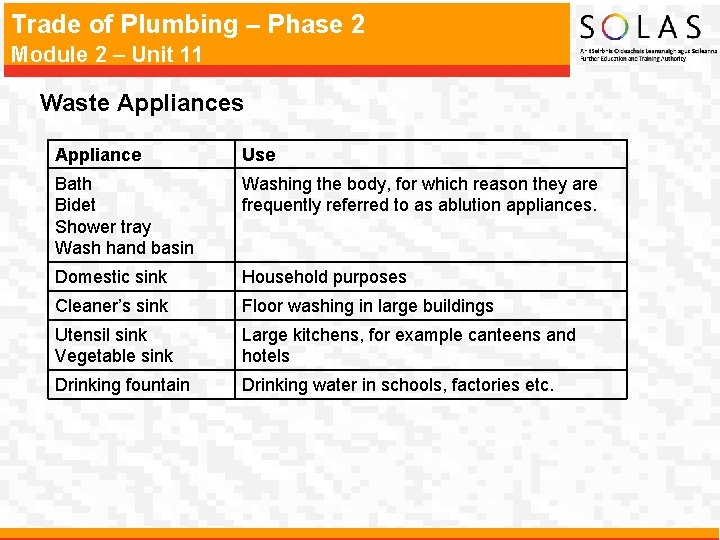
Trade of Plumbing – Phase 2 Module 2 – Unit 11 Waste Appliances Appliance Use Bath Bidet Shower tray Wash hand basin Washing the body, for which reason they are frequently referred to as ablution appliances. Domestic sink Household purposes Cleaner’s sink Floor washing in large buildings Utensil sink Vegetable sink Large kitchens, for example canteens and hotels Drinking fountain Drinking water in schools, factories etc.
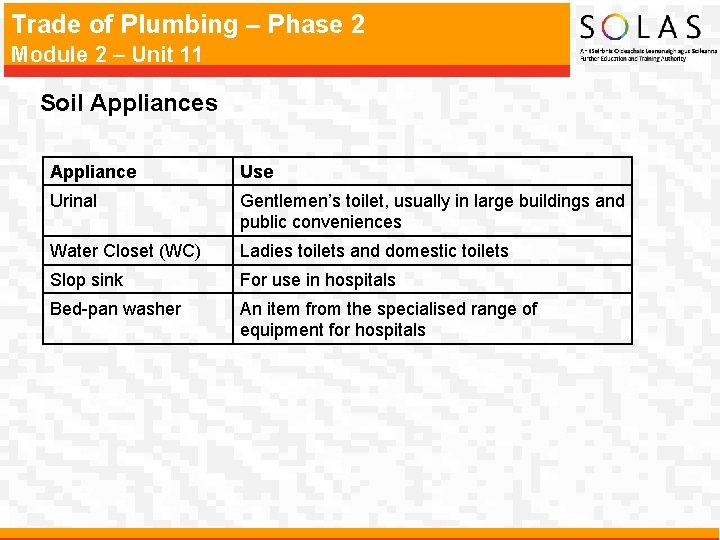
Trade of Plumbing – Phase 2 Module 2 – Unit 11 Soil Appliances Appliance Use Urinal Gentlemen’s toilet, usually in large buildings and public conveniences Water Closet (WC) Ladies toilets and domestic toilets Slop sink For use in hospitals Bed-pan washer An item from the specialised range of equipment for hospitals
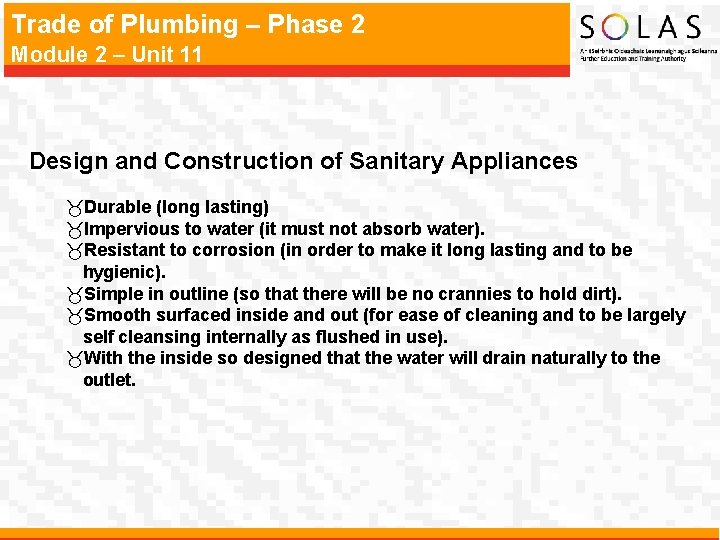
Trade of Plumbing – Phase 2 Module 2 – Unit 11 Design and Construction of Sanitary Appliances _Durable (long lasting) _Impervious to water (it must not absorb water). _Resistant to corrosion (in order to make it long lasting and to be hygienic). _Simple in outline (so that there will be no crannies to hold dirt). _Smooth surfaced inside and out (for ease of cleaning and to be largely self cleansing internally as flushed in use). _With the inside so designed that the water will drain naturally to the outlet.
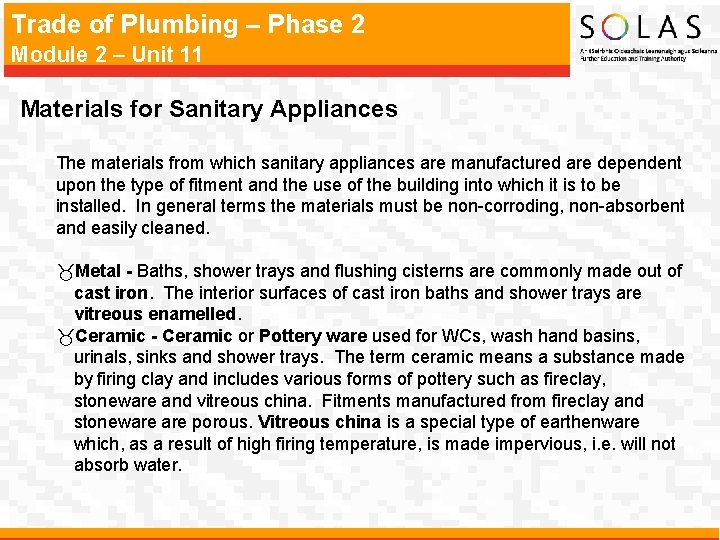
Trade of Plumbing – Phase 2 Module 2 – Unit 11 Materials for Sanitary Appliances The materials from which sanitary appliances are manufactured are dependent upon the type of fitment and the use of the building into which it is to be installed. In general terms the materials must be non-corroding, non-absorbent and easily cleaned. _Metal - Baths, shower trays and flushing cisterns are commonly made out of cast iron. The interior surfaces of cast iron baths and shower trays are vitreous enamelled. _Ceramic - Ceramic or Pottery ware used for WCs, wash hand basins, urinals, sinks and shower trays. The term ceramic means a substance made by firing clay and includes various forms of pottery such as fireclay, stoneware and vitreous china. Fitments manufactured from fireclay and stoneware porous. Vitreous china is a special type of earthenware which, as a result of high firing temperature, is made impervious, i. e. will not absorb water.
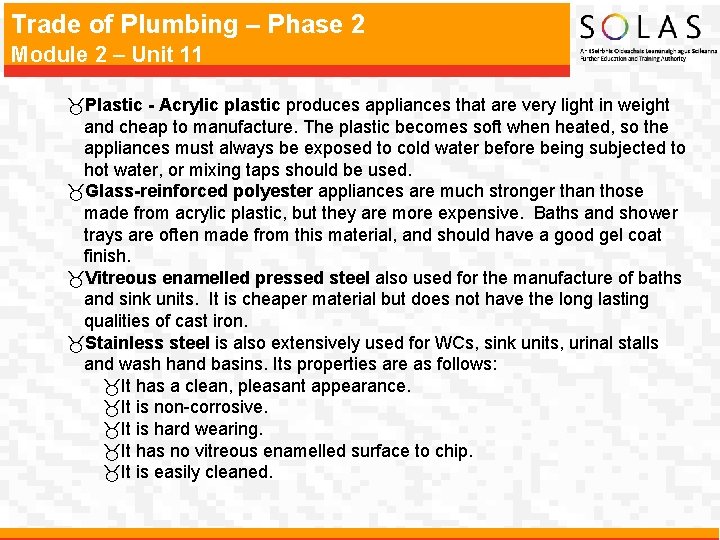
Trade of Plumbing – Phase 2 Module 2 – Unit 11 _Plastic - Acrylic plastic produces appliances that are very light in weight and cheap to manufacture. The plastic becomes soft when heated, so the appliances must always be exposed to cold water before being subjected to hot water, or mixing taps should be used. _Glass-reinforced polyester appliances are much stronger than those made from acrylic plastic, but they are more expensive. Baths and shower trays are often made from this material, and should have a good gel coat finish. _Vitreous enamelled pressed steel also used for the manufacture of baths and sink units. It is cheaper material but does not have the long lasting qualities of cast iron. _Stainless steel is also extensively used for WCs, sink units, urinal stalls and wash hand basins. Its properties are as follows: _It has a clean, pleasant appearance. _It is non-corrosive. _It is hard wearing. _It has no vitreous enamelled surface to chip. _It is easily cleaned.

Trade of Plumbing – Phase 2 Module 2 – Unit 11 Sanitary Appliances
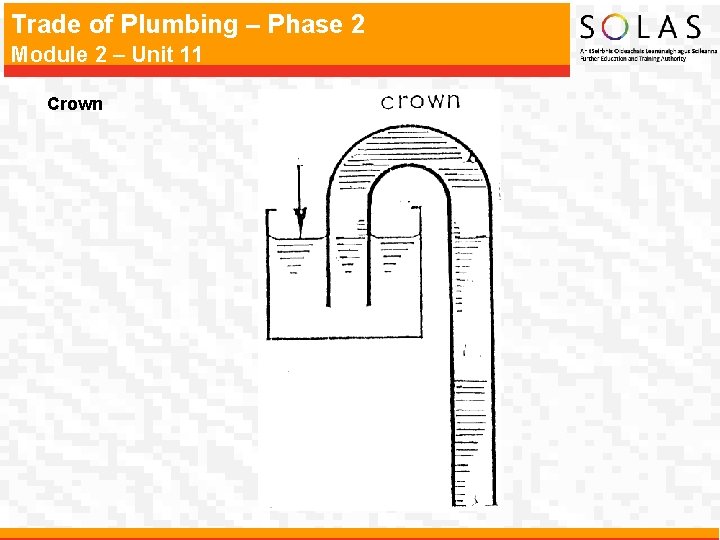
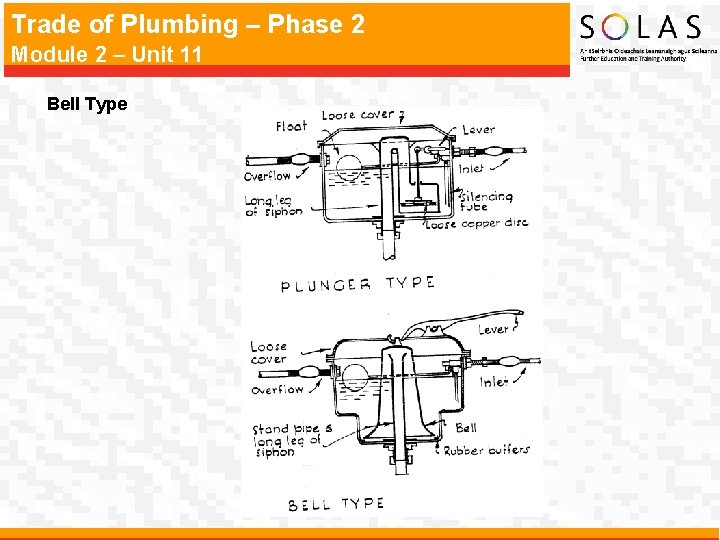
Trade of Plumbing – Phase 2 Module 2 – Unit 11 Flushing Cisterns The cistern is operated by depressing a lever which lifts the piston. Thi action forces or lifts a body of water over the crown of the siphon and into the flush pipe. Siphonic action is then created which empties the cistern. _For siphonic action to take place all siphons require a “short leg” and a “long leg” _In a WC cistern the short leg of the siphon is located within the cistern, and the long leg is created by the addition of a flush pipe to the outlet connection of the siphon. This pattern of cistern is the most common sort and is known as the “plunger” or “disc type” cistern.

Trade of Plumbing – Phase 2 Module 2 – Unit 11 Flushing Cisterns
Trade of Plumbing – Phase 2 Module 2 – Unit 11 Crown

Trade of Plumbing – Phase 2 Module 2 – Unit 11 Flush Pipe

Trade of Plumbing – Phase 2 Module 2 – Unit 11 Flushing Cistern
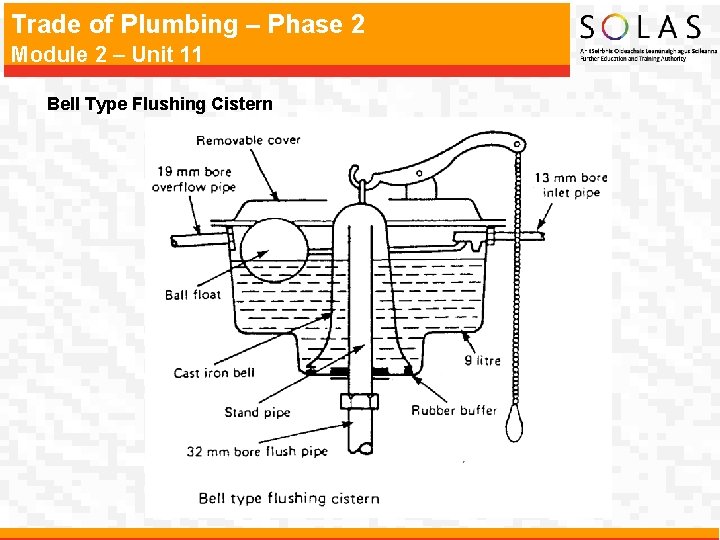
Trade of Plumbing – Phase 2 Module 2 – Unit 11 Bell-Type Flushing Cistern The bell-type flushing cistern is rather noisy but may be used in factories and schools. The cistern is operated by the chain being pulled down which also lifts the bell. When the chain is released the bell falls thus displacing water under the bell down the stand pipe. Siphonic action is then created which empties the cistern.
Trade of Plumbing – Phase 2 Module 2 – Unit 11 Bell Type Flushing Cistern
Trade of Plumbing – Phase 2 Module 2 – Unit 11 Bell Type

Trade of Plumbing – Phase 2 Module 2 – Unit 11 W. C. Flushing Cistern Maintainence
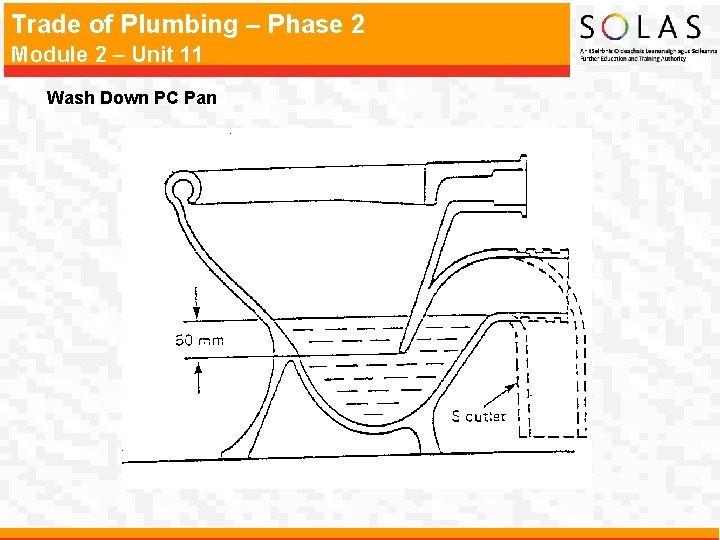
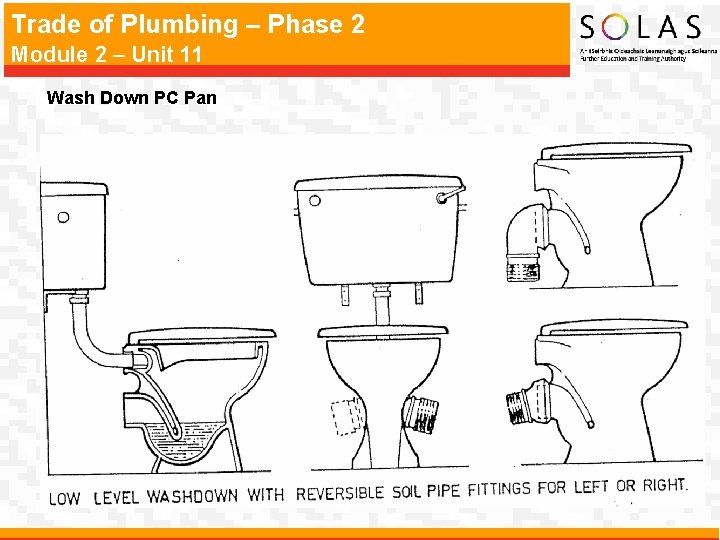
Trade of Plumbing – Phase 2 Module 2 – Unit 11 Wash Down PC Pans The wash down WC pan is cheap, simple and efficient and rarely becomes blocked. It is used in all types of buildings and is made from vitreous china, glazed fireclay or stonewash. The contents of the pan are removed by the momentum of the water flush. A high-level flushing cistern gives a good flush but is noisy. A low-level cistern gives a quieter flush, is neater and now more popular. The outlet of the pan may be horizontal, P, S left or right hand. A plastic connector is a popular outlet joint and only requires pushing over the outlet and into the soil pipe. The flush pipe joint is usually made by a rubber cone connector
Trade of Plumbing – Phase 2 Module 2 – Unit 11 Wash Down PC Pan
Trade of Plumbing – Phase 2 Module 2 – Unit 11 Wash Down PC Pan

Trade of Plumbing – Phase 2 Module 2 – Unit 11 Connector Types
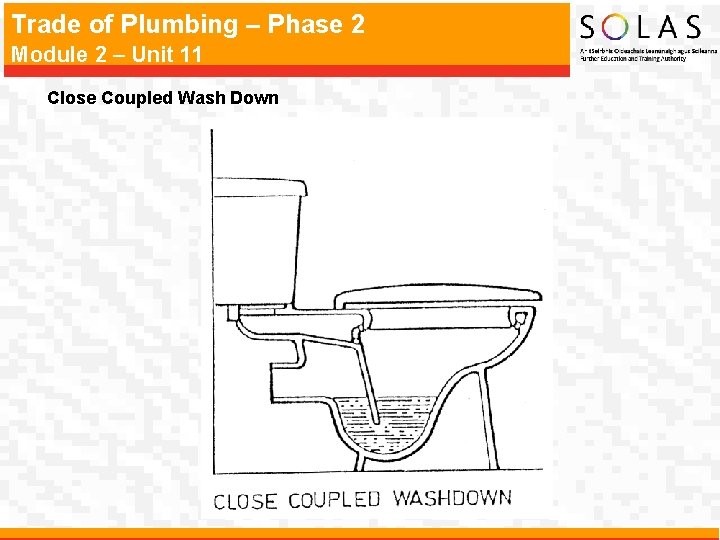
Trade of Plumbing – Phase 2 Module 2 – Unit 11 Close Coupled Wash Down
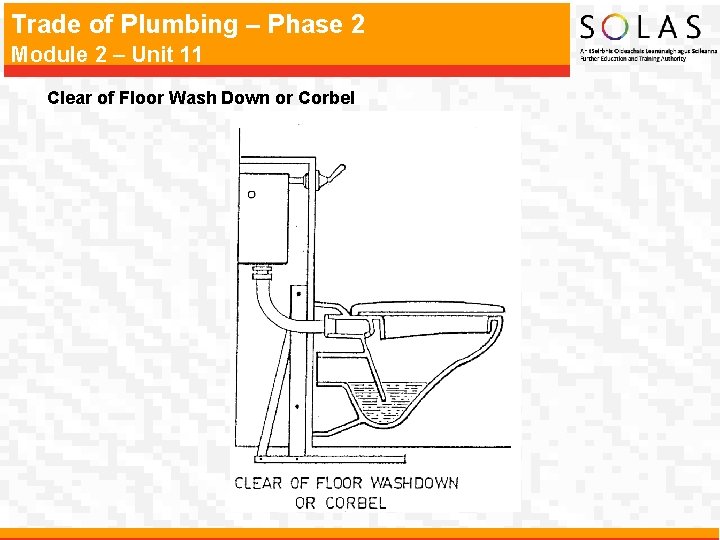
Trade of Plumbing – Phase 2 Module 2 – Unit 11 Clear of Floor Wash Down or Corbel

Trade of Plumbing – Phase 2 Module 2 – Unit 11 Flush Pipe
Trade of Plumbing – Phase 2 Module 2 – Unit 11 Siphonic Water Closets _Recommended for fixing in houses, flats, hotels, hospitals etc. _Have a larger water area and a deeper seal than ordinary wash-down types. _More expensive than the wash-down type. _Do not stand up as well to rough usage. _All types fall within the category of either single or double traps.
Trade of Plumbing – Phase 2 Module 2 – Unit 11 A siphonic WC with two traps is known as the “exhaust action type”. Its action is as follows: _Flushing cistern lever is pulled down, causing water to pass down the flush pipe. _Water passing the end of the air pipe at A draws air from the space between the two traps at B, and creates a reduction in air pressure (partial vacuum) at this point. _Immediately, the greater pressure of the atmosphere acting on the surface of the water in the pan, sets up siphonic action and forces the water with its contents out of the pan. _This siphonic action is completed and the pan is emptied before the flush water enters the pan. The water therefore simply washes the pan down and refills the first seal.

Trade of Plumbing – Phase 2 Module 2 – Unit 11 Siphonic Action
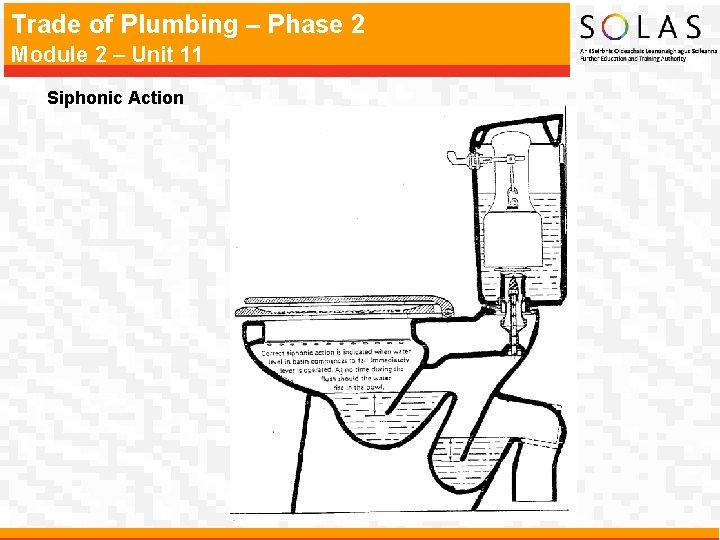
Trade of Plumbing – Phase 2 Module 2 – Unit 11 Siphonic Action
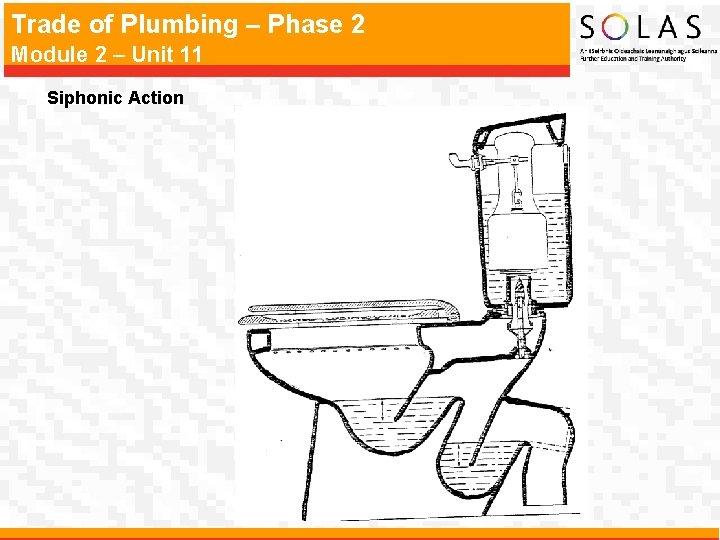
Trade of Plumbing – Phase 2 Module 2 – Unit 11 Siphonic Action
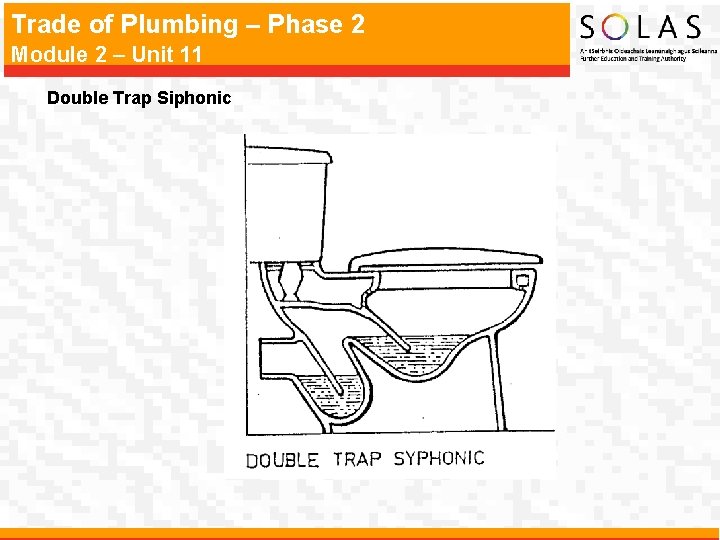
Trade of Plumbing – Phase 2 Module 2 – Unit 11 Double Trap Siphonic
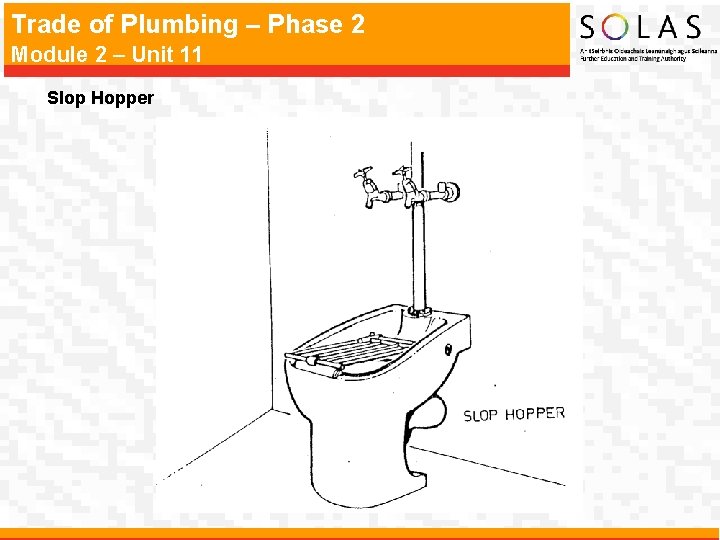
Trade of Plumbing – Phase 2 Module 2 – Unit 11 Slop Hopper
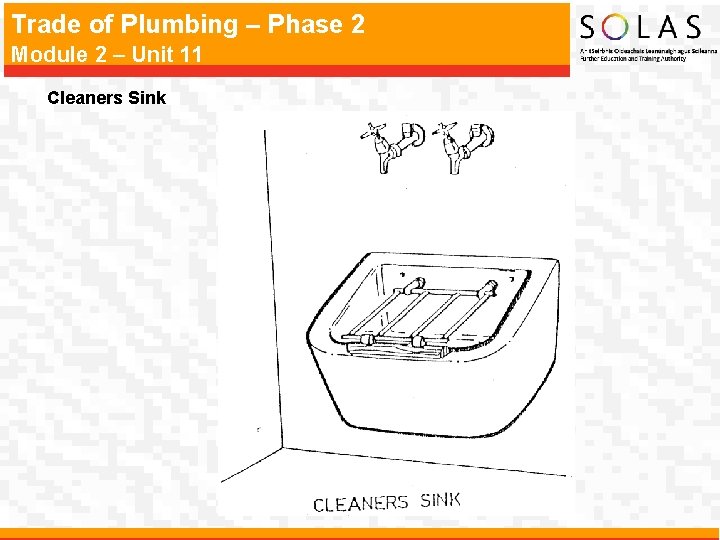
Trade of Plumbing – Phase 2 Module 2 – Unit 11 Cleaners Sink
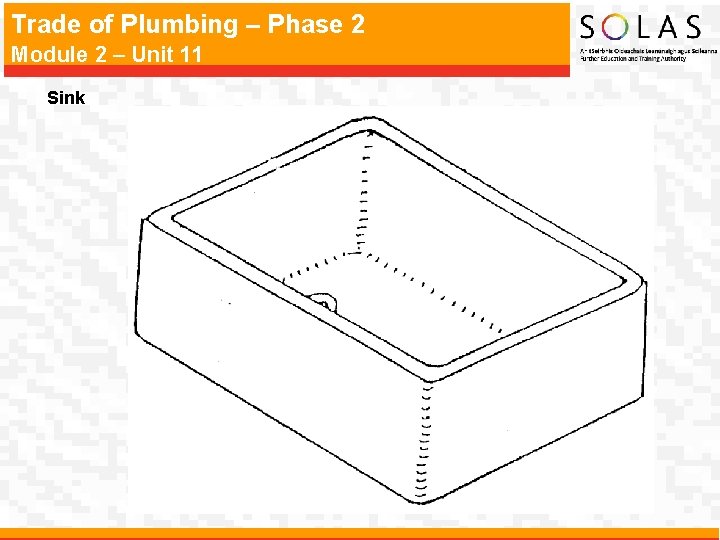
Trade of Plumbing – Phase 2 Module 2 – Unit 11 Sink

Trade of Plumbing – Phase 2 Module 2 – Unit 11 Drainer Types
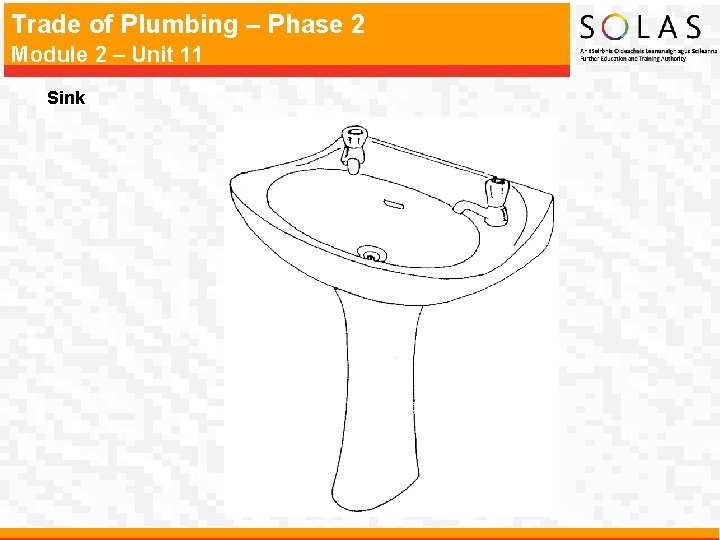
Trade of Plumbing – Phase 2 Module 2 – Unit 11 Sink
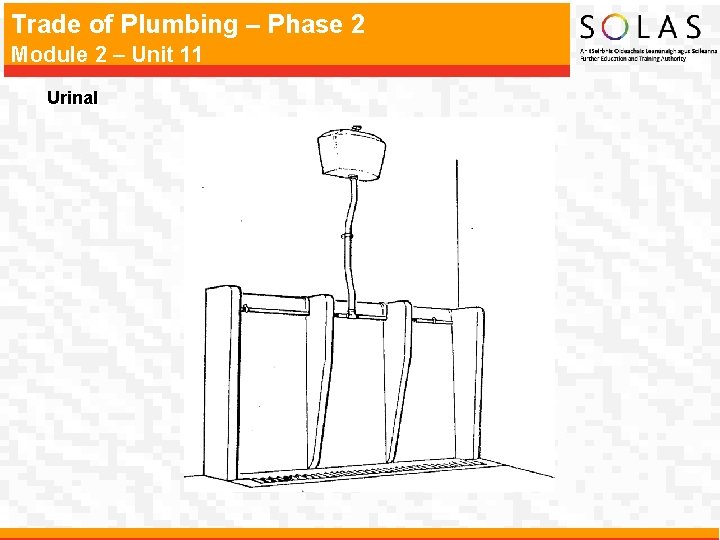
Trade of Plumbing – Phase 2 Module 2 – Unit 11 Urinal
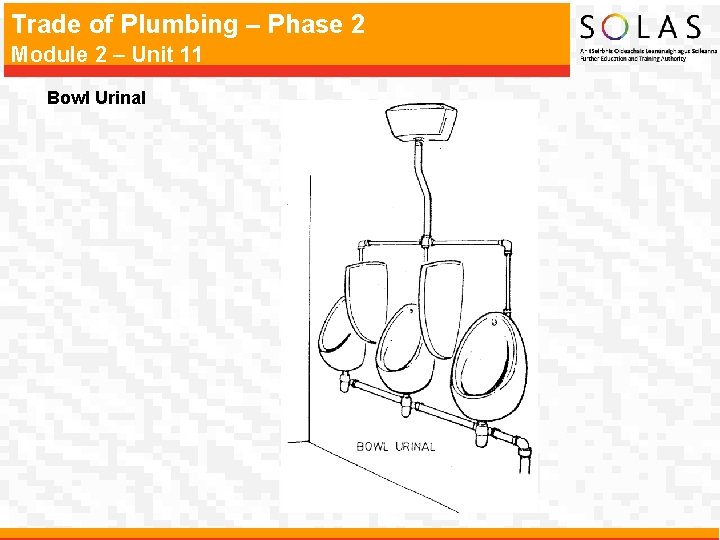
Trade of Plumbing – Phase 2 Module 2 – Unit 11 Bowl Urinal
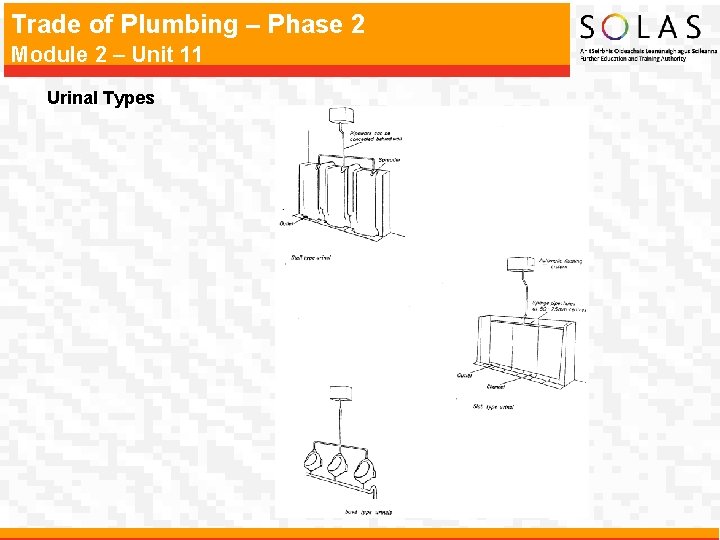
Trade of Plumbing – Phase 2 Module 2 – Unit 11 Urinal Types
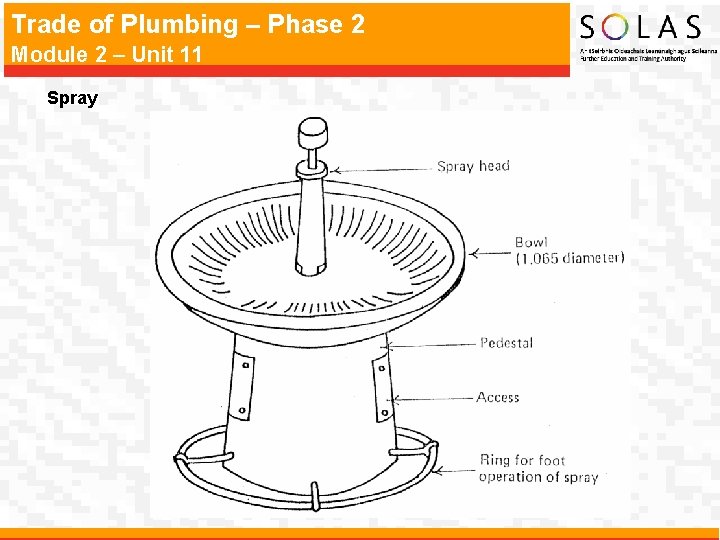
Trade of Plumbing – Phase 2 Module 2 – Unit 11 Spray
Trade of Plumbing – Phase 2 Module 2 – Unit 11 Bidets A sanitary fitting used for washing the lower parts of the body. Also can be used as a footbath. Bidets are usually classified in two distinct types: _Submerged inlet. _Over-rim-supply. Tap controls are placed to enable the user to adjust the flow rate and temperature of the water. With most submerged inlet bidets the rim seat may be warmed by an ascending spray which then fills the bowl for washing. To prevent back siphonage, most water authorities have special requirements for bidets with submerged inlets: _Non-return valves should be fitted to both the hot and cold supplies. _Hot and cold pipes to the bidet should be taken at least two metres above the appliance before being connected into the main supplies. _In some instances a separate cistern may be required. Bidets with over-rim supply are simpler to install and are supplied with water in the same manner as a wash basin.

Trade of Plumbing – Phase 2 Module 2 – Unit 11 Bidets
- Slides: 43