
Tracking the able in stable Toward an understanding
Tracking the able in stable: Toward an understanding of morphological decomposition in processing and representation Alec Marantz, Olla Somolyak, Ehren Reilly Bill Badecker, Asaf Bachrach, Susan Gabrieli, John Gabrieli KIT/NYU MEG Joint Research Lab (et al. ) Departments of Psychology and Linguistics NYU
Outline • Strawmen Burnt w cartoon dual route model w cartoon obligatory decomposition model • Real Issues Identified w modality specific access “lexicon”? w access lexicon contains morphologically complex forms? w knowledge contributions to affixstripping/decomposition? w effects of decomposition on stem access? w effects of stages of processing on RT in, e. g. , lexical decision? 2
• Experiment Done w evidence for, at least, full decomposition or interactive dual route model w no support for whole word access route w support for early effects of surface frequency of affixed forms relative to stem frequency – at decomposition stage • Experiment Planned w tracking the -able in amiable and stable 3

Competing Models of Lexical Access – take your pick (or, the field’s take on Words and Rules) 4

Saturday Morning Models of Lexical Access (as most people read Pinker) • Full storage model: all complex words (walked, taught) stored and accessed as wholes: w only surface frequency effects on access predicted • Full decomposition model: no complex words stored and accessed as wholes: w only stem frequency effects on access predicted 5
• Dual Route Model (hooray!): irregular complex forms are stored and accessed as wholes; regular complex forms (except high frequency regulars) are not: w surface frequency effects on access for irregulars and high frequency regulars w stem frequency but no surface frequency effects on access for regulars 6
Facts Support Dual Route Model, if Alternatives are these Cartoon Versions • Fact: Stem Frequency effects in access for complex words • Fact: These effects are arguably not attributable to post-access decomposition w particularly when considered in connection with masked priming studies showing morphological priming when neither form nor semantic priming are found 7
• But, fact: Surface frequency effects in lexical access are found in wide variety of cases, including completely regular morphology (e. g. , for most inflected words in Finnish) 8
Problems for Cartoon Dual Route Model • The representation of even irregular derived or inflected forms must be complex w from the grammatical point of view, from morphology, syntax and semantics, felt is as complex as walked § e. g. , behavior with respect to do support, further inflection, impossibility of derivation, rigidity of meaning… w from the psycho and neurolinguistic point of view, irregulars contain the stem in the same way that regulars do § taught-teach identity priming in long-lag priming and for M 350 brain response 9
• So, the issue of “whole word” access to complex irregulars must be focused on possible “whole word” representations in something like a modality-specific “access lexicon, ” not on the lexical representations of such forms, which must be complex and as complex as the representations of regulars. 10
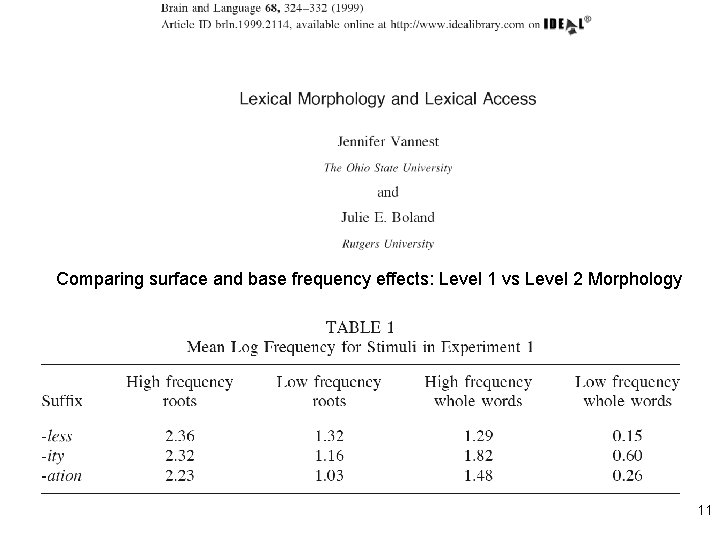
Comparing surface and base frequency effects: Level 1 vs Level 2 Morphology 11
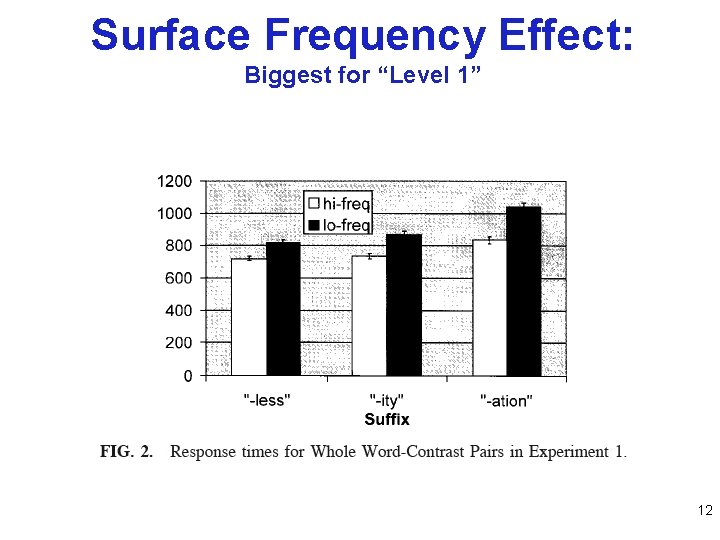
Surface Frequency Effect: Biggest for “Level 1” 12
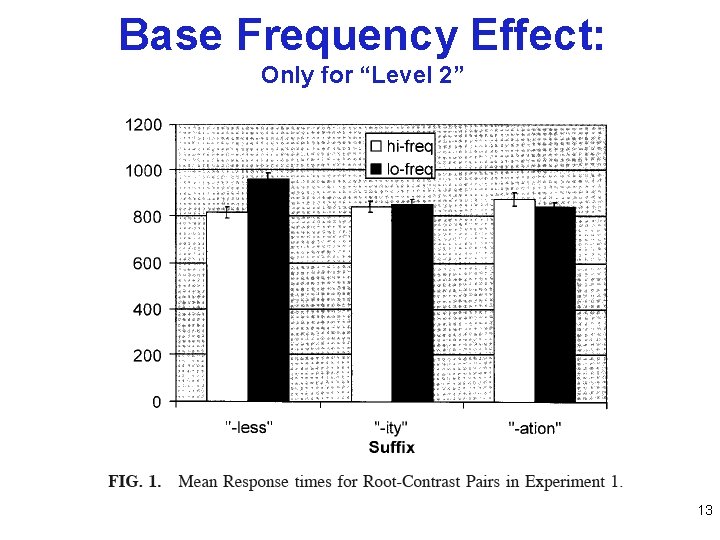
Base Frequency Effect: Only for “Level 2” 13
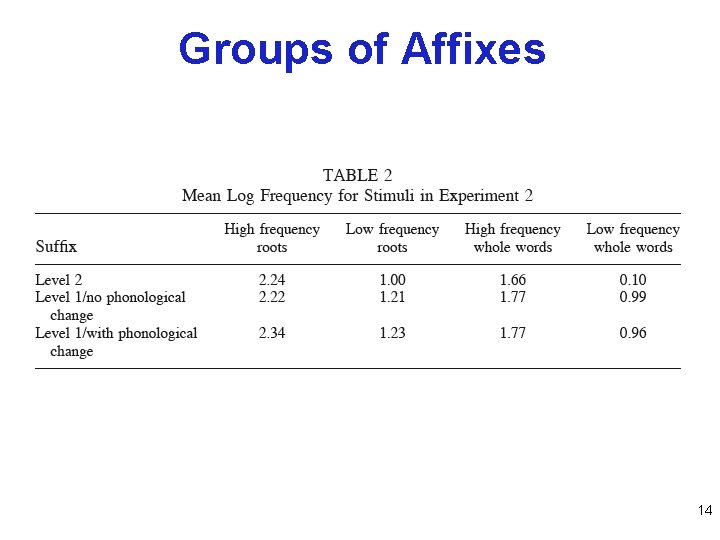
Groups of Affixes 14
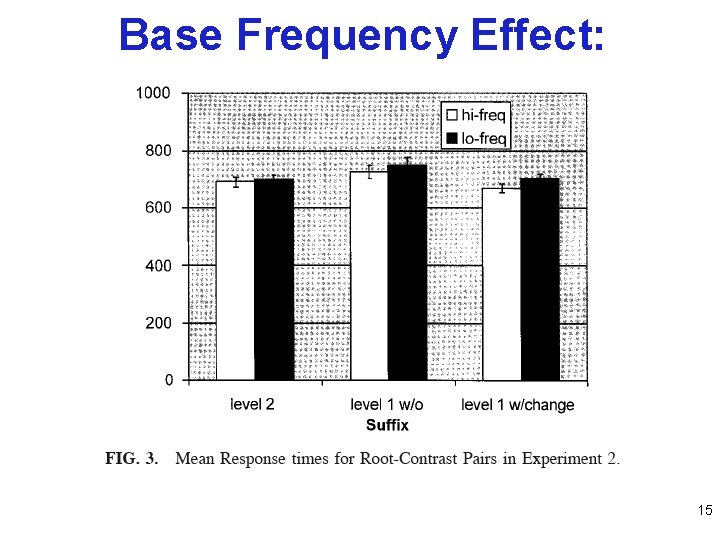
Base Frequency Effect: Nothing significant for groups of affixes 15
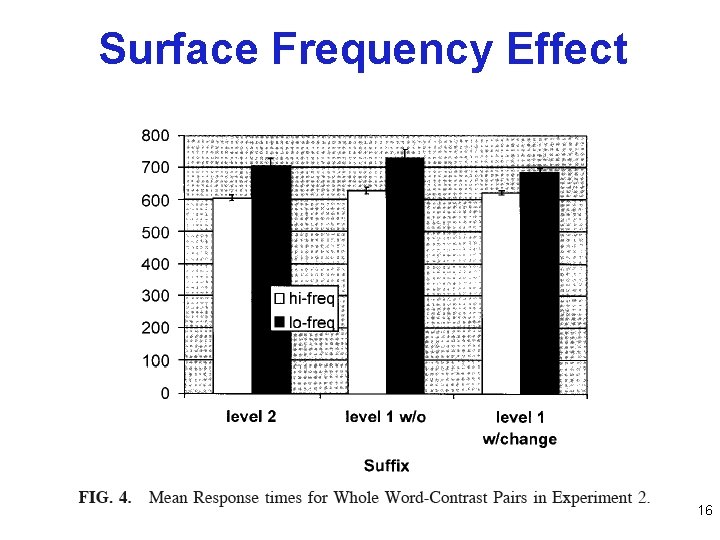
Surface Frequency Effect 16
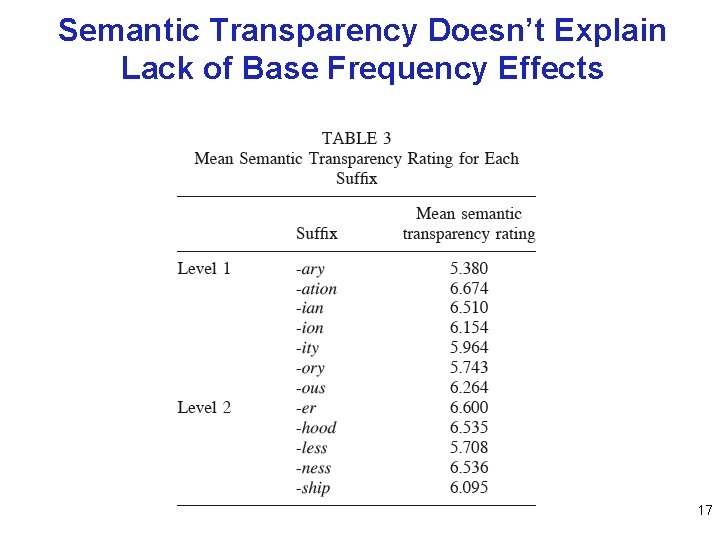
Semantic Transparency Doesn’t Explain Lack of Base Frequency Effects 17
Whole Word “Representations” for Regulars • Surface frequency effects on access are seen for a variety of completely regular derivations and inflections. • This should not surprise any obligatory decompositionalist, since surface frequency effects could be tied to the decomposition (the more you’ve decomposed a particular letter/sound sequence into stem and affix, the faster you are at it) or recombination (the more often you’ve put together a particular stems and affix, the faster you are at it) stages of processing. But any such effects imply representation of whole word as complex structure, regardless of regularity. 18
“Representations” • Saying that every combination of morphemes in perception or production, no matter how regular, leaves a trace in the language system of the speaker is saying that frequency information is part of the grammar and that all combinations of morphemes are stored in some sense. • Theories of morphology in particular have made explicit the difference between stored information about combinations of morphemes that may have grammatical effects on syntax, morphology, phonology and certain types of compositional semantics and stored information about combinations that may only have an effect on “idiomatic” or phrasal meanings. 19
• It’s fairly straightforward to claim that walked is “stored” as a complex form with a certain frequency in the same way that And now for something completely different is. Both must be composed with the grammar when heard or produced, but both may have frequency and special meaning information associated with them that, as far as the kinds of things most linguists study, have no implications for the grammar whatsoever. 20
Beyond the Cartoons 21
Realistic Full Decomposition Models Must… • Recognize that complex words, both regular and irregular, are stored in some sense, leading to possible surface frequency effects • Investigate the role of surface frequency in w decomposition w stem access w recombination 22
Realistic Dual Route Models Must… • Recognize that all complex forms must be representationally complex, containing structures of morphemes and contrasting with monomorphemic constituents • Focus on the possible existence of stored “whole word” representations at modality-dependent “access lexicons” (whole word form representations) to distinguish themselves from obligatory decomposition models 23
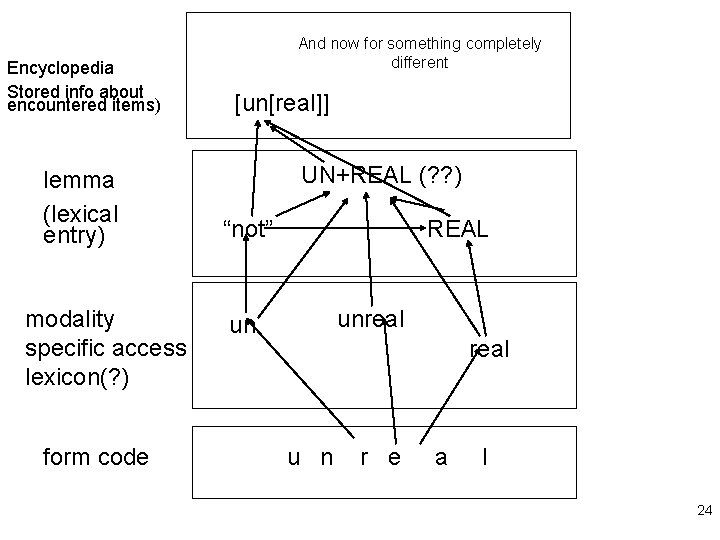
Encyclopedia Stored info about encountered items) lemma (lexical entry) modality specific access lexicon(? ) form code And now for something completely different [un[real]] UN+REAL (? ? ) “not” REAL unreal un real u n r e a l 24
Realistic Interactive Dual Route Models • Discuss possible sources for facilitation or difficulty for identifying the affixes for decomposition • These include phonotactic clues to morpheme boundaries (cf. sixths) as well as statistically properties of the combinations of morphemes, particularly conditional probabilities. 25
Effect of “Dominance” on Lexical Access • Jen Hay has made some about the importance of the relative frequency of a morphologically complex form with respect to the frequency of its stem. • Complex words with high frequencies relative to their stems are “affix-” or “surface dominant”; those with low frequencies are “stem” or “base dominant” • Hay: affix dominance leads to difficulty in parsing/decomposition, thus reliance on whole-word recognition and suppression of complexity of representation. 26
Simplistic Prediction of Hay Model • Affix dominant words should show surface frequency effects since they are accessed via the whole word route. • Stem dominant words should show stem (cumulative) frequency effects since they are accessed via the decomposition route. 27
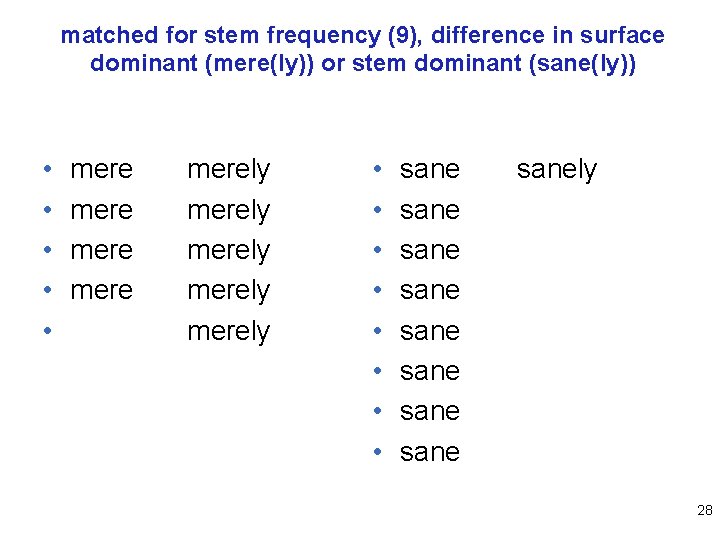
matched for stem frequency (9), difference in surface dominant (mere(ly)) or stem dominant (sane(ly)) • • • mere merely merely • • sane sane sanely 28
Taft (2004): “Morphological Decomposition and the Reverse Base Frequency Effect” Makes same predictions as Hay for RT with full parsing theory • Base frequency effects… § RT to complex word correlates with freq of stem • …reflect accessing the stem of morphological complex forms whereas • Surface frequency effects… § RT to complex word correlates with freq of complex word • …reflect the stage of checking the recombination of stem and stripped affix for existence and/or well-formedness. 29
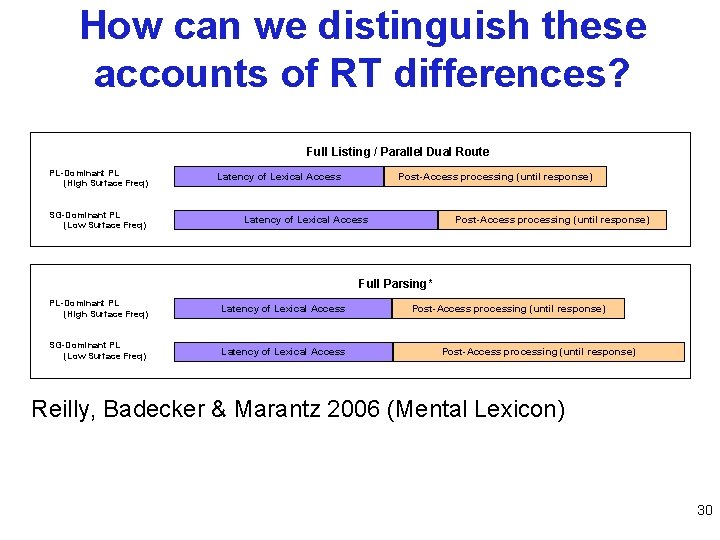
How can we distinguish these accounts of RT differences? Full Listing / Parallel Dual Route PL-Dominant PL (High Surface Freq) SG-Dominant PL (Low Surface Freq) Latency of Lexical Access Post-Access processing (until response) Full Parsing* PL-Dominant PL (High Surface Freq) Latency of Lexical Access SG-Dominant PL (Low Surface Freq) Latency of Lexical Access Post-Access processing (until response) Reilly, Badecker & Marantz 2006 (Mental Lexicon) 30
Sequential processing of words 31
Sequential processing of words 32 Pylkkänen and Marantz, 2003, Trends in Cognitive Sciences
Latency of M 350 sensitive to lexical factors such as lexical frequency and repetition Frequency (Embick, Hackl, Shaeffer, Kelepir, Marantz, Cognitive Brain Research, 2001) Repetition (Pylkkänen, Stringfellow, Flagg, Marantz, Biomag 2000 Proceedings, 2000) 33
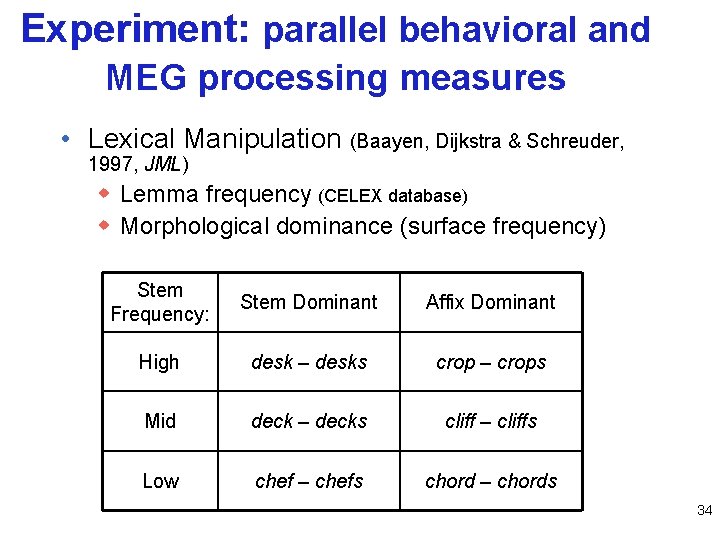
Experiment: parallel behavioral and MEG processing measures • Lexical Manipulation (Baayen, Dijkstra & Schreuder, 1997, JML) w Lemma frequency (CELEX database) w Morphological dominance (surface frequency) Stem Frequency: Stem Dominant Affix Dominant High desk – desks crop – crops Mid deck – decks cliff – cliffs Low chef – chefs chord – chords 34
Stimuli: 3 Lexical Categories • Nouns: singular/plural w bones • Verbs: stem/progressive w chopping • Adjectives: adjective/-ly adverb w clearly 35
Experiment: behavioral measures • Reliable effect of stem frequency in RT 36
Experiment: behavioral measures • Interacting effects on RT of affixation (base vs. affixed) and dominance (base-dominant vs. affix-dominant 37
Analysis of M 350 peak latency • Reliable effect of Stem frequency for unaffixed words and for affixed words Unaffixed Words Affixed Words 38
Analysis of M 350 peak latency • Reliable effect of Affixation (base vs. affixed) 39
Analysis of M 350 peak latency • No effect of Dominance (base-dominant vs. affixdominant) on M 350 peak latency 40
Analysis of M 350 peak latency • No interaction between Dominance (base-dominant vs. affixdominant) and Affixation (base vs. affixed) Cumulative Response Time M 350 peak latency 41
Analysis of M 350 peak latency • Evidence that early stages of access for affixed words is based on full parsing: Whole word frequency affects post-access stages. 42
Problem with this Conclusion • No acknowledgement of the effects of dominance and/or surface frequency on parsing stage of decomposition • No acknowledgement of possible effects of finding affix on stem access 43
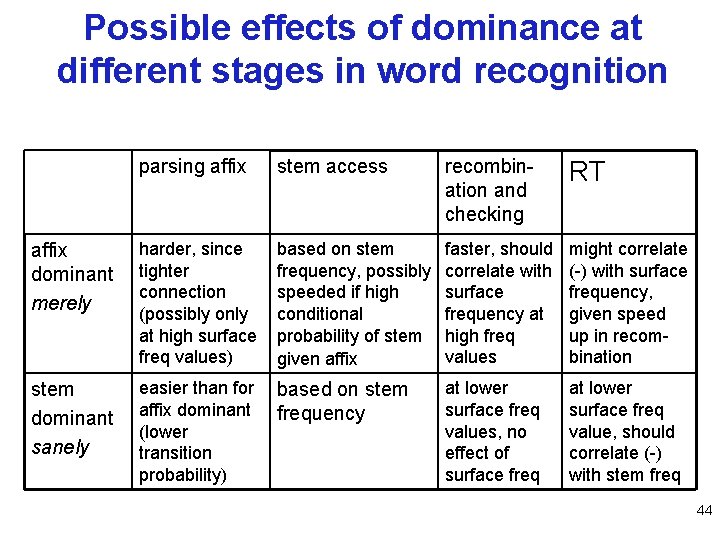
Possible effects of dominance at different stages in word recognition parsing affix stem access recombination and checking RT affix dominant merely harder, since tighter connection (possibly only at high surface freq values) based on stem frequency, possibly speeded if high conditional probability of stem given affix faster, should correlate with surface frequency at high freq values might correlate (-) with surface frequency, given speed up in recombination stem dominant sanely easier than for affix dominant (lower transition probability) based on stem frequency at lower surface freq values, no effect of surface freq at lower surface freq value, should correlate (-) with stem freq 44
• Let’s examine these effects with correlational analysis • [For affixed words, dominance and surface frequency are correlated in these materials, perhaps unfortunately for our purposes] 45
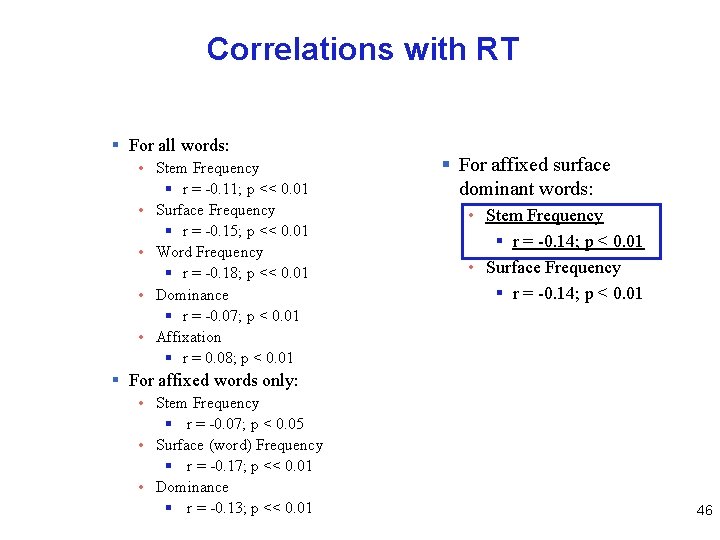
Correlations with RT § For all words: • Stem Frequency § r = -0. 11; p << 0. 01 • Surface Frequency § r = -0. 15; p << 0. 01 • Word Frequency § r = -0. 18; p << 0. 01 • Dominance § r = -0. 07; p < 0. 01 • Affixation § r = 0. 08; p < 0. 01 § For affixed surface dominant words: • Stem Frequency § r = -0. 14; p < 0. 01 • Surface Frequency § r = -0. 14; p < 0. 01 § For affixed words only: • Stem Frequency § r = -0. 07; p < 0. 05 • Surface (word) Frequency § r = -0. 17; p << 0. 01 • Dominance § r = -0. 13; p << 0. 01 46
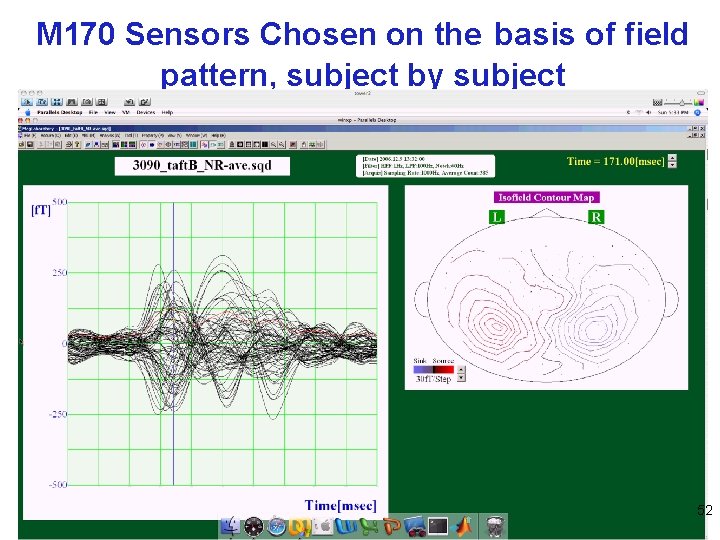
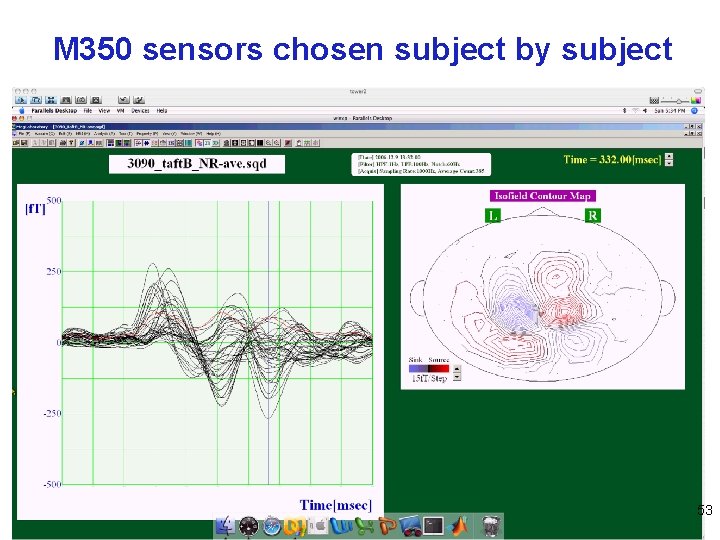
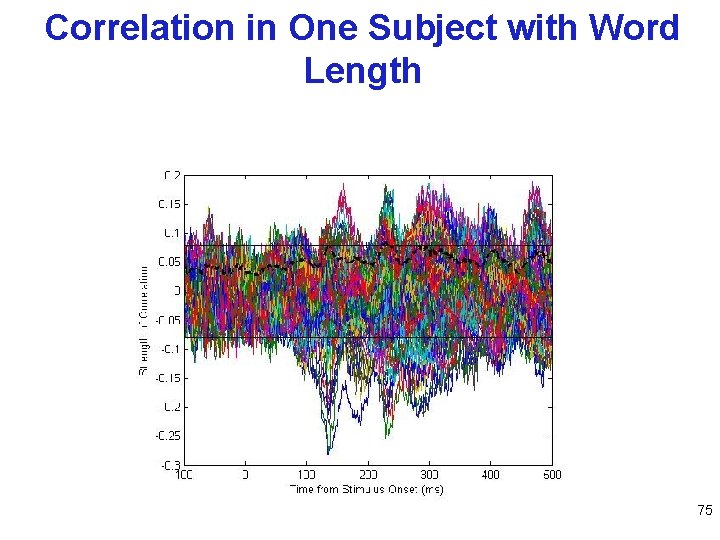
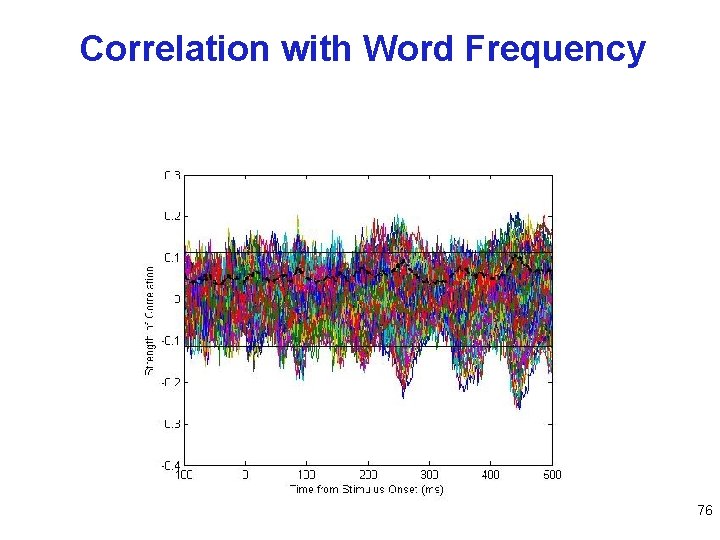
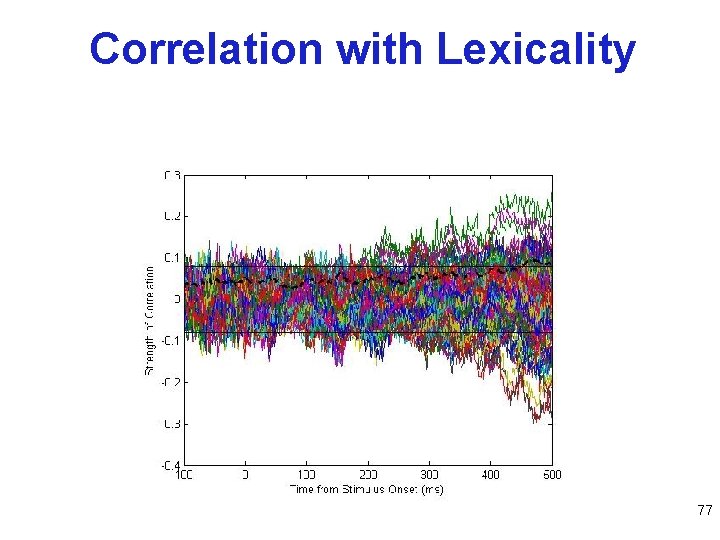
Correlational Analyses • Within a subject (or two): w for each sensor, for each point in time, correlate measured magnetic field strength for each stimulus with the value of some stimulus variable (length, frequency, etc. ) 47
correlation with left vs. right hemifield presentation 48
150 ms 49
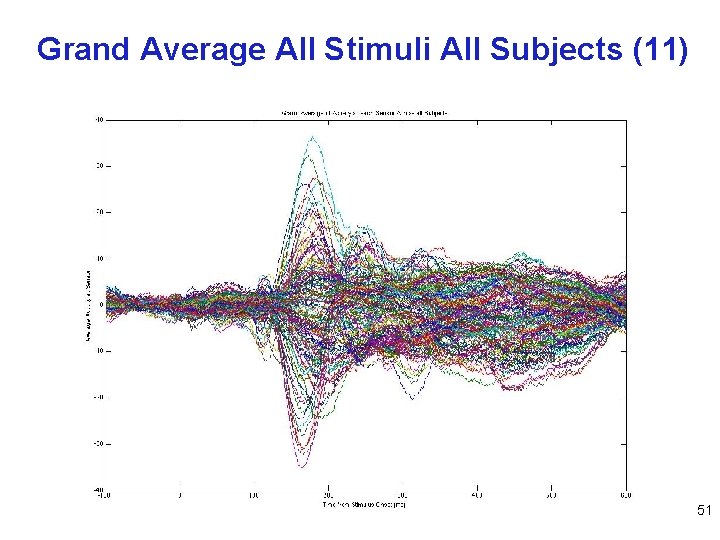
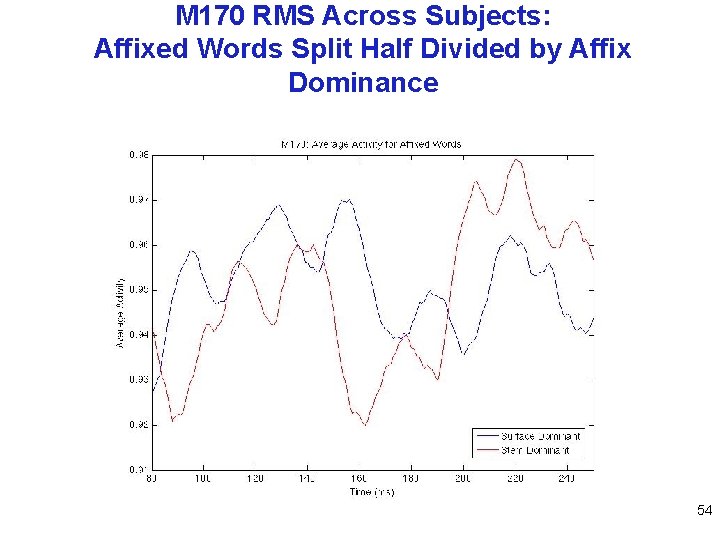
RMS Correlations Across Subjects • For some set of sensors, calculate at each time point in each experimental “epoch” the root mean square (RMS) = the square root of the mean of the squares of the values at each sensor (after normalization of values) • So, for each subject, for each item, an RMS “wave” can be provided for the correlational analysis • At each time point, the RMS value for each stimulus is correlated with a stimulus variable 50
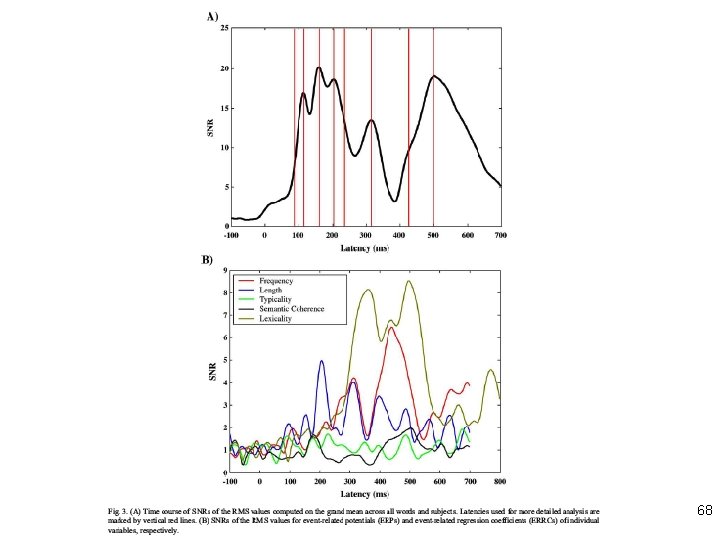
Grand Average All Stimuli All Subjects (11) 51
M 170 Sensors Chosen on the basis of field pattern, subject by subject 52
M 350 sensors chosen subject by subject 53
M 170 RMS Across Subjects: Affixed Words Split Half Divided by Affix Dominance 54
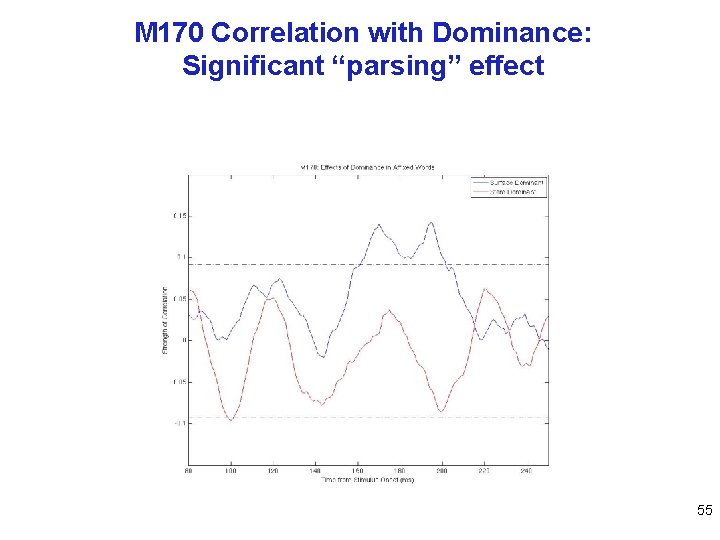
M 170 Correlation with Dominance: Significant “parsing” effect 55
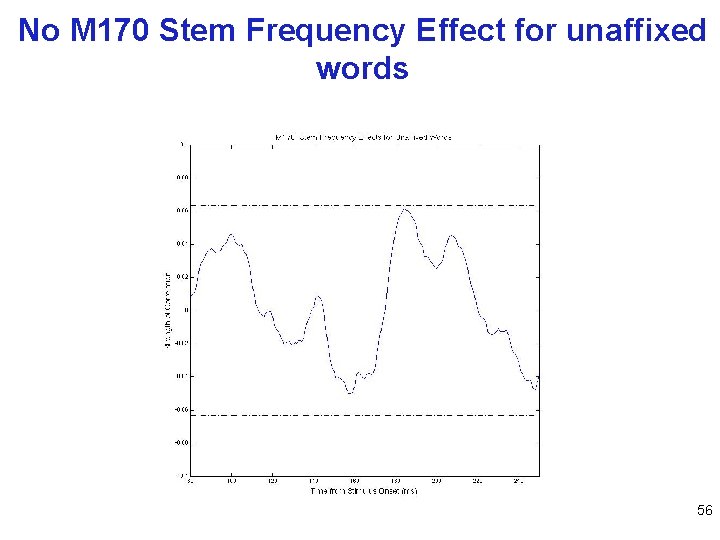
No M 170 Stem Frequency Effect for unaffixed words 56
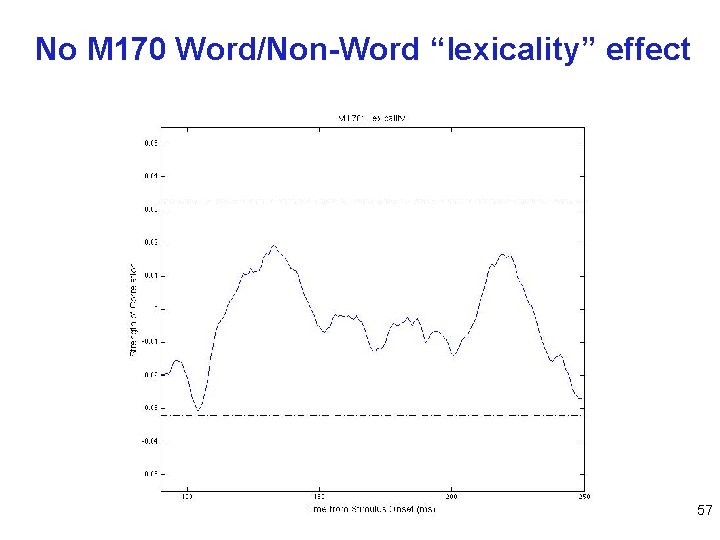
No M 170 Word/Non-Word “lexicality” effect 57
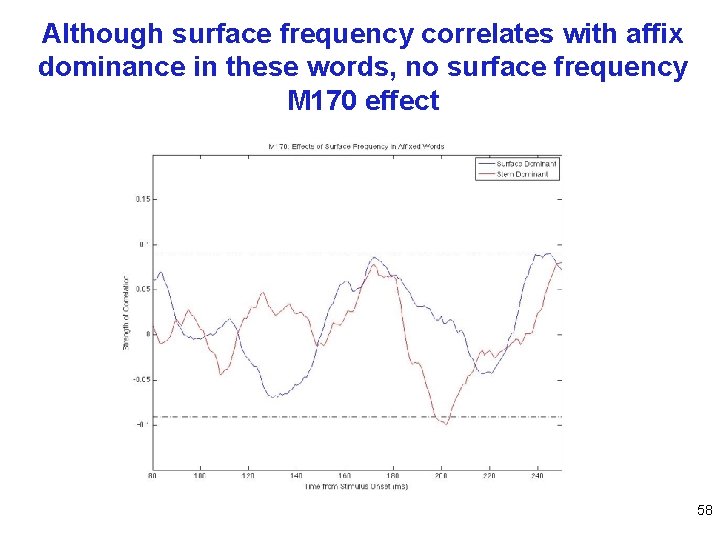
Although surface frequency correlates with affix dominance in these words, no surface frequency M 170 effect 58
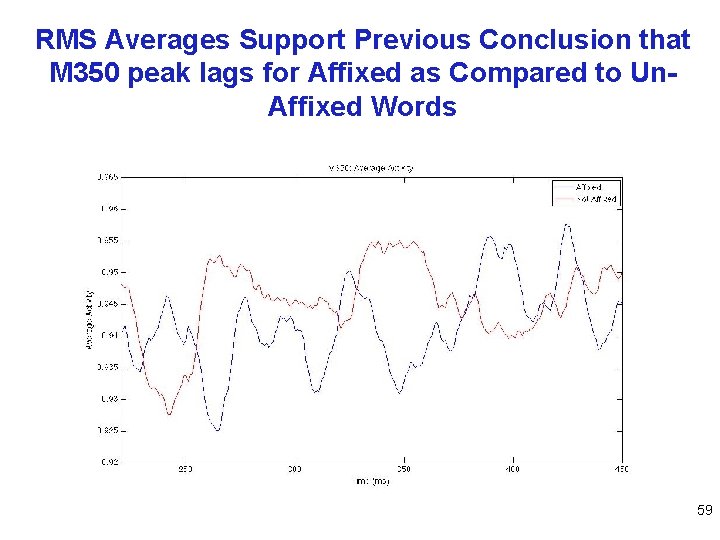
RMS Averages Support Previous Conclusion that M 350 peak lags for Affixed as Compared to Un. Affixed Words 59
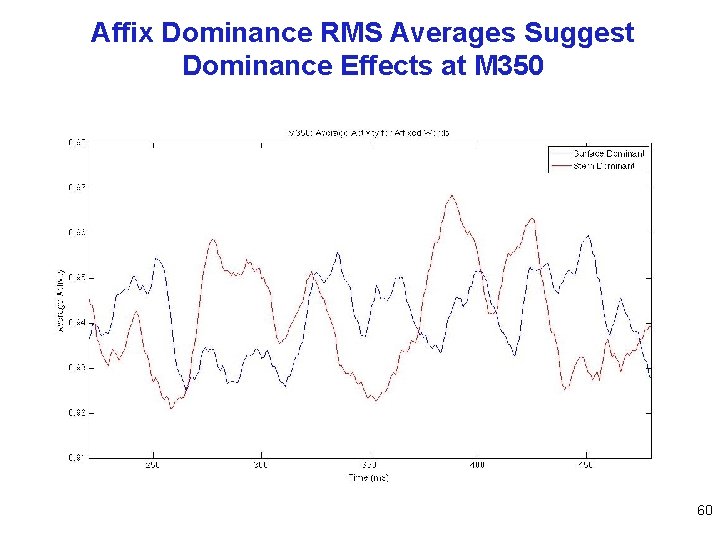
Affix Dominance RMS Averages Suggest Dominance Effects at M 350 60
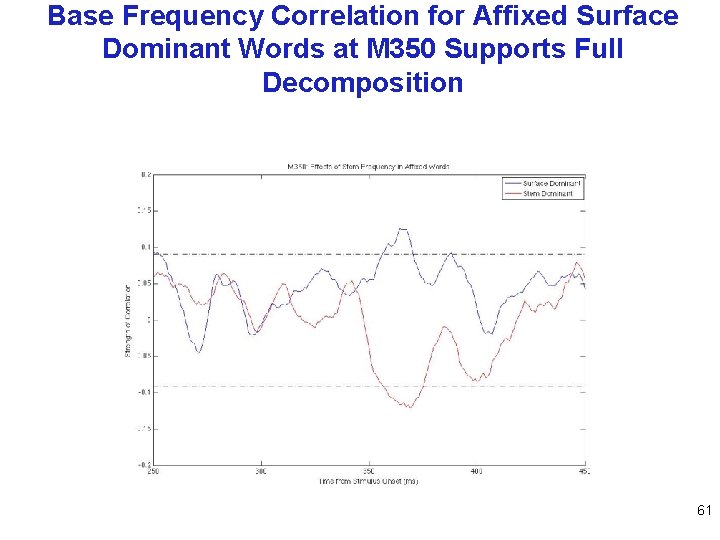
Base Frequency Correlation for Affixed Surface Dominant Words at M 350 Supports Full Decomposition 61
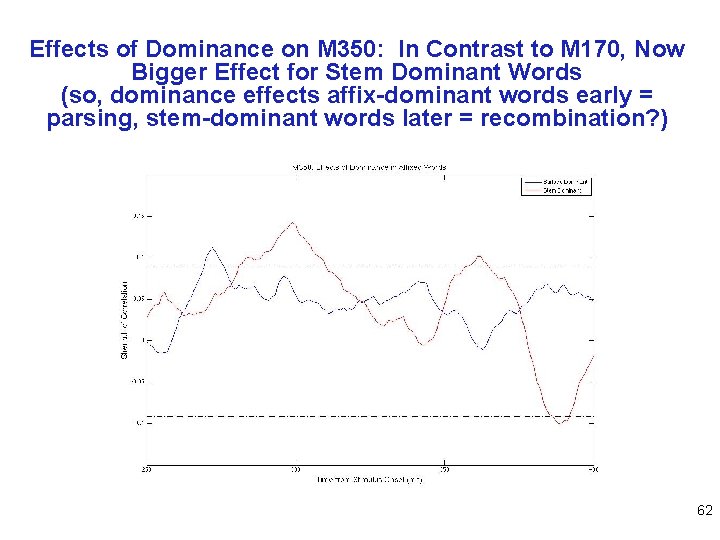
Effects of Dominance on M 350: In Contrast to M 170, Now Bigger Effect for Stem Dominant Words (so, dominance effects affix-dominant words early = parsing, stem-dominant words later = recombination? ) 62
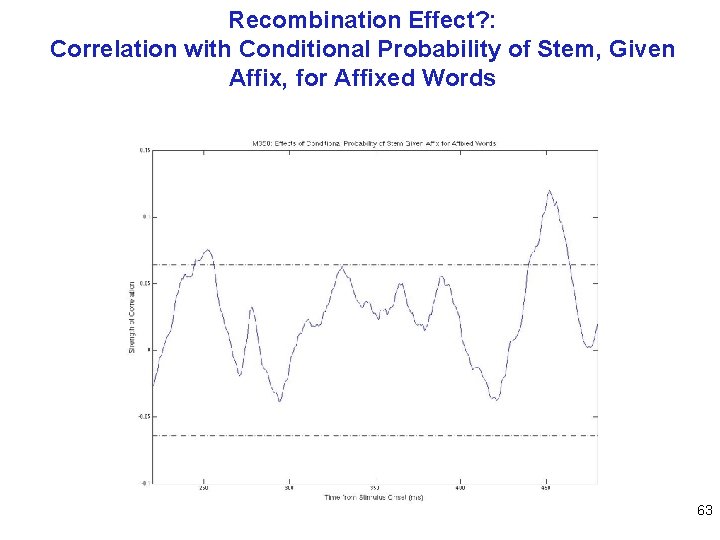
Recombination Effect? : Correlation with Conditional Probability of Stem, Given Affix, for Affixed Words 63
Evidence For Modality-Specific Access Lexicon? • At M 170, where there are large effects of dominance, it’s difficult to find word-form frequency effects or lexicality effects • However, does “parsing” at M 170 require access to “lexicalized” word forms (recall Zweig & Pylkkänen’s winter/farmer contrast) or to high-n n-grams or what? • Dominance effects at M 170 suggest frequency information associated with word-forms, as does winter/farmer contrast w dominance reflects the conditional probability of the affix given the stem 64
Sophisticated Interactive Dual-Route Models predict Whole Word. Form Effects • Note that there is no evidence from the current study (or any study I know of) that whole wordforms are available for complex words • To the contrary, complex words with high affix dominance – the very words that should have whole wordforms according to Hay – show the biggest effect of complexity at the M 170, where wordform effects are expected (i. e. , these don’t act like simplex wordforms) 65
66
67
68
word length; 2 subjects combined 69
70
Localization of M 100 from averaged data 71
one subject, with orthographic neighborhood size 72
73
f. MRI data, same experiment, same variable 74
Correlation in One Subject with Word Length 75
Correlation with Word Frequency 76
Correlation with Lexicality 77
if there were a modality specific word form lexicon… • Since word-form access lexicon effects would be expected at the M 170, given the nature of the morphological complexity results for the M 170, the whole-word form hypothesis would predict: w if word-form frequency effects are at all visible for unaffixed words at the M 170, there should be wordform frequency effects at the M 170 for complex forms once effects of parsing are regressed away 78
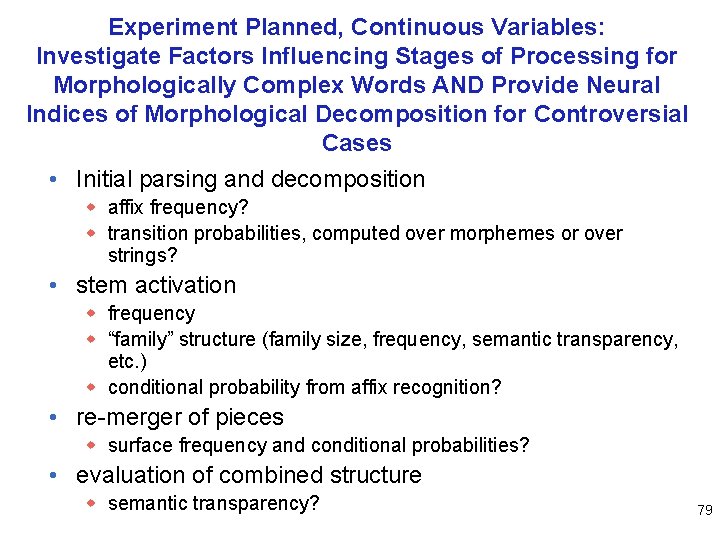
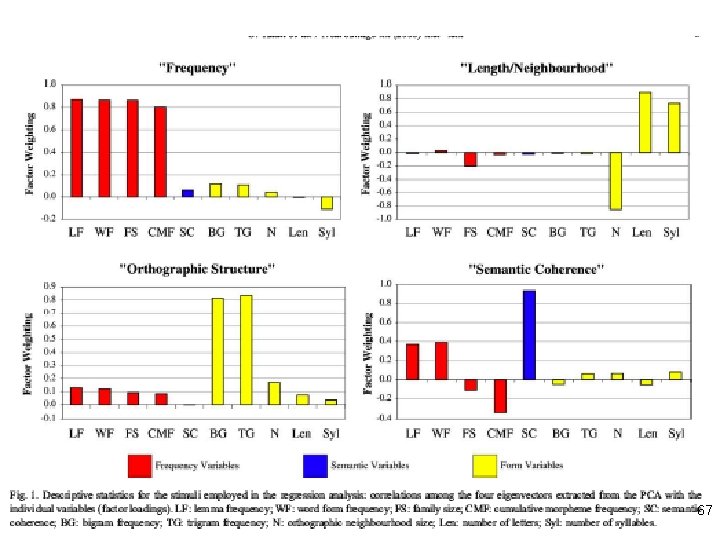
Experiment Planned, Continuous Variables: Investigate Factors Influencing Stages of Processing for Morphologically Complex Words AND Provide Neural Indices of Morphological Decomposition for Controversial Cases • Initial parsing and decomposition w affix frequency? w transition probabilities, computed over morphemes or over strings? • stem activation w frequency w “family” structure (family size, frequency, semantic transparency, etc. ) w conditional probability from affix recognition? • re-merger of pieces w surface frequency and conditional probabilities? • evaluation of combined structure w semantic transparency? 79
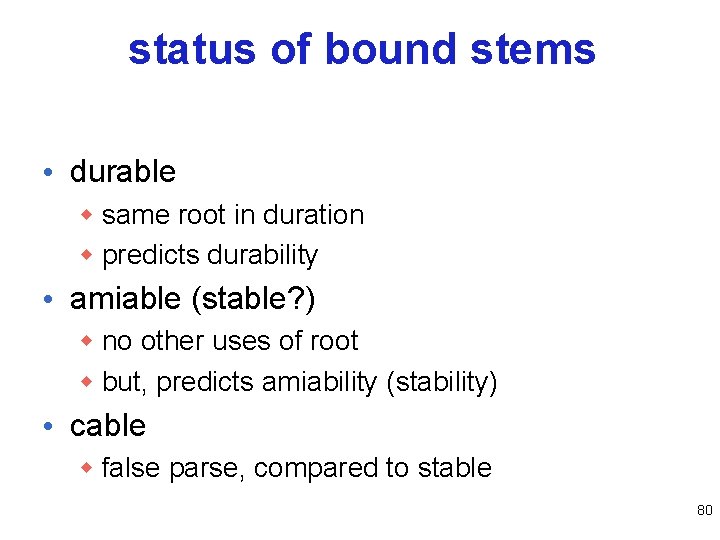
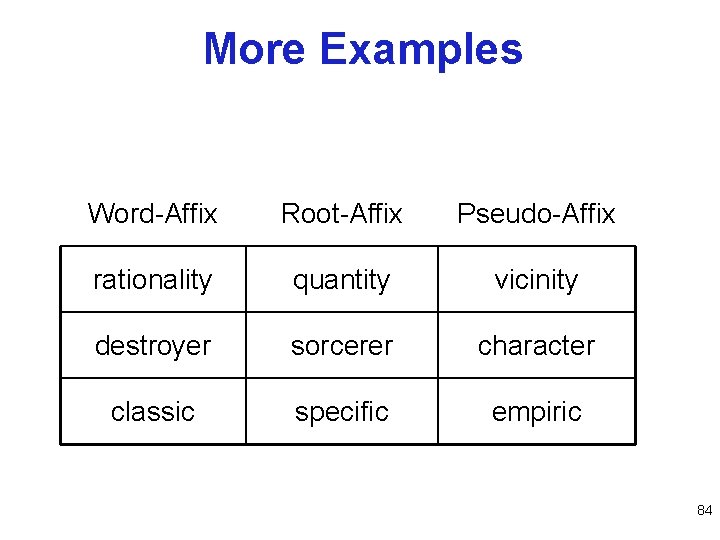
status of bound stems • durable w same root in duration w predicts durability • amiable (stable? ) w no other uses of root w but, predicts amiability (stability) • cable w false parse, compared to stable 80
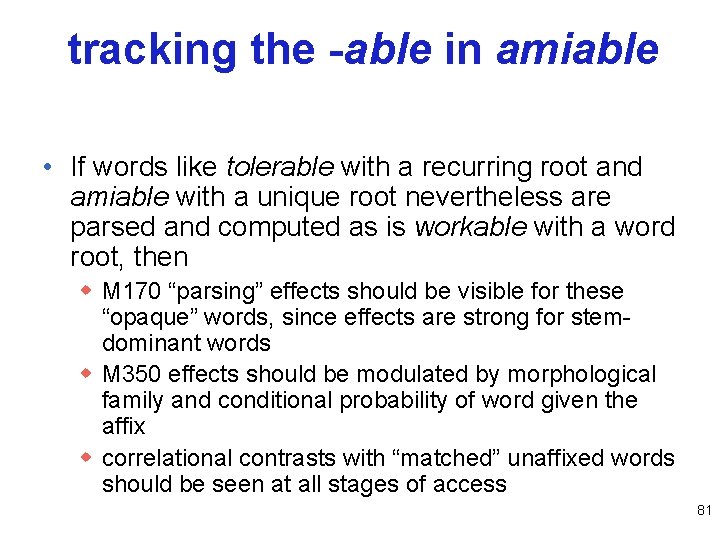
tracking the -able in amiable • If words like tolerable with a recurring root and amiable with a unique root nevertheless are parsed and computed as is workable with a word root, then w M 170 “parsing” effects should be visible for these “opaque” words, since effects are strong for stemdominant words w M 350 effects should be modulated by morphological family and conditional probability of word given the affix w correlational contrasts with “matched” unaffixed words should be seen at all stages of access 81
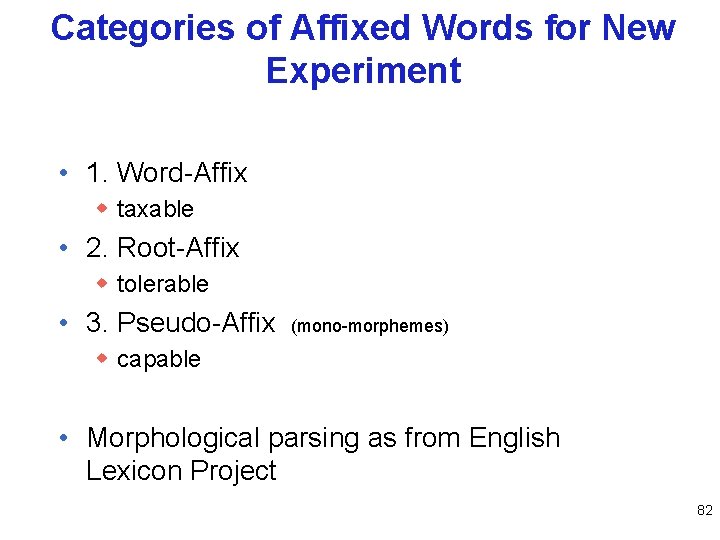
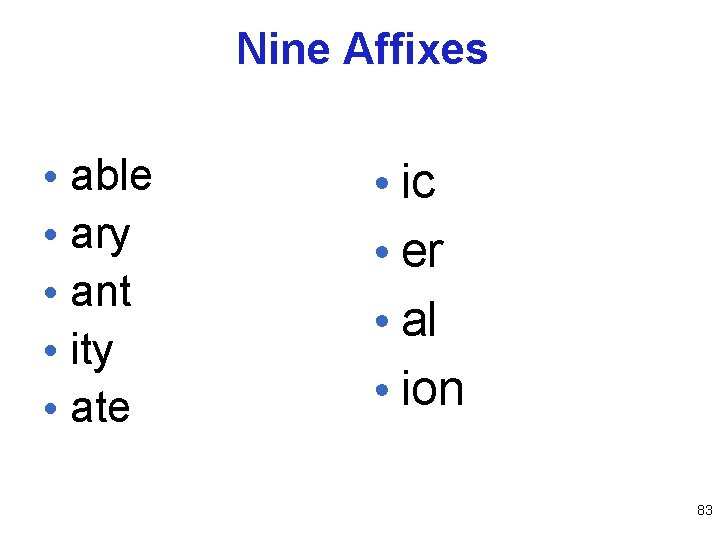
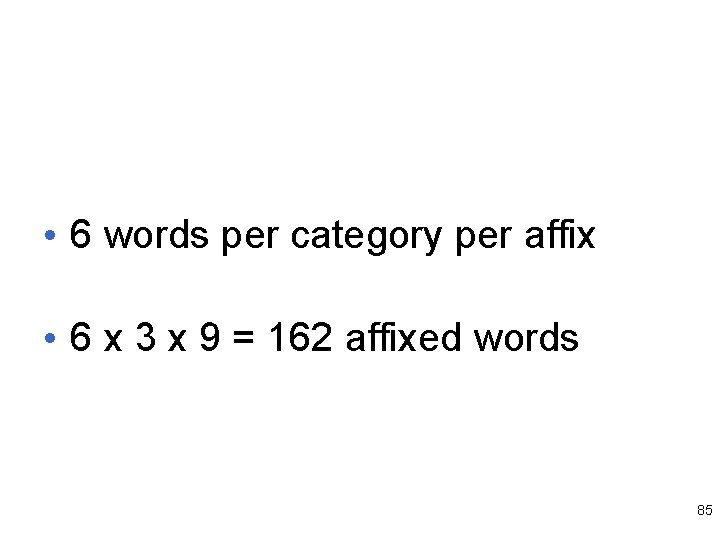
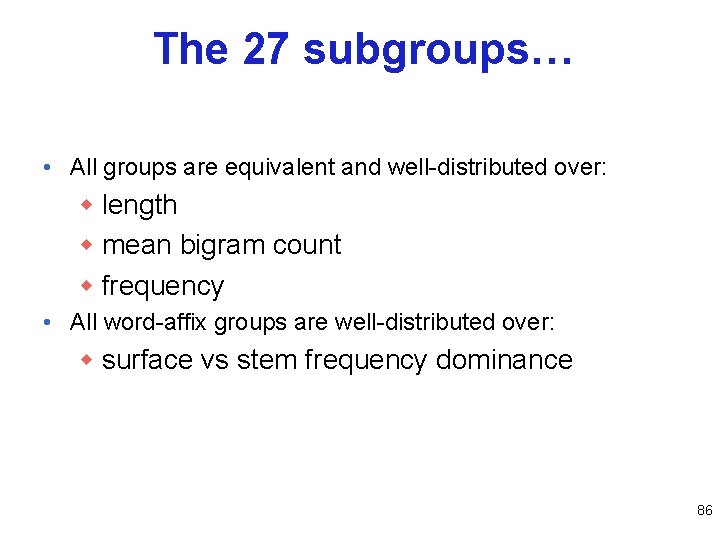
Categories of Affixed Words for New Experiment • 1. Word-Affix w taxable • 2. Root-Affix w tolerable • 3. Pseudo-Affix (mono-morphemes) w capable • Morphological parsing as from English Lexicon Project 82
Nine Affixes • able • ary • ant • ity • ate • ic • er • al • ion 83
More Examples Word-Affix Root-Affix Pseudo-Affix rationality quantity vicinity destroyer sorcerer character classic specific empiric 84
• 6 words per category per affix • 6 x 3 x 9 = 162 affixed words 85
The 27 subgroups… • All groups are equivalent and well-distributed over: w length w mean bigram count w frequency • All word-affix groups are well-distributed over: w surface vs stem frequency dominance 86
Length 87
Log Frequency 88
Mean Bigram Count 89
Matched Words • Matched on frequency of ending: w Calculated affix frequencies from CELEX database w For each affix, found a list of mono-morphemes with roughly the same ending frequency. (log frequency of +/- 0. 3 from affix log frequency) w Chose 18 matched words for each affix that had same parameter distributions as affixed words. 90
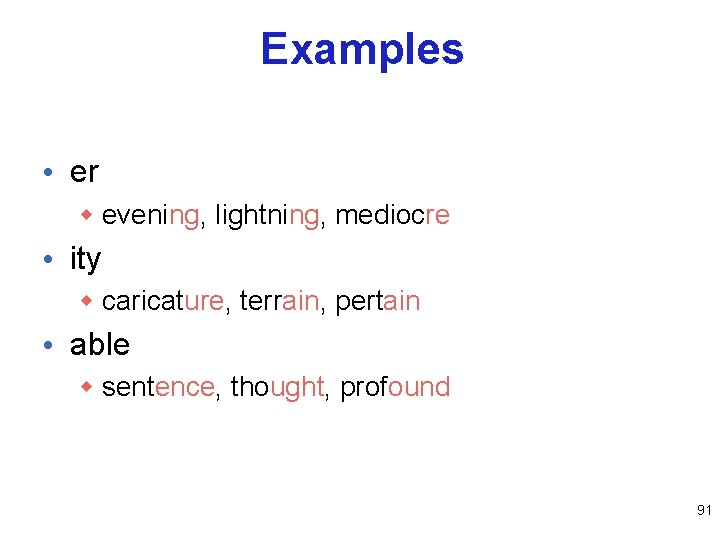
Examples • er w evening, lightning, mediocre • ity w caricature, terrain, pertain • able w sentence, thought, profound 91
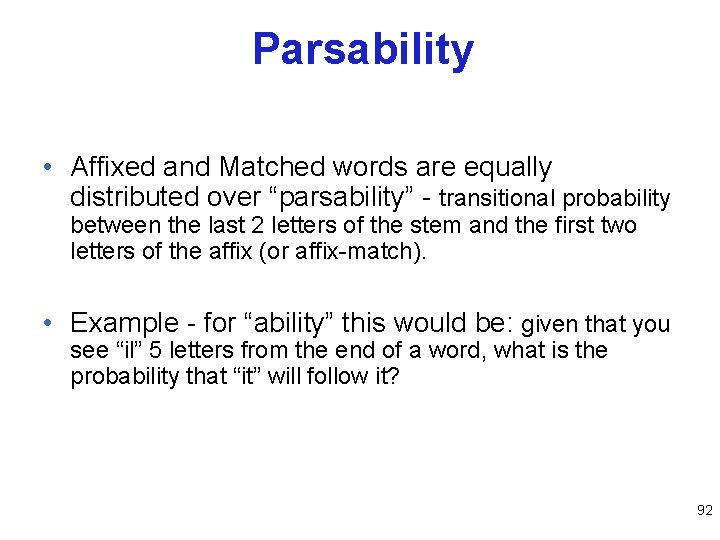
Parsability • Affixed and Matched words are equally distributed over “parsability” - transitional probability between the last 2 letters of the stem and the first two letters of the affix (or affix-match). • Example - for “ability” this would be: given that you see “il” 5 letters from the end of a word, what is the probability that “it” will follow it? 92
Non Words • 324 non-words chosen randomly to have the same distributions over length and mean bigram count as the words. • 648 total words and non-words 93
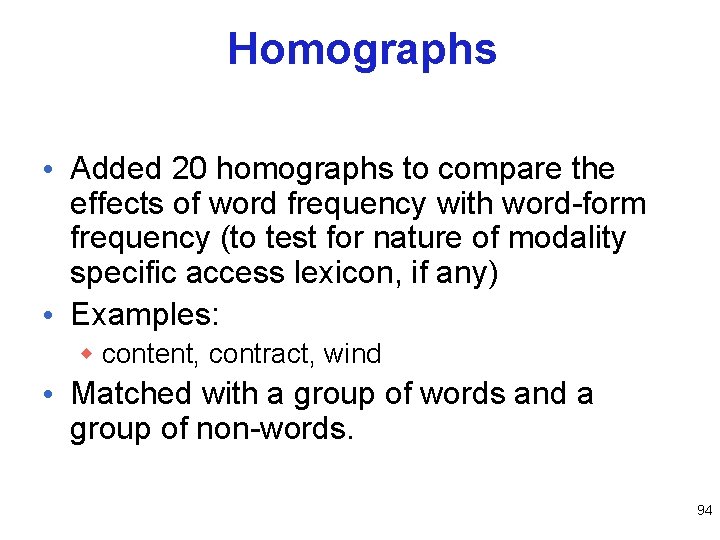
Homographs • Added 20 homographs to compare the effects of word frequency with word-form frequency (to test for nature of modality specific access lexicon, if any) • Examples: w content, contract, wind • Matched with a group of words and a group of non-words. 94
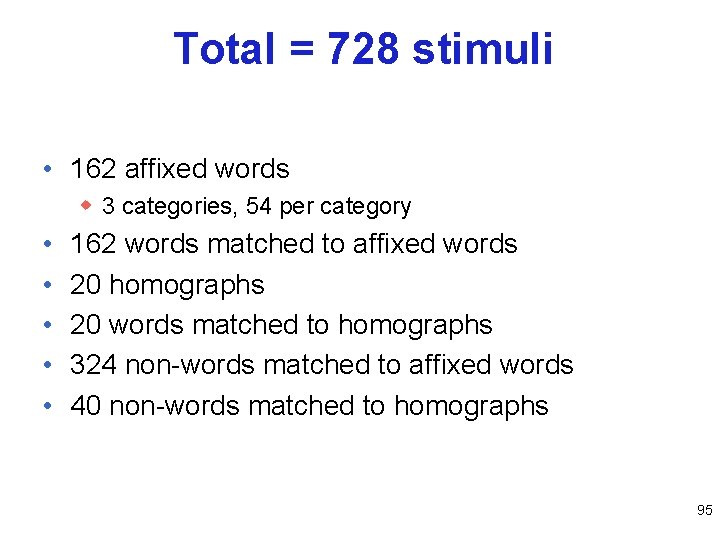
Total = 728 stimuli • 162 affixed words w 3 categories, 54 per category • • • 162 words matched to affixed words 20 homographs 20 words matched to homographs 324 non-words matched to affixed words 40 non-words matched to homographs 95
That’s all, fo. . (oh, you know the rest…) 96
- Slides: 96