
Tracking steelhead migration from the Columbia River through

Tracking steelhead migration from the Columbia River through the Pacific Ocean: a proposal Michelle Rub and Laurie Weitkamp NOAA Fisheries Northwest Fisheries Science Center
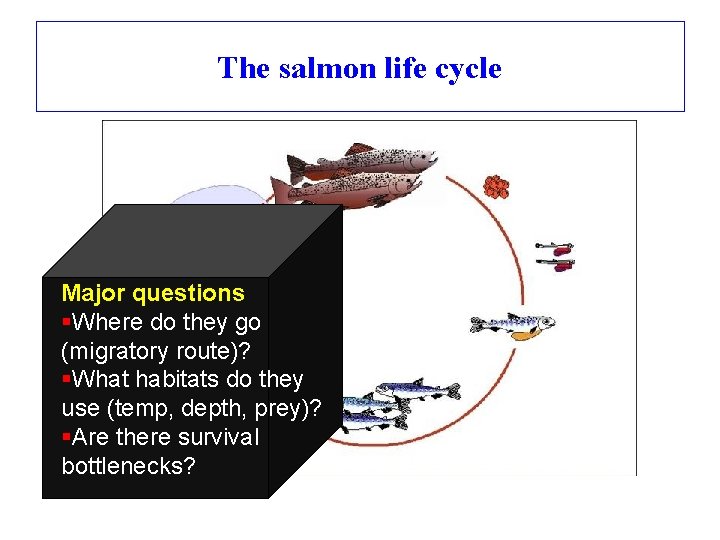
The salmon life cycle Major questions §Where do they go (migratory route)? §What habitats do they use (temp, depth, prey)? §Are there survival bottlenecks?
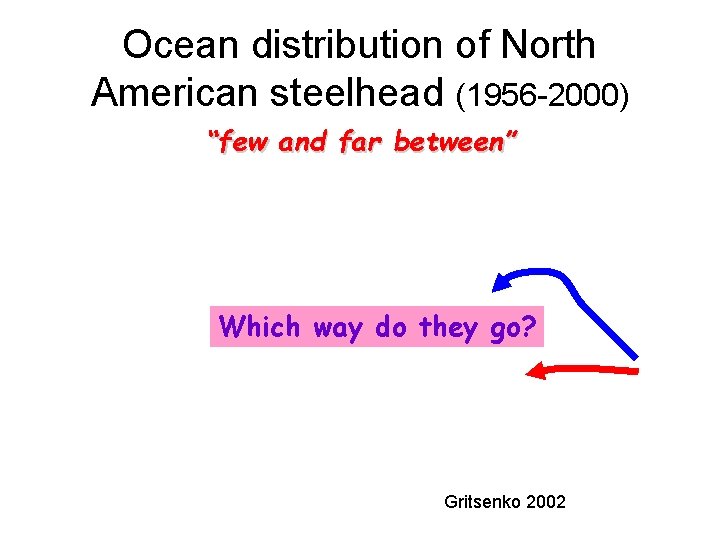
Ocean distribution of North American steelhead (1956 -2000) “few and far between” Which way do they go? Gritsenko 2002

Why we need to know more about Columbia steelhead ocean residence • Better understand how if or how ocean conditions influence growth and survival – Where and when does it happen? • Determine what “good” ocean conditions are for steelhead • Predict how they might fare with climate change – Changing productivity of California current – Explosion of Humboldt squid
Study Objectives • Determine feasibility of tagging Columbia River steelhead in estuary • Test three acoustic ‘detection systems’ in the North Pacific • Supplement ‘sporadic’ but precise information on geo-position with continuous information on temperature and depth ►Increase our understanding of ocean residence period for Columbia steelhead
Talk outline • Collecting Columbia steelhead – Existing sampling in Columbia estuary • Tagging technology – Acoustic, archival • Listening arrays – Coastal, oceanic, living • Expected results
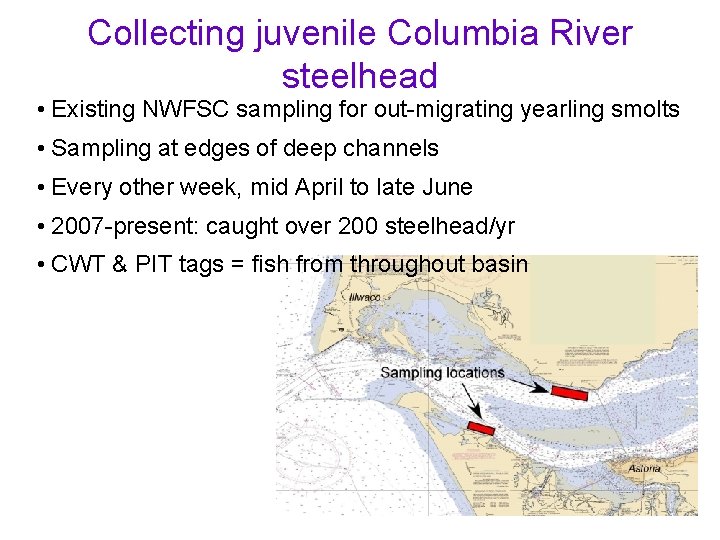
Collecting juvenile Columbia River steelhead • Existing NWFSC sampling for out-migrating yearling smolts • Sampling at edges of deep channels • Every other week, mid April to late June • 2007 -present: caught over 200 steelhead/yr • CWT & PIT tags = fish from throughout basin
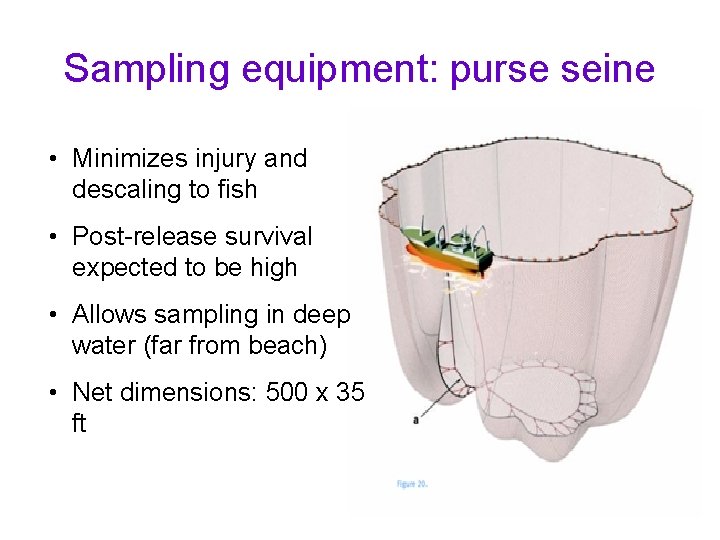
Sampling equipment: purse seine • Minimizes injury and descaling to fish • Post-release survival expected to be high • Allows sampling in deep water (far from beach) • Net dimensions: 500 x 35 ft
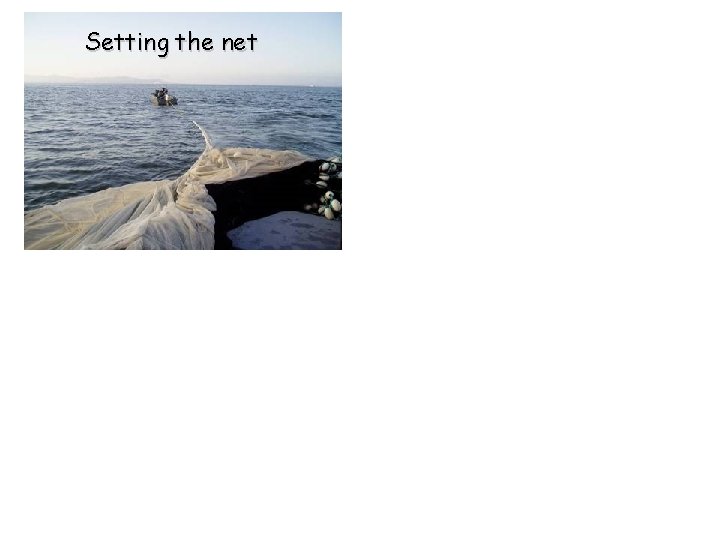
Setting the net Pursed net Pulling it on deck Fish in the bunt
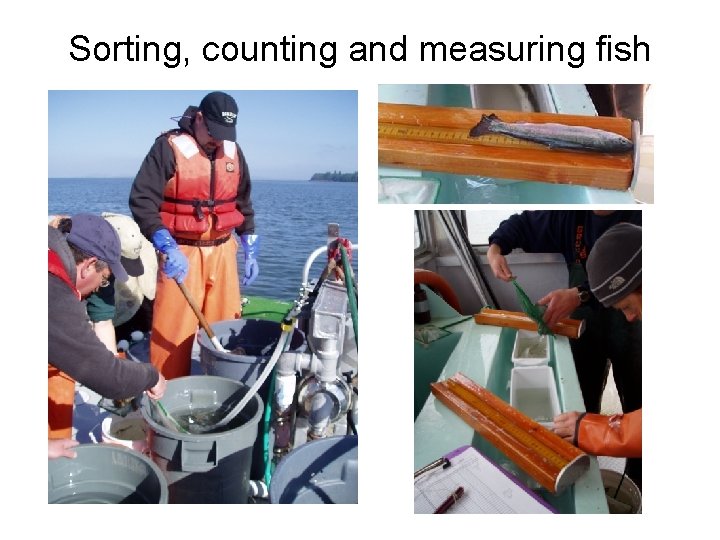
Sorting, counting and measuring fish
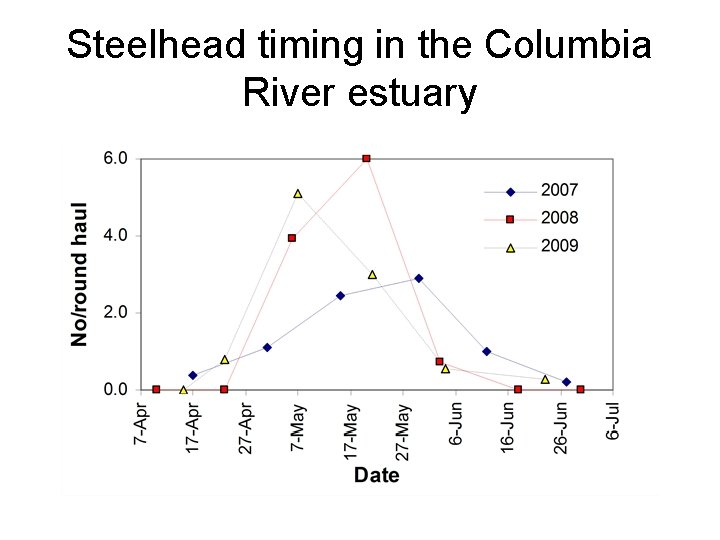
Steelhead timing in the Columbia River estuary
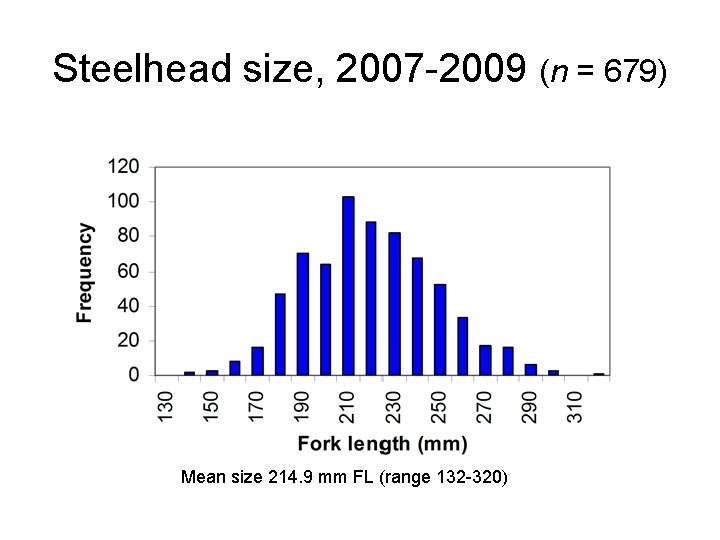
Steelhead size, 2007 -2009 (n = 679) Mean size 214. 9 mm FL (range 132 -320)
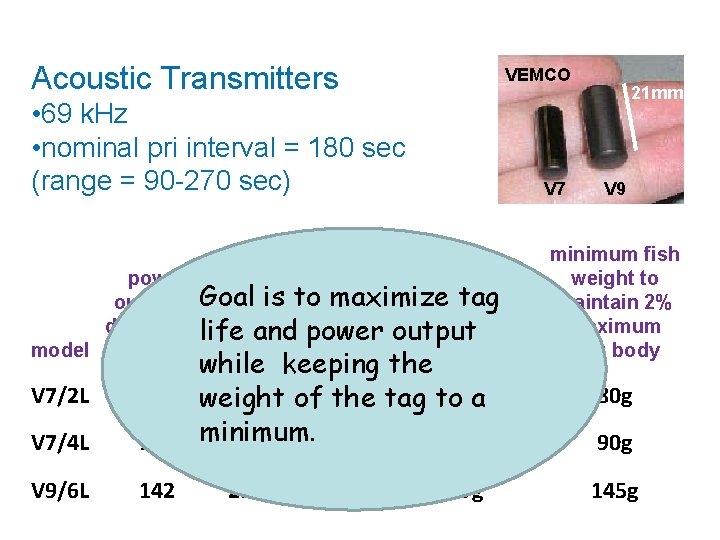
Acoustic Transmitters VEMCO • 69 k. Hz • nominal pri interval = 180 sec (range = 90 -270 sec) V 7 power output in. Goal is to maximize tag d. B re 1µPalife and power output model @1 m tag life diameter weight in air V 7/4 L while keeping the 136 weight 230 d of 7 mm 1. 6 ga the tag to 136 minimum. 337 d 7 mm 1. 8 g V 9/6 L 142 V 7/2 L 275 d 9 mm 2. 9 g 21 mm V 9 minimum fish weight to maintain 2% maximum tag: body 80 g 90 g 145 g
Advantages of acoustic transmitters for this study • can be used to collect precise geopositional information • information transferred to receiver for collection Disadvantages of acoustic transmitters • long-lived tags are large/heavy • expensive (~$275 each) • must be ‘heard’
In 2010, there will be three different types of ‘receivers’ operating in the Northern Pacific Ocean with the capability of hearing or detecting VEMCO acoustic tags. • SWFSC towed hydrophone array • The POST project acoustic receiver arrays • SWFSC elephant seal array *Extensive collection of acoustic receivers in the lower Columbia River and estuary
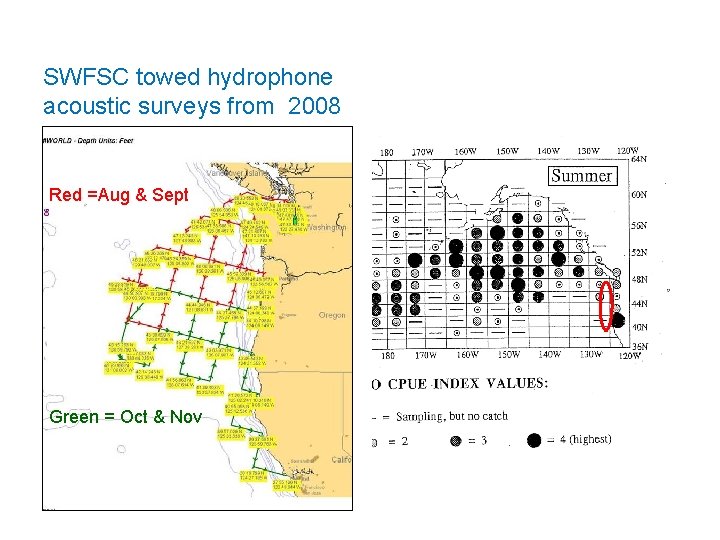
SWFSC towed hydrophone acoustic surveys from 2008 Red =Aug & Sept Green = Oct & Nov
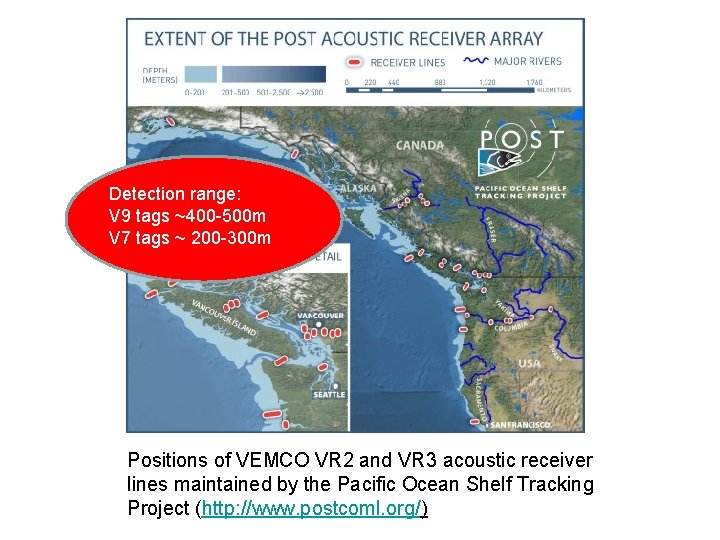
Detection range: V 9 tags ~400 -500 m V 7 tags ~ 200 -300 m Positions of VEMCO VR 2 and VR 3 acoustic receiver lines maintained by the Pacific Ocean Shelf Tracking Project (http: //www. postcoml. org/)
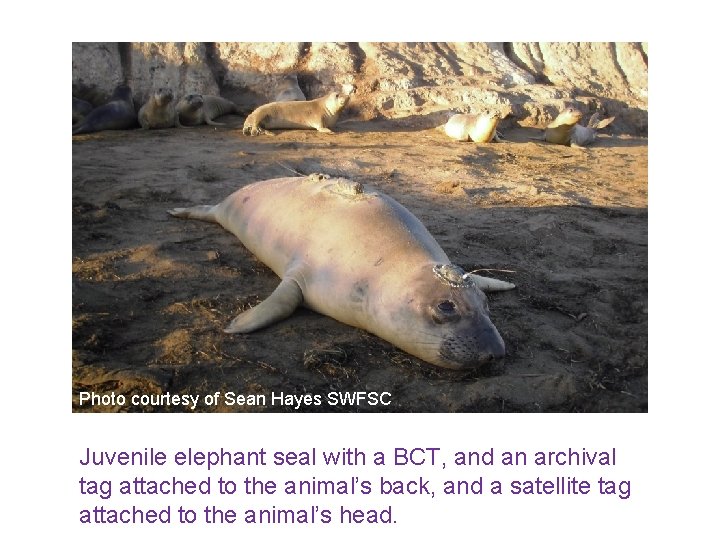
Photo courtesy of Sean Hayes SWFSC Juvenile elephant seal with a BCT, and an archival tag attached to the animal’s back, and a satellite tag attached to the animal’s head.
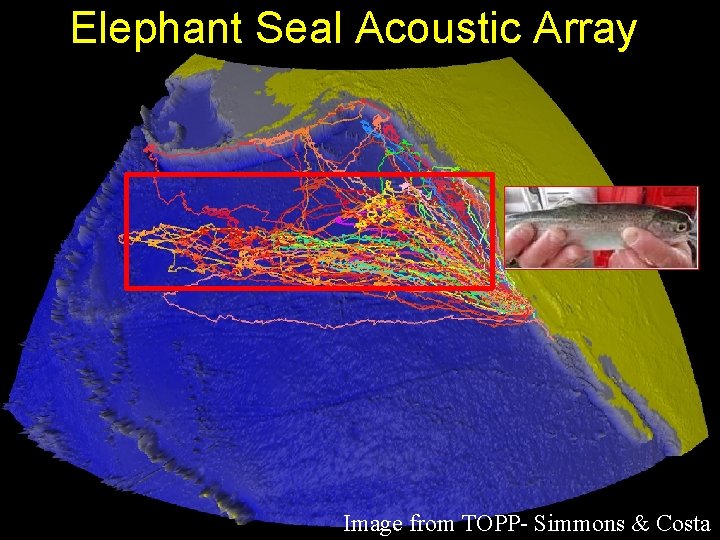
Elephant Seal Acoustic Array Image from TOPP- Simmons & Costa
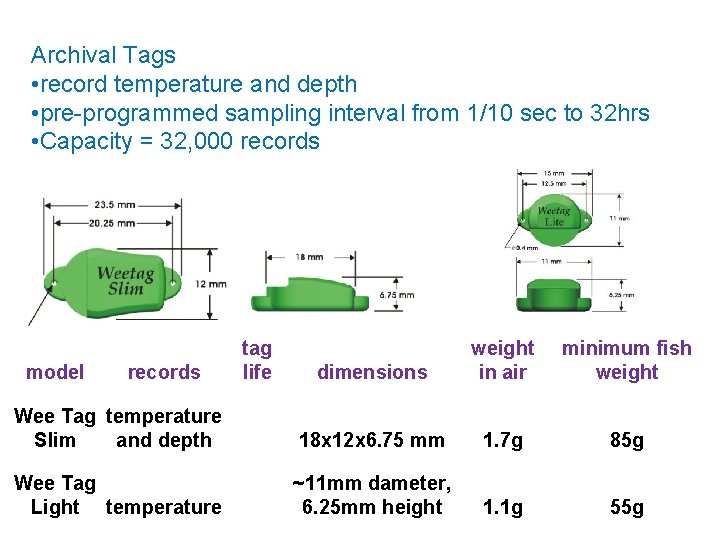
Archival Tags • record temperature and depth • pre-programmed sampling interval from 1/10 sec to 32 hrs • Capacity = 32, 000 records dimensions weight in air minimum fish weight Wee Tag temperature Slim and depth 18 x 12 x 6. 75 mm 1. 7 g 85 g Wee Tag Light temperature ~11 mm dameter, 6. 25 mm height 1. 1 g 55 g model records tag life
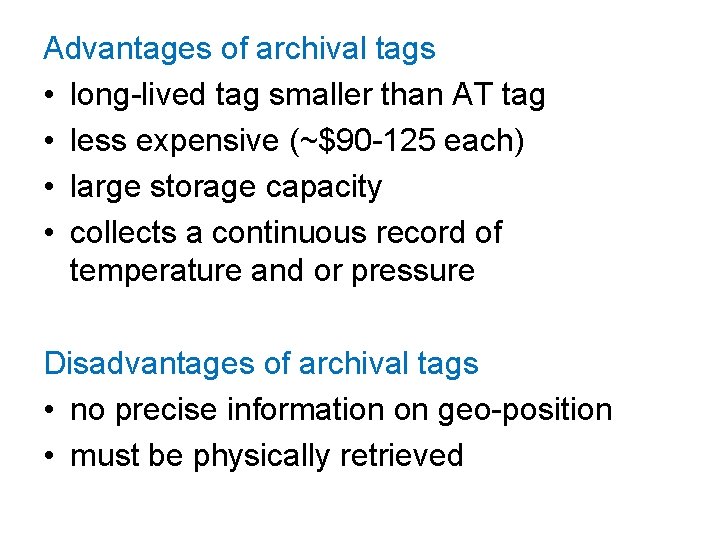
Advantages of archival tags • long-lived tag smaller than AT tag • less expensive (~$90 -125 each) • large storage capacity • collects a continuous record of temperature and or pressure Disadvantages of archival tags • no precise information on geo-position • must be physically retrieved
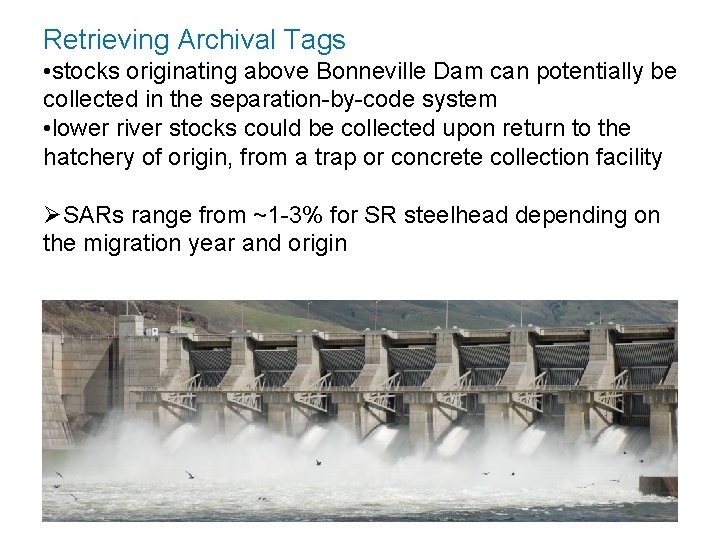
Retrieving Archival Tags • stocks originating above Bonneville Dam can potentially be collected in the separation-by-code system • lower river stocks could be collected upon return to the hatchery of origin, from a trap or concrete collection facility ØSARs range from ~1 -3% for SR steelhead depending on the migration year and origin
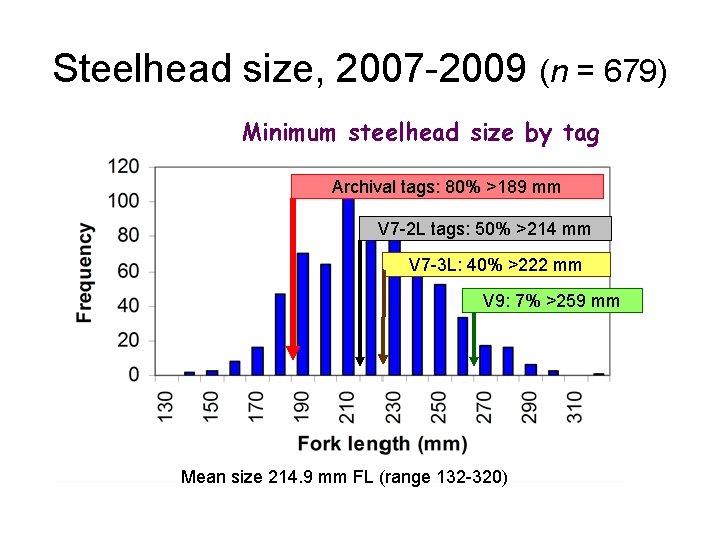
Steelhead size, 2007 -2009 (n = 679) Minimum steelhead size by tag Archival tags: 80% >189 mm V 7 -2 L tags: 50% >214 mm V 7 -3 L: 40% >222 mm V 9: 7% >259 mm Mean size 214. 9 mm FL (range 132 -320)
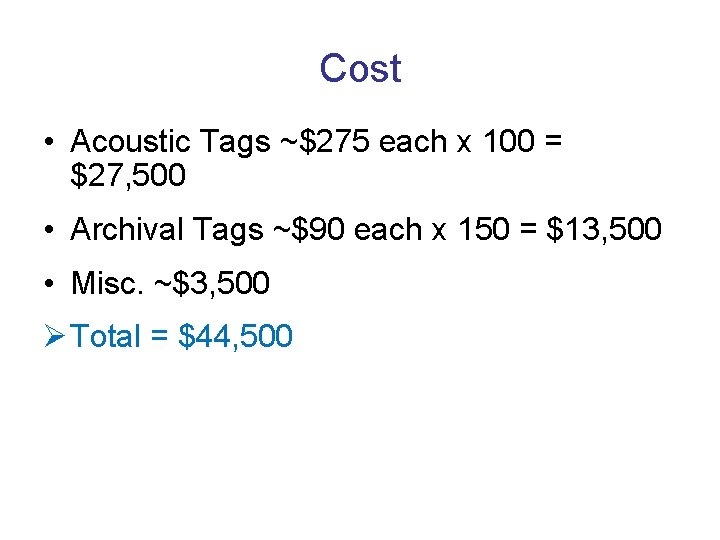
Cost • Acoustic Tags ~$275 each x 100 = $27, 500 • Archival Tags ~$90 each x 150 = $13, 500 • Misc. ~$3, 500 Ø Total = $44, 500
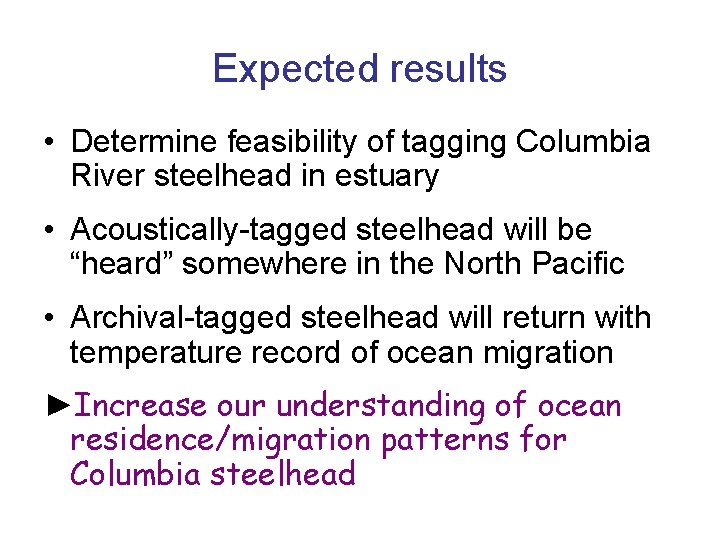
Expected results • Determine feasibility of tagging Columbia River steelhead in estuary • Acoustically-tagged steelhead will be “heard” somewhere in the North Pacific • Archival-tagged steelhead will return with temperature record of ocean migration ►Increase our understanding of ocean residence/migration patterns for Columbia steelhead
- Slides: 25