
Tracing the Halo Cosmic Web Connection Marius Cautun
Tracing the Halo – Cosmic Web Connection Marius Cautun Kapteyn Astronomical Institute Rien van de Weygaert, Wojciech Hellwing, Carlos Frenk, Bernard J. T. Jones September 6 th 2012 Cosmo. Comp 2012, Trieste
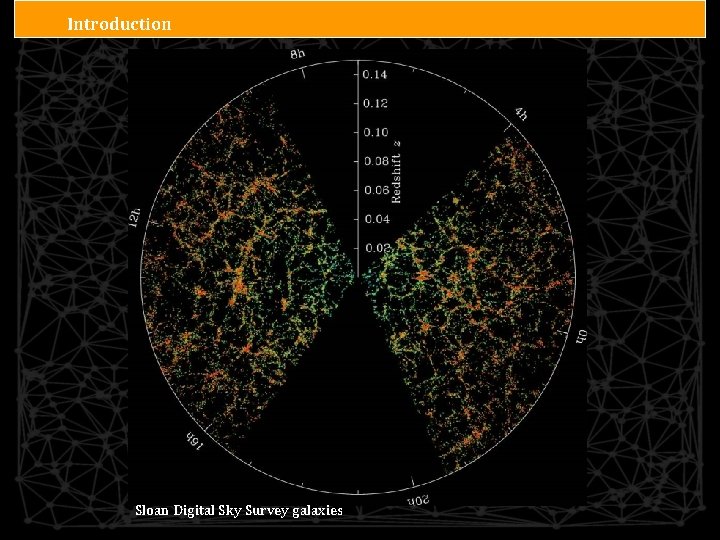
Introduction Sloan Digital Sky Survey galaxies
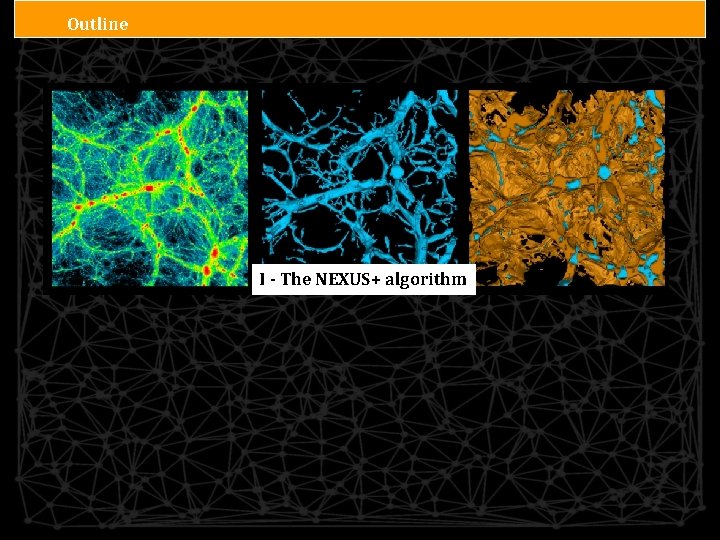
Outline I - The NEXUS+ algorithm
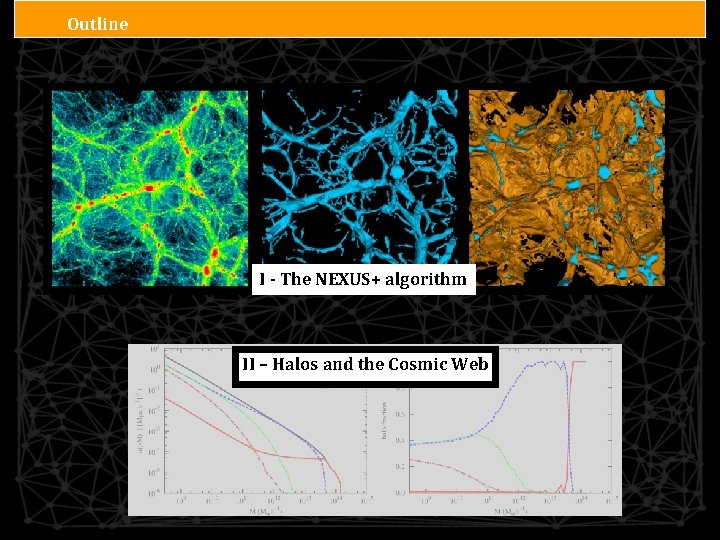
Outline I - The NEXUS+ algorithm II – Halos and the Cosmic Web
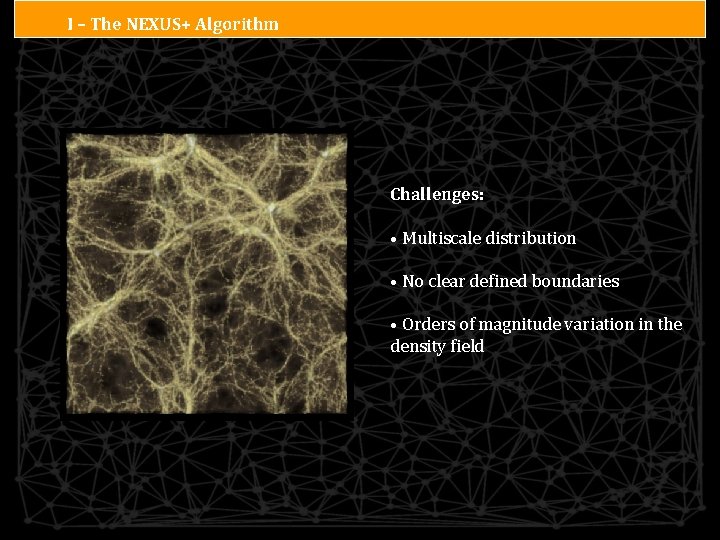
I – The NEXUS+ Algorithm Challenges: • Multiscale distribution • No clear defined boundaries • Orders of magnitude variation in the density field
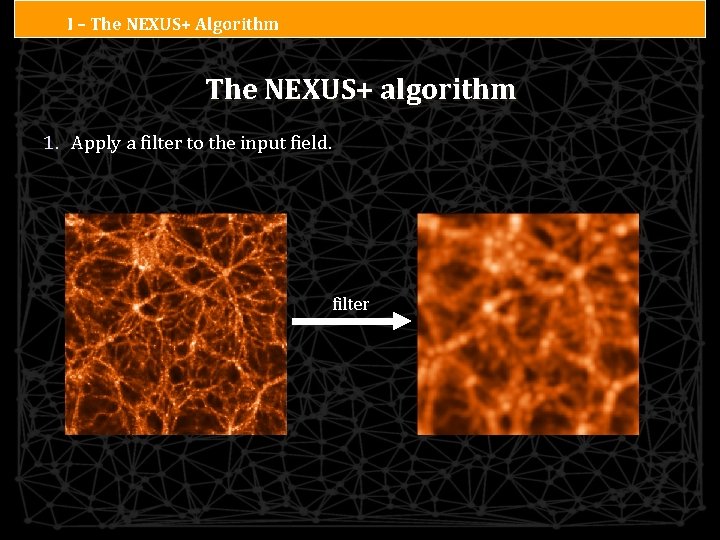
I – The NEXUS+ Algorithm The NEXUS+ algorithm 1. Apply a filter to the input field. filter
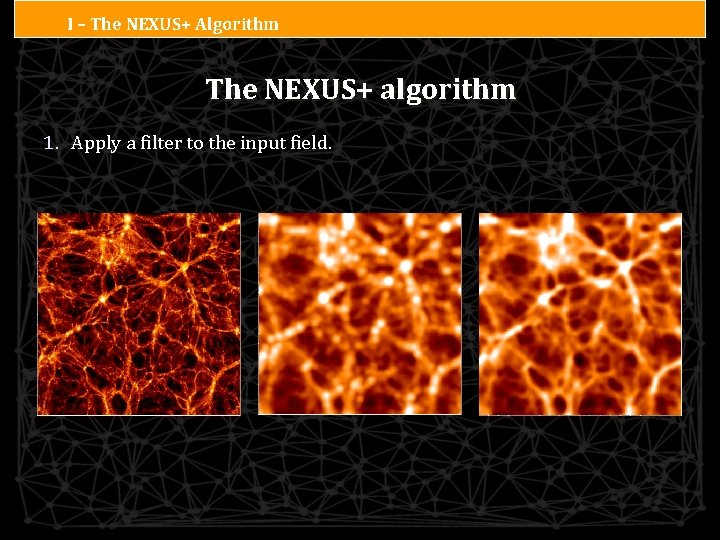
I – The NEXUS+ Algorithm The NEXUS+ algorithm 1. Apply a filter to the input field.
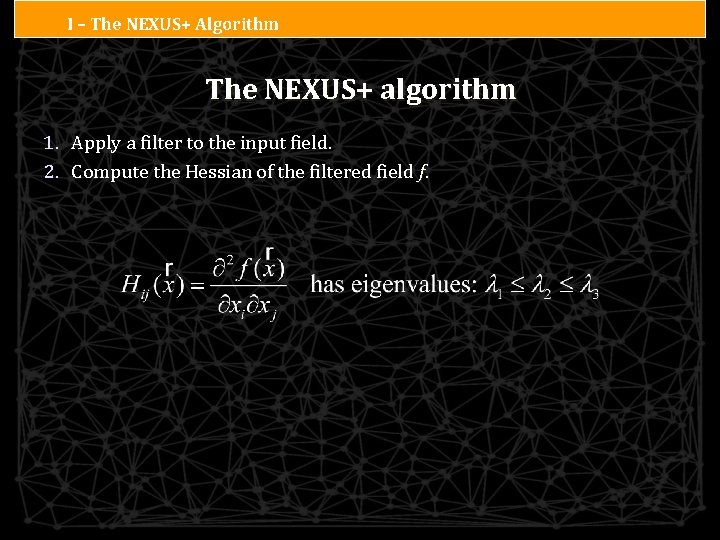
I – The NEXUS+ Algorithm The NEXUS+ algorithm 1. Apply a filter to the input field. 2. Compute the Hessian of the filtered field f.
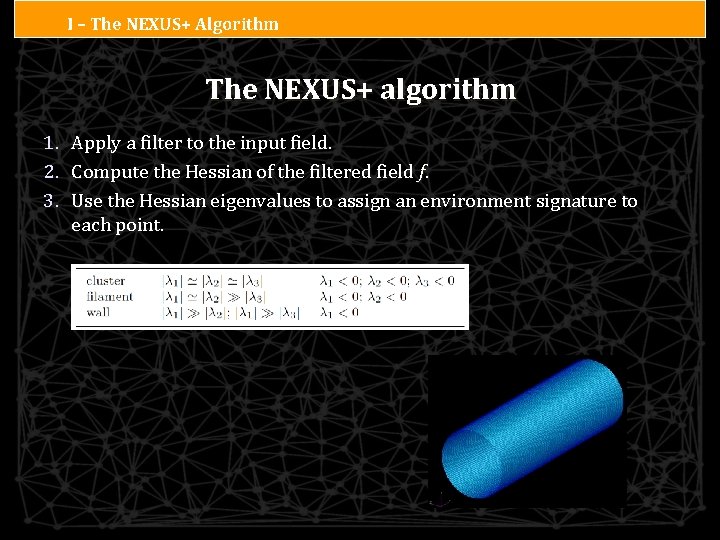
I – The NEXUS+ Algorithm The NEXUS+ algorithm 1. Apply a filter to the input field. 2. Compute the Hessian of the filtered field f. 3. Use the Hessian eigenvalues to assign an environment signature to each point.
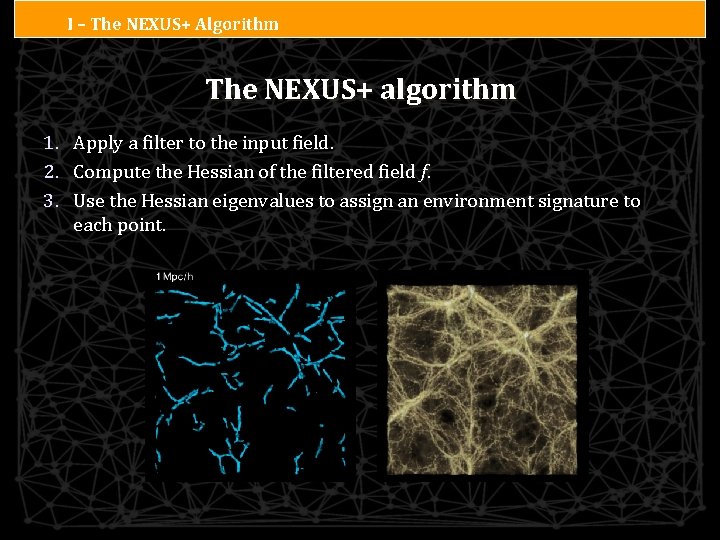
I – The NEXUS+ Algorithm The NEXUS+ algorithm 1. Apply a filter to the input field. 2. Compute the Hessian of the filtered field f. 3. Use the Hessian eigenvalues to assign an environment signature to each point.
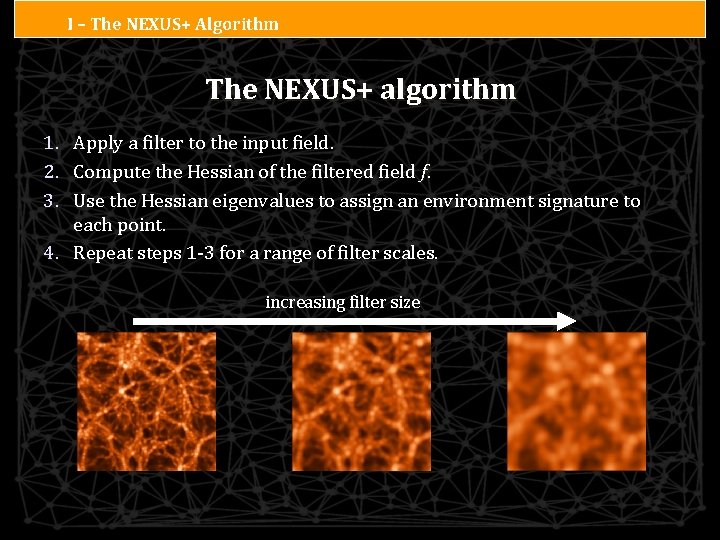
I – The NEXUS+ Algorithm The NEXUS+ algorithm 1. Apply a filter to the input field. 2. Compute the Hessian of the filtered field f. 3. Use the Hessian eigenvalues to assign an environment signature to each point. 4. Repeat steps 1 -3 for a range of filter scales. increasing filter size
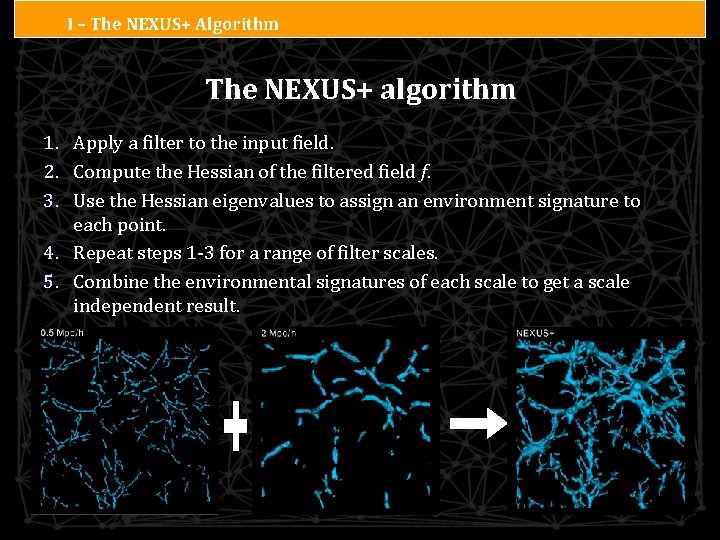
I – The NEXUS+ Algorithm The NEXUS+ algorithm 1. Apply a filter to the input field. 2. Compute the Hessian of the filtered field f. 3. Use the Hessian eigenvalues to assign an environment signature to each point. 4. Repeat steps 1 -3 for a range of filter scales. 5. Combine the environmental signatures of each scale to get a scale independent result.
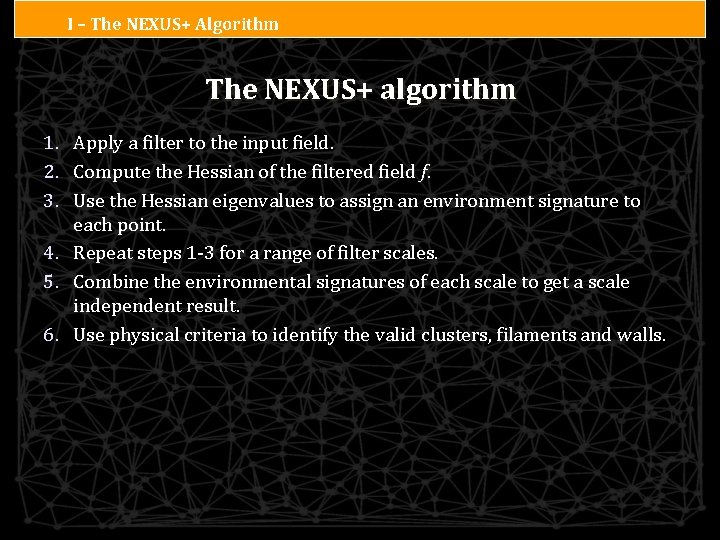
I – The NEXUS+ Algorithm The NEXUS+ algorithm 1. Apply a filter to the input field. 2. Compute the Hessian of the filtered field f. 3. Use the Hessian eigenvalues to assign an environment signature to each point. 4. Repeat steps 1 -3 for a range of filter scales. 5. Combine the environmental signatures of each scale to get a scale independent result. 6. Use physical criteria to identify the valid clusters, filaments and walls.
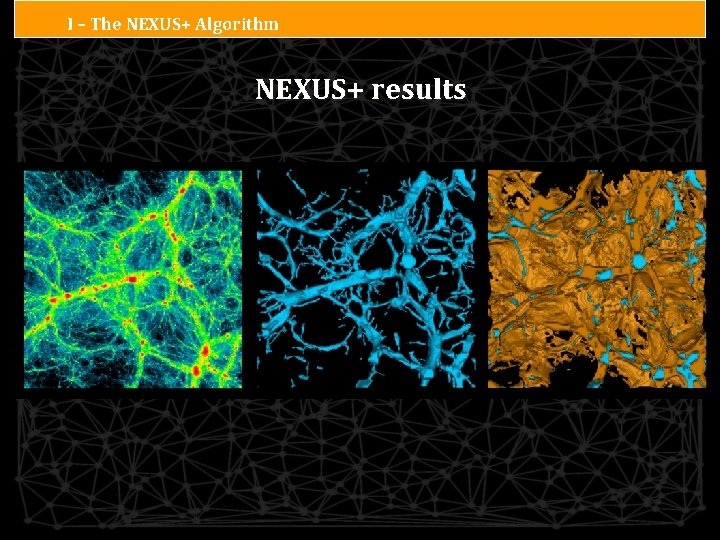
I – The NEXUS+ Algorithm NEXUS+ results
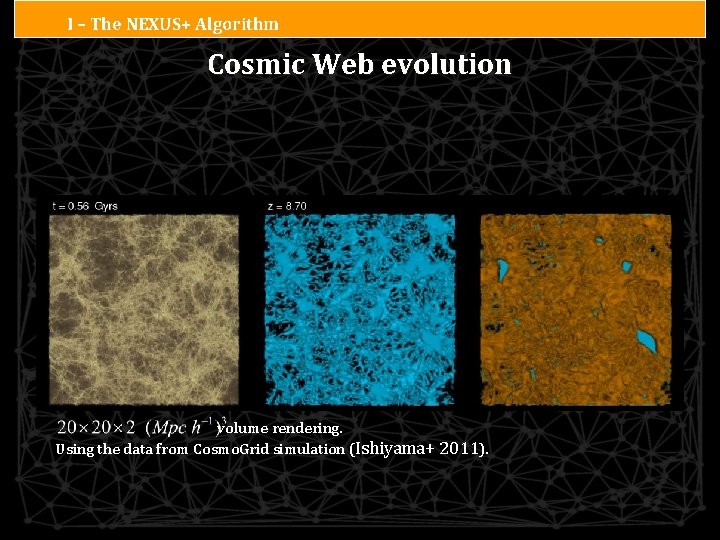
I – The NEXUS+ Algorithm Cosmic Web evolution volume rendering. Using the data from Cosmo. Grid simulation (Ishiyama+ 2011).
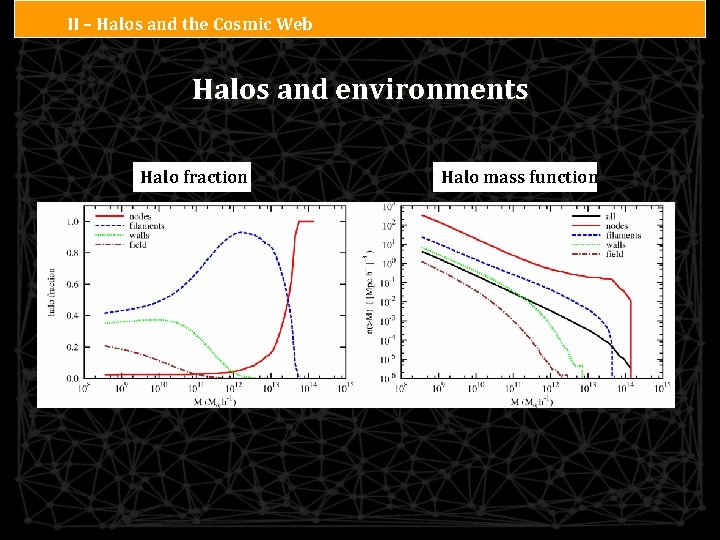
II – Halos and the Cosmic Web Halos and environments Halo fraction Halo mass function
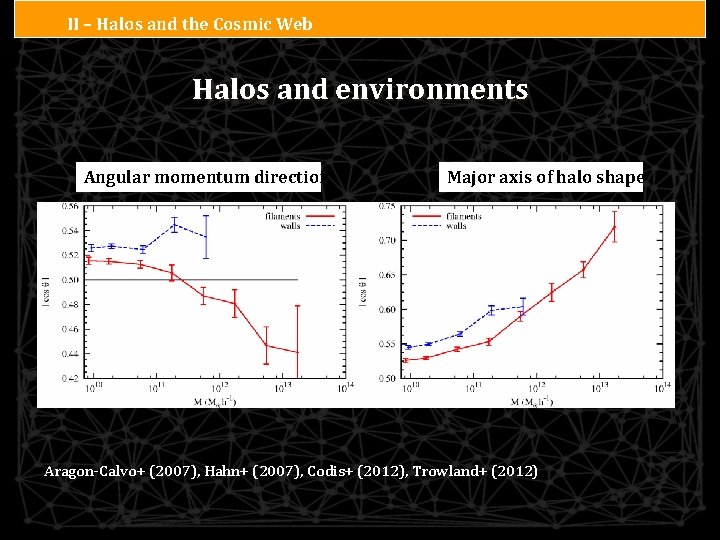
II – Halos and the Cosmic Web Halos and environments Angular momentum direction Major axis of halo shape Aragon-Calvo+ (2007), Hahn+ (2007), Codis+ (2012), Trowland+ (2012)
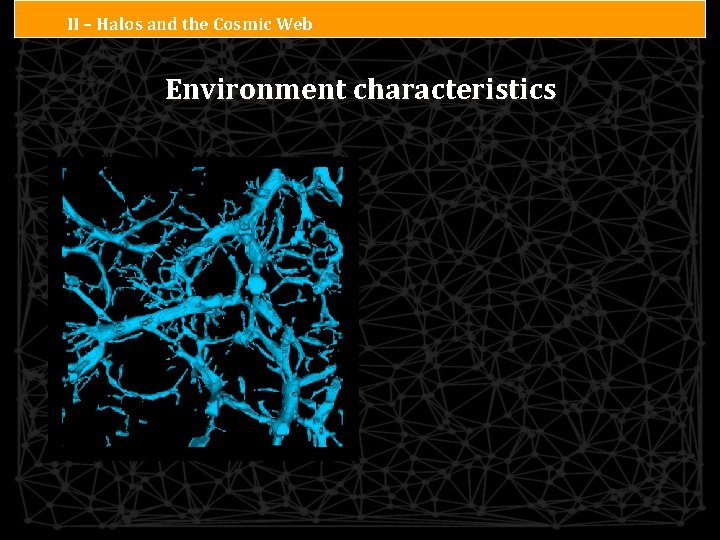
II – Halos and the Cosmic Web Environment characteristics
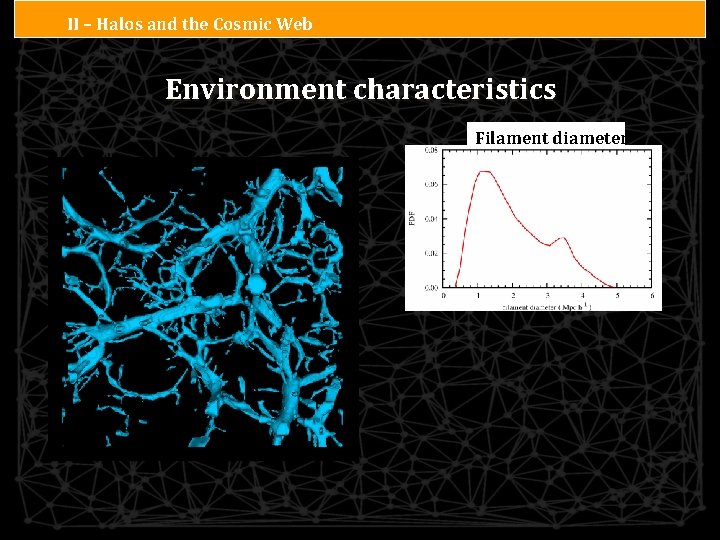
II – Halos and the Cosmic Web Environment characteristics Filament diameter
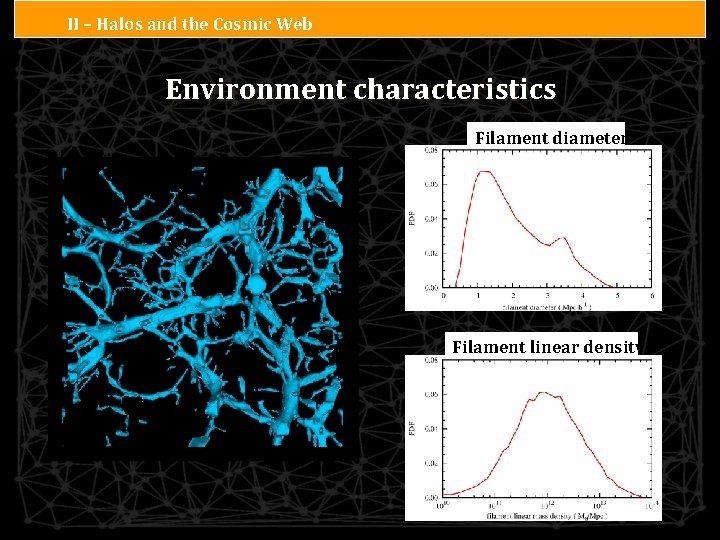
II – Halos and the Cosmic Web Environment characteristics Filament diameter Filament linear density
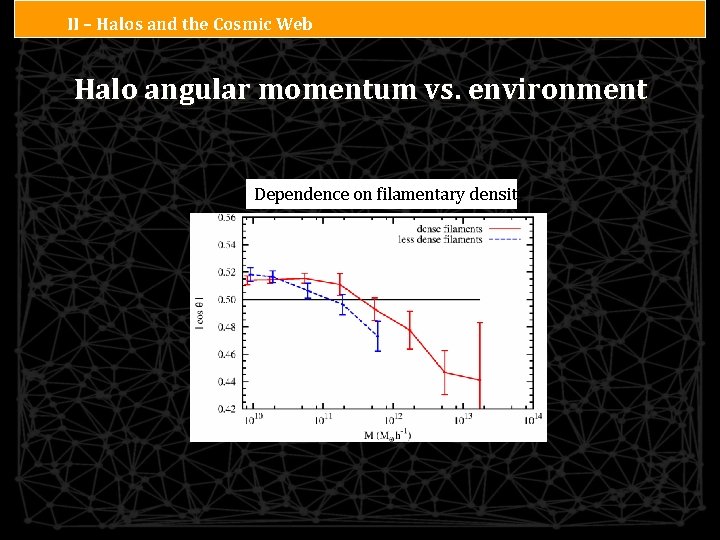
II – Halos and the Cosmic Web Halo angular momentum vs. environment Dependence on filamentary density
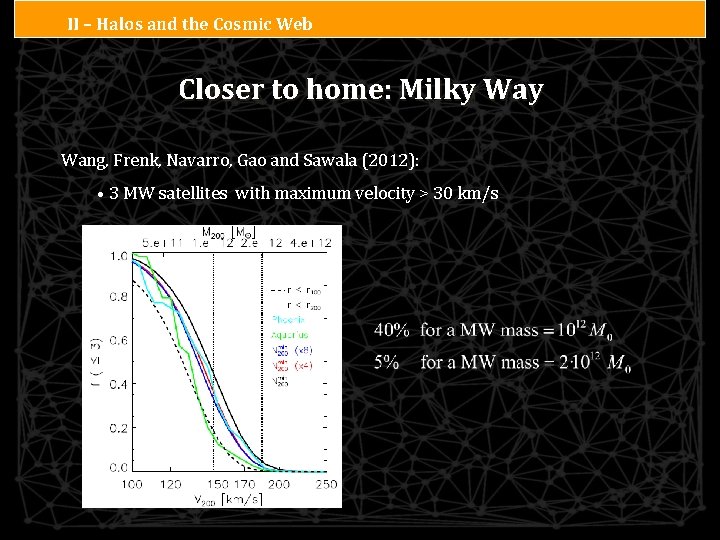
II – Halos and the Cosmic Web Closer to home: Milky Wang, Frenk, Navarro, Gao and Sawala (2012): • 3 MW satellites with maximum velocity > 30 km/s
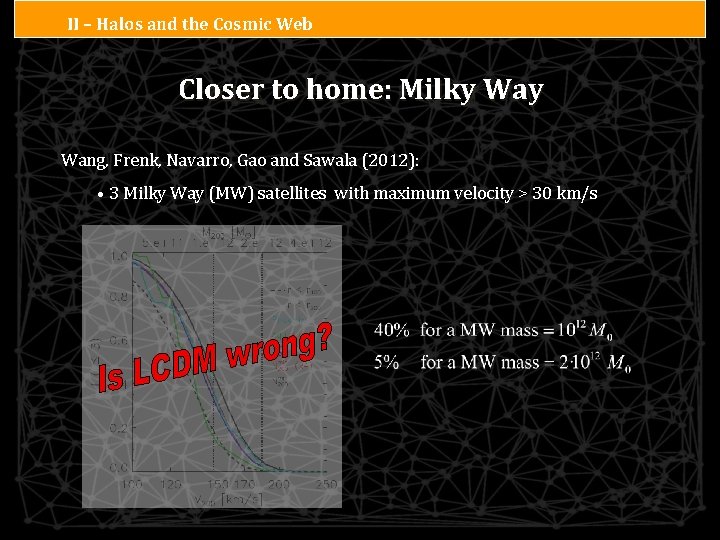
II – Halos and the Cosmic Web Closer to home: Milky Wang, Frenk, Navarro, Gao and Sawala (2012): • 3 Milky Way (MW) satellites with maximum velocity > 30 km/s
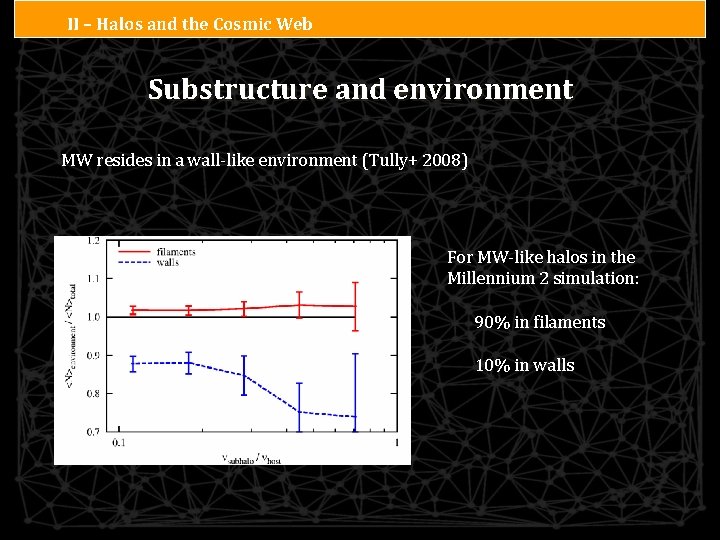
II – Halos and the Cosmic Web Substructure and environment MW resides in a wall-like environment (Tully+ 2008) For MW-like halos in the Millennium 2 simulation: 90% in filaments 10% in walls
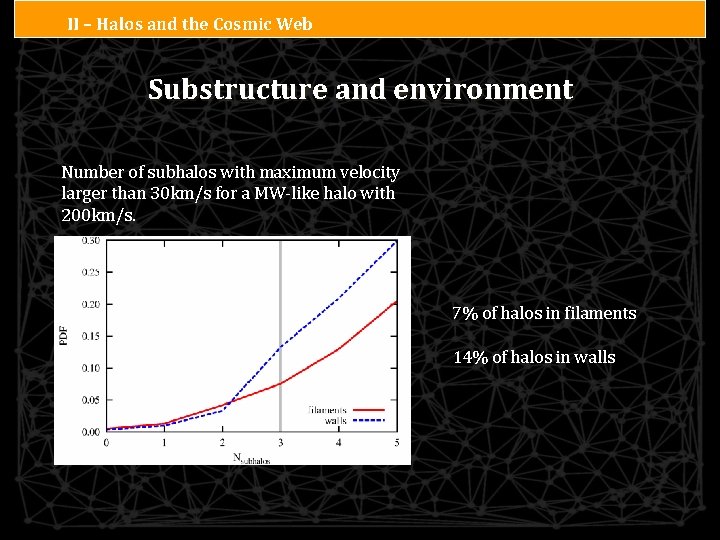
II – Halos and the Cosmic Web Substructure and environment Number of subhalos with maximum velocity larger than 30 km/s for a MW-like halo with 200 km/s. 7% of halos in filaments 14% of halos in walls
II – Halos and the Cosmic Web Conclusions • The NEXUS+ algorithm: a tool for multiscale and automatic Cosmic Web environment detection. • Very successful in following the evolution of the cosmic environments. • Ideal tool for measuring the influence of the Cosmic Web on dark matter halos and galaxies. • Understanding how the Cosmic Web influences the formation and evolution of halos and galaxies.
II – Halos and the Cosmic Web
- Slides: 27