
TRACING NEW SAFETY THINKING PRACTICES IN SAFETY INVESTIGATION


- Slides: 18
TRACING NEW SAFETY THINKING PRACTICES IN SAFETY INVESTIGATION REPORTS Dr Nektarios Karanikas Aviation Academy, Amsterdam University of Applied Sciences (NL) Dimitrios Chionis MSc, Ph. D candidate Bolton University (UK) 3 rd International Cross-industry Safety Conference (ICSC) Amsterdam, 31 October – 2 November 2018 1
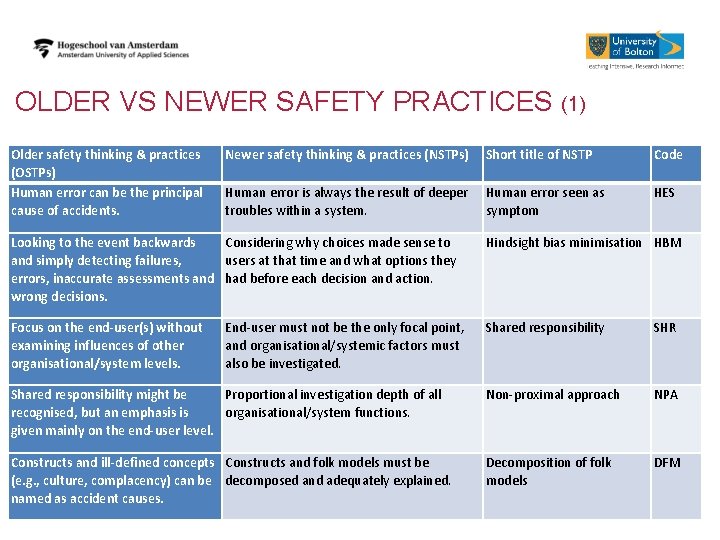
OLDER VS NEWER SAFETY PRACTICES Older safety thinking & practices (OSTPs) Human error can be the principal cause of accidents. (1) Newer safety thinking & practices (NSTPs) Short title of NSTP Code Human error is always the result of deeper troubles within a system. Human error seen as symptom HES Looking to the event backwards Considering why choices made sense to and simply detecting failures, users at that time and what options they errors, inaccurate assessments and had before each decision and action. wrong decisions. Hindsight bias minimisation HBM Focus on the end-user(s) without examining influences of other organisational/system levels. Shared responsibility SHR Shared responsibility might be Proportional investigation depth of all recognised, but an emphasis is organisational/system functions. given mainly on the end-user level. Non-proximal approach NPA Constructs and ill-defined concepts Constructs and folk models must be (e. g. , culture, complacency) can be decomposed and adequately explained. named as accident causes. Decomposition of folk models DFM End-user must not be the only focal point, and organisational/systemic factors must also be investigated. 2
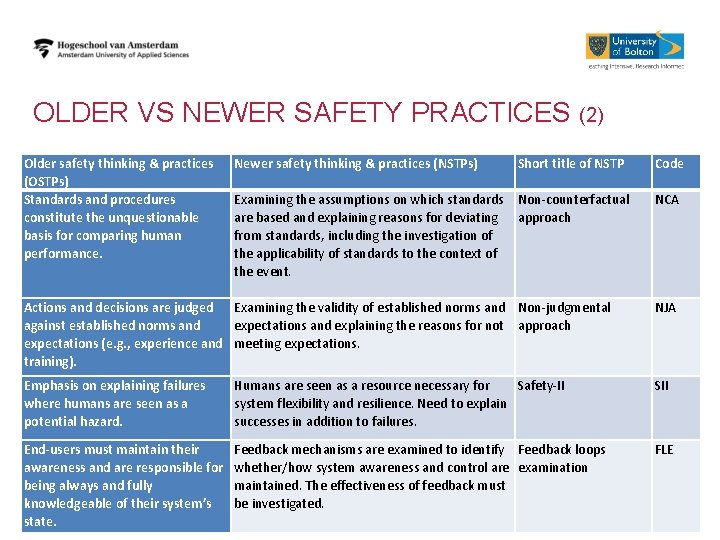
OLDER VS NEWER SAFETY PRACTICES Older safety thinking & practices (OSTPs) Standards and procedures constitute the unquestionable basis for comparing human performance. Newer safety thinking & practices (NSTPs) (2) Short title of NSTP Examining the assumptions on which standards Non-counterfactual are based and explaining reasons for deviating approach from standards, including the investigation of the applicability of standards to the context of the event. Code NCA Actions and decisions are judged Examining the validity of established norms and Non-judgmental against established norms and expectations and explaining the reasons for not approach expectations (e. g. , experience and meeting expectations. training). NJA Emphasis on explaining failures where humans are seen as a potential hazard. Humans are seen as a resource necessary for Safety-II system flexibility and resilience. Need to explain successes in addition to failures. SII End-users must maintain their awareness and are responsible for being always and fully knowledgeable of their system’s state. Feedback mechanisms are examined to identify Feedback loops whether/how system awareness and control are examination maintained. The effectiveness of feedback must be investigated. FLE 3
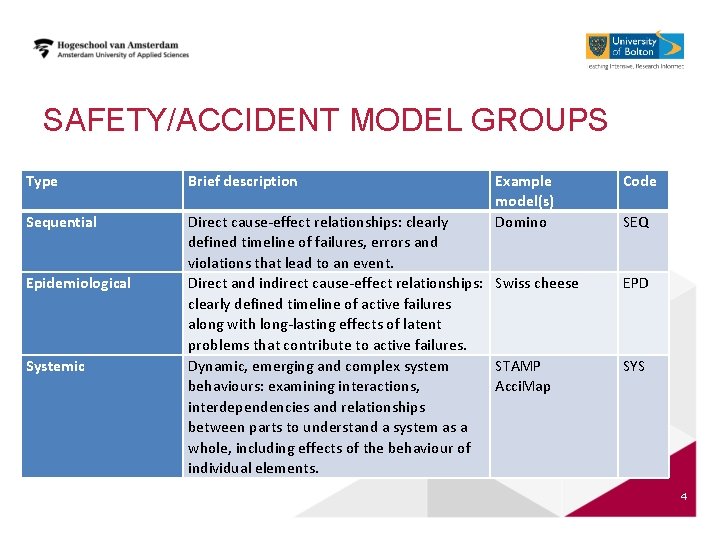
SAFETY/ACCIDENT MODEL GROUPS Type Brief description Sequential Direct cause-effect relationships: clearly defined timeline of failures, errors and violations that lead to an event. Direct and indirect cause-effect relationships: Swiss cheese clearly defined timeline of active failures along with long-lasting effects of latent problems that contribute to active failures. Dynamic, emerging and complex system STAMP behaviours: examining interactions, Acci. Map interdependencies and relationships between parts to understand a system as a whole, including effects of the behaviour of individual elements. Epidemiological Systemic Example model(s) Domino Code SEQ EPD SYS 4
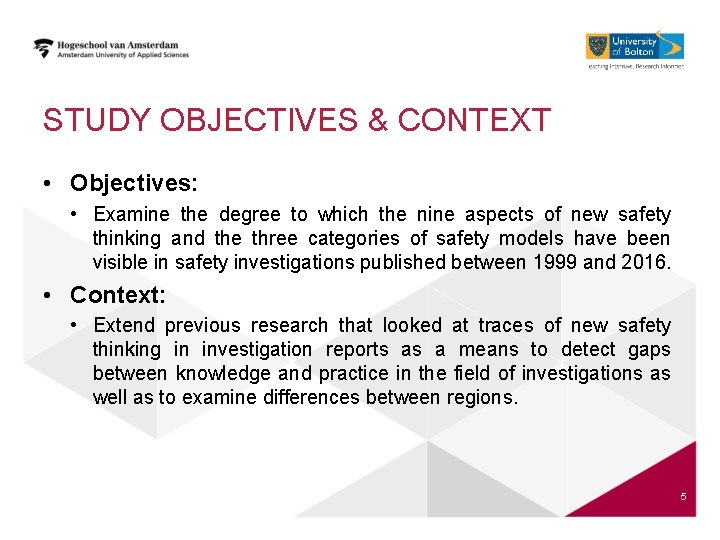
STUDY OBJECTIVES & CONTEXT • Objectives: • Examine the degree to which the nine aspects of new safety thinking and the three categories of safety models have been visible in safety investigations published between 1999 and 2016. • Context: • Extend previous research that looked at traces of new safety thinking in investigation reports as a means to detect gaps between knowledge and practice in the field of investigations as well as to examine differences between regions. 5
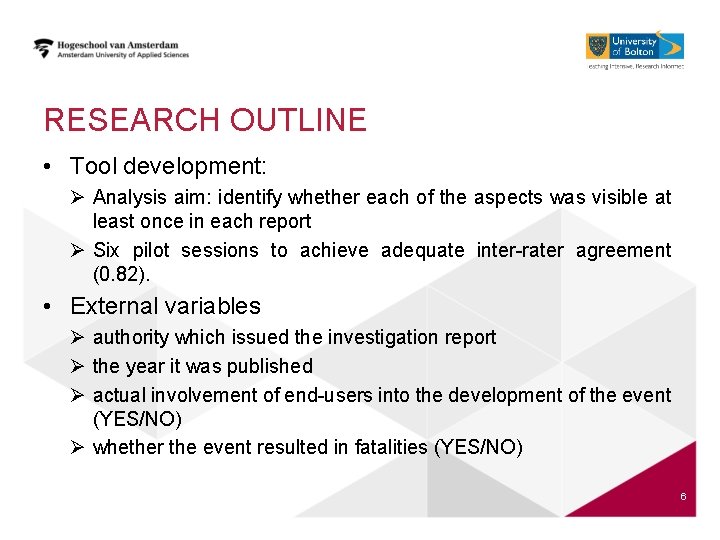
RESEARCH OUTLINE • Tool development: Ø Analysis aim: identify whether each of the aspects was visible at least once in each report Ø Six pilot sessions to achieve adequate inter-rater agreement (0. 82). • External variables Ø authority which issued the investigation report Ø the year it was published Ø actual involvement of end-users into the development of the event (YES/NO) Ø whether the event resulted in fatalities (YES/NO) 6
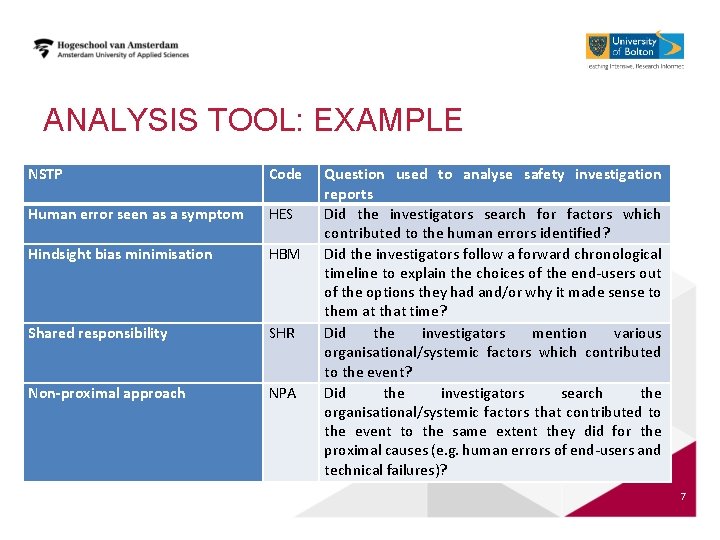
ANALYSIS TOOL: EXAMPLE NSTP Code Human error seen as a symptom HES Hindsight bias minimisation HBM Shared responsibility SHR Non-proximal approach NPA Question used to analyse safety investigation reports Did the investigators search for factors which contributed to the human errors identified? Did the investigators follow a forward chronological timeline to explain the choices of the end-users out of the options they had and/or why it made sense to them at that time? Did the investigators mention various organisational/systemic factors which contributed to the event? Did the investigators search the organisational/systemic factors that contributed to the event to the same extent they did for the proximal causes (e. g. human errors of end-users and technical failures)? 7
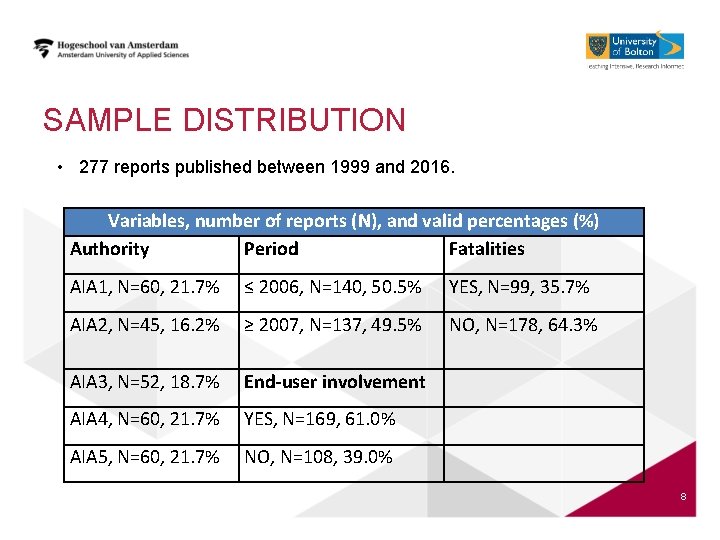
SAMPLE DISTRIBUTION • 277 reports published between 1999 and 2016. Variables, number of reports (N), and valid percentages (%) Authority Period Fatalities AIA 1, N=60, 21. 7% ≤ 2006, N=140, 50. 5% YES, N=99, 35. 7% AIA 2, N=45, 16. 2% ≥ 2007, N=137, 49. 5% NO, N=178, 64. 3% AIA 3, N=52, 18. 7% End-user involvement AIA 4, N=60, 21. 7% YES, N=169, 61. 0% AIA 5, N=60, 21. 7% NO, N=108, 39. 0% 8
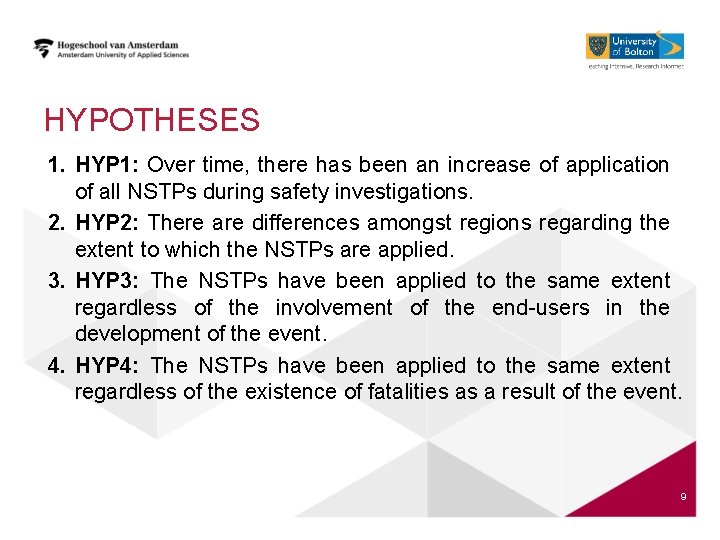
HYPOTHESES 1. HYP 1: Over time, there has been an increase of application of all NSTPs during safety investigations. 2. HYP 2: There are differences amongst regions regarding the extent to which the NSTPs are applied. 3. HYP 3: The NSTPs have been applied to the same extent regardless of the involvement of the end-users in the development of the event. 4. HYP 4: The NSTPs have been applied to the same extent regardless of the existence of fatalities as a result of the event. 9
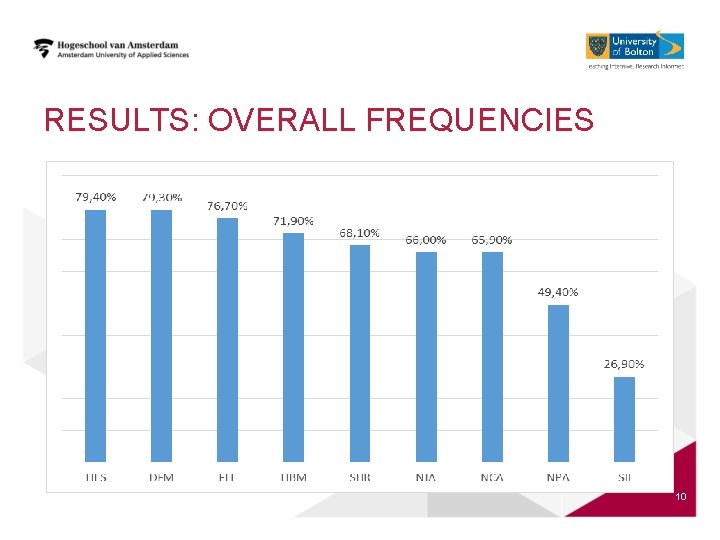
RESULTS: OVERALL FREQUENCIES 10
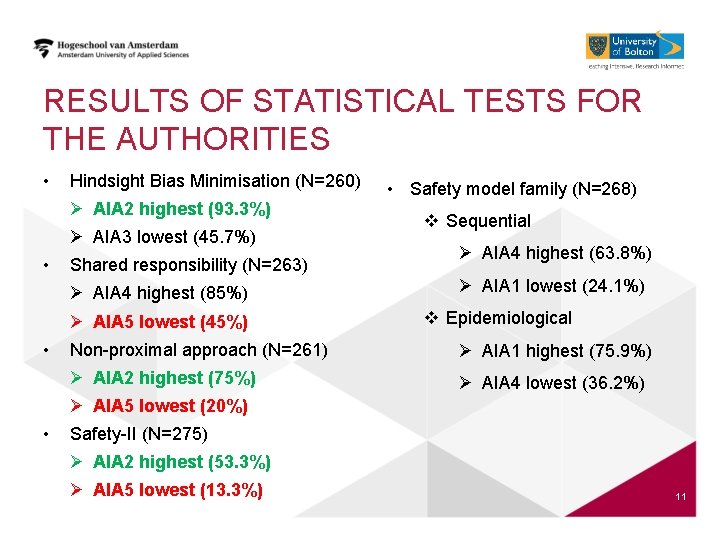
RESULTS OF STATISTICAL TESTS FOR THE AUTHORITIES • Hindsight Bias Minimisation (N=260) Ø AIA 2 highest (93. 3%) Ø AIA 3 lowest (45. 7%) • Shared responsibility (N=263) Ø AIA 4 highest (85%) Ø AIA 5 lowest (45%) • • Safety model family (N=268) v Sequential Ø AIA 4 highest (63. 8%) Ø AIA 1 lowest (24. 1%) v Epidemiological Non-proximal approach (N=261) Ø AIA 1 highest (75. 9%) Ø AIA 2 highest (75%) Ø AIA 4 lowest (36. 2%) Ø AIA 5 lowest (20%) • Safety-II (N=275) Ø AIA 2 highest (53. 3%) Ø AIA 5 lowest (13. 3%) 11
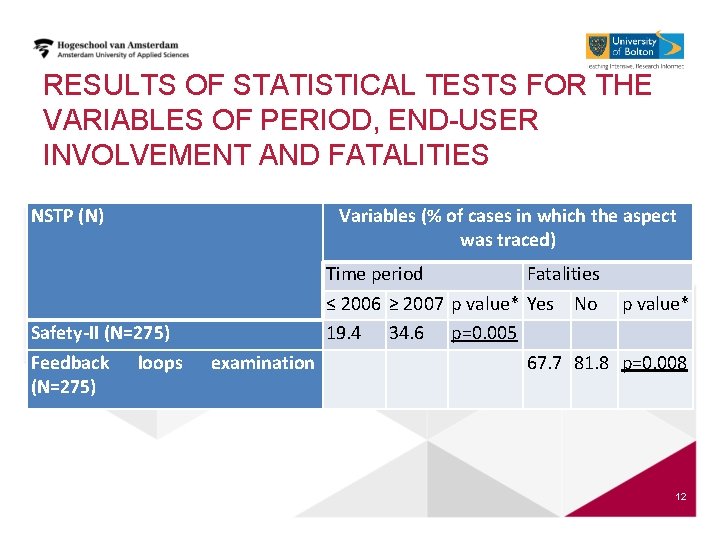
RESULTS OF STATISTICAL TESTS FOR THE VARIABLES OF PERIOD, END-USER INVOLVEMENT AND FATALITIES NSTP (N) Safety-II (N=275) Feedback loops (N=275) Variables (% of cases in which the aspect was traced) Time period Fatalities ≤ 2006 ≥ 2007 p value* Yes No p value* 19. 4 34. 6 p=0. 005 examination 67. 7 81. 8 p=0. 008 12
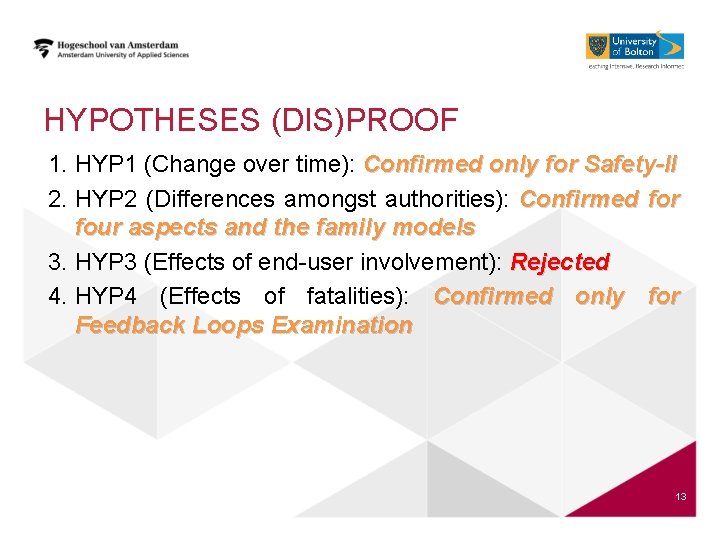
HYPOTHESES (DIS)PROOF 1. HYP 1 (Change over time): Confirmed only for Safety-II 2. HYP 2 (Differences amongst authorities): Confirmed for four aspects and the family models 3. HYP 3 (Effects of end-user involvement): Rejected 4. HYP 4 (Effects of fatalities): Confirmed only for Feedback Loops Examination 13
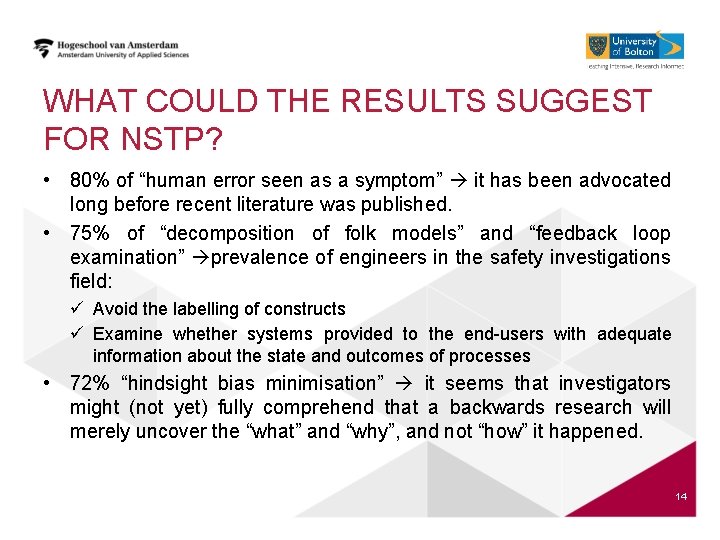
WHAT COULD THE RESULTS SUGGEST FOR NSTP? • 80% of “human error seen as a symptom” it has been advocated long before recent literature was published. • 75% of “decomposition of folk models” and “feedback loop examination” prevalence of engineers in the safety investigations field: ü Avoid the labelling of constructs ü Examine whether systems provided to the end-users with adequate information about the state and outcomes of processes • 72% “hindsight bias minimisation” it seems that investigators might (not yet) fully comprehend that a backwards research will merely uncover the “what” and “why”, and not “how” it happened. 14
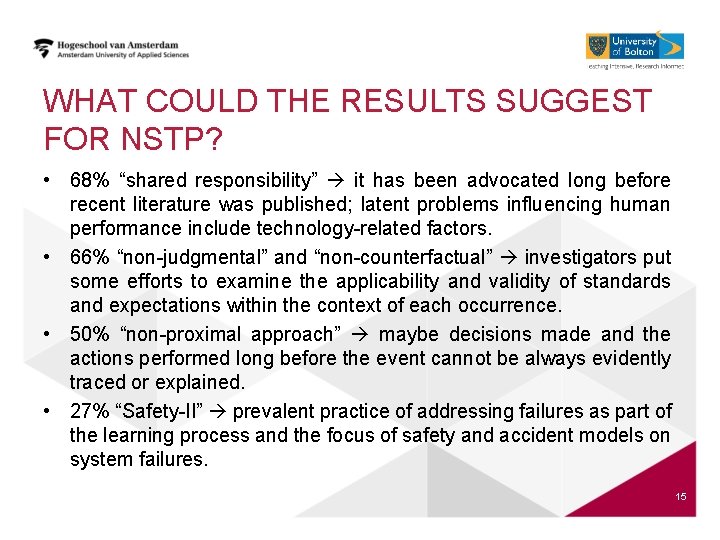
WHAT COULD THE RESULTS SUGGEST FOR NSTP? • 68% “shared responsibility” it has been advocated long before recent literature was published; latent problems influencing human performance include technology-related factors. • 66% “non-judgmental” and “non-counterfactual” investigators put some efforts to examine the applicability and validity of standards and expectations within the context of each occurrence. • 50% “non-proximal approach” maybe decisions made and the actions performed long before the event cannot be always evidently traced or explained. • 27% “Safety-II” prevalent practice of addressing failures as part of the learning process and the focus of safety and accident models on system failures. 15
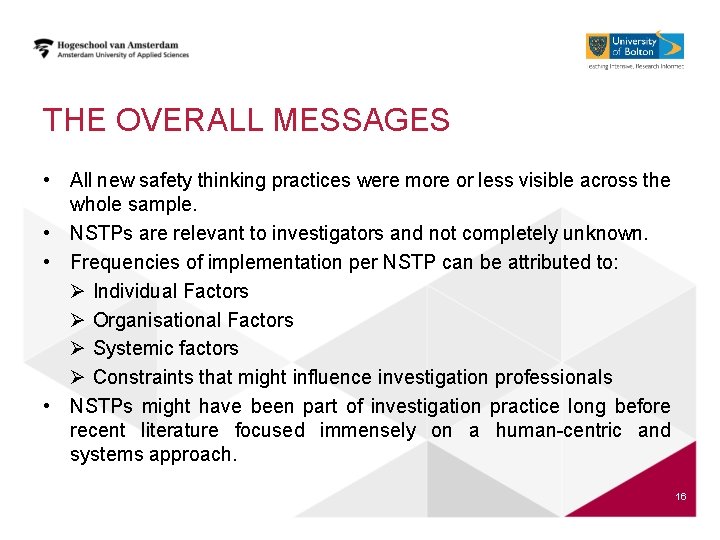
THE OVERALL MESSAGES • All new safety thinking practices were more or less visible across the whole sample. • NSTPs are relevant to investigators and not completely unknown. • Frequencies of implementation per NSTP can be attributed to: Ø Individual Factors Ø Organisational Factors Ø Systemic factors Ø Constraints that might influence investigation professionals • NSTPs might have been part of investigation practice long before recent literature focused immensely on a human-centric and systems approach. 16
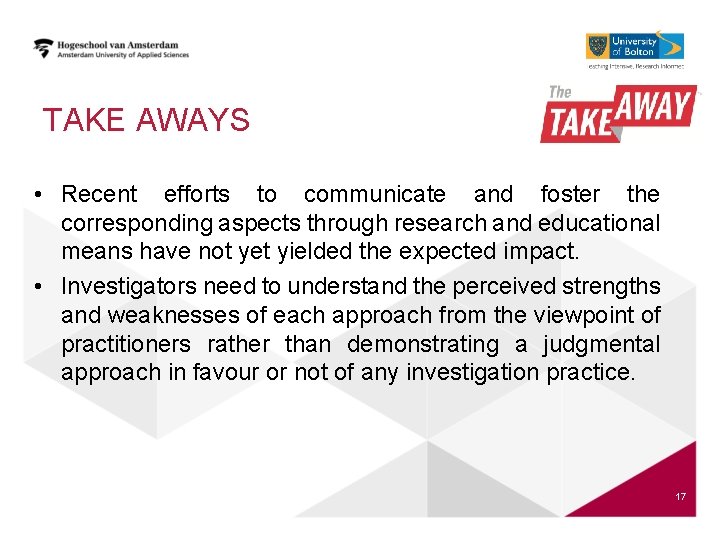
TAKE AWAYS • Recent efforts to communicate and foster the corresponding aspects through research and educational means have not yet yielded the expected impact. • Investigators need to understand the perceived strengths and weaknesses of each approach from the viewpoint of practitioners rather than demonstrating a judgmental approach in favour or not of any investigation practice. 17
! n o i t n e t t a r u o y r o f s k n a h T TRACING NEW SAFETY THINKING PRACTICES IN SAFETY INVESTIGATION REPORTS Dr Nektarios Karanikas Aviation Academy, Amsterdam University of Applied Sciences (NL) Dimitrios Chionis MSc, Ph. D candidate Bolton University (UK) 3 rd International Cross-industry Safety Conference (ICSC) Amsterdam, 31 October – 2 November 2018 Contact: nektkar@gmail. com, n. karanikas@hva. nl 18