
Traceability of Gas Pipeline Materials October 13 2016

Traceability of Gas Pipeline Materials October 13, 2016 Ed Newton Research & Materials Manager 1

Gas Engineering / Pipeline Integrity ØTracking and Traceability of Materials is a quality management objective § To be assured that what is specified is the same as what is acquired and installed ØPipeline Design establishes pipeline component requirements § Characterizes application requirements and matches available materials to unique system requirements ØMaterials Quality Management Program § § Identify critical features of components Approve Manufacturers Perform QA/QC Manage Defective Materials ØIntegrity Management Programs address risk and material threats after installation 2
Material Specifications Ø Material Specification (MSP) contains the technical requirements for critical pipeline materials § Stock Codes with standardized technical part description § Approved Manufacturers, plants, and Mfg. Part Numbers § Quality Control Inspection Instructions of critical attributes Ø MSPs “incorporate by reference” Industry Codes and Standards § Recently established a library of codes & standards and monitor them for revisions by the various industry organizations § Revision of a referenced Code or Standard drives a review and update process for the MSP 3

Material Tracking & Traceability Initiatives Ø Implemented manual process to maintain traceability of PE pipe in YR 2000 § Prompted by TR-130 resin mix-up Ø Implemented tracking and traceability policy for High Pressure Pipelines in 2015 § Prompted by Pipeline Safety Enhancement Plan following San Bruno incident § Implemented a materials standardization policy Ø Initiated End-to-End Material Traceability Project § § Initial “Blueprint” phase completed, planned phased approach Defined current state of existing processes and gap analysis Developing future state processes Cleaning-up system data to migrate to batch management process 4

Traceability “Levels” Ø Level 1 – Meets Current Regulatory Requirements § Materials meet Industry Specifications “Incorporated by Reference”, and are marked according to § 192. 63 Marking of materials Ø Level 2 – Traceable Material Lots to Purchase Order § Requires association of material lot records to Company purchasing records Ø Level 3 – Traceable Material Lots to Construction Records § Requires association of material lot records to BOM Ø Level 4 – Traceable Material Lots to the Installed Locations § Requires association of part lot number to geospatial location 5
Company Material Records ØManufacturer-Supplied Documents § MTRs § Certificates of Analysis (Physical/Chemical) § Certificates of Conformance or Quality ØCompany-Level Records § Purchase Order (P. O. ) and Bill of Lading (BOL) • Company contract with Terms and Conditions. • Record of what was purchased and quantity ordered. • Record of what was received. § Records of QA/QC Inspections ØProject-Level Records § BOM, Charge-Direct purchase Records*, Material Certifications, etc. *Eliminating as an option ØLocation-Level Records § Drawings, Relative Position Dimensions, X-Y Coordinates, GPS Coordinates, etc. 6
Benefits of Tracking & Traceability Ø Knowledge of Material Location can help Improve Material Utilization, Requirements Planning, and Buying Power Ø Knowledge of Material Location helps Facilitate Response to: § Product recalls by manufacturers § Discovery of defective material during quality control inspections § Discovery of defective material during pipeline installation or commissioning (prior to placement into service) § Discovery of defective material after commissioning (usually due to pipeline leak or failure involving a material defect) ØProvides Knowledge of Material Pedigree § Manufacturer and Post-Processing § AKA “Origin of Material” 7
High Pressure Pipeline Materials Ø Engineering Review of MTRs and Certifications (prior to purchase) Ø Material Received – associate material records to the P. O. Ø Inspect Material – per QC Instruction Ø Material “Shepherd” Labels material with unique identifier matched to material records Materials are not labeled unless traceable Maintain traceability through fabrication as pieces are cut Updates material location when material are moved (Warehouse to Job to ROW to Installed Location) § Record stationing & GPS Coordinates § § 8
High Pressure Pipeline Materials Ø As-built drawing created by Surveyor § Information hand-off from Material “Shepherd” § Weld map is created with each connected component identified Ø Installation log is maintained of all materials installed on the job and reconciled by the Project Manager Progress over the last 18 months Ø 41 projects completed Ø Over 70 miles of pipe tracked and traceable Ø Over 5, 000 valves and fittings tracked and traceable 9

Plastic Pipe - Manual Traceability Ø Implemented policy to manually document PE pipe lot numbers on Pipeline Construction Sketches Ø Added data fields to record PE pipe lot number in Enterprise Construction Management System Database Ø Added data fields to records PE pipe lot number in O&M Maintenance Order for pipe repairs § Also capture lot number of existing PE pipe Ø Added Certification Addendum to PE Pipe Material Specification § Provides record of footage received for each PE lot number 10
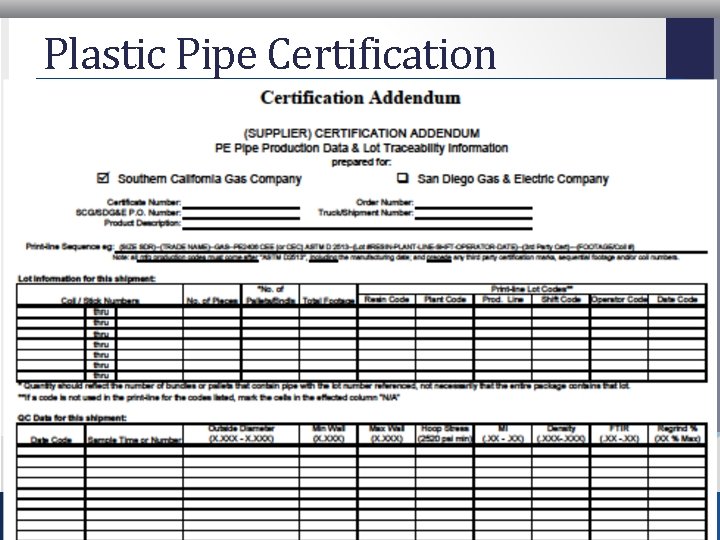
Plastic Pipe Certification 11
Next Steps Toward Ø Implementing lot traceability for all plastic pipeline materials Ø Creating Association between P. O. and Material Records Ø Improving Document Management of Material Records Ø Building Out System Capability for Batch Management Ø Select Technology Solution to Manage Data & Image Capture of Batch & Component Information § § During Material Movement Transactions During Installation Example of EFV traceability through dual label approach Individual packaging for small fittings 12

Thank You 13
- Slides: 13