
Trace Evidence Part I Summary Microscopic Analysis Types
- Slides: 39
Trace Evidence (Part I)
Summary § § Microscopic Analysis Types of Trace Evidence Glass § Hair (fur) § Fibers § Paint § Soil § Gunshot Residue §
What is Trace Evidence? Loosely defined, trace evidence is small evidence used to link victims, suspects, objects, and crime scenes. Trace analysis uses microscopes and other instrumentation. Other sections (Drugs, Firearms) also use microscopes.
Microscopic Analysis Who analyzes trace evidence? n Labs sections are arranged differently in different labs. n Different evidence could be assigned to different sections (hair: biology, fiber: chemistry) n Some labs have trace or microscopy sections.
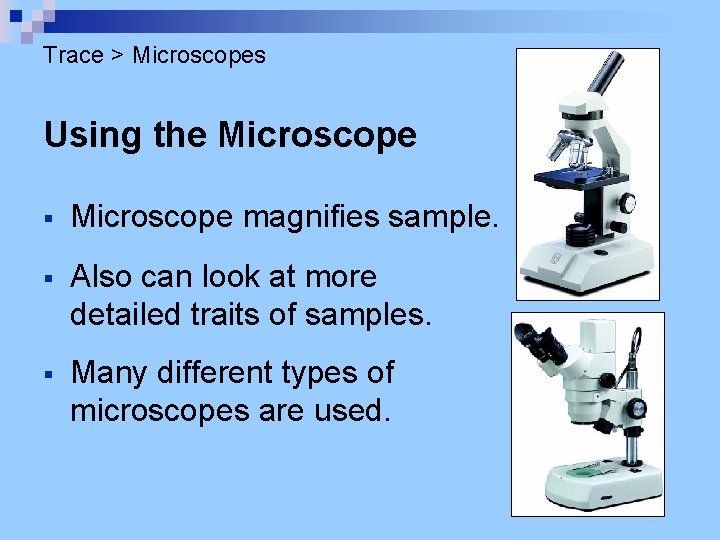
Trace > Microscopes Using the Microscope § Microscope magnifies sample. § Also can look at more detailed traits of samples. § Many different types of microscopes are used.
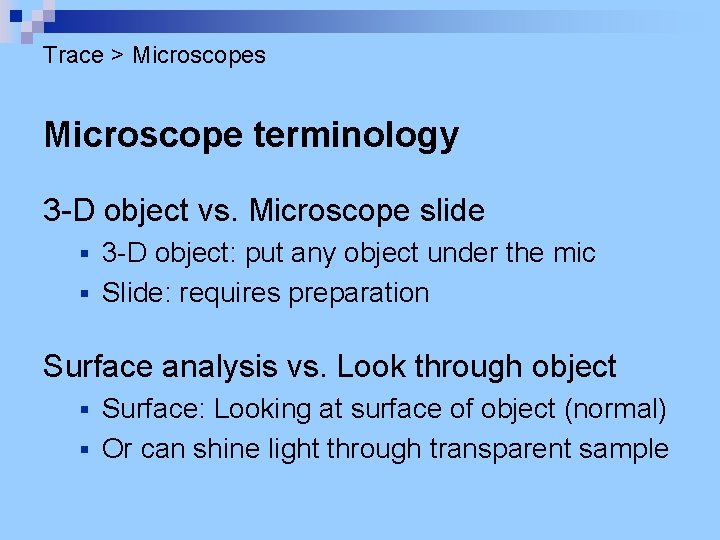
Trace > Microscopes Microscope terminology 3 -D object vs. Microscope slide 3 -D object: put any object under the mic § Slide: requires preparation § Surface analysis vs. Look through object Surface: Looking at surface of object (normal) § Or can shine light through transparent sample §
Trace > Microscopes Microscope terminology Reflected light vs. Transmitted light Refected: bounces off object (normal light) § Transmitted: passes through object §
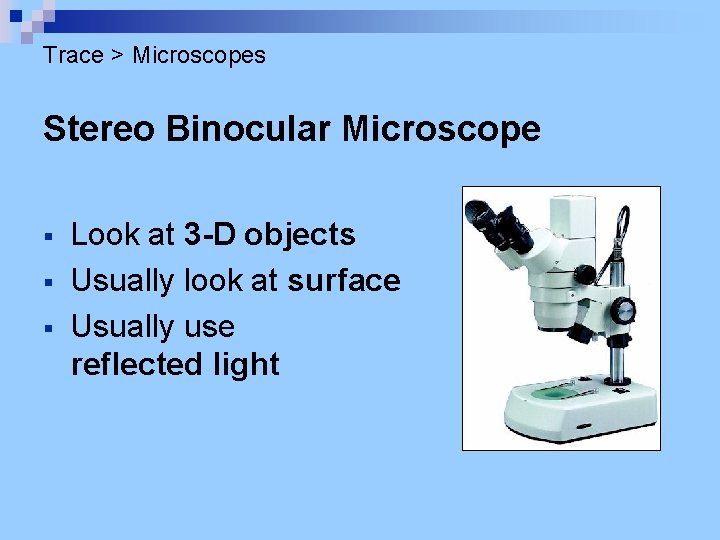
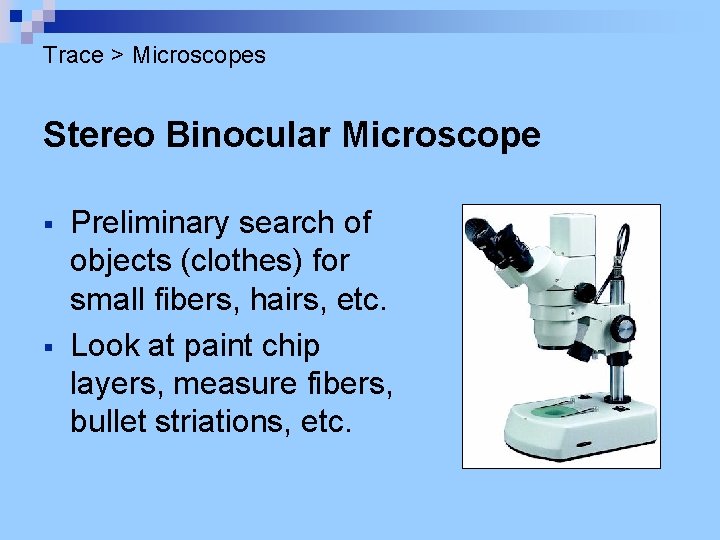
Trace > Microscopes Stereo Binocular Microscope § § § Look at 3 -D objects Usually look at surface Usually use reflected light
Trace > Microscopes Stereo Binocular Microscope § § Preliminary search of objects (clothes) for small fibers, hairs, etc. Look at paint chip layers, measure fibers, bullet striations, etc.
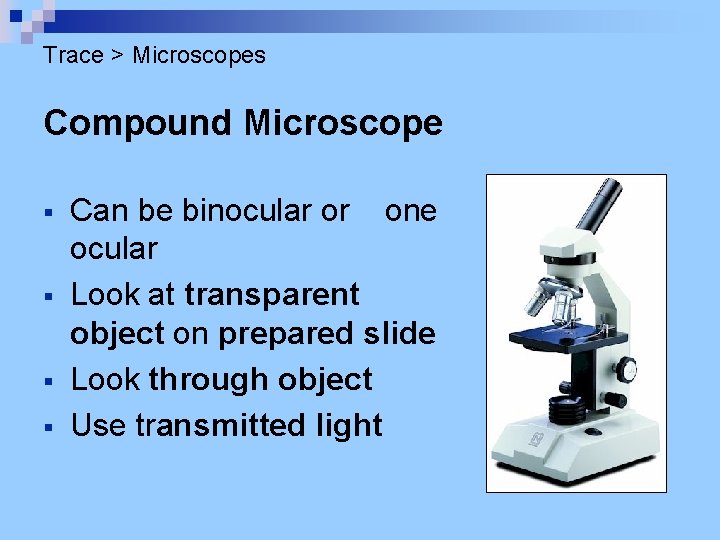
Trace > Microscopes Compound Microscope § § Can be binocular or one ocular Look at transparent object on prepared slide Look through object Use transmitted light
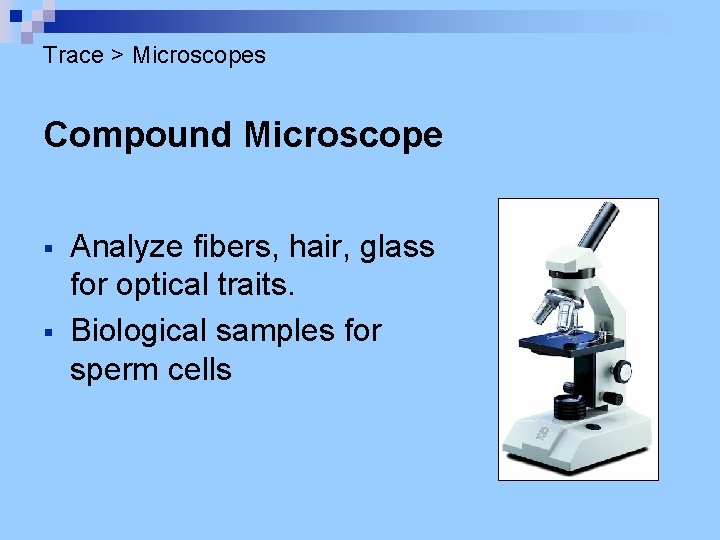
Trace > Microscopes Compound Microscope § § Analyze fibers, hair, glass for optical traits. Biological samples for sperm cells
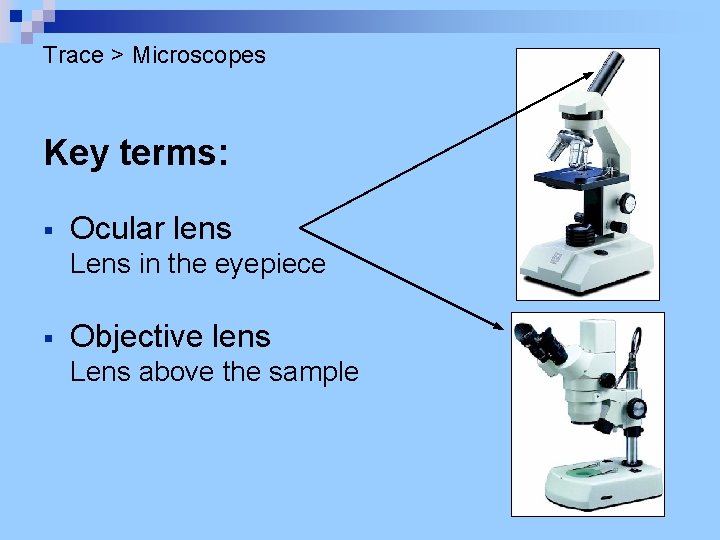
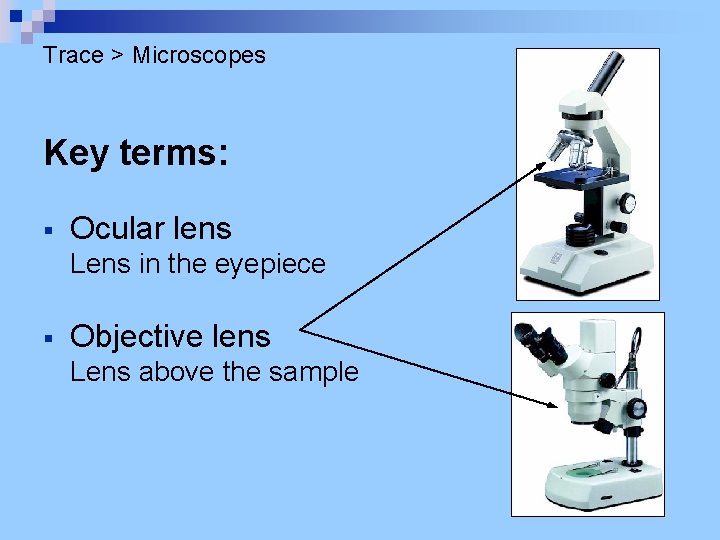
Trace > Microscopes Key terms: § Ocular lens Lens in the eyepiece § Objective lens Lens above the sample
Trace > Microscopes Key terms: § Ocular lens Lens in the eyepiece § Objective lens Lens above the sample
Trace > Microscopes Key terms: § Micrometer - “ruler” in the eyepiece, allows for measurement of sample. § Magnification - Amount the object is enlarged § Working Distance - Distance between the object and objective lens
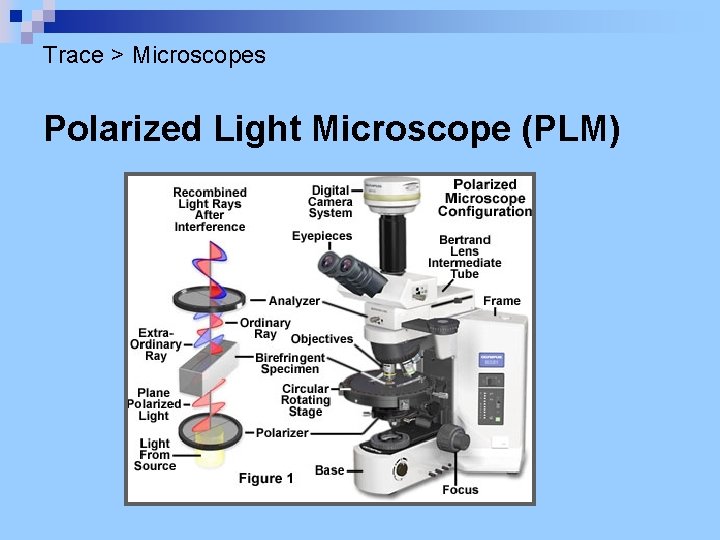
Trace > Microscopes Polarized Light Microscope (PLM)
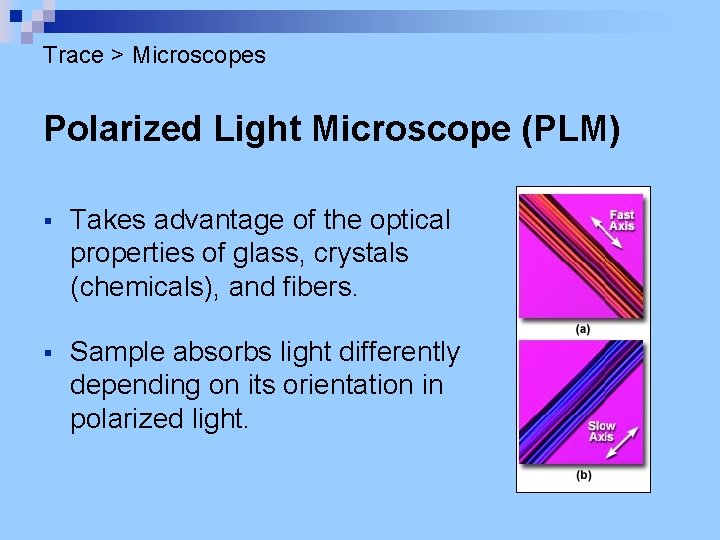
Trace > Microscopes Polarized Light Microscope (PLM) § Takes advantage of the optical properties of glass, crystals (chemicals), and fibers. § Sample absorbs light differently depending on its orientation in polarized light.
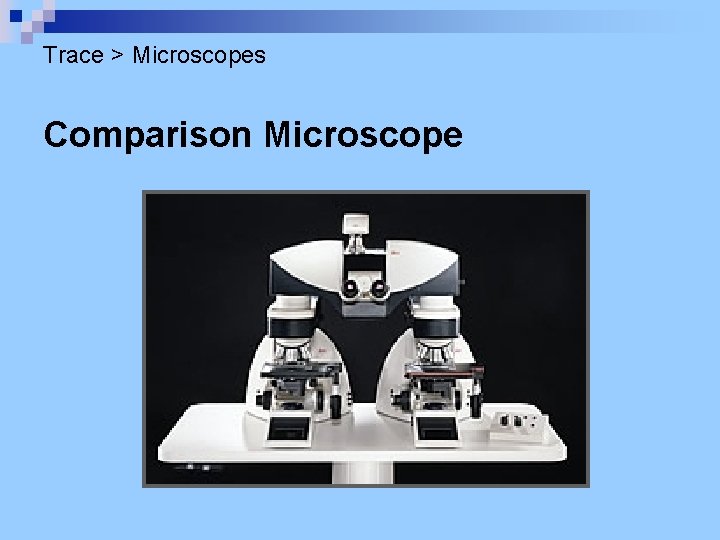
Trace > Microscopes Comparison Microscope
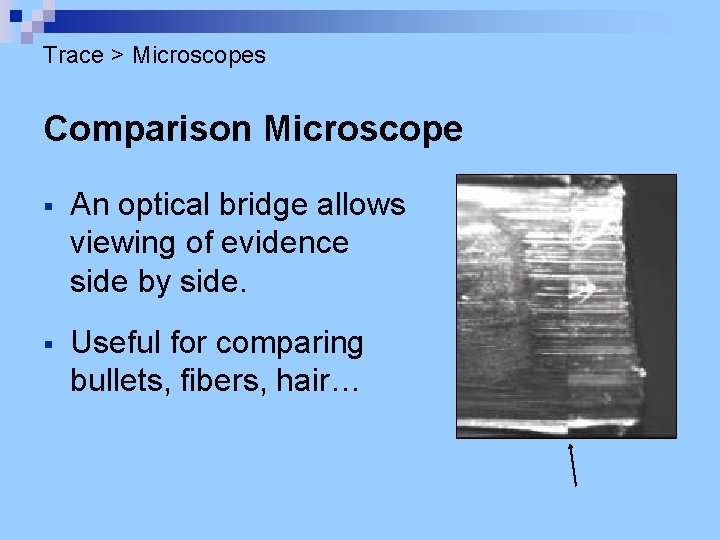
Trace > Microscopes Comparison Microscope § An optical bridge allows viewing of evidence side by side. § Useful for comparing bullets, fibers, hair…
Summary of Trace § Why is trace evidence useful? § Collecting trace evidence Types trace evidence: Glass § Hair (fur) § Fibers § Paint § Soil § Gunshot Residue §
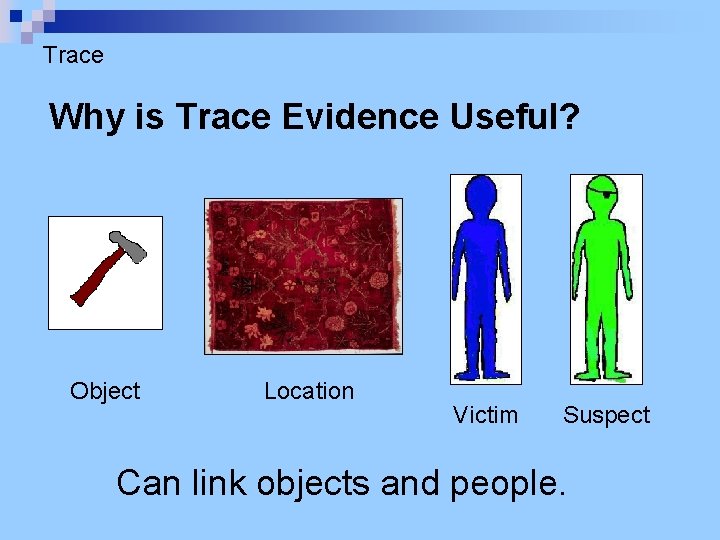
Trace Why is Trace Evidence Useful? Object Location Victim Suspect Can link objects and people.
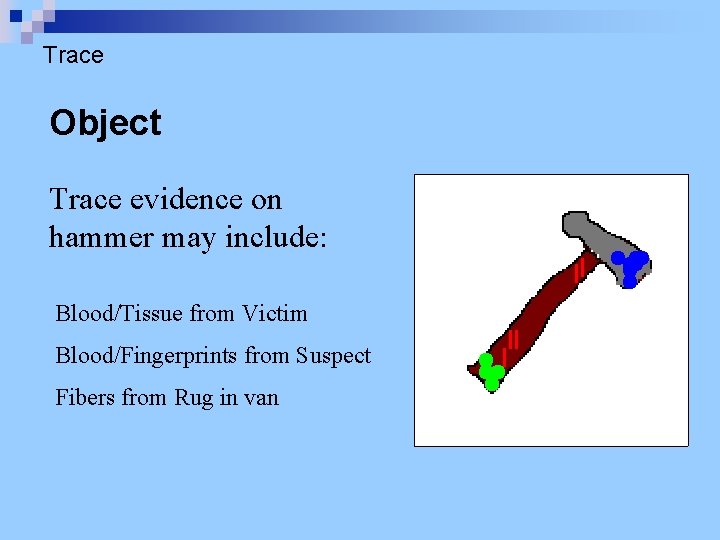
Trace Object Trace evidence on hammer may include: Blood/Tissue from Victim Blood/Fingerprints from Suspect Fibers from Rug in van
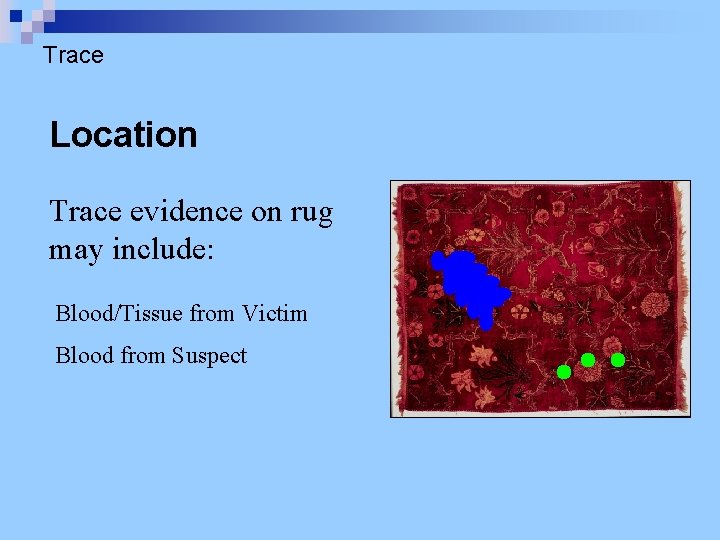
Trace Location Trace evidence on rug may include: Blood/Tissue from Victim Blood from Suspect
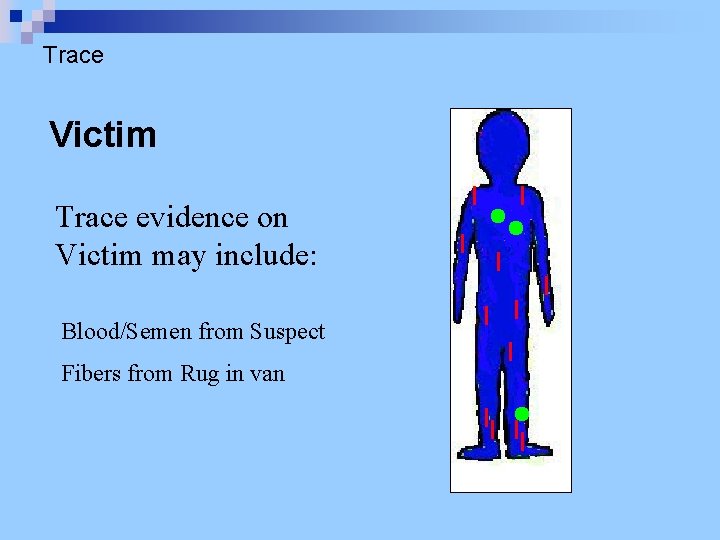
Trace Victim Trace evidence on Victim may include: Blood/Semen from Suspect Fibers from Rug in van
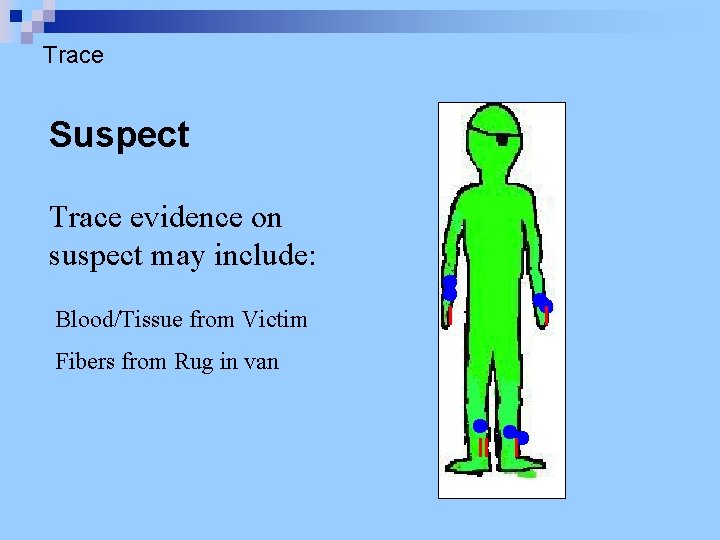
Trace Suspect Trace evidence on suspect may include: Blood/Tissue from Victim Fibers from Rug in van
Trace How is Trace Evidence Transferred? Locard Exchange Principle: Whenever there is contact between two objects, they will leave or pick up debris from the other object. During a crime, there is always be a transfer of evidence. The difficulty is finding & collecting this evidence.
Collecting Trace Evidence Who collects the evidence? § § § Police Officer Crime Scene Investigator Forensic Scientist Depends on the state/community Often one person to ensure consistency of labeling
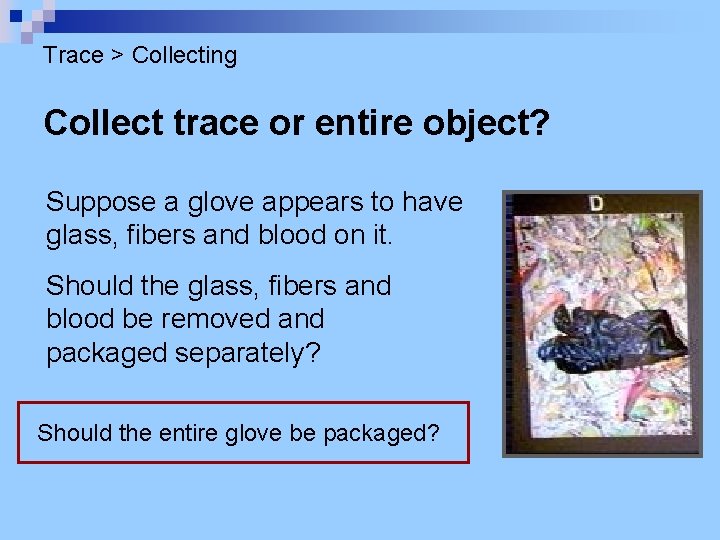
Trace > Collecting Collect trace or entire object? Suppose a glove appears to have glass, fibers and blood on it. Should the glass, fibers and blood be removed and packaged separately? Should the entire glove be packaged?
Trace > Collection Considerations before packaging entire object: § § § Object may be too large or difficult to move Trace evidence may fall off item during transport. Trace Evidence may be transferred to different, irrelevant area of object. If packaging object, package objects separately. Prevents trace being transferred to other objects.
Trace > Collection NEVER package known material with evidence. Example in book: Suspect’s clothes had tar on the knees of pants. His clothes were collected at the station. Tar was collected at the crime scene. The clothes and the tar were packaged in the same bag. Whoops!
Trace > Collection These 3 methods can be done at the crime scene or in the crime lab. 1. Visual Inspection 2. Tape Lift 3. Vacuum
Trace > Collection Visible Inspection § § § Use naked eye or hand lens. Evidence removed and packaged for later analysis Use bright light and forceps to collect.
Trace > Collection Visible Inspection (Packaging) § § § Small paper envelopes are bad (Holes allow small objects to escape). Use small plastic bags, glass vial or paper using a druggist fold. Double package. Label each package.
Trace > Collection Tape Lift § § Clear tape is used. Repeatedly apply tape to small area until most of the stickiness is gone. Tape is folded back upon itself, taped to a glass slide or taped to a piece of plastic. Put in separate labeled container. Be sure to document specific area covered.
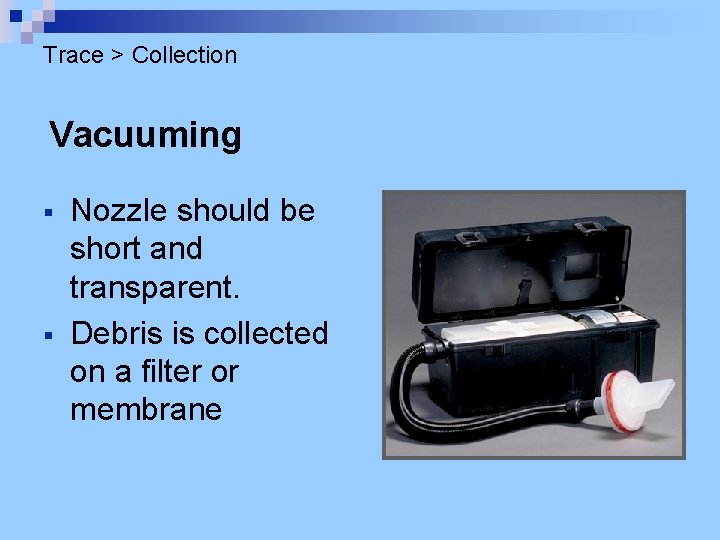
Trace > Collection Vacuuming § § Nozzle should be short and transparent. Debris is collected on a filter or membrane
Trace > Collection Vacuuming § Small area is vacuumed. (Filters changed frequently) § Filters packaged in separate labeled container. (Be sure to document specific area covered) § Most improperly used method because it often results in the collection of a lot of irrelevant material.
Trace > Analysis What is the purpose of analysis? To identify the source of the collected evidence. Fiber recovered from victim. Source: Matches fibers from rug in suspect’s van Soil found on Suspect’s shoe Source: Matches soil at crime scene Blood found on suspect’s couch Source: Matches blood of victim
Trace > Analysis The Catch: With trace evidence, an investigator usually cannot say that one piece of evidence definitely originated from a specific item. The investigator can only tell the jury what similarities were found and give them an idea of how rare those similarities are.
Trace > Analysis Classifying Evidence: Most trace evidence is classified using class characteristics (color, shape, refractive index, etc. ) When examining class characteristics, absolute identification is not possible. The Forensic Scientist’s main objective is to give the jury an idea about how rare the category is.
Trace > Analysis Classifying Evidence: If physical properties differ, they did not come from the same source. Exclusion is possible.