
TRACE EVIDENCE I HAIRS AND FIBERS SFS 2
TRACE EVIDENCE I: HAIRS AND FIBERS
SFS 2. Students will use various scientific techniques to analyze physical and trace evidence. b. Analyze the morphology and types of hair, fibers, soil and glass. SFS 1. Students will recognize and classify various types of evidence in relation to the definition and scope of Forensic Science. b. Distinguish and categorize physical and trace evidence (e. g. ballistics, drugs, fibers, fingerprints, glass, hair, metal, lip prints, soil, and toxins). c. Determine the proper techniques to search, isolate, collect, and record physical and trace evidence. d. Evaluate the relevance of possible evidence at the site of an investigation.
Learning Targets: I can � Identify the parts of a hair and describe how does it grows. � Demonstrate how hair is collected analyzed as evidence. � Identify the different types of fibers typically found in a crime scene. � Demonstrate how fiber is collected analyzed as evidence.
Introduction Hair is encountered as physical evidence in a wide variety of crimes. Hair is an abundant type of trace evidence found at nearly all crime scenes. The abundance of hair in crime scenes, and the fact that everyone routinely sheds hair as part of the hair growth cycle, makes it very difficult to separate hair samples from the victim and their associates from those left by the perpetrator.
Introduction Although it is not yet possible to individualize a human hair to any single head or body through its morphology, it still has value as physical evidence. � Hair evidence based solely on morphology can't be used to identify an individual. In a morphological match, it can only be said that the “hair sample from the crime scene is consistent with the suspect hair sample”. � To identify an individual from a hair sample, nuclear DNA must be obtained from the hair follicle. �
Introduction When properly collected and submitted to the laboratory accompanied by an adequate number of standard/reference samples, hair can provide strong corroborative evidence for placing an individual at a crime scene.
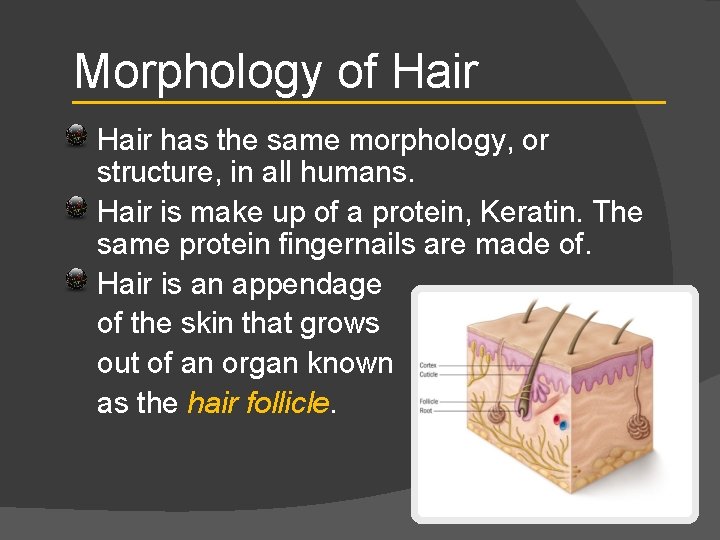
Morphology of Hair has the same morphology, or structure, in all humans. Hair is make up of a protein, Keratin. The same protein fingernails are made of. Hair is an appendage of the skin that grows out of an organ known as the hair follicle.
Morphology of Hair � Hair grows from the papilla, a large structure at the base of the hair follicle connects the hair to the blood supply. � Surrounding the base of the hairs are tiny muscles known as Arretor Pili. These make the hairs stand on end, causing “goose bumps”. � The sebaceous gland in the skin secretes a lubricating oily matter (sebum) to lubricate the skin and hair. 8
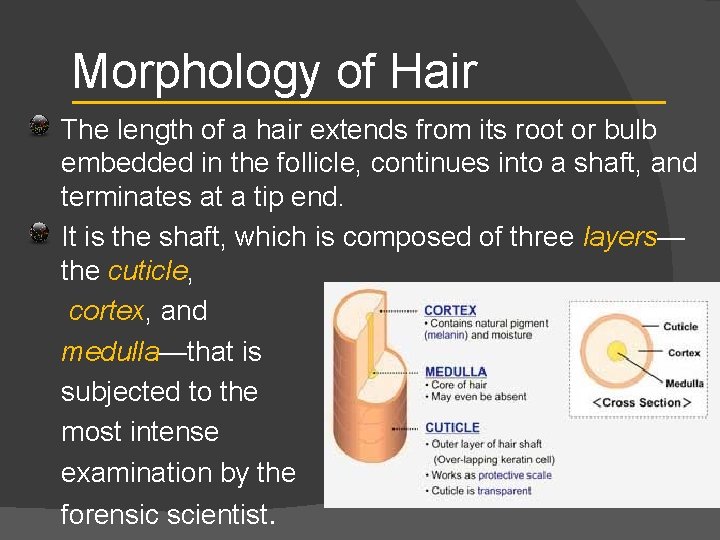
Morphology of Hair The length of a hair extends from its root or bulb embedded in the follicle, continues into a shaft, and terminates at a tip end. It is the shaft, which is composed of three layers— the cuticle, cortex, and medulla—that is subjected to the most intense examination by the forensic scientist.
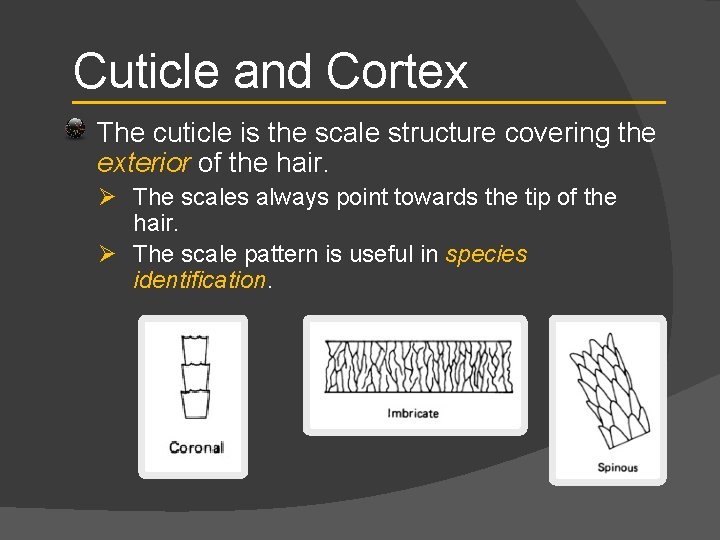
Cuticle and Cortex The cuticle is the scale structure covering the exterior of the hair. Ø The scales always point towards the tip of the hair. Ø The scale pattern is useful in species identification.
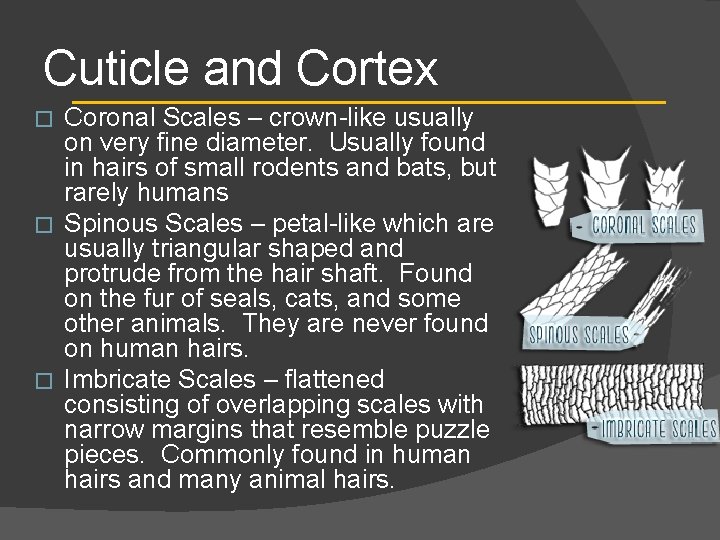
Cuticle and Cortex Coronal Scales – crown-like usually on very fine diameter. Usually found in hairs of small rodents and bats, but rarely humans � Spinous Scales – petal-like which are usually triangular shaped and protrude from the hair shaft. Found on the fur of seals, cats, and some other animals. They are never found on human hairs. � Imbricate Scales – flattened consisting of overlapping scales with narrow margins that resemble puzzle pieces. Commonly found in human hairs and many animal hairs. �
Cuticle and Cortex The cortex is the main body of the hair shaft. Ø Its major forensic importance is the fact that it is embedded with the pigment granules that impart hair with color. Ø The color, shape, and distribution of these granules provide the criminalist with important points of comparison among the hairs of different individuals.
Medulla The medulla is a cellular column running through the center of the hair. Ø The medullary index measures the diameter of the medulla relative to the diameter of the hair shaft. Ø For humans, the medulla generally occupies less than one-third the diameter of the shaft, while for animals it is generally one-half or greater.

Medulla The medulla may be continuous, interrupted, fragmented, or absent.
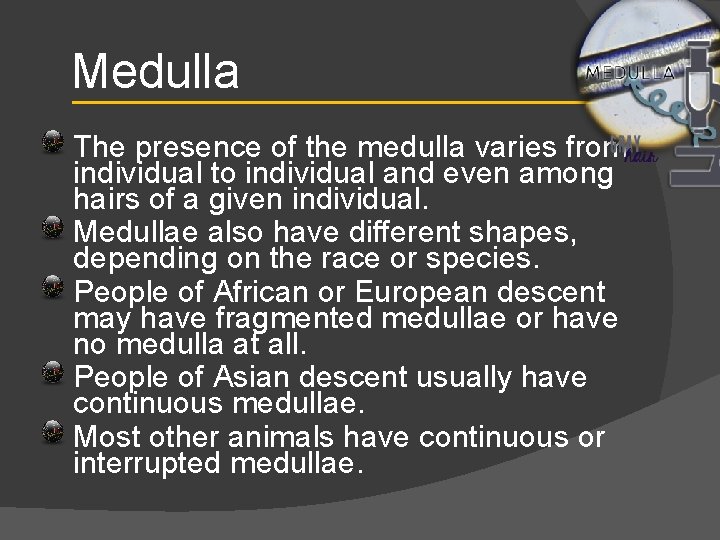
Medulla The presence of the medulla varies from individual to individual and even among hairs of a given individual. Medullae also have different shapes, depending on the race or species. People of African or European descent may have fragmented medullae or have no medulla at all. People of Asian descent usually have continuous medullae. Most other animals have continuous or interrupted medullae.
Root The root and other surrounding cells in the hair follicle provide the tools necessary to produce hair and continue its growth. When pulled from the head, some translucent tissue surrounding the hair’s shaft near the root may be found. This is called a follicular tag. By using DNA analysis on the follicular tag, the hair may be individualized.
Hair from different parts of the body � The structure of hair differs on different parts of the body. �Hairs from the scalp have consistent diameters and uniform distribution of pigment. �Pubic hairs typically have continuous medullae �Facial and beard hairs have trianglur crosssections and eyebrow hair decreases in diameter from the root to tip.
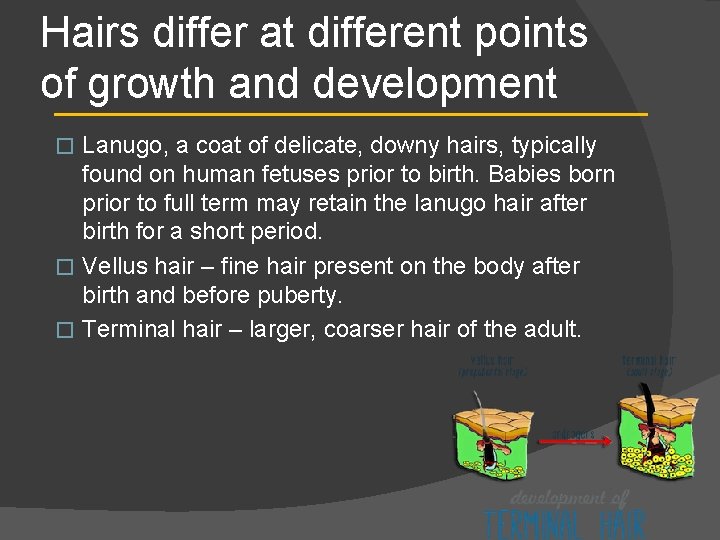
Hairs differ at different points of growth and development Lanugo, a coat of delicate, downy hairs, typically found on human fetuses prior to birth. Babies born prior to full term may retain the lanugo hair after birth for a short period. � Vellus hair – fine hair present on the body after birth and before puberty. � Terminal hair – larger, coarser hair of the adult. �
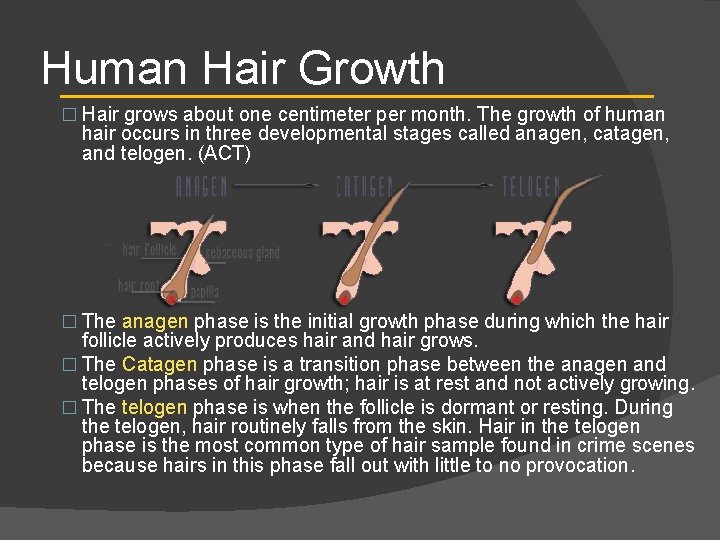
Human Hair Growth � Hair grows about one centimeter per month. The growth of human hair occurs in three developmental stages called anagen, catagen, and telogen. (ACT) � The anagen phase is the initial growth phase during which the hair follicle actively produces hair and hair grows. � The Catagen phase is a transition phase between the anagen and telogen phases of hair growth; hair is at rest and not actively growing. � The telogen phase is when the follicle is dormant or resting. During the telogen, hair routinely falls from the skin. Hair in the telogen phase is the most common type of hair sample found in crime scenes because hairs in this phase fall out with little to no provocation.
Human Hair and Race It is not always possible to determine race from hair samples. Some characteristics are common in each race, but there always variations and exceptions. � People of Asian descent typically have continuous medullae. The pigment granules are generally very dense and occur in large patches or streaks. In cross-section, the hairs are almost always circular. Hair color is almost exclusively black. � People of European descent have an even distribution of pigments in cortex and may have fragmented or completely absent medullae. In cross-section, the hairs appear to be irregularly shaped ovals. Hair color varies from blonde to black; this group of people have the most variation in hair color. � People of African descent are more likely to have dense and unevenly distributed pigment granules. In cross section, the hair is often thin and appears somewhat flattened. The medulla is typically fragmented or absent. Hair color is generally black with some variances noted in individuals with albinism or European ancestry. �
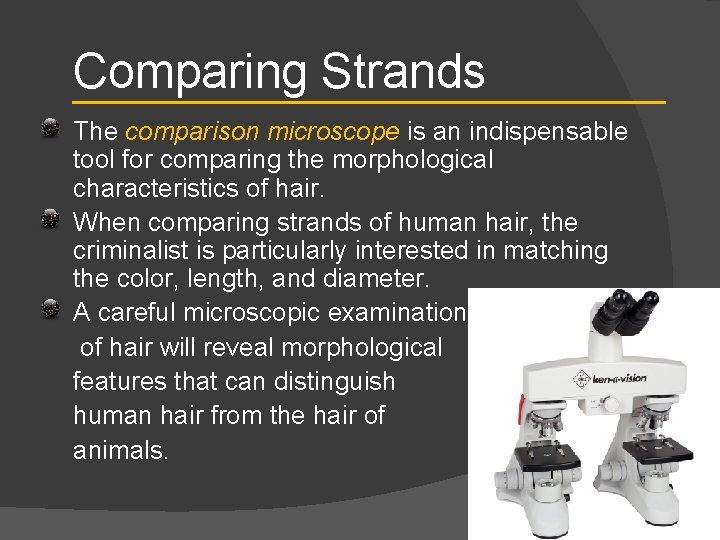
Comparing Strands The comparison microscope is an indispensable tool for comparing the morphological characteristics of hair. When comparing strands of human hair, the criminalist is particularly interested in matching the color, length, and diameter. A careful microscopic examination of hair will reveal morphological features that can distinguish human hair from the hair of animals.
Comparing Strands Scale structure, medullary index, and medullary shape are particularly important in animal hair identification. Other important features for comparing human hair are: Ø The presence or absence of a medulla. Ø The distribution, shape, and color intensity of the pigment granules present in the cortex.
Comparing Strands The most common request is to determine whether or not hair recovered at the crime scene compares to hair removed from the suspect. However, microscopic hair examinations tend to be subjective and highly dependent on the skills and integrity of the analyst.
Hair and DNA Recent major breakthroughs in DNA profiling have extended this technology to the individualization of human hair. The probability of detecting DNA in hair roots is more likely for hair being examined in its anagen or early growth phase as opposed to its catagen (middle) or telogen (final) phases.
Hair and DNA Often, when hair is forcibly removed a follicular tag, a translucent piece of tissue surrounding the hair’s shaft near the root may be present. This has proven to be a rich source of nuclear DNA associated with hair.
Hair and Mitochondrial DNA can be extracted from the hair shaft. Mitochondrial DNA is found in cellular material located outside of the nucleus and it is transmitted only from the mother to child. As a rule, all positive microscopic hair comparisons must be confirmed by DNA analysis.
Collection and Preservation Recover all hair present. Use the fingers or tweezers to pick up hair, place in paper bindles or coin envelopes which should then be folded and sealed in larger envelopes. Label the outer sealed envelope. If hair is attached, such as in dry blood, or caught in metal or a crack of glass, do not attempt to remove it but rather leave hair intact on the object. If the object is small, mark it, wrap it, and seal it in an envelope. If the object is large, wrap the area containing the hair in paper to prevent loss of hairs during shipment.
Collection and Preservation In rape cases, the victim's pubic region should be combed prior to collecting standards. Obtain known hair samples from the victim, suspect, or any other possible sources for comparison with unknown specimens. The recommended method for collecting head hairs is to start by having the person from whom they are being collected bend over a large sheet of clean paper, rubbing or massaging their hands through the hair so that loose hair will fall out on the paper. More should then be gathered by plucking them from representative areas all over the head. A total or 50 -100 hairs is desired. Do not cut the hair. This same method may be used to collect hairs from other parts of the body. 3060 pubic hairs are required. When the person is a suspect, hair should be gathered from all parts of the body even though there may only be an interest in hair from the head at that particular time. Hair samples are also collected from the victim of suspicious deaths during an autopsy.
Hair as Evidence � � � � Hair evidence is tricky and can be both class and individual evidence. Everyone routinely sheds hair which means hair is everywhere. It is NOT possible to link hair to a specific individual based on morphology, or structural characteristics of the hair alone. Even if a hair has nuclear DNA attached, it is often difficult to show that the hair actually belonged to the perpetrator of the crime and not someone who merely passed by the crime scene. Hair can establish an association of a suspect with a victim or a crime scene. Hair can provide corroborative evidence for placing an individual at a crime scene. Hair can be very important for Toxicology testing. It can be tested for toxic substances such a illegal drugs or poisons. Some substances remain in the hair for months after the last use or exposure.
Hair as Evidence (cont) Most commonly, forensic analysis is used to determine if hair recovered from a crime scene is comparable to hair removed from a suspect. � IF hair has been forcibly removed the follicular tag may be present which is rich source of Mitochondrial DNA and can be used to identify an individual. � � Mitochondrial DNA is found inside the Mitochondria of the � cell rather than the nucleus and is passed down only by the mother � A hair with a follicular tag can be considered individual evidence if mt. DNA can be extracted. More info � http: //www. forensicmag. com/article/2013/04/challenges-dna-testing-and-forensic- analysis-hair-samples#. Ui 3 a. Wbwve. Tg � http: //www. pri. org/stories/2012 -10 -17/strands-evidence-hair-forensics � https: //www. fbi. gov/about-us/lab/forensic-sciencecommunications/fsc/april 2009/review/2009_04_review 02. htm/

Case Study: James Anagnos Case � Use the link to access information about this case http: //www. riversidesheriff. org/pdf/Cold. Cas e/CHU 1977 -1018 -Anagnos. pdf

Hair Lab with Microscope � Go to http: //www. carolina. com/teacherresources/Interactive/forensic-hair-analysisactivity/tr 10879. tr for lab instructions More info: http: //www. exploratorium. edu/exploring/hair_2. html � http: //sites. bergen. org/forensic/Hair. Analysis. htm � �
Fibers as Physical Evidence Fibers found at the crime scene often present challenges to investigator. Fibers can sometimes be linked to a suspect if the fiber is sufficiently unique and is found in the suspect’s possession and at the crime scene.
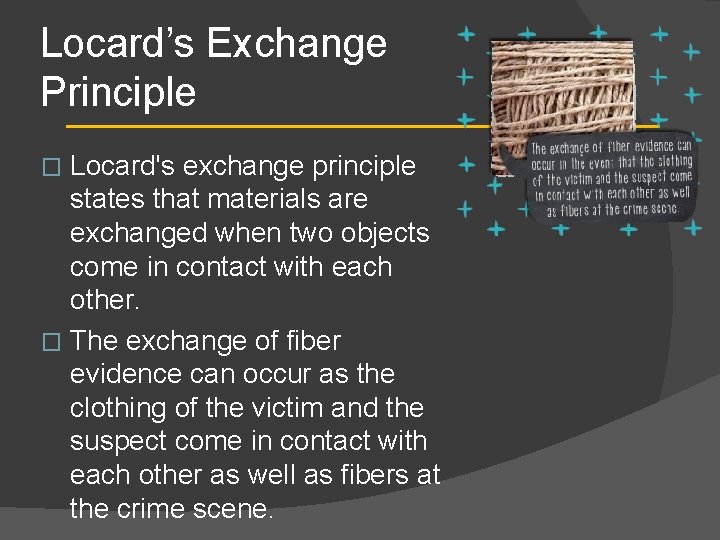
Locard’s Exchange Principle Locard's exchange principle states that materials are exchanged when two objects come in contact with each other. � The exchange of fiber evidence can occur as the clothing of the victim and the suspect come in contact with each other as well as fibers at the crime scene. �
Types of Fibers • A textile is an artifact made by weaving, felting, knitting, or crocheting natural or synthetic fibers. • Textiles can be initially categorized by their weave patterns. • Further examination of the individual fibers would reveal the type of fiber, length, color, and method of spinning. • Fibers can also be classified as natural or synthetic (man-made).
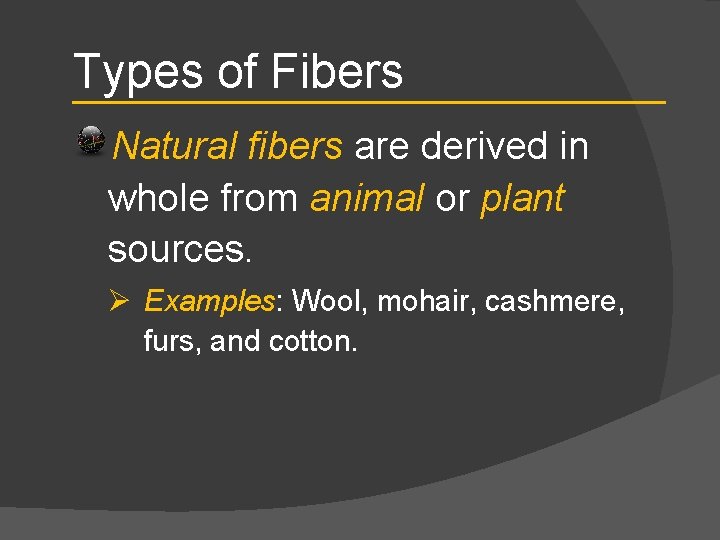
Types of Fibers Natural fibers are derived in whole from animal or plant sources. Ø Examples: Wool, mohair, cashmere, furs, and cotton.
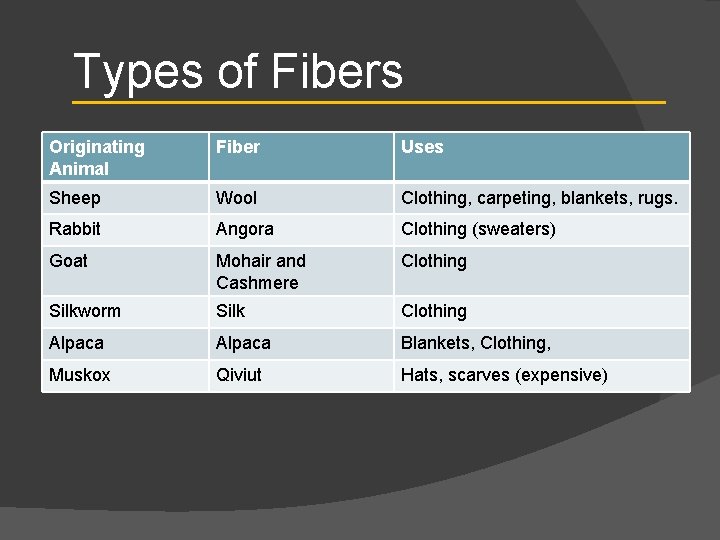
Types of Fibers Originating Animal Fiber Uses Sheep Wool Clothing, carpeting, blankets, rugs. Rabbit Angora Clothing (sweaters) Goat Mohair and Cashmere Clothing Silkworm Silk Clothing Alpaca Blankets, Clothing, Muskox Qiviut Hats, scarves (expensive)
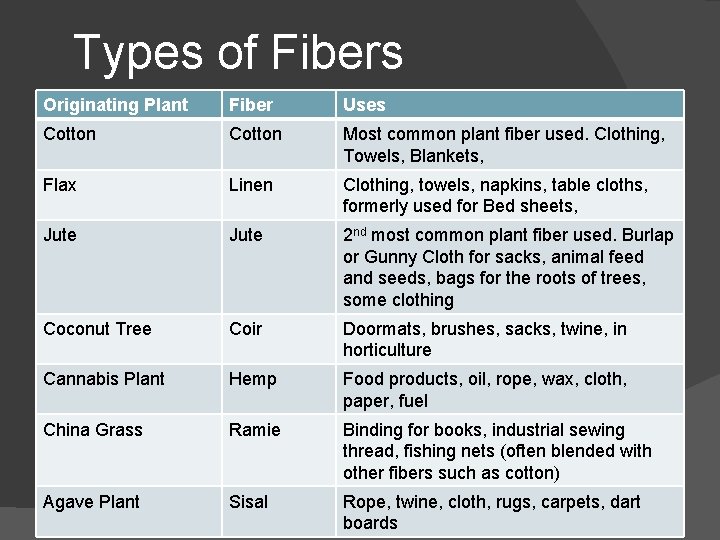
Types of Fibers Originating Plant Fiber Uses Cotton Most common plant fiber used. Clothing, Towels, Blankets, Flax Linen Clothing, towels, napkins, table cloths, formerly used for Bed sheets, Jute 2 nd most common plant fiber used. Burlap or Gunny Cloth for sacks, animal feed and seeds, bags for the roots of trees, some clothing Coconut Tree Coir Doormats, brushes, sacks, twine, in horticulture Cannabis Plant Hemp Food products, oil, rope, wax, cloth, paper, fuel China Grass Ramie Binding for books, industrial sewing thread, fishing nets (often blended with other fibers such as cotton) Agave Plant Sisal Rope, twine, cloth, rugs, carpets, dart boards
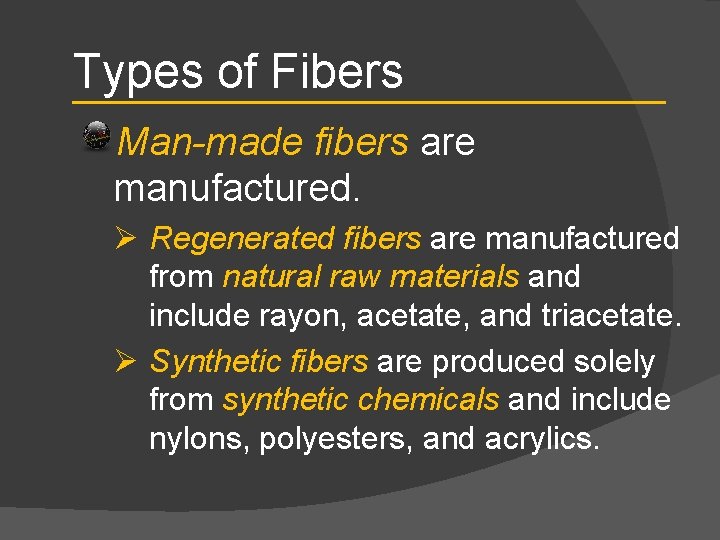
Types of Fibers Man-made fibers are manufactured. Ø Regenerated fibers are manufactured from natural raw materials and include rayon, acetate, and triacetate. Ø Synthetic fibers are produced solely from synthetic chemicals and include nylons, polyesters, and acrylics.
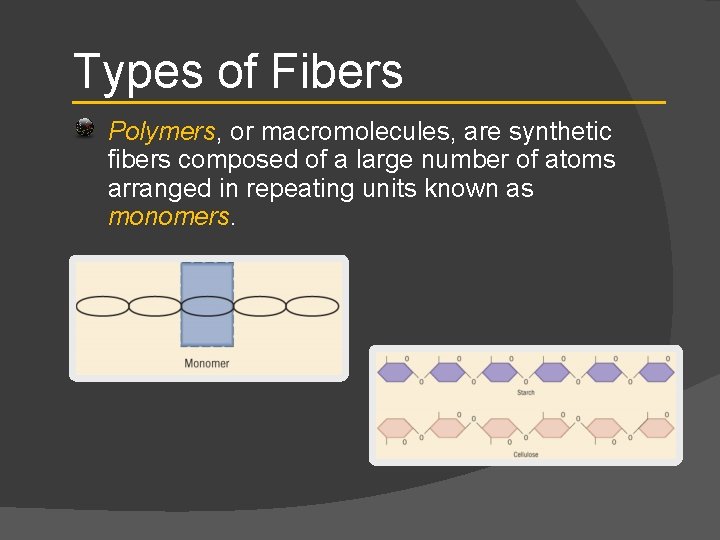
Types of Fibers Polymers, or macromolecules, are synthetic fibers composed of a large number of atoms arranged in repeating units known as monomers.
Man-made Fibers �Mad-made fibers made from natural or synthetic polymers (composed for a large number of atoms usually arranged in repeating units). Ex. Nylon, polyester, and acrylics. �Regenerated Fibers – are man-made from regenerated cellulose which comes from wood or cotton pulp. Ex. Rayon, acetate, triacetate �Polyester, most popular synthetic fiber �Nylon, created in 1939 by Dupont, is the 2 nd most popular synthetic fiber
Identification and Comparison of Man-Made Fibers The combined factors of color, size, shape, microscopic appearance, chemical composition, and dye content make it very unlikely to find two different people wearing identical fabrics. � The physical characteristics of fibers may be examined by the following: � � Counting the number of filaments � Calculating the density of the fiber � Evaluating the Refraction Index of the fiber � Checking the fiber for fluorescence � The chemical characteristics of fibers may be examined in the following ways: � Oxidation tests: This involves burning the fiber to evaluate the ash, behavior in the flame and any smells associated with the fiber. � p. H Testing � Evaluating any residues or component parts within synthetic fibers � Chemical Decomposition tests: Treating fibers with strong acids, bases or solvents
Fibers as Evidence A unique fiber on a victim matched with the same type unique fiber on a suspect, or in the suspect's possession, can be compelling evidence if the fiber characteristics match in all of the above testing! � Even though fiber evidence is generally considered class evidence, fibers that still have matching characteristics after numerous sets of testing is very useful evidence in an investigation! �
Fiber Evidence The quality of the fiber evidence depends on the ability of the criminalist to identify the origin of the fiber or at least be able to narrow the possibilities to a limited number of sources. Obviously, if the examiner is presented with fabrics that can be exactly fitted together at their torn edges, it is a virtual certainty that the fabrics were of common origin.
Fiber Evidence Microscopic comparisons between questioned and standard/reference fibers are initially undertaken for color and diameter characteristics, using a comparison microscope.
Fiber Evidence Other morphological features that could be important in comparing fibers are: Ø Lengthwise striations on the surface of the fiber. Ø The presence of delustering particles that reduce shine. Ø The cross-sectional shape of the fiber.
Fiber Evidence Compositional differences may exist in the dyes that were applied to the fibers during the manufacturing process.
Methods for Fiber Comparison The visible light microspectrophotometer is a convenient way for analysts to compare the colors of fibers through spectral patterns. A more detailed analysis of the fiber’s dye composition can be obtained through a chromatographic separation.
Methods for Fiber Comparison Infrared spectrophotometry is a rapid and reliable method for identifying the generic class of fibers, as does the polarizing microscope. Depending on the class of fiber, each polarized plane of light will have a characteristic index of refraction.
Collection and Preservation The investigator’s task of looking for minute strands of fibers often becomes one of identifying and preserving potential “carriers” of fiber evidence. Relevant articles of clothing should be packaged carefully in separate paper bags.
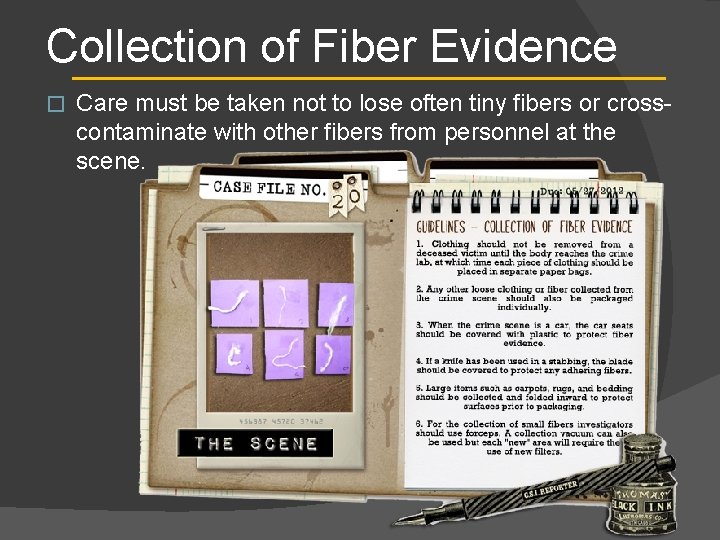
Collection of Fiber Evidence � Care must be taken not to lose often tiny fibers or crosscontaminate with other fibers from personnel at the scene.

Collection and Preservation If it is necessary to remove a fiber from an object, the investigator must use clean forceps, place it in a small sheet of paper, fold and label the paper, and place the paper packet inside another container.
Hair, Fibers Evidence Review 1. Hair is made up of mostly this protein Keratin Medualla Cuticle Cortex lass

Hair, Fibers, Evidence Review ANSWER 1. Hair is made up of mostly this protein Keratin Medualla Cuticle Cortex lass
Hair, Fibers Evidence Review 2. The innermost layer of hair is known as the ____. Class Cuticle Cortex Medulla Keratin
Hair, Fibers Evidence Review 2. The innermost layer of hair is known as the ____. Class Cuticle Cortex Medulla Keratin
Hair, Fibers Evidence Review 3. The pigment granules are located in which layer of the hair? Class Keratin Medulla Cuticle Cortex

Hair, Fibers, and Botanical Evidence Review ANSWER 3. The pigment granules are located in which layer of the hair? Class Keratin Medulla Cuticle Cortex
Hair, Fibers Evidence Review 4. The outer-most layer of the hair is known as the _____ Keratin Cortex Class Medulla cuticle

Hair, Fibers Evidence Review ANSWER 4. The outer-most layer of the hair is known as the _____ Keratin Cortex Class Medulla cuticle
Hair, Fibers Evidence Review 5. Hair is generally considered ____ evidence if based entirely on the morphology of the hair. Cortex Keratin Class Medulla Cuticle
Hair, Fibers Evidence Review ANSWER 5. Hair is generally considered ____ evidence if based entirely on the morphology of the hair. Cortex Keratin Class Medulla Cuticle
Hair, Fibers Evidence Review 6. What type of DNA can be found in the follicular tag of a hair? Triangular Animal Mitochondrial Arrector Pili Human
Hair, Fibers Evidence Review ANSWER 6. What type of DNA can be found in the follicular tag of a hair? Triangular Animal Mitochondrial Arrector Pili Human

Hair, Fibers Evidence Review 7. What is the name of the muscle surrounding hairs that is responsible for “Goose Bumps”? Animal Mitochondrial Human Triangular Arrector Pili

Hair, Fibers Evidence Review ANSWER 7. What is the name of the muscle surrounding hairs that is responsible for “Goose Bumps”? Animal Mitochondrial Human Triangular Arrector Pili
Hair, Fibers Evidence Review 8. Finding a Medulla means that the hair or fiber being examined is from an _____. Arrector Pili Human Mitochondrial Triangular Animal
Hair, Fibers, Evidence Review ANSWER 8. Finding a Medulla means that the hair or fiber being examined is from an _____. Arrector Pili Human Mitochondrial Triangular Animal
Hair, Fibers, Evidence Review 9. A hair with a medullary index less than one third of the total width of the hair is from a ______. Animal Arrector Pili Mitochondrial Human Triangular
Hair, Fibers Evidence Review ANSWER 9. A hair with a medullary index less than one third of the total width of the hair is from a ______. Animal Arrector Pili Mitochondrial Human Triangular
Hair, Fibers Evidence Review 10. Beard hairs are ______ in crosssection. Human Arrector Pili Animal Mitochondrial Triangular
Hair, Fibers Evidence Review ANSWER 10. Beard hairs are ______ in crosssection. Human Arrector Pili Animal Mitochondrial Triangular
Hair, Fibers Evidence Review 11. _____ hair is the fine hair found on the body after birth, but before puberty. Telogen Catagen Natural Vellus Anagen
Hair, Fibers Evidence Review ANSWER 11. _____ hair is the fine hair found on the body after birth, but before puberty. Telogen Catagen Natural Vellus Anagen

Hair, Fibers Evidence Review 12. The initial growth phase of the hair growth cylce is known as _______ Anagen Catagen Natural Talogen Vellus

Hair, Fibers Evidence Review ANSWER 12. The initial growth phase of the hair growth cylce is known as _______ Anagen Catagen Natural Talogen Vellus
Hair, Fibers Evidence Review 13. The dormant phase of the hair growth cycle when hair typically sheds is known as ____. Telogen Catagen Anagen Natural Vellus
Hair, Fibers Evidence Review ANSWER 13. The dormant phase of the hair growth cycle when hair typically sheds is known as ____. Telogen Catagen Anagen Natural Vellus
Hair, Fibers Evidence Review 14. The middle phase of the hair growth cycle when hair is neither growing nor shedding is known as ____ Natural Telogen Anagen Catagen Vellus
Hair, Fibers Evidence Review ANSWER 14. The middle phase of the hair growth cycle when hair is neither growing nor shedding is known as ____ Natural Telogen Anagen Catagen Vellus

Hair, Fibers Evidence Review 15. _____ fibers originate from plant or animal sources. Catagen Anagen Natural Telogen

Hair, Fibers Evidence Review ANSWER 15. _____ fibers originate from plant or animal sources. Catagen Anagen Natural Telogen
Hair, Fibers Evidence Review 16. The most common plant fiber used in clothing is ____ Polyster Polymer Cotton Bindles Less
Hair, Fibers Evidence Review ANSWER 16. The most common plant fiber used in clothing is ____ Polyster Polymer Cotton Bindles Less
Hair, Fibers Evidence Review 17. Natural fibers appear to be ___ uniform that synthetic fibers when viewed through a microscope. Less Bindles Polymer Polyster Cotton
Hair, Fibers Evidence Review ANSWER 17. Natural fibers appear to be ___ uniform that synthetic fibers when viewed through a microscope. Less Bindles Polymer Polyster Cotton
Hair, Fibers Evidence Review 18. Fiber evidence should be collected in paper ____ to avoid being lost or crosscontaminated. Bindles Polyster Less Cotton Polymer
Hair, Fibers Evidence Review ANSWER 18. Fiber evidence should be collected in paper ____ to avoid being lost or crosscontaminated. Bindles Polyster Less Cotton Polymer

Hair, Fibers Evidence Review 19. A substance composed of a large number of atoms that are usually arranged in repeating units is known as a ______. Polyster Cotton Polymer Less Bindles

Hair, Fibers Evidence Review ANSWER 19. A substance composed of a large number of atoms that are usually arranged in repeating units is known as a ______. Polyster Cotton Polymer Less Bindles
Hair, Fibers Evidence Review 20. The most common synthetic fiber is Bindles Cotton Polymer Less Polyester
Hair, Fibers Evidence Review ANSWER 20. The most common synthetic fiber is Bindles Cotton Polymer Less Polyester
Hair, Fibers Evidence Review 21. Synthetic fibers are manufactured by melting small pieces of the material and forcing them through ____. Oxidation Class Forensic Botany Pollen Spinnerets

Hair, Fibers Evidence Review ANSWER 21. Synthetic fibers are manufactured by melting small pieces of the material and forcing them through ____. Oxidation Class Forensic Botany Pollen Spinnerets
Hair, Fibers Evidence Review 22. ____ tests involve burning the fiver to evaluate the ask, behavior in the flame and any smells associated with the fiber. Class Forensic Botany Pollen Oxidation Spinnerets
Hair, Fibers Evidence Review ANSWER 22. ____ tests involve burning the fiver to evaluate the ask, behavior in the flame and any smells associated with the fiber. Class Forensic Botany Pollen Oxidation Spinnerets

Hair, Fibers Evidence Review 23. Fiber evidence is ____ evidence. Oxidation Class Forensic Botany Spinnerets Pollen

Hair, Fibers Evidence Review ANSWER 23. Fiber evidence is ____ evidence. Oxidation Class Forensic Botany Spinnerets Pollen
- Slides: 98