
TRACE EVIDENCE FOOTWEAR TIRE IMPRESSIONS Forensic Science OBJECTIVES
TRACE EVIDENCE: FOOTWEAR & TIRE IMPRESSIONS Forensic Science
OBJECTIVES UNT in partnership with TEA, Copyright ©. All rights reserved. The student will be able to: Distinguish between various types of impression evidence. Differentiate between class and individual characteristics. Collect and preserve footwear impressions left on soil by plaster casting. 2
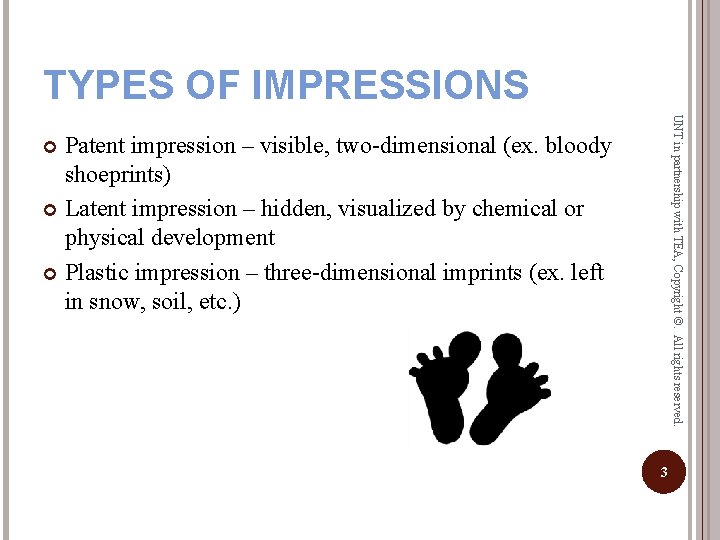
TYPES OF IMPRESSIONS UNT in partnership with TEA, Copyright ©. All rights reserved. Patent impression – visible, two-dimensional (ex. bloody shoeprints) Latent impression – hidden, visualized by chemical or physical development Plastic impression – three-dimensional imprints (ex. left in snow, soil, etc. ) 3
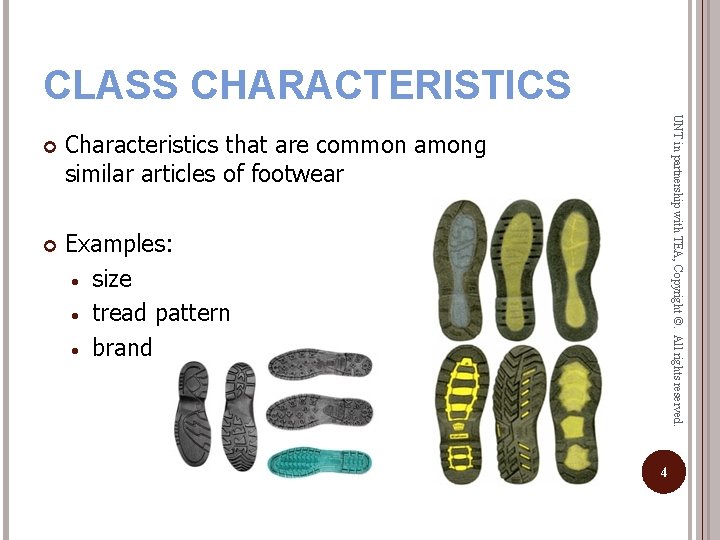
CLASS CHARACTERISTICS Characteristics that are common among similar articles of footwear Examples: • size • tread pattern • brand UNT in partnership with TEA, Copyright ©. All rights reserved. 4
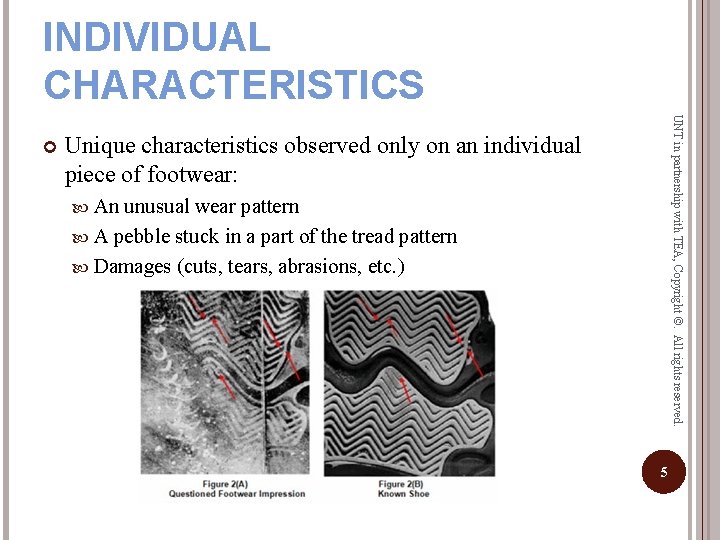
INDIVIDUAL CHARACTERISTICS UNT in partnership with TEA, Copyright ©. All rights reserved. Unique characteristics observed only on an individual piece of footwear: An unusual wear pattern A pebble stuck in a part of the tread pattern Damages (cuts, tears, abrasions, etc. ) 5
TYPICAL CLUES DETERMINED FROM SHOW IMPRESSIONS UNT in partnership with TEA, Copyright ©. All rights reserved. Size of the footwear Brand of the footwear Sex of the wearer Weight of the wearer (based on the depth of the impression) The type of footwear (high heels, work boots, etc. ) 6
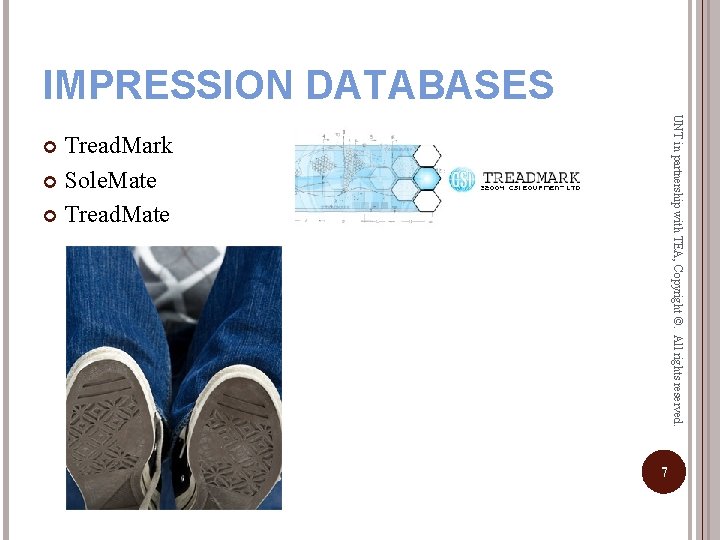
IMPRESSION DATABASES UNT in partnership with TEA, Copyright ©. All rights reserved. Tread. Mark Sole. Mate Tread. Mate 7
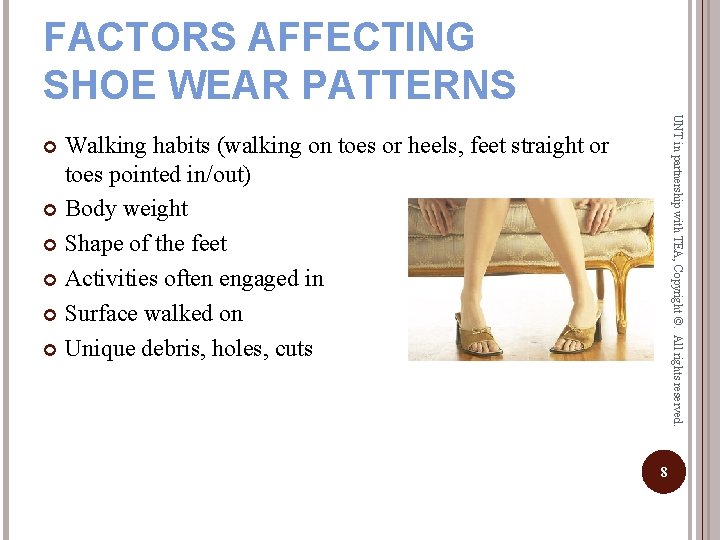
FACTORS AFFECTING SHOE WEAR PATTERNS UNT in partnership with TEA, Copyright ©. All rights reserved. Walking habits (walking on toes or heels, feet straight or toes pointed in/out) Body weight Shape of the feet Activities often engaged in Surface walked on Unique debris, holes, cuts 8
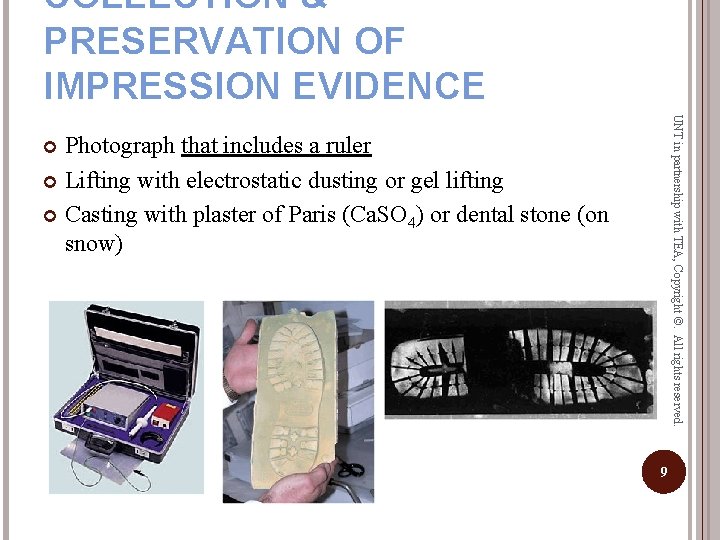
COLLECTION & PRESERVATION OF IMPRESSION EVIDENCE UNT in partnership with TEA, Copyright ©. All rights reserved. Photograph that includes a ruler Lifting with electrostatic dusting or gel lifting Casting with plaster of Paris (Ca. SO 4) or dental stone (on snow) 9
RESOURCES Saferstein, Richard. Forensic Science: An Introduction. New Jersey: Pearson Prentice Hall, 2008. Bertino, Anthony J. Forensic Science: Fundamentals and Investigations. Mason, OH: South-Western Cengage Learning, 2009. Dr. Murray’s Footprint Lab http: //science. marshall. edu/murraye/Footprint%20 Lab. html Federal Bureau of Investigation http: //www. fbi. gov/about-us/lab/handbook-of-forensicservices-pdf/ UNT in partnership with TEA, Copyright ©. All rights reserved. 10
- Slides: 10