
Trace alignment with dynamic programming Chris Liner and

- Slides: 40
Trace alignment with dynamic programming Chris Liner and Bob Clapp SEP 115 Pg. 337 -345
Outline • Dynamic programming • Needleman-Wunsch • Seismic extensions
Dynamic programming • Solve non-linear problem • Works for non-linear problems that can be characterized as a series of decisions with a limited (discrete) set of outcomes • The best solution is built by finding the path that gives the maximum “score”
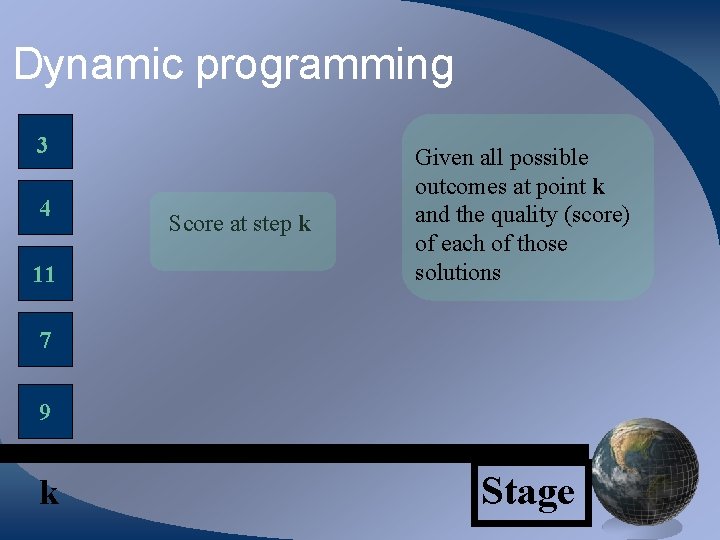
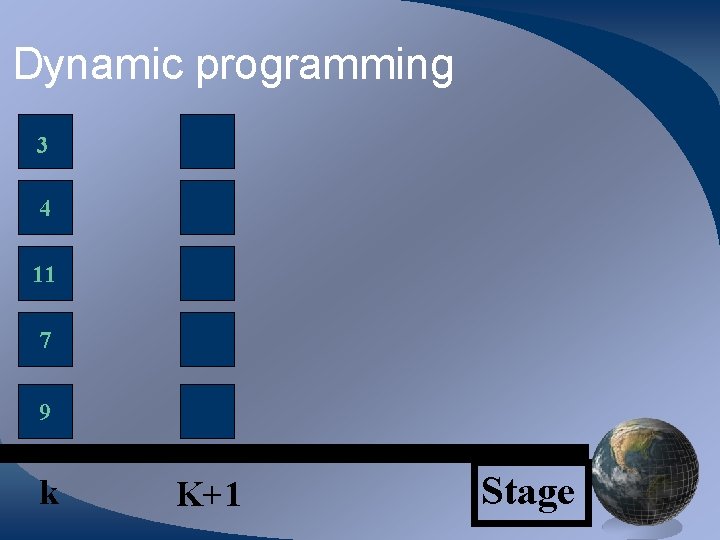
Dynamic programming 3 4 11 Score at step k Given all possible outcomes at point k and the quality (score) of each of those solutions 7 9 k Stage
Dynamic programming 3 4 11 7 9 k K+1 Stage
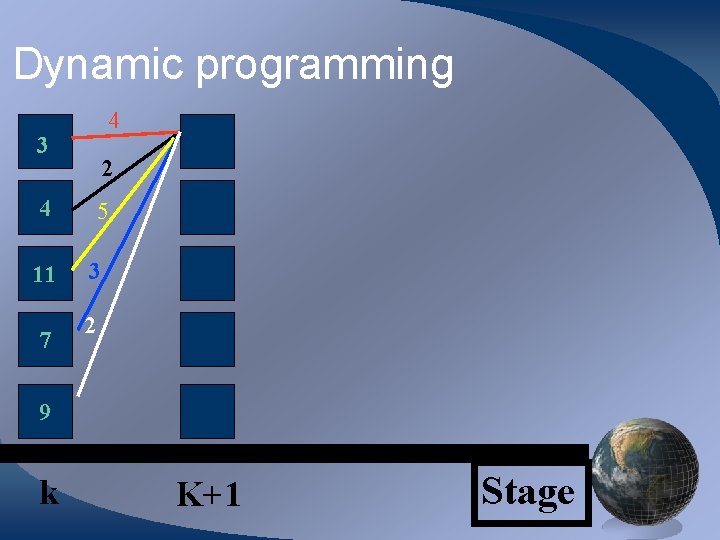
Dynamic programming 4 3 2 4 11 7 5 3 2 9 k K+1 Stage
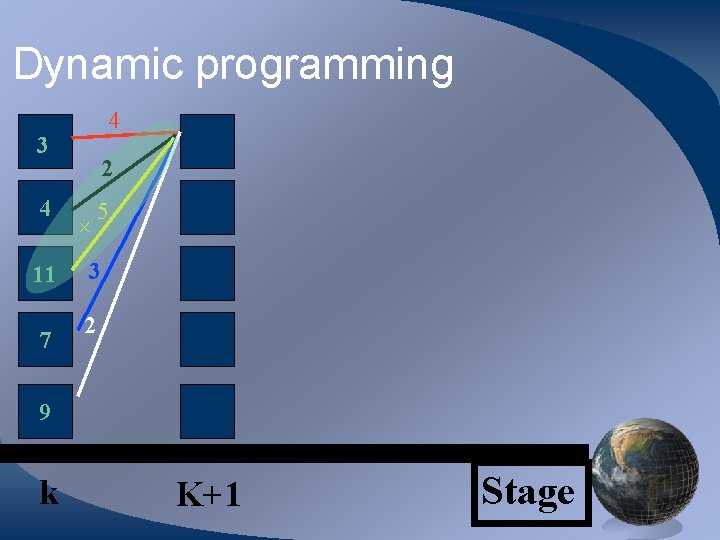
Dynamic programming 4 3 2 4 + 5 11 7 3 2 9 k K+1 Stage
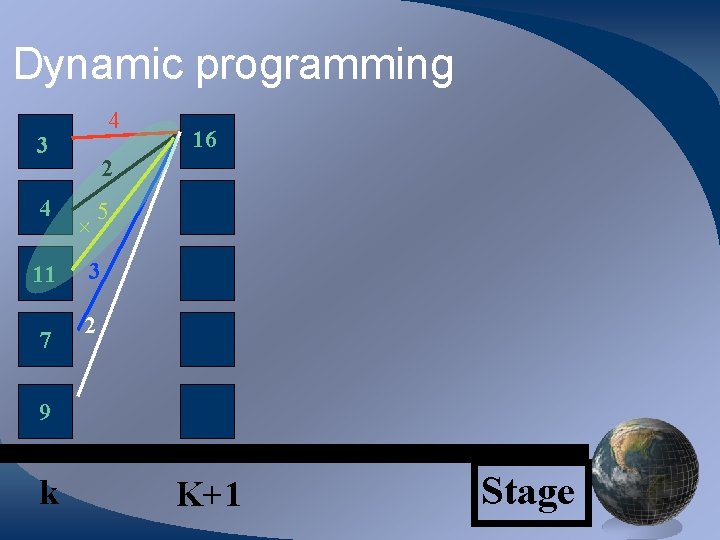
Dynamic programming 4 3 16 2 4 + 5 11 7 3 2 9 k K+1 Stage
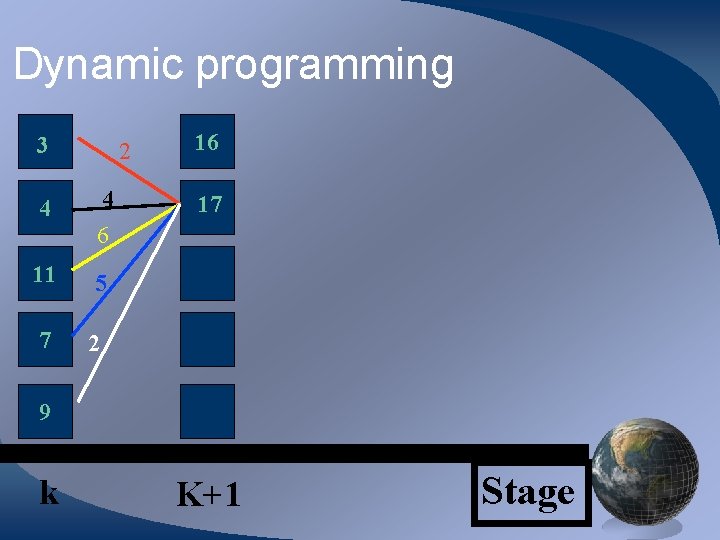
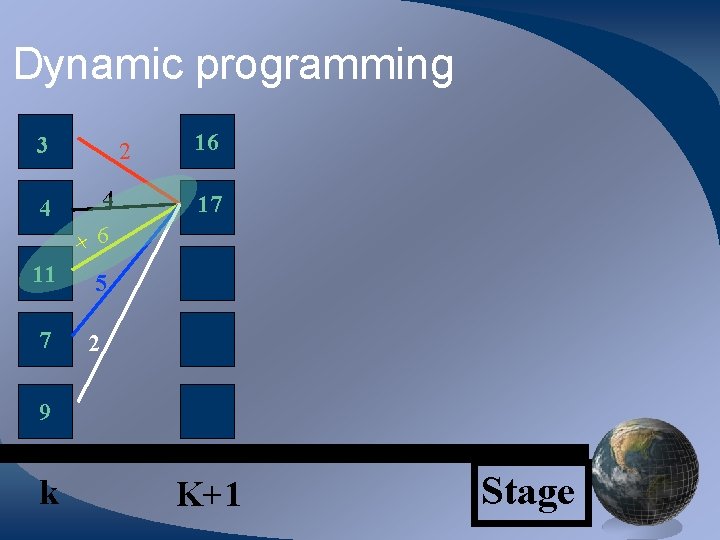
Dynamic programming 3 2 4 4 6 11 5 7 2 16 17 9 k K+1 Stage
Dynamic programming 3 2 4 4 +6 11 5 7 2 16 17 9 k K+1 Stage
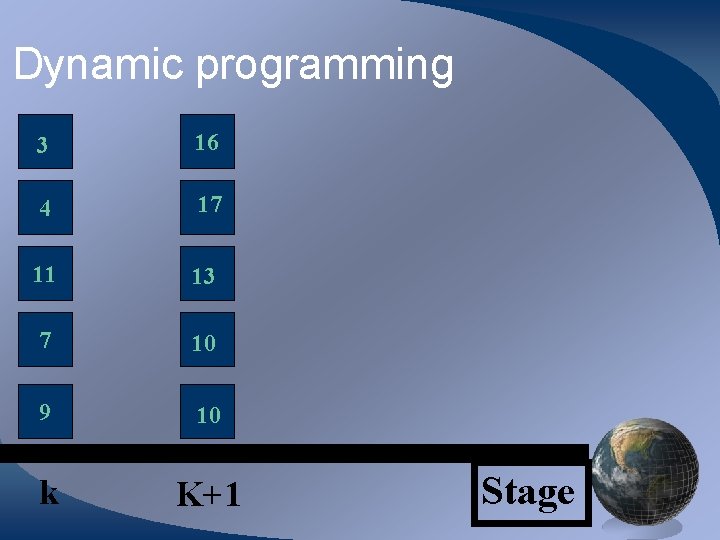
Dynamic programming 3 16 4 17 11 13 7 10 9 10 k K+1 Stage
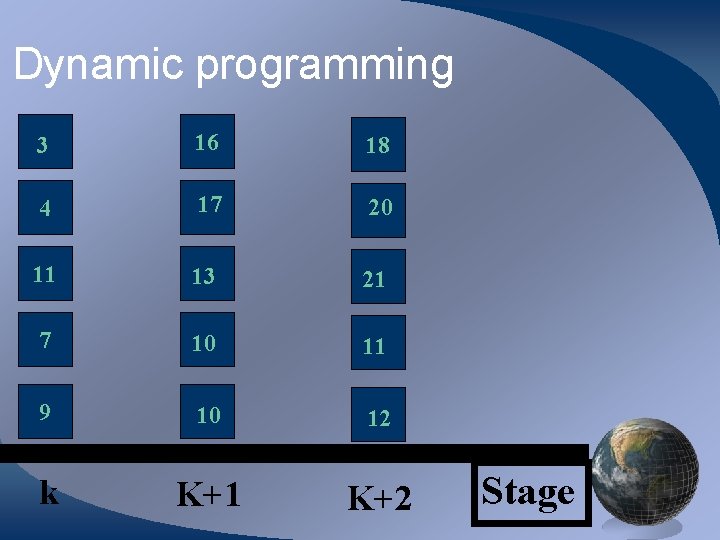
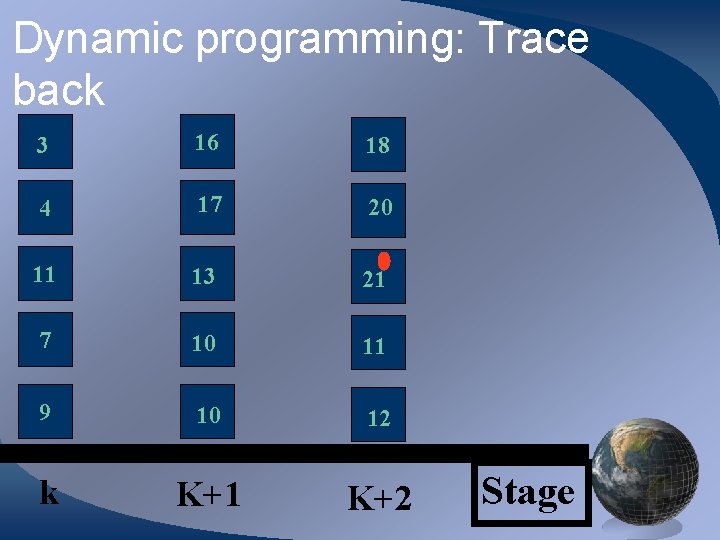
Dynamic programming 3 16 18 4 17 20 11 13 21 7 10 11 9 10 12 k K+1 K+2 Stage
Dynamic programming: Trace back 3 16 18 4 17 20 11 13 21 7 10 11 9 10 12 k K+1 K+2 Stage
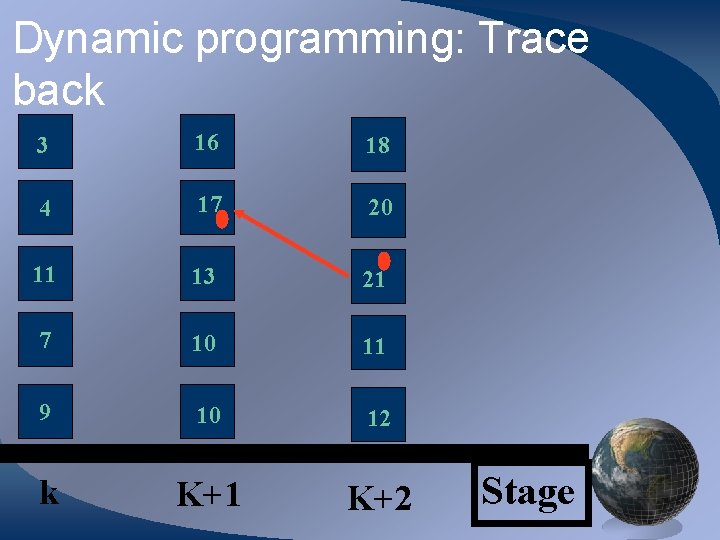
Dynamic programming: Trace back 3 16 18 4 17 20 11 13 21 7 10 11 9 10 12 k K+1 K+2 Stage
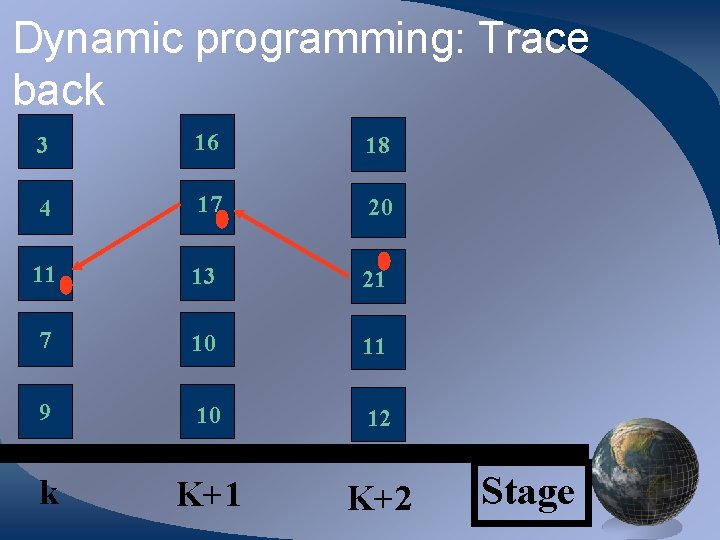
Dynamic programming: Trace back 3 16 18 4 17 20 11 13 21 7 10 11 9 10 12 k K+1 K+2 Stage
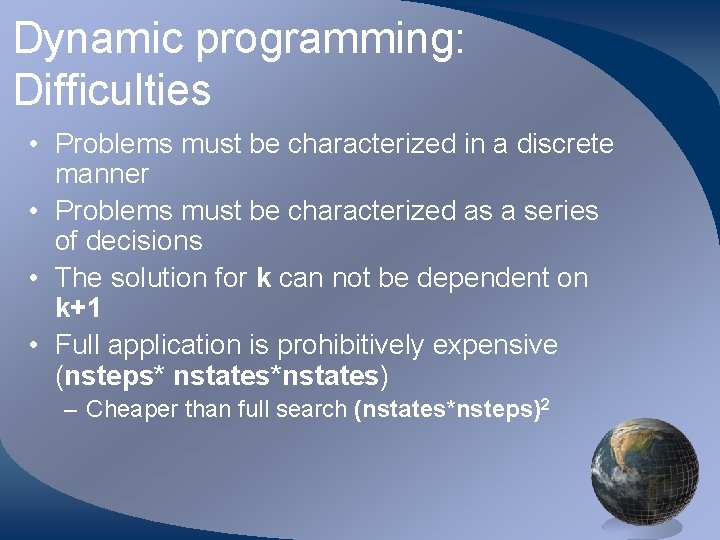
Dynamic programming: Difficulties • Problems must be characterized in a discrete manner • Problems must be characterized as a series of decisions • The solution for k can not be dependent on k+1 • Full application is prohibitively expensive (nsteps* nstates*nstates) – Cheaper than full search (nstates*nsteps)2
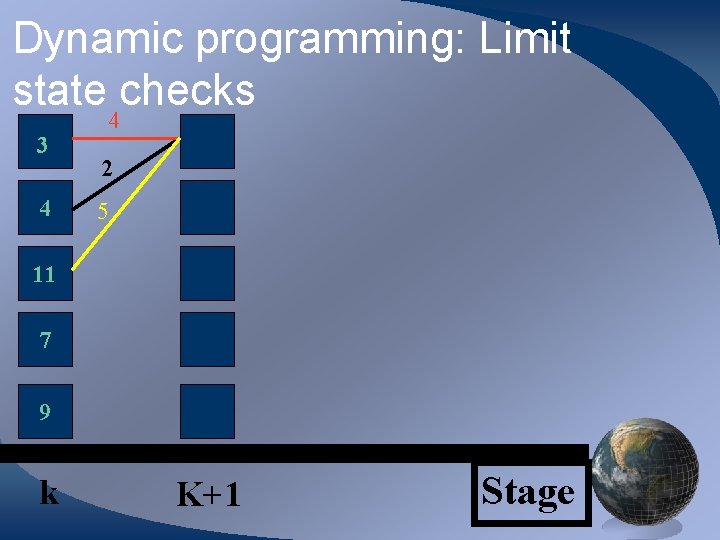
Dynamic programming: Limit state checks 3 4 4 2 5 11 7 9 k K+1 Stage
Outline • Dynamic programming • Needleman-Wunsch • Seismic extensions
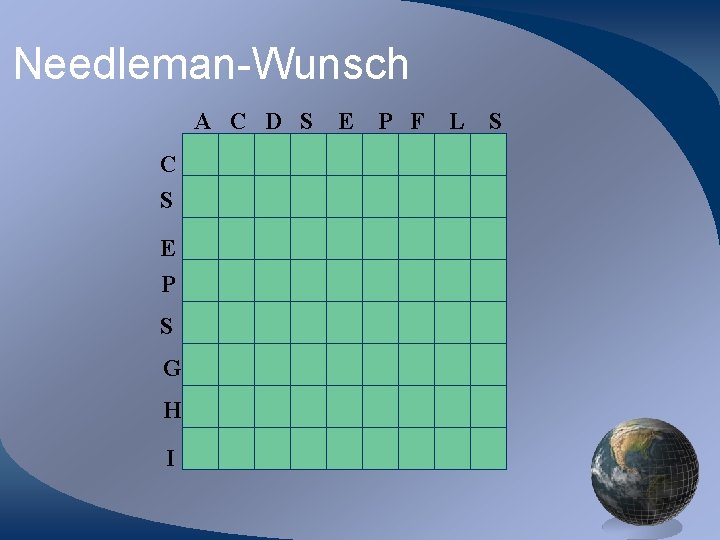
Needleman-Wunsch A C D S E C S E P S G H I P F L S
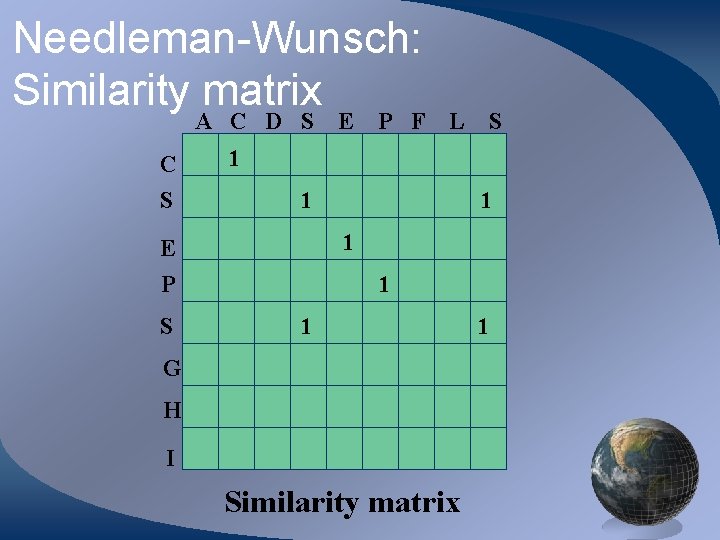
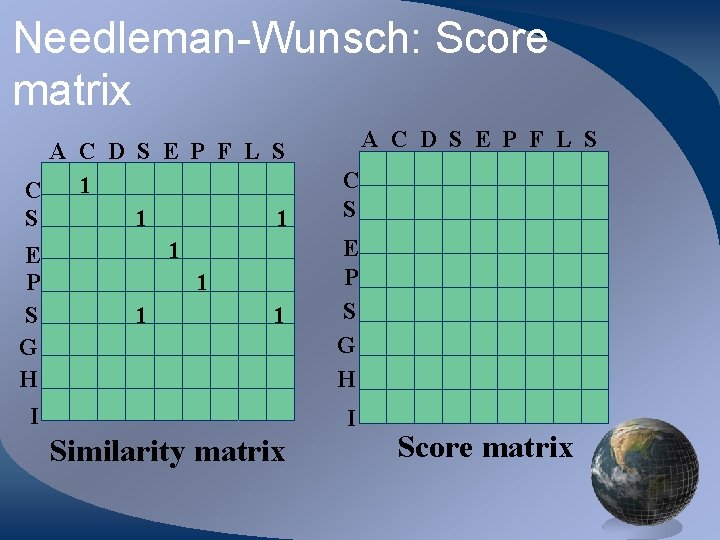
Needleman-Wunsch: Similarity matrix A C D S E C S L S 1 1 E P S P F 1 1 G H I Similarity matrix 1
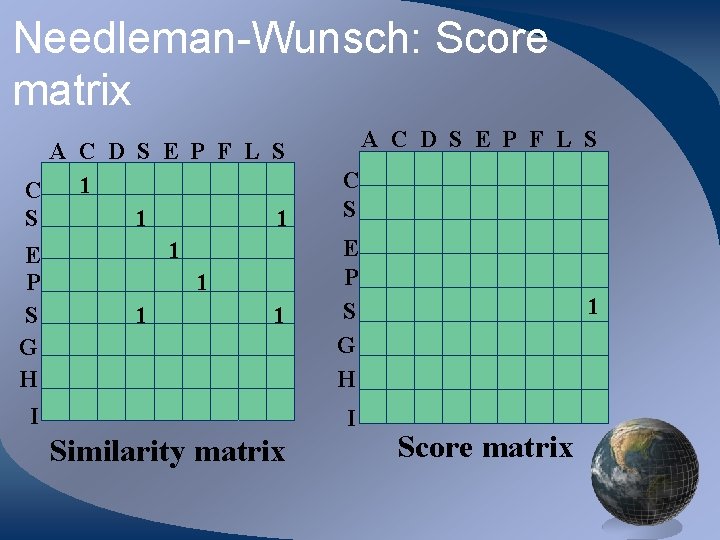
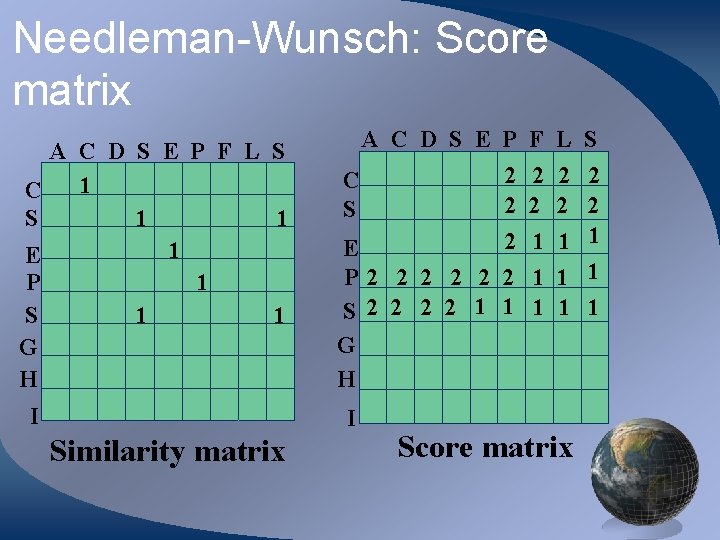
Needleman-Wunsch: Score matrix A C D S E P F L S 1 C S 1 1 1 E P 1 S 1 1 G H I A C D S E P F L S C S E P S G H I Similarity matrix Score matrix
Needleman-Wunsch: Score matrix A C D S E P F L S 1 C S 1 1 1 E P 1 S 1 1 G H I A C D S E P F L S C S E P S G H I Similarity matrix 1 Score matrix
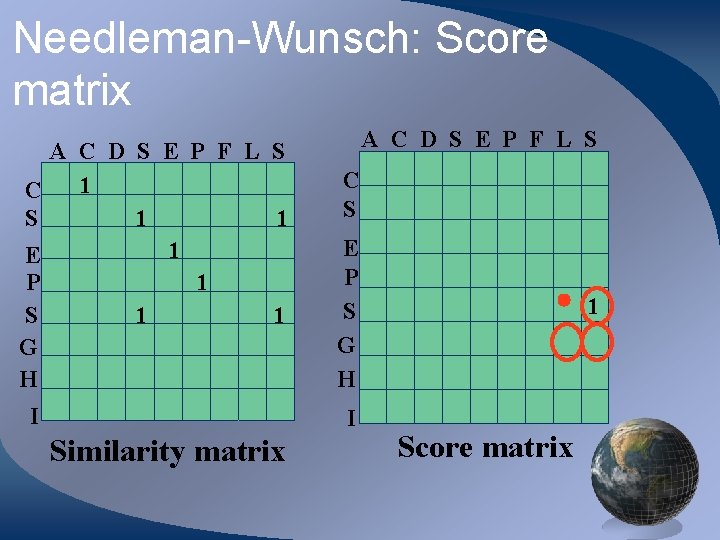
Needleman-Wunsch: Score matrix A C D S E P F L S 1 C S 1 1 1 E P 1 S 1 1 G H I A C D S E P F L S C S E P S G H I Similarity matrix 1 Score matrix
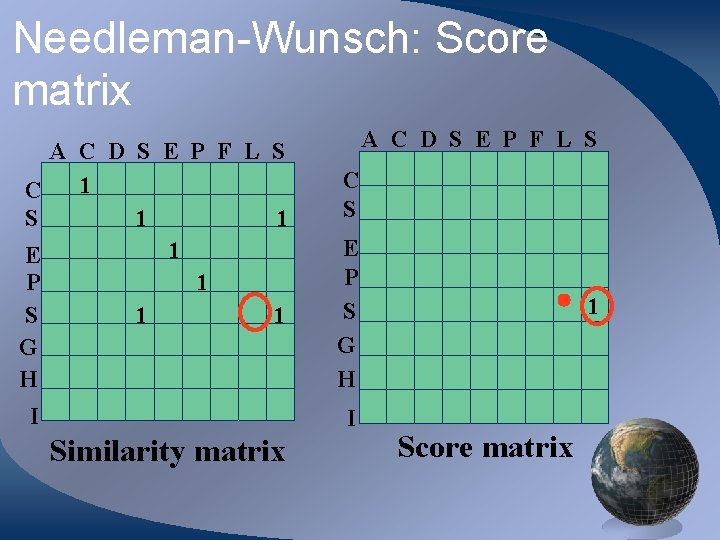
Needleman-Wunsch: Score matrix A C D S E P F L S 1 C S 1 1 1 E P 1 S 1 1 G H I A C D S E P F L S C S E P S G H I Similarity matrix 1 Score matrix
Needleman-Wunsch: Score matrix A C D S E P F L S 1 C S 1 1 1 E P 1 S 1 1 G H I A C D S E P F L S 2 2 2 E P 2 2 2 S 2 2 1 1 G H C S I Similarity matrix 2 2 1 1 1 Score matrix 2 2 1 1 1
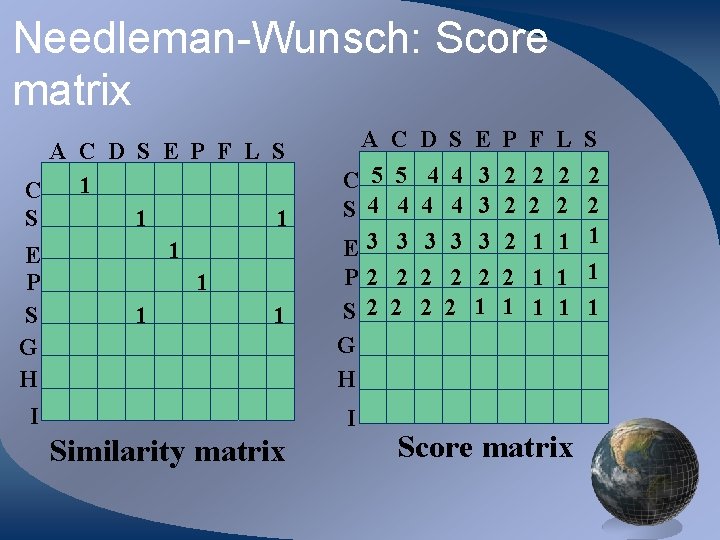
Needleman-Wunsch: Score matrix A C D S E P F L S 1 C S 1 1 1 E P 1 S 1 1 G H I A C D S E P F L S C 5 S 4 E 3 P 2 S 2 G H I Similarity matrix 5 4 3 2 2 4 4 3 3 2 2 3 3 3 2 1 2 2 1 1 1 Score matrix 2 2 1 1 1
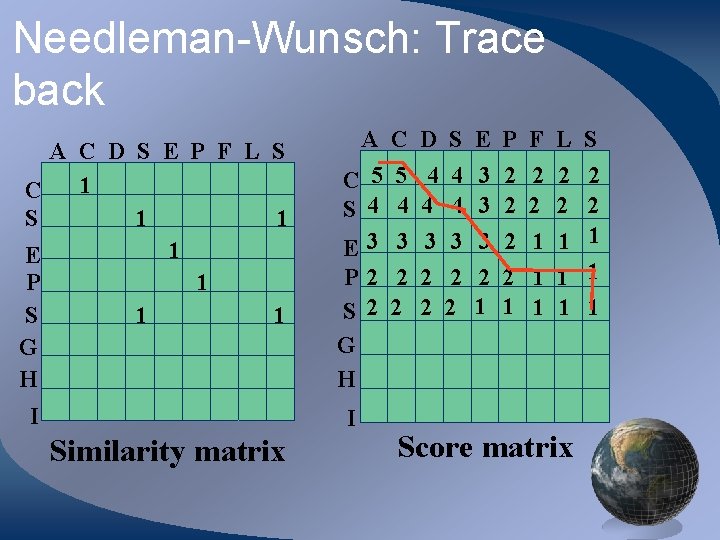
Needleman-Wunsch: Trace back A C D S E P F L S 1 C S 1 1 1 E P 1 S 1 1 G H I A C D S E P F L S C 5 S 4 E 3 P 2 S 2 G H I Similarity matrix 5 4 3 2 2 4 4 3 3 2 2 3 3 3 2 1 2 2 1 1 1 Score matrix 2 2 1 1 1
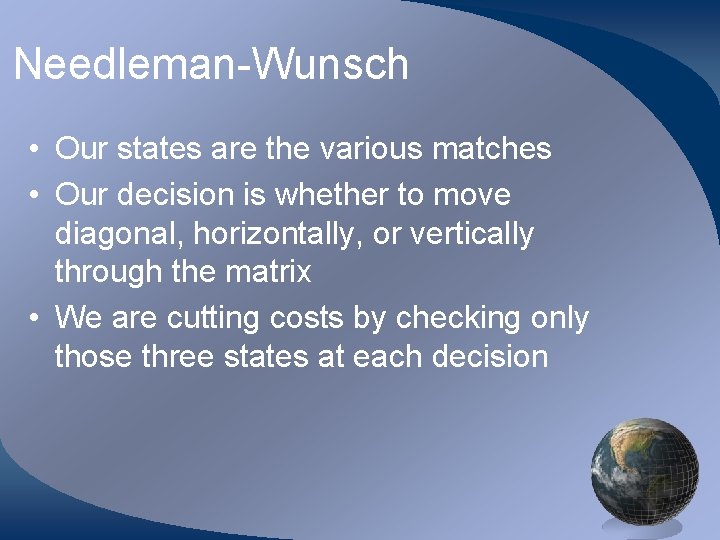
Needleman-Wunsch • Our states are the various matches • Our decision is whether to move diagonal, horizontally, or vertically through the matrix • We are cutting costs by checking only those three states at each decision
Outline • Dynamic programming • Needleman-Wunsch • Seismic extensions
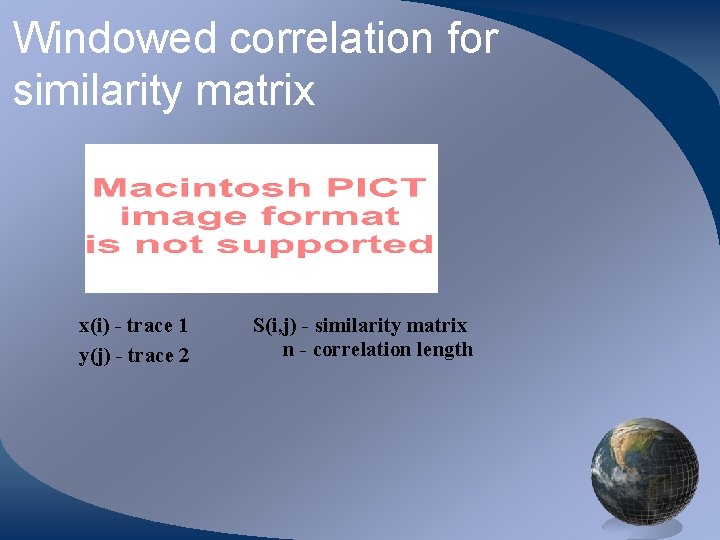
Windowed correlation for similarity matrix x(i) - trace 1 y(j) - trace 2 S(i, j) - similarity matrix n - correlation length
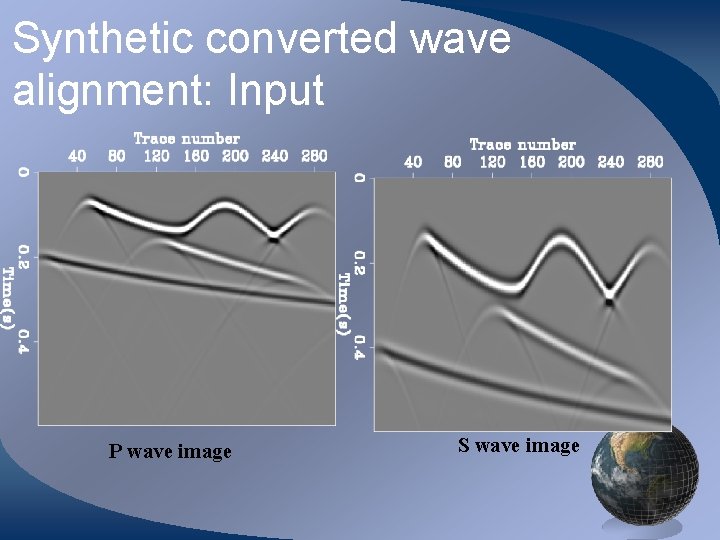
Synthetic converted wave alignment: Input P wave image S wave image
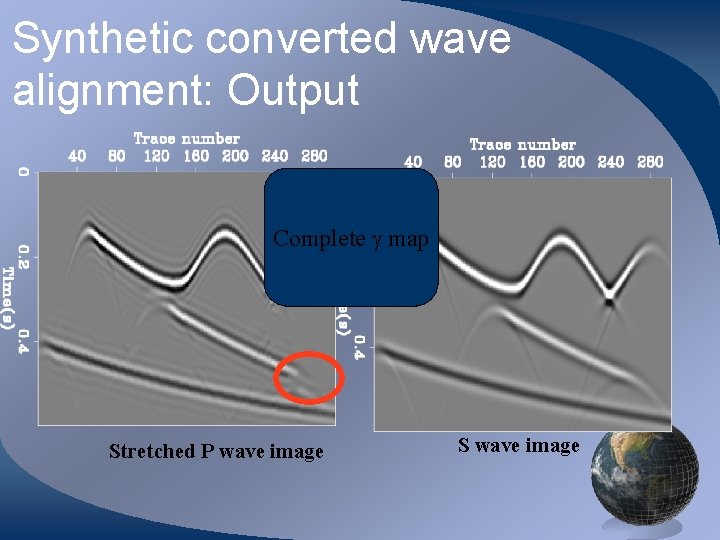
Synthetic converted wave alignment: Output Complete map Stretched P wave image S wave image
Gather alignment d - non-aligned gather m - aligned gather - smoothness parameter L - Mapping operator from alignment A - Non-stationary PEF estimated from data operator
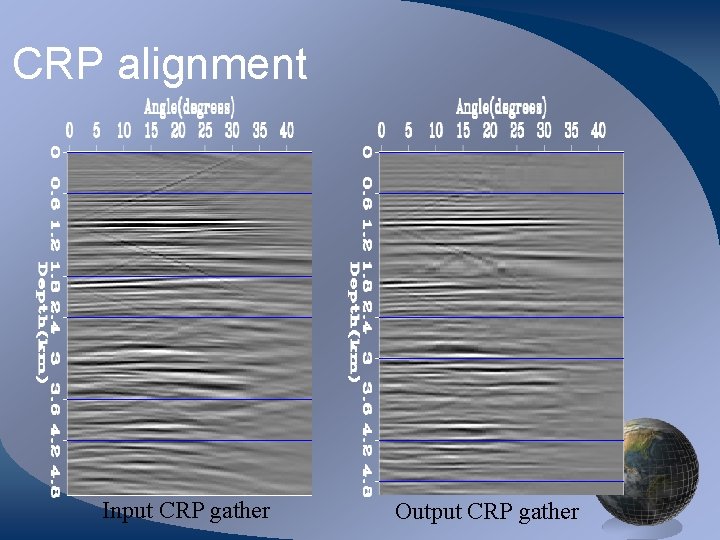
CRP alignment Input CRP gather Output CRP gather
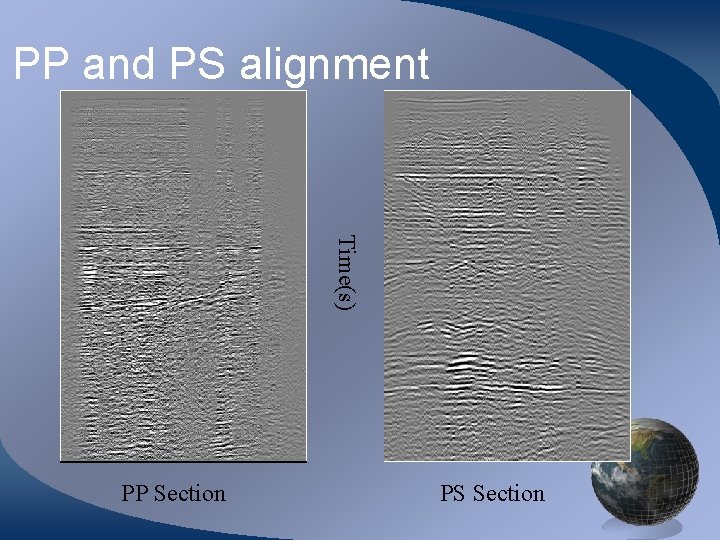
PP and PS alignment Time(s) PP Section PS Section
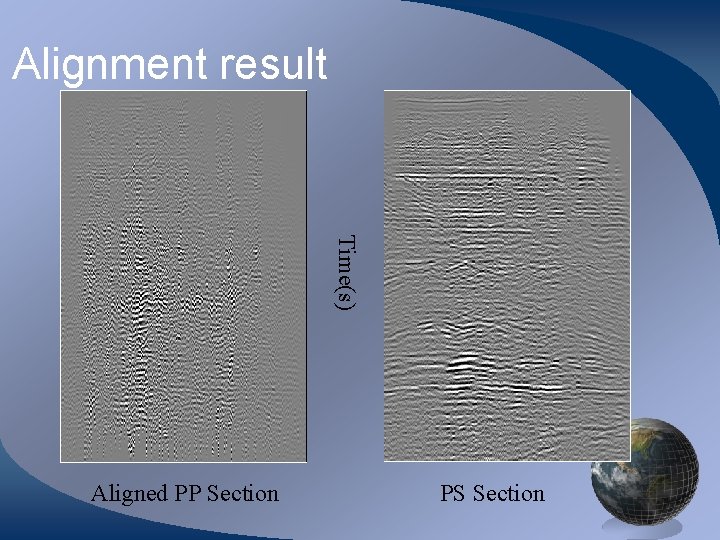
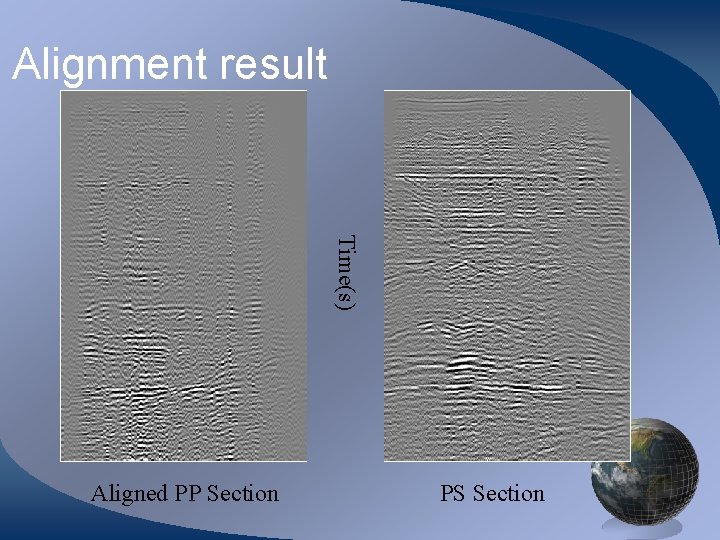
Alignment result Time(s) Aligned PP Section PS Section
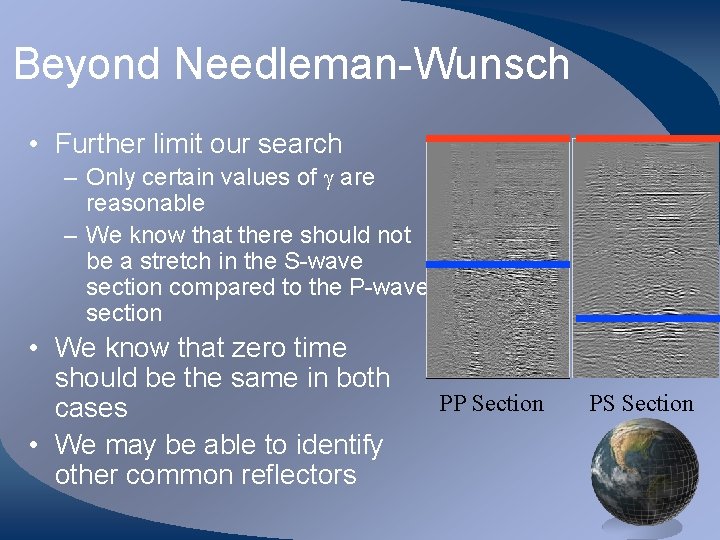
Beyond Needleman-Wunsch • Further limit our search – Only certain values of are reasonable – We know that there should not be a stretch in the S-wave section compared to the P-wave section • We know that zero time should be the same in both cases • We may be able to identify other common reflectors PP Section PS Section
Alignment result Time(s) Aligned PP Section PS Section
Alignment result Time(s) Aligned PP Section Poor PP alignment
Conclusions • Dynamic programming can be an effective tool for solving certain classes of problems • For simple alignment problems Needlman-Wunsch is an effective alignment tool • For more complex problems additional constraints need to be added