
TPC Benchmarks Charles Levine Microsoft clevinemicrosoft com Western
TPC Benchmarks Charles Levine Microsoft clevine@microsoft. com Western Institute of Computer Science Stanford, CA August 6, 1999
Outline l l l Introduction History of TPC-A/B Legacy TPC-C TPC-H/R TPC Futures
Benchmarks: What and Why l l What is a benchmark? Domain specific l l No single metric possible The more general the benchmark, the less useful it is for anything in particular. A benchmark is a distillation of the essential attributes of a workload Desirable attributes l l l Relevant meaningful within the target domain Understandable Good metric(s) linear, orthogonal, monotonic Scaleable applicable to a broad spectrum of hardware/architecture Coverage does not oversimplify the typical environment Acceptance Vendors and Users embrace it

Benefits and Liabilities l Good benchmarks l l Define the playing field Accelerate progress l Engineers do a great job once objective is measureable and repeatable Set the performance agenda l Measure release-to-release progress l Set goals (e. g. , 100, 000 tpm. C, < 10 $/tpm. C) l Something managers can understand (!) Benchmark abuse l l Benchmarketing Benchmark wars l more $ on ads than development
Benchmarks have a Lifetime l l Good benchmarks drive industry and technology forward. At some point, all reasonable advances have been made. Benchmarks can become counter productive by encouraging artificial optimizations. So, even good benchmarks become obsolete over time.
Outline l l l Introduction History of TPC-A Legacy TPC-C TPC-H/R TPC Futures
What is the TPC? l l l TPC = Transaction Processing Performance Council Founded in Aug/88 by Omri Serlin and 8 vendors. Membership of 40 -45 for last several years l Everybody who’s anybody in software & hardware l De facto industry standards body for OLTP performance l Administered by: Shanley Public Relations ph: (408) 295 -8894 650 N. Winchester Blvd, Suite 1 fax: (408) 271 -6648 San Jose, CA 95128 email: shanley@tpc. org l Most TPC specs, info, results are on the web page: http: www. tpc. org
Two Seminal Events Leading to TPC l Anon, et al, “A Measure of Transaction Processing Power”, Datamation, April fools day, 1985. l l l Anon = Jim Gray (Dr. E. A. Anon) Sort: 1 M 100 byte records Mini-batch: copy 1000 records Debit. Credit: simple ATM style transaction Tandem Top. Gun Benchmark l l l Debit. Credit 212 tps on Non. Stop SQL in 1987 (!) Audited by Tom Sawyer of Codd and Date (A first) Full Disclosure of all aspects of tests (A first) Started the ET 1/TP 1 Benchmark wars of ’ 87 -’ 89
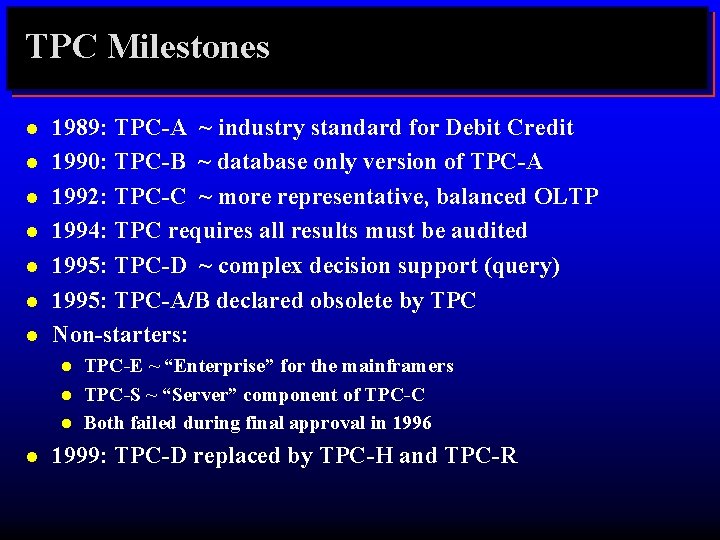
TPC Milestones l l l l 1989: TPC-A ~ industry standard for Debit Credit 1990: TPC-B ~ database only version of TPC-A 1992: TPC-C ~ more representative, balanced OLTP 1994: TPC requires all results must be audited 1995: TPC-D ~ complex decision support (query) 1995: TPC-A/B declared obsolete by TPC Non-starters: l l TPC-E ~ “Enterprise” for the mainframers TPC-S ~ “Server” component of TPC-C Both failed during final approval in 1996 1999: TPC-D replaced by TPC-H and TPC-R
TPC vs. SPEC l SPEC (System Performance Evaluation Cooperative) l l SPEC ships code l l l Unix centric CPU centric TPC ships specifications l l SPECMarks Ecumenical Database/System/TP centric Price/Performance The TPC and SPEC happily coexist l There is plenty of room for both
Outline l l l Introduction History of TPC-A/B Legacy TPC-C TPC-H/R TPC Futures
TPC-A Legacy l l l First results in 1990: 38. 2 tps. A, 29. 2 K$/tps. A (HP) Last results in 1994: 3700 tps. A, 4. 8 K$/tps. A (DEC) WOW! 100 x on performance and 6 x on price in five years!!! TPC cut its teeth on TPC-A/B; became functioning, representative body Learned a lot of lessons: l l If benchmark is not meaningful, it doesn’t matter how many numbers or how easy to run (TPC-B). How to resolve ambiguities in spec How to police compliance Rules of engagement
TPC-A Established OLTP Playing Field l l TPC-A criticized for being irrelevant, unrepresentative, misleading But, truth is that TPC-A drove performance, drove price/performance, and forced everyone to clean up their products to be competitive. Trend forced industry toward one price/performance, regardless of size. Became means to achieve legitimacy in OLTP for some.
Outline l l l Introduction History of TPC-A/B Legacy TPC-C TPC-D TPC Futures
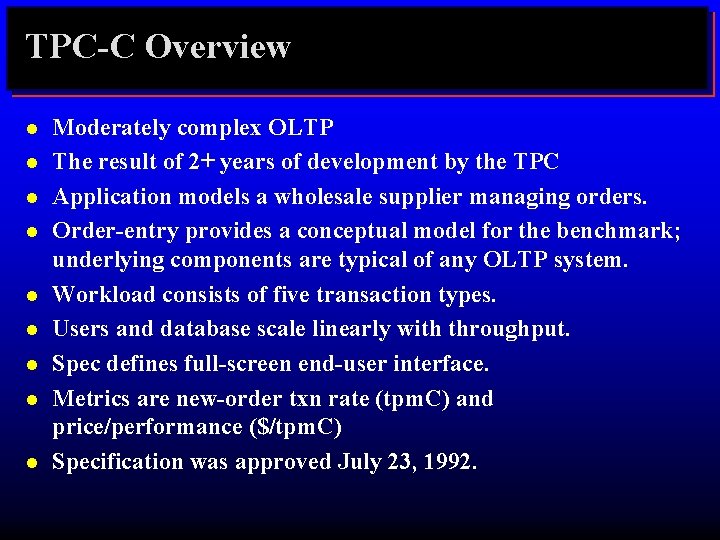
TPC-C Overview l l l l l Moderately complex OLTP The result of 2+ years of development by the TPC Application models a wholesale supplier managing orders. Order-entry provides a conceptual model for the benchmark; underlying components are typical of any OLTP system. Workload consists of five transaction types. Users and database scale linearly with throughput. Spec defines full-screen end-user interface. Metrics are new-order txn rate (tpm. C) and price/performance ($/tpm. C) Specification was approved July 23, 1992.
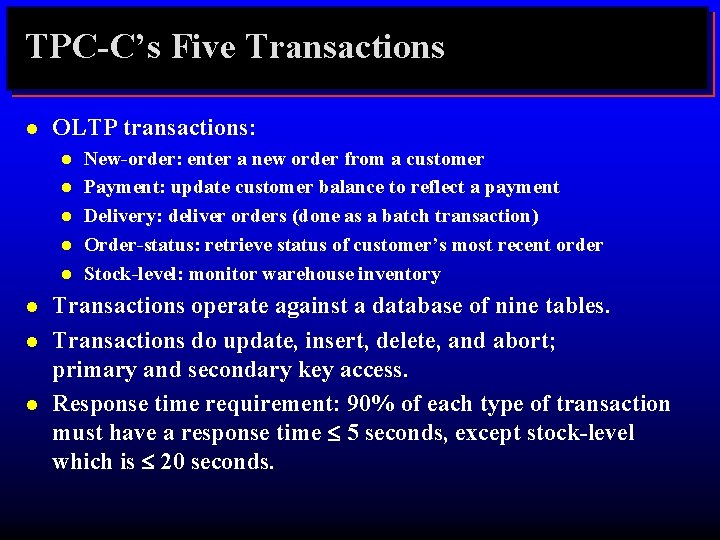
TPC-C’s Five Transactions l OLTP transactions: l l l l New-order: enter a new order from a customer Payment: update customer balance to reflect a payment Delivery: deliver orders (done as a batch transaction) Order-status: retrieve status of customer’s most recent order Stock-level: monitor warehouse inventory Transactions operate against a database of nine tables. Transactions do update, insert, delete, and abort; primary and secondary key access. Response time requirement: 90% of each type of transaction must have a response time £ 5 seconds, except stock-level which is £ 20 seconds.
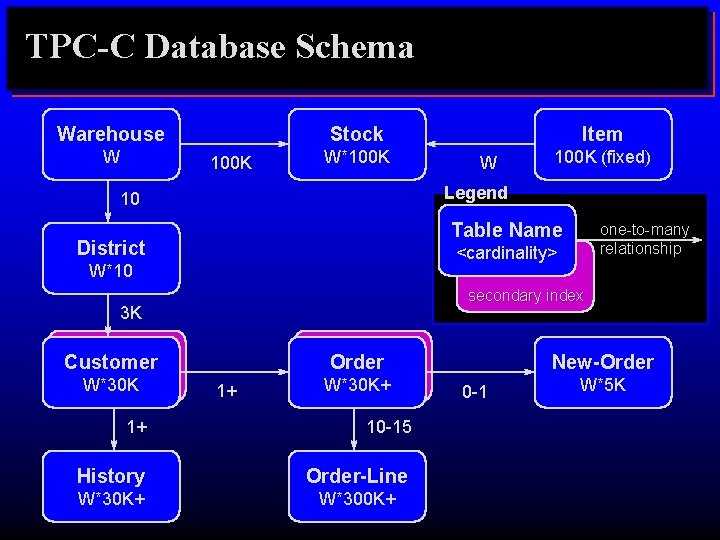
TPC-C Database Schema Warehouse W Stock 100 K W*100 K W 100 K (fixed) Legend 10 Table Name District one-to-many relationship <cardinality> W*10 secondary index 3 K Customer W*30 K Item Order 1+ W*30 K+ 1+ 10 -15 History Order-Line W*30 K+ W*300 K+ New-Order 0 -1 W*5 K
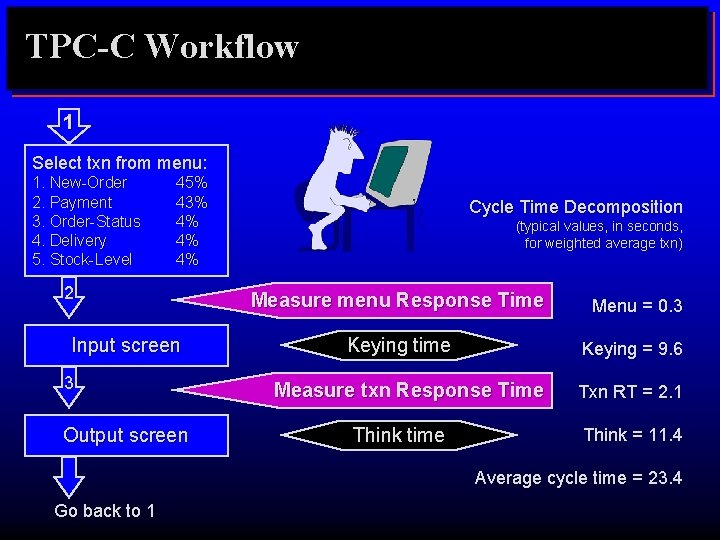
TPC-C Workflow 1 Select txn from menu: 1. New-Order 2. Payment 3. Order-Status 4. Delivery 5. Stock-Level 45% 43% 4% 4% 4% 2 Input screen 3 Output screen Cycle Time Decomposition (typical values, in seconds, for weighted average txn) Measure menu Response Time Menu = 0. 3 Keying time Keying = 9. 6 Measure txn Response Time Think time Txn RT = 2. 1 Think = 11. 4 Average cycle time = 23. 4 Go back to 1
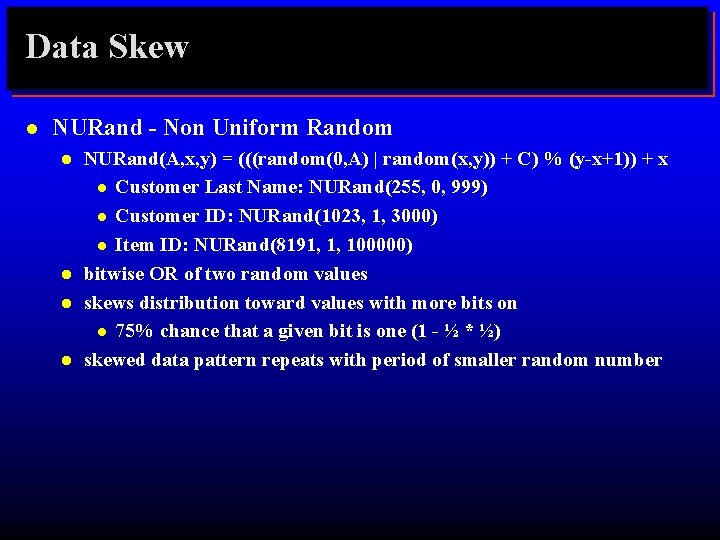
Data Skew l NURand - Non Uniform Random l l NURand(A, x, y) = (((random(0, A) | random(x, y)) + C) % (y-x+1)) + x l Customer Last Name: NURand(255, 0, 999) l Customer ID: NURand(1023, 1, 3000) l Item ID: NURand(8191, 1, 100000) bitwise OR of two random values skews distribution toward values with more bits on l 75% chance that a given bit is one (1 - ½ * ½) skewed data pattern repeats with period of smaller random number
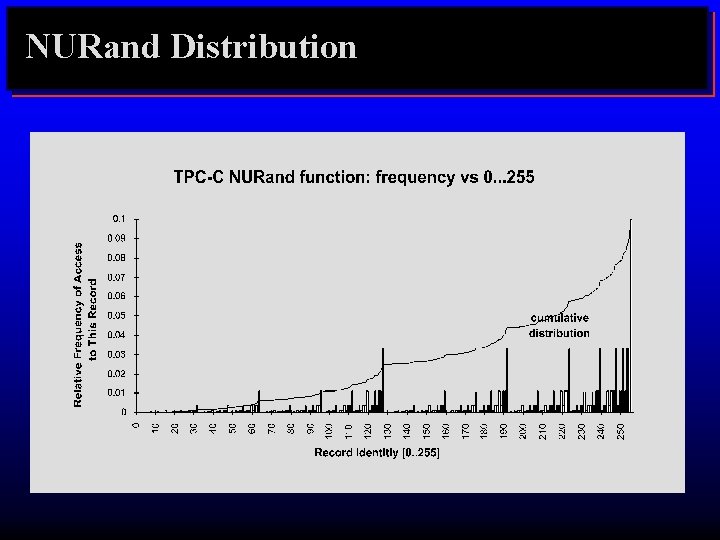
NURand Distribution
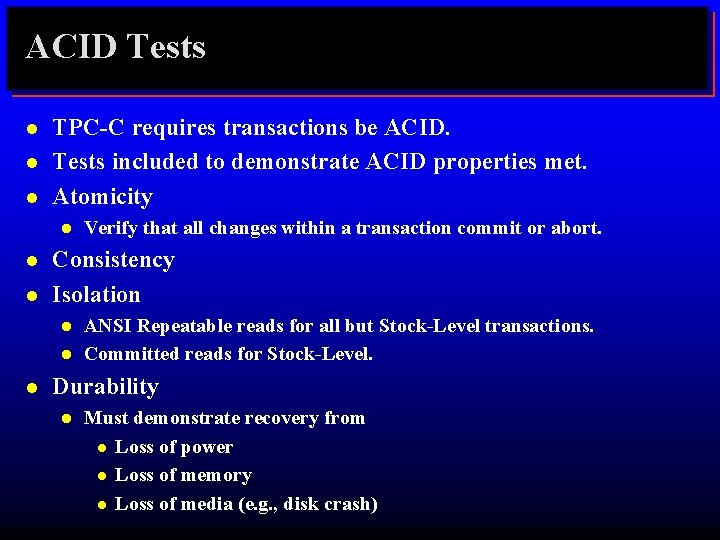
ACID Tests l l l TPC-C requires transactions be ACID. Tests included to demonstrate ACID properties met. Atomicity l l l Consistency Isolation l l l Verify that all changes within a transaction commit or abort. ANSI Repeatable reads for all but Stock-Level transactions. Committed reads for Stock-Level. Durability l Must demonstrate recovery from l Loss of power l Loss of memory l Loss of media (e. g. , disk crash)
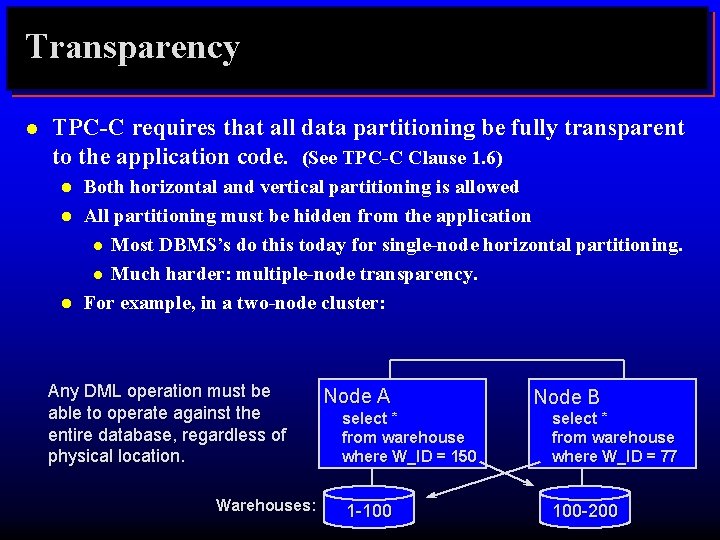
Transparency l TPC-C requires that all data partitioning be fully transparent to the application code. (See TPC-C Clause 1. 6) l l l Both horizontal and vertical partitioning is allowed All partitioning must be hidden from the application l Most DBMS’s do this today for single-node horizontal partitioning. l Much harder: multiple-node transparency. For example, in a two-node cluster: Any DML operation must be able to operate against the entire database, regardless of physical location. Warehouses: Node A Node B select * from warehouse where W_ID = 150 select * from warehouse where W_ID = 77 1 -100 100 -200
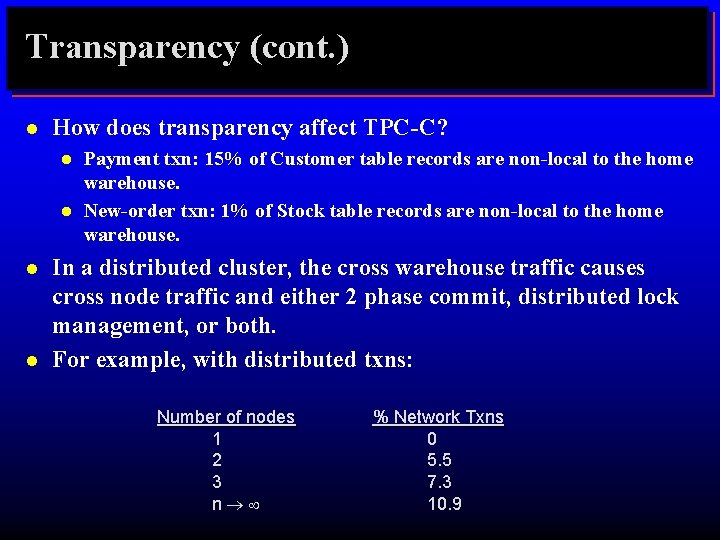
Transparency (cont. ) l How does transparency affect TPC-C? l l Payment txn: 15% of Customer table records are non-local to the home warehouse. New-order txn: 1% of Stock table records are non-local to the home warehouse. In a distributed cluster, the cross warehouse traffic causes cross node traffic and either 2 phase commit, distributed lock management, or both. For example, with distributed txns: Number of nodes 1 2 3 n®¥ % Network Txns 0 5. 5 7. 3 10. 9
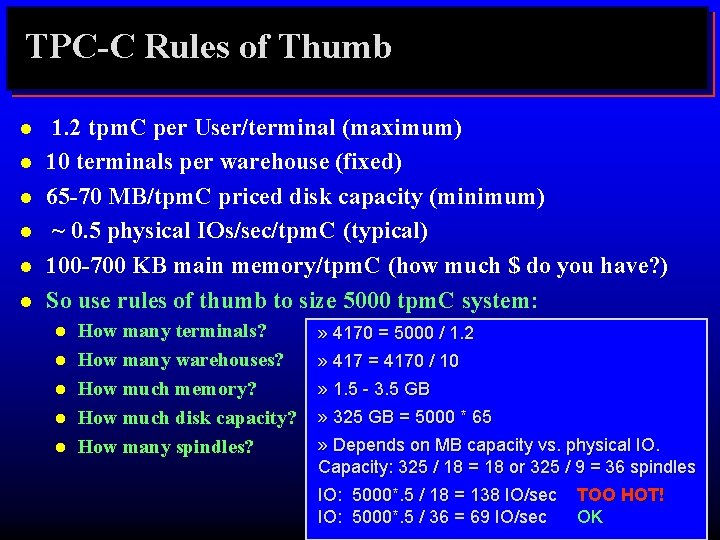
TPC-C Rules of Thumb l l l 1. 2 tpm. C per User/terminal (maximum) 10 terminals per warehouse (fixed) 65 -70 MB/tpm. C priced disk capacity (minimum) ~ 0. 5 physical IOs/sec/tpm. C (typical) 100 -700 KB main memory/tpm. C (how much $ do you have? ) So use rules of thumb to size 5000 tpm. C system: l l l How many terminals? How many warehouses? How much memory? How much disk capacity? How many spindles? » 4170 = 5000 / 1. 2 » 417 = 4170 / 10 » 1. 5 - 3. 5 GB » 325 GB = 5000 * 65 » Depends on MB capacity vs. physical IO. Capacity: 325 / 18 = 18 or 325 / 9 = 36 spindles IO: 5000*. 5 / 18 = 138 IO/sec IO: 5000*. 5 / 36 = 69 IO/sec TOO HOT! OK
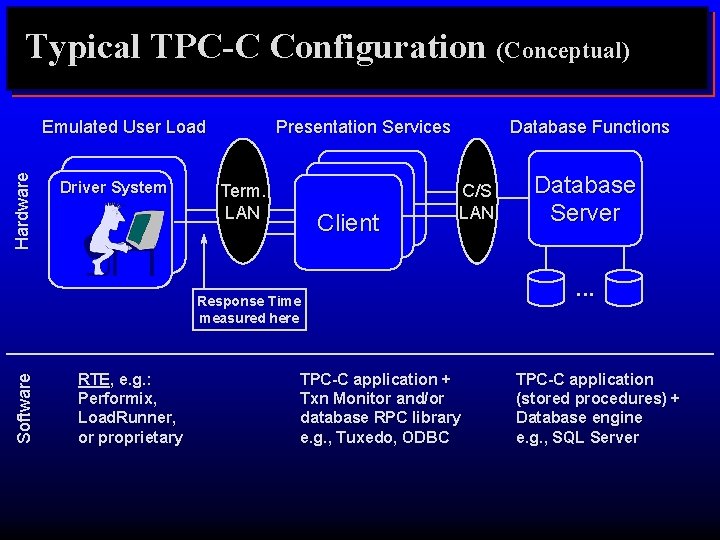
Typical TPC-C Configuration (Conceptual) Hardware Emulated User Load Driver System Presentation Services Term. LAN Client Database Functions C/S LAN Software Response Time measured here RTE, e. g. : Performix, Load. Runner, or proprietary TPC-C application + Txn Monitor and/or database RPC library e. g. , Tuxedo, ODBC Database Server. . . TPC-C application (stored procedures) + Database engine e. g. , SQL Server
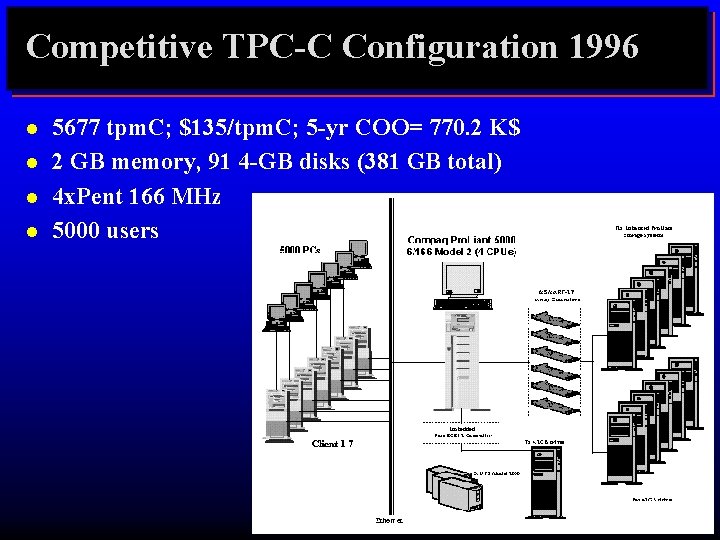
Competitive TPC-C Configuration 1996 l l 5677 tpm. C; $135/tpm. C; 5 -yr COO= 770. 2 K$ 2 GB memory, 91 4 -GB disks (381 GB total) 4 x. Pent 166 MHz 5000 users
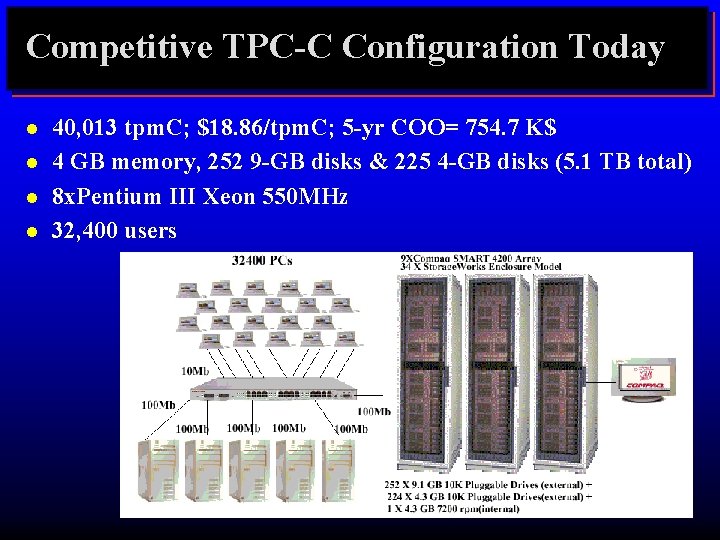
Competitive TPC-C Configuration Today l l 40, 013 tpm. C; $18. 86/tpm. C; 5 -yr COO= 754. 7 K$ 4 GB memory, 252 9 -GB disks & 225 4 -GB disks (5. 1 TB total) 8 x. Pentium III Xeon 550 MHz 32, 400 users
The Complete Guide to TPC-C l l In the spirit of The Compleat Works of Wllm Shkspr (Abridged)… The Complete Guide to TPC-C: l l l First, do several years of prep work. Next, Install OS Install and configure database Build TPC-C database Install and configure TPC-C application Install and configure RTE Run benchmark Analyze results Publish Typical elapsed time: 2 – 6 months The Challenge: Do it all in the next 30 minutes!
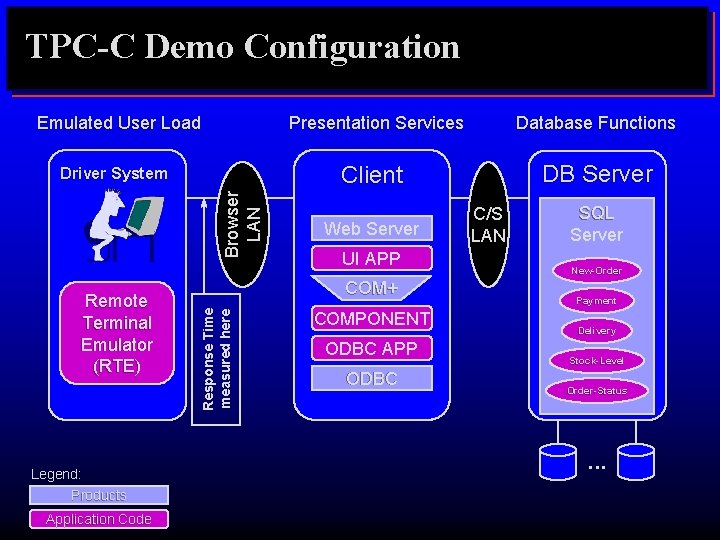
TPC-C Demo Configuration Emulated User Load Browser LAN Driver System Legend: Products Application Code Database Functions Client DB Server Web Server UI APP COM+ Resp o n se T i me measu red h ere Remote Terminal Emulator (RTE) Presentation Services COMPONENT ODBC APP ODBC C/S LAN SQL Server New-Order Payment Delivery Stock-Level Order-Status . . .
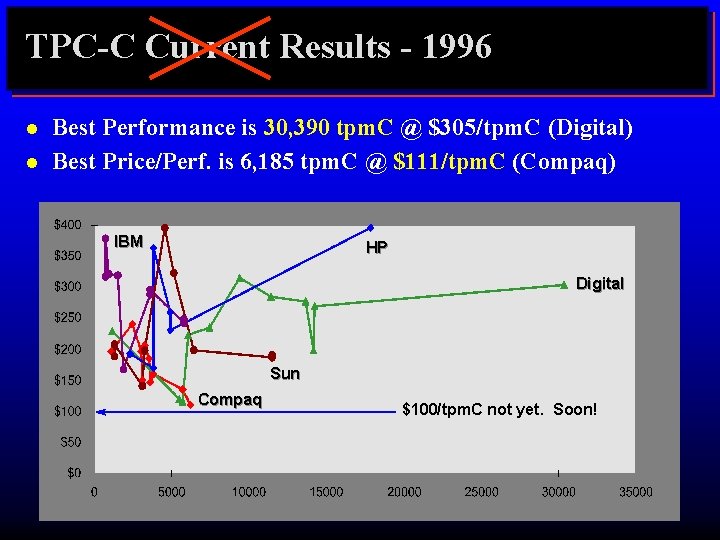
TPC-C Current Results - 1996 l l Best Performance is 30, 390 tpm. C @ $305/tpm. C (Digital) Best Price/Perf. is 6, 185 tpm. C @ $111/tpm. C (Compaq) IBM HP Digital Sun Compaq $100/tpm. C not yet. Soon!
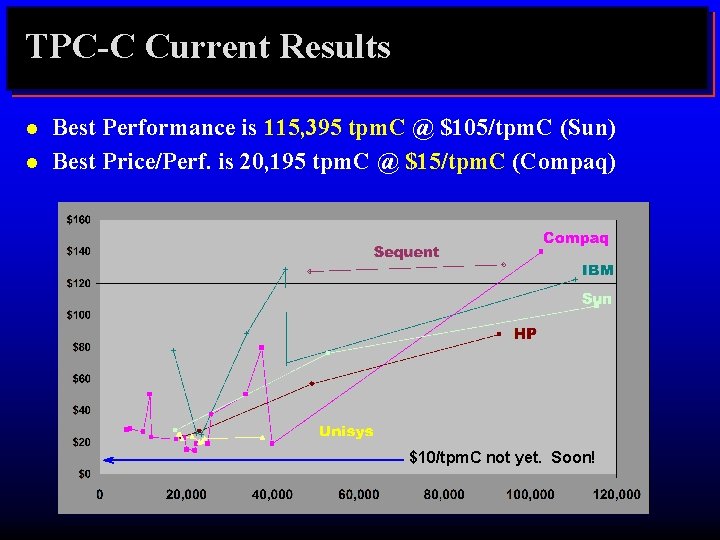
TPC-C Current Results l l Best Performance is 115, 395 tpm. C @ $105/tpm. C (Sun) Best Price/Perf. is 20, 195 tpm. C @ $15/tpm. C (Compaq) $10/tpm. C not yet. Soon!
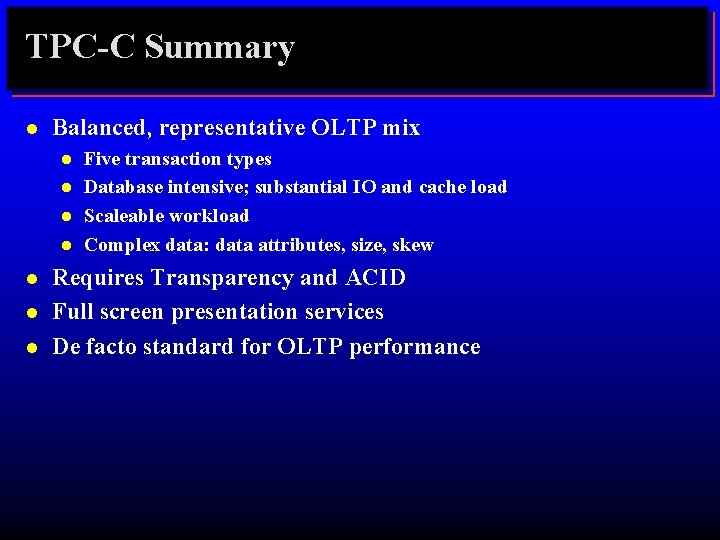
TPC-C Summary l Balanced, representative OLTP mix l l l l Five transaction types Database intensive; substantial IO and cache load Scaleable workload Complex data: data attributes, size, skew Requires Transparency and ACID Full screen presentation services De facto standard for OLTP performance
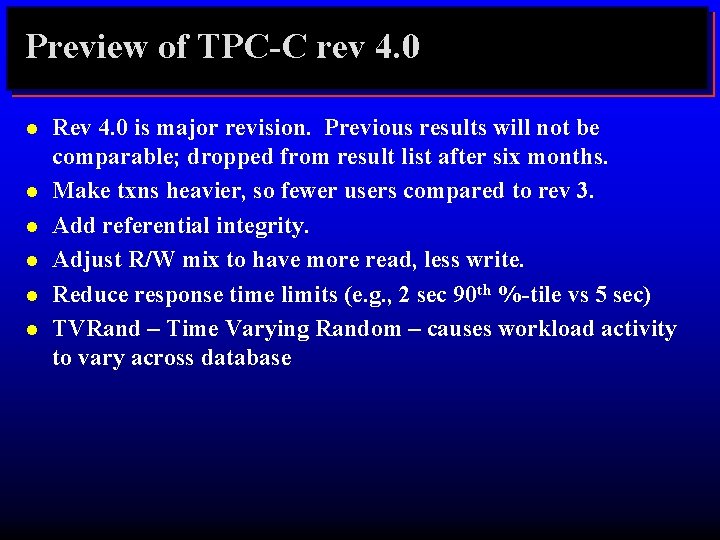
Preview of TPC-C rev 4. 0 l l l Rev 4. 0 is major revision. Previous results will not be comparable; dropped from result list after six months. Make txns heavier, so fewer users compared to rev 3. Add referential integrity. Adjust R/W mix to have more read, less write. Reduce response time limits (e. g. , 2 sec 90 th %-tile vs 5 sec) TVRand – Time Varying Random – causes workload activity to vary across database
Outline l l l Introduction History of TPC-A/B Legacy TPC-C TPC-H/R TPC Futures
TPC-H/R Overview l l Complex Decision Support workload Originally released as TPC-D l l Benchmark models ad hoc queries (TPC-H) or reporting (TPC-R) l l l extract database with concurrent updates multi-user environment Workload consists of 22 queries and 2 update streams l l the result of 5 years of development by the TPC SQL as written in spec Database is quantized into fixed sizes (e. g. , 1, 10, 30, … GB) Metrics are Composite Queries-per-Hour (Qph. H or Qph. R), and Price/Performance ($/Qph. H or $/Qph. R) TPC-D specification was approved April 5, 1995 TPC-H/R specifications were approved April, 1999
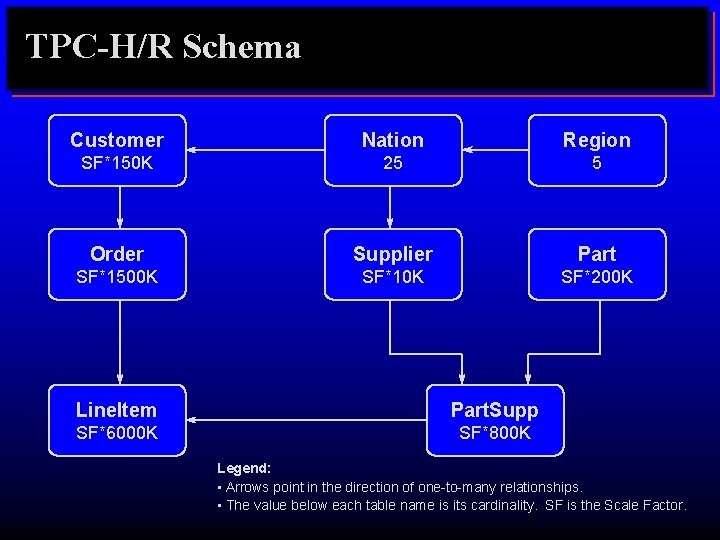
TPC-H/R Schema Customer Nation Region SF*150 K 25 5 Order Supplier Part SF*1500 K SF*10 K SF*200 K Line. Item Part. Supp SF*6000 K SF*800 K Legend: • Arrows point in the direction of one-to-many relationships. • The value below each table name is its cardinality. SF is the Scale Factor.
TPC-H/R Database Scaling and Load l Database size is determined from fixed Scale Factors (SF): l l Database is generated by DBGEN l l 1, 10, 30, 100, 300, 1000, 3000, 10000 (note that 3 is missing, not a typo) These correspond to the nominal database size in GB. (i. e. , SF 10 is approx. 10 GB, not including indexes and temp tables. ) Indices and temporary tables can significantly increase the total disk capacity. (3 -5 x is typical) DBGEN is a C program which is part of the TPC-H/R specs Use of DBGEN is strongly recommended. TPC-H/R database contents must be exact. Database Load time must be reported l l Includes time to create indexes and update statistics. Not included in primary metrics.
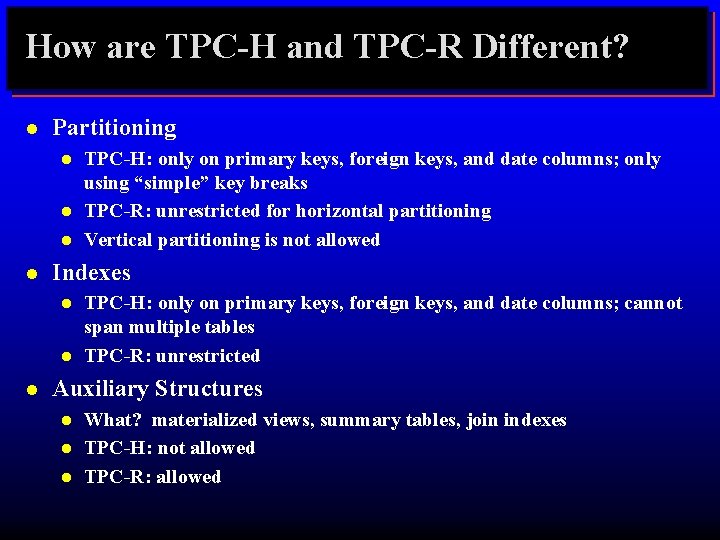
How are TPC-H and TPC-R Different? l Partitioning l l Indexes l l l TPC-H: only on primary keys, foreign keys, and date columns; only using “simple” key breaks TPC-R: unrestricted for horizontal partitioning Vertical partitioning is not allowed TPC-H: only on primary keys, foreign keys, and date columns; cannot span multiple tables TPC-R: unrestricted Auxiliary Structures l l l What? materialized views, summary tables, join indexes TPC-H: not allowed TPC-R: allowed
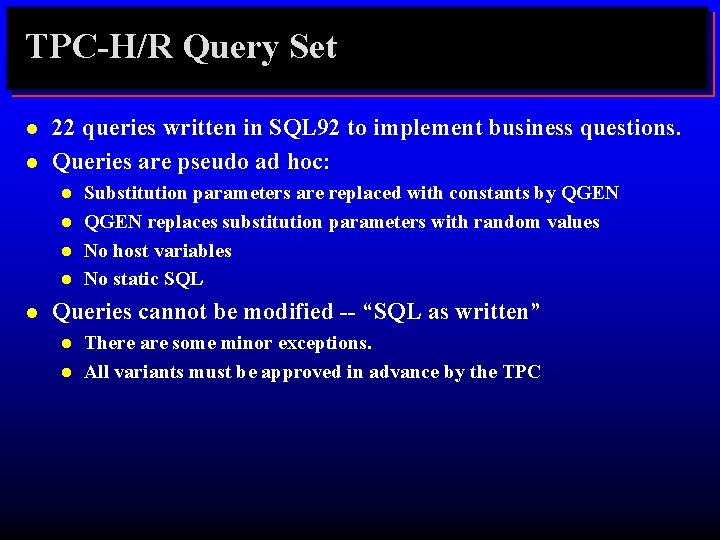
TPC-H/R Query Set l l 22 queries written in SQL 92 to implement business questions. Queries are pseudo ad hoc: l l l Substitution parameters are replaced with constants by QGEN replaces substitution parameters with random values No host variables No static SQL Queries cannot be modified -- “SQL as written” l l There are some minor exceptions. All variants must be approved in advance by the TPC
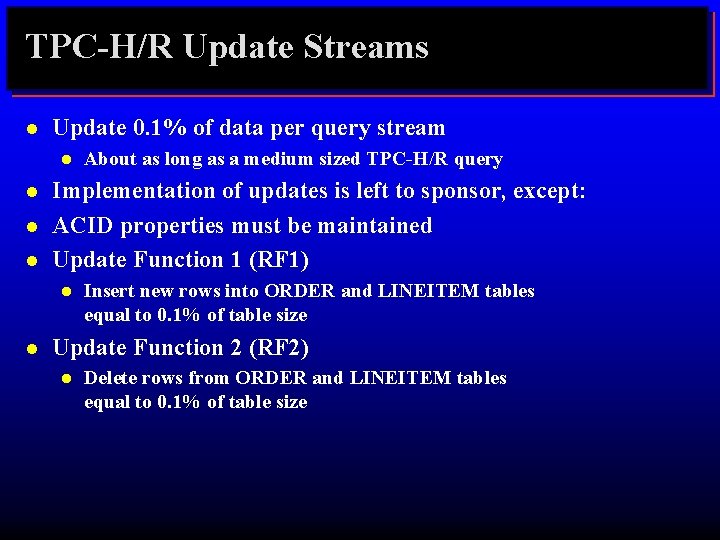
TPC-H/R Update Streams l Update 0. 1% of data per query stream l l Implementation of updates is left to sponsor, except: ACID properties must be maintained Update Function 1 (RF 1) l l About as long as a medium sized TPC-H/R query Insert new rows into ORDER and LINEITEM tables equal to 0. 1% of table size Update Function 2 (RF 2) l Delete rows from ORDER and LINEITEM tables equal to 0. 1% of table size
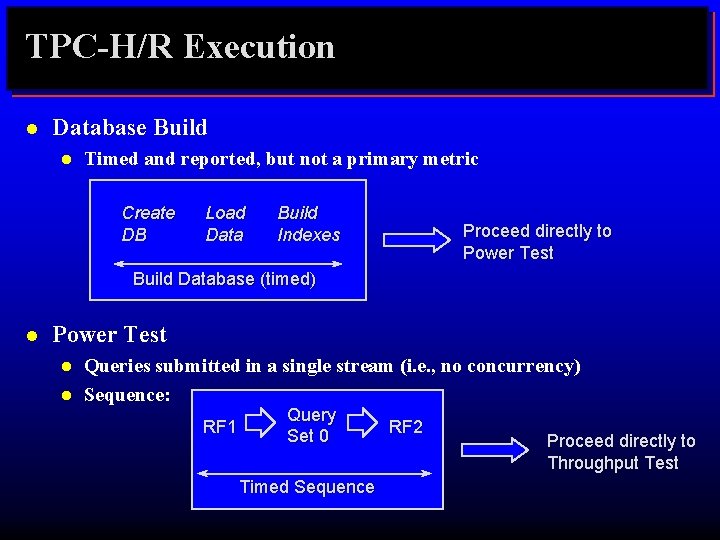
TPC-H/R Execution l Database Build l Timed and reported, but not a primary metric Create DB Load Data Build Indexes Proceed directly to Power Test Build Database (timed) l Power Test l l Queries submitted in a single stream (i. e. , no concurrency) Sequence: RF 1 Query Set 0 Timed Sequence RF 2 Proceed directly to Throughput Test
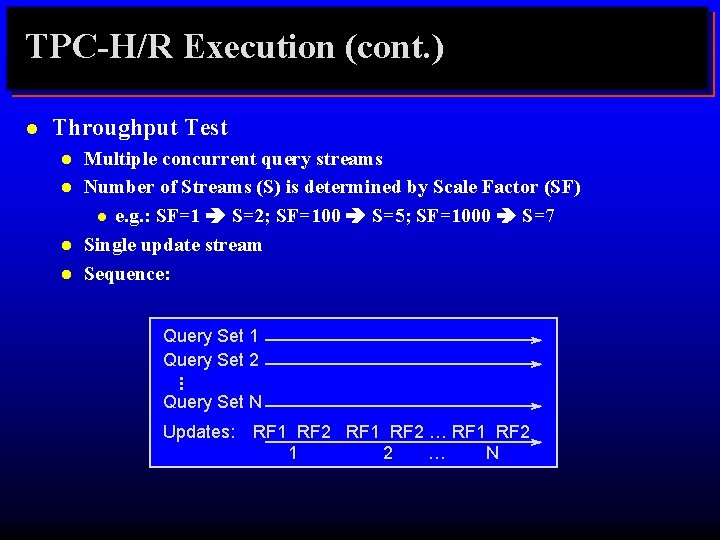
TPC-H/R Execution (cont. ) Throughput Test l l Multiple concurrent query streams Number of Streams (S) is determined by Scale Factor (SF) l e. g. : SF=1 S=2; SF=100 S=5; SF=1000 S=7 Single update stream Sequence: Query Set 1 Query Set 2. . . l Query Set N Updates: RF 1 RF 2 … RF 1 RF 2 1 2 … N
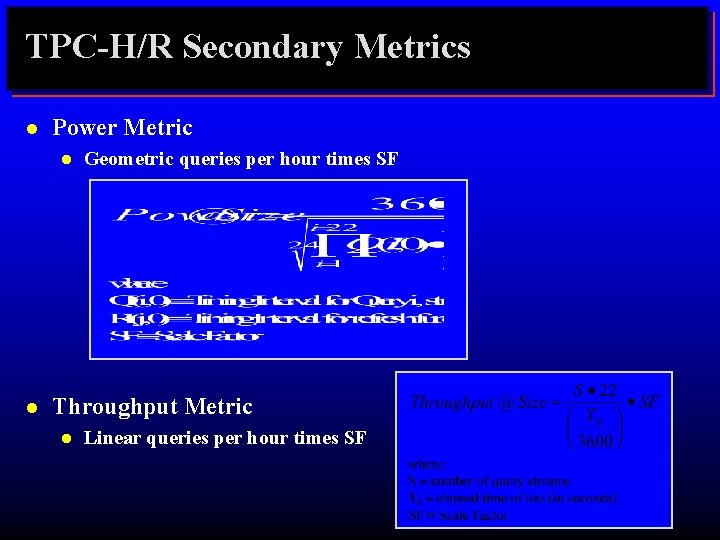
TPC-H/R Secondary Metrics l Power Metric l l Geometric queries per hour times SF Throughput Metric l Linear queries per hour times SF
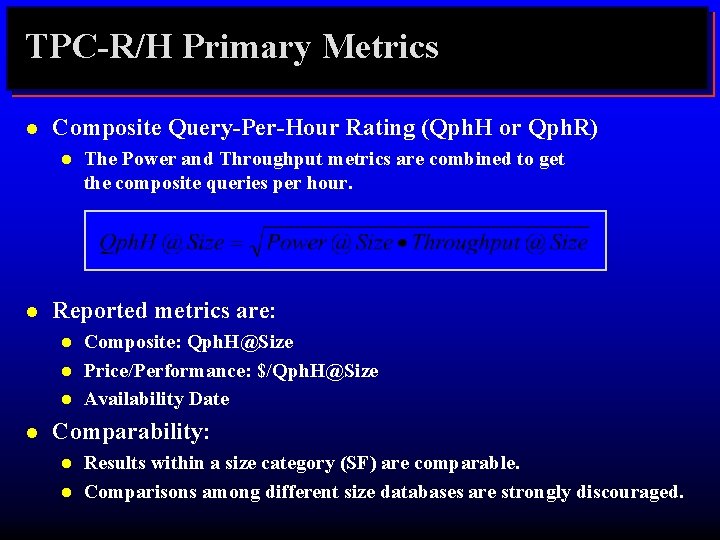
TPC-R/H Primary Metrics l Composite Query-Per-Hour Rating (Qph. H or Qph. R) l l Reported metrics are: l l The Power and Throughput metrics are combined to get the composite queries per hour. Composite: Qph. H@Size Price/Performance: $/Qph. H@Size Availability Date Comparability: l l Results within a size category (SF) are comparable. Comparisons among different size databases are strongly discouraged.
TPC-H/R Results l l No TPC-R results yet. One TPC-H result: l l Sun Enterprise 4500 (Informix), 1280 Qph. H@100 GB, 816 $/Qph. H@100 GB, available 11/15/99 Too early to know how TPC-H and TPC-R will fare l In general, hardware vendors seem to be more interested in TPC-H
Outline l l l Introduction History of TPC-A/B TPC-C TPC-H/R TPC Futures
Next TPC Benchmark: TPC-W l l TPC-W (Web) is a transactional web benchmark. TPC-W models a controlled Internet Commerce environment that simulates the activities of a business oriented web server. The application portrayed by the benchmark is a Retail Store on the Internet with a customer browse-and-order scenario. TPC-W measures how fast an E-commerce system completes various E-commerce-type transactions
TPC-W Characteristics l l l TPC-W features: The simultaneous execution of multiple transaction types that span a breadth of complexity. On-line transaction execution modes. Databases consisting of many tables with a wide variety of sizes, attributes, and relationship. Multiple on-line browser sessions. Secure browser interaction for confidential data. On-line secure payment authorization to an external server. Consistent web object update. Transaction integrity (ACID properties). Contention on data access and update. 24 x 7 operations requirement. Three year total cost of ownership pricing model.
TPC-W Metrics l There are three workloads in the benchmark, representing different customer environments. l l Primarily shopping (WIPS). Representing typical browsing, searching and ordering activities of on-line shopping. Browsing (WIPSB). Representing browsing activities with dynamic web page generation and searching activities. Web-based Ordering (WIPSO). Representing intranet and business to business secure web activities. Primary metrics are: WIPS rate (WIPS), price/performance ($/WIPS), and the availability date of the priced configuration.
TPC-W Public Review l l TPC-W specification is currently available for public review on TPC web site. Approved standard likely in Q 1/2000
Reference Material l l Jim Gray, The Benchmark Handbook for Database and Transaction Processing Systems, Morgan Kaufmann, San Mateo, CA, 1991. Raj Jain, The Art of Computer Systems Performance Analysis: Techniques for Experimental Design, Measurement, Simulation, and Modeling, John Wiley & Sons, New York, 1991. William Highleyman, Performance Analysis of Transaction Processing Systems, Prentice Hall, Englewood Cliffs, NJ, 1988. TPC Web site: www. tpc. org IDEAS web site: www. ideasinternational. com

The End
Background Material on TPC-A/B
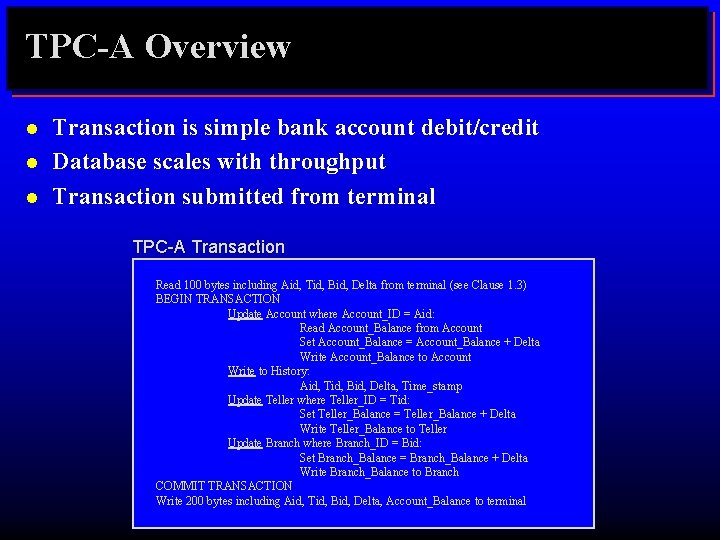
TPC-A Overview l l l Transaction is simple bank account debit/credit Database scales with throughput Transaction submitted from terminal TPC-A Transaction Read 100 bytes including Aid, Tid, Bid, Delta from terminal (see Clause 1. 3) BEGIN TRANSACTION Update Account where Account_ID = Aid: Read Account_Balance from Account Set Account_Balance = Account_Balance + Delta Write Account_Balance to Account Write to History: Aid, Tid, Bid, Delta, Time_stamp Update Teller where Teller_ID = Tid: Set Teller_Balance = Teller_Balance + Delta Write Teller_Balance to Teller Update Branch where Branch_ID = Bid: Set Branch_Balance = Branch_Balance + Delta Write Branch_Balance to Branch COMMIT TRANSACTION Write 200 bytes including Aid, Tid, Bid, Delta, Account_Balance to terminal
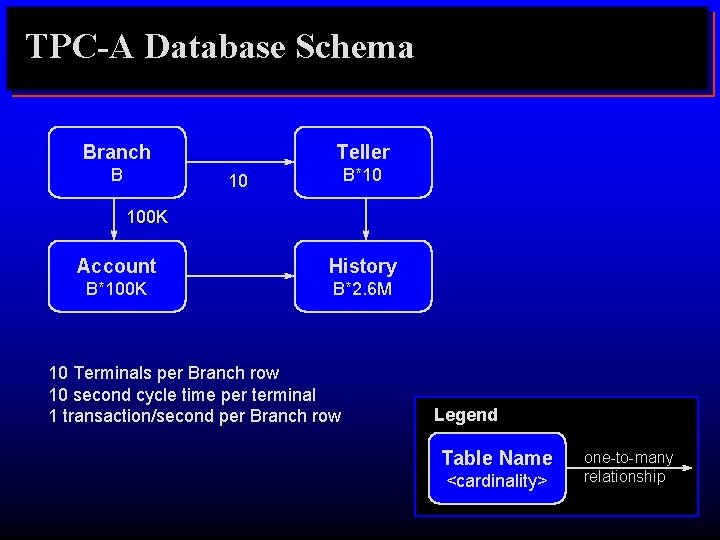
TPC-A Database Schema Branch B Teller B*10 10 100 K Account History B*100 K B*2. 6 M 10 Terminals per Branch row 10 second cycle time per terminal 1 transaction/second per Branch row Legend Table Name <cardinality> one-to-many relationship
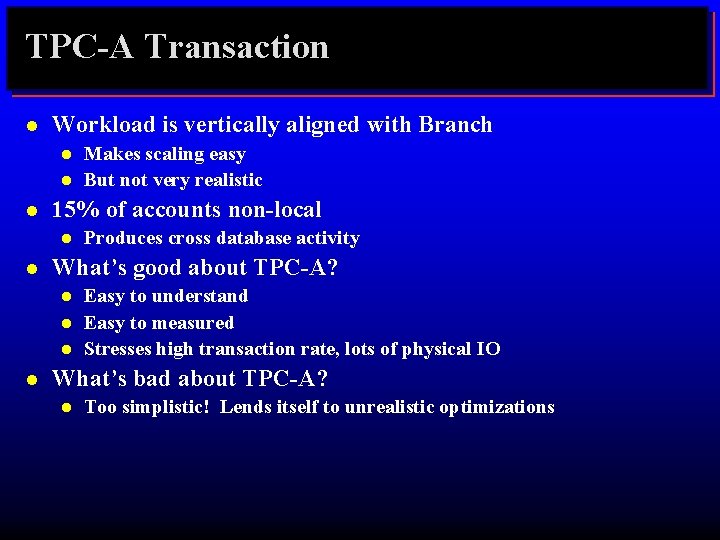
TPC-A Transaction l Workload is vertically aligned with Branch l l l 15% of accounts non-local l l Produces cross database activity What’s good about TPC-A? l l Makes scaling easy But not very realistic Easy to understand Easy to measured Stresses high transaction rate, lots of physical IO What’s bad about TPC-A? l Too simplistic! Lends itself to unrealistic optimizations
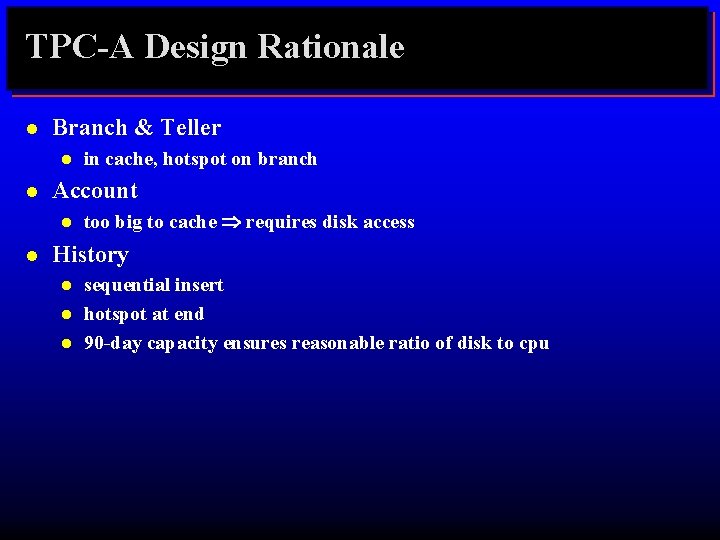
TPC-A Design Rationale l Branch & Teller l l Account l l in cache, hotspot on branch too big to cache Þ requires disk access History l l l sequential insert hotspot at end 90 -day capacity ensures reasonable ratio of disk to cpu
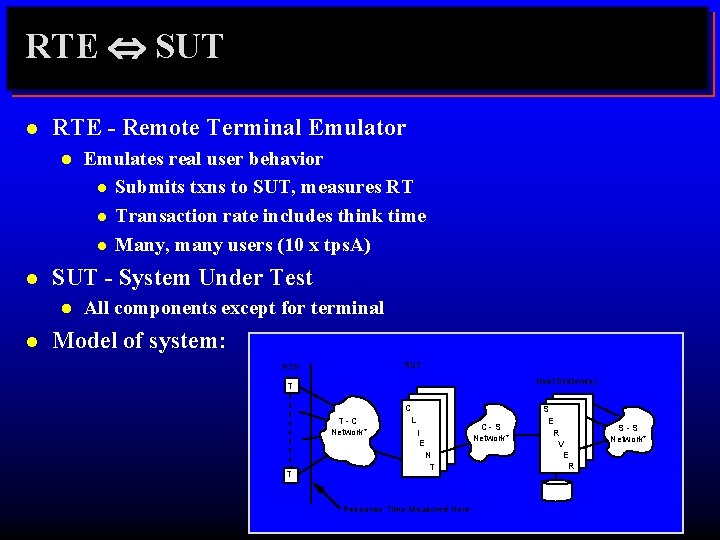
RTE Û SUT l RTE - Remote Terminal Emulator l l SUT - System Under Test l l Emulates real user behavior l Submits txns to SUT, measures RT l Transaction rate includes think time l Many, many users (10 x tps. A) All components except for terminal Model of system: SUT RTE Host System(s) T T-C Network* T C L C-S Network* I E N T Response Time Measured Here S E R V E R S-S Network*
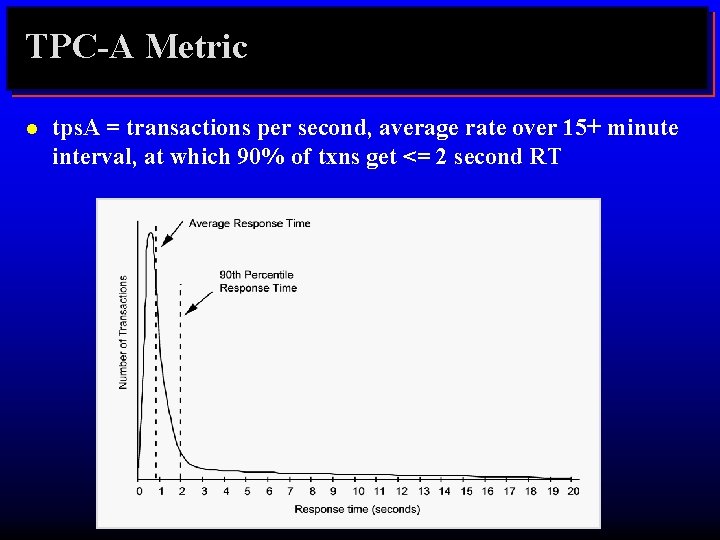
TPC-A Metric l tps. A = transactions per second, average rate over 15+ minute interval, at which 90% of txns get <= 2 second RT
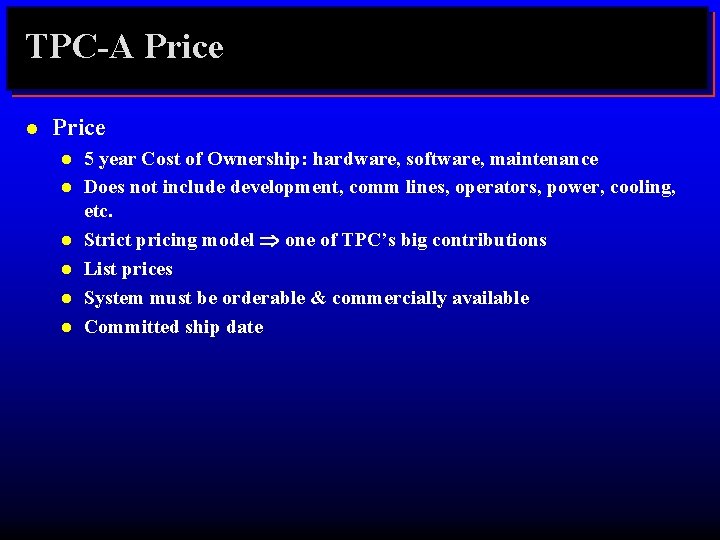
TPC-A Price l l l l 5 year Cost of Ownership: hardware, software, maintenance Does not include development, comm lines, operators, power, cooling, etc. Strict pricing model Þ one of TPC’s big contributions List prices System must be orderable & commercially available Committed ship date
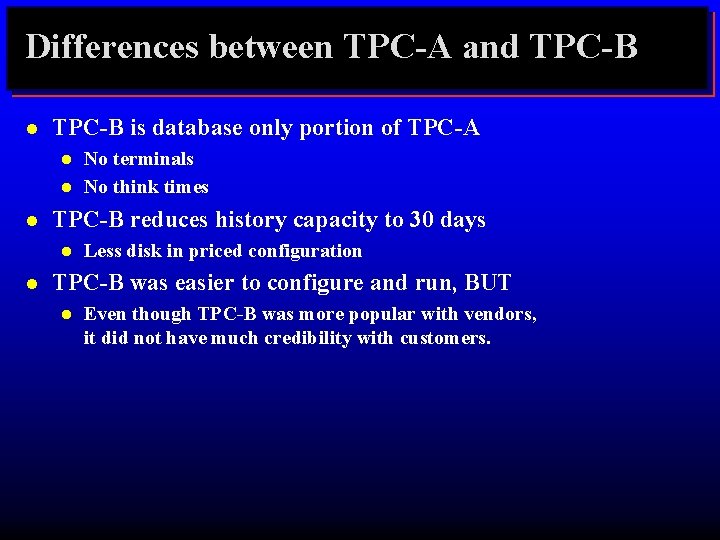
Differences between TPC-A and TPC-B l TPC-B is database only portion of TPC-A l l l TPC-B reduces history capacity to 30 days l l No terminals No think times Less disk in priced configuration TPC-B was easier to configure and run, BUT l Even though TPC-B was more popular with vendors, it did not have much credibility with customers.
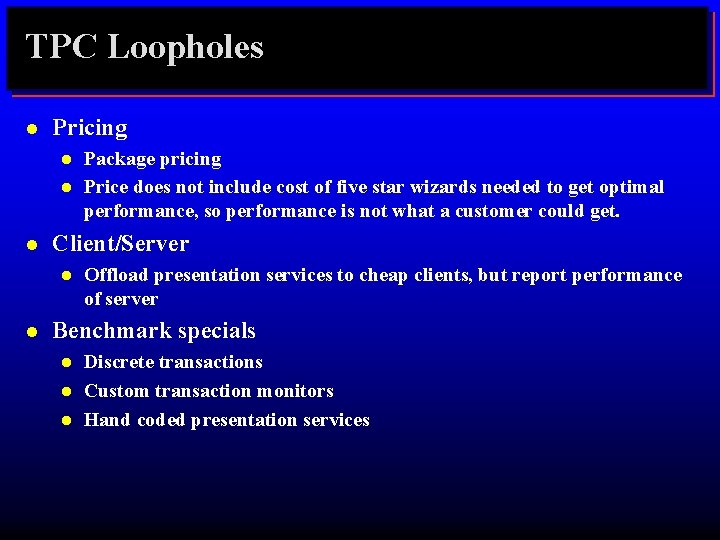
TPC Loopholes l Pricing l l l Client/Server l l Package pricing Price does not include cost of five star wizards needed to get optimal performance, so performance is not what a customer could get. Offload presentation services to cheap clients, but report performance of server Benchmark specials l l l Discrete transactions Custom transaction monitors Hand coded presentation services
- Slides: 62