
TOXICS USE REDUCTION INSTITUTE Brominated Flame Retardants Uses
TOXICS USE REDUCTION INSTITUTE Brominated Flame Retardants Uses and Alternatives 1/28/05 TURI Toxics Use Reduction Institute University of Massachusetts Lowell
Overview • Why and where do we use FRs? – Types of BFRs, uses • Why are we concerned? – Environmental, Health and Safety Issues • Policy Responses – Government: International, State, Federal – Industry • Alternatives to Brominated FRs – – Classes of FRs, how they work Chemical substitutes Material substitutes Product redesign
Why do we use FRs? • We use polymerized fuels (hydrocarbons) as materials of construction • Flame Retardants limit the spread of fire and save lives by allowing time to escape • BFRs are used in HIPS, ABS, epoxy, nylon, thermoplastic polyester, foams, polyolefins, other textiles TURI
Flame Retardants in Products • • Furniture – upholstered furniture, mattress Electronics – TV, computer, copier, handhelds, toys Appliances – hair dryer, microwave, wire and cable Transportation – car and airplane cushion and interior plastics • Interior home and office finishes – curtains, shades, carpets, lighting, electrical systems TURI
Flame Retardant Substances • Halogens – Bromine (BFRs), Chlorine • Phosphorous • Antimony • Metal salts and hydroxides • Nitrogen TURI
Brominated Flame Retardants • Br bisphenols (Tetrabromobisphenol-A TBBPA) • Polybrominated diphenyl ethers (PBDEs) – Incl. Deca-, Octa- and Penta- congener blends • Hexabromocyclododecane (HBCD) • Polybrominated biphenyls (no longer produced) (PBBs) • Phenols, phthalates, ethanes, others TURI
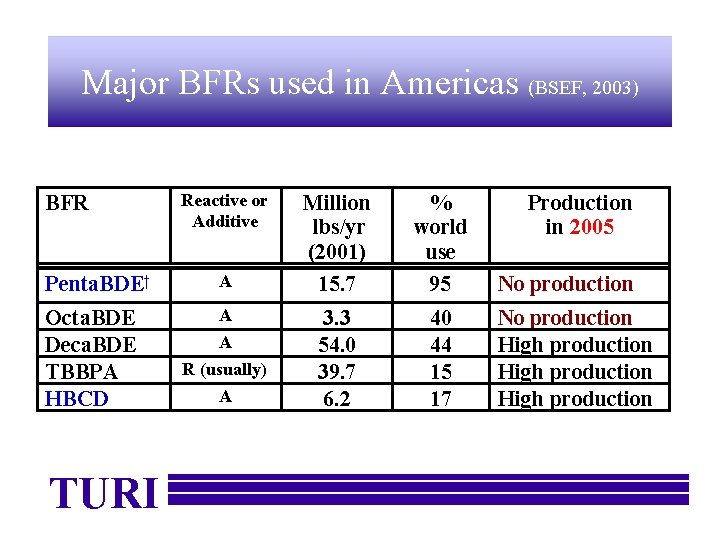
Major BFRs used in Americas (BSEF, 2003) BFR Reactive or Additive Penta. BDE† A Octa. BDE Deca. BDE TBBPA HBCD A TURI A R (usually) A Million lbs/yr (2001) 15. 7 % world use 95 3. 3 54. 0 39. 7 6. 2 40 44 15 17 Production in 2005 No production High production

Poly brominated diphenyl ethers (PBDEs) Penta-BDE (average 5 bromines) Octa-BDE Deca-BDE (average 8 bromines) (average 10, fully brominated) TURI

PBDEs Major Uses • Penta BDE – Mostly in polyurethane foam (sofas, mattresses, chairs, automobiles) • Octa BDE – ABS plastics, nylons, polyolefins (home and office appliances/electronics, automobiles) • Deca BDE – Fabric coating/treatment (home furnishings), HIPS, nylon, rubber (electronics housings, wire and cable) TURI
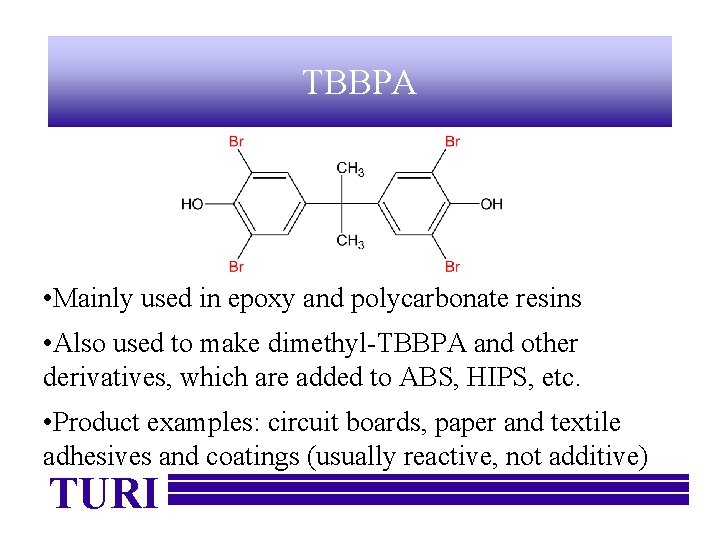
TBBPA • Mainly used in epoxy and polycarbonate resins • Also used to make dimethyl-TBBPA and other derivatives, which are added to ABS, HIPS, etc. • Product examples: circuit boards, paper and textile adhesives and coatings (usually reactive, not additive) TURI

Hexabromocyclododecane (HBCD) • Additive FR used in thermoplastics, PS padding, calbe, latex, textiles TURI
Why are we concerned? PB&T • Persistence – Presence in humans, environment and biota • Bioaccumulation – Rapidly increasing concentrations in mammals and birds • Toxicity – Varies from high to low • Unknowns – Unknown degradation products & metabolites – Unknown toxicity v Much of this section adapted from materials by Tom Mc. Donald, CAL EPA
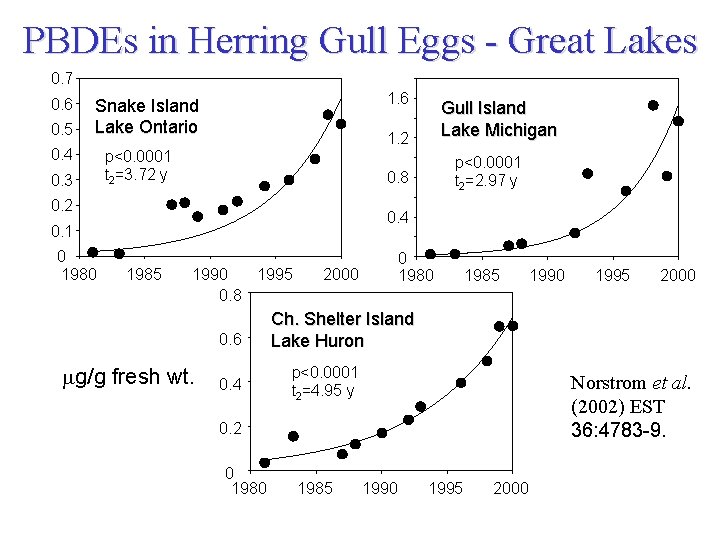
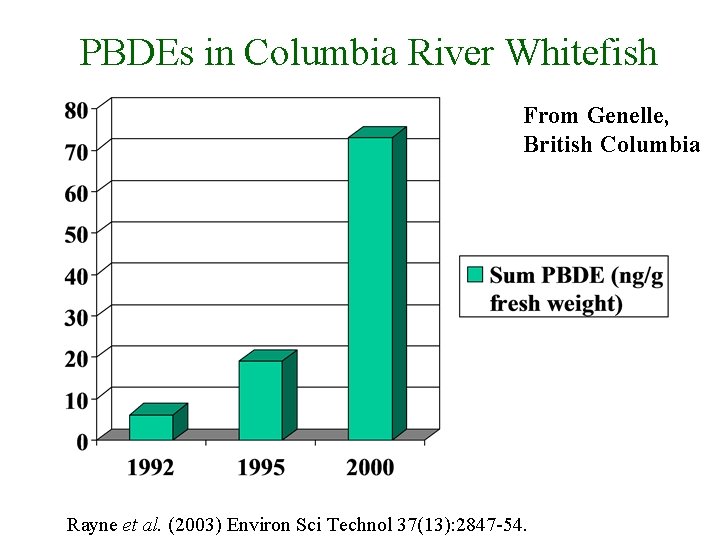
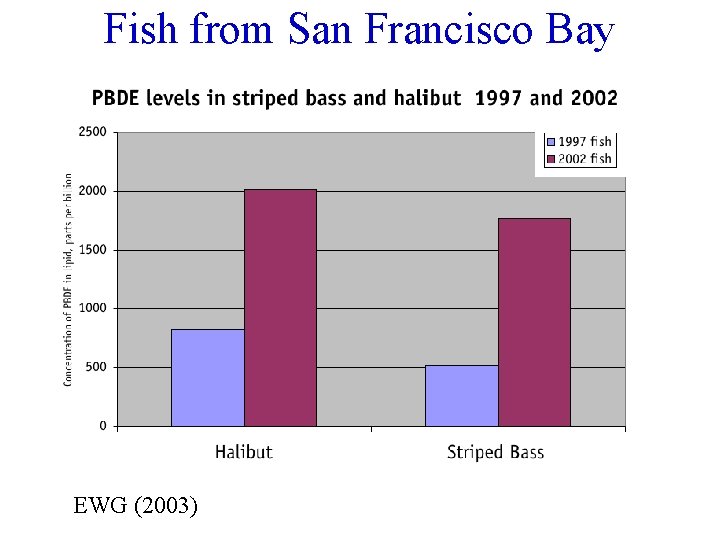
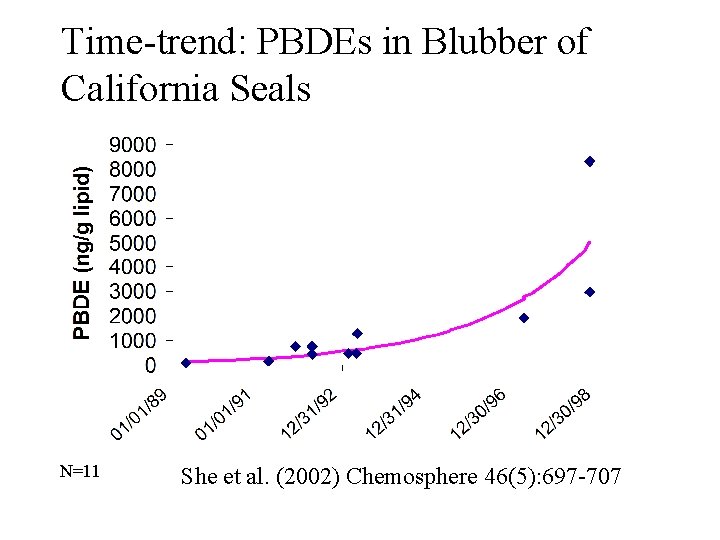
PBDEs in environment and biota • PBDEs have been measured in: – Biota (terrestrial and marine mammals, fish, humans, birds) – Indoor and outdoor air – Home and office dust – Remote Arctic regions (i. e. , long-range transport) – Rivers, lakes and sediments – Sewage sludge – Foods TURI
PBDEs in environment and biota • Primarily tetra- and penta-BDE congeners, some hexa-BDE • $10, 000 Question: Does deca-BDE break down in environment or biota to lower brominated BDEs? – Growing evidence that it may – results of fish and UV studies TURI
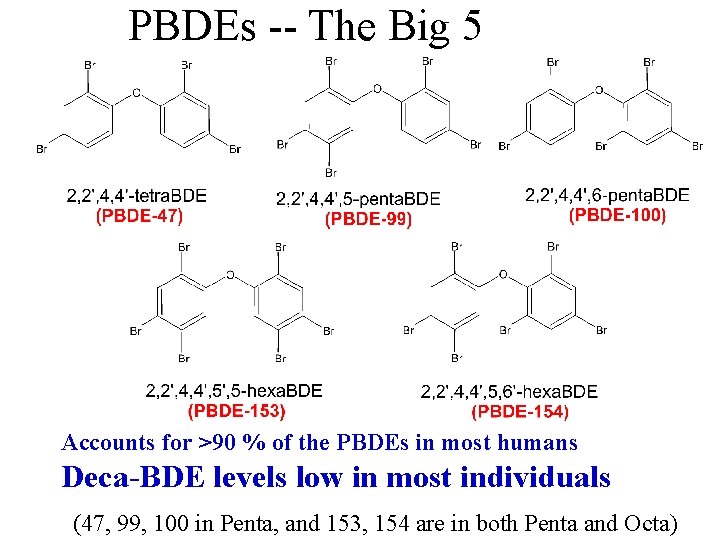
PBDEs -- The Big 5 Accounts for >90 % of the PBDEs in most humans Deca-BDE levels low in most individuals (47, 99, 100 in Penta, and 153, 154 are in both Penta and Octa)
PBDEs in Herring Gull Eggs - Great Lakes 0. 7 0. 6 0. 5 1. 6 Snake Island Lake Ontario 0. 4 0. 3 1. 2 p<0. 0001 t 2=3. 72 y p<0. 0001 t 2=2. 97 y 0. 8 0. 2 0. 4 0. 1 0 1980 Gull Island Lake Michigan 1985 1990 1995 0. 8 0. 6 mg/g fresh wt. 0. 4 0 1980 2000 1985 1995 2000 Ch. Shelter Island Lake Huron p<0. 0001 t 2=4. 95 y Norstrom et al. (2002) EST 36: 4783 -9. 0. 2 0 1980 1990 1985 1990 1995 2000
PBDEs in Columbia River Whitefish From Genelle, British Columbia Rayne et al. (2003) Environ Sci Technol 37(13): 2847 -54.
Fish from San Francisco Bay EWG (2003)
Time-trend: PBDEs in Blubber of California Seals N=11 She et al. (2002) Chemosphere 46(5): 697 -707
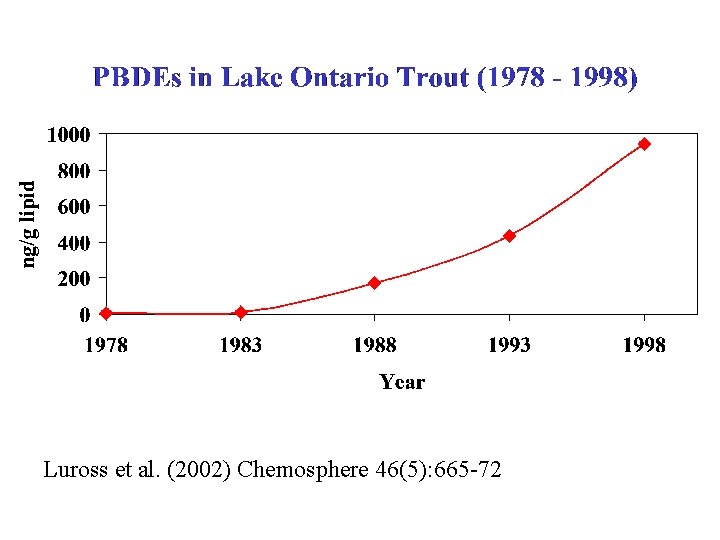
Luross et al. (2002) Chemosphere 46(5): 665 -72
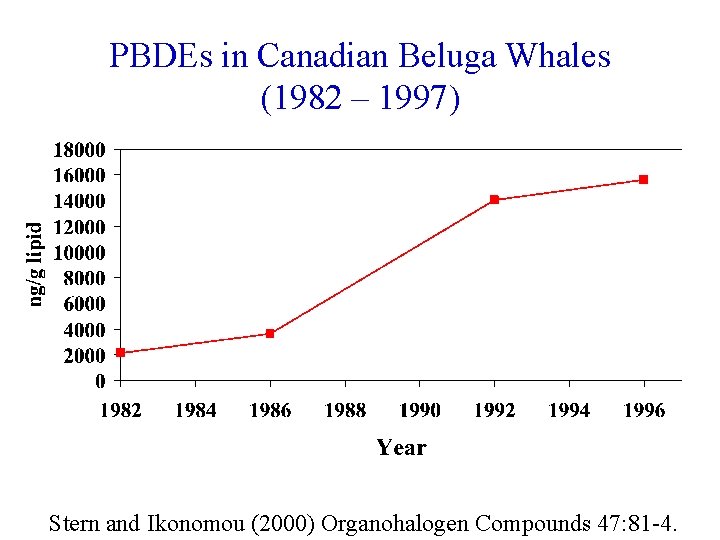
PBDEs in Canadian Beluga Whales (1982 – 1997) Stern and Ikonomou (2000) Organohalogen Compounds 47: 81 -4.
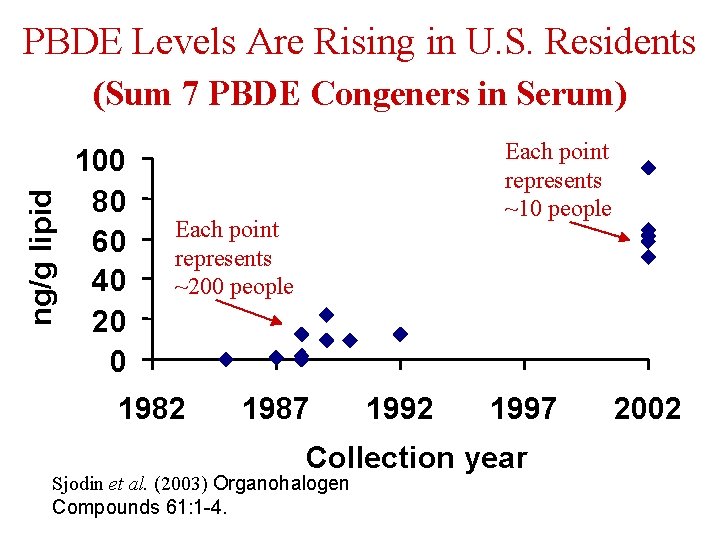
PBDE Levels Are Rising in U. S. Residents ng/g lipid (Sum 7 PBDE Congeners in Serum) 100 80 Each point 60 represents 40 ~200 people 20 0 1982 1987 Each point represents ~10 people 1992 1997 Collection year Sjodin et al. (2003) Organohalogen Compounds 61: 1 -4. 2002
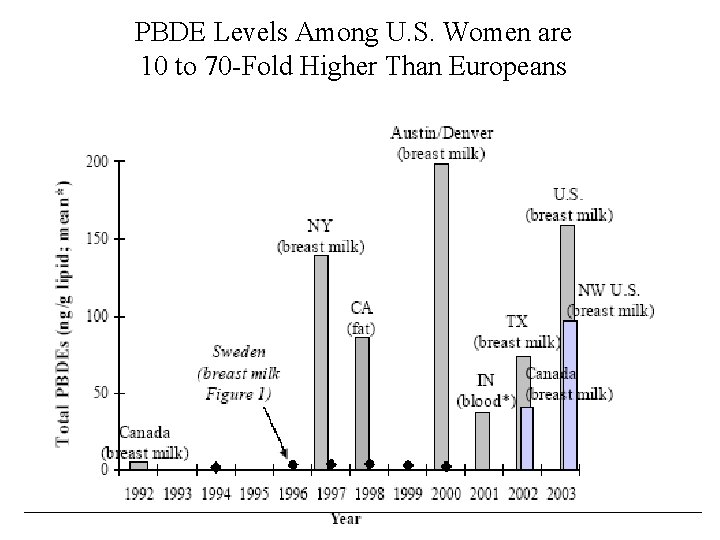
PBDE Levels Among U. S. Women are 10 to 70 -Fold Higher Than Europeans
Toxicity Concerns for the PBDEs • Endocrine disruption – Thyroid and estrogenic effects • Developmental effects – Brain and reproductive organs • Possibly cancer – NTP initiating long-term studies of Penta-BDE – Environmental conversion to dioxins/furans • Brominated dioxins/furans measured in Japanese people
Developmental Toxicity Studies of PBDEs • Neurological system (PBDEs tested: PBDE-47, -99, -153, – 209 and the Penta. BDE technical mixture) – Altered behavior, learning and memory in mice and rats – Hearing loss in rats – Sexually dimorphic behavior – Synaptic plasticity and altered # brain receptors • Data from multiple studies from 5 independent laboratories (Sweden, U. S. , Germany, Italy, Switzerland)
Developmental Toxicity Studies of PBDE-99 and Penta (tech. ) • Male reproductive system – Delayed puberty – Increased ventral prostate and seminal vesicle weights – Changes to epididymis weight † At very low doses – Decreased sperm count† • Female reproductive system of PBDE-99: 60 to 300 µg/kg – Delayed puberty – Alterations to ovary cell structure† • Data from 3 independent laboratories
Other Toxicity Issues • An even greater concern: PBDEs and PCBs may be working together. – PCB levels are usually higher than PBDEs – Same effects on some mechanistic endpoints – Co-administration of PCB and PBDE caused additive effects with respect to: • behavior alterations in mice • thyroid hormone disruption – PBDEs/PCB co-exposures further increases the likelihood that exposure will result in health effects.
Other Toxicity Issues • PBDEs and PCBs may be working together. – PCB levels are usually higher than PBDEs – Same effects on some mechanistic endpoints – Co-administration of PCB and PBDE caused additive effects with respect to: • behavior alterations in mice • thyroid hormone disruption – PBDEs/PCB co-exposures further increases the likelihood that exposure will result in health effects. TURI
Other Toxicity Issues • Compare 95 th Percentile Human Levels to Tissue Levels in PBDE-treated Rodents • Modeled and measured estimates of rodent body burdens of PBDE resulting from doses that caused these effects are only slightly higher than (1 - to 100 -fold) total PBDE levels attained in humans. – If humans are as sensitive as animals, then the current margin of safety is low. TURI
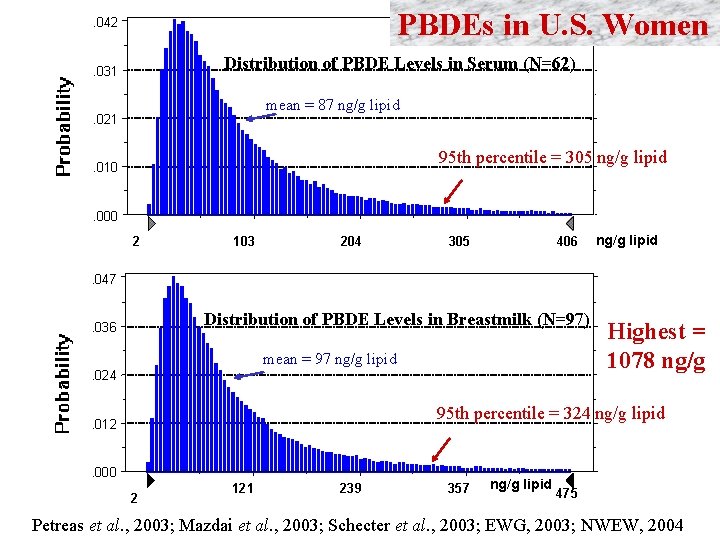
PBDEs in U. S. Women . 042 Distribution of PBDE Levels in Serum (N=62) . 031 mean = 87 ng/g lipid . 021 95 th percentile = 305 ng/g lipid . 010 . 000 2 103 204 305 406 ng/g lipid . 047 Distribution of PBDE Levels in Breastmilk (N=97) . 036 mean = 97 ng/g lipid. 024 Highest = 1078 ng/g 95 th percentile = 324 ng/g lipid . 012 . 000 2 121 239 357 ng/g lipid 475 Petreas et al. , 2003; Mazdai et al. , 2003; Schecter et al. , 2003; EWG, 2003; NWEW, 2004
Dioxins and Furans • PBDEs are converted to PBDD/F – Fire tests and fire accident studies – Heating by other means – UV light • PBDD/F recently measured in Japanese individuals – Levels in U. S. unknown • PBDD/F measured in used PBDE-treated plastics • PBDE and PBDD/F correlated in German sludge, suggesting environmental conversion of PBDE IPCS, 1994; Soderstrom et al. 2004; Ebert and Bahadir, 2003; Olsman et al. 2002; Choi et al. 2003; Hagenmaeir et al. 1992
TBBPA in the Environment • Reacted into polymer matrix, although some TBBPA does escape into environment. – Measured in sewage sludge, sediment and soil. – Data very limited on levels in biota • May reflect short half-life in environment – Levels in electronics workers were very low (1 to 3 pmol/g lipid). – bioaccumulative potential is low to moderate. )
TBBPA toxicity • Not very toxic following acute or subchronic dosing (30 or 90 -day studies) • Some concerns have been raised regarding its potential for endocrine disruption – TBBPA is similar in structure to thyroid hormone – TBBPA out-competes thyroxine for thyroid hormone transport proteins in rodent blood. – When given to pregnant rats, TBBPA increased fetal TSH levels, but did not alter T 3 and T 4 levels (e. g. , findings hard to interpret). • Overall: no clear concerns identified.
HBCD Toxicity • Not soluble enough in water to reach toxic levels for invertebrates • In mammals, most toxicity findings occurred at quite high doses – Except for neurodevelopmental effects (which appeared additive with PCBs) – In vitro studies found HBCD to be very potent in blocking dopamine uptake in rat synaptosomes
HBCD • Tissue levels are lower for HBCD than the PBDEs and PCBs. – This may reflect the metabolic elimination of HBr. • Thus, are there more persistent, bioaccumulative metabolites of HBCD? – Like DDE is for DDT • Co-exposure to HBCD and PCBs (which are also present in people) cause increased harm to brain development of mice than each given separately (Eriksson et al. , 2002).
Policy Responses • Regulatory Materials Restrictions – European Union – US States • Market Drivers – OEMs – Labeling • Voluntary Phase-Outs TURI
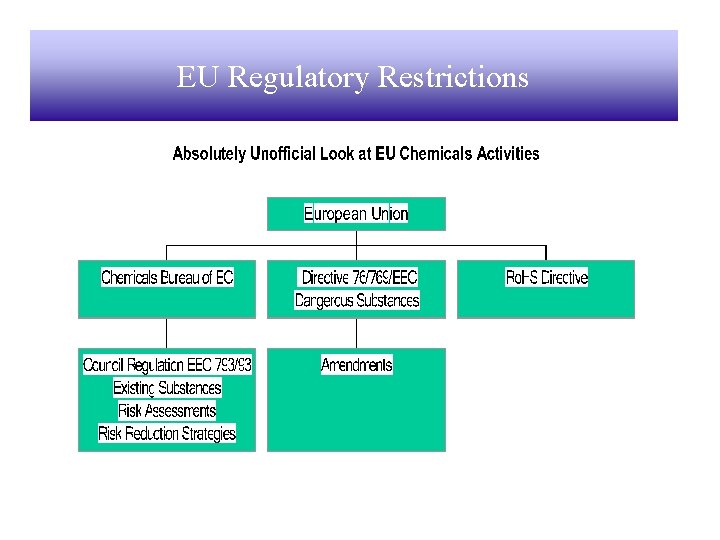
EU Regulatory Restrictions
EU Regulatory Restrictions • EU Directive 76/769/EEC: Restrictions on the Marketing and Use of Certain Dangerous Substances and Preparations • EU Risk Assessments on Octa and Penta-BDE resulted in Commission adopting risk reduction measures: – EU Directive 2003/11/EC (6 Feb 2003 amending 76/769/EEC) restricting octa and penta-DBE in products, effective 15 August 2004 – Concentration limited to 0. 1% by mass
EU Regulatory Restrictions • WEEE and Ro. HS – Ro. HS: 1 July 2006 restricts use of mercury, lead, cadmium, hex chromium, PBBs and PBDEs • PBBs no longer used in EU and US – Octa and Penta BDE covered under Dangerous Substances Directive – Deca phase out included - exemption still uncertain • Ro. HS states that EU Commission shall evaluate as a matter of priority, whether Deca should receive exemption • Human Health Risk Assessment completed with “no further risk reduction measures required”
EU Deca BDE Risk Assessment • EU Deca BDE Environmental R. A. – final draft May 2004 • Need for further information and testing wrt PBT assessment • "Decabromodiphenyl ether is likely to be very persistent (v. P), but not bioaccumulative nor toxic in the marine environment according to the criteria presented in the Technical Guidance Document. However, the PBT assessment is complicated by data available on the: · widespread occurrence of the substance in top predators (e. g. birds and mammals, including terrestrial species) and the Arctic; · neurotoxic effects and uptake of the substance by mammals in laboratory studies; and · possible formation of more toxic and accumulative products such as lower brominated diphenyl ether congeners and brominated dibenzofurans in the environment. • This means that the available assessment methodology might not be applicable to this substance. "
EU Ro. HS and Deca BDE Risk Assessment Multiple Interpretations! • EBFRIP - European Brominated Flame Retardant Industry Panel – “. . outcome of the 26 -27 May meeting of the EU Member States’ Competent Authorities which agreed to close the Deca-BDE Risk Assessment without restrictions and to support an industry voluntary programme of industrial emissions control. ” – “We expect the Risk Assessment report to enable the European Commission to exempt Deca-BDE from restrictions under the Ro. HS Directive. ”
EU Ro. HS and Deca BDE Risk Assessment Multiple Interpretations! • Commissioner Margot Wallstrom’s 24 Aug 2004 reply to European Environment Bureau’s comments: – “meeting of competent authorities for Reg. 793/93 on 26 May 2004 concluded that additional information is required to address the remaining scientific uncertainties” – “I see. . outstanding safety concerns related to Deca. BDE and agree that proportionate precautionary measures are necessary to reduce Deca. BDE’s emissions in the environment. Therefore…I will not propose to the Commission that it lift the ban on Deca. BDE currently existing under the Ro. HS Directive. ”
European WEEE • Broad applicability to electronic products and electrical equipment, with list of exemptions • Objective: Divert WEEE from landfills and incinerators to environmentally sound re-use and recycling • Producer responsibility, recycling at EOL, Df. E recycled content of new products, Ro. HS • Separation of toxic-containing components • Plastic parts containing BFRs must be separated prior to recovery and recycling
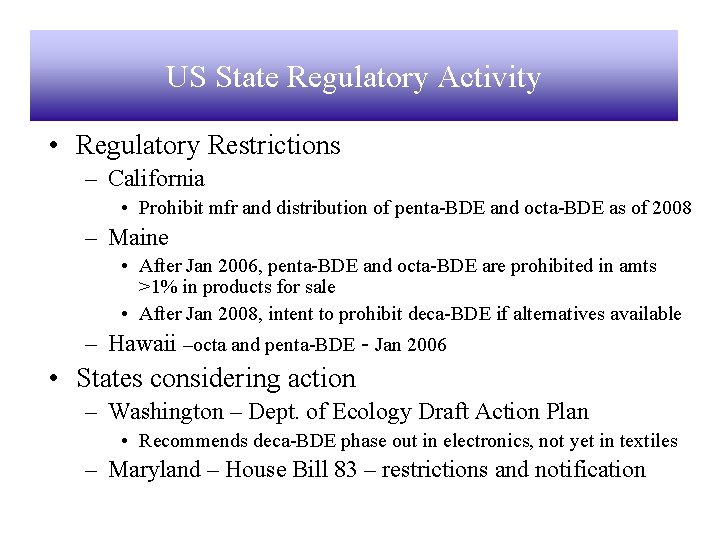
US State Regulatory Activity • Regulatory Restrictions – California • Prohibit mfr and distribution of penta-BDE and octa-BDE as of 2008 – Maine • After Jan 2006, penta-BDE and octa-BDE are prohibited in amts >1% in products for sale • After Jan 2008, intent to prohibit deca-BDE if alternatives available – Hawaii –octa and penta-BDE - Jan 2006 • States considering action – Washington – Dept. of Ecology Draft Action Plan • Recommends deca-BDE phase out in electronics, not yet in textiles – Maryland – House Bill 83 – restrictions and notification
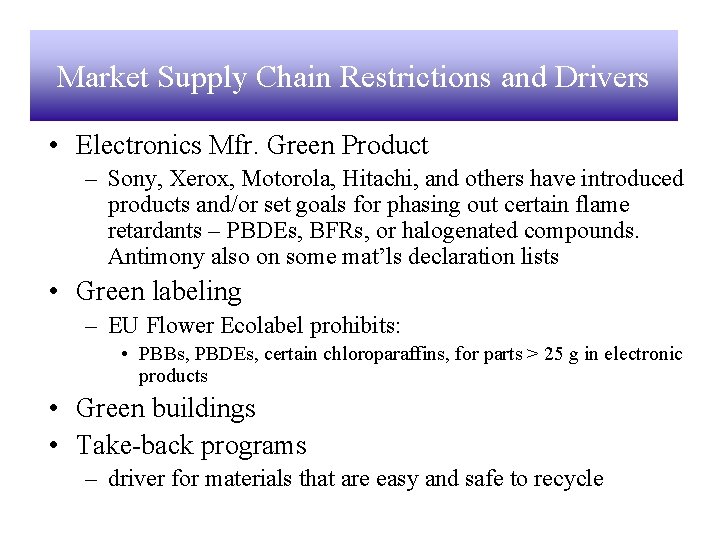
Market Supply Chain Restrictions and Drivers • Electronics Mfr. Green Product – Sony, Xerox, Motorola, Hitachi, and others have introduced products and/or set goals for phasing out certain flame retardants – PBDEs, BFRs, or halogenated compounds. Antimony also on some mat’ls declaration lists • Green labeling – EU Flower Ecolabel prohibits: • PBBs, PBDEs, certain chloroparaffins, for parts > 25 g in electronic products • Green buildings • Take-back programs – driver for materials that are easy and safe to recycle
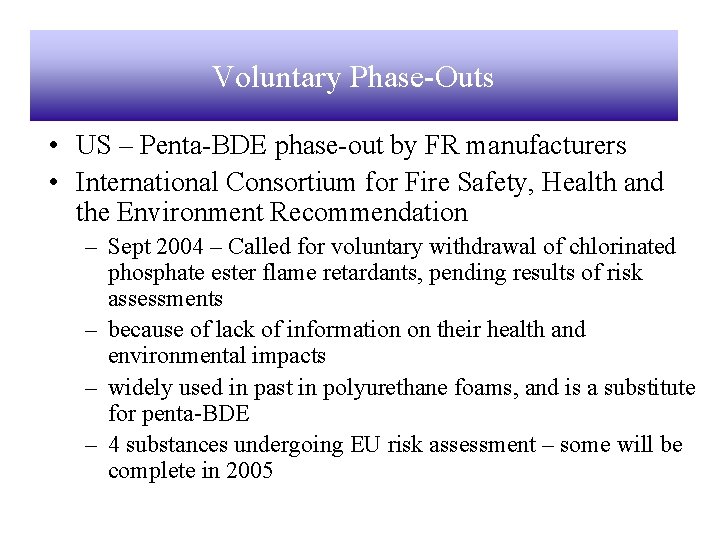
Voluntary Phase-Outs • US – Penta-BDE phase-out by FR manufacturers • International Consortium for Fire Safety, Health and the Environment Recommendation – Sept 2004 – Called for voluntary withdrawal of chlorinated phosphate ester flame retardants, pending results of risk assessments – because of lack of information on their health and environmental impacts – widely used in past in polyurethane foams, and is a substitute for penta-BDE – 4 substances undergoing EU risk assessment – some will be complete in 2005
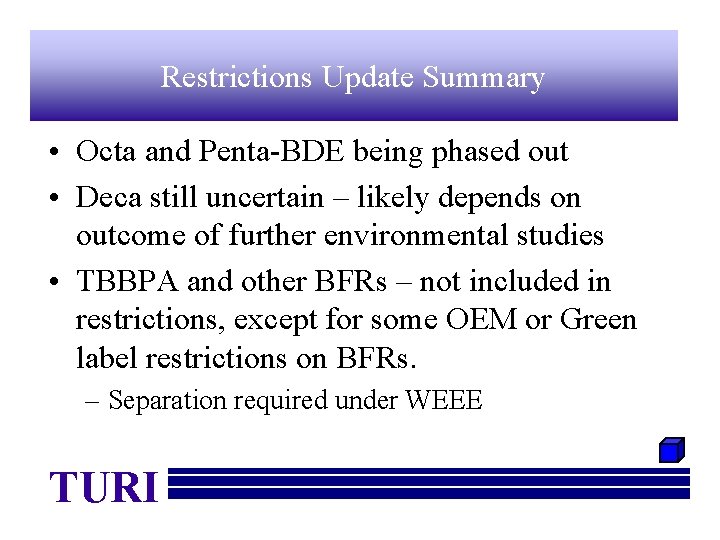
Restrictions Update Summary • Octa and Penta-BDE being phased out • Deca still uncertain – likely depends on outcome of further environmental studies • TBBPA and other BFRs – not included in restrictions, except for some OEM or Green label restrictions on BFRs. – Separation required under WEEE TURI
How do FRs work? • Physical Action – Cooling via endothermic processes (e. g. aluminum hydroxide) – Formation of physically protective layer (e. g. , phosphorous or boron compounds) – Dilution with inorganic fillers that decompose into inert gases (e. g. , aluminum hydroxide) TURI
How do FRs work? • Chemical Action – Gas phase reaction – combustion interrupted by decomposition products (e. g. halogens) – Solid phase reaction – carbon char layer (e. g. , phosphorus compounds) TURI
Flame Retardant Substances • Halogens – Bromine (BFRs), Chlorine • Phosphorous • Antimony • Metal salts and hydroxides • Nitrogen TURI
Alternative Flame Retardant Chemicals • Penta-BDE in Furniture, foams – Chlorinated phosphate esters (used prior to penta, problems with scorching and off-gassing) – Brominated phosphate compounds and blends – Chloroparaffins, other chlorinated compounds – Organic and Inorganic phosphorous compounds TURI
Alternative Flame Retardant Chemicals • Deca-BDE – HIPS electronics enclosures (TVs, printers, copiers) • Ethane 1, 2 bis (pentabromophenyl) • Ethylene 1, 2 bis (tetrabromophthalimide) – Flexible PVC (plenum-rated wire and cable) • Fluoropolymers • Emerging alternatives – nanocomposites – Fabric Backing • Phosphorous-based TURI
Alternative Flame Retardant Chemicals • TBBPA – Printed wiring board epoxy laminates (reactive) • Phosphorous compounds • Phosphorous-Nitrogen compounds – ABS computer monitor enclosures, copiers, faxes • Brominated epoxy oligomers • Halogenated and inorganic blends TURI
Alternative Resins and Materials • Inherently FR resins – XLPE – cross-linked polyethylene • Non-flammable materials – Apple Computer using metal casings for laptops • Resins that utilize reactive or safer FRs • Inherently more FR Fabrics/Fibers – IKEA using wool, Aramide and Alessandra fibers TURI
Redesign • Product Redesign – Apple Computer - Metal casing inside plastic exterior housing for monitor (isolates electronics) – Upholstered furniture, seating – use interliner, barrier fabric or more FR fabric rather than FR in foam, Impregnate fibers with phosphorus-based FRs • Building Construction – Non-plenum construction TURI
- Slides: 55