
TOXICOLOGY The study of chemical or physical agents










- Slides: 36
TOXICOLOGY The study of chemical or physical agents and their interaction with biologic systems to produce a response in a organism. The dose makes the poison!
TOXICOLOGY • DOSE = AMOUNT – Units • • mg/Kg (per unit weight) mg/cm 2 (per area of skin surface) ppm (per unit volume of air inhaled (gas/vapor)) mg/m 3 (for solids inhaled in air)
TOXICOLOGY Types of Exposure – Acute – amount of substance which is capable of causing an immediate reaction (less than 24 hours) – Chronic – small amount which does not cause an immediate reaction but is accumulated in the body to cause a delayed reaction over a longer period of time.
TOXICOLOGY • Routes of Exposure • • oral dermal inhalation injection
TOXICOLOGY • Toxicity Tests – goal is to select a test species that is a good model of humans, a response that is not subjective and can be consistently determined, and a test period that is relatively short.
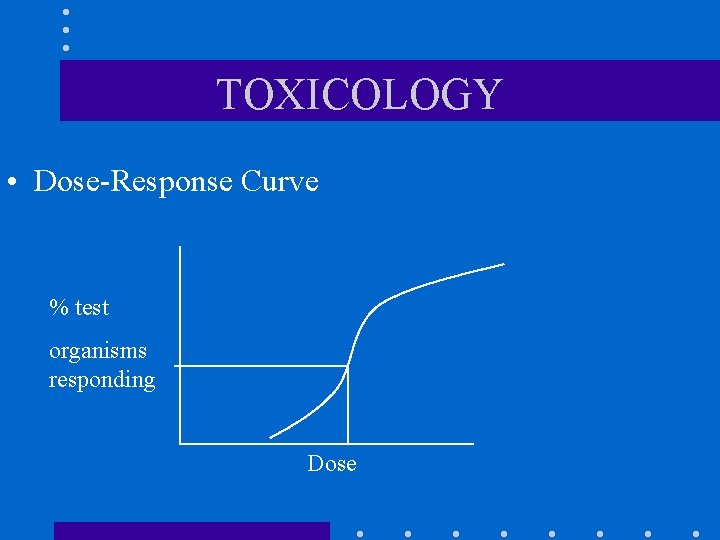
TOXICOLOGY • Dose-Response Curve % test organisms responding Dose
TOXICOLOGY • DOSE - RESPONSE TERMS – Toxic dose low (TLlo) = lowest dose introduced by any route (except inhalation) reported to produce any toxic effect in humans or to produce tumorigenic or reproductive effects in animals.
TOXICOLOGY • DOSE - RESPONSE TERMS - Toxic Concentration Low (TClo) - Lowest concentration of substance in air to which humans or animals have been exposed and has produced any toxic effect
TOXICOLOGY • DOSE - RESPONSE TERMS – Lethal Dose low (LDl 0) Lowest dose of a substance introduced by any route (except inhalation) which has been reported to have caused death in humans or animals.
TOXICOLOGY • DOSE - RESPONSE TERMS – Lethal Dose 50 (LD 50) - Calculated dose of a substance which is expected to cause death of 50% of the entire defined experimental population.
TOXICOLOGY • DOSE - RESPONSE TERMS – Lethal Concentration 50 (LC 50) Calculated concentration of a substance in air to which is expected to cause the death of 50% of an entire defined experimental population. (Table 1. )
TOXICOLOGY USING DOSE - RESPONSE INFORMATION • Can compare LD 50 of chemicals gives a relative rating of toxicity (Table 2. ) • Use LD 50 (mg/Kg) and multiply by 70 gives a rough estimate of toxic potential for humans.
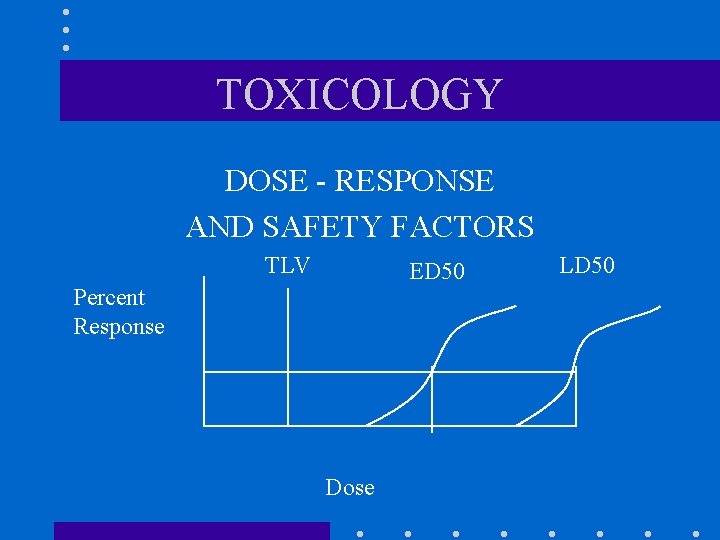
TOXICOLOGY DOSE - RESPONSE AND SAFETY FACTORS TLV ED 50 Percent Response Dose LD 50
TOXICOLOGY • FACTORS INFLUENCING TOXICITY – ROUTE OF EXPOSURE Route determines how much is absorbed and which organs are exposed to the highest concentrations.
TOXICOLOGY • FACTORS INFLUENCING TOXICITY – GENDER Some substances are more toxic to one gender than another.
TOXICOLOGY • FACTORS INFLUENCING TOXICITY – AGE Older people have different blood, hepatic systems, musculature, metabolism, and excretory patterns than younger people. This can influence disposition and toxic effects of chemicals.
TOXICOLOGY • FACTORS INFLUENCING TOXICITY – SYNERGISM - 1 + 1 = 3 – ANTAGONISM - 1 + 1 = 1/2 – POTENTIATION - Type of Synergism
TOXICOLOGY • FACTORS INFLUENCING TOXICITY – GENETICS Not all people are created equal genetically!
TOXICOLOGY • FACTORS INFLUENCING TOXICITY – SPECIES VARIATION Physiological differences between species can lead one to over or under estimate toxic effects of a chemical when comparing results from one to another species.
TOXICOLOGY EXPOSURE GUIDELINES ACGIH - American Conference of Governmental Industrial Hygienists Develop and Publish - Threshold Limit Values (TLVs)
TOXICOLOGY • TLV - based on the concept that there is a threshold dose or concentration below which there is no adverse effects. - Developed for use in the workplace
TOXICOLOGY • TLVs – Refer to airborne concentrations – Represent conditions under which nearly all workers may be repeatedly exposed day after day without adverse effects. – Limited: healthy working age individuals
Toxicology • TLV TYPES – TLV-TWA: Time Weighted Average time weighted average concentration for a normal eight-hour work day – TLV-STEL: Short Term Exposure Limit 15 minute time weighted average exposure repeated exposure no more than four times per 8 hour work shift
TOXICOLOGY • TLV TYPES – TLV-C: Ceiling Concentration that should not be exceeded, even instantaneously.
TOXICOLOGY EXPOSURE GUIDELINES • OSHA - PELs: Permissible Exposure Limits • PELs are legally enforceable and apply to all private industries and the Federal government. • 29 CFR 1910. 1000 lists PELs for specific compounds
TOXICOLOGY EXPOSURE TYPES • IDLH - Immediately Dangerous to Life and Health – represent maximum concentrations from which one could escape within 30 minutes without any irreversible health effects
TOXICOLOGY BODY RESPONSE TO TOXIC CHEMICALS • Respiratory Tract – upper - nasopharyngeal – middle - tracheobronchial – lower - pulmonary acinus
TOXICOLOGY BODY RESPONSE TO TOXIC CHEMICALS Types of inhaled toxicants – Asphyxiants: gases that deprive the body of oxygen • Simple asphyxiants (nitrogen, helium, methane) • Chemical asphyxiants (cyanide, Carbon Monoxide)
TOXICOLOGY BODY RESPONSE TO TOXIC CHEMICALS • Irritants: – chemicals that irritate the air passages, causing constriction of airways and edema (liquid in the lungs) and infection. (ammonia, chlorine, HF, HCl)
TOXICOLOGY BODY RESPONSE TO TOXIC CHEMICALS • Necrosis Producers: – chemicals that result in cell death and edema. (ozone, nitrogen dioxide)
TOXICOLOGY BODY RESPONSE TO TOXIC CHEMICALS • Fibrosis producers: – chemicals that produce fibrotic tissue which if massive, block airways and decrease lung capacity. (asbestos, silicates, beryllium)
TOXICOLOGY BODY RESPONSE TO TOXIC CHEMICALS • Allergens: – chemicals that induce allergic response characterized by bronhoconstriction and pulmonary disease. (isocyanates, sulfur dioxide)
TOXICOLGY BODY RESPONSE TO TOXIC CHEMICALS • Carcinogens: – chemicals associated with lung cancer (cigarette smoke, coke emissions, asbestos, arsenic)
TOXICOLOGY BODY RESPONSE TO TOXIC CHEMICALS • SKIN – natural barrier: prevents absorption – Sebaceous glands: secrete fatty acids – Melanocytes: protects from UV – Sweat galnds: regulate heat
TOXICOLOGY BODY RESPONSE TO TOXIC CHEMICALS • • • EYES CENTRAL NERVOUS SYSTEM LIVER KIDNEYS BLOOD
TOXICOLOGY • TERATOGENS • MUTAGENS • CARCINOGENS