
TOXICOLOGY OF ALCOHOL The most heavily abused drug
TOXICOLOGY OF ALCOHOL (The most heavily abused drug in the Western world. ) (
Introduction • A major branch of forensic toxicology deals with the measurement of alcohol in the body for matters that pertain to violations of criminal law.
Toxicology of Alcohol • Like any depressant, alcohol principally affects the central nervous system, particularly the brain.
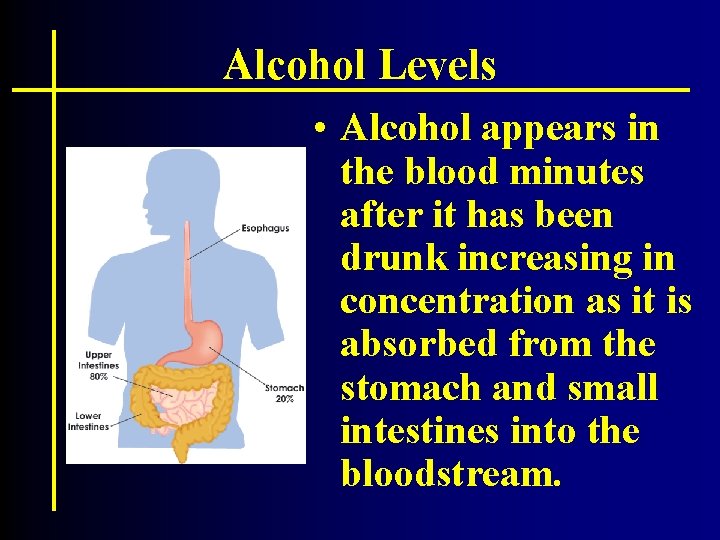
Alcohol Levels • Alcohol appears in the blood minutes after it has been drunk increasing in concentration as it is absorbed from the stomach and small intestines into the bloodstream.
Alcohol Levels • When all the alcohol has been absorbed, a maximum alcohol level is reached in the blood. • Then the alcohol concentration slowly decreases until a zero level is again reached. • TIME IS THE ONLY THING THAT REDUCES INTOXICATION!
Alcohol Levels • Factors such as time taken to consume the drink, the alcohol content, the amount consumed, and food present in the stomach determine the rate at which alcohol is absorbed. http: //reesenews. org/files/interactives/mccreight_alcohol/mccreight_final. swf
Alcohol Levels • Alcohol is eliminated from the body through oxidation and excretion. • Oxidation takes place almost entirely in the liver, while alcohol is excreted in breath, urine, and perspiration.
Alcohol Levels • Intoxication level is determined by measuring the quantity of alcohol present in blood or in breath. • Experimental evidence has verified the amount of alcohol exhaled in breath is directly proportional to the blood concentration.
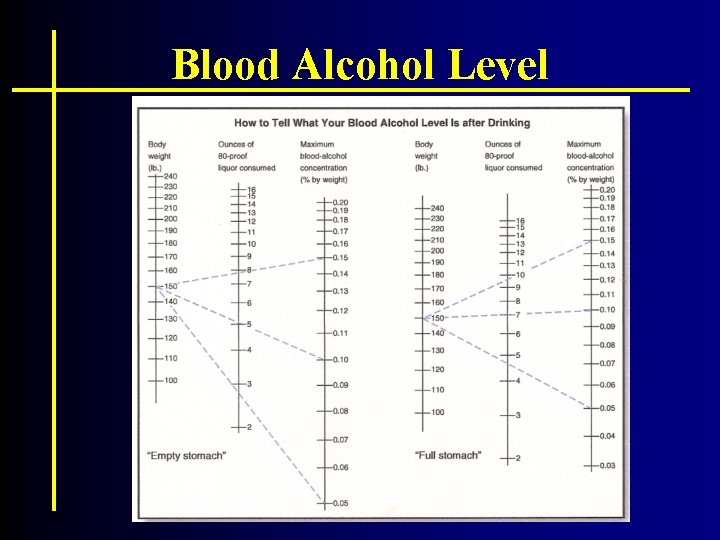
Blood Alcohol Level
Alcohol and Law • Between 1939 and 1964 a person having a blood-alcohol level in excess of 0. 15 was considered under the influence, which was lowered to 0. 10 percent by 1965. • In 1972 the impairment level was recommended to be lowered again to 0. 08.
- Slides: 10