
Toxicology III Classification Diagnosis in dead viscera preservation
- Slides: 18
Toxicology –III Classification, Diagnosis in dead, viscera preservation , duties of RMP Dr. Prakash Kulkarni
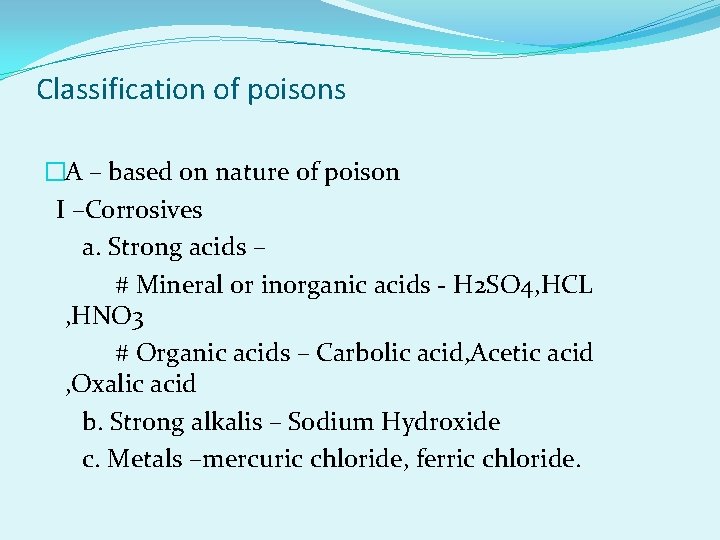
Classification of poisons �A – based on nature of poison I –Corrosives a. Strong acids – # Mineral or inorganic acids - H 2 SO 4, HCL , HNO 3 # Organic acids – Carbolic acid, Acetic acid , Oxalic acid b. Strong alkalis – Sodium Hydroxide c. Metals –mercuric chloride, ferric chloride.
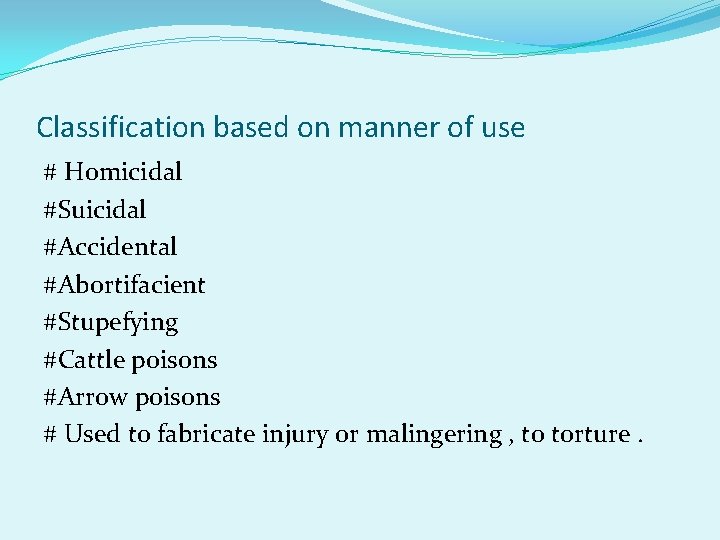
Classification based on manner of use # Homicidal #Suicidal #Accidental #Abortifacient #Stupefying #Cattle poisons #Arrow poisons # Used to fabricate injury or malingering , to torture.
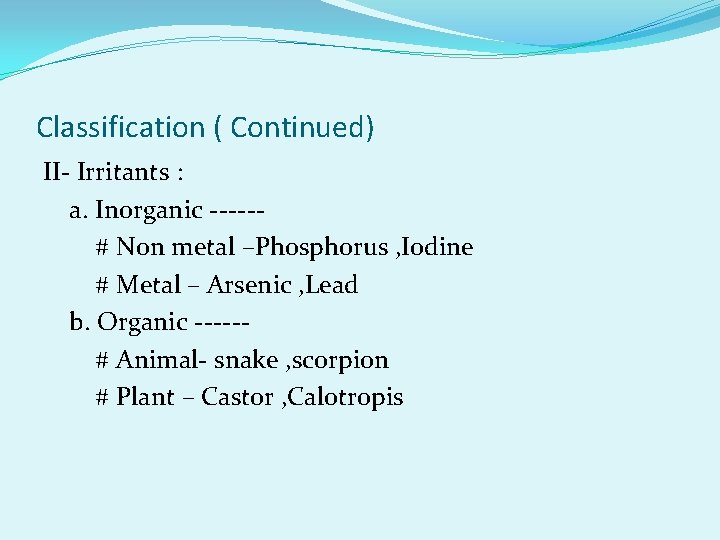
Classification ( Continued) II- Irritants : a. Inorganic ----- # Non metal –Phosphorus , Iodine # Metal – Arsenic , Lead b. Organic ----- # Animal- snake , scorpion # Plant – Castor , Calotropis
Classification ( Continued) III- Systemic a. Cerebral poisons # Somniferous & Narcotics-(Sleep inducing )Opium and its alkaloids, morphine . # Inebriants – Alcohol. # Stimulants –cocaine, methamphetamine # Deliriant –Dhatura, Cannabis Indica. # Depressants –alcohol, valium. # Psycho tropics—cocaine
Classification ( Continued) b. Spinal poisons – Strychnine. c. Peripheral nerve poison- Curare. d. Cardiac poisons- Aconite. e. Asphyxiants –Carbon Monoxide f. Nephrotoxic– Mercury g. Hepatotoxic – Phosphorus. IV. Miscellaneous – Food poisoning.
Medico legal aspects of poisons �In law, the real difference between a medicine and a poison is the intent with which it is given. If the substance is given with the intention to save the life , it is medicine , but if it is given with intention to cause bodily harm , it is a poison. The law does not make any difference between murder by means of poison and murder by any other means.
PM Findings in poisoning cases �External Findings – � 1. Post mortem lividity-Bluish in asphyxiant poisons , Cherry Red in CO and HCN poisoning � 2. Deep cyanosis –in cardiac and opium poisoning � 3. Early rigor mortis in strychnine poisoning and early decomposition in H 2 S poisoning � 4. Ulceration over lips and near angle of mouth in corrosive poisoning � 5. Alopecia , hyper pigmentation and hyperkeratosis in chronic Arsenic poisoning � 6. Staining , erosion and ulcerations near female genitalia –use of abortifacient agents � 7. Injection marks-in injectable poisons, snake bites.
Internal PM Findings � 1. Corrosion , ulcerations of GIT – in corrosive poisonings � 2. Yellowish discoloration –in Nitric Acid poisoning , Bluish in Copper sulphate poisoning � 3. Charring of mucosa and chalky white teeth- Cons. H 2 SO 4 poisoning � 4. Blue linings on gums –Chronic Lead poisoning. � 5. Esophageal strictures – in corrosives � 6. Perforation of stomach – in H 2 SO 4 and HNO 3 poisoning . � 7. Luminous stomach contents – in phosphorus poisoning � 8. Detctable smell- Kerosene , alcohol , OP compounds.
Preservation of viscera �Preserved in four bottles – Bottle- 1 – Stomach full with it’s contents and 2 feet of small intestine from upper part with it’s contents. Bottle- 2 – Liver ( 500 gms or half –whichever is more ) Spleen ( whole ) Kidneys ( longitudinal half of each ) Bottle – 3 – Blood 50 ccs from chamber of heart or IVC. Bottle- 4 Sample of preservative �Preservatives in first two bottles , no preservative in blood.
Mode of preservation of viscera � 1. The viscera should be submerged completely in a clean glass container with glass lid. � 2. One third of container should be empty to accommodate the gas which may be formed � 3. Container should be made air tight with paraffin wax � 5. Proper labeling and sealing � 6. Sample of preservative should also be sent.
Reasons for non detection of poison in viscera. � 1. Delay in examination of viscera � 2. Improper preservation of viscera � 3. Use of wrong analytical technique � 4. Early disintegration of poison � 5. Complete metabolism of poison in body � 6. Negligible amount of poison in viscera � 7. Lack of suitable tests for certain poisons � 8. Tampering of preserved viscera.
Preservatives �Preservatives are substances which are added to prevent bacterial and enzymatic action and in turn prevent decomposition changes. �Saturated solution of common salt-more commonly used preservative as it has no contraindication. �Rectified spirit or absolute alcohol- in acid poisoning cases except carbolic acid � 10% formal saline – for histopath exam �For blood – fluoride , oxalate , EDTA , mercuric chloride or citrate depending on type of test to be performed. �For urine – in sterile container without any preservative.
Special situations � 1. Volatile poisons and anesthetic deaths – parts of both lungs to be preserved in polythene bag. � 2. Cadiotoxic poisons- whole heart. � 3. Cerebral poisons –whole brain � 4. Strychnine poisoning- spinal cord � 5. Heavy metal poisoning –bones, hair and nail � 6. Abortifacient drugs-uterus and vagina � 7. Injection – skin , subcut and muscles
Analytical methods of viscera analysis � 1. Chemical tests –Use of solvents to extract poison. evaporation of solvent chemical tests of remaining concentrated part. � 2. Physico-chemical tests –Chromatography ( column , paper , thin layer , gas) , gas petroscopy , electrophoresis.
Fate of poison in body �Elimination from body by the way of vomiting, purging , and through exhaled air. �By sweating , through milk or bile. �Through urine �Metabolism in liver ( Biotransformation ) �Deposited in tissues. ( Lead , Arsenic )
Duty of doctor in poisoning cases. �Treatment (Mandatory ) �Register Medico legal case and inform police. Arrange for dying declaration if required. �Must preserve all the samples (vomitus , stomach wash , urine or feces ) �In case of death do not issue death certificate without autopsy. �If public eateries are source of poisoning , inform the health authorities.
Poison information center �This concept was first adopted in Netherlands in 1949. �Objective is to provide information regarding poisons through a call center. �In India , the first such center was established in AIIMS New Delhi in 1994. �At present there are 4 centers in India –Ahmedabad , Chennai , Cochin and New Delhi.