
Toxic Gases Carbon Monoxide The most common form
Toxic Gases
Carbon Monoxide • • The most common form of poisoning From 1979 to 1988, 56, 000 people died from CO Colorless, odorless, nonirritating gas Produced by incomplete combustion of carbon containing compounds • Combines with Hb to form carboxyhemoglobin • CO-Hb will not transport O 2 • T 1/2 of CO-Hb is 5 -6 hours in room air, 90 min in pure O 2 at 1 atm, 23 min in O 2 at 3 atm

Carbon monoxide, cont. • Sources: – propane powered engines – natural gas appliances - space heaters – automobile exhaust – gas log fireplaces – kerosene heaters – hibachi grills – portable generators

Carbon monoxide, cont. Mechanism of action: • Competes with O 2 for active sites on Hb (220 x the affinity for Hb as O 2) • Interference with cellular respiration at the mitochondria level, binds to cytochrome oxidase • Induces smooth muscle relaxation • Hypoxemia, tissue hypoxia, no cyanosis, CO -Hb is cherry red in color

Carbon monoxide, cont. • Diagnosis based on patient presentation and a good history • Signs and symptoms vary widely • Signs depend on % CO-Hb levels in the blood • Presence of cherry red blood is pathognomonic

Carbon monoxide, cont. Clinical grading of CO poisoning • Mild • Moderate • Severe headache, nausea, dizziness, vomiting, flu like symptoms confusion, slow thinking, shortness of breath, blurred vision, tachycardia, tachypnea, ataxia, weakness chest pain, palpitations, severe drowsiness, disorientation, hypotension, syncope, myocardial ischemia, pulmonary edema
Carbon monoxide, cont. • Exposure during pregnancy can be teratogenic • Chronic low level exposure can cause: – tiredness and lethargy – memory disturbances (most common) – irritability – visual impairment – increased incidence of heart disease on atherosclerosis
Carbon monoxide, cont. Management of Toxicity: • The antidote for CO poisoning is 100% oxygen • hyperbaric chambers should be used more frequently than they currently are in the treatment of CO poisoning
Hydrogen sulfide poisoning • Highly toxic, malodorous, intensely irritating gas • Sources: – – – decaying organic materials natural gas volcanic gas petroleum sulfur deposits sulfur springs • Most exposures are occupational
Hydrogen sulfide, cont. Mechanism of action: • inhibits mitochondrial cytochrome oxidase • paralyzes the electron transport system • inhibits cellular utilization of O 2 • metabolic acidosis secondary to anaerobic metabolism • plenty of O 2 in the bloodstream, cells can not utilize it, so no hypoxemia but tissue hypoxia
Hydrogen sulfide, cont. Mechanism of action, cont. : • more potent cytochrome oxidase inhibitor than cyanide • rapidly absorbed through the inhalation route • metabolized by the liver and excreted through the kidneys • cause of death is respiratory paralysis due to toxic effects of H 2 S on respiratory centers in the brain
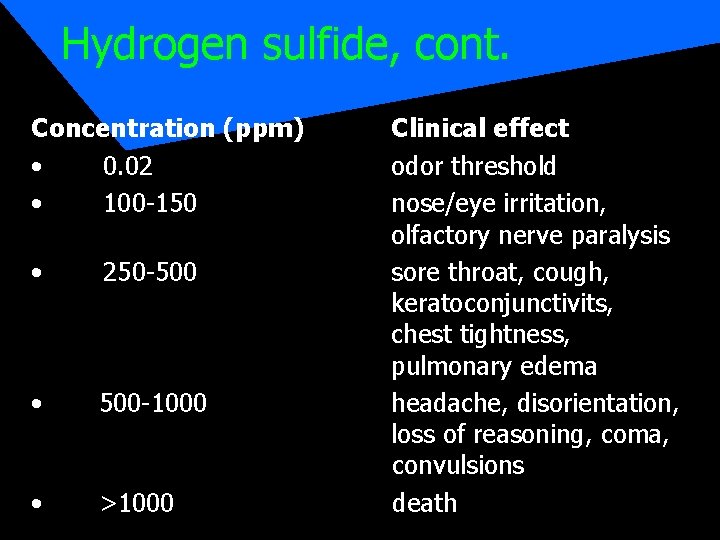
Hydrogen sulfide, cont. Concentration (ppm) • 0. 02 • 100 -150 • 250 -500 • 500 -1000 • >1000 Clinical effect odor threshold nose/eye irritation, olfactory nerve paralysis sore throat, cough, keratoconjunctivits, chest tightness, pulmonary edema headache, disorientation, loss of reasoning, coma, convulsions death
Hydrogen sulfide, cont. Treatment: • rescuer protection • basic life support • give O 2, hyperbaric oxygenation is beneficial • nitrates are antidotal by inducing Meth-Hb providing a large available source of ferricheme which has a greater affinity for H 2 S than does cytochrome oxidase, sequestering sulfide ions freeing cytochrome oxidase
Cyanide • Hydrocyanic acid, Prussic acid, HCN • In 1998 only 8 fatal exposures reported • Cyanide may be a major contributor to morbidity and mortality observed in approx. 5, 000 -10, 000 deaths occurring each year from smoke inhalation. Many compounds contains nitrogen and carbon produce cyanide when burned (so do household plastics, polyurethane foam in furniture, etc). • Suicide by cyanide poisoning occurs predominantly in males as does industrial exposure
Cyanide • Sources: – – – electroplating, jewelry and metal cleaners photographic processing X-Ray film recovery fumigant rodenticide criminal tampering with OTC capsules Amygdalin - pits of peaches, cherries, apricots, apples, plums – laetrile
Cyanide, cont. Mechanism of action: • causes tissue hypoxia by binding with ferric iron of mitochondrial cytochrome oxidase, thus inhibiting the functioning of the electron transport chain and the cells ability to utilize O 2 in oxidative phosphorylation • substantial decrease in ATP production • see a shift to anaerobic metabolism • increased lactic acid production - metabolic acidosis
Cyanide • Cyanide exists in several forms: – gaseous hydrogen cyanide - HCN – potassium and sodium cyanide salts • The delay between exposure and onset of clinical signs depends upon the type of cyanide involved, route of entry and dose. • Clinical presentation: tissue hypoxia, especially of the heart and brain (plenty of O 2 in the bloodstream, cells can not utilize what is there)
Cyanide, cont. Clinical presentations, cont. • Patients who do not experience sudden collapse you will see anxiety, hyperventilation, CNS stimulation, tachycardia, palpitations • Late signs of poisoning include nausea, vomiting, hypotension, generalized seizures, coma, apnea, a variety of cardiac dysrhythmias • Smell of bitter almonds to the breath • Absence of cyanosis
Cyanide, cont. • Causes – smoke inhalation – suicidal ingestion - seen more in health care and lab personnel because they have access – industrial exposures • Treatment – amyl nitrate - to induce Meth-Hb (same as with H 2 S) – aggressive airway management - give O 2
- Slides: 19