
Town Health Officer Program Environmental Health Division What


- Slides: 46
Town Health Officer Program Environmental Health Division
What is a Town Health Officer Vermont Department of Health
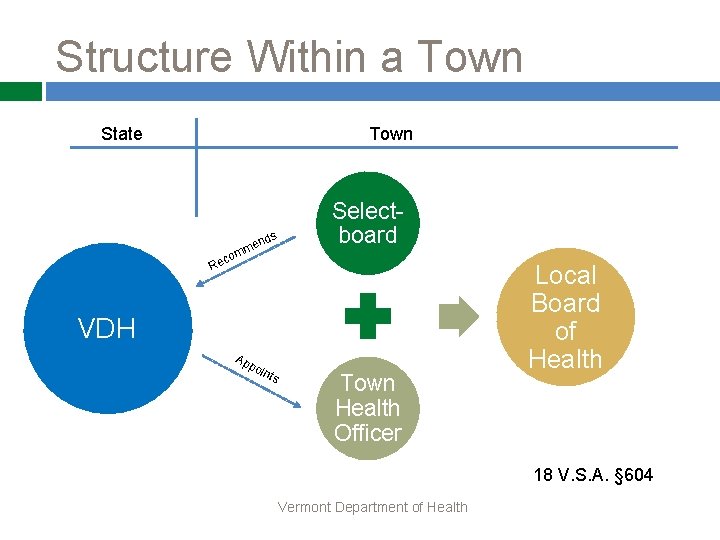
Local Health Officer Appointment “The commissioner shall appoint, upon recommendation of the selectmen, a local health officer for each town or city…” 18 V. S. A. § 601(a) § § Every selectboard or city council must recommend a THO for appointment by VDH Commissioner § If no THO recommended, selectboard chair automatically appointed § Currently 23 selectboard chairs are THOs A THO’s term automatically ends after 3 years THOs can be removed “for cause” and can resign Vermont Department of Health The selectboard chair will automatically assume
Deputy Health Officers Towns are encouraged to appoint additional Health Officers, called Deputy THOs Same authority and appointment process No limit on number of deputy THOs Deputies can share duties, cover when the THO is unavailable, or step in during conflicts of interest Not all towns have a deputy: ~70 currently Vermont Department of Health do
Health Districts 18 V. S. A. § 602(b) provides a process by which towns can combine to form health districts, with a district health officer and an advisory district board of health Currently, no cities or towns have formed official health districts under that provision Several towns have appointed the same THO, though, forming an unofficial health district Vermont Department of Health
Structure Within a Town State Town nds e mm Select- board co Re VDH Ap p oin ts Town Health Officer Local Board of Health 18 V. S. A. § 604 Vermont Department of Health
Town Health Officer Funding and Background § THOs not funded by state § § § Many THOs are unpaid, voluntary positions Some towns opt to give a small stipend, some reimburse for expenses only Some towns incorporate THO duties into an existing position § § § Ex: in Burlington, code enforcement officers are THOs, in some towns zoning administrators or fire safety officers also serve as THO Many THOS have expressed frustration with the system and feel it’s too much work and stress for a volunteer position Most THOs are not public health or rental housing safety experts § § Many are retirees, or have a full time job in addition to their THO role Those with a full-time job can, at times, be difficult to reach Vermont Department of Health
Unpacking the THO Statute Under Vermont State Statute Title 18, Chapter 11 § 602 a. Duties of local health officers (a) A local health officer, within his or her jurisdiction, shall: (1) upon receipt of information regarding a condition that may be a public health hazard, conduct an investigation; (2) enforce the provisions of this title, the rules promulgated and permits issued thereunder; (3) prevent, remove, or destroy any public health hazard, or mitigate any significant public health risk in accordance with the provisions of this title; (4) in consultation with the department, take the steps necessary to enforce all orders issued pursuant to chapter 3 of this title. (b) Upon discovery of violation or a public health hazard or public health risk that involves a public water system, a food or lodging establishment, or any other matter regulated by department rule, the local health officer shall immediately notify the division of environmental health. Upon discovery of any other violation, public health hazard, or public health risk, the local health officer shall notify the division of environmental health within 48 hours of discovery of such violation or hazard and of any action taken by the officer. (Added 1985, No. 267 (Adj. Sess. ), § 19. ) Vermont Department of Health
What does a THO do? § A Town Health Officer shall: § § Conduct inspections on complaints of public health hazards Conduct inspections on rental housing complaints Work with property owners toward voluntary compliance Issue Health Orders & Emergency Health Orders as necessary to prevent, remove, or destroy any public health hazard Vermont Department of Health
Understanding Public Health Hazards “…potential harm to the public health by virtue of any condition or any biological, chemical, or physical agent. ” 18 V. S. A. § 2 (9) Vermont Department of Health
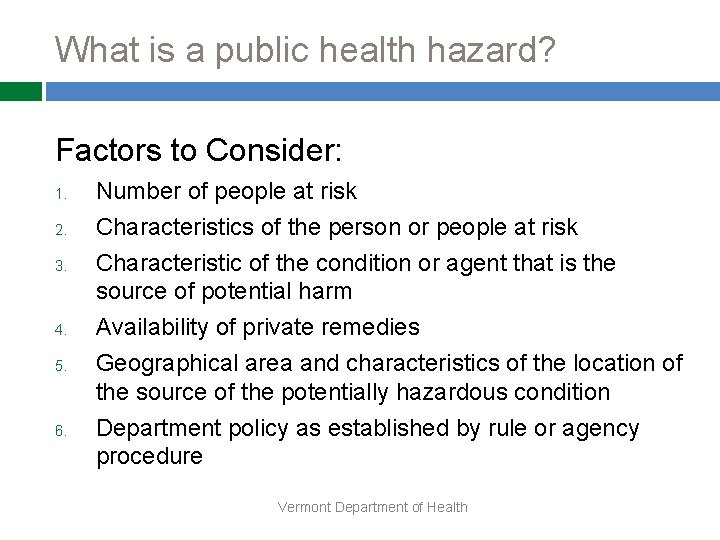
What is a public health hazard? Factors to Consider: 1. 2. 3. 4. 5. 6. Number of people at risk Characteristics of the person or people at risk Characteristic of the condition or agent that is the source of potential harm Availability of private remedies Geographical area and characteristics of the location of the source of the potentially hazardous condition Department policy as established by rule or agency procedure Vermont Department of Health
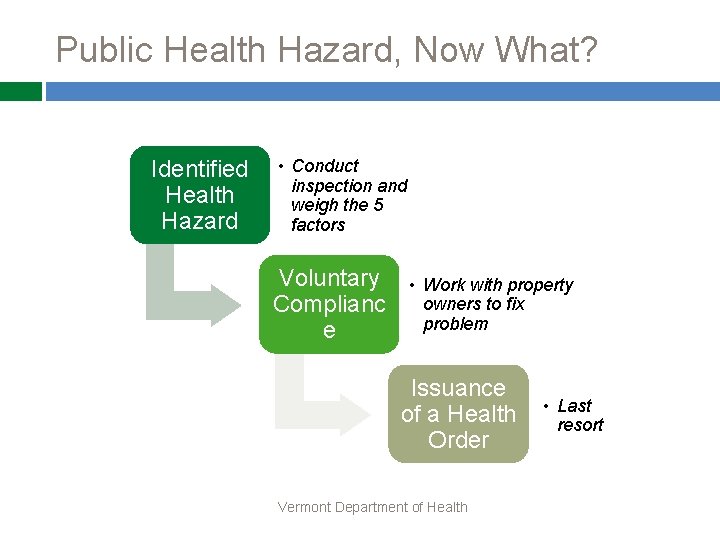
Public Health Hazard, Now What? Identified Health Hazard • Conduct inspection and weigh the 5 factors Voluntary Complianc e • Work with property owners to fix problem Issuance of a Health Order Vermont Department of Health • Last resort
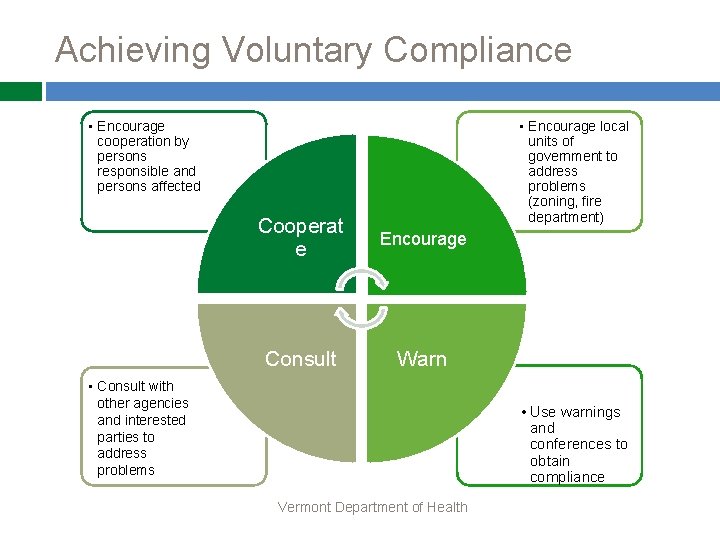
Achieving Voluntary Compliance • Encourage cooperation by persons responsible and persons affected • Encourage local units of government to address problems (zoning, fire department) Cooperat e Encourage Consult Warn • Consult with other agencies and interested parties to address problems • Use warnings and conferences to obtain compliance Vermont Department of Health
Enforcement of Public Health Laws Vermont Department of Health
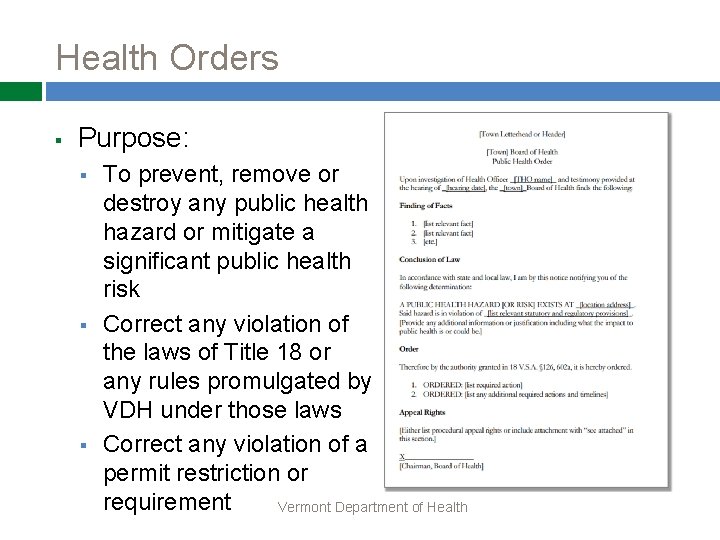
Health Orders § Purpose: § § § To prevent, remove or destroy any public health hazard or mitigate a significant public health risk Correct any violation of the laws of Title 18 or any rules promulgated by VDH under those laws Correct any violation of a permit restriction or requirement Vermont Department of Health
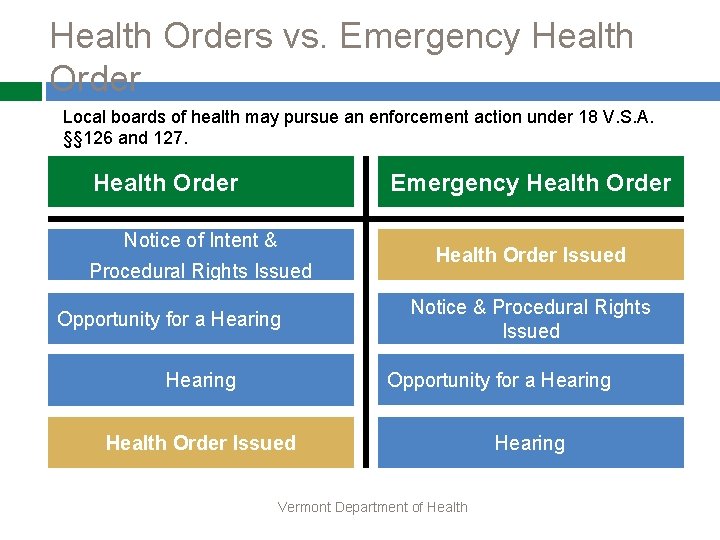
Health Orders vs. Emergency Health Order Local boards of health may pursue an enforcement action under 18 V. S. A. §§ 126 and 127. Health Order Emergency Health Order Notice of Intent & Procedural Rights Issued Opportunity for a Hearing Health Order Issued Notice & Procedural Rights Issued Opportunity for a Hearing Health Order Issued Vermont Department of Health Hearing
How do Health Orders work? THO (and town attorney) draft notice of intent to issue Health Order The notice of intent must be served on the party Hearing in front of Local Board of Health THO and party can present evidence Local Board of Health decides to issue HO (or not) Decision can be appealed to the State Board of Health within 30 days State Board of Health decision can be Vermont Department of Health appealed to Vermont Supreme Court
Enforcing a Health Order When issued, Health Orders should be filed with local Superior Court If the party fails to comply with the order they may be subject to further legal action including civil enforcement and criminal penalties Civil penalties up to $10, 000 per violation/day available at judge’s discretion Vermont Department of Health
How does VDH support THOs? Vermont Department of Health
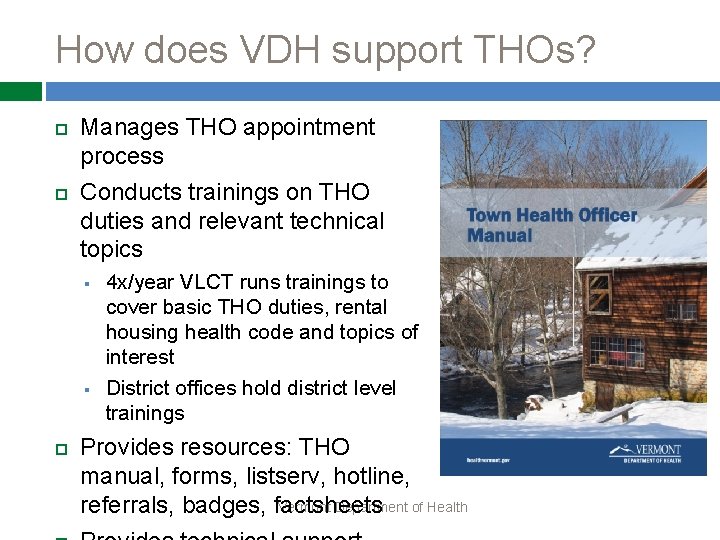
How does VDH support THOs? Manages THO appointment process Conducts trainings on THO duties and relevant technical topics § § 4 x/year VLCT runs trainings to cover basic THO duties, rental housing health code and topics of interest District offices hold district level trainings Provides resources: THO manual, forms, listserv, hotline, Vermont Department of Health referrals, badges, factsheets
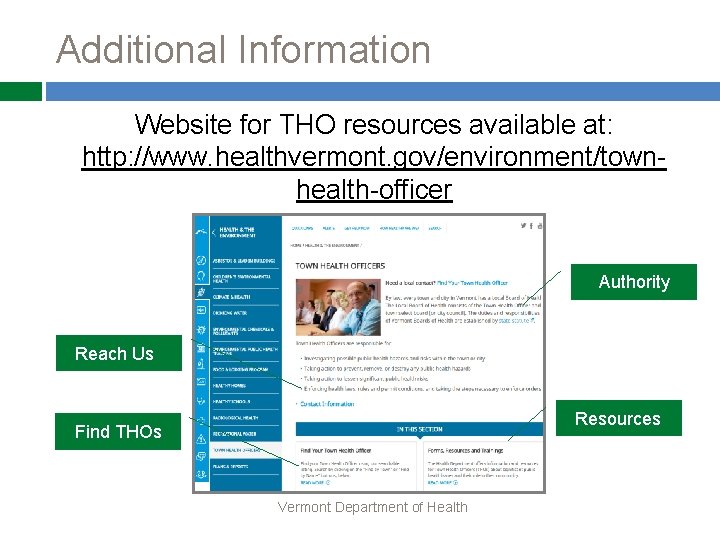
Additional Information Website for THO resources available at: http: //www. healthvermont. gov/environment/townhealth-officer Authority Reach Us Resources Find THOs Vermont Department of Health
What issues does a THO encounter? Vermont Department of Health
THOs serve as the local enforcement of the Rental Housing Health Code (18 VSA § 602 a) Rental Housing “Dwelling: means a rented building or structure, excluding tents or similar structures used for the express purpose of camping, that is wholly or partly used or intended to be used as a primary residence for living or sleeping by human inhabitants. This includes rented mobile homes and ‘housing provided as a benefit of farm employment’ as defined in 9 VSA § 4469(a)(3). ” - Vermont Rental Housing Health Code Photo courtesy of HUD Vermont Department of Health
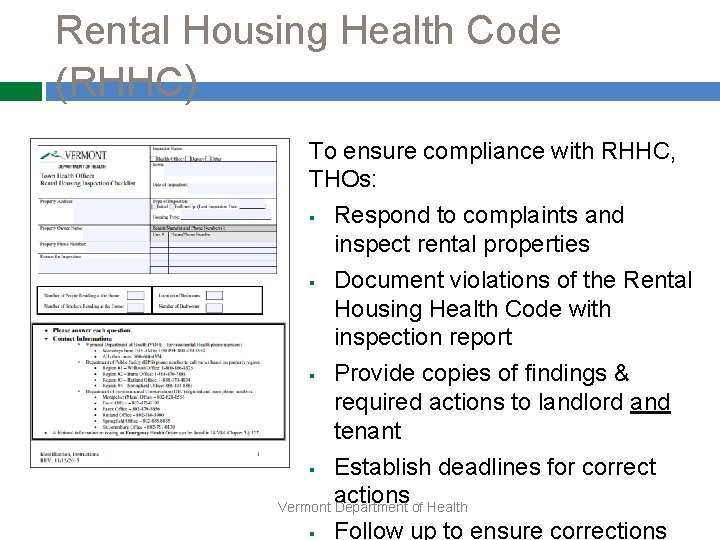
Rental Housing Health Code (RHHC) To ensure compliance with RHHC, THOs: § Respond to complaints and inspect rental properties § Document violations of the Rental Housing Health Code with inspection report § Provide copies of findings & required actions to landlord and tenant § Establish deadlines for correct actions Vermont Department of Health § Follow up to ensure corrections
Other rental housing issues Beyond the RHHC, when investigating rental housing issues, THOs: Alert Dept. of Public Safety/Fire Safety if there are life/fire safety and structural issues found during an inspection Report lead paint and asbestos issues to VDH regulatory program Contact Dept. of Environmental Conservation for issues with Vermont Department of Health septic/wastewater
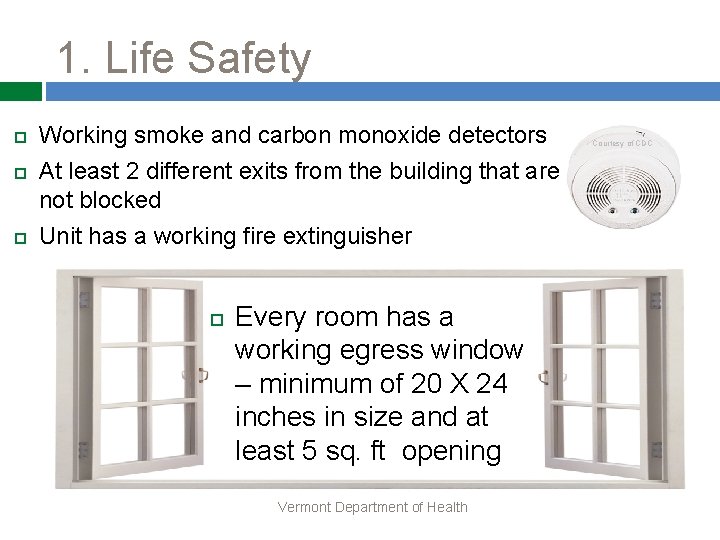
1. Life Safety Working smoke and carbon monoxide detectors At least 2 different exits from the building that are not blocked Unit has a working fire extinguisher Every room has a working egress window – minimum of 20 X 24 inches in size and at least 5 sq. ft opening Vermont Department of Health Courtesy of CDC
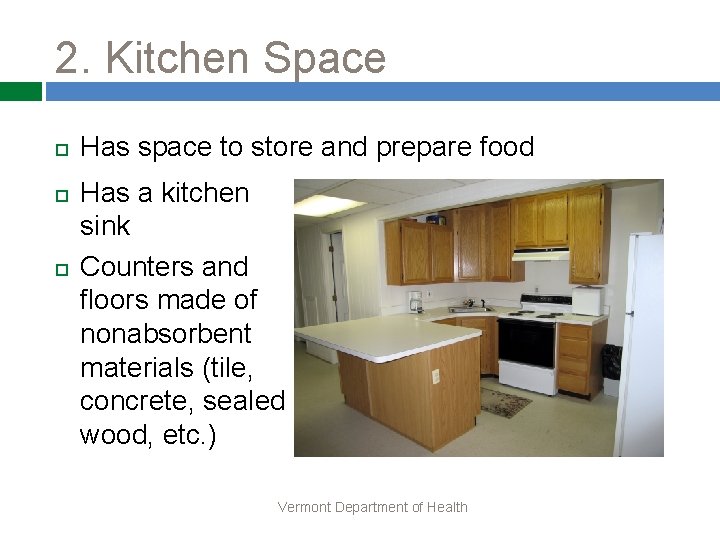
2. Kitchen Space Has space to store and prepare food Has a kitchen sink Counters and floors made of nonabsorbent materials (tile, concrete, sealed wood, etc. ) Vermont Department of Health
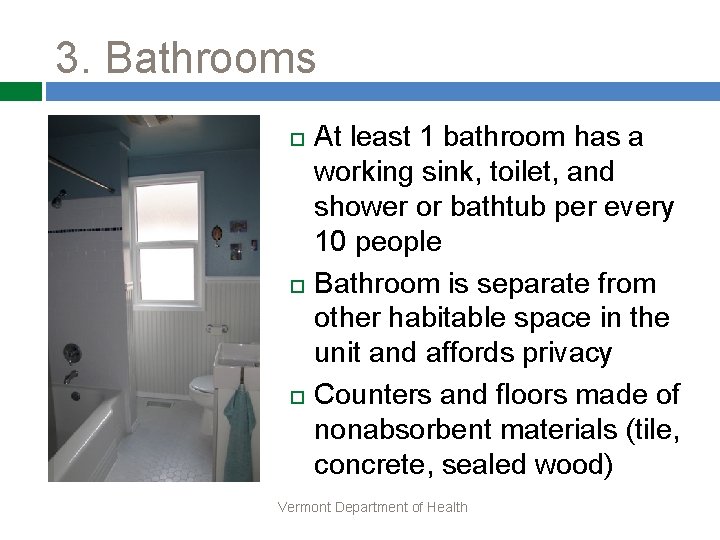
3. Bathrooms At least 1 bathroom has a working sink, toilet, and shower or bathtub per every 10 people Bathroom is separate from other habitable space in the unit and affords privacy Counters and floors made of nonabsorbent materials (tile, concrete, sealed wood) Vermont Department of Health
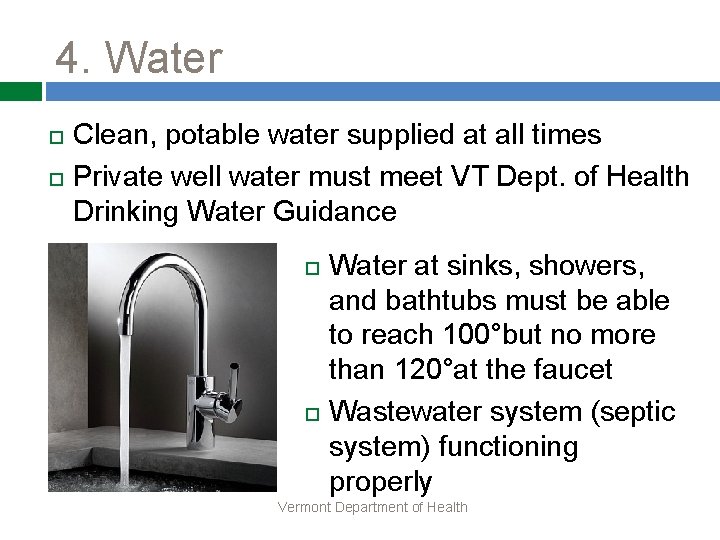
4. Water Clean, potable water supplied at all times Private well water must meet VT Dept. of Health Drinking Water Guidance Water at sinks, showers, and bathtubs must be able to reach 100°but no more than 120°at the faucet Wastewater system (septic system) functioning properly Vermont Department of Health
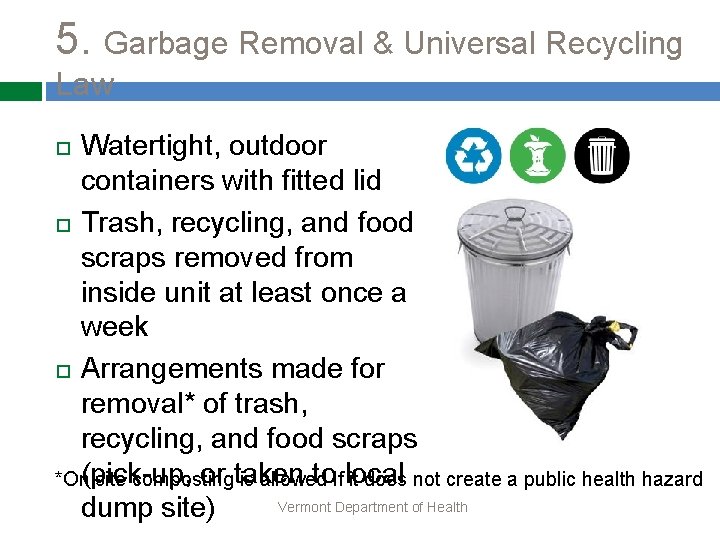
5. Garbage Removal & Universal Recycling Law Watertight, outdoor containers with fitted lid Trash, recycling, and food scraps removed from inside unit at least once a week Arrangements made for removal* of trash, recycling, and food scraps (pick-up, or taken to local *On site composting is allowed if it does not create a public health hazard Vermont Department of Health dump site)
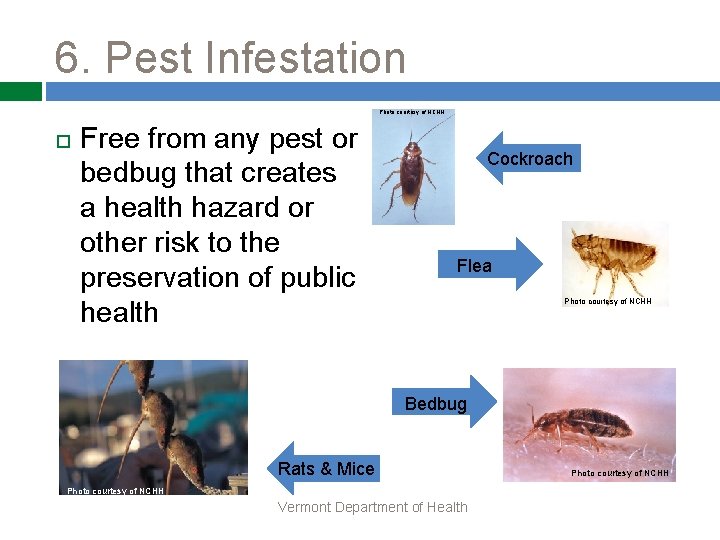
6. Pest Infestation Photo courtesy of NCHH Free from any pest or bedbug that creates a health hazard or other risk to the preservation of public health Cockroach Flea Photo courtesy of NCHH Bedbug Rats & Mice Photo courtesy of NCHH Vermont Department of Health Photo courtesy of NCHH
7. Heating Heat must be available when outside temperature is less than 55° Heating system able to maintain temperature in all habitable space at minimum of 65°without overheating portions of the unit – must be consistent throughout the property All fuel-fired heating systems property vented to the outside of the building Heating system must be serviced at least every two years by a qualified technician Vermont Department of Health
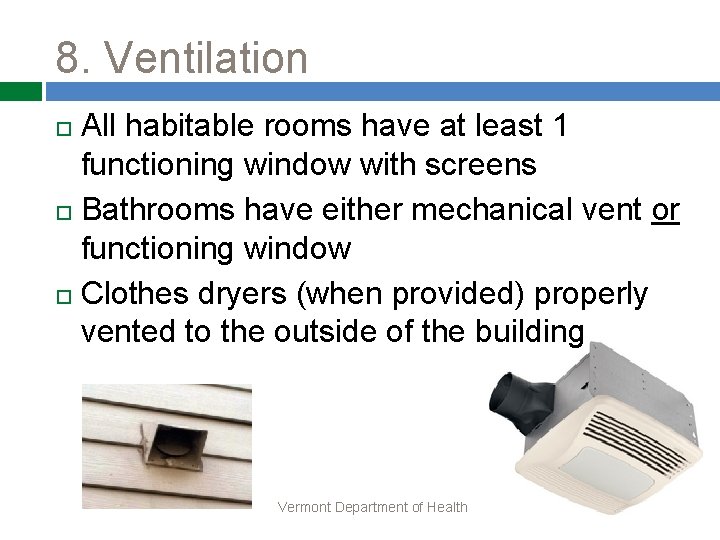
8. Ventilation All habitable rooms have at least 1 functioning window with screens Bathrooms have either mechanical vent or functioning window Clothes dryers (when provided) properly vented to the outside of the building Vermont Department of Health
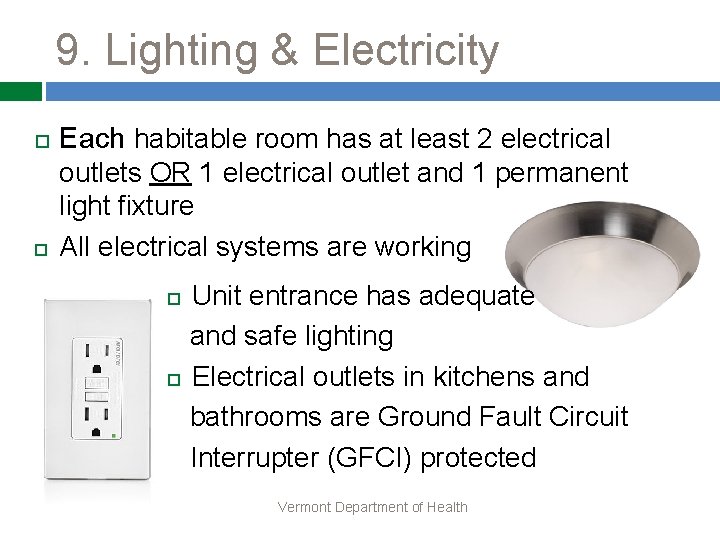
9. Lighting & Electricity Each habitable room has at least 2 electrical outlets OR 1 electrical outlet and 1 permanent light fixture All electrical systems are working Unit entrance has adequate and safe lighting Electrical outlets in kitchens and bathrooms are Ground Fault Circuit Interrupter (GFCI) protected Vermont Department of Health
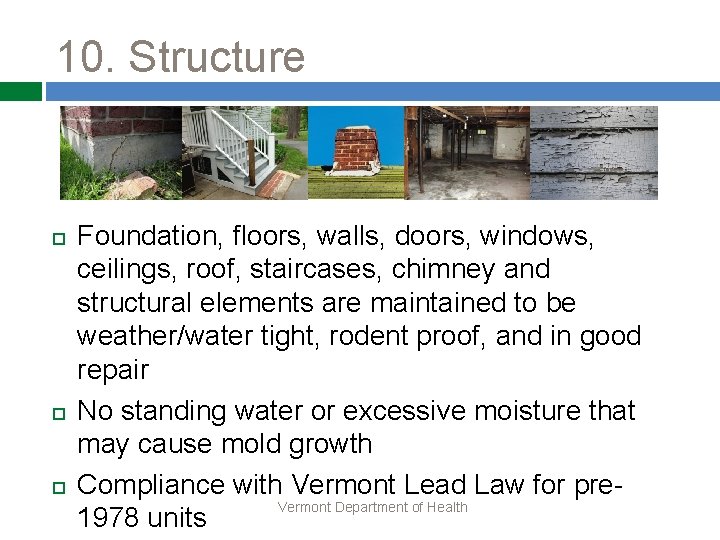
10. Structure Foundation, floors, walls, doors, windows, ceilings, roof, staircases, chimney and structural elements are maintained to be weather/water tight, rodent proof, and in good repair No standing water or excessive moisture that may cause mold growth Compliance with Vermont Lead Law for pre. Vermont Department of Health 1978 units
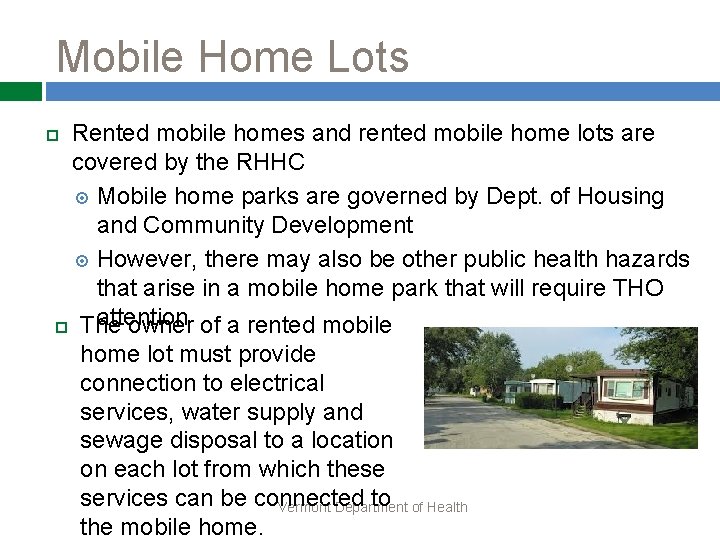
Mobile Home Lots Rented mobile homes and rented mobile home lots are covered by the RHHC Mobile home parks are governed by Dept. of Housing and Community Development However, there may also be other public health hazards that arise in a mobile home park that will require THO attention The owner of a rented mobile home lot must provide connection to electrical services, water supply and sewage disposal to a location on each lot from which these services can be connected to Vermont Department of Health the mobile home.
Other issues THOs encounter Beyond rental housing… Vermont Department of Health
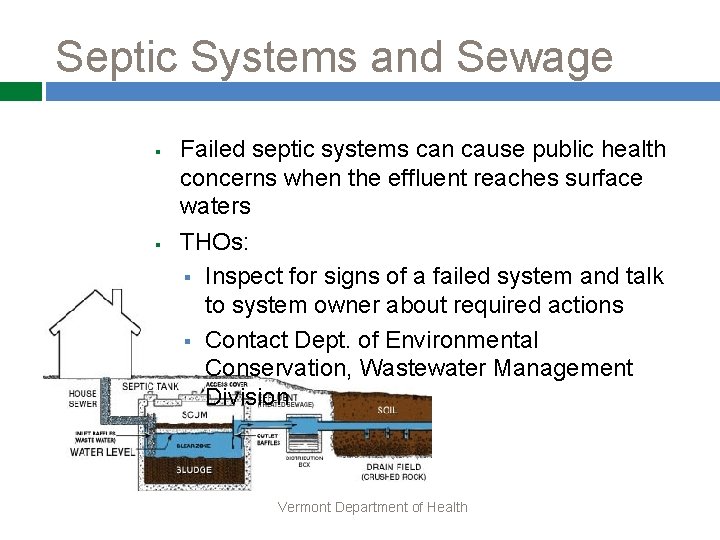
Septic Systems and Sewage § § Failed septic systems can cause public health concerns when the effluent reaches surface waters THOs: § Inspect for signs of a failed system and talk to system owner about required actions § Contact Dept. of Environmental Conservation, Wastewater Management Division Vermont Department of Health
Lead Paint and Asbestos Photo courtesy of HUD Lead paint and asbestos are found in many buildings in Vermont VT law requires rental properties owners to conduct maintenance to ensure no chipping or peeling paint Handling of lead and asbestos during abatement or renovations must comply with state and federal regulations THOs inspect for compliance with laws, notify VDH and property owner of violations Vermont Department of Health
Animal Control THOs work with law enforcement officers, game wardens, and humane society personnel to address issues of animal cruelty and possible rabies exposures All potential human rabies exposures must be reported to the THO within 24 hours THOs conduct an investigation, complete an Animal Bite Report, determine animal’s vaccination status, and require any necessary quarantine and observation May also be asked to assist in cases of rabies exposure to domestic animals Vermont Department of Health
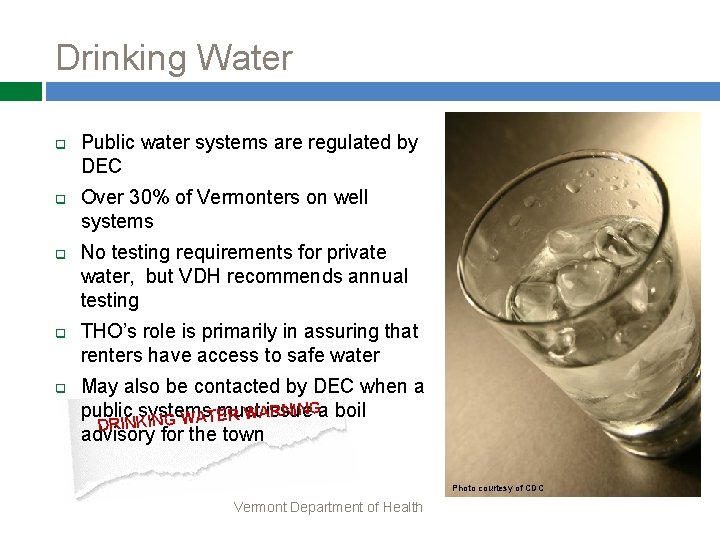
Drinking Water q q q Public water systems are regulated by DEC Over 30% of Vermonters on well systems No testing requirements for private water, but VDH recommends annual testing THO’s role is primarily in assuring that renters have access to safe water May also be contacted by DEC when a public systems must issue a boil R WARNING E T A W G IN K DRIN advisory for the town Photo courtesy of CDC Vermont Department of Health
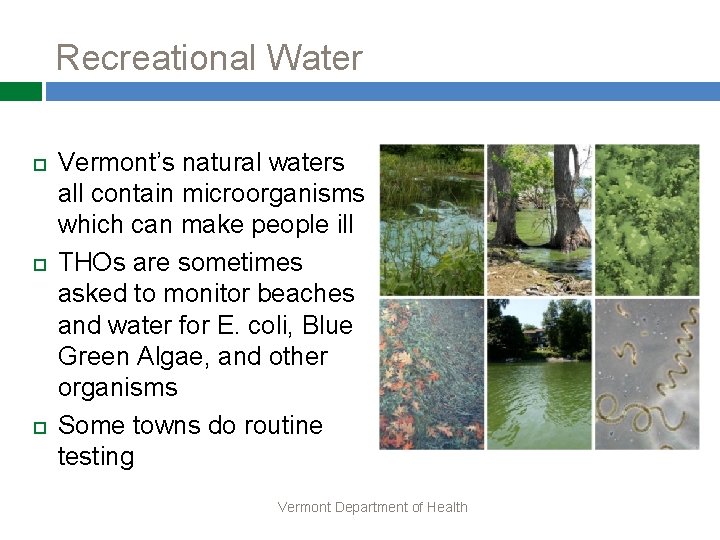
Recreational Water Vermont’s natural waters all contain microorganisms which can make people ill THOs are sometimes asked to monitor beaches and water for E. coli, Blue Green Algae, and other organisms Some towns do routine testing Vermont Department of Health
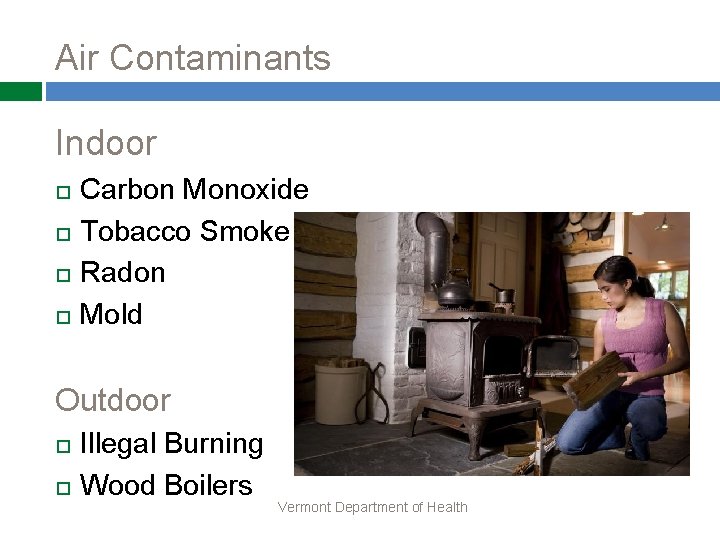
Air Contaminants Indoor Carbon Monoxide Tobacco Smoke Radon Mold Outdoor Illegal Burning Wood Boilers Photo courtesy of CDC Vermont Department of Health
Solid & Hazardous Waste THOs may receive calls concerning improper disposal of waste Often, DEC has jurisdiction over these issues and may ask THOs to assist in an inspection The Rental Housing Health Code provides rules for garbage removal in rental properties Improper disposal of waste can lead to pest infestation, groundwater contamination, and health effects Vermont Department of Health
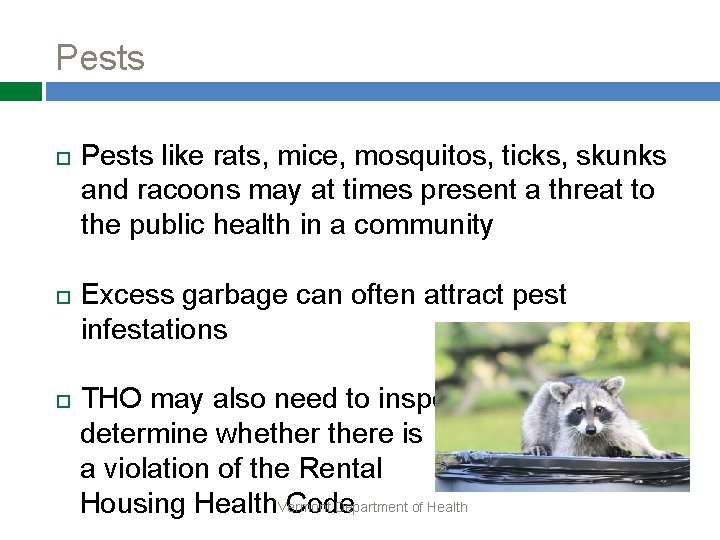
Pests like rats, mice, mosquitos, ticks, skunks and racoons may at times present a threat to the public health in a community Excess garbage can often attract pest infestations THO may also need to inspect to determine whethere is a violation of the Rental Vermont Department of Health Housing Health Code
Emergency Condemnation 24 V. S. A § 2291(26) Grants authority to “municipal building inspector, health officer, fire marshal, or zoning administrator” to declare a property “condemned to be destroyed” if… Governor makes disaster or emergency declaration, and Property has been damaged by the disaster or emergency, and Property is dangerous to life, health, or safety due to the disaster related damage Vermont Department of Health