
Towards Webbased Delta Synchronization for Cloud Storage Services
Towards Web-based Delta Synchronization for Cloud Storage Services He Xiao and Zhenhua Li, Tsinghua University; Ennan Zhai, Yale University; Tianyin Xu, UIUC; Yang Li and Yunhao Liu, Tsinghua University; Quanlu Zhang, Microsoft Research Asia; Yao Liu, SUNY Binghamton xiaoh 16@gmail. com USENIX FAST’ 18, Feb. 14, 2018
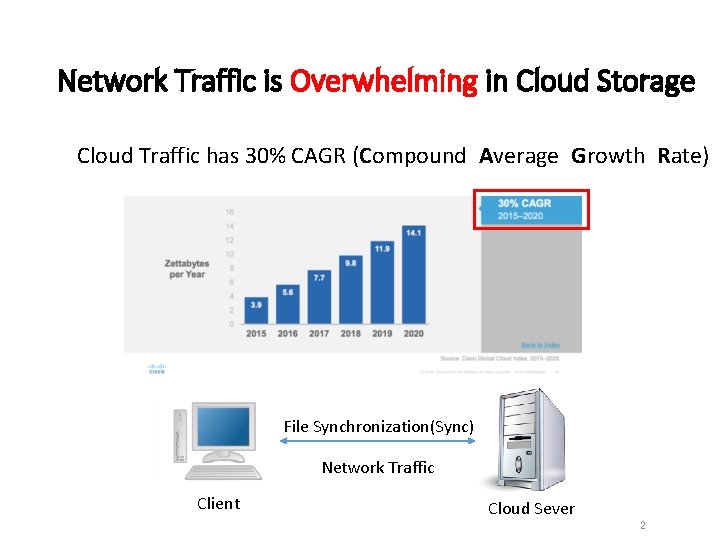
Network Traffic is Overwhelming in Cloud Storage Cloud Traffic has 30% CAGR (Compound Average Growth Rate) File Synchronization(Sync) Network Traffic Client Cloud Sever 2
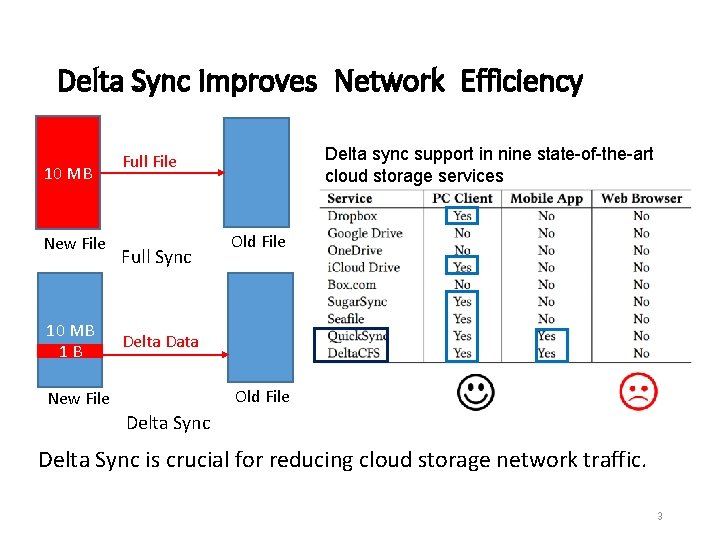
Delta Sync Improves Network Efficiency 10 MB New File 10 MB 1 B Delta sync support in nine state-of-the-art cloud storage services Full File Full Sync Old File Delta Data Old File New File Delta Sync is crucial for reducing cloud storage network traffic. 3
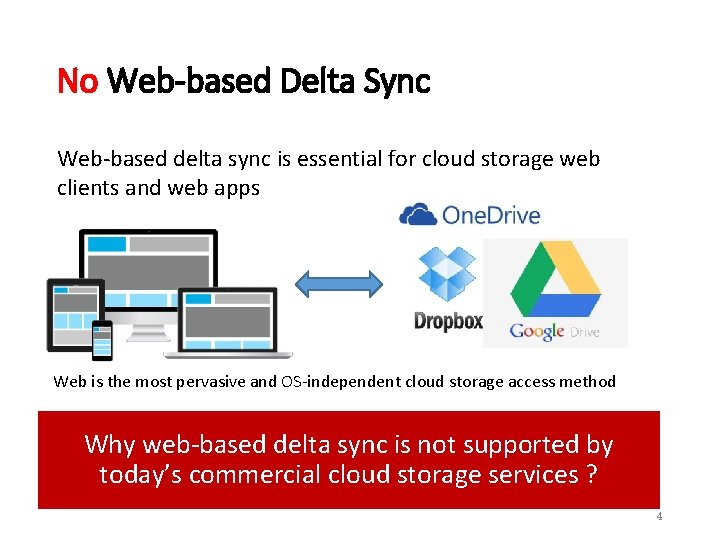
No Web-based Delta Sync Web-based delta sync is essential for cloud storage web clients and web apps Web is the most pervasive and OS-independent cloud storage access method Why web-based delta sync is not supported by today’s commercial cloud storage services ? 4
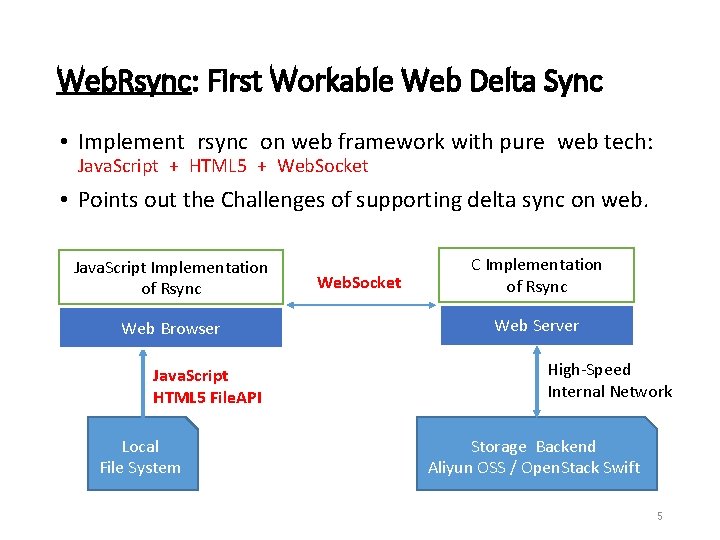
Web. Rsync: First Workable Web Delta Sync • Implement rsync on web framework with pure web tech: Java. Script + HTML 5 + Web. Socket • Points out the Challenges of supporting delta sync on web. Java. Script Implementation of Rsync Web Browser Java. Script HTML 5 File. API Local File System Web. Socket C Implementation of Rsync Web Server High-Speed Internal Network Storage Backend Aliyun OSS / Open. Stack Swift 5
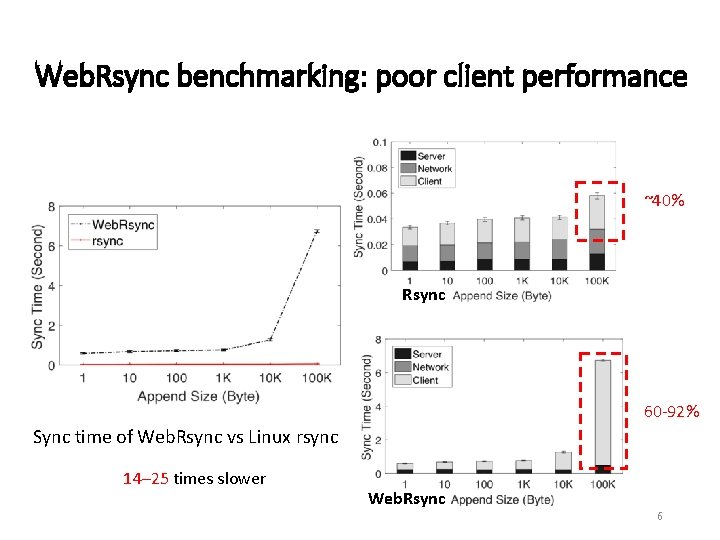
Web. Rsync benchmarking: poor client performance ~40% Rsync 60 -92% Sync time of Web. Rsync vs Linux rsync 14– 25 times slower Web. Rsync 6
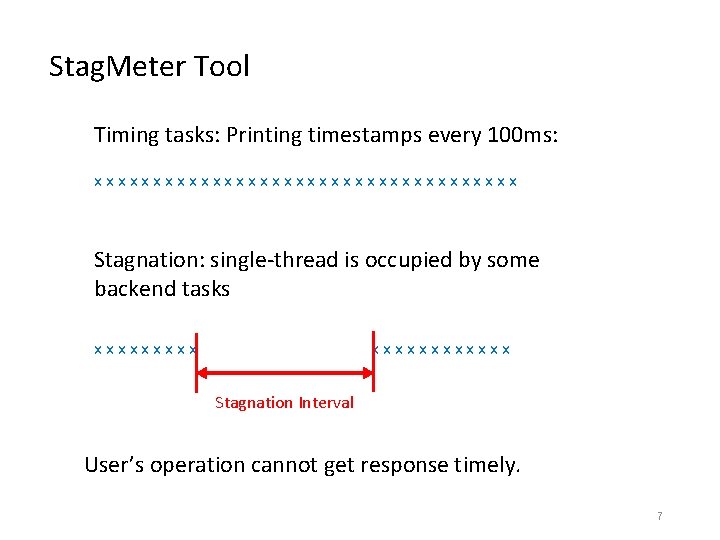
Stag. Meter Tool Timing tasks: Printing timestamps every 100 ms: xxxxxxxxxxxxxxxxxx Stagnation: single-thread is occupied by some backend tasks xxxxxxxxxxxx Stagnation Interval User’s operation cannot get response timely. 7
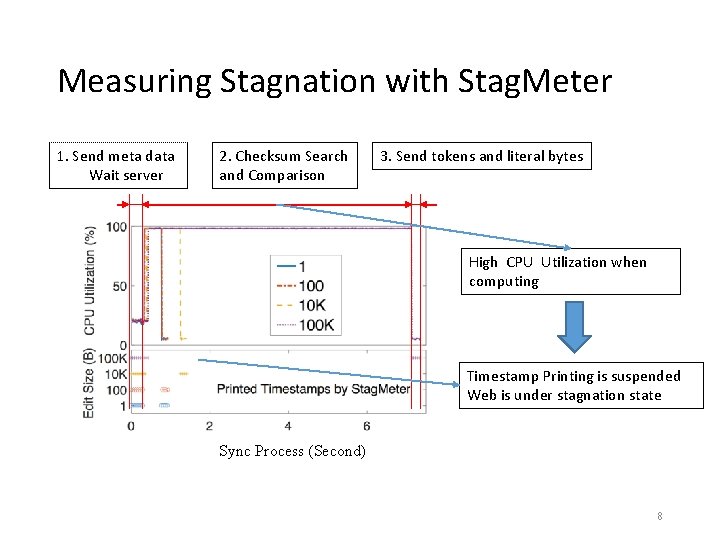
Measuring Stagnation with Stag. Meter 1. Send meta data Wait server 2. Checksum Search and Comparison 3. Send tokens and literal bytes High CPU Utilization when computing Timestamp Printing is suspended Web is under stagnation state Sync Process (Second) 8
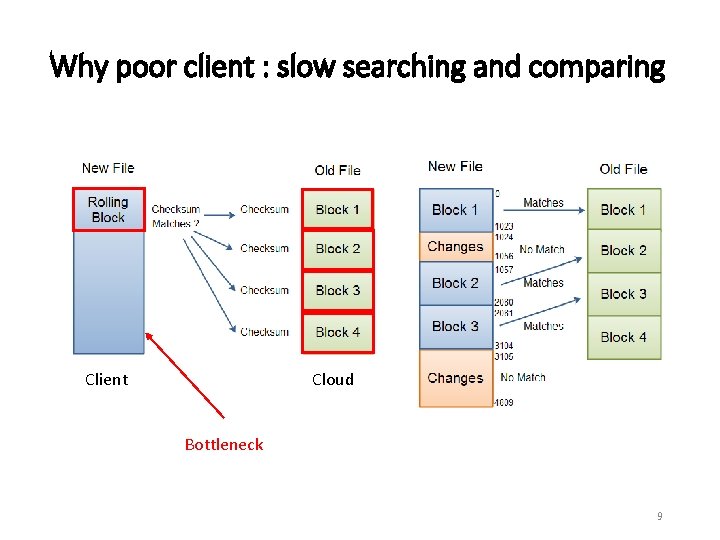
Why poor client : slow searching and comparing Client Cloud Bottleneck 9
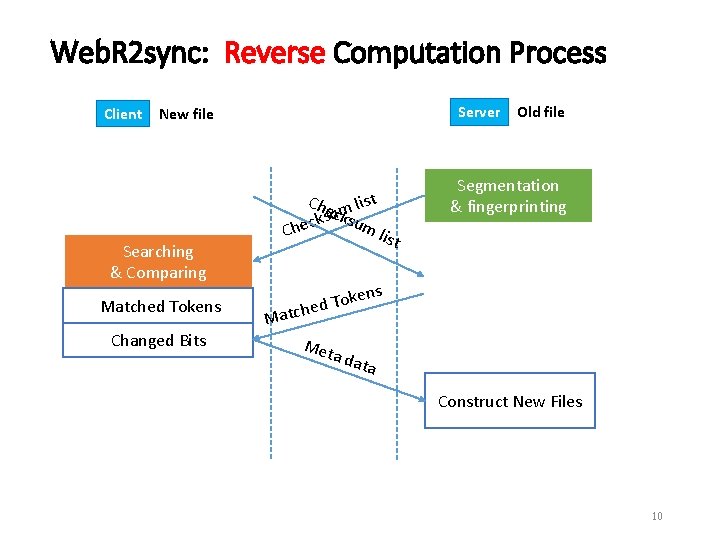
Web. R 2 sync: Reverse Computation Process Client Server New file Searching & Comparing Matched Tokens Changed Bits Old file Segmentation & fingerprinting Che list ksuckmsum c e Ch l ist ens Tok d e h tc Ma Met a da ta Construct New Files 10
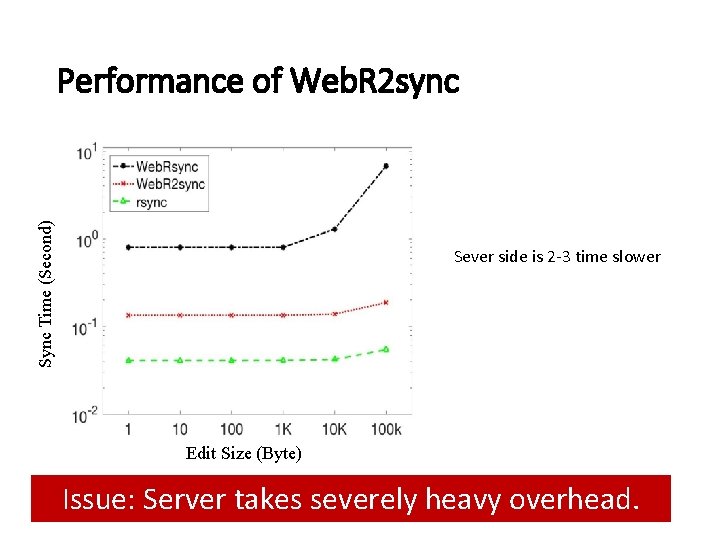
Sync Time (Second) Performance of Web. R 2 sync Sever side is 2 -3 time slower Edit Size (Byte) Issue: Server takes severely heavy overhead. 11
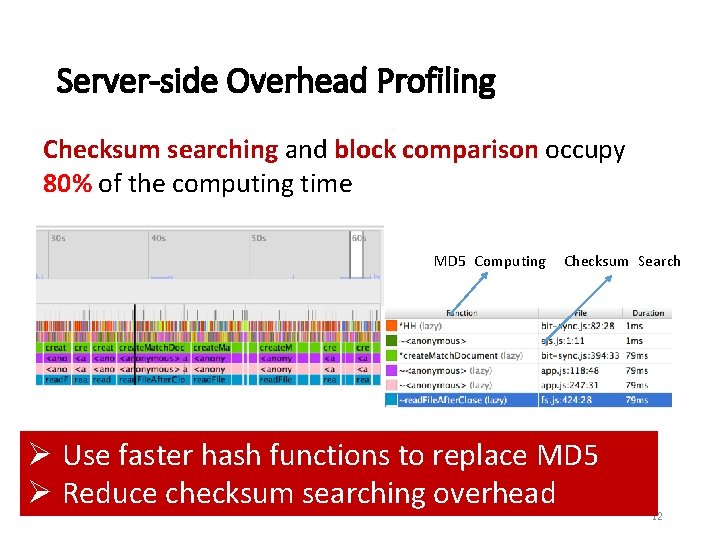
Server-side Overhead Profiling Checksum searching and block comparison occupy 80% of the computing time MD 5 Computing Checksum Search Ø Use faster hash functions to replace MD 5 Ø Reduce checksum searching overhead 12
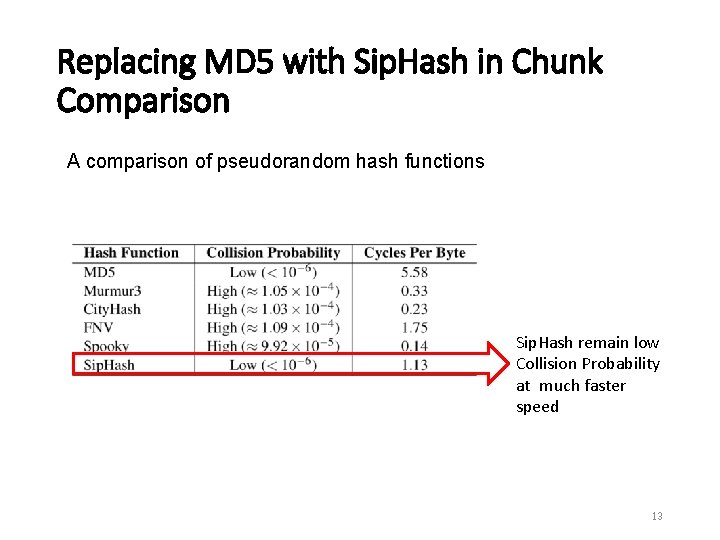
Replacing MD 5 with Sip. Hash in Chunk Comparison A comparison of pseudorandom hash functions Sip. Hash remain low Collision Probability at much faster speed 13
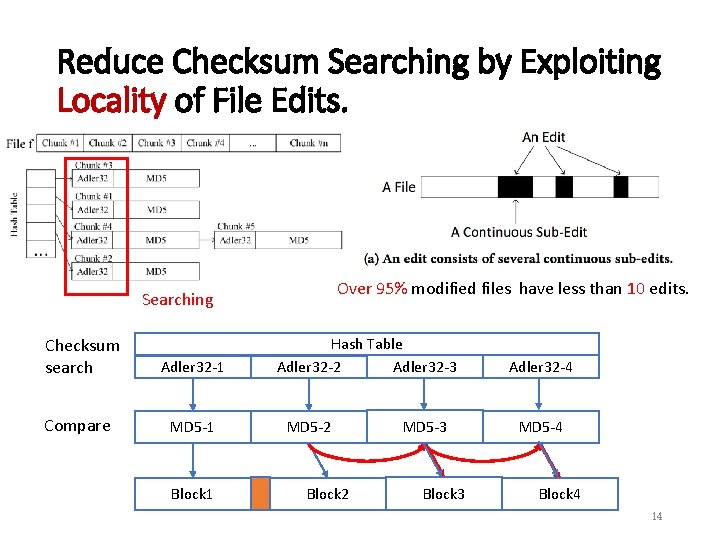
Reduce Checksum Searching by Exploiting Locality of File Edits. Over 95% modified files have less than 10 edits. Searching Checksum search Compare Adler 32 -1 MD 5 -1 Block 1 Hash Table Adler 32 -3 Adler 32 -2 MD 5 -2 Block 2 MD 5 -3 Block 3 Adler 32 -4 MD 5 -4 Block 4 14
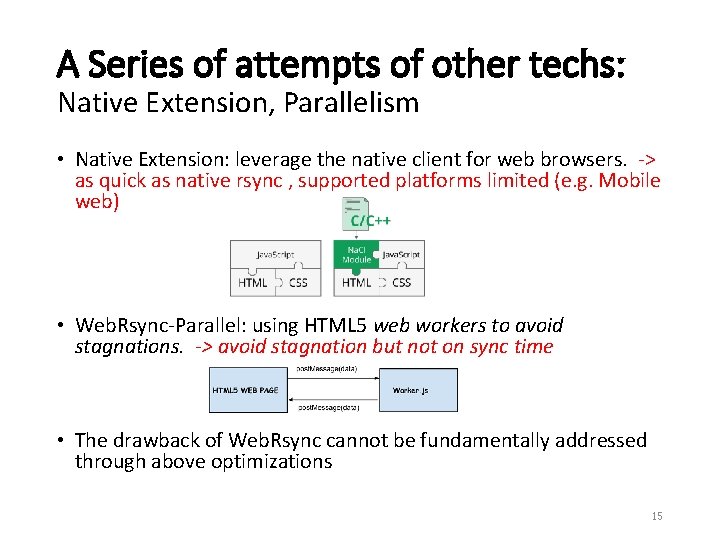
A Series of attempts of other techs: Native Extension, Parallelism • Native Extension: leverage the native client for web browsers. -> as quick as native rsync , supported platforms limited (e. g. Mobile web) • Web. Rsync-Parallel: using HTML 5 web workers to avoid stagnations. -> avoid stagnation but not on sync time • The drawback of Web. Rsync cannot be fundamentally addressed through above optimizations 15
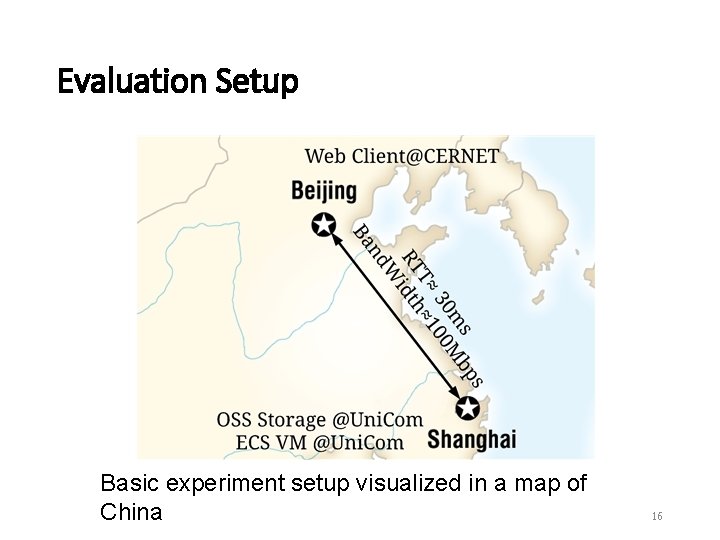
Evaluation Setup Basic experiment setup visualized in a map of China 16
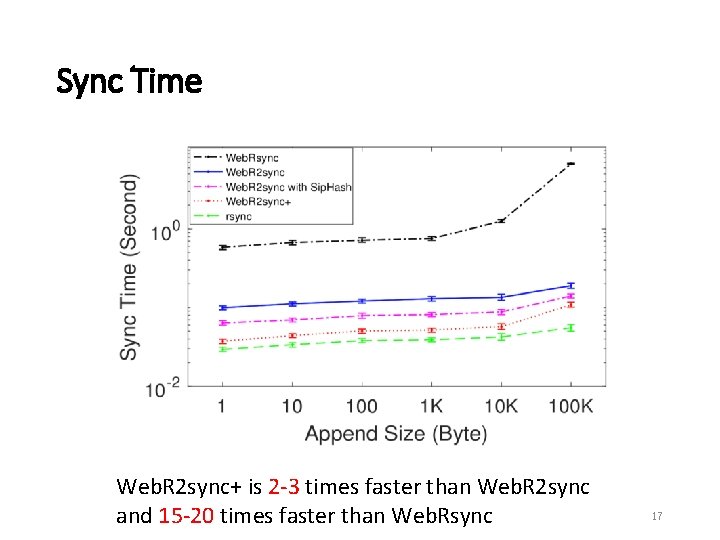
Sync Time Web. R 2 sync+ is 2 -3 times faster than Web. R 2 sync and 15 -20 times faster than Web. Rsync 17
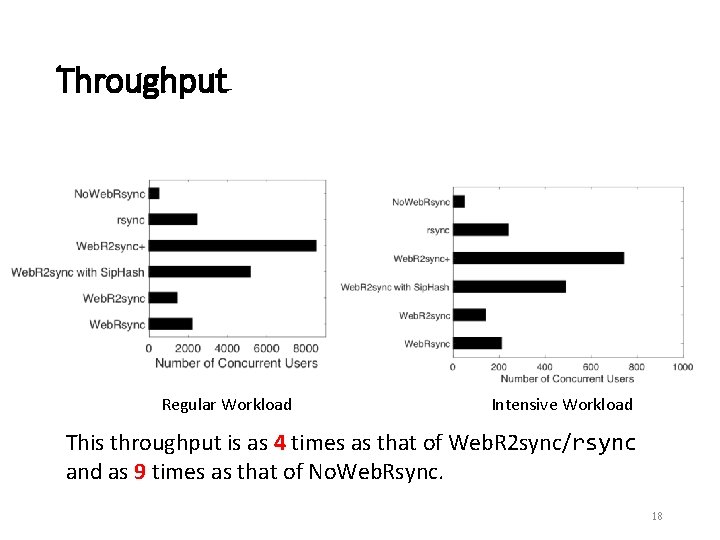
Throughput Regular Workload Intensive Workload This throughput is as 4 times as that of Web. R 2 sync/rsync and as 9 times as that of No. Web. Rsync. 18
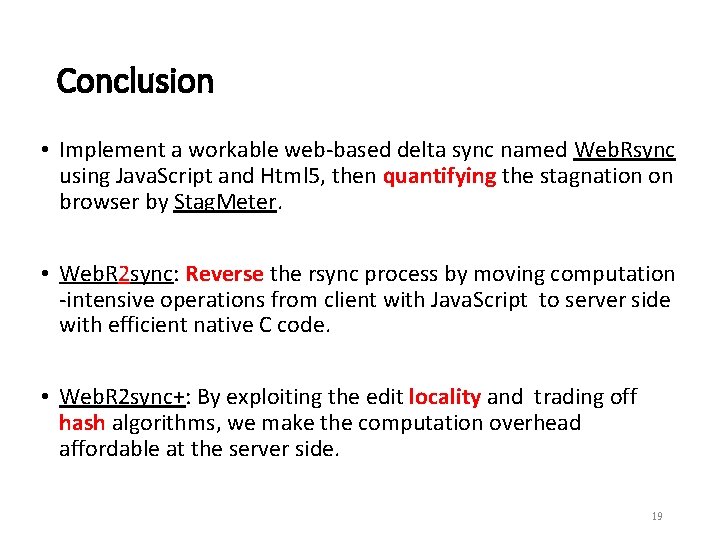
Conclusion • Implement a workable web-based delta sync named Web. Rsync using Java. Script and Html 5, then quantifying the stagnation on browser by Stag. Meter. • Web. R 2 sync: Reverse the rsync process by moving computation -intensive operations from client with Java. Script to server side with efficient native C code. • Web. R 2 sync+: By exploiting the edit locality and trading off hash algorithms, we make the computation overhead affordable at the server side. 19
Future Work • A seamless way to integrate the server-side design of Web. R 2 sync+ with the back-end of commercial cloud storage vendors (like Dropbox and i. Cloud Drive). • Explore the benefits of using more fine-grained and complex delta sync protocols, such as CDC and its variants. • We envision to expand the usage of Web. R 2 sync+ for a broader range of web service scenarios. 20

Q&A Thanks! 21
Conclusion • Web. Rsync: an intuitive web-based delta sync solution • understand the obstacles to support web-based delta sync • A series of efforts towards a practical solution of webbased delta sync for cloud storage services: • Web. Rsync-native, Web. Rsync-parallel, Web. Rsync+ • Web. R 2 sync+: a practical web-based delta sync solution with one client-side optimization called Web. R 2 sync and two-fold server-side optimizations. 23
- Slides: 22