
Towards Unbiased EndtoEnd Network Diagnosis Name Kwan Kai
Towards Unbiased End-to-End Network Diagnosis Name: Kwan Kai Chung Student ID: 05133720 Date: 18/3/2007
Why Network Diagnosis • Several Months before, Taiwan earth crack • Surely a Disaster to Taiwan, cause death • Surely a Disaster to Hong Kong, cause…. .
Why Network Diagnosis • Damage to major physical link, of course can discover immediately • How about small/insignificant/local damage, or non-physical problem (heavy traffic by infected PC) • Problem shooting need information on network traffic/link status
Why Network Diagnosis • By knowing Traffic information, user know which ISP to pay (though they may never get real information) • Local ISP know how to choose higher level ISP, and troubleshooting • Overlay Service provider and provide more intelligent network choosing method for better service • So we desire, and provide research, aims to improve diagnosis mechanism, provide better visibility on network information. More Fast, more accurate, more adaptive to fast network growth,
Why so hard • Internet is non-centralized • Physical equipments (routers) are maintained by different organizations, and they don’t willing to cooperate • In business sense, hardware modification method is not a short term prefer solution • Software only solution meet limited from hardware by leak of information in segment the network • Some method are not usable as they depends on protocol (e. g. ICMP) that banned as security reason • Asymmetric behavior of Network
Diagnosis Method • Classification method - End – to –End Require a number of observer locate in distributed location - Router Response base Single location observer, ping/traceroute method, estimate network status by send message and observe response
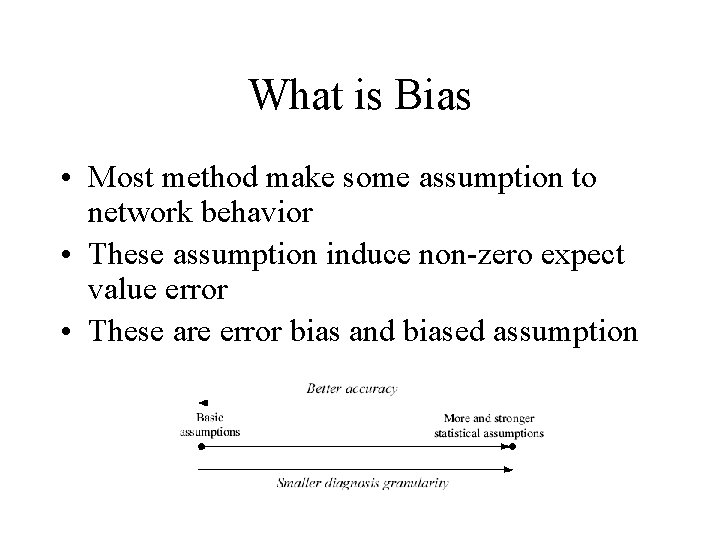
What is Bias • Most method make some assumption to network behavior • These assumption induce non-zero expect value error • These are error bias and biased assumption
Least-biased End-to-End Network Diagnosis (LEND) • Aims to provide Unbiased Diagnosis method • Use End-to-End Method • Identify segments that can infer it’s property by End-to-End Measurement
Current two Minimum Assumptions 1. End-to-End measurement can infer the end -to-end properties accurately 2. The linear system between path and link level properties assumes independence between link-level properties • These two assumption may also biased!

Algebraic Model s: Number of links v: Vector with s elements, element j is 1 if the jth link is in the path, else 0 lj: loss rate of the jth link xj: log(1 -lj) r: Number of path G: A matrix with row as a path and column as link bi: log(1 -pi), i is the path index
Minimal Identifiable Link Sequence (MILS) • Link – LEND we conside physical link only, it is actually a cable between routers/End System • MILS A minimum path segment with loss rate that can be uniquely identified by end-to-end path measurements
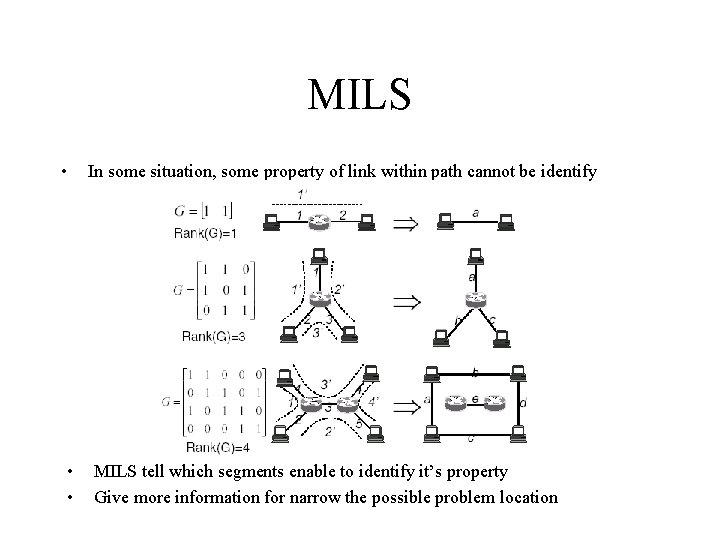
MILS • • • In some situation, some property of link within path cannot be identify MILS tell which segments enable to identify it’s property Give more information for narrow the possible problem location
MILS • • • MILS may linear dependent MILS may be a sub-segment of other MILS is consecutive sequence of link MILS cannot be composed by other MILSes can be expressed as linear combination of end-end paths • MILSes does not share end-points • MILSes must in the path space
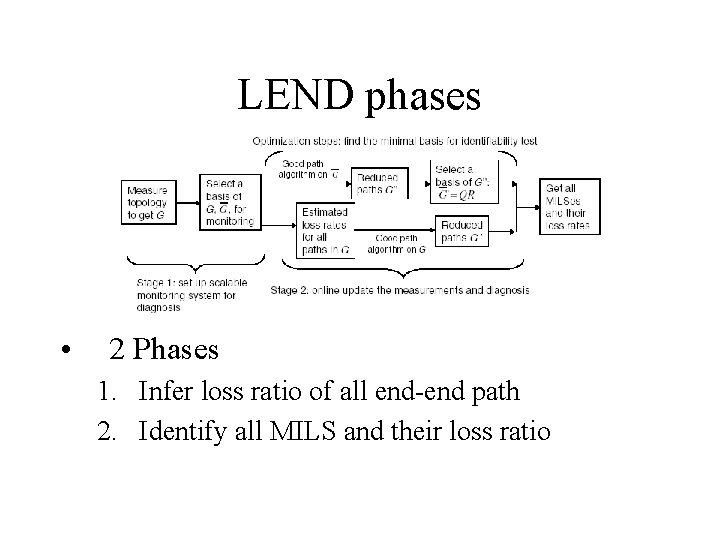
LEND phases • 2 Phases 1. Infer loss ratio of all end-end path 2. Identify all MILS and their loss ratio
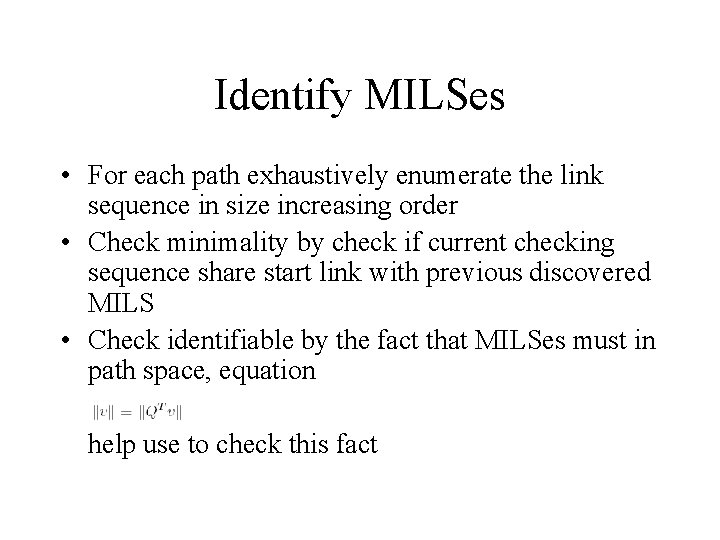
Identify MILSes • For each path exhaustively enumerate the link sequence in size increasing order • Check minimality by check if current checking sequence share start link with previous discovered MILS • Check identifiable by the fact that MILSes must in path space, equation help use to check this fact
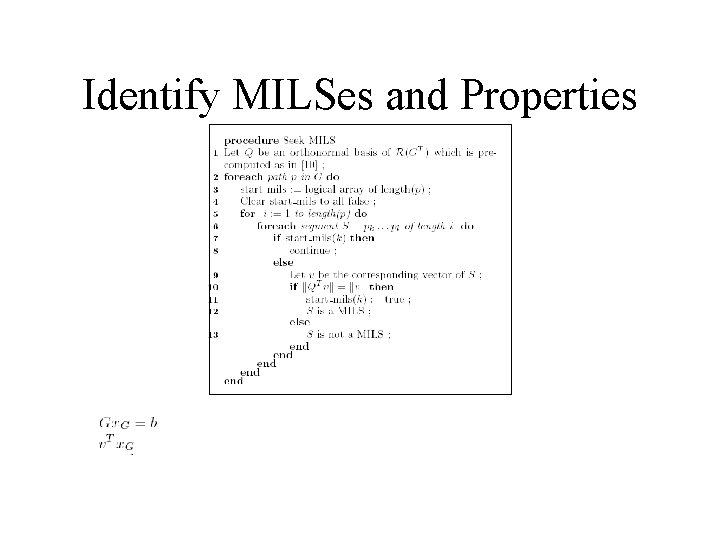
Identify MILSes and Properties
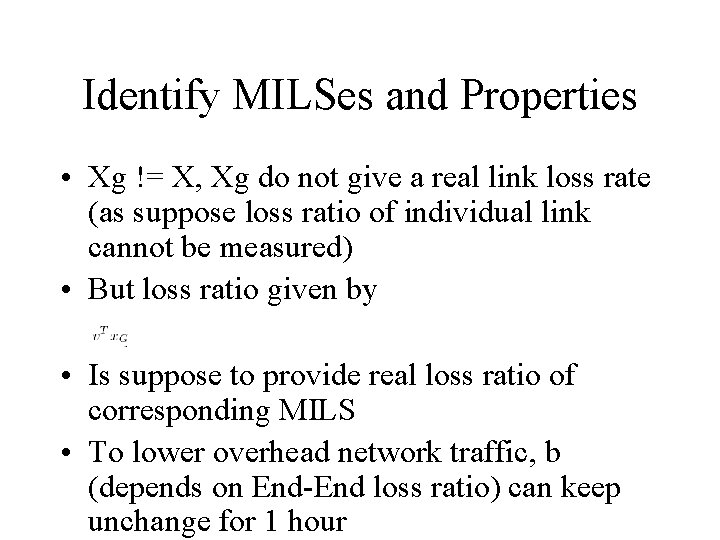
Identify MILSes and Properties • Xg != X, Xg do not give a real link loss rate (as suppose loss ratio of individual link cannot be measured) • But loss ratio given by • Is suppose to provide real loss ratio of corresponding MILS • To lower overhead network traffic, b (depends on End-End loss ratio) can keep unchange for 1 hour
Extend To Directed Graph • Previous Calculation model network as undirected graph • Not suitable as network behavior is asymmetric • Cannot extend directly, without change, all MILSes are End-End path, cannot further segment
How to extend to Directed Graph • Make use of “Good Path Algorithm” • No Negative loss rate • Without remove good link, we can identify all link and their loss rate as 0 • Sometime act low loss rate path as good path can provide diagnosis granularity with tradeoff of accuracy

Update of Network Topology • 4 Changes: add/delete bad path, add/delete good path • Update of the orthonormal basis Q according to 1 column/1 row change in path space have a smaller Big O then re-initialize new Q • MILSes re-identify after update Q
Remarks • LEND provide information on which segment can uniquely identify their property • Can work with other statistical method to estimate property of un-identifiable segments
Advantage of LEND • Provide additional information for narrow the problem location range • No Hardware modification need for all routers • Low number of assumption, less bias and more accuracy
Disadvantage of LEND • Require distributed observer • Diagnosis granularity depends on observer distribution (location with more observer population will get better granularity)
- Slides: 23