
Towards the Capacity of Noncoherent Orthogonal Modulation BICMID
Towards the Capacity of Noncoherent Orthogonal Modulation: BICM-ID for Turbo Coded NFSK Matthew Valenti West Virginia University Ewald Hueffmeier and Bob Bogusch Mission Research Corporation (Monterey) John Fryer Applied Data Trends (Huntsville) 11/1/2004 1
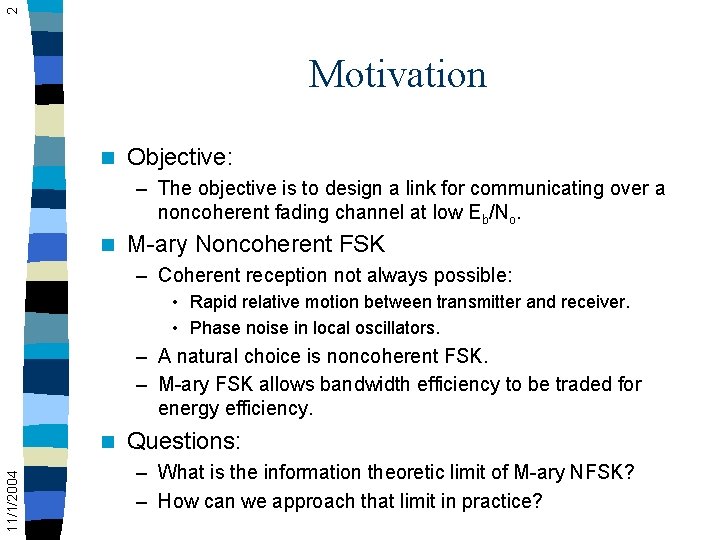
2 Motivation n Objective: – The objective is to design a link for communicating over a noncoherent fading channel at low Eb/No. n M-ary Noncoherent FSK – Coherent reception not always possible: • Rapid relative motion between transmitter and receiver. • Phase noise in local oscillators. – A natural choice is noncoherent FSK. – M-ary FSK allows bandwidth efficiency to be traded for energy efficiency. 11/1/2004 n Questions: – What is the information theoretic limit of M-ary NFSK? – How can we approach that limit in practice?
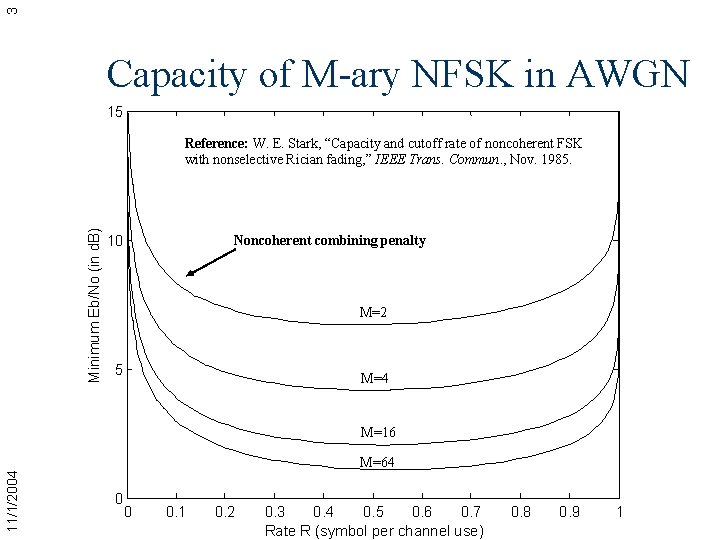
3 Capacity of M-ary NFSK in AWGN 15 Minimum Eb/No (in d. B) Reference: W. E. Stark, “Capacity and cutoff rate of noncoherent FSK with nonselective Rician fading, ” IEEE Trans. Commun. , Nov. 1985. 10 Noncoherent combining penalty M=2 5 M=4 M=16 11/1/2004 M=64 0 0 0. 1 0. 2 0. 3 0. 4 0. 5 0. 6 0. 7 Rate R (symbol per channel use) 0. 8 0. 9 1
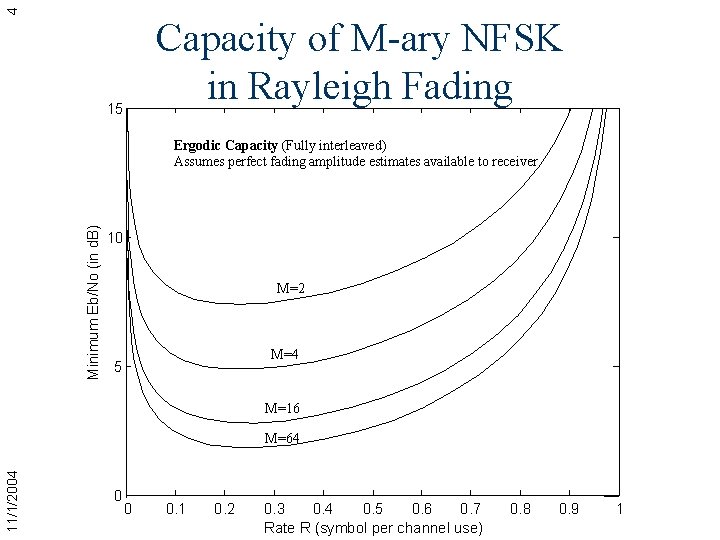
4 Capacity of M-ary NFSK in Rayleigh Fading 15 Minimum Eb/No (in d. B) Ergodic Capacity (Fully interleaved) Assumes perfect fading amplitude estimates available to receiver 10 M=2 M=4 5 M=16 11/1/2004 M=64 0 0 0. 1 0. 2 0. 3 0. 4 0. 5 0. 6 0. 7 Rate R (symbol per channel use) 0. 8 0. 9 1
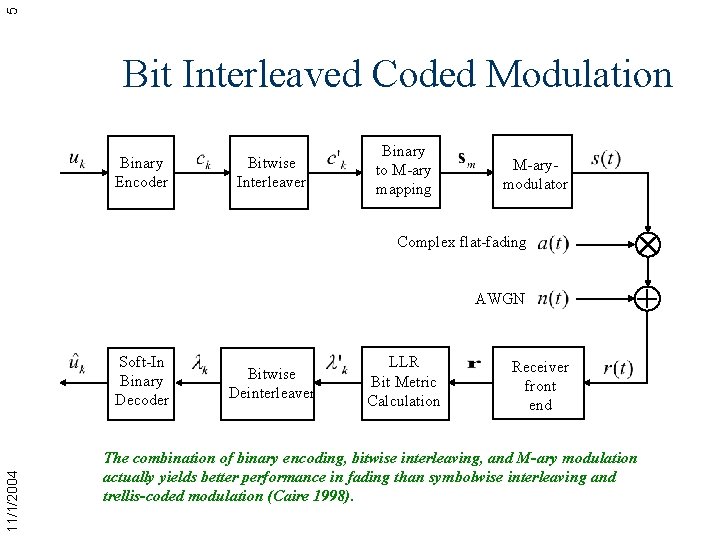
5 Bit Interleaved Coded Modulation Binary Encoder Bitwise Interleaver Binary to M-ary mapping M-arymodulator Complex flat-fading AWGN 11/1/2004 Soft-In Binary Decoder Bitwise Deinterleaver LLR Bit Metric Calculation Receiver front end The combination of binary encoding, bitwise interleaving, and M-ary modulation actually yields better performance in fading than symbolwise interleaving and trellis-coded modulation (Caire 1998).
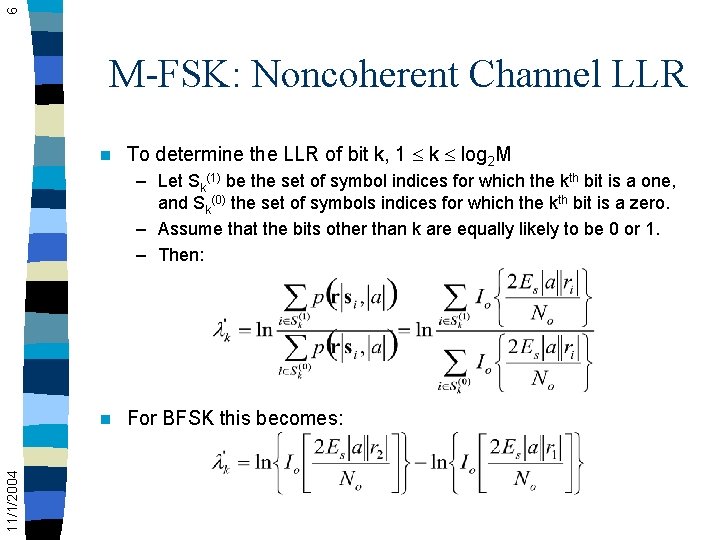
6 M-FSK: Noncoherent Channel LLR n To determine the LLR of bit k, 1 k log 2 M – Let Sk(1) be the set of symbol indices for which the kth bit is a one, and Sk(0) the set of symbols indices for which the kth bit is a zero. – Assume that the bits other than k are equally likely to be 0 or 1. – Then: 11/1/2004 n For BFSK this becomes:
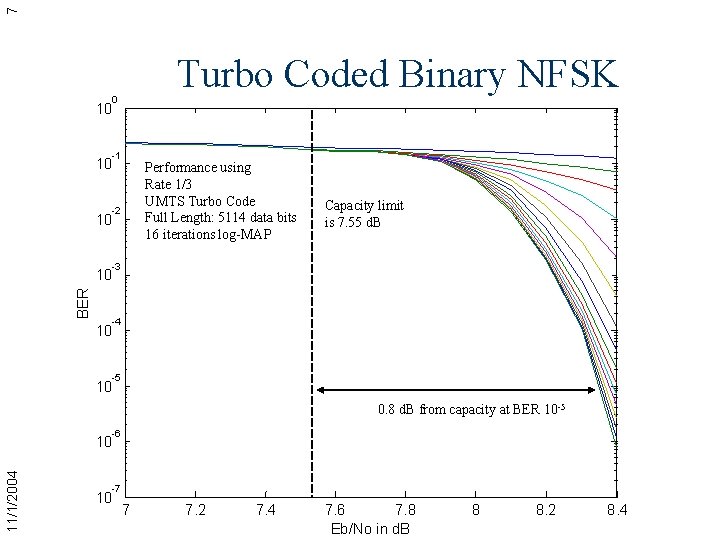
7 Turbo Coded Binary NFSK 0 10 -1 10 Performance using Rate 1/3 UMTS Turbo Code Full Length: 5114 data bits 16 iterations log-MAP -2 10 Capacity limit is 7. 55 d. B -3 BER 10 -4 10 -5 10 0. 8 d. B from capacity at BER 10 -5 -6 11/1/2004 10 -7 10 7 7. 2 7. 4 7. 6 7. 8 Eb/No in d. B 8 8. 2 8. 4
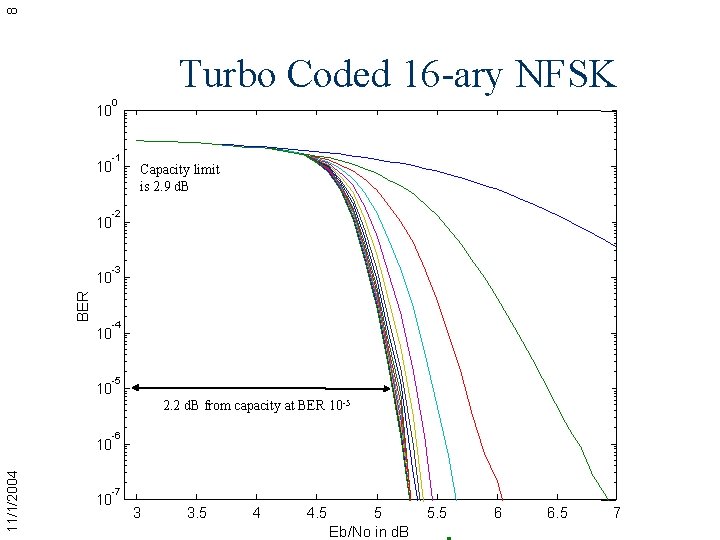
8 Turbo Coded 16 -ary NFSK 0 10 -1 10 Capacity limit is 2. 9 d. B -2 10 -3 BER 10 -4 10 -5 10 2. 2 d. B from capacity at BER 10 -5 -6 11/1/2004 10 -7 10 3 3. 5 4 4. 5 5 Eb/No in d. B 5. 5 6 6. 5 7

9 BICM-ID: Bit Interleaved Coded Modulation with Iterative Decoding Binary Encoder Bitwise Interleaver Binary to M-ary mapping M-arymodulator Complex flat-fading AWGN 11/1/2004 Soft-In Binary Decoder Soft-Output Estimates of Coded Bits Bitwise Deinterleaver Bitwise Interleaver LLR Bit Metric Calculation Receiver front end Li and Ritcey indicate a 1 d. B gain from hard decision feedback in Rayleigh fading for 8 -PSK and r=2/3 convolutional coding
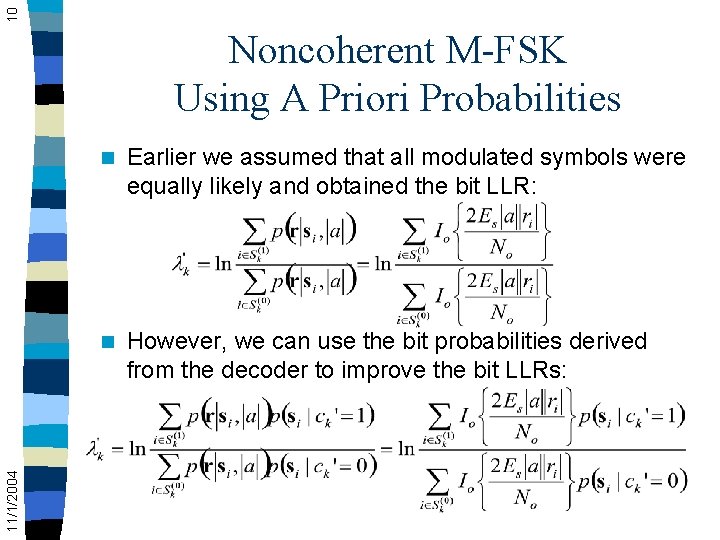
10 11/1/2004 Noncoherent M-FSK Using A Priori Probabilities n Earlier we assumed that all modulated symbols were equally likely and obtained the bit LLR: n However, we can use the bit probabilities derived from the decoder to improve the bit LLRs:
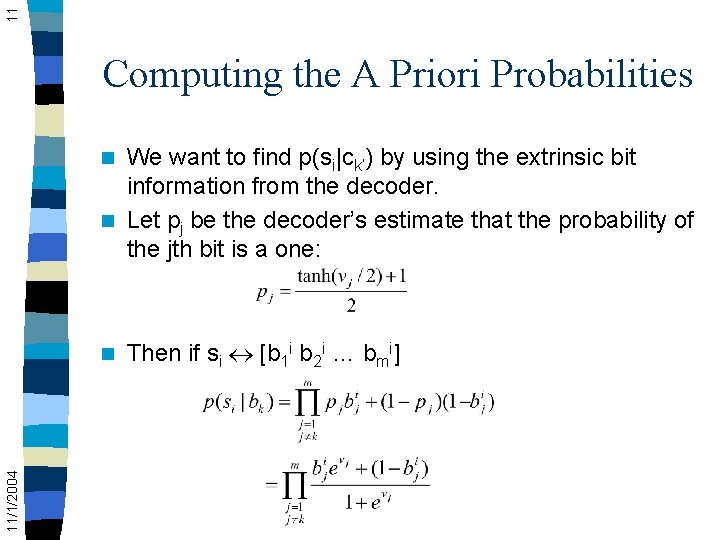
11 Computing the A Priori Probabilities We want to find p(si|ck’) by using the extrinsic bit information from the decoder. n Let pj be the decoder’s estimate that the probability of the jth bit is a one: n 11/1/2004 n Then if si [b 1 i b 2 i … bmi]
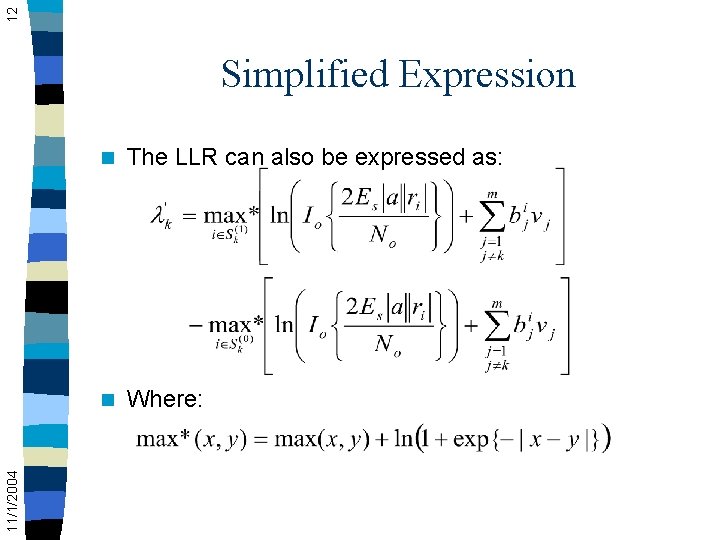
12 11/1/2004 Simplified Expression n The LLR can also be expressed as: n Where:
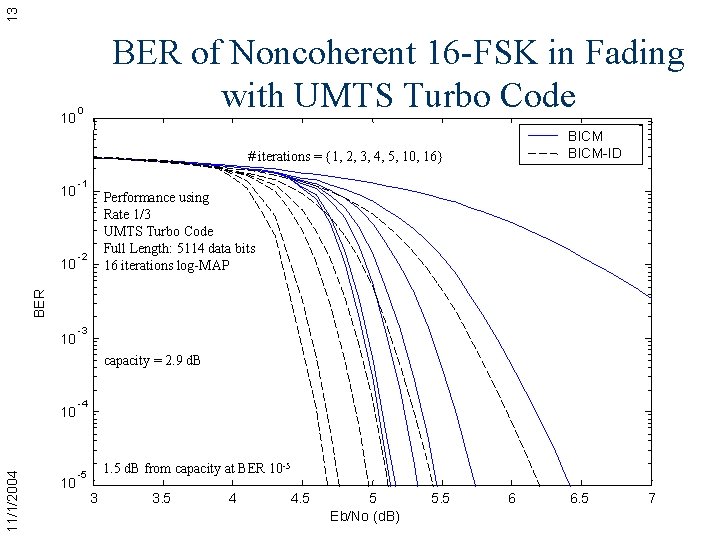
13 10 BER of Noncoherent 16 -FSK in Fading with UMTS Turbo Code 0 BICM-ID # iterations = {1, 2, 3, 4, 5, 10, 16} 10 Performance using Rate 1/3 UMTS Turbo Code Full Length: 5114 data bits 16 iterations log-MAP -2 BER 10 -1 10 -3 capacity = 2. 9 d. B 11/1/2004 10 10 -4 1. 5 d. B from capacity at BER 10 -5 -5 3 3. 5 4 4. 5 5 Eb/No (d. B) 5. 5 6 6. 5 7
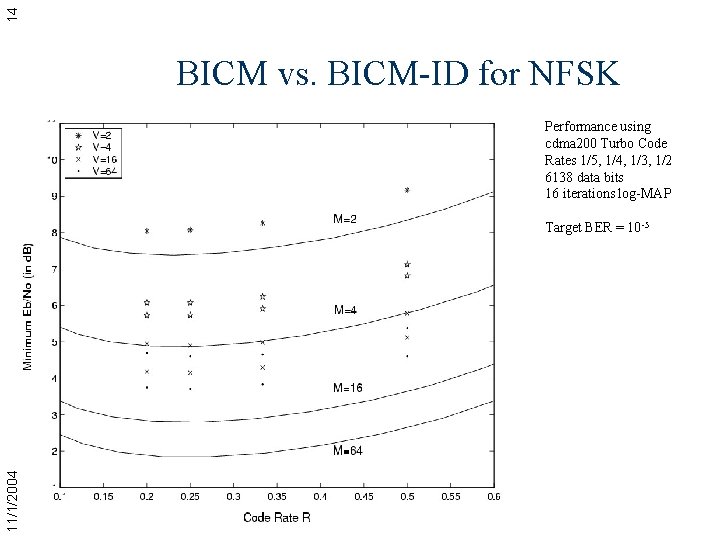
14 BICM vs. BICM-ID for NFSK Performance using cdma 200 Turbo Code Rates 1/5, 1/4, 1/3, 1/2 6138 data bits 16 iterations log-MAP 11/1/2004 Target BER = 10 -5
15 Conclusions Feeding back from decoder to demod can improve the performance of noncoherent M-FSK. n For M=16 and r=⅓ coding, the improvement is 0. 7 d. B in Rayleigh flat fading. n Other possible benefits n – Reduce number of iterations from 16 to 4 – Reduce signal constellation size from 64 to 16 n The additional complexity is negligible 11/1/2004 – No extra iterations needed. – Only need to update demod metrics during each iteration
16 Ongoing and Future Work n Try to close gap further – Optimize interleaver design. – Consider symbol-interleaving and nonbinary codes. n Analysis – EXIT charts to predict waterfall. – Simulation over variety of conditions and parameters: • Constellation size M, rate, code length, channels. n Consider lack of amplitude estimates. 11/1/2004 – Demodulator with no CSI – Methods to estimate channel n Other applications – Performance in FH systems with partial band jamming.
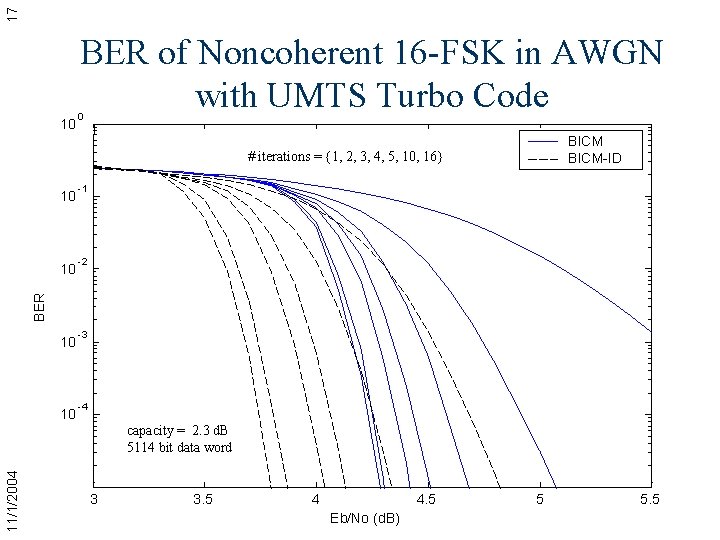
17 BER of Noncoherent 16 -FSK in AWGN with UMTS Turbo Code 10 0 BICM-ID # iterations = {1, 2, 3, 4, 5, 10, 16} 10 -2 BER 10 -1 10 11/1/2004 10 -3 -4 capacity = 2. 3 d. B 5114 bit data word 3 3. 5 4 4. 5 Eb/No (d. B) 5 5. 5
- Slides: 17