
Towards modularization and vectorization of Geant 4 physics
- Slides: 17
Towards modularization and vectorization of Geant 4 physics: a pilot study Tatsumi Koi, Andrea Dotti SLAC National Accelerator Laboratory Soon Yung Jun, Jose Guilherme Lima, Philippe G. Canal, Daniel Elvira Fermi National Accelerator Laboratory
SLAC-FNAL Pilot Project on Geant R&D funded by DOE Explore new computing avenues for HEP simulation • Sharable and modularized components • Modern hardware technologies and parallel architectures • Key R&D needs and cross-cutting solutions Inter-US-national-laboratory collaboration • Modularize Geant 4 Bertini cascade model and first pass algorithm optimization – SLAC (T. Koi) • Vectorized a sub-part of the model – G. Lima (FNAL) • Integrate and evaluate performance gains – FNAL (S. Y. Jun) • Identify requirements for future extension/development Joint WLCG and HSF workshop, Napoli, 2018 -Mar-28 2
A pilot project for developing a common hadronic simulation model for Geant 4 and Geant. V Accurate modeling of the 0~12 Ge. V energy range for hadrons is crucial for achieving good simulated response in calorimeters and thick targets. The Geant 4 Bertini-style (BERT) cascade is the preferred model for hadron-nucleus interactions in this region. • It handles the large range of energies and particle types • relatively fast calculation speed than other cascade models (Binary and INCL) of Geant 4 • The pre-equilibrium and de-excitation phases of the nuclear interaction are already contained within the model. Therefore, the BERT Model is selected for the target model of the pilot project. Joint WLCG and HSF workshop, Napoli, 2018 -Mar-28 3
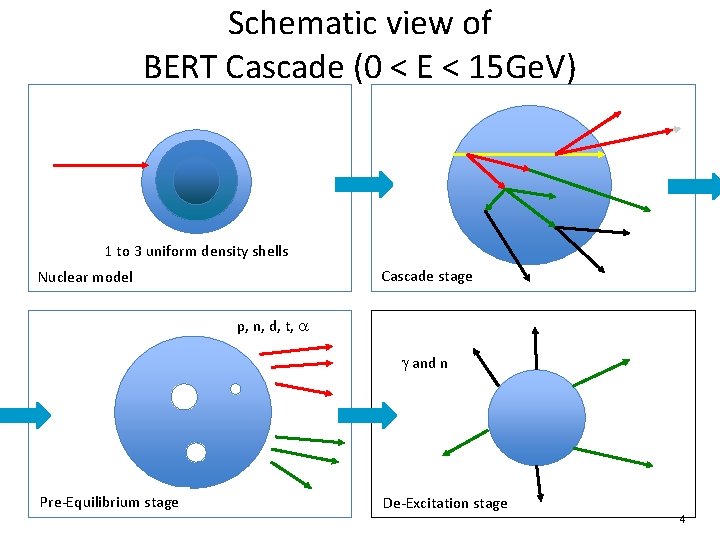
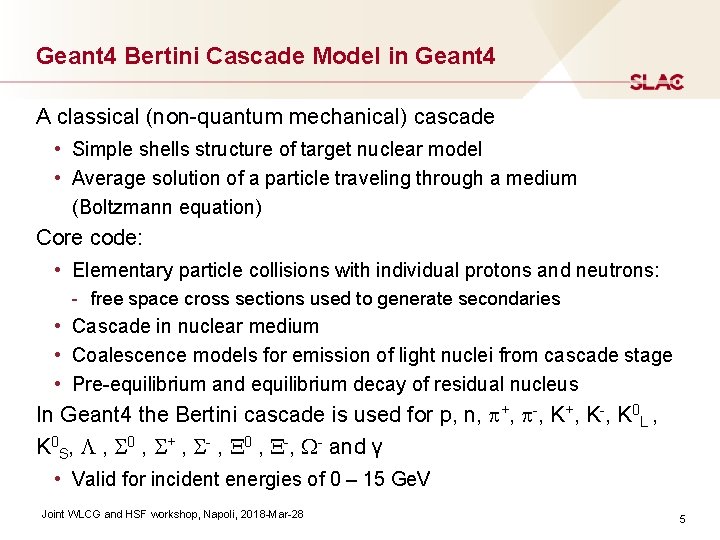
Schematic view of BERT Cascade (0 < E < 15 Ge. V) 1 to 3 uniform density shells Cascade stage Nuclear model p, n, d, t, and n Pre-Equilibrium stage De-Excitation stage 4
Geant 4 Bertini Cascade Model in Geant 4 A classical (non-quantum mechanical) cascade • Simple shells structure of target nuclear model • Average solution of a particle traveling through a medium (Boltzmann equation) Core code: • Elementary particle collisions with individual protons and neutrons: - free space cross sections used to generate secondaries • Cascade in nuclear medium • Coalescence models for emission of light nuclei from cascade stage • Pre-equilibrium and equilibrium decay of residual nucleus In Geant 4 the Bertini cascade is used for p, n, +, -, K+, K-, K 0 L , K 0 S, , 0 , + , - , 0 , -, W- and γ • Valid for incident energies of 0 – 15 Ge. V Joint WLCG and HSF workshop, Napoli, 2018 -Mar-28 5
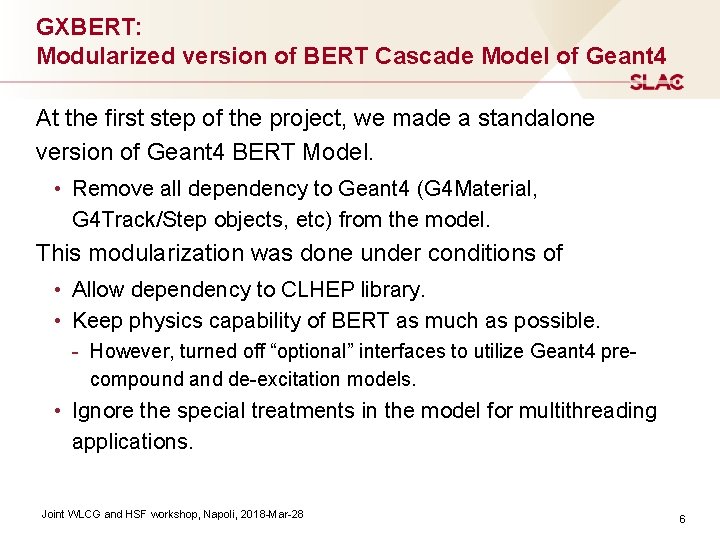
GXBERT: Modularized version of BERT Cascade Model of Geant 4 At the first step of the project, we made a standalone version of Geant 4 BERT Model. • Remove all dependency to Geant 4 (G 4 Material, G 4 Track/Step objects, etc) from the model. This modularization was done under conditions of • Allow dependency to CLHEP library. • Keep physics capability of BERT as much as possible. - However, turned off “optional” interfaces to utilize Geant 4 precompound and de-excitation models. • Ignore the special treatments in the model for multithreading applications. Joint WLCG and HSF workshop, Napoli, 2018 -Mar-28 6
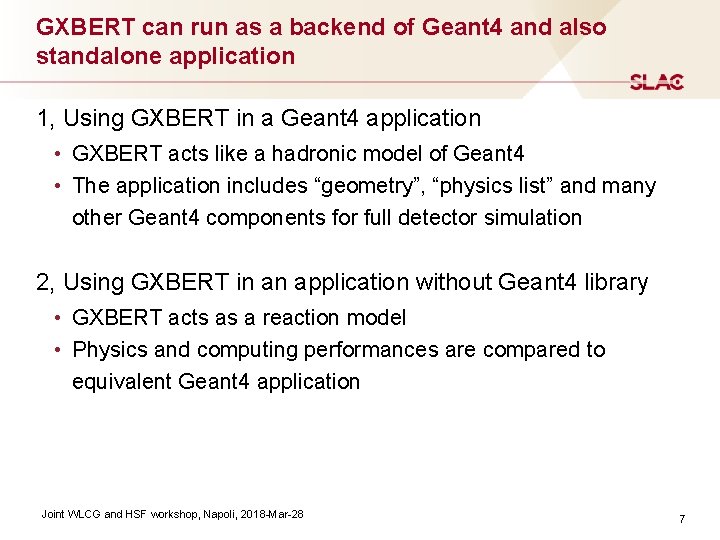
GXBERT can run as a backend of Geant 4 and also standalone application 1, Using GXBERT in a Geant 4 application • GXBERT acts like a hadronic model of Geant 4 • The application includes “geometry”, “physics list” and many other Geant 4 components for full detector simulation 2, Using GXBERT in an application without Geant 4 library • GXBERT acts as a reaction model • Physics and computing performances are compared to equivalent Geant 4 application Joint WLCG and HSF workshop, Napoli, 2018 -Mar-28 7
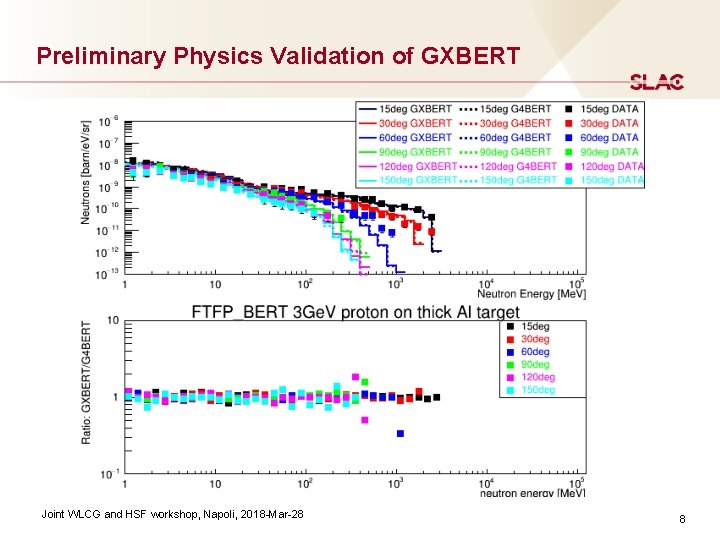
Preliminary Physics Validation of GXBERT Joint WLCG and HSF workshop, Napoli, 2018 -Mar-28 8
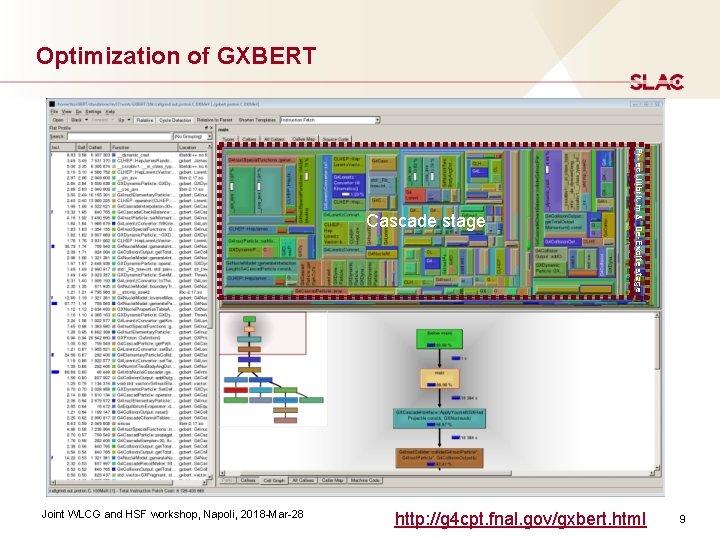
Optimization of GXBERT Joint WLCG and HSF workshop, Napoli, 2018 -Mar-28 Pr- equilibrium & De-Excite stage Cascade stage http: //g 4 cpt. fnal. gov/gxbert. html 9
Optimization of GXBERT Confirmed previous conclusions (based on full applications): for detector simulations there are no single kernel with important fractions of CPU Three components for CPU (each several kernels) • Cascade stage spends 90% of CPU time - This stage includes coalescence sub-model • Pre-Equilibrium and De-Excitation stage spends 10% of CPU time • Clustering calculation in the coalescence sub-model spends non negligible amount of CPU time in high energy and high Z target interactions Joint WLCG and HSF workshop, Napoli, 2018 -Mar-28 10
Optimization of GXBERT Although there is no major bottle neck, based on code review and profiling result, followings parts are optimized • • • “cbrt” function member of “Dynamic. Particle” constructor and destructor of “Dynamic. Particle” “Inucl. Elemntary. Particle: : type()” method Implementation of singleton classes of “Proton” and “Neutron” After these optimizations, total performance of GXBERT is improved of 13 -25% with respect to Geant 4 -Bertini Joint WLCG and HSF workshop, Napoli, 2018 -Mar-28 11
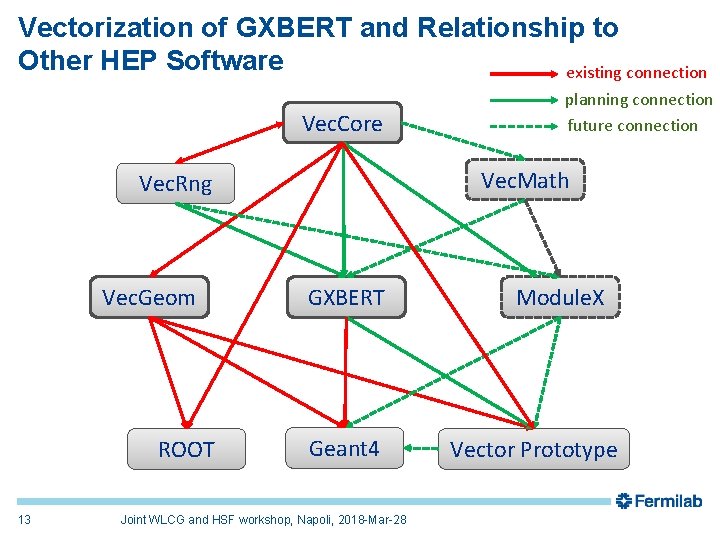
Vectorization • Support both sequential (scalar) and parallel (vector) particle transport with a common code – Vec. Core: hide architectures (SIMD instruction sets and GPU) – Simplify layers of workflows and decompose tasks as units of vector(parallel) tasks – Add multiple particles or vector interfaces (tracks, vector-type of input, SOA, etc. ) • Minimal dependencies – Identify external common components for vectorization (à la vector version of CLHEP) • Parallel random number generation (Vec. Rng) – ready to use • Math library (Vec. Math) – add a minimal set for HEP • Data structure (container classes) for vectorization 12 Joint WLCG and HSF workshop, Napoli, 2018 -Mar-28
Vectorization of GXBERT and Relationship to Other HEP Software existing connection Vec. Core Vec. Math Vec. Rng Vec. Geom ROOT 13 planning connection future connection GXBERT Geant 4 Joint WLCG and HSF workshop, Napoli, 2018 -Mar-28 Module. X Vector Prototype
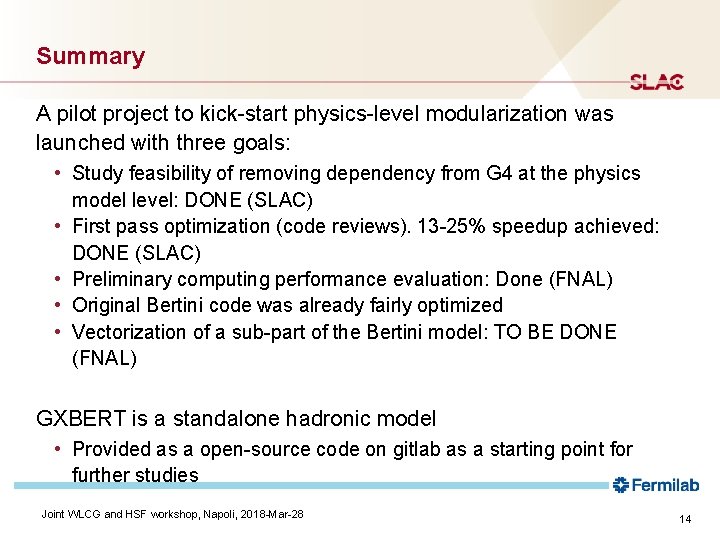
Summary A pilot project to kick-start physics-level modularization was launched with three goals: • Study feasibility of removing dependency from G 4 at the physics model level: DONE (SLAC) • First pass optimization (code reviews). 13 -25% speedup achieved: DONE (SLAC) • Preliminary computing performance evaluation: Done (FNAL) • Original Bertini code was already fairly optimized • Vectorization of a sub-part of the Bertini model: TO BE DONE (FNAL) GXBERT is a standalone hadronic model • Provided as a open-source code on gitlab as a starting point for further studies Joint WLCG and HSF workshop, Napoli, 2018 -Mar-28 14
Back up slides Joint WLCG and HSF workshop, Napoli, 2018 -Mar-28 15
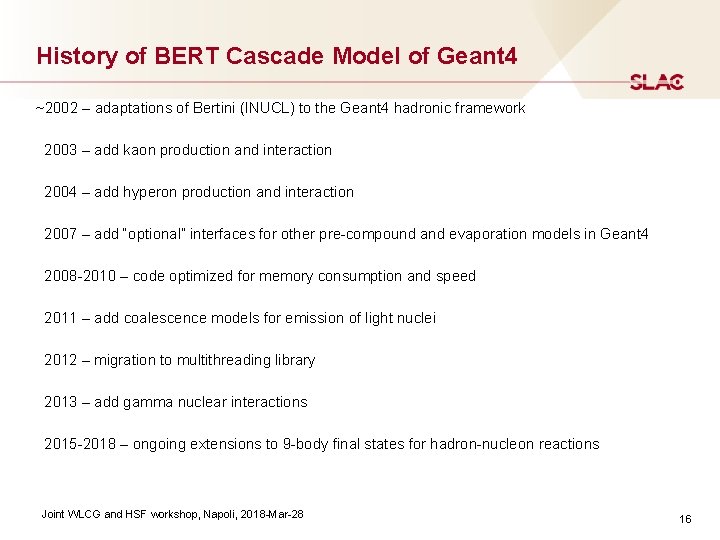
History of BERT Cascade Model of Geant 4 ~2002 – adaptations of Bertini (INUCL) to the Geant 4 hadronic framework 2003 – add kaon production and interaction 2004 – add hyperon production and interaction 2007 – add “optional” interfaces for other pre-compound and evaporation models in Geant 4 2008 -2010 – code optimized for memory consumption and speed 2011 – add coalescence models for emission of light nuclei 2012 – migration to multithreading library 2013 – add gamma nuclear interactions 2015 -2018 – ongoing extensions to 9 -body final states for hadron-nucleon reactions Joint WLCG and HSF workshop, Napoli, 2018 -Mar-28 16
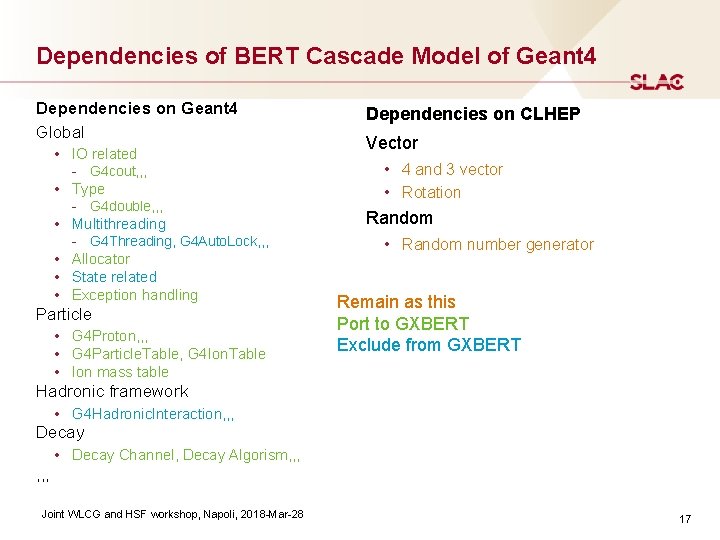
Dependencies of BERT Cascade Model of Geant 4 Dependencies on Geant 4 Global • IO related • • • - G 4 cout, , , Type - G 4 double, , , Multithreading - G 4 Threading, G 4 Auto. Lock, , , Allocator State related Exception handling Particle • G 4 Proton, , , • G 4 Particle. Table, G 4 Ion. Table • Ion mass table Dependencies on CLHEP Vector • 4 and 3 vector • Rotation Random • Random number generator Remain as this Port to GXBERT Exclude from GXBERT Hadronic framework • G 4 Hadronic. Interaction, , , Decay • Decay Channel, Decay Algorism, , , , Joint WLCG and HSF workshop, Napoli, 2018 -Mar-28 17