
Towards highthroughput DNA synthesis in a siliconbased MEMS
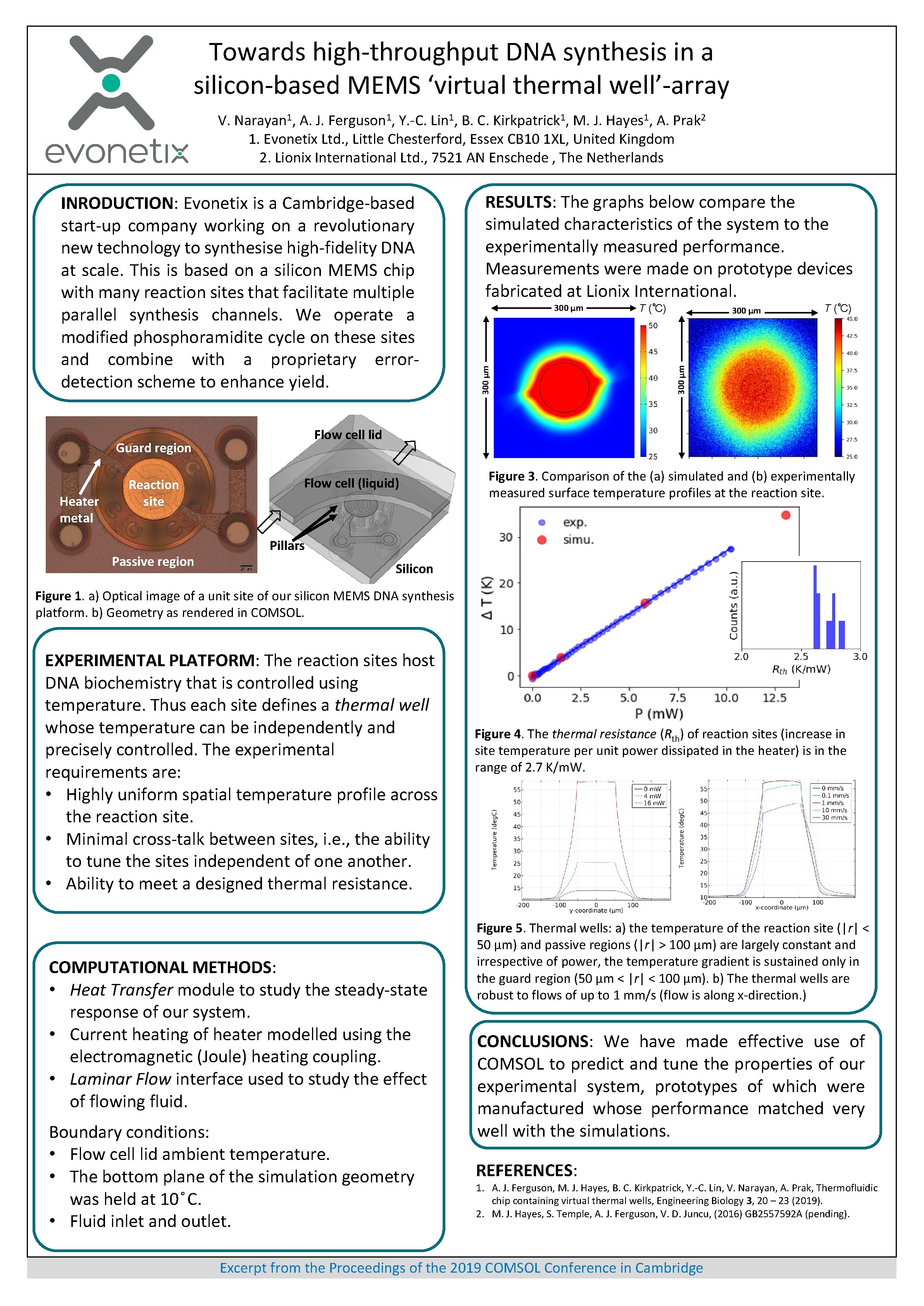
Towards high-throughput DNA synthesis in a silicon-based MEMS ‘virtual thermal well’-array V. Narayan 1, A. J. Ferguson 1, Y. -C. Lin 1, B. C. Kirkpatrick 1, M. J. Hayes 1, A. Prak 2 1. Evonetix Ltd. , Little Chesterford, Essex CB 10 1 XL, United Kingdom 2. Lionix International Ltd. , 7521 AN Enschede , The Netherlands Heater metal Passive region T ( C) 300 µm Flow cell lid Guard region Reaction site RESULTS: The graphs below compare the simulated characteristics of the system to the experimentally measured performance. Measurements were made on prototype devices fabricated at Lionix International. 300 µm INRODUCTION: Evonetix is a Cambridge-based start-up company working on a revolutionary new technology to synthesise high-fidelity DNA at scale. This is based on a silicon MEMS chip with many reaction sites that facilitate multiple parallel synthesis channels. We operate a modified phosphoramidite cycle on these sites and combine with a proprietary errordetection scheme to enhance yield. Flow cell (liquid) Figure 3. Comparison of the (a) simulated and (b) experimentally measured surface temperature profiles at the reaction site. Pillars Silicon Figure 1. a) Optical image of a unit site of our silicon MEMS DNA synthesis platform. b) Geometry as rendered in COMSOL. EXPERIMENTAL PLATFORM: The reaction sites host DNA biochemistry that is controlled using temperature. Thus each site defines a thermal well whose temperature can be independently and precisely controlled. The experimental requirements are: • Highly uniform spatial temperature profile across the reaction site. • Minimal cross-talk between sites, i. e. , the ability to tune the sites independent of one another. • Ability to meet a designed thermal resistance. COMPUTATIONAL METHODS: • Heat Transfer module to study the steady-state response of our system. • Current heating of heater modelled using the electromagnetic (Joule) heating coupling. • Laminar Flow interface used to study the effect of flowing fluid. Boundary conditions: • Flow cell lid ambient temperature. • The bottom plane of the simulation geometry was held at 10 C. • Fluid inlet and outlet. Figure 4. The thermal resistance (Rth) of reaction sites (increase in site temperature per unit power dissipated in the heater) is in the range of 2. 7 K/m. W. Figure 5. Thermal wells: a) the temperature of the reaction site (|r| < 50 µm) and passive regions (|r| > 100 µm) are largely constant and irrespective of power, the temperature gradient is sustained only in the guard region (50 µm < |r| < 100 µm). b) The thermal wells are robust to flows of up to 1 mm/s (flow is along x-direction. ) CONCLUSIONS: We have made effective use of COMSOL to predict and tune the properties of our experimental system, prototypes of which were manufactured whose performance matched very well with the simulations. REFERENCES: 1. A. J. Ferguson, M. J. Hayes, B. C. Kirkpatrick, Y. -C. Lin, V. Narayan, A. Prak, Thermofluidic chip containing virtual thermal wells, Engineering Biology 3, 20 – 23 (2019). 2. M. J. Hayes, S. Temple, A. J. Ferguson, V. D. Juncu, (2016) GB 2557592 A (pending). Excerpt from the Proceedings of the 2019 COMSOL Conference in Cambridge
- Slides: 1