
Towards High Resolution Cavity Enhanced Spectroscopy with Fast
- Slides: 14
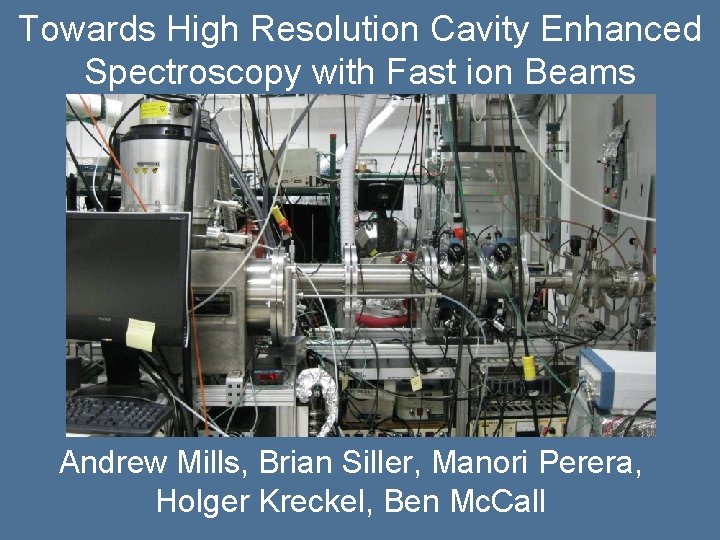
Towards High Resolution Cavity Enhanced Spectroscopy with Fast ion Beams Andrew Mills, Brian Siller, Manori Perera, Holger Kreckel, Ben Mc. Call
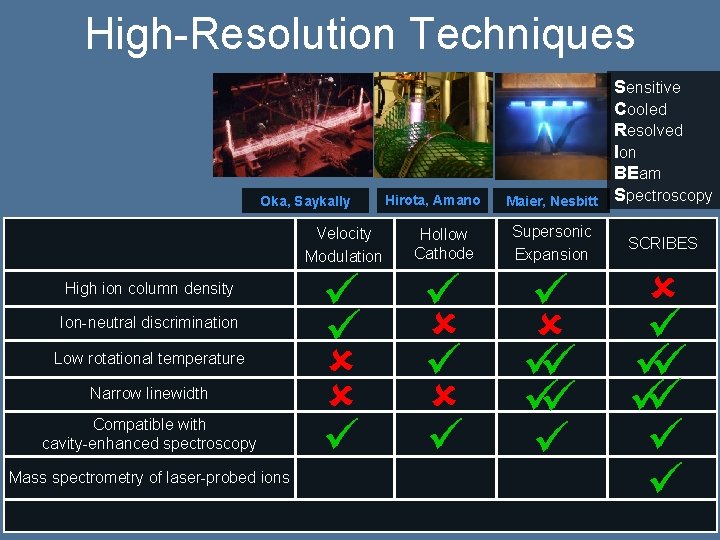
High-Resolution Techniques Oka, Saykally High ion column density Ion-neutral discrimination Low rotational temperature Narrow linewidth Compatible with cavity-enhanced spectroscopy Mass spectrometry of laser-probed ions Hirota, Amano Maier, Nesbitt Velocity Modulation Hollow Cathode Supersonic Expansion Sensitive Cooled Resolved Ion BEam Spectroscopy SCRIBES
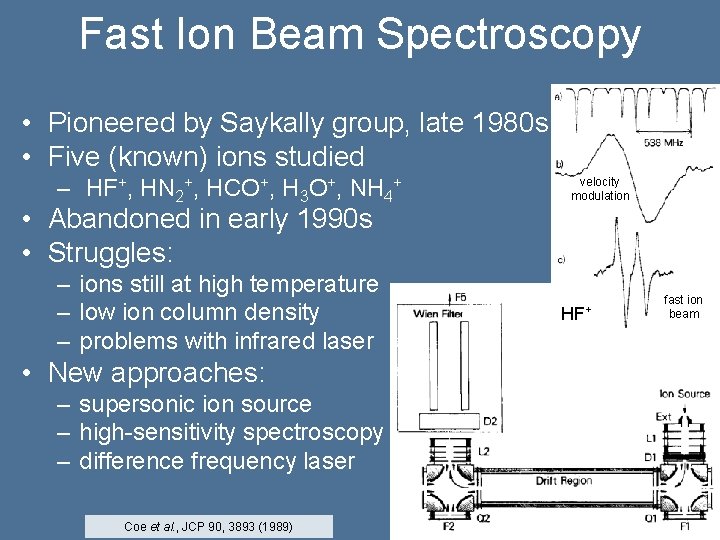
Fast Ion Beam Spectroscopy • Pioneered by Saykally group, late 1980 s • Five (known) ions studied – HF+, HN 2+, HCO+, H 3 O+, NH 4+ • Abandoned in early 1990 s • Struggles: – ions still at high temperature – low ion column density – problems with infrared laser • New approaches: – supersonic ion source – high-sensitivity spectroscopy – difference frequency laser Coe et al. , JCP 90, 3893 (1989) velocity modulation HF+ fast ion beam
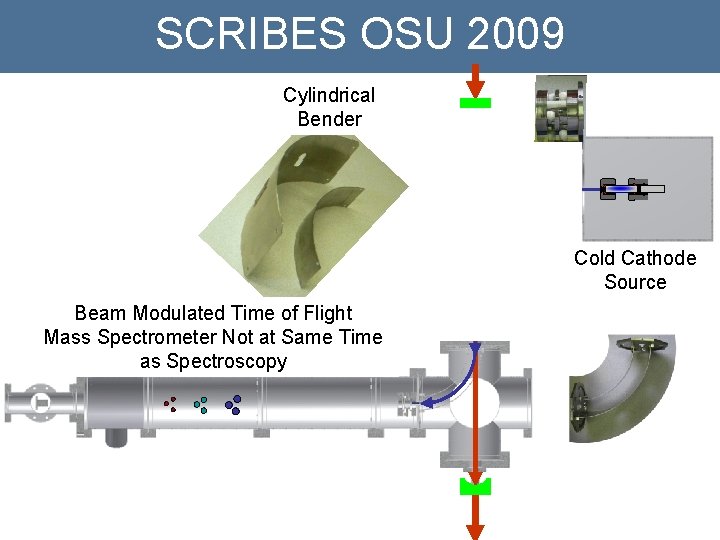
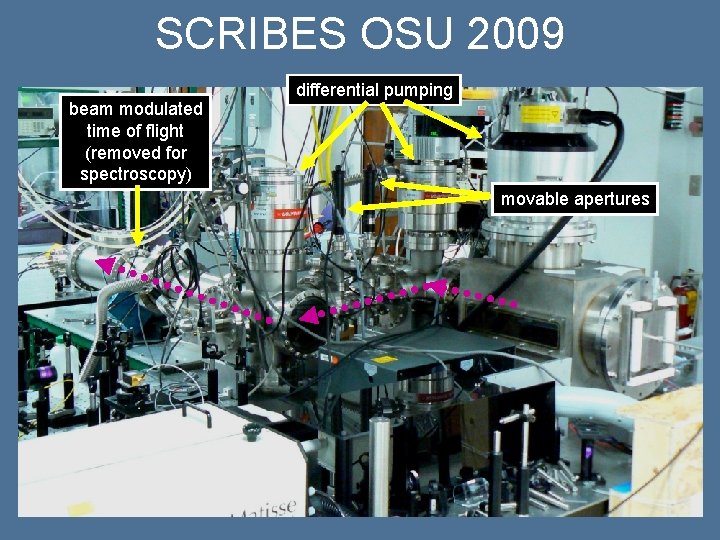
SCRIBES OSU 2009 Cylindrical Bender Cold Cathode Source Beam Modulated Time of Flight Mass Spectrometer Not at Same Time as Spectroscopy
SCRIBES OSU 2009 beam modulated time of flight (removed for spectroscopy) differential pumping movable apertures
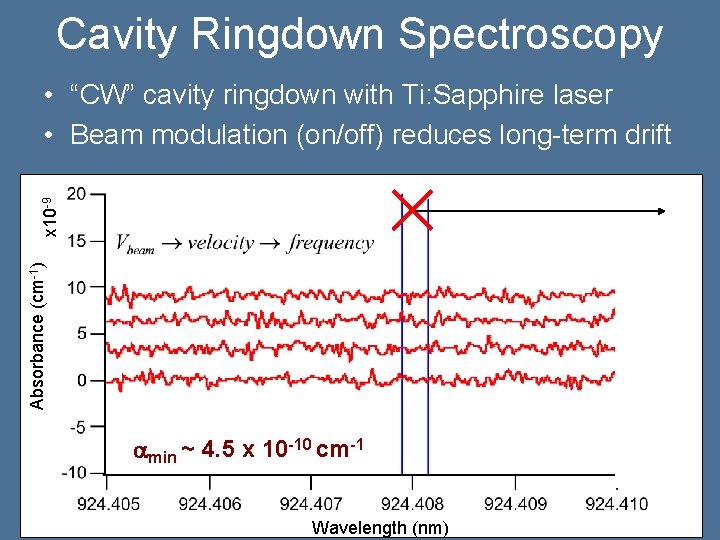
Cavity Ringdown Spectroscopy Absorbance (cm-1) x 10 -9 • “CW” cavity ringdown with Ti: Sapphire laser • Beam modulation (on/off) reduces long-term drift amin ~ 4. 5 x 10 -10 cm-1 Wavelength (nm)
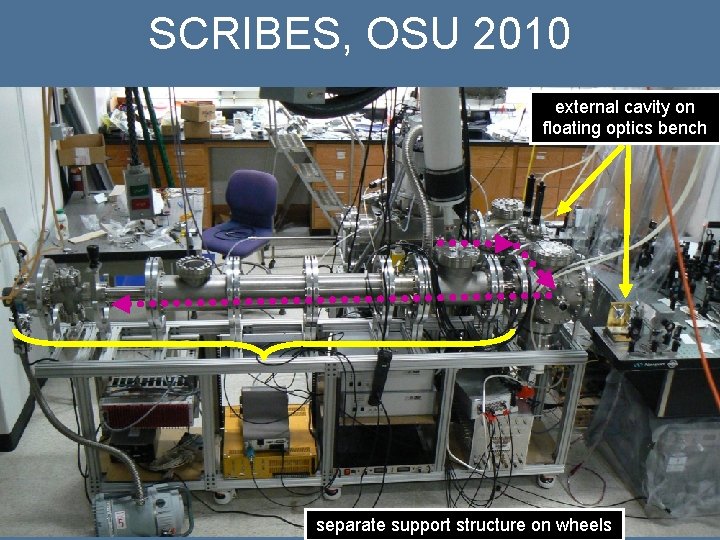
SCRIBES @ OSU 2010 • Removed ion beam machine from laser table – reduce vibration from pumps • Higher sensitivity spectroscopy – separate cavity from ion beam machine – cavity-locked spectroscopy • Simultaneous laser and mass spectroscopy – verify mass distribution – verify absolute beam energy (Doppler shift) – fast high voltage probe
SCRIBES, OSU 2010 external cavity on floating optics bench separate support structure on wheels
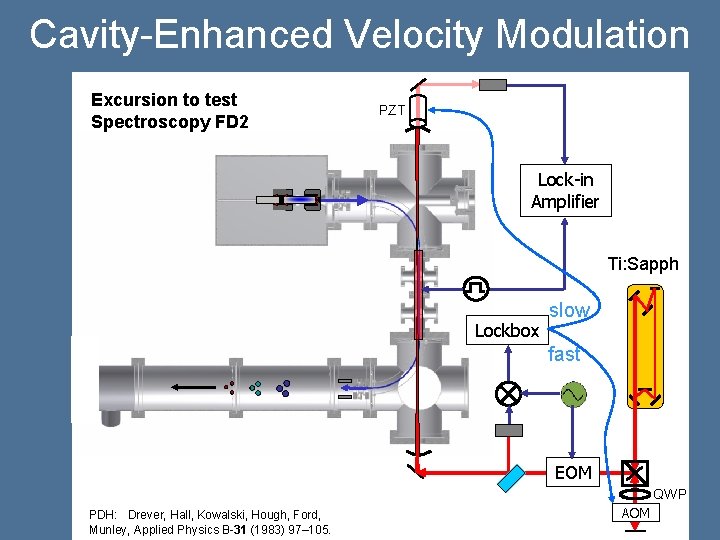
Cavity-Enhanced Velocity Modulation Excursion to test Spectroscopy FD 2 PZT Lock-in Amplifier Ti: Sapph Lockbox slow fast EOM QWP PDH: Drever, Hall, Kowalski, Hough, Ford, Munley, Applied Physics B-31 (1983) 97– 105. AOM
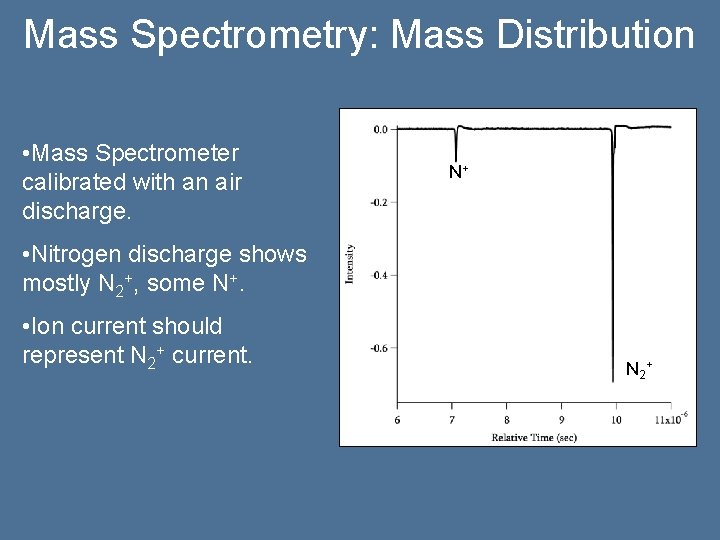
Mass Spectrometry: Mass Distribution • Mass Spectrometer calibrated with an air discharge. N+ • Nitrogen discharge shows mostly N 2+, some N+. • Ion current should represent N 2+ current. N 2 +
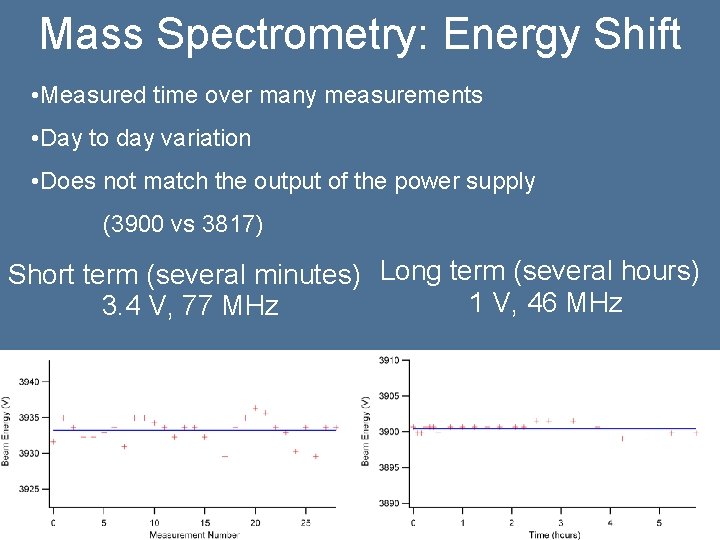
Mass Spectrometry: Energy Shift • Measured time over many measurements • Day to day variation • Does not match the output of the power supply (3900 vs 3817) Short term (several minutes) Long term (several hours) 1 V, 46 MHz 3. 4 V, 77 MHz
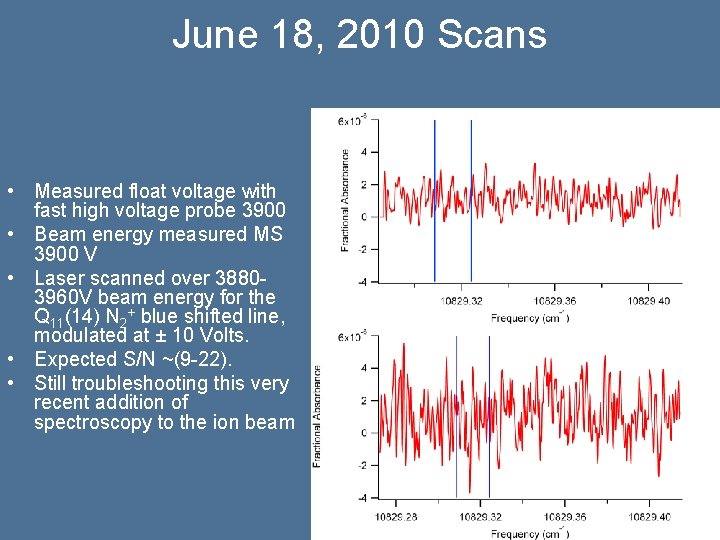
June 18, 2010 Scans • Measured float voltage with fast high voltage probe 3900 • Beam energy measured MS 3900 V • Laser scanned over 38803960 V beam energy for the Q 11(14) N 2+ blue shifted line, modulated at ± 10 Volts. • Expected S/N ~(9 -22). • Still troubleshooting this very recent addition of spectroscopy to the ion beam
Conclusions • A laser-table independent ion beam instrument has been constructed with well collimated ion beam collinear to a laser beam. • The ion beam allows for simultaneous monitoring of the beam energy prior to spectroscopy. • The output of the power supply monitor voltage is not accurate enough and the mass spectrometer must be used to determine the beam energy. • Preliminary scans have been performed, and we are continuing to search for a signal.
Acknowledgments Air Force Young Investigator Award FA 9550 -07 -1 -0128 Dreyfus New Faculty, Teacher-Scholar Awards NASA Laboratory Astrophysics NSF Chemistry, Physics, Astronomy Packard Fellowship Cottrell Scholarship Visit us at: http: //bjm. scs. uiuc. edu Sloan Fellowship