
Towards Effective Partition Management for Large Graphs Shengqi



- Slides: 22
Towards Effective Partition Management for Large Graphs Shengqi Yang, Xifeng Yan, Bo Zong and Arijit Khan Computer Science, UC Santa Barbara {sqyang, xyan, bzong, arijitkhan}@cs. ucsb. edu Project Homepage http: //grafia. cs. ucsb. edu/sedge 11/24/2020 1
Motivation - Challenges p New requirements for data processing n Ubiquitous demands on graph data management. n Information Networks n Social Networks n Biological systems n Communication Networks n Efficient data processing in extremely large graphs. n Google: 1 trillion indexed pages n Facebook: >500 million active users n De Bruijn: 500 million vertices 11/24/2020 2
Motivation – Existed solutions p Memory-resident solution n Running on single server. n Difficult/Impossible to accommodate the content of an extremely large graph. n Low concurrency. p Simple distributed solution (e. g. , Hadoop) n Running on commodity cluster n High concurrency and enough memory space n Some successful applications n Not ideal (poor locality and little work per vertex) 11/24/2020 3
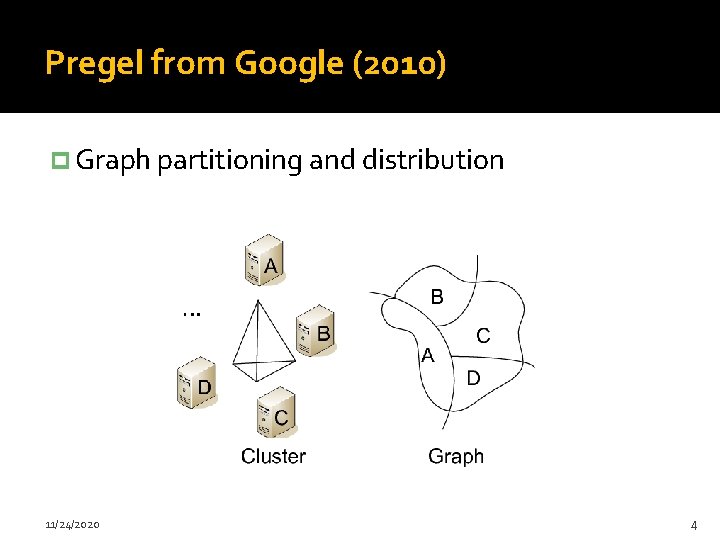
Pregel from Google (2010) p Graph partitioning and distribution 11/24/2020 4
Is Pregel suitable? �How Pregel works (BSP model) Distribution Model: Graph partitioning Computational model: run on each partition (vertex) Communication model: message passing �Why Not Pregel? Limitations 11/24/2020 5
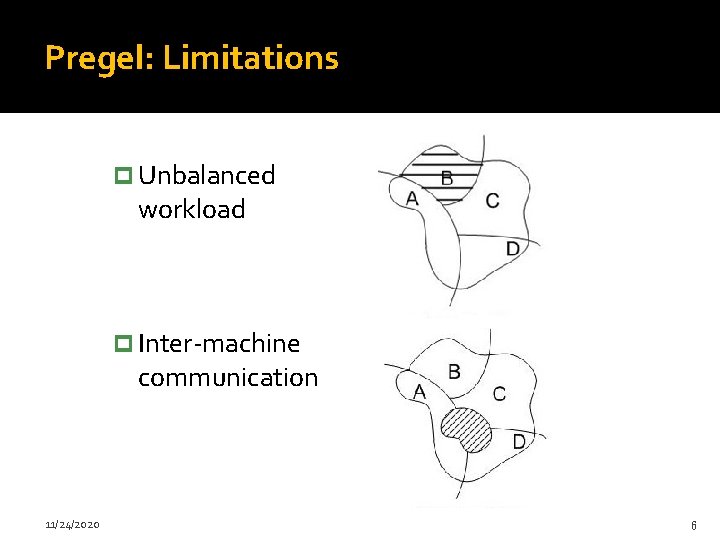
Pregel: Limitations p Unbalanced workload p Inter-machine communication 11/24/2020 6
Our Solution: Sedge p SEDGE: a Self Evolving Distributed Graph Processing Environment n Solving the problems facing Pregel n Workload balancing (replication) n Communication reduction n Novel partitioning techniques. n 2 -level partition architecture that supports the new generated partitions. 11/24/2020 7
Outline �Partitioning techniques Complementary partitioning On-demand partitioning Two-level partition management �System Architecture �Experiments �Conclusions 11/24/2020 8
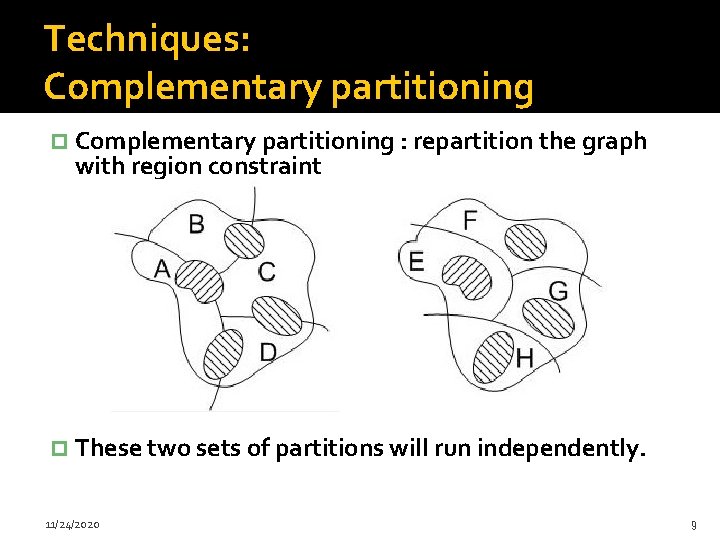
Techniques: Complementary partitioning p Complementary partitioning : repartition the graph with region constraint p These two sets of partitions will run independently. 11/24/2020 9
An Iterative Solution … … �Iteratively repartition the graph �Pros �Effective communication reduction �Cons �Space limitation 11/24/2020 10
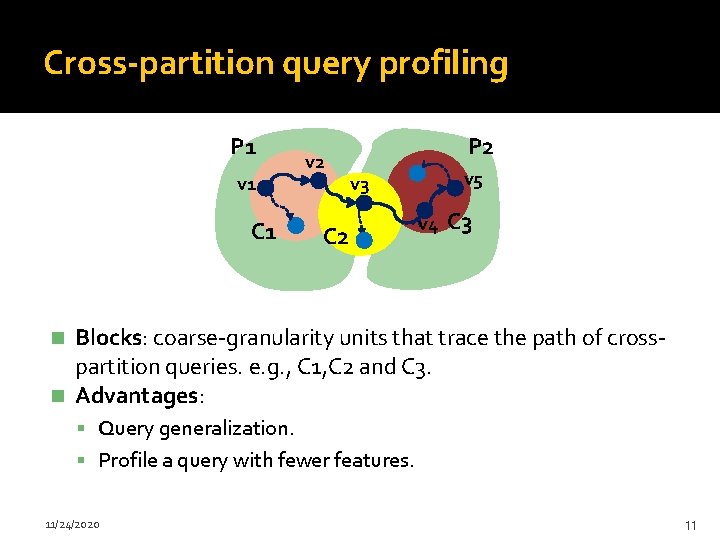
Cross-partition query profiling P 1 v 1 C 1 v 2 P 2 v 5 v 3 C 2 v 4 C 3 Blocks: coarse-granularity units that trace the path of crosspartition queries. e. g. , C 1, C 2 and C 3. n Advantages: n Query generalization. Profile a query with fewer features. 11/24/2020 11
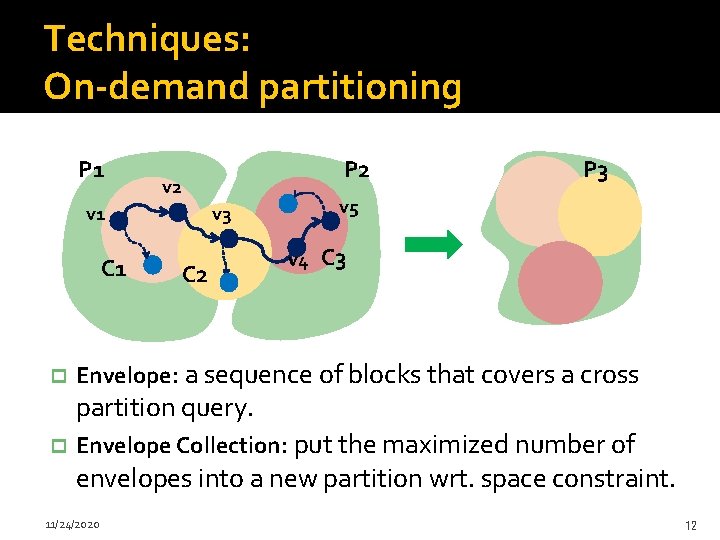
Techniques: On-demand partitioning P 1 P 2 v 1 C 1 p v 5 v 3 C 2 P 3 v 4 C 3 Envelope: a sequence of blocks that covers a cross partition query. p Envelope Collection: put the maximized number of envelopes into a new partition wrt. space constraint. 11/24/2020 12
A Similarity-Based Greedy Algorithm p The algorithm intends to combine similar envelopes sharing many common color-blocks. p 2 -step greedy algorithm: 1) Similarity search (nearest neighbor search). Locality Sensitive Hashing (LSH): Min-Hash, in O(n) 2) Envelope combining 1. Cluster the envelopes in the same bucket produced by Min-Hash. 2. Combine the clusters with highest benefit. 11/24/2020 13
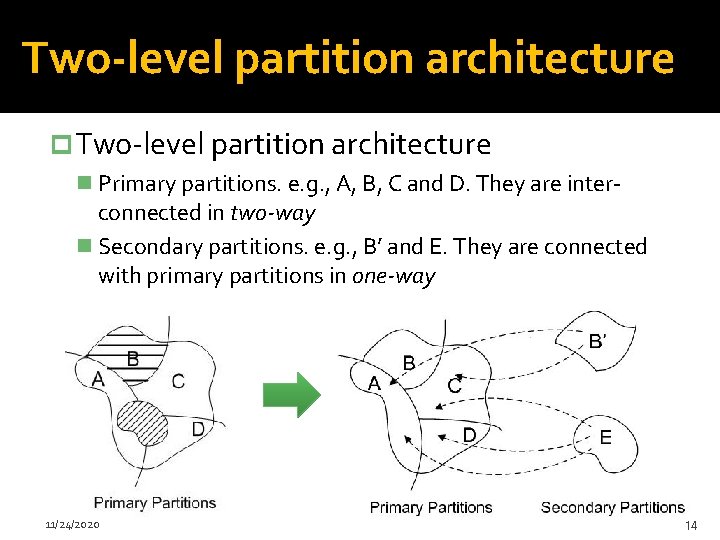
Two-level partition architecture p Two-level partition architecture n Primary partitions. e. g. , A, B, C and D. They are inter- connected in two-way n Secondary partitions. e. g. , B’ and E. They are connected with primary partitions in one-way 11/24/2020 14
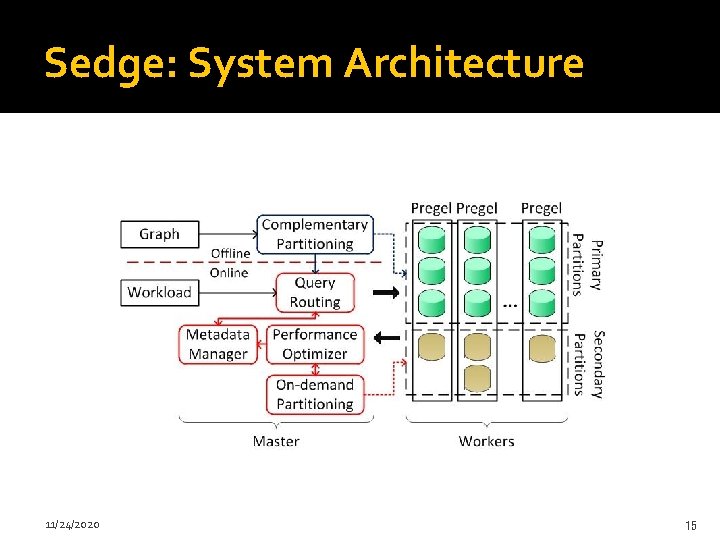
Sedge: System Architecture 11/24/2020 15
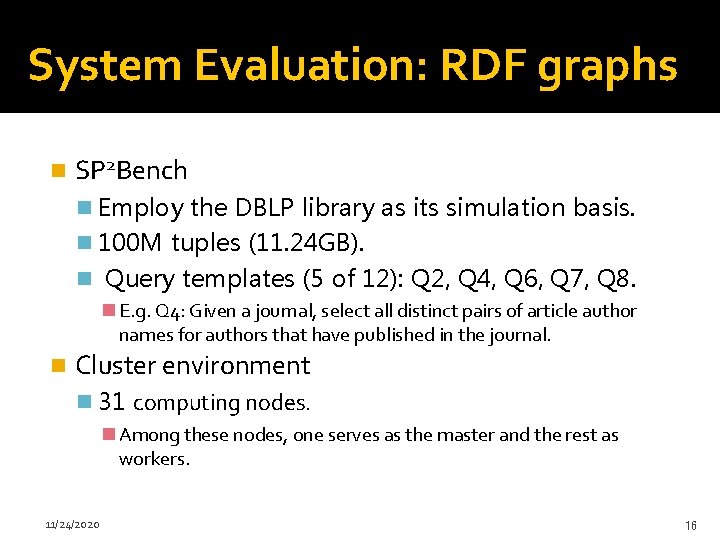
System Evaluation: RDF graphs n SP 2 Bench n Employ the DBLP library as its simulation basis. n 100 M tuples (11. 24 GB). n Query templates (5 of 12): Q 2, Q 4, Q 6, Q 7, Q 8. n E. g. Q 4: Given a journal, select all distinct pairs of article author names for authors that have published in the journal. n Cluster environment n 31 computing nodes. n Among these nodes, one serves as the master and the rest as workers. 11/24/2020 16
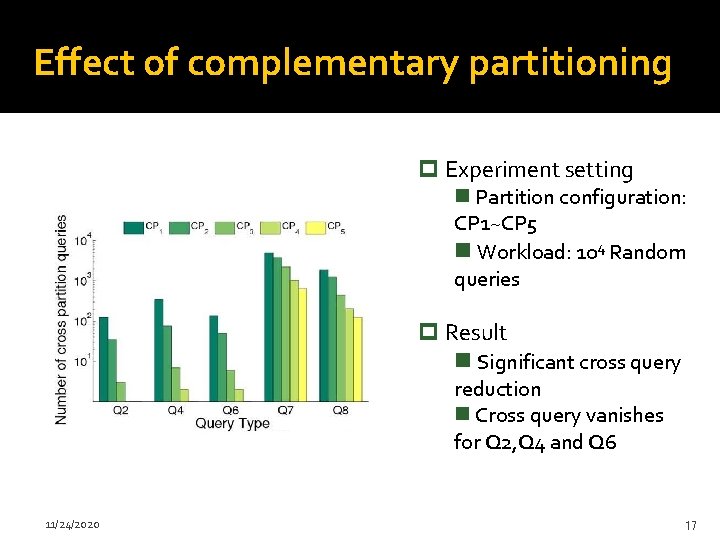
Effect of complementary partitioning p Experiment setting n Partition configuration: CP 1~CP 5 n Workload: 104 Random queries p Result n Significant cross query reduction n Cross query vanishes for Q 2, Q 4 and Q 6 11/24/2020 17
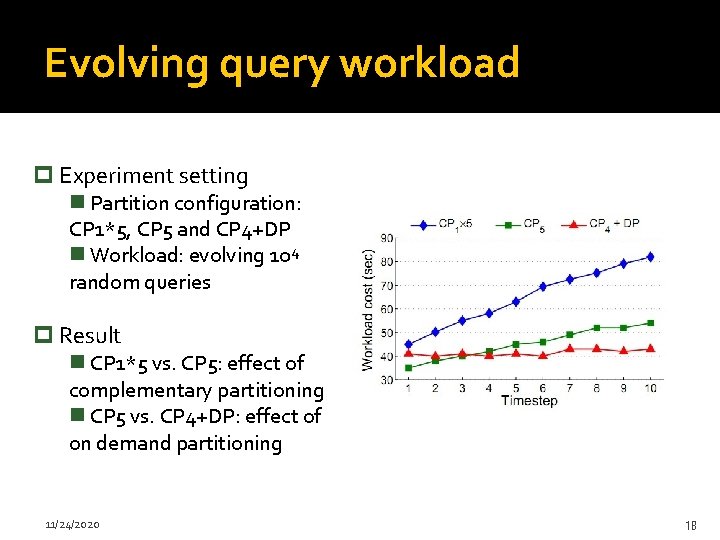
Evolving query workload p Experiment setting n Partition configuration: CP 1*5, CP 5 and CP 4+DP n Workload: evolving 104 random queries p Result n CP 1*5 vs. CP 5: effect of complementary partitioning n CP 5 vs. CP 4+DP: effect of on demand partitioning 11/24/2020 18
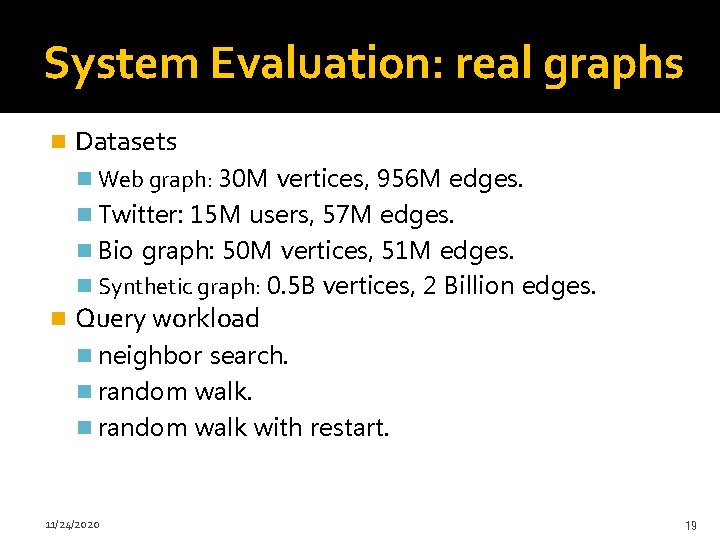
System Evaluation: real graphs n Datasets n Web graph: 30 M vertices, 956 M edges. n Twitter: 15 M users, 57 M edges. n Bio graph: 50 M vertices, 51 M edges. n Synthetic graph: 0. 5 B vertices, 2 Billion edges. n Query workload n neighbor search. n random walk with restart. 11/24/2020 19
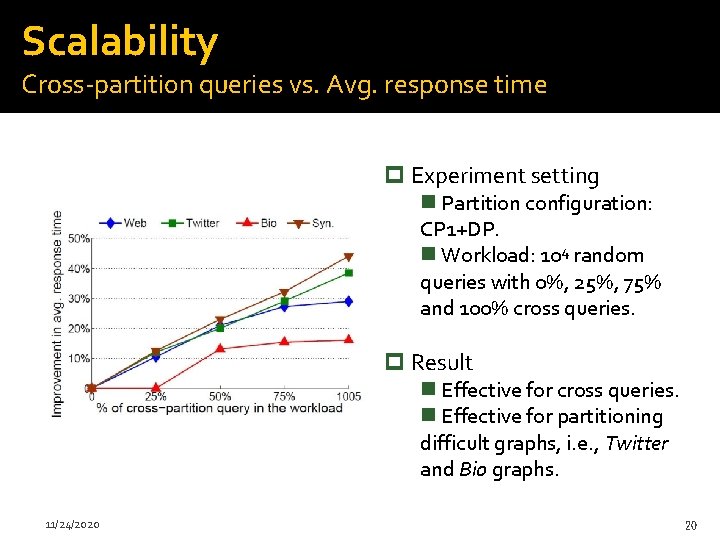
Scalability Cross-partiti 0 n queries vs. Avg. response time p Experiment setting n Partition configuration: CP 1+DP. n Workload: 104 random queries with 0%, 25%, 75% and 100% cross queries. p Result n Effective for cross queries. n Effective for partitioning difficult graphs, i. e. , Twitter and Bio graphs. 11/24/2020 20
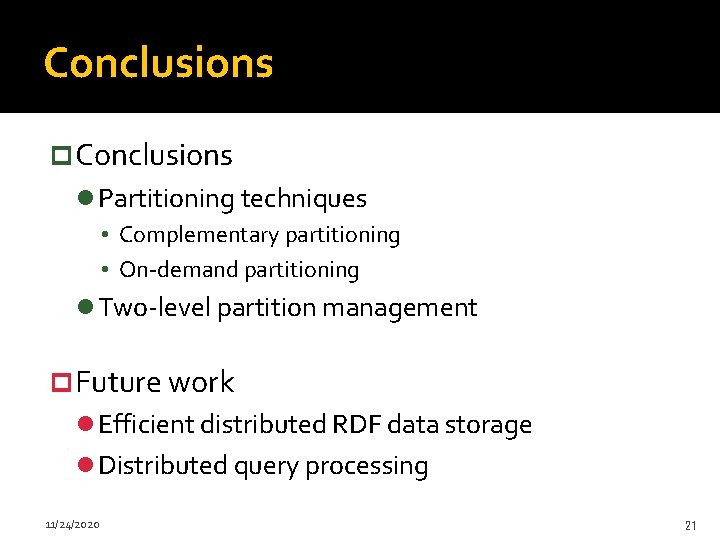
Conclusions p Conclusions l Partitioning techniques • Complementary partitioning • On-demand partitioning l Two-level partition management p Future work l Efficient distributed RDF data storage l Distributed query processing 11/24/2020 21
Thank You! 11/24/2020 22