
Towards an EarthSystem Model JeanRaymond Bidlot Earth System

Towards an Earth-System Model. Jean-Raymond Bidlot Earth System Modelling Section Coupled Processes Team Research Department European Centre for Medium-range Weather Forecasts Reading, UK jean. bidlot@ecmwf. int
Outline Part 1: - ECMWF global forecast models. - Wave modelling and its role. - Towards an Earth-System model at ECMWF. Part 2: - Call sequence and communication issues. - Impact study: Tropical cyclone forecast. - Coupled data assimilation. - Conclusion.

ECMWF global forecast models High resolution / Ensemble systems Atmospheric TCo 1279/TCo 639* model** (IFS) 9 km/18 km Wave model (ECWAM) Ocean model (NEMO) ** including land atmospheric composition modules 14 km/28 km* Ice model (LIM) ORCA 1°_Z 42 These models are the components of ECMWF Earth-System * Resolution as of 8 March 2016

Ocean waves Wave forecasting took off as an important subject when knowledge of the sea state was required for numerous landing operations during the second World War, for D-Day for example. From then onwards a rapid development because of improved weather forecasting (better surface winds), enormous increase in the number of observations and faster and bigger computers. From the beginning it was clear, however, that the sea state was so complicated that only a prediction of the average sea state at a location of interest was possible. Example of parameters are the average wave height and the average period of the waves.
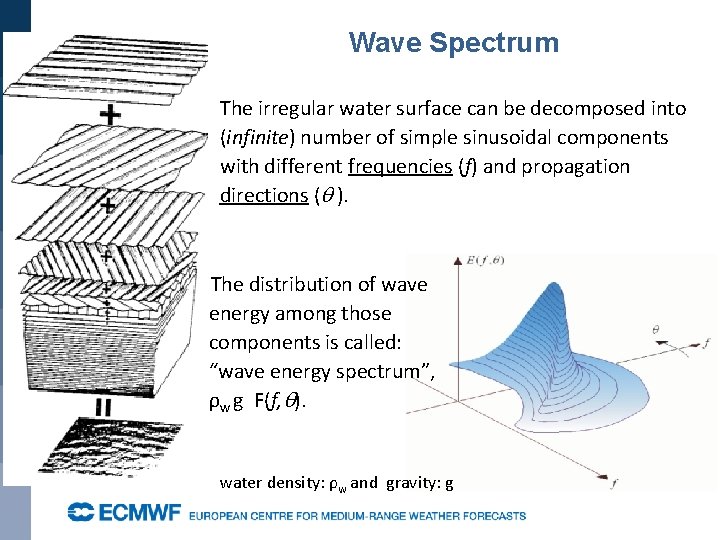
Wave Spectrum The irregular water surface can be decomposed into (infinite) number of simple sinusoidal components with different frequencies (f) and propagation directions ( ). The distribution of wave energy among those components is called: “wave energy spectrum”, ρw g F(f, ). water density: ρw and gravity: g
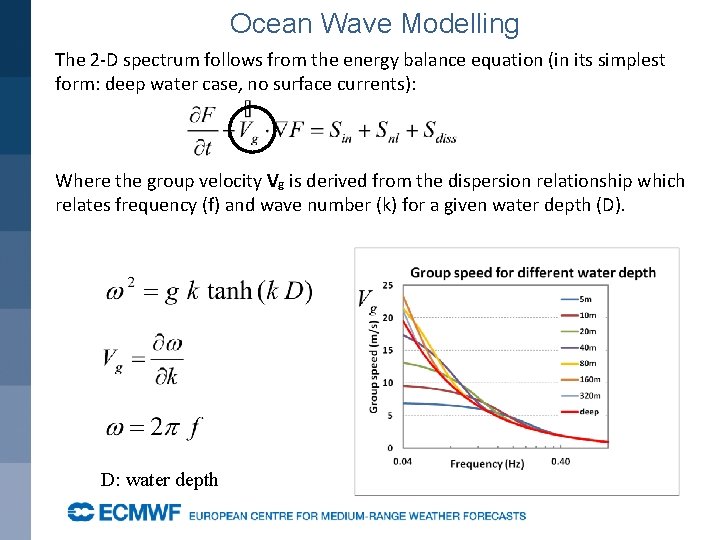
Ocean Wave Modelling The 2 -D spectrum follows from the energy balance equation (in its simplest form: deep water case, no surface currents): Where the group velocity Vg is derived from the dispersion relationship which relates frequency (f) and wave number (k) for a given water depth (D). D: water depth
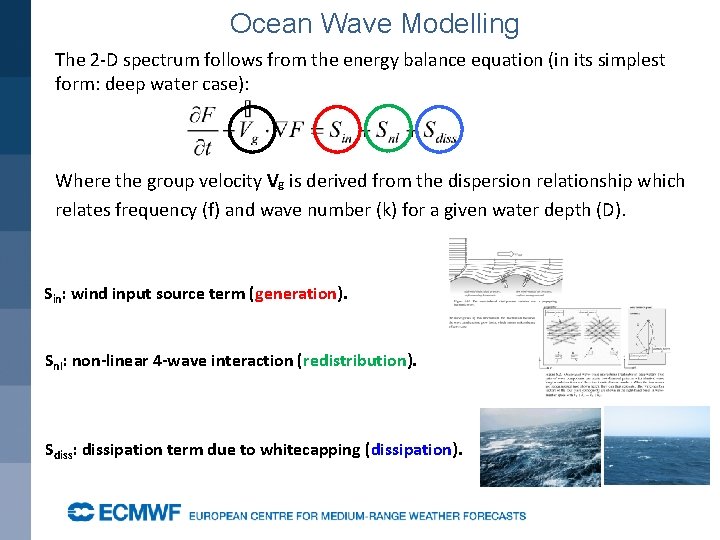
Ocean Wave Modelling The 2 -D spectrum follows from the energy balance equation (in its simplest form: deep water case): Where the group velocity Vg is derived from the dispersion relationship which relates frequency (f) and wave number (k) for a given water depth (D). Sin: wind input source term (generation). Snl: non-linear 4 -wave interaction (redistribution). Sdiss: dissipation term due to whitecapping (dissipation).
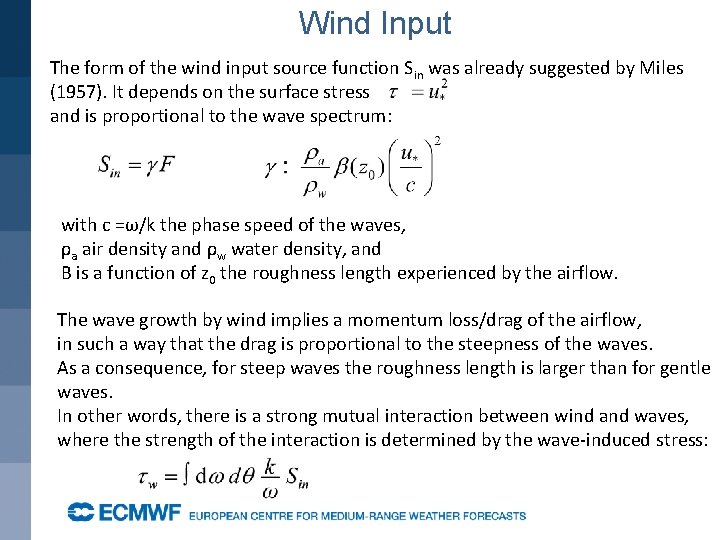
Wind Input The form of the wind input source function Sin was already suggested by Miles (1957). It depends on the surface stress and is proportional to the wave spectrum: with c =ω/k the phase speed of the waves, ρa air density and ρw water density, and Β is a function of z 0 the roughness length experienced by the airflow. The wave growth by wind implies a momentum loss/drag of the airflow, in such a way that the drag is proportional to the steepness of the waves. As a consequence, for steep waves the roughness length is larger than for gentle waves. In other words, there is a strong mutual interaction between wind and waves, where the strength of the interaction is determined by the wave-induced stress:
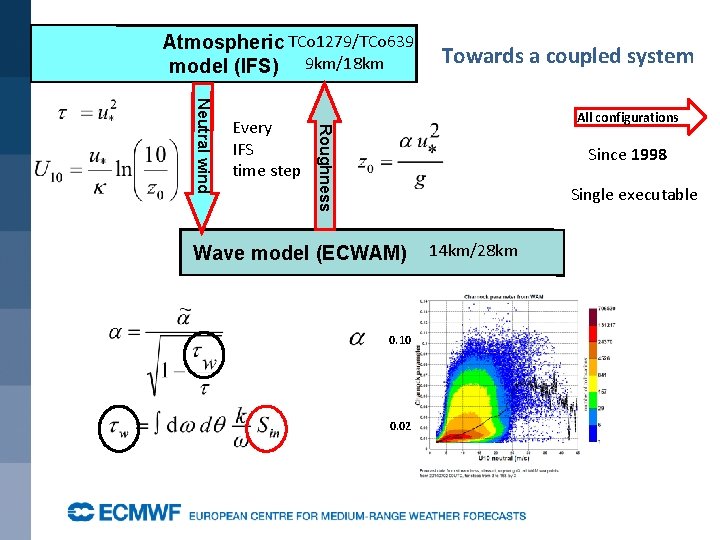
Atmospheric TCo 1279/TCo 639 model (IFS) 9 km/18 km All configurations Roughness Neutral wind Every IFS time step Towards a coupled system Since 1998 Single executable Wave model (ECWAM) 0. 10 0. 02 14 km/28 km
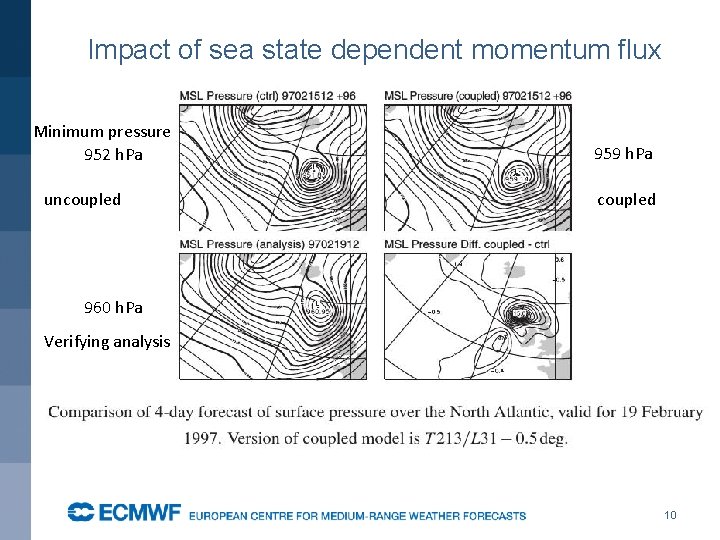
Impact of sea state dependent momentum flux Minimum pressure 952 h. Pa uncoupled 959 h. Pa coupled 960 h. Pa Verifying analysis 10
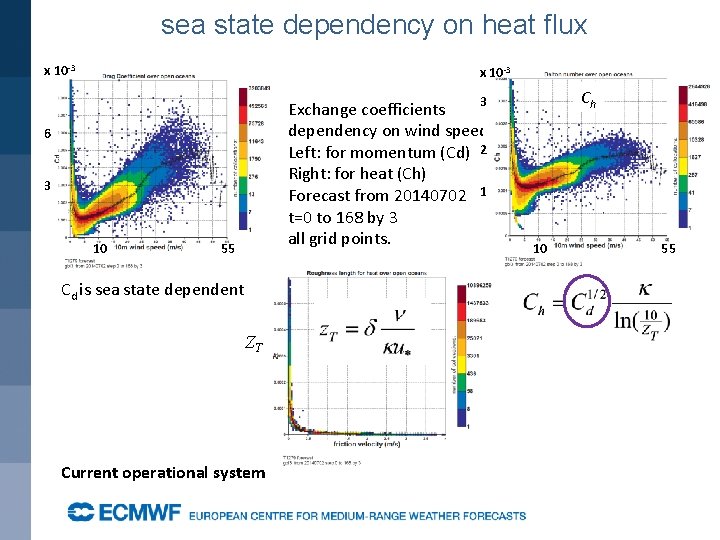
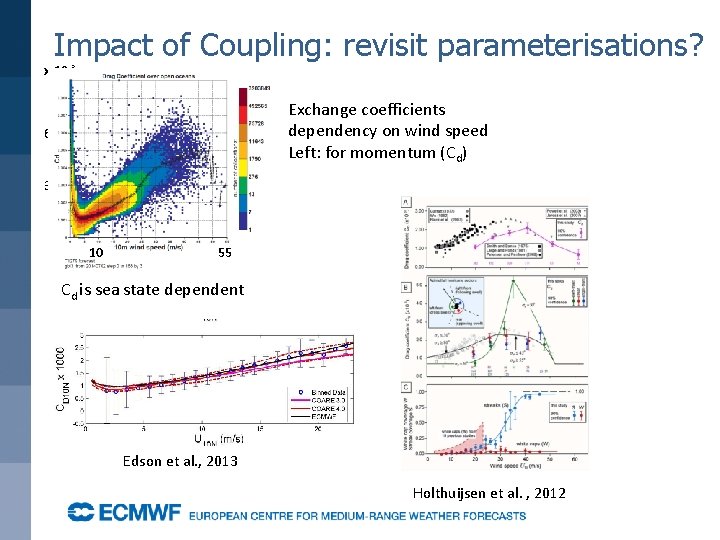
sea state dependency on heat flux x 10 -3 Cd 3 Exchange coefficients dependency on wind speed Left: for momentum (Cd) 2 Right: for heat (Ch) Forecast from 20140702 1 t=0 to 168 by 3 all grid points. 6 3 10 55 Cd is sea state dependent ZT Current operational system Ch 10 55
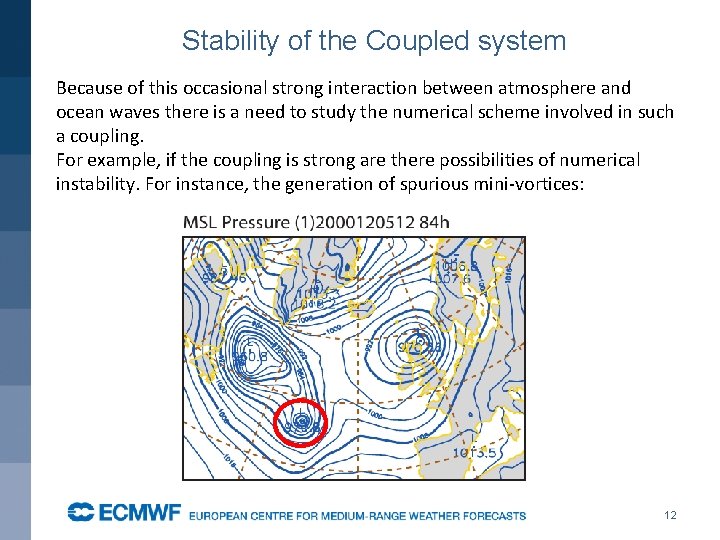
Stability of the Coupled system Because of this occasional strong interaction between atmosphere and ocean waves there is a need to study the numerical scheme involved in such a coupling. For example, if the coupling is strong are there possibilities of numerical instability. For instance, the generation of spurious mini-vortices: 12
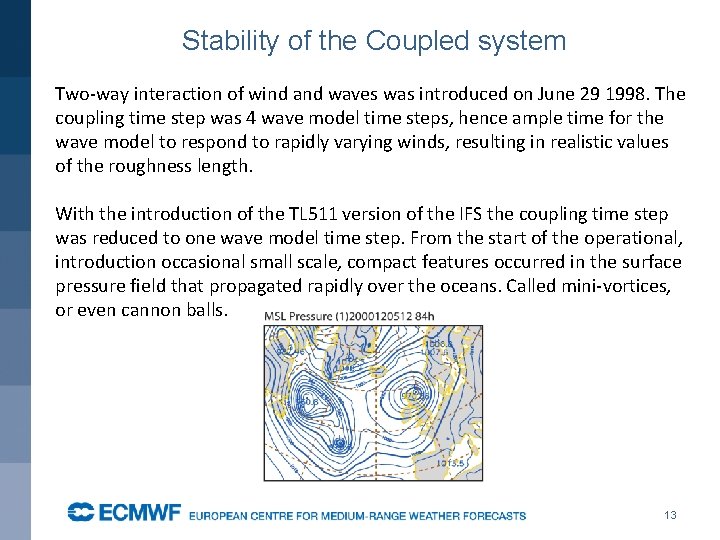
Stability of the Coupled system Two-way interaction of wind and waves was introduced on June 29 1998. The coupling time step was 4 wave model time steps, hence ample time for the wave model to respond to rapidly varying winds, resulting in realistic values of the roughness length. With the introduction of the TL 511 version of the IFS the coupling time step was reduced to one wave model time step. From the start of the operational, introduction occasional small scale, compact features occurred in the surface pressure field that propagated rapidly over the oceans. Called mini-vortices, or even cannon balls. 13
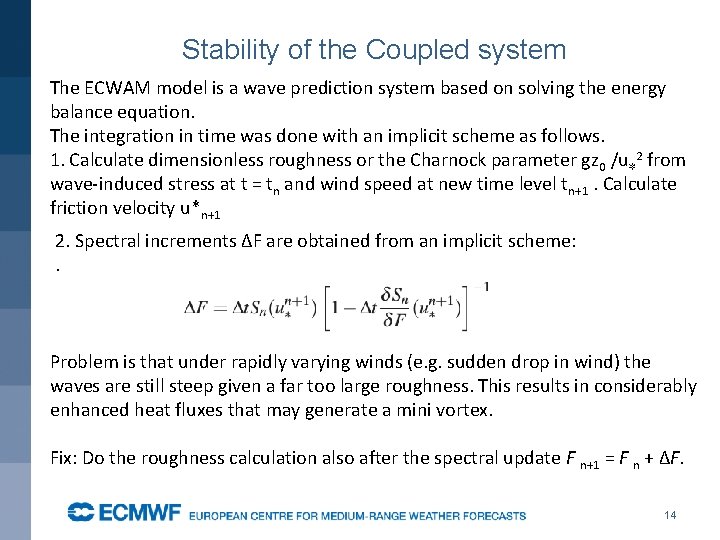
Stability of the Coupled system The ECWAM model is a wave prediction system based on solving the energy balance equation. The integration in time was done with an implicit scheme as follows. 1. Calculate dimensionless roughness or the Charnock parameter gz 0 /u∗ 2 from wave-induced stress at t = tn and wind speed at new time level tn+1. Calculate friction velocity u*n+1 2. Spectral increments ∆F are obtained from an implicit scheme: . Problem is that under rapidly varying winds (e. g. sudden drop in wind) the waves are still steep given a far too large roughness. This results in considerably enhanced heat fluxes that may generate a mini vortex. Fix: Do the roughness calculation also after the spectral update F n+1 = F n + ∆F. 14
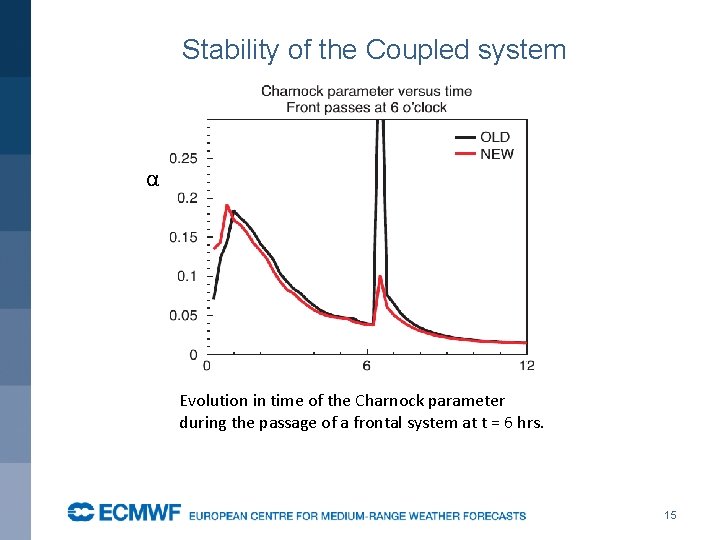
Stability of the Coupled system α Evolution in time of the Charnock parameter during the passage of a frontal system at t = 6 hrs. 15
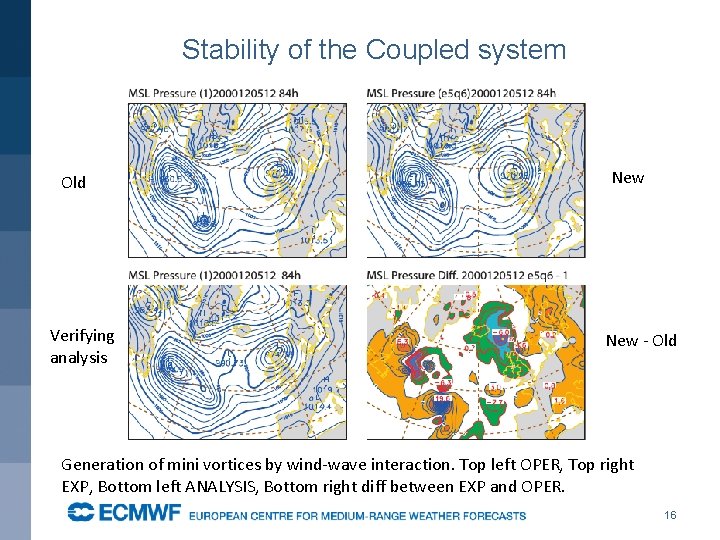
Stability of the Coupled system Old Verifying analysis New - Old Generation of mini vortices by wind-wave interaction. Top left OPER, Top right EXP, Bottom left ANALYSIS, Bottom right diff between EXP and OPER. 16
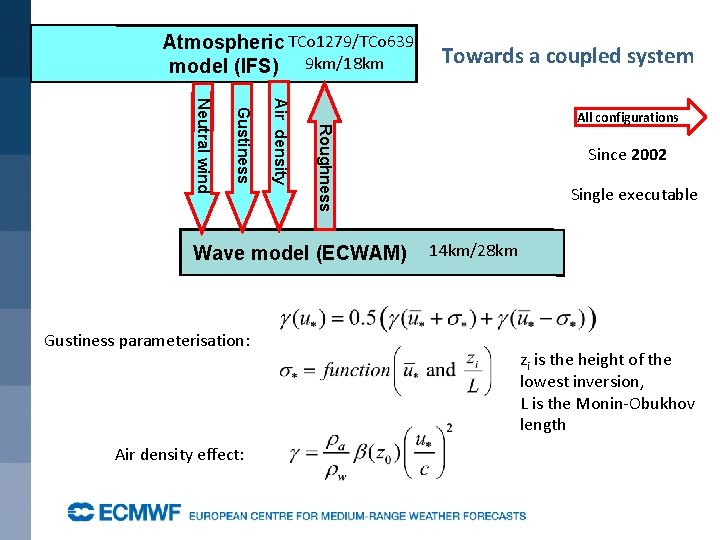
Atmospheric TCo 1279/TCo 639 model (IFS) 9 km/18 km Air density effect: All configurations Roughness Air density Gustiness Neutral wind Wave model (ECWAM) Gustiness parameterisation: Towards a coupled system Since 2002 Single executable 14 km/28 km zi is the height of the lowest inversion, L is the Monin-Obukhov length
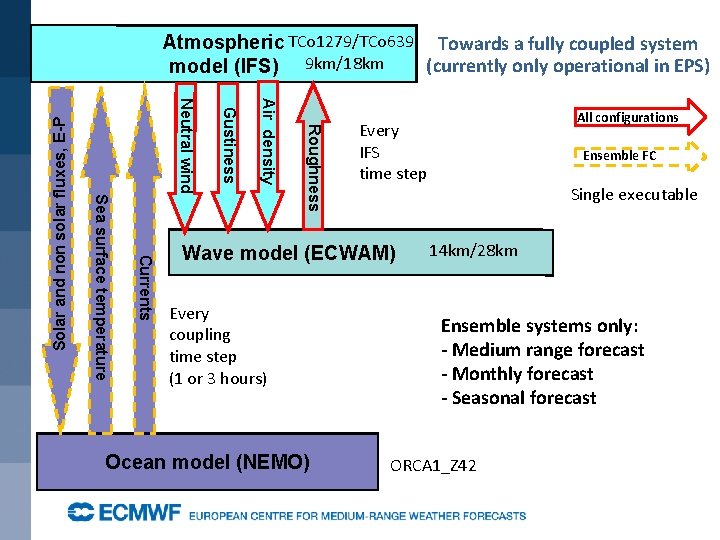
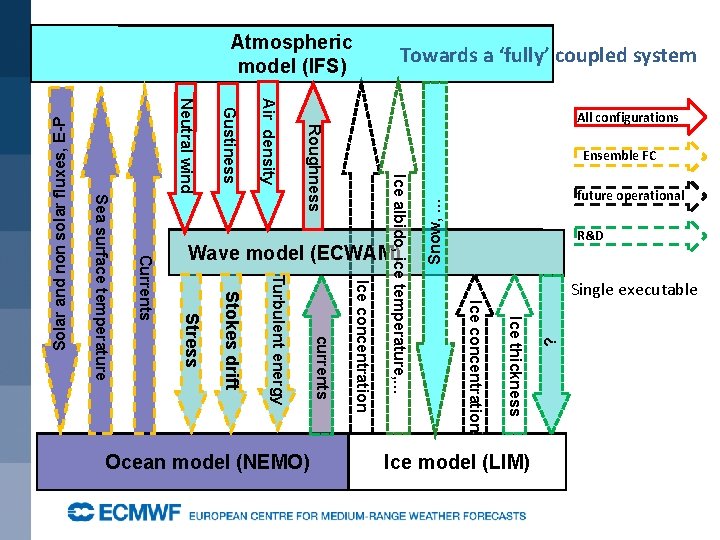
Roughness Air density Gustiness Neutral wind Currents Sea surface temperature Solar and non solar fluxes, E-P Atmospheric TCo 1279/TCo 639 Towards a fully coupled system (currently only operational in EPS) model (IFS) 9 km/18 km Wave model (ECWAM) Every coupling time step (1 or 3 hours) Ocean model (NEMO) All configurations Every IFS time step Ensemble FC Single executable 14 km/28 km Ensemble systems only: - Medium range forecast - Monthly forecast - Seasonal forecast ORCA 1_Z 42
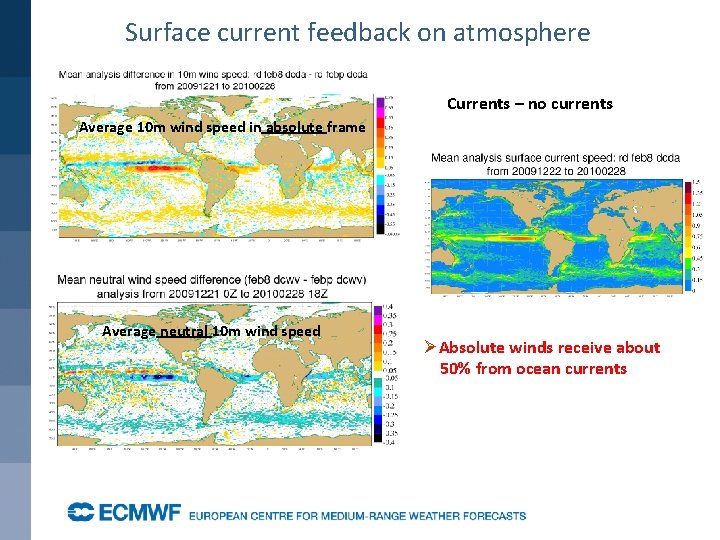
Surface current feedback on atmosphere Currents – no currents Average 10 m wind speed in absolute frame Average neutral 10 m wind speed ØAbsolute winds receive about 50% from ocean currents
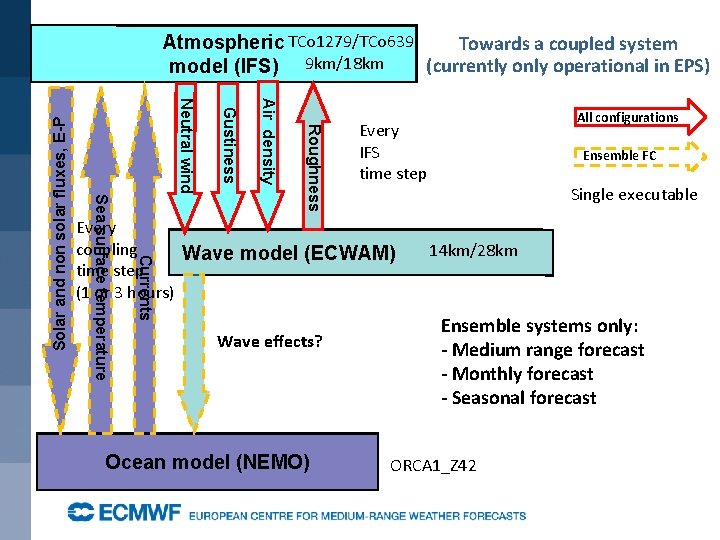
Roughness Air density Gustiness Neutral wind Sea surface temperature Wave effects? Ocean model (NEMO) All configurations Every IFS time step Every coupling Wave model (ECWAM) time step (1 or 3 hours) Currents Solar and non solar fluxes, E-P Atmospheric TCo 1279/TCo 639 Towards a coupled system (currently only operational in EPS) model (IFS) 9 km/18 km Ensemble FC Single executable 14 km/28 km Ensemble systems only: - Medium range forecast - Monthly forecast - Seasonal forecast ORCA 1_Z 42
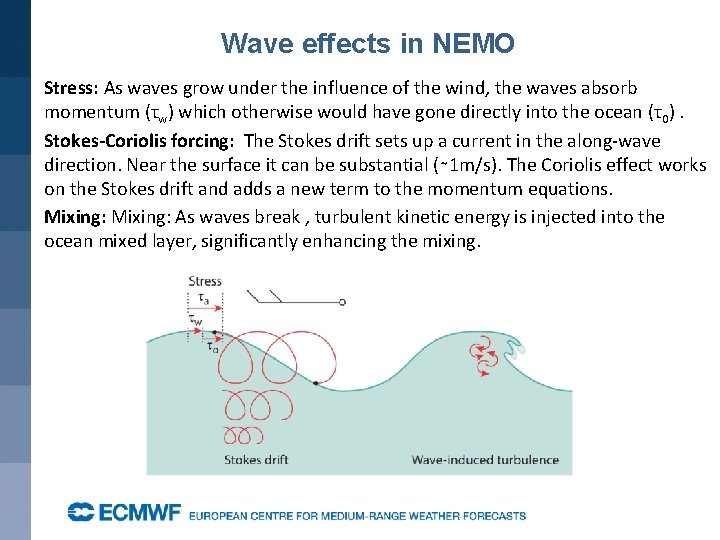
Wave effects in NEMO Stress: As waves grow under the influence of the wind, the waves absorb momentum (τw) which otherwise would have gone directly into the ocean (τ0). Stokes-Coriolis forcing: The Stokes drift sets up a current in the along-wave direction. Near the surface it can be substantial (∼ 1 m/s). The Coriolis effect works on the Stokes drift and adds a new term to the momentum equations. Mixing: As waves break , turbulent kinetic energy is injected into the ocean mixed layer, significantly enhancing the mixing.
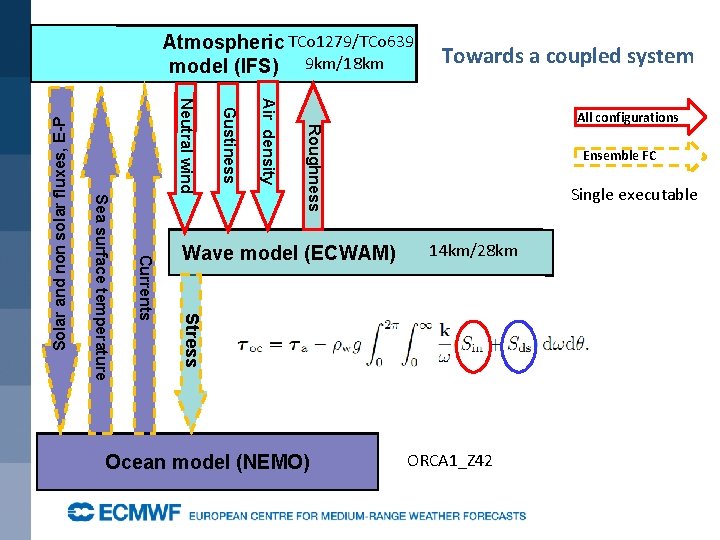
Towards a coupled system All configurations Roughness Air density Gustiness Neutral wind Wave model (ECWAM) Ensemble FC Single executable 14 km/28 km Stress Currents Sea surface temperature Solar and non solar fluxes, E-P Atmospheric TCo 1279/TCo 639 model (IFS) 9 km/18 km Ocean model (NEMO) ORCA 1_Z 42
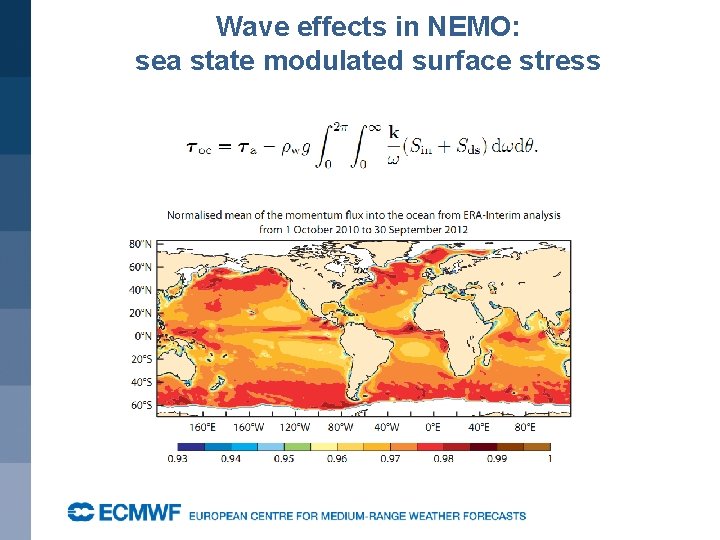
Wave effects in NEMO: sea state modulated surface stress
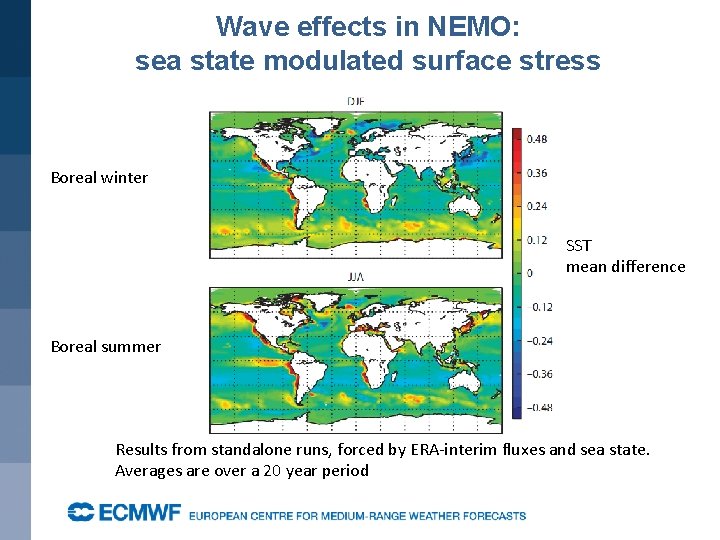
Wave effects in NEMO: sea state modulated surface stress Boreal winter SST mean difference Boreal summer Results from standalone runs, forced by ERA-interim fluxes and sea state. Averages are over a 20 year period
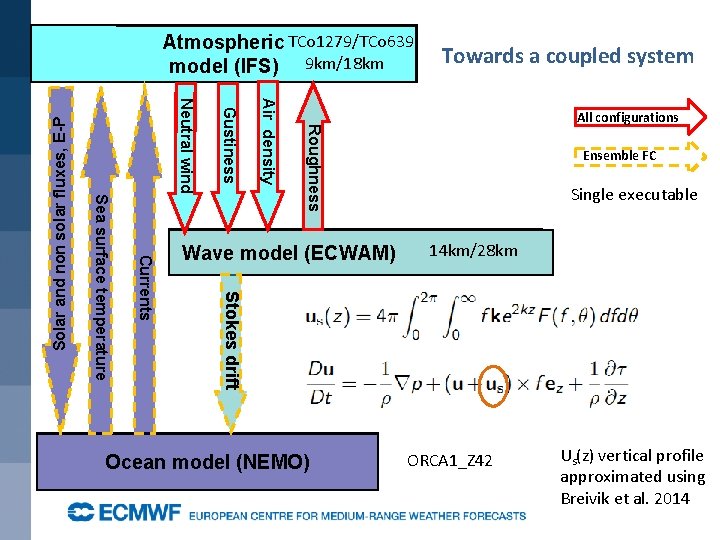
Towards a coupled system All configurations Roughness Air density Gustiness Neutral wind Wave model (ECWAM) Ensemble FC Single executable 14 km/28 km Stokes drift Currents Sea surface temperature Solar and non solar fluxes, E-P Atmospheric TCo 1279/TCo 639 model (IFS) 9 km/18 km Ocean model (NEMO) ORCA 1_Z 42 Us(z) vertical profile approximated using Breivik et al. 2014
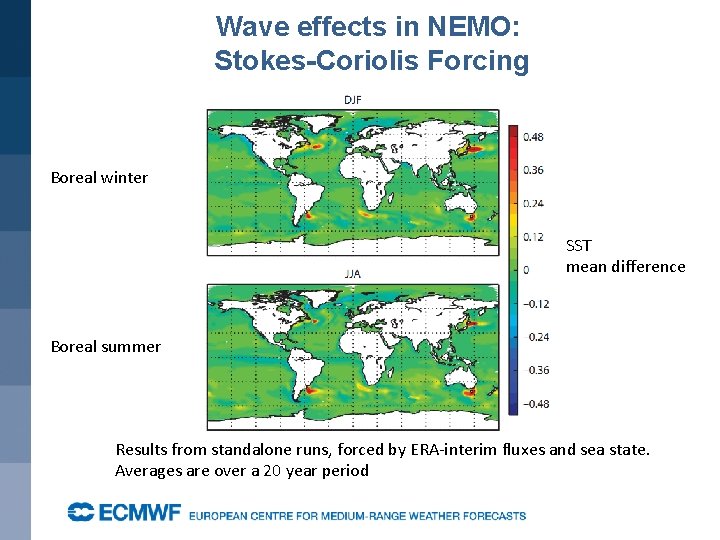
Wave effects in NEMO: Stokes-Coriolis Forcing Boreal winter SST mean difference Boreal summer Results from standalone runs, forced by ERA-interim fluxes and sea state. Averages are over a 20 year period
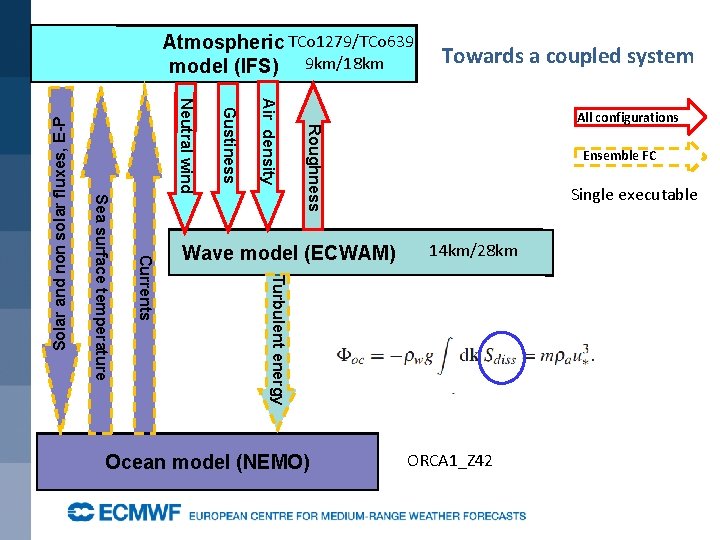
Towards a coupled system All configurations Roughness Air density Gustiness Neutral wind Wave model (ECWAM) Ensemble FC Single executable 14 km/28 km Turbulent energy Currents Sea surface temperature Solar and non solar fluxes, E-P Atmospheric TCo 1279/TCo 639 model (IFS) 9 km/18 km Ocean model (NEMO) ORCA 1_Z 42
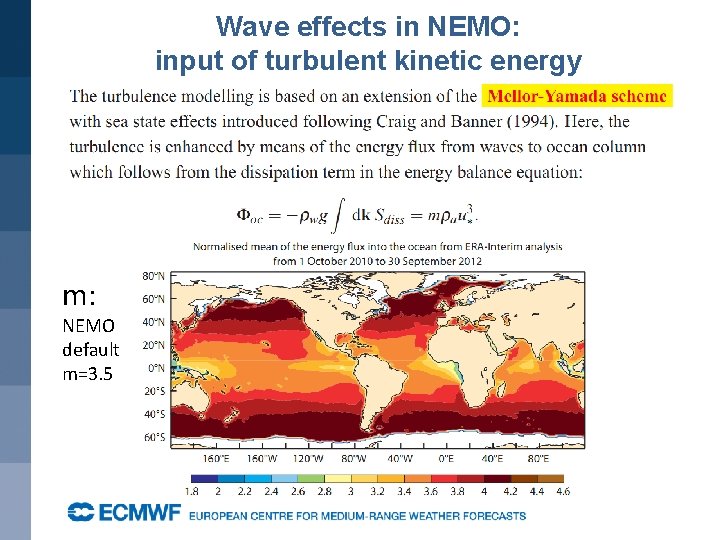
Wave effects in NEMO: input of turbulent kinetic energy m: NEMO default m=3. 5
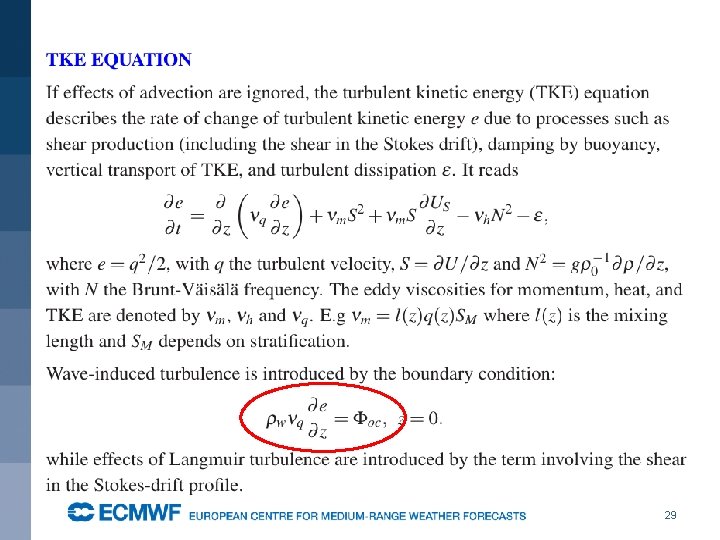
29
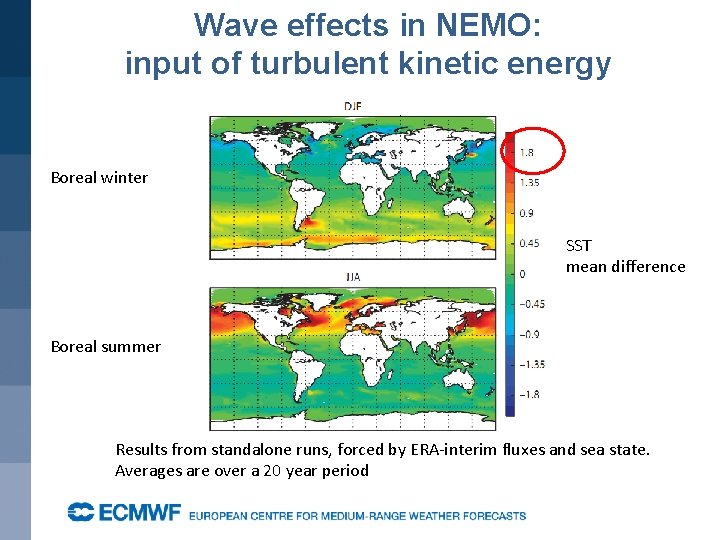
Wave effects in NEMO: input of turbulent kinetic energy Boreal winter SST mean difference Boreal summer Results from standalone runs, forced by ERA-interim fluxes and sea state. Averages are over a 20 year period
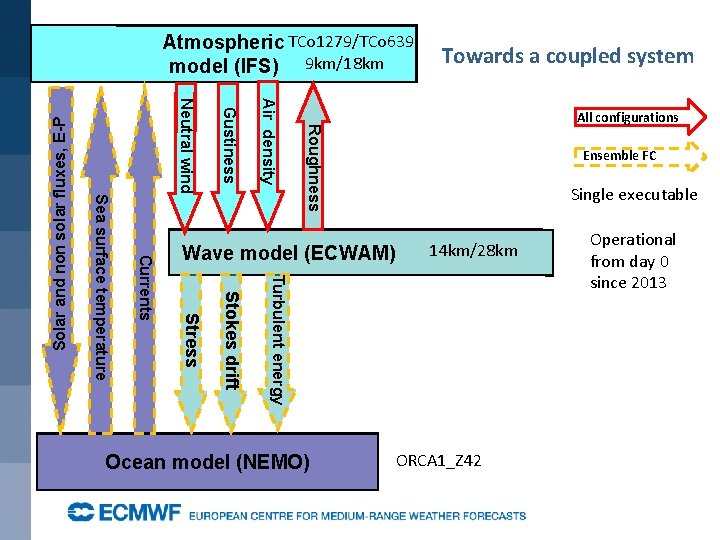
Towards a coupled system All configurations Roughness Air density Gustiness Neutral wind Wave model (ECWAM) Ensemble FC Single executable 14 km/28 km Turbulent energy Stokes drift Stress Currents Sea surface temperature Solar and non solar fluxes, E-P Atmospheric TCo 1279/TCo 639 model (IFS) 9 km/18 km Ocean model (NEMO) ORCA 1_Z 42 Operational from day 0 since 2013
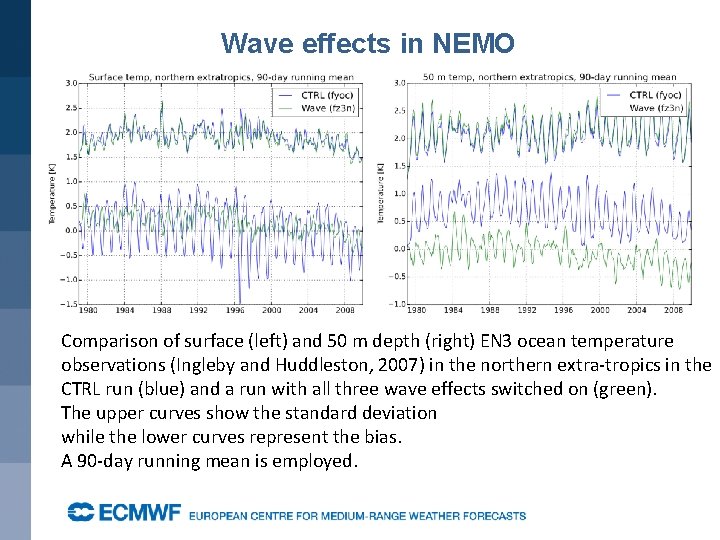
Wave effects in NEMO Comparison of surface (left) and 50 m depth (right) EN 3 ocean temperature observations (Ingleby and Huddleston, 2007) in the northern extra-tropics in the CTRL run (blue) and a run with all three wave effects switched on (green). The upper curves show the standard deviation while the lower curves represent the bias. A 90 -day running mean is employed.
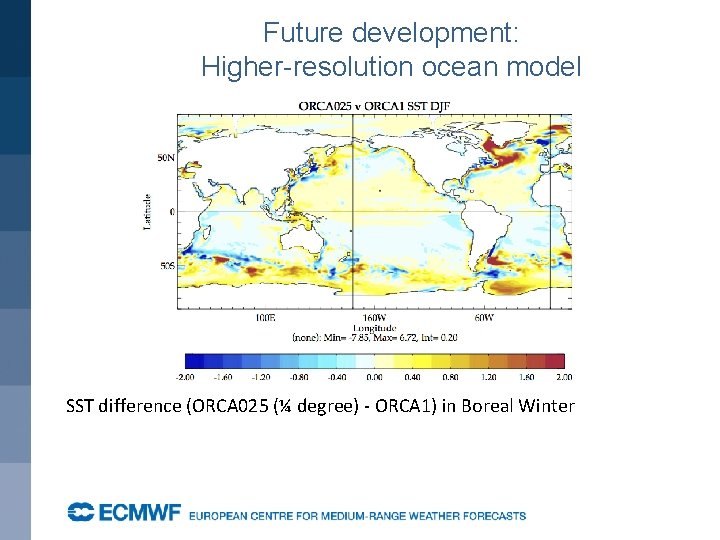
Future development: Higher-resolution ocean model SST difference (ORCA 025 (¼ degree) - ORCA 1) in Boreal Winter
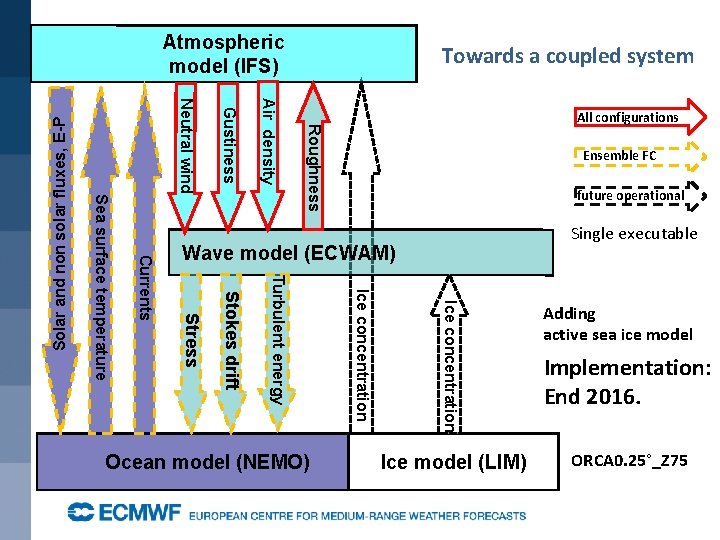
Towards a coupled system All configurations Roughness Air density Gustiness Neutral wind Ensemble FC future operational Single executable Wave model (ECWAM) Ice concentration Ocean model (NEMO) Ice concentration Turbulent energy Stokes drift Stress Currents Sea surface temperature Solar and non solar fluxes, E-P Atmospheric model (IFS) Ice model (LIM) Adding active sea ice model Implementation: End 2016. ORCA 0. 25°_Z 75
End of part 1:
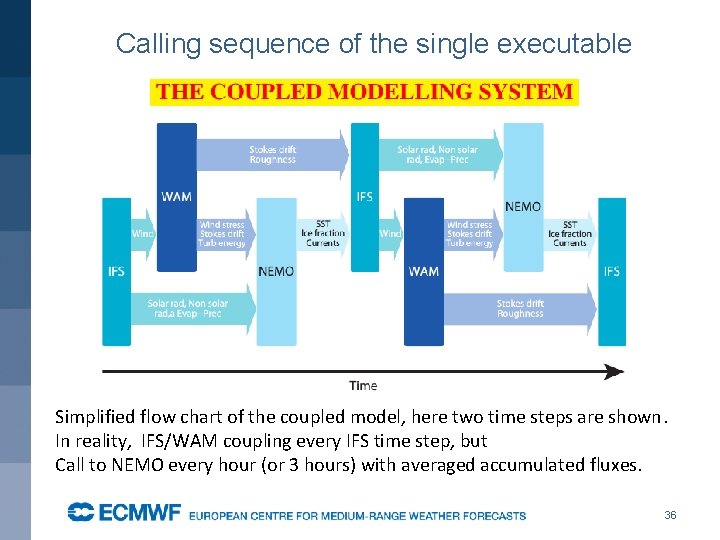
Calling sequence of the single executable Simplified flow chart of the coupled model, here two time steps are shown. In reality, IFS/WAM coupling every IFS time step, but Call to NEMO every hour (or 3 hours) with averaged accumulated fluxes. 36
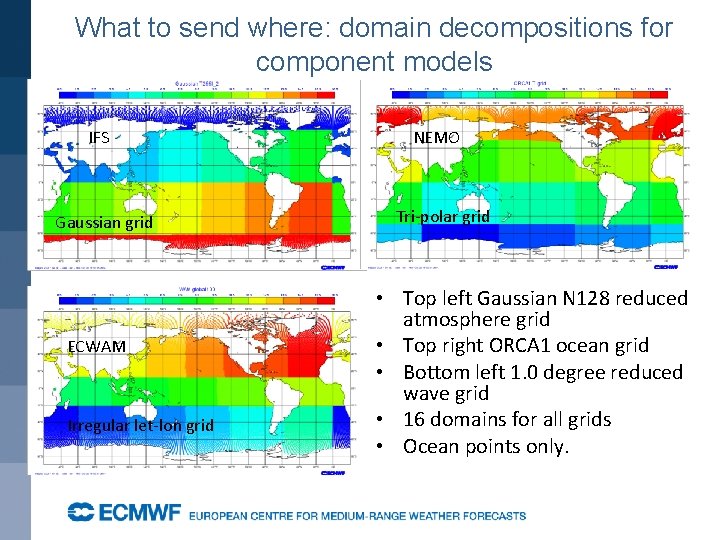
What to send where: domain decompositions for component models IFS Gaussian grid ECWAM Irregular let-lon grid NEMO Tri-polar grid • Top left Gaussian N 128 reduced atmosphere grid • Top right ORCA 1 ocean grid • Bottom left 1. 0 degree reduced wave grid • 16 domains for all grids • Ocean points only.
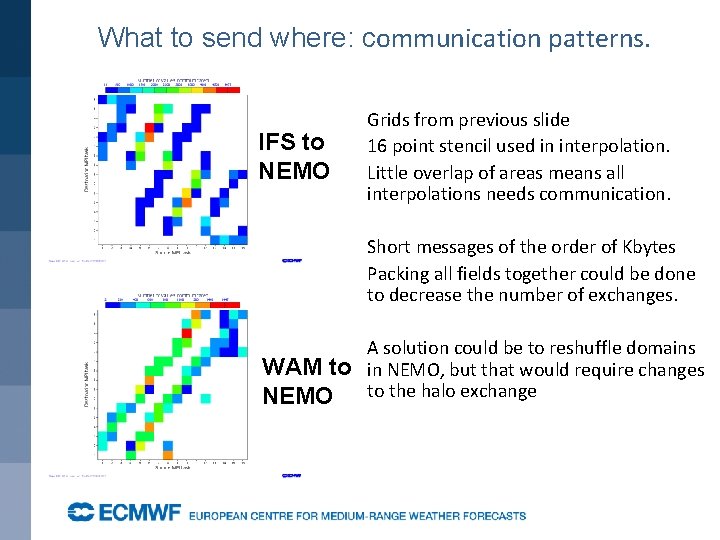
What to send where: communication patterns. IFS to NEMO Grids from previous slide 16 point stencil used in interpolation. Little overlap of areas means all interpolations needs communication. Short messages of the order of Kbytes Packing all fields together could be done to decrease the number of exchanges. WAM to NEMO A solution could be to reshuffle domains in NEMO, but that would require changes to the halo exchange
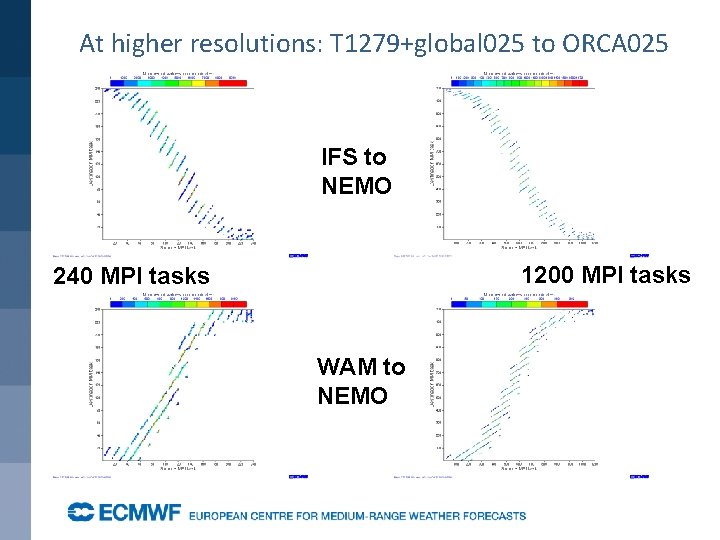
At higher resolutions: T 1279+global 025 to ORCA 025 IFS to NEMO 1200 MPI tasks 240 MPI tasks WAM to NEMO
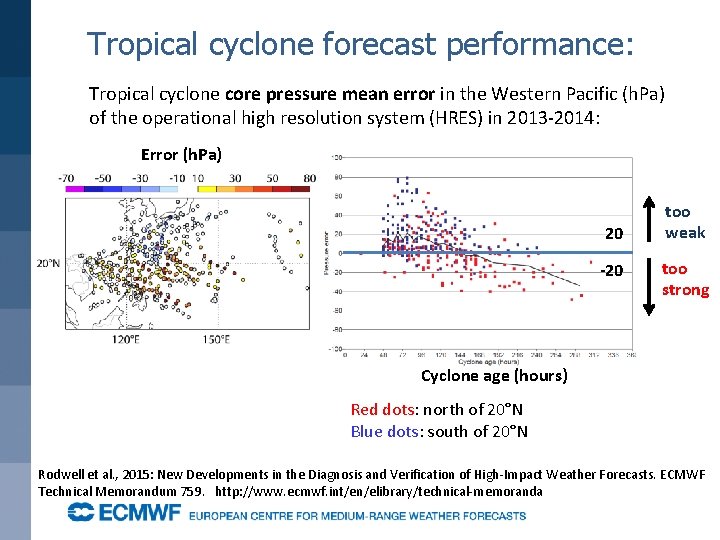
Tropical cyclone forecast performance: Tropical cyclone core pressure mean error in the Western Pacific (h. Pa) of the operational high resolution system (HRES) in 2013 -2014: Error (h. Pa) 20 -20 too weak too strong Cyclone age (hours) Red dots: north of 20°N Blue dots: south of 20°N Rodwell et al. , 2015: New Developments in the Diagnosis and Verification of High-Impact Weather Forecasts. ECMWF Technical Memorandum 759. http: //www. ecmwf. int/en/elibrary/technical-memoranda
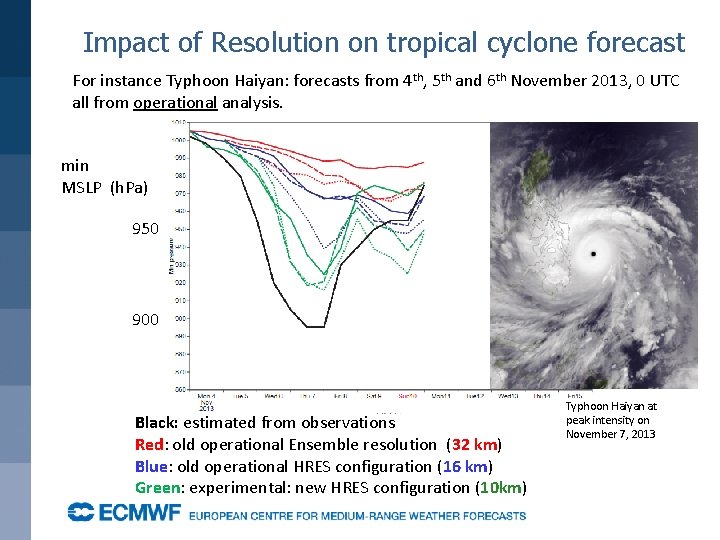
Impact of Resolution on tropical cyclone forecast For instance Typhoon Haiyan: forecasts from 4 th, 5 th and 6 th November 2013, 0 UTC all from operational analysis. min MSLP (h. Pa) 950 900 Black: estimated from observations Red: old operational Ensemble resolution (32 km) Blue: old operational HRES configuration (16 km) Green: experimental: new HRES configuration (10 km) Typhoon Haiyan at peak intensity on November 7, 2013
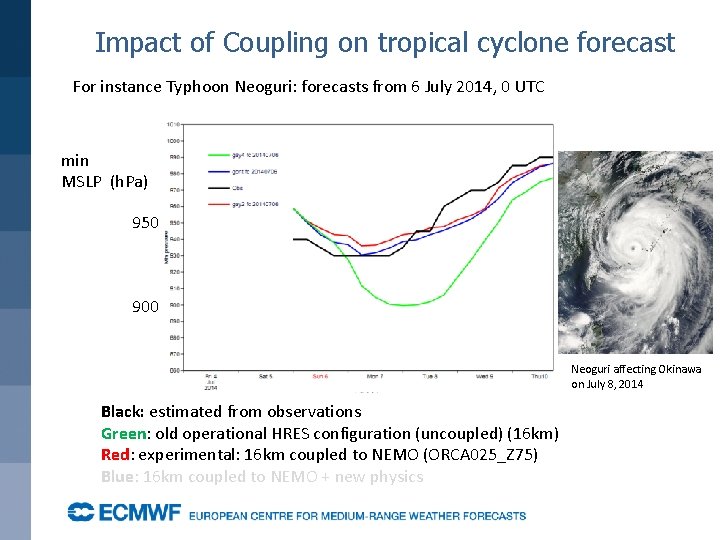
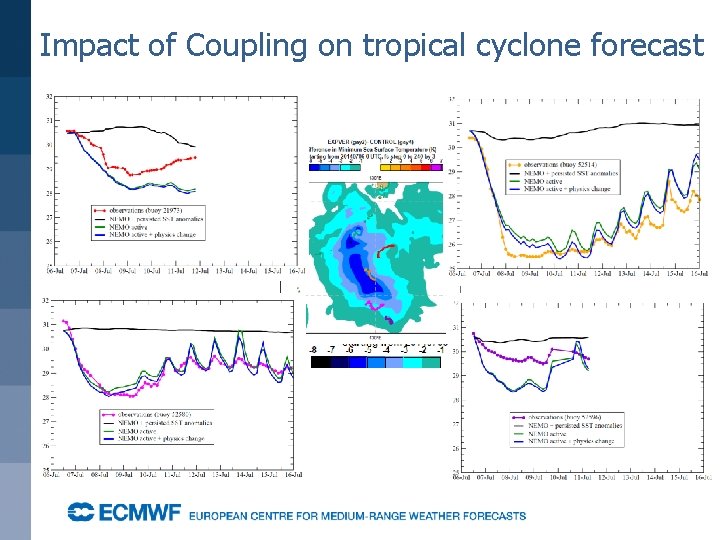
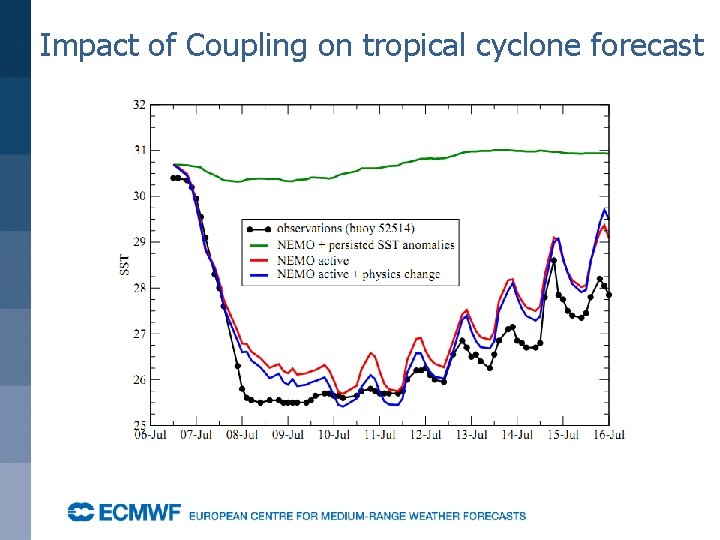
Impact of Coupling on tropical cyclone forecast For instance Typhoon Neoguri: forecasts from 6 July 2014, 0 UTC min MSLP (h. Pa) 950 900 Neoguri affecting Okinawa on July 8, 2014 Black: estimated from observations Green: old operational HRES configuration (uncoupled) (16 km) Red: experimental: 16 km coupled to NEMO (ORCA 025_Z 75) Blue: 16 km coupled to NEMO + new physics
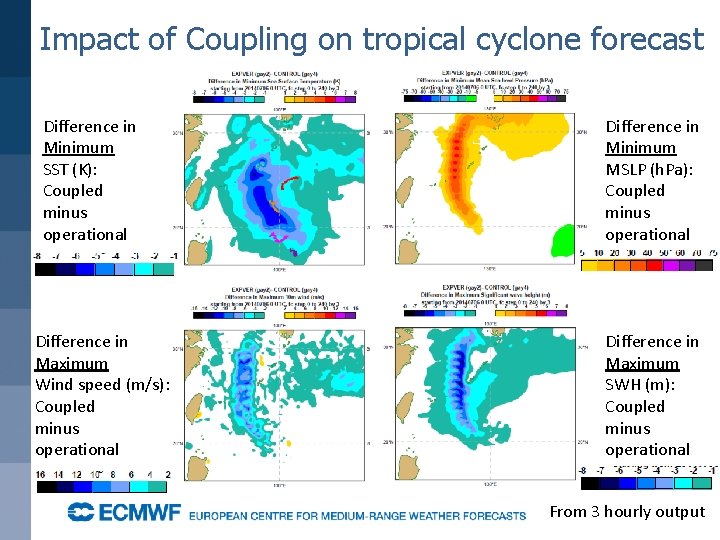
Impact of Coupling on tropical cyclone forecast Difference in Minimum SST (K): Coupled minus operational Difference in Maximum Wind speed (m/s): Coupled minus operational Difference in Minimum MSLP (h. Pa): Coupled minus operational Difference in Maximum SWH (m): Coupled minus operational From 3 hourly output
Impact of Coupling on tropical cyclone forecast
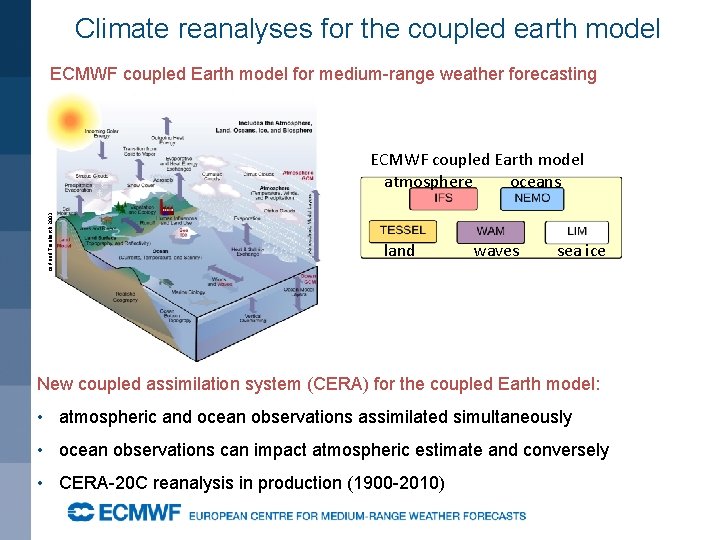
Climate reanalyses for the coupled earth model ECMWF coupled Earth model for medium-range weather forecasting Karl and Trenberth 2003 ECMWF coupled Earth model oceans atmosphere land waves sea ice New coupled assimilation system (CERA) for the coupled Earth model: • atmospheric and ocean observations assimilated simultaneously • ocean observations can impact atmospheric estimate and conversely • CERA-20 C reanalysis in production (1900 -2010)
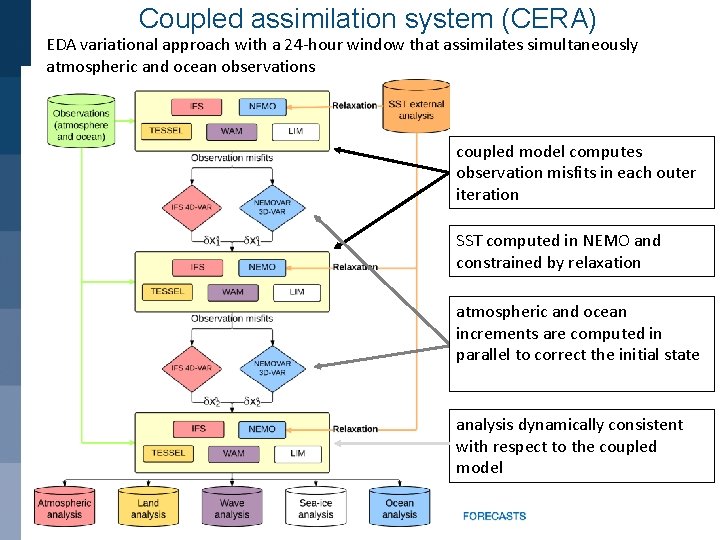
Coupled assimilation system (CERA) EDA variational approach with a 24 -hour window that assimilates simultaneously atmospheric and ocean observations coupled model computes observation misfits in each outer iteration SST computed in NEMO and constrained by relaxation atmospheric and ocean increments are computed in parallel to correct the initial state analysis dynamically consistent with respect to the coupled model
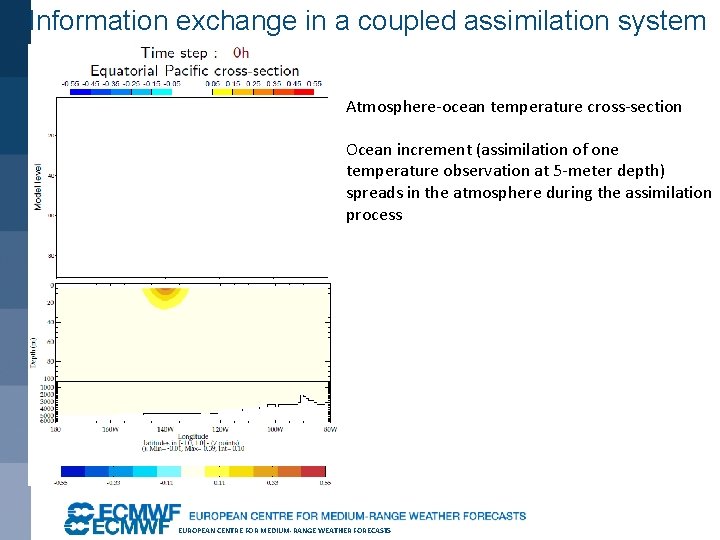
Information exchange in a coupled assimilation system Atmosphere-ocean temperature cross-section Ocean increment (assimilation of one temperature observation at 5 -meter depth) spreads in the atmosphere during the assimilation process October 29, 2014 EUROPEAN CENTRE FOR MEDIUM-RANGE WEATHER FORECASTS
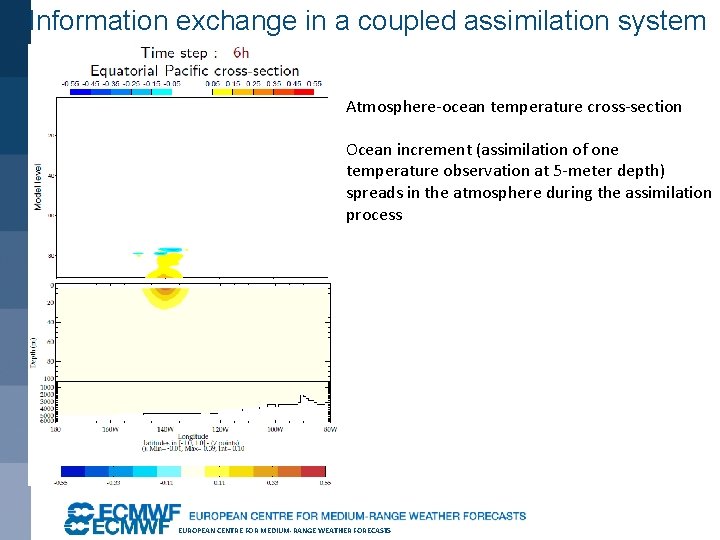
Information exchange in a coupled assimilation system Atmosphere-ocean temperature cross-section Ocean increment (assimilation of one temperature observation at 5 -meter depth) spreads in the atmosphere during the assimilation process October 29, 2014 EUROPEAN CENTRE FOR MEDIUM-RANGE WEATHER FORECASTS
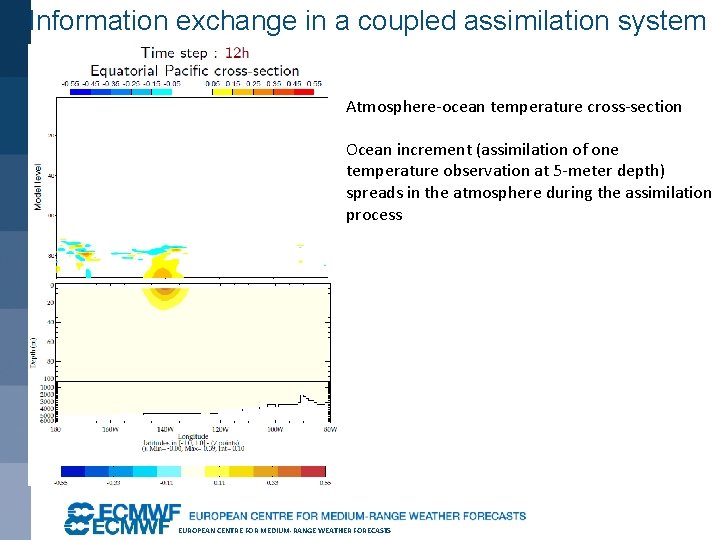
Information exchange in a coupled assimilation system Atmosphere-ocean temperature cross-section Ocean increment (assimilation of one temperature observation at 5 -meter depth) spreads in the atmosphere during the assimilation process October 29, 2014 EUROPEAN CENTRE FOR MEDIUM-RANGE WEATHER FORECASTS
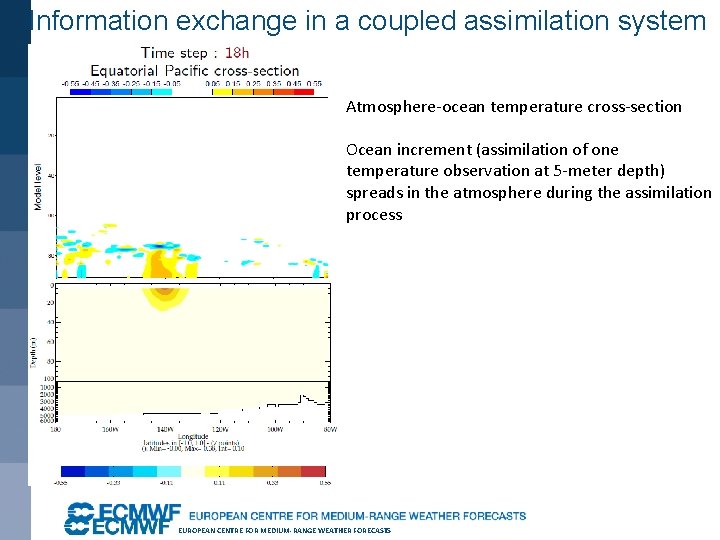
Information exchange in a coupled assimilation system Atmosphere-ocean temperature cross-section Ocean increment (assimilation of one temperature observation at 5 -meter depth) spreads in the atmosphere during the assimilation process October 29, 2014 EUROPEAN CENTRE FOR MEDIUM-RANGE WEATHER FORECASTS
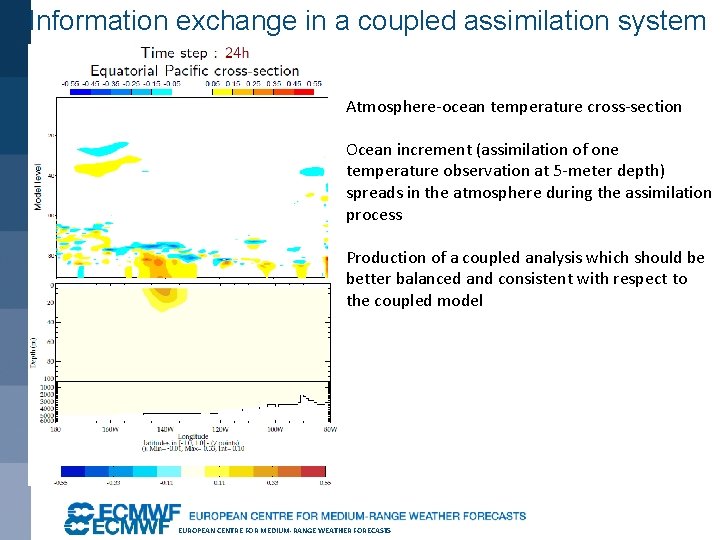
Information exchange in a coupled assimilation system Atmosphere-ocean temperature cross-section Ocean increment (assimilation of one temperature observation at 5 -meter depth) spreads in the atmosphere during the assimilation process Production of a coupled analysis which should be better balanced and consistent with respect to the coupled model October 29, 2014 EUROPEAN CENTRE FOR MEDIUM-RANGE WEATHER FORECASTS
Single executable All configurations Ensemble FC Ice concentration currents Turbulent energy Stokes drift Stress Currents Wave model (ECWAM) Solar and non solar fluxes, E-P Neutral wind Gustiness Air density Roughness Ice albido, ice temperature, … Ice concentration Ice thickness ? R&D Snow, … future operational Sea surface temperature Ice model (LIM) Ocean model (NEMO) Towards a ‘fully’ coupled system Atmospheric model (IFS)
Conclusions: • ECMWF has a coupled atmosphere-wave-ocean circulation forecasting system, currently operational in the Ensemble Prediction System. • Work is ongoing on using a higher resolution ocean components (ORCA 025 z 75) planned for end of 2016 in the Ensemble forecasts and later in the High resolution system. • There is a clear benefit in coupling the different models, but it creates new challenges in determining what physical parameters need to be exchanged. • Furthermore, model parameterisations might need revisiting.
Thank you for your attention … ECMWF annual Seminar, 5 -8 September 2016, Reading. UK : Earth system modelling for seamless prediction: on which processes should we focus to further improve Atmospheric predictive skill? Øyvind Breivik, Kristian Mogensen, Jean-Raymond Bidlot, Magdalena Alonso Balmaseda, and Peter A. E. M. Janssen, 2015: Surface Wave Effects in the NEMO Ocean Model: Forced and Coupled Experiments. JGR, doi: 10. 1002/2014 JC 010565 Janssen, P. A. E. M. , 1997: Effect of surface gravity waves on the heat flux. ECMWF Technical Memorandum 239. http: //www. ecmwf. int/en/elibrary/technical-memoranda Rodwell et al. , 2015: New Developments in the Diagnosis and Verification of High-Impact Weather Forecasts. ECMWF Technical Memorandum 759. http: //www. ecmwf. int/en/elibrary/technical-memoranda
Impact of Coupling: revisit parameterisations? x 10 -3 Cd Exchange coefficients dependency on wind speed Left: for momentum (Cd) 6 3 10 55 Cd is sea state dependent Edson et al. , 2013 Holthuijsen et al. , 2012
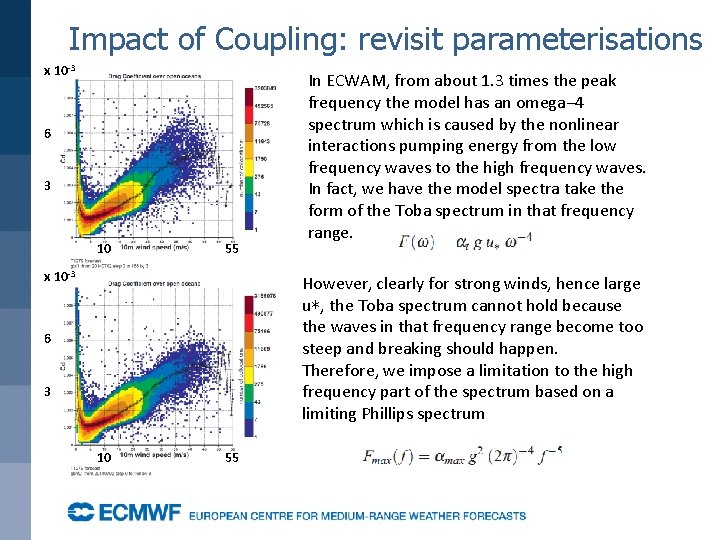
Impact of Coupling: revisit parameterisations x 10 -3 6 3 10 55 x 10 -3 In ECWAM, from about 1. 3 times the peak frequency the model has an omega− 4 spectrum which is caused by the nonlinear interactions pumping energy from the low frequency waves to the high frequency waves. In fact, we have the model spectra take the form of the Toba spectrum in that frequency range. However, clearly for strong winds, hence large u∗, the Toba spectrum cannot hold because the waves in that frequency range become too steep and breaking should happen. Therefore, we impose a limitation to the high frequency part of the spectrum based on a limiting Phillips spectrum 6 3 10 55
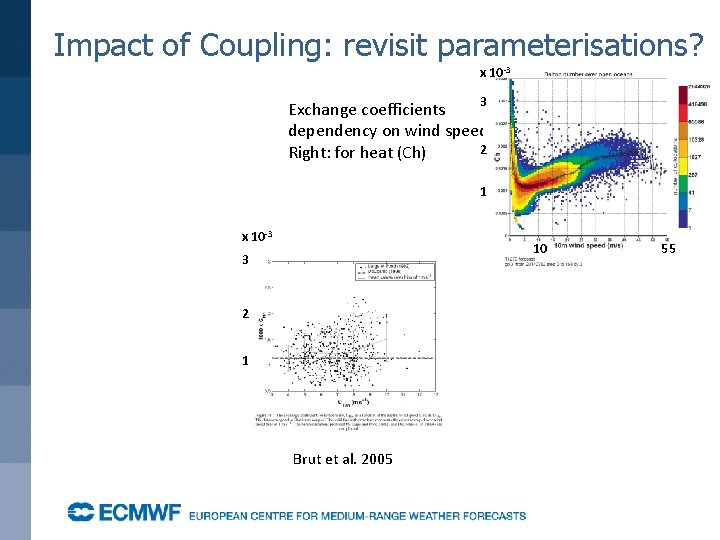
Impact of Coupling: revisit parameterisations? x 10 -3 Ch 3 Exchange coefficients dependency on wind speed 2 Right: for heat (Ch) 1 x 10 -3 10 3 2 1 Brut et al. 2005 55
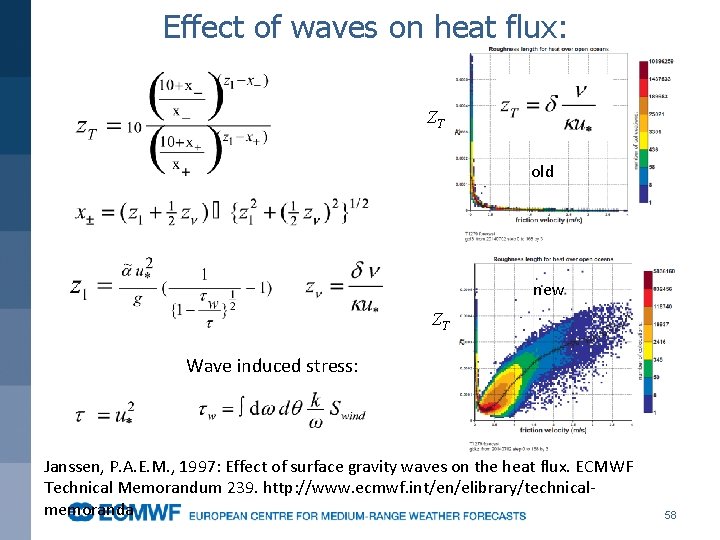
Effect of waves on heat flux: ZT old new ZT Wave induced stress: Janssen, P. A. E. M. , 1997: Effect of surface gravity waves on the heat flux. ECMWF Technical Memorandum 239. http: //www. ecmwf. int/en/elibrary/technicalmemoranda 58
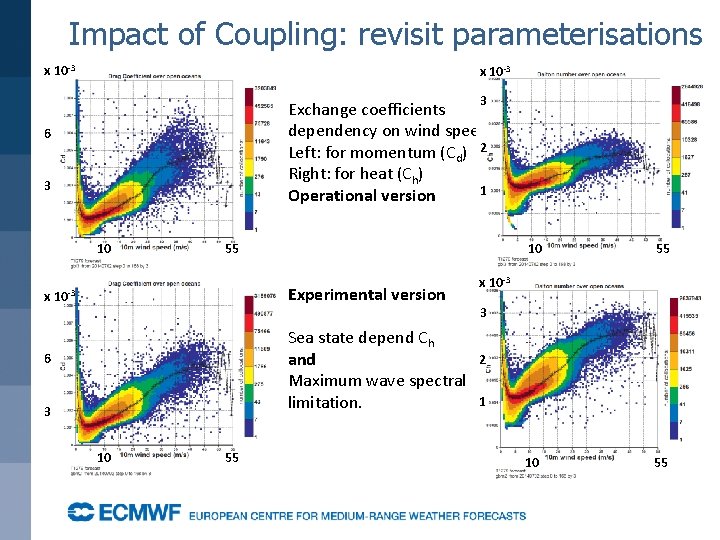
Impact of Coupling: revisit parameterisations x 10 -3 3 Exchange coefficients dependency on wind speed Left: for momentum (Cd) 2 Right: for heat (Ch) 1 Operational version 6 3 10 55 Experimental version x 10 -3 Sea state depend Ch and Maximum wave spectral limitation. 6 3 10 55 x 10 -3 3 2 1
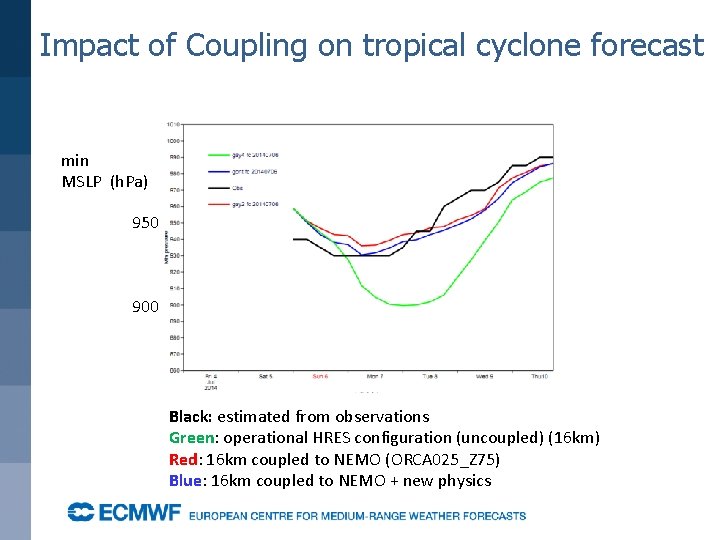
Impact of Coupling on tropical cyclone forecast min MSLP (h. Pa) 950 900 Black: estimated from observations Green: operational HRES configuration (uncoupled) (16 km) Red: 16 km coupled to NEMO (ORCA 025_Z 75) Blue: 16 km coupled to NEMO + new physics
Impact of Coupling on tropical cyclone forecast
- Slides: 61