
Towards an ASEAN Comprehensive School Safety Framework Outcome


- Slides: 16
Towards an ASEAN Comprehensive School Safety Framework Outcome of Country Consultations and Background Work
Technical Assistance to the ASEAN Safe School Initiative Phase 2
Technical Assistance to the ASSI Phase 2 To contribute to the achievement of the objectives of ASSI Phase 2 – Outcome 1, UNISDR in consultation with ASec and ASSI partners, engaged the Asian Disaster Preparedness Center (ADPC) to provide technical assistance for: a. building a consensus to assist in the development and adoption of an ASEAN common framework for safe schools, and b. development of a set of indicators to measure progress in building safe schools in the region. While ADPC implemented the background review and country consultations, UNISDR provided overall management of the assignment. The ASEC, APG and the ASSI partners provided technical inputs and coordination in the countries.
TA Objectives and Deliverables • Deliverable 1. Compendium of existing national policies, guidelines, standards and indicators on Safe School (taking the AADMER Work Programme and the Comprehensive School Safety Framework as reference) • Deliverable 2. Introduce the Comprehensive School Safety Framework and consult with ASEAN Member States and Stakeholders on its adoption and/or adaption to serve as ASEAN common framework for safe schools • Deliverable 3. Draft set of indicators to monitor the implementation of school safety in the ASEAN region ready for review by Ministry of Education, NDMOs and other relevant stakeholders in the ASEAN.
Deliverable 1: Development of a compendium • Gathered and reviewed about 60 existing national policies, guidelines, frameworks, practices and other initiatives on school safety (2004 -present) in the ten (10) ASEAN Member States • The compendium includes: (1) description or summary of the material, and (2) brief discussion on the relevance or significance of the material on the three pillars of the CSS and how it contributes in the enhancement of school safety in the country or region. • Compendium is a live document, data collection and analysis is continuous • Additional data gathering will be conducted for Singapore, Malaysia and Brunei Darussalam
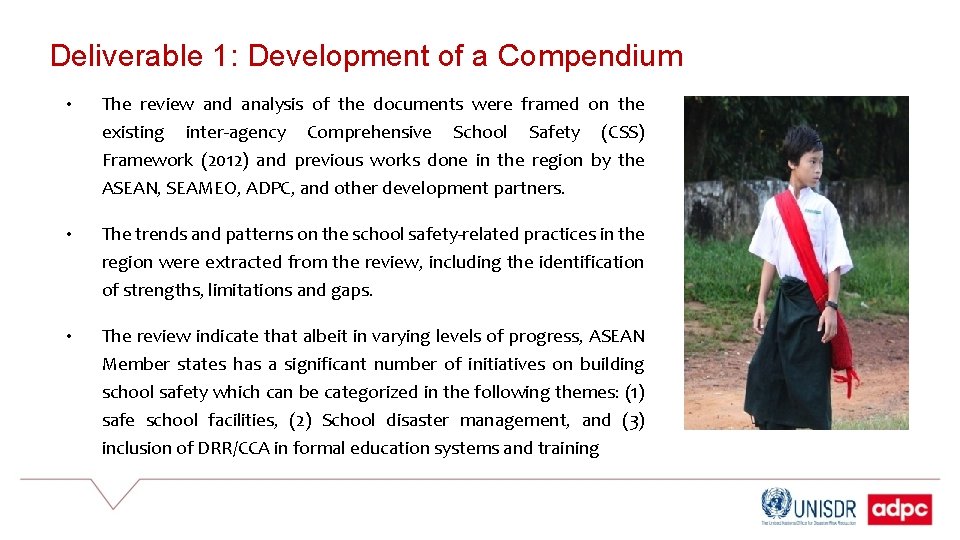
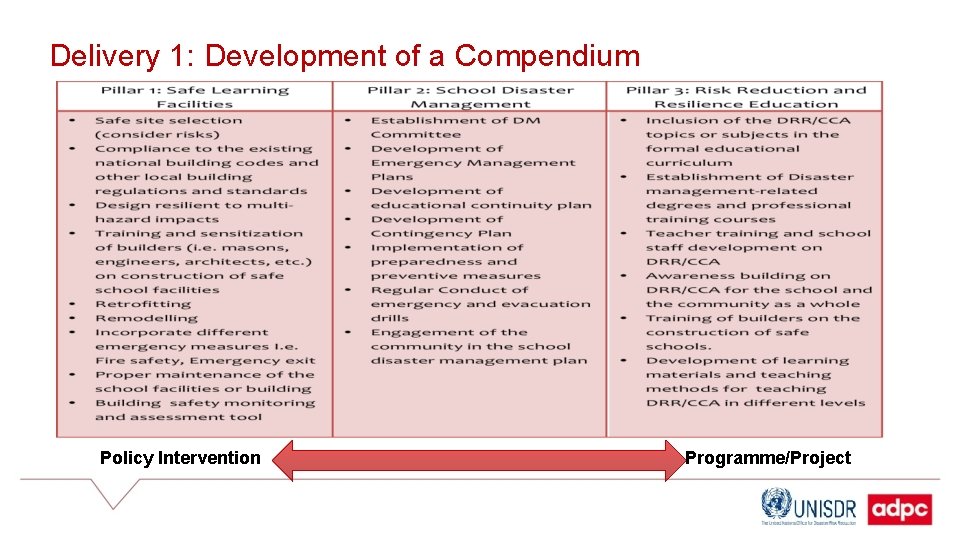
Deliverable 1: Development of a Compendium • The review and analysis of the documents were framed on the existing inter-agency Comprehensive School Safety (CSS) Framework (2012) and previous works done in the region by the ASEAN, SEAMEO, ADPC, and other development partners. • The trends and patterns on the school safety-related practices in the region were extracted from the review, including the identification of strengths, limitations and gaps. • The review indicate that albeit in varying levels of progress, ASEAN Member states has a significant number of initiatives on building school safety which can be categorized in the following themes: (1) safe school facilities, (2) School disaster management, and (3) inclusion of DRR/CCA in formal education systems and training
Delivery 1: Development of a Compendium Policy Intervention Programme/Project
Deliverable 2: Recommendations for consideration in setting up a common framework for Safe School in SEA • Ensure the institutionalization of DRR/CCA in the education sector for each ASEAN Member States • Strengthen legislation and policies related to building school safety • Encourage documentation of school safety practices and sharing of experiences among the nations • Identify framework goals and objectives that can be generally aligned to national priorities and strategies as well as to international/global interventions (i. e. Hyogo Framework for Action on DRR, Millennium Development Goals 2015, etc. )
Deliverable 3: Development of Indicators for measuring progress on SS • Initial set of indicators to monitor the progress of ASEAN countries on school safety was developed through previous discussions with partners and literature review • Consultation meetings were organized to present the initial set of indicators in three ASEAN countries – Indonesia, Thailand, Cambodia, Viet Nam, and Lao PDR (January to July 2014) • Key stakeholders in the education sector in each of the countries including the Ministry of Education, local and international organizations, as well as the APG members, the ASEAN Secretariat, UNISDR and other UN agencies doing related work on the education sector (i. e. UNICEF, UNESCO, UN-OCHA etc. )
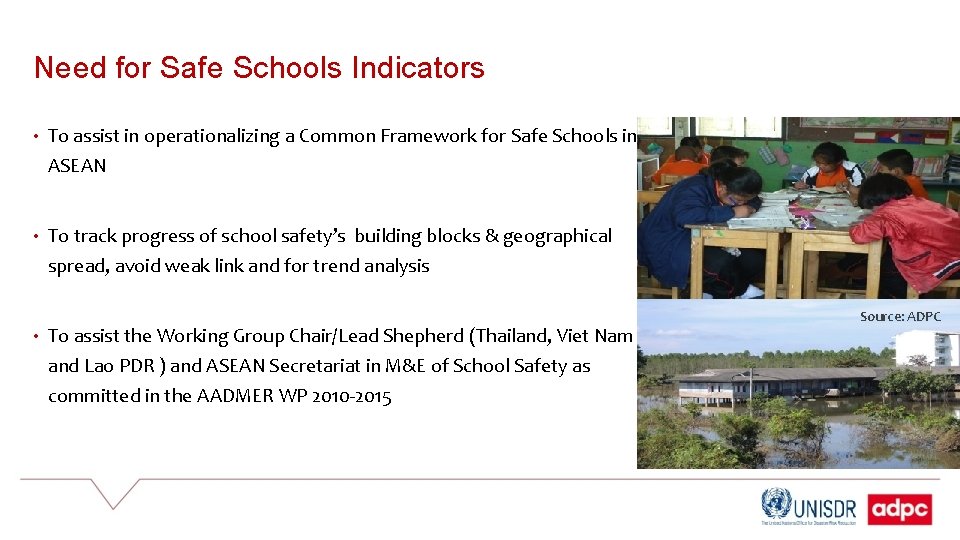
Need for Safe Schools Indicators • To assist in operationalizing a Common Framework for Safe Schools in ASEAN • To track progress of school safety’s building blocks & geographical spread, avoid weak link and for trend analysis • To assist the Working Group Chair/Lead Shepherd (Thailand, Viet Nam and Lao PDR ) and ASEAN Secretariat in M&E of School Safety as committed in the AADMER WP 2010 -2015 AFP News Source: ADPC
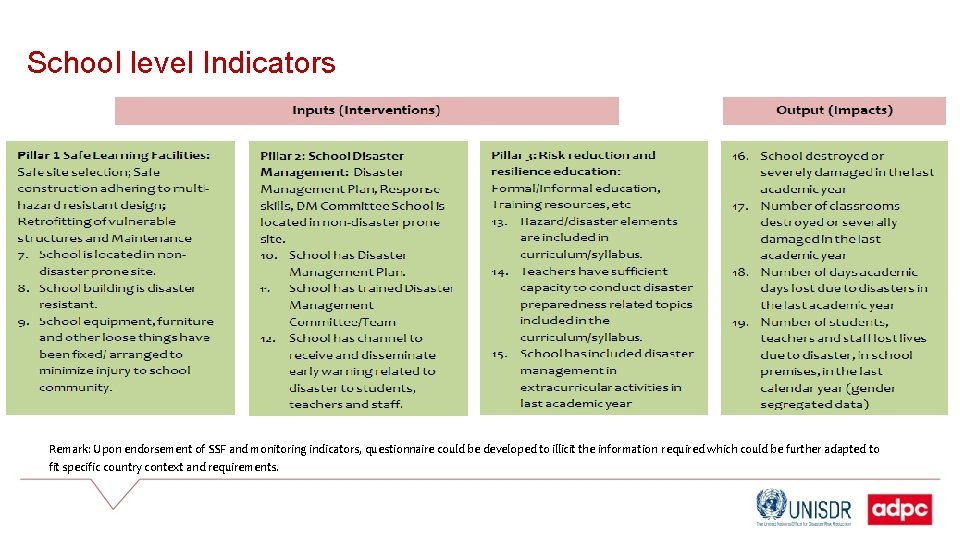
Proposed indicator for monitoring School Safety implementation • Indicators to track progress of the school safety are at two phases, namely • Impact/Outcome phase, and • Activity/Input phase • Uses following principle/approach: • SMART (Specific, Measurable, Attainable, Relevant and Time bound) • Tracks progress of the implementation of all key building blocks of school safety (input) as well as outcome/impact • It engages stakeholders at both levels: National and sub-national level and School level • Flexible AFP News
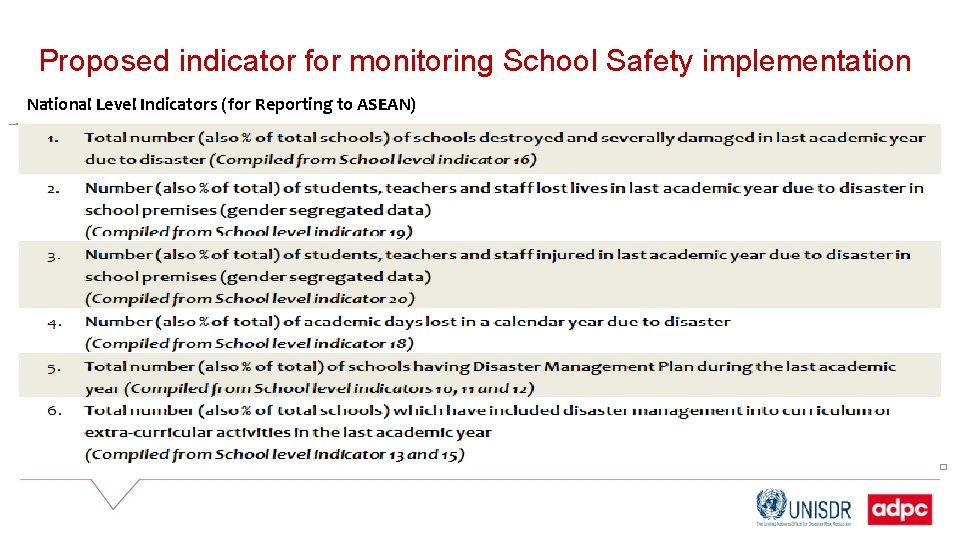
Proposed indicator for monitoring School Safety implementation To track national and ASEAN region progress towards achieving the goals of a comprehensive school safety • To protect learners and education workers from death, injury, nd harm in schools (indicators 2 & 3) • To plan for educational continuity in the face of expected hazards (indicator 4 & 5) • To safeguard education sector investments (Indicator 1) • To strengthen climate-smart disaster resilience through education (Indicator 6) AFP News
Proposed indicator for monitoring School Safety implementation National Level Indicators (for Reporting to ASEAN) AFP News
School level Indicators Remark: Upon endorsement of SSF and monitoring indicators, questionnaire could be developed to illicit the information required which could be further adapted to fit specific country context and requirements. AFP News
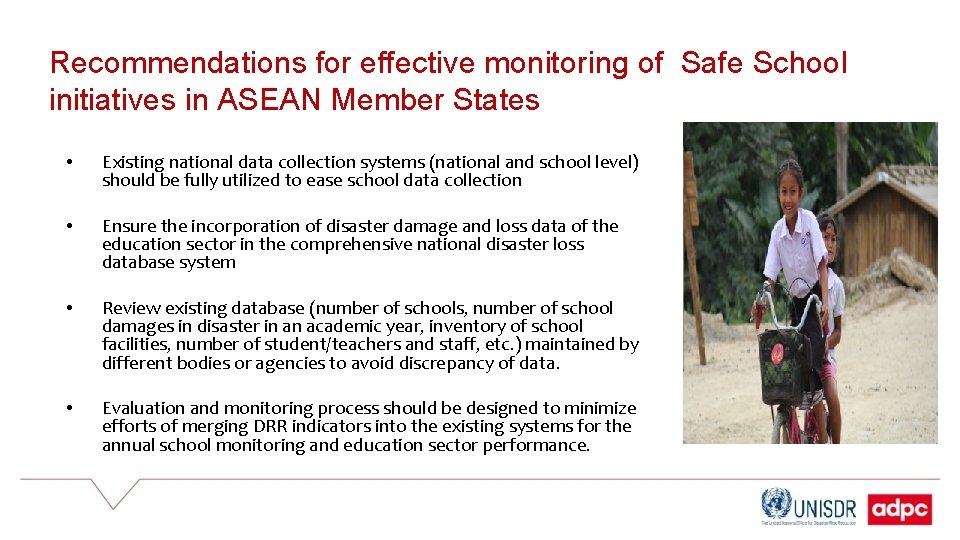
Recommendations for effective monitoring of Safe School initiatives in ASEAN Member States • Existing national data collection systems (national and school level) should be fully utilized to ease school data collection • Ensure the incorporation of disaster damage and loss data of the education sector in the comprehensive national disaster loss database system • Review existing database (number of schools, number of school damages in disaster in an academic year, inventory of school facilities, number of student/teachers and staff, etc. ) maintained by different bodies or agencies to avoid discrepancy of data. • Evaluation and monitoring process should be designed to minimize efforts of merging DRR indicators into the existing systems for the annual school monitoring and education sector performance.
THANK YOU FOR YOUR ATTENTION