
Towards a Reference Library of Upper Ontologies the
Towards a Reference Library of Upper Ontologies the DOLCE point of view Nicola Guarino Head, Laboratory for Applied Ontology Institute for Cognitive Sciences and Technology, National Research Council Trento, Italy Thanks to all LOA people! www. loa-cnr. it
Summary 1. 2. 3. 4. Lightweight ontologies vs. axiomatic ontologies Why a Reference Library of (axiomatic) Upper Ontologies What might the library look like How to build such a library: a common framework • • A common minimal vocabulary (meta-ontology? ) A common strategy to elicit the (hidden) assumptions behind each UO Common guidelines to express Ontology Design Rationale Common metrics to compare ontologies 5. How to evaluate the practical utility of the library and of the single modules. 6. (DOLCE’s basic choices) Upper Ontology Summit, March 14 -15, 2006 www. loa-cnr. it 2
Lightweight ontologies vs. axiomatic ontologies different roles of ontologies • Lightweight ontologies • • • Intended meaning of terms mostly known in advance Taxonomic reasoning is the main ontology service Limited expressivity On-line reasoning (stringent computational requirements) Axiomatic ontologies • • • Negotiate meaning across different communities Establish consensus about meaning of a new term within a community Explain meaning of a term to somebody new to community Higher expressivity required to express intended meaning Off-line reasoning (only needed once, before cooperation process starts) Upper Ontology Summit, March 14 -15, 2006 www. loa-cnr. it 3
When are axiomatic ontologies useful? 1. When subtle distinctions are important 2. When recognizing disagreement is important 3. When rigorous referential semantics is important 4. When general abstractions are important 5. When careful explanation and justification of ontological commitment is important 6. When mutual understanding is important. Upper Ontology Summit, March 14 -15, 2006 www. loa-cnr. it 4
Why a Reference Library of Upper Ontologies • Understand disagreements • Maximize agreements • Promote interoperability • A starting point for building new ontologies • A reference point for easy and rigorous comparison among different ontological approaches • A common framework for analyzing, harmonizing and integrating existing ontologies and metadata standards
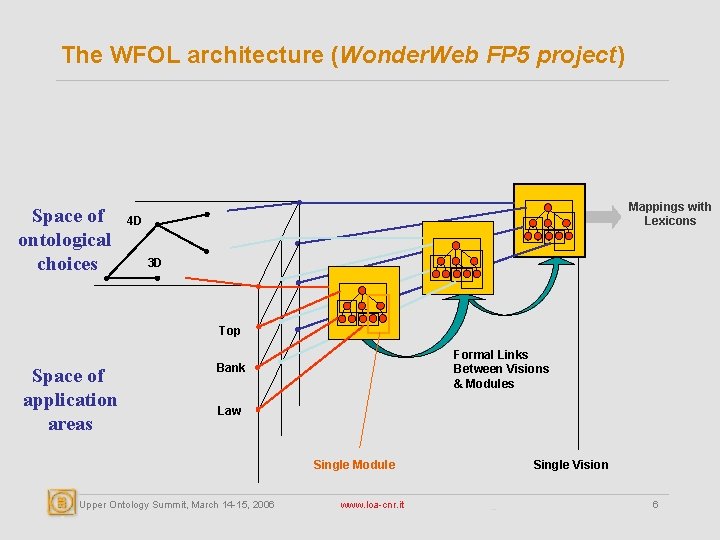
The WFOL architecture (Wonder. Web FP 5 project) Space of ontological choices Mappings with Lexicons 4 D 3 D Top Space of application areas Formal Links Between Visions & Modules Bank Law Single Module Upper Ontology Summit, March 14 -15, 2006 www. loa-cnr. it Single Vision 6
A common minimal vocabulary (meta-ontology? ) • What is an ontology • Common terms • • • Property vs. relation Property vs. quality (harder…) Primitive/defined relation Conceptual relation vs. extensional relation … Upper Ontology Summit, March 14 -15, 2006 www. loa-cnr. it 7
Common strategy to elicit hidden assumptions • Systematically explore hidden intra- and inter-categorial relationships • How is subprocess related to part? • What are the possible relations within processes? • Use general issues of formal (philosophical) ontology to elicit the assumptions made (possibly by means of simple NL questions) • Common examples (such as the statue and the clay…) • Exploit formal meta-properties (Onto. Clean-like) Upper Ontology Summit, March 14 -15, 2006 www. loa-cnr. it 8
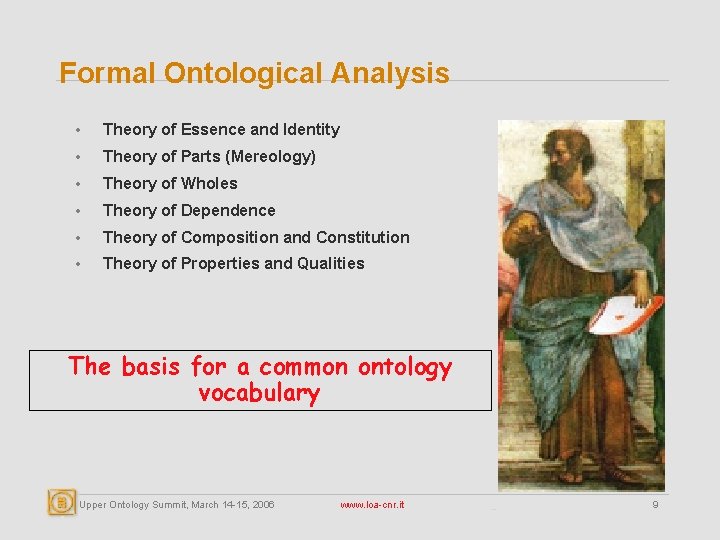
Formal Ontological Analysis • Theory of Essence and Identity • Theory of Parts (Mereology) • Theory of Wholes • Theory of Dependence • Theory of Composition and Constitution • Theory of Properties and Qualities The basis for a common ontology vocabulary Upper Ontology Summit, March 14 -15, 2006 www. loa-cnr. it 9
Common guidelines to express ontology design rationale • Identify issues • List possible alternatives • Carefully justify and position the choices made with respect to possible alternatives • Basic options should be clearly documented • Clear branching points should allow for easy comparison of ontological options • Tradeoffs with respect to: • Choice of domain • Choice of relevant conceptual relations • Choice of primitives • Choice of axioms Upper Ontology Summit, March 14 -15, 2006 www. loa-cnr. it 10
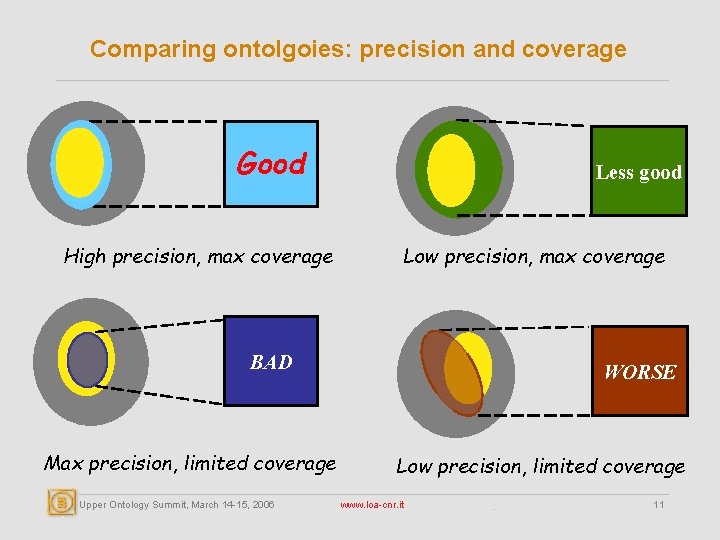
Comparing ontolgoies: precision and coverage Good High precision, max coverage Less good Low precision, max coverage BAD Max precision, limited coverage Upper Ontology Summit, March 14 -15, 2006 WORSE Low precision, limited coverage www. loa-cnr. it 11
Evaluating Upper Ontologies • Methodology-oriented evaluation • Impact on principles and best practices for conceptual modeling • Application-oriented evaluation • Impact on the development of domain ontologies • Impact on the adaptability of domain ontologies to different domains • Cognitive and linguistic evaluation • Impact on multilingual linguistic resources • Experiments based on linguistic corpora • Psychological experiments on cognitive adequacy Upper Ontology Summit, March 14 -15, 2006 www. loa-cnr. it 12
Aldo Gangemi’s contribution • Ontology patterns • Role of socially constructed entities (D&S)
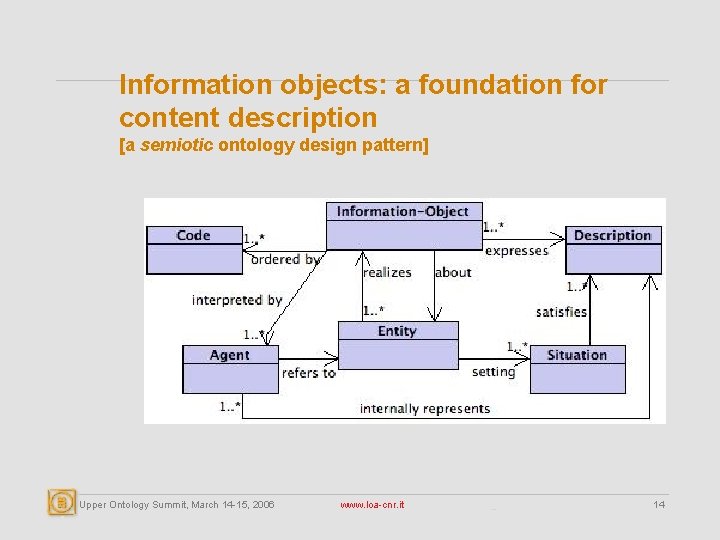
Information objects: a foundation for content description [a semiotic ontology design pattern] Upper Ontology Summit, March 14 -15, 2006 www. loa-cnr. it 14
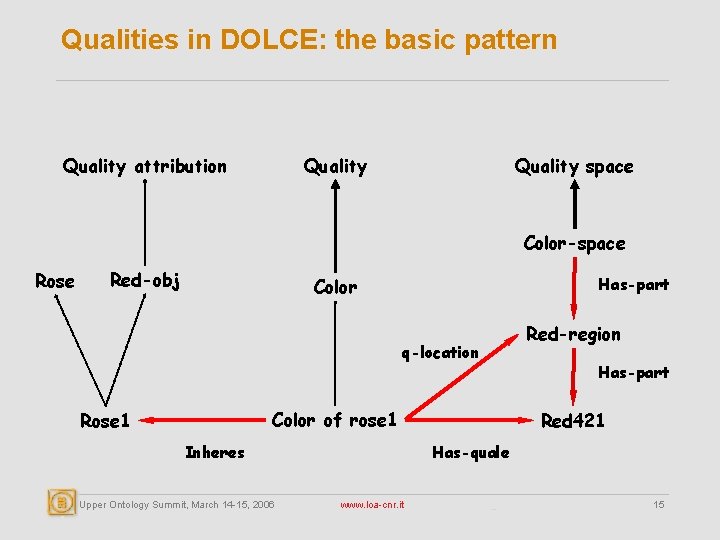
Qualities in DOLCE: the basic pattern Quality attribution Quality space Color-space Rose Red-obj Has-part Color q-location Color of rose 1 Rose 1 Inheres Upper Ontology Summit, March 14 -15, 2006 Red-region Has-part Red 421 Has-quale www. loa-cnr. it 15
Concepts and descriptions • Reify social concepts to be able to predicate on them Social concepts and roles as first-class-citizens CN(x): “x is a social concept” • Reify contexts or concept definitions, called here descriptions Deal with the social, relational, and contextual nature of social concepts DS(x): “x is a description” DF(x, y): “the concept x is defined by the description y” US(x, y): “the concept x is (re)used in the description y • Introduce a temporalized classification relation to link concepts to the entities they classify Account for the dynamic behavior of social concepts CF(x, y, t): “at the time t, x is classified by the concept y” Upper Ontology Summit, March 14 -15, 2006 www. loa-cnr. it 16
Underlying assumptions • Descriptions: • are created by intentional agents at the time of their first encoding in an expression of a ‘public’ language • cease to exist when their last physical support ceases to exist • have a unique semantic content (different, but semantically equivalent, expressions can be associated to the same description) • have an internal structure intimately related to the logical structure of their semantic contents; partially accounted by means of the predicate US • Concepts: • are statically linked to descriptions: they cannot change their definitions • inherit the temporal extension of their definitions Upper Ontology Summit, March 14 -15, 2006 www. loa-cnr. it 17

Extra slides
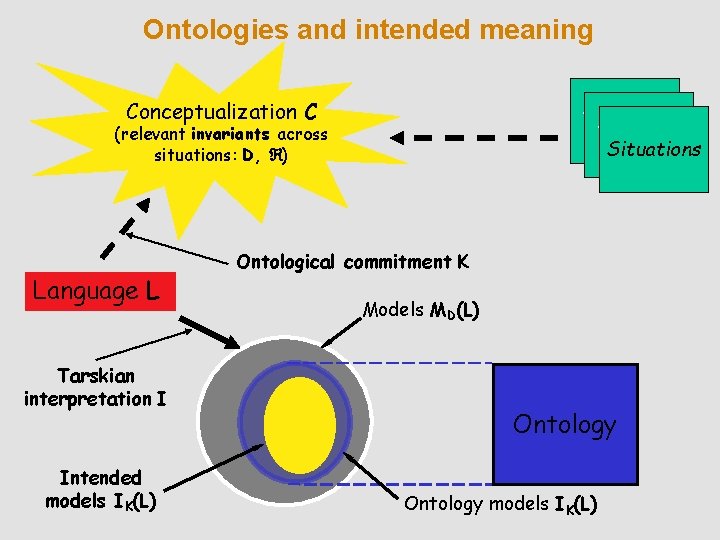
Ontologies and intended meaning State of affairs Situations Conceptualization C (relevant invariants across situations: D, ) Language L Tarskian interpretation I Intended models IK(L) Ontological commitment K Models MD(L) Ontology models IK(L)
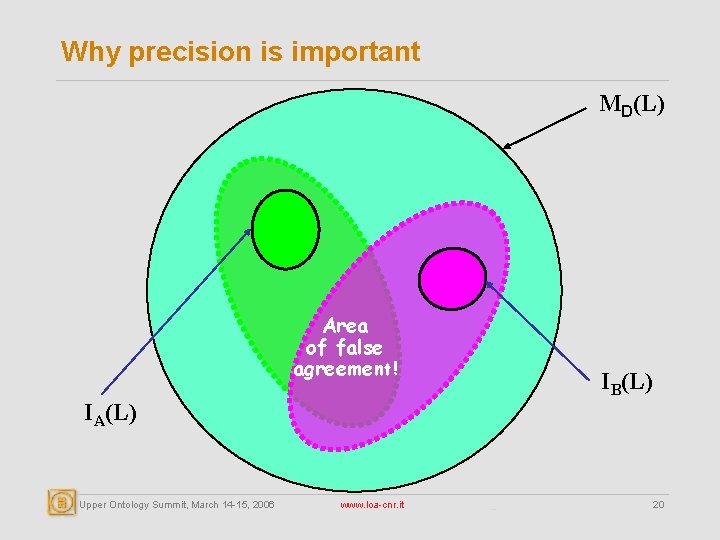
Why precision is important MD(L) Area of false agreement! IB(L) IA(L) Upper Ontology Summit, March 14 -15, 2006 www. loa-cnr. it 20
DOLCE a Descriptive Ontology for Linguistic and Cognitive Engineering • Strong cognitive/linguistic bias: • • Emphasis on cognitive invariants Categories as conceptual containers: no “deep” metaphysical implications Focus on design rationale to allow easy comparison with different ontological options Rigorous, systematic, interdisciplinary approach Rich axiomatization • • • descriptive (as opposite to prescriptive) attitude Categories mirror cognition, common sense, and the lexical structure of natural language. 37 basic categories 7 basic relations 80 axioms, 100 definitions, 20 theorems Rigorous quality criteria Documentation Upper Ontology Summit, March 14 -15, 2006 www. loa-cnr. it 21
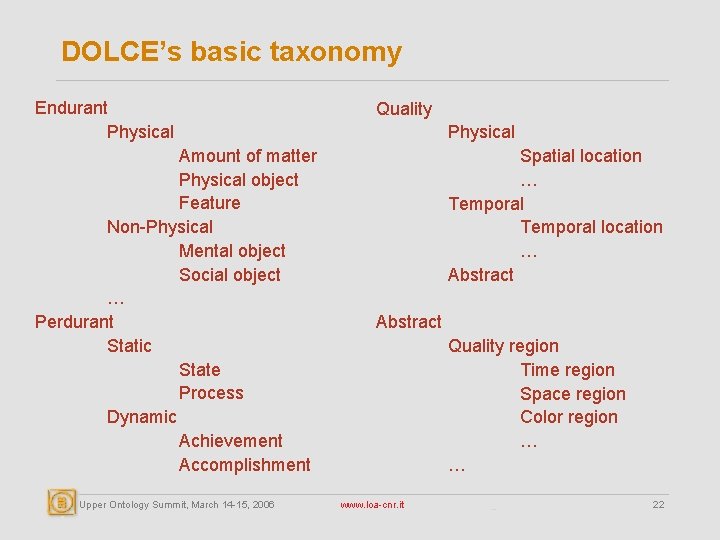
DOLCE’s basic taxonomy Endurant Physical Amount of matter Physical object Feature Non-Physical Mental object Social object … Perdurant Static State Process Dynamic Achievement Accomplishment Upper Ontology Summit, March 14 -15, 2006 Quality Physical Spatial location … Temporal location … Abstract Quality region Time region Space region Color region … … www. loa-cnr. it 22
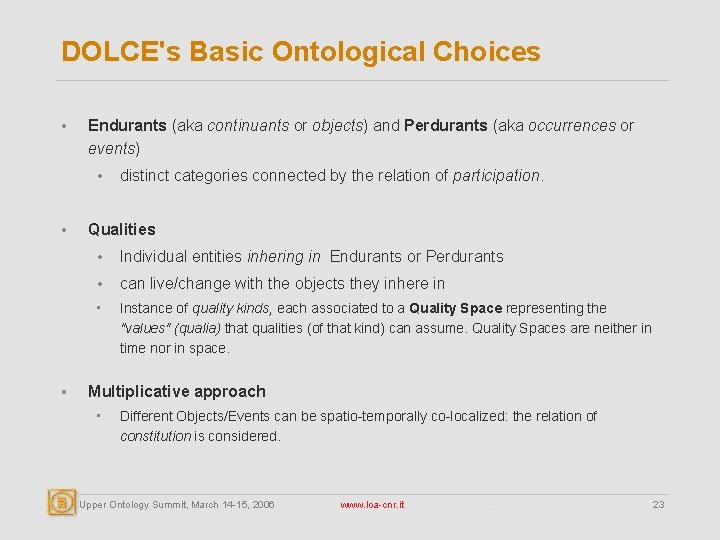
DOLCE's Basic Ontological Choices • Endurants (aka continuants or objects) and Perdurants (aka occurrences or events) • • • distinct categories connected by the relation of participation. Qualities • Individual entities inhering in Endurants or Perdurants • can live/change with the objects they inhere in • Instance of quality kinds, each associated to a Quality Space representing the "values" (qualia) that qualities (of that kind) can assume. Quality Spaces are neither in time nor in space. Multiplicative approach • Different Objects/Events can be spatio-temporally co-localized: the relation of constitution is considered. Upper Ontology Summit, March 14 -15, 2006 www. loa-cnr. it 23
- Slides: 23