
Towards a Library of Workflow User Interface Patterns
Towards a Library of Workflow User Interface Patterns Josefina Guerrero García 1, Jean Vanderdonckt 1, Juan Manuel González Calleros 1, Marco Winckler 1, 2 1 Université catholique de Louvain (UCL) Louvain School of Management (LSM) - Information Systems Unit (ISYS) Belgian Laboratory of Computer-Human Interaction (BCHI) http: //www. isys. ucl. ac. be/bchi 2 IRIT, Université Toulouse 3, France, 118 route de Narbonne, F-31062 Toulouse cedex 9 (France), winckler@irit. fr – http: //liihs. irit. fr/winckler/ 1 DSV-IS’ 2008, Kingston, Ontario, Canada, July 16 -18, 2008
Outline • Introduction & motivations • Developing user interfaces for workflow information systems • Workflow user interface patterns • Conclusion and related work 2 DSV-IS’ 2008, Kingston, Ontario, Canada, July 16 -18, 2008
Introduction & motivations • Workflow is defined as the automation of business process. • A Workflow Information System (Wf. IS) is a system that defines, creates and manages the execution of workflows through the use of software; the users of a Wf. IS interact with it through its user interfaces (UIs). • Workflow patterns refer specifically to recurrent problems and proven solutions related to the development of Wf. IS in particular, and more broadly, of process-oriented applications. • Workflow resource patterns have been identified that capture the different manners in which resources are presented and used in workflows. 3 DSV-IS’ 2008, Kingston, Ontario, Canada, July 16 -18, 2008
Introduction & motivations • The rationale for identifying these patterns was the need to master the many ways according which work can be distributed. • We explore a systematic manner to develop user interfaces (UIs) for each workflow resource pattern following the same definition and using Usi. XML language. • The goal of this work is not to reproduce the workflow resource patterns, but to associate a default UI to each pattern. 4 DSV-IS’ 2008, Kingston, Ontario, Canada, July 16 -18, 2008
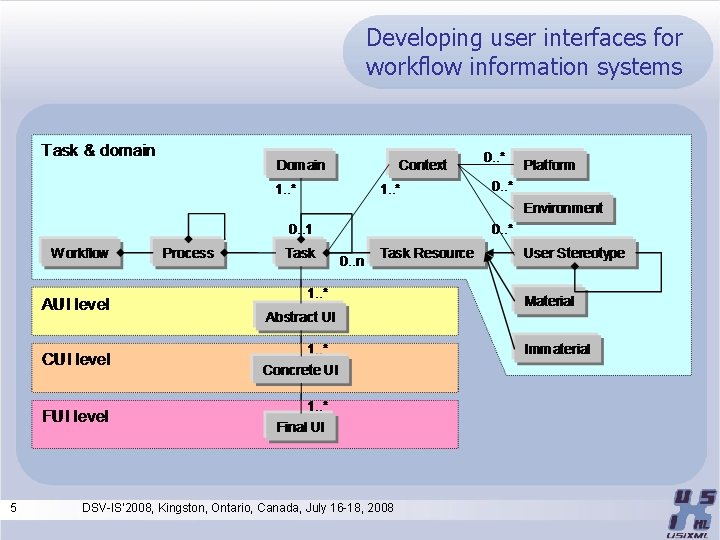
Developing user interfaces for workflow information systems 5 DSV-IS’ 2008, Kingston, Ontario, Canada, July 16 -18, 2008
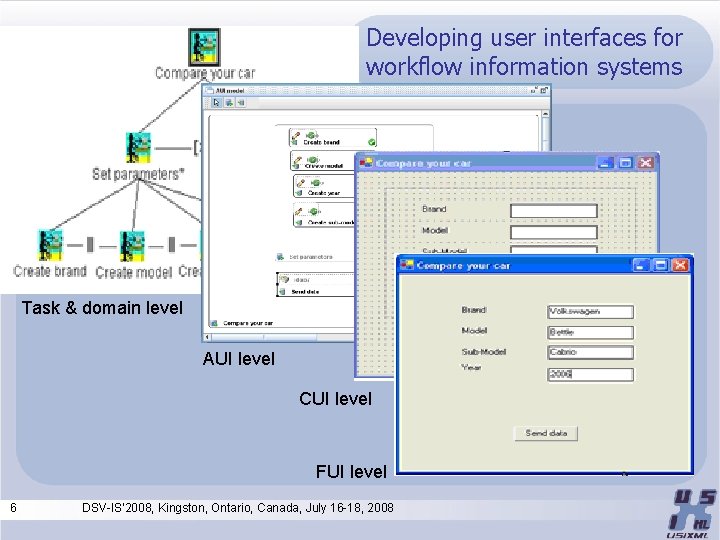
Developing user interfaces for workflow information systems Task & domain level AUI level CUI level FUI level 6 DSV-IS’ 2008, Kingston, Ontario, Canada, July 16 -18, 2008
Workflow user interface patterns • We adopted the following methodology for defining Workflow User Interface Pattern (WUIP): – Augmented UI pattern definition – Incorporation in the model-driven engineering method – Final WUIPs 7 DSV-IS’ 2008, Kingston, Ontario, Canada, July 16 -18, 2008
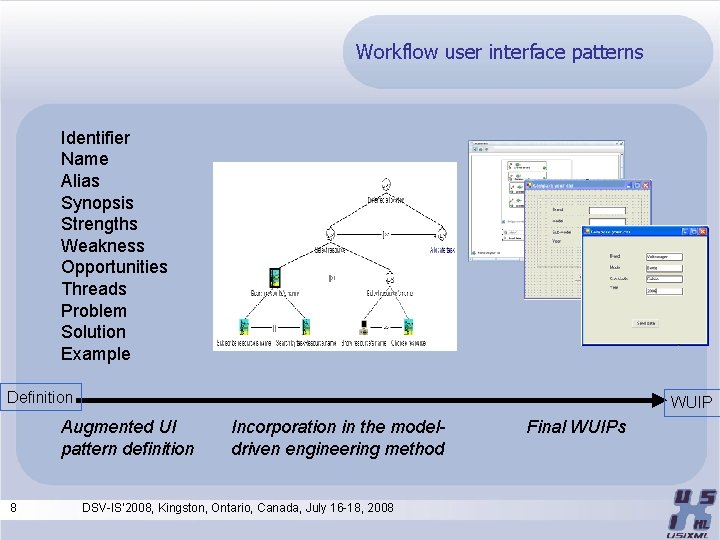
Workflow user interface patterns Identifier Name Alias Synopsis Strengths Weakness Opportunities Threads Problem Solution Example Definition WUIP Augmented UI pattern definition 8 Incorporation in the modeldriven engineering method DSV-IS’ 2008, Kingston, Ontario, Canada, July 16 -18, 2008 Final WUIPs
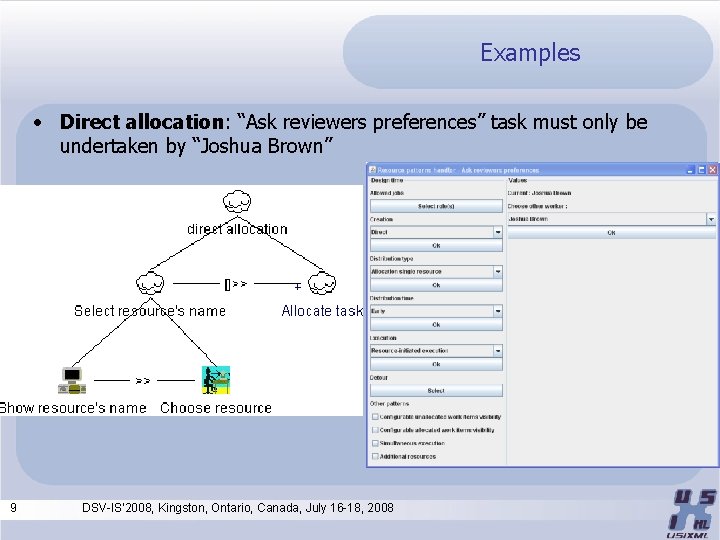
Examples • Direct allocation: “Ask reviewers preferences” task must only be undertaken by “Joshua Brown” 9 DSV-IS’ 2008, Kingston, Ontario, Canada, July 16 -18, 2008
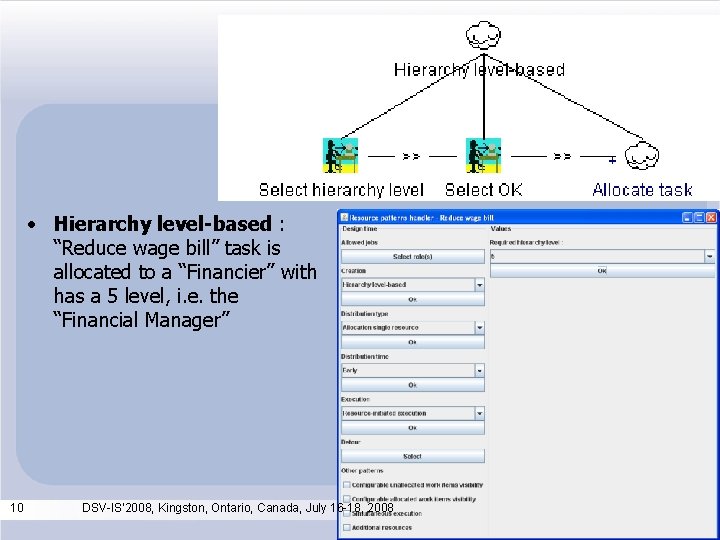
Example 2 • Hierarchy level-based : “Reduce wage bill” task is allocated to a “Financier” with has a 5 level, i. e. the “Financial Manager” 10 DSV-IS’ 2008, Kingston, Ontario, Canada, July 16 -18, 2008
11 DSV-IS’ 2008, Kingston, Ontario, Canada, July 16 -18, 2008
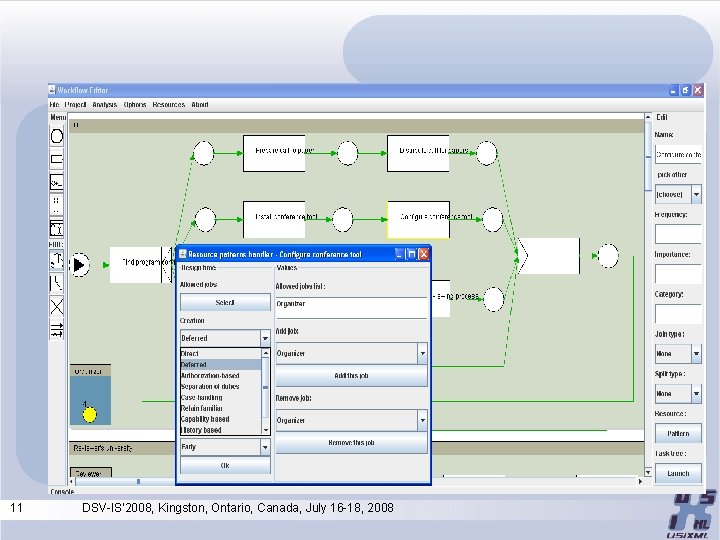
Conclusion and related work • Workflow resource patterns correspond to the manner in which tasks are allocated to resources. • This paper introduced a library of user interface design patterns that are particularly applicable to user interfaces of workflow information systems. • For each workflow pattern from Russel & van der Aalst, we have a task model, a AUI model, a CUI model • Designers are able now to specificity resource allocation patterns using UIs that fits: both at design-time and at run-time, considering constraints imposed by mutually excluded patterns. 12 DSV-IS’ 2008, Kingston, Ontario, Canada, July 16 -18, 2008
Conclusion and related work • YAWL (Yet Another Workflow Language) provides support for the resource perspective. • We rely on a proved method to generate User Interfaces, Usi. XML, passing from task model and abstract user interface to final user interface. • We propose a model-driven engineering method that provides designers with methodological guidance on how to systematically derive user interfaces of workflow information systems from a series of models. • It is intended that our model supports changes inside the organization and automatically update the UIs generated. 13 DSV-IS’ 2008, Kingston, Ontario, Canada, July 16 -18, 2008
Thank you very much for your attention http: //www. usixml. org User Interface e. Xtensible Markup Language http: //www. similar. cc European network on Multimodal UIs For more information and downloading, http: //www. isys. ucl. ac. be/bchi Special thanks to all members of the team! 14 DSV-IS’ 2008, Kingston, Ontario, Canada, July 16 -18, 2008
- Slides: 14