
Towards a HEPworkload GEN GPU benchmark Mad Graph
Towards a HEP-workload GEN GPU benchmark: Mad. Graph 5_a. MC@NLO Andrea Valassi (CERN IT-SC-RD) HEPi. X Benchmarking WG meeting, 5 th November 2020 - https: //indico. cern. ch/event/946409 A. Valassi – Mad. Graph on GPU Benchmarking meeting – 05 Nov 2020 1
Foreword: GEN workloads and GPUs in WLCG • MC event generators are essential for HEP physics analyses – First step in the GEN-SIM-DIGI-RECO chain for simulated data – Mad. Graph 5_a. MC@NLO (MGa. MC) is one of the main generators at the LHC • Growing interest (and concerns) about the software aspects of generators – GEN workloads are a sizeable (and growing) fraction of WLCG CPU budgets • Currently ~12% for ATLAS (mainly Sherpa) and ~5% for CMS (mainly MGa. MC) – Paper for the HL-LHC LHCC review: https: //arxiv. org/abs/2004. 13687 • See also the recent LHCC talk: https: //doi. org/10. 5281/zenodo. 4028834 – Code modernization and speedup, faster algorithms, port to new architectures… • WLCG does not provide/account GPUs yet, but it will one day – Example: HPCs (and the experiments already have access to these resources) – Only few workloads could make sizable use of GPUs today (e. g. CMS patatrack) – Porting generators to GPUs would open up new ways of using GPUs in WLCG • And generators are natural candidates for exploiting parallelism on GPUs (see later…) Generators are a natural fit for preparing a HEP-workload GPU benchmark – Bonus: in principle one can run exactly the same algorithm on CPUs and GPUs A. Valassi – Mad. Graph on GPU Benchmarking meeting – 05 Nov 2020 2
MGa. MC on GPU – overview • Why choose Mad. Graph and not another MC generator for a GPU port? – Earlier efforts at KEK in 2010 -2013, which were never released for production • Touched both matrix element (ME) and MC integration – see summary at HOW 2019 • We are ~not leveraging on this work (based on old version of Mad. Graph’s ME library) – Main reason: active involvement of core Mad. Graph developer (Olivier Mattelaer) • Project is maintained on https: //github. com/madgraph 5/madgraph 4 gpu – Overall coordination: Stefan Roiser – Composite effort: physicists & engineers (CERN, Louvain, Argonne, Bangalore) • Core CUDA development: AV, OM, SR, Taran Singhania • Abstraction layers, profiling, MC integration: David Smith, Laurence Field, Smita Darmora, Taylor Childers, Tyler Burch, Walter Hopkins • Just joined: Josh Mc. Fayden, Stephan Hageboek – Meetings every two weeks • Plus more frequent discussions of core CUDA developers – The collaboration is largely a spin-off of the activities in the HSF generator WG • https: //hepsoftwarefoundation. org/workinggroups/generators. html A. Valassi – Mad. Graph on GPU Benchmarking meeting – 05 Nov 2020 3
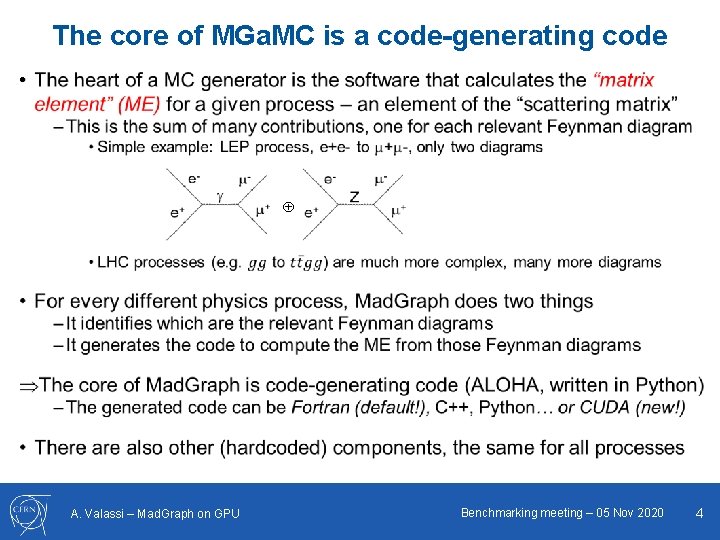
The core of MGa. MC is a code-generating code • A. Valassi – Mad. Graph on GPU Benchmarking meeting – 05 Nov 2020 4
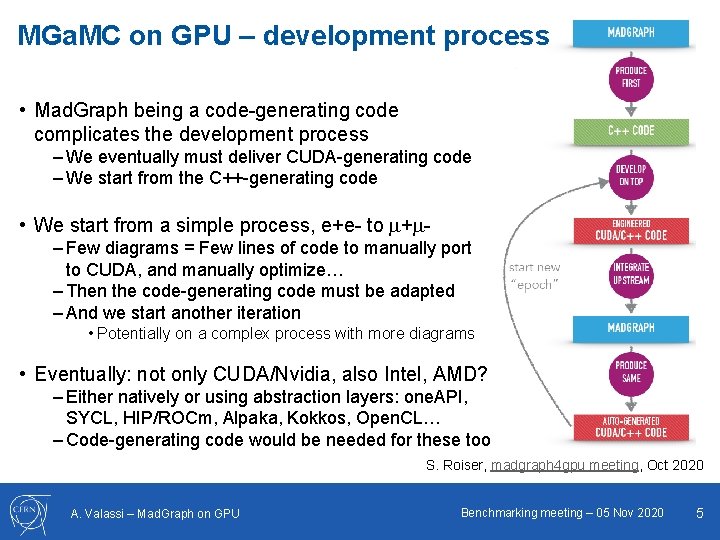
MGa. MC on GPU – development process • Mad. Graph being a code-generating code complicates the development process – We eventually must deliver CUDA-generating code – We start from the C++-generating code • We start from a simple process, e+e- to + – Few diagrams = Few lines of code to manually port to CUDA, and manually optimize… – Then the code-generating code must be adapted – And we start another iteration • Potentially on a complex process with more diagrams • Eventually: not only CUDA/Nvidia, also Intel, AMD? – Either natively or using abstraction layers: one. API, SYCL, HIP/ROCm, Alpaka, Kokkos, Open. CL… – Code-generating code would be needed for these too S. Roiser, madgraph 4 gpu meeting, Oct 2020 A. Valassi – Mad. Graph on GPU Benchmarking meeting – 05 Nov 2020 5
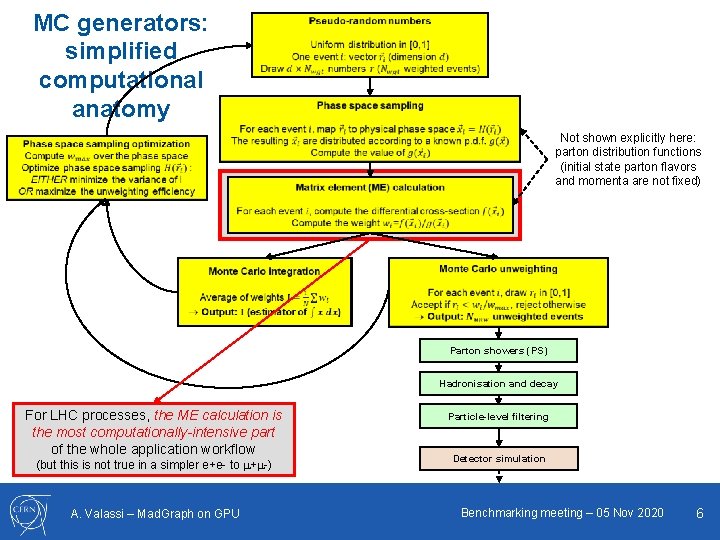
MC generators: simplified computational anatomy Not shown explicitly here: parton distribution functions (initial state parton flavors and momenta are not fixed) Parton showers (PS) Hadronisation and decay For LHC processes, the ME calculation is the most computationally-intensive part of the whole application workflow (but this is not true in a simpler e+e- to + -) A. Valassi – Mad. Graph on GPU Particle-level filtering Detector simulation Benchmarking meeting – 05 Nov 2020 6
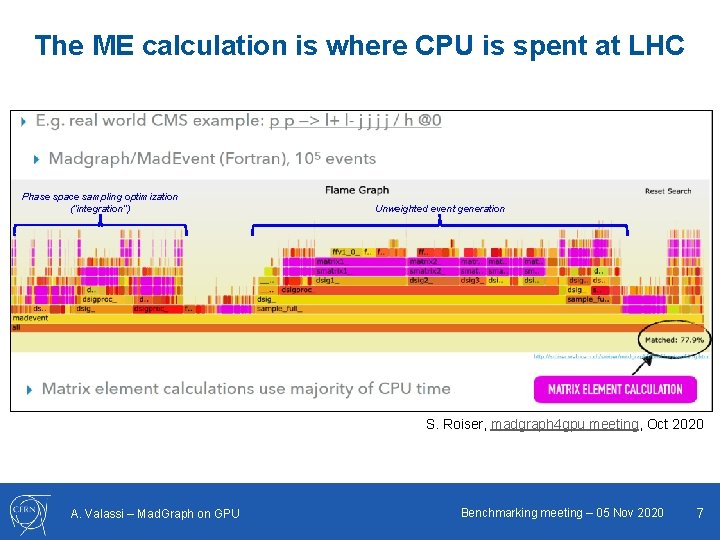
The ME calculation is where CPU is spent at LHC Phase space sampling optimization (“integration”) Unweighted event generation S. Roiser, madgraph 4 gpu meeting, Oct 2020 A. Valassi – Mad. Graph on GPU Benchmarking meeting – 05 Nov 2020 7
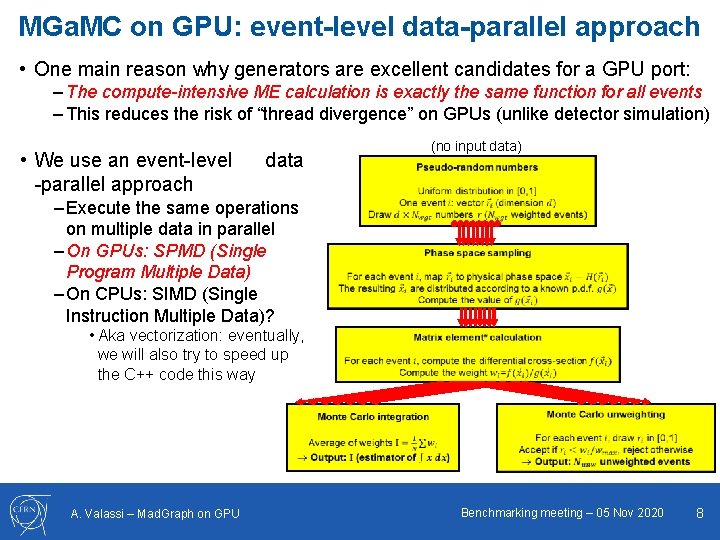
MGa. MC on GPU: event-level data-parallel approach • One main reason why generators are excellent candidates for a GPU port: – The compute-intensive ME calculation is exactly the same function for all events – This reduces the risk of “thread divergence” on GPUs (unlike detector simulation) • We use an event-level -parallel approach data (no input data) – Execute the same operations on multiple data in parallel – On GPUs: SPMD (Single Program Multiple Data) – On CPUs: SIMD (Single Instruction Multiple Data)? • Aka vectorization: eventually, we will also try to speed up the C++ code this way A. Valassi – Mad. Graph on GPU Benchmarking meeting – 05 Nov 2020 8
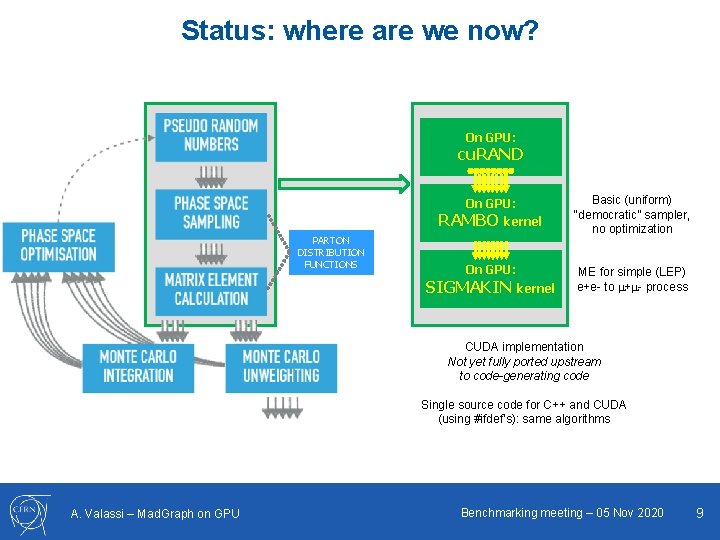
Status: where are we now? On GPU: cu. RAND On GPU: Basic (uniform) “democratic” sampler, no optimization On GPU: ME for simple (LEP) e+e- to + - process RAMBO kernel PARTON DISTRIBUTION FUNCTIONS SIGMAKIN kernel CUDA implementation Not yet fully ported upstream to code-generating code Single source code for C++ and CUDA (using #ifdef’s): same algorithms A. Valassi – Mad. Graph on GPU Benchmarking meeting – 05 Nov 2020 9
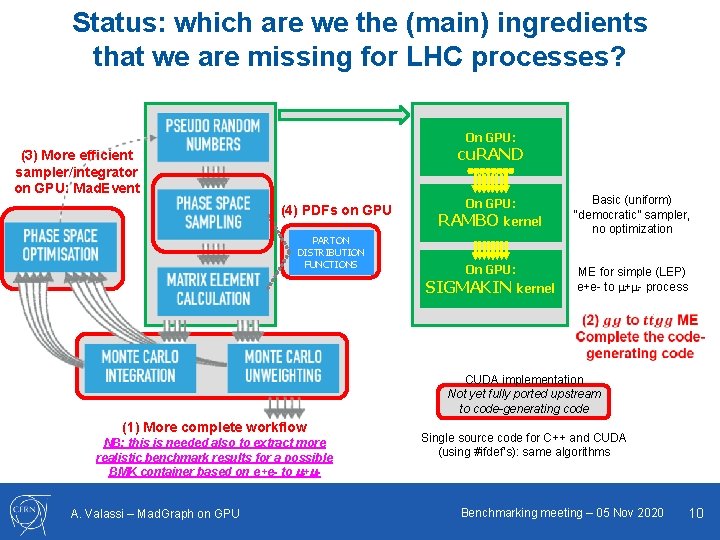
Status: which are we the (main) ingredients that we are missing for LHC processes? On GPU: cu. RAND (3) More efficient sampler/integrator on GPU: Mad. Event (4) PDFs on GPU PARTON DISTRIBUTION FUNCTIONS On GPU: Basic (uniform) “democratic” sampler, no optimization On GPU: ME for simple (LEP) e+e- to + - process RAMBO kernel SIGMAKIN kernel CUDA implementation Not yet fully ported upstream to code-generating code (1) More complete workflow NB: this is needed also to extract more realistic benchmark results for a possible BMK container based on e+e- to + A. Valassi – Mad. Graph on GPU Single source code for C++ and CUDA (using #ifdef’s): same algorithms Benchmarking meeting – 05 Nov 2020 10
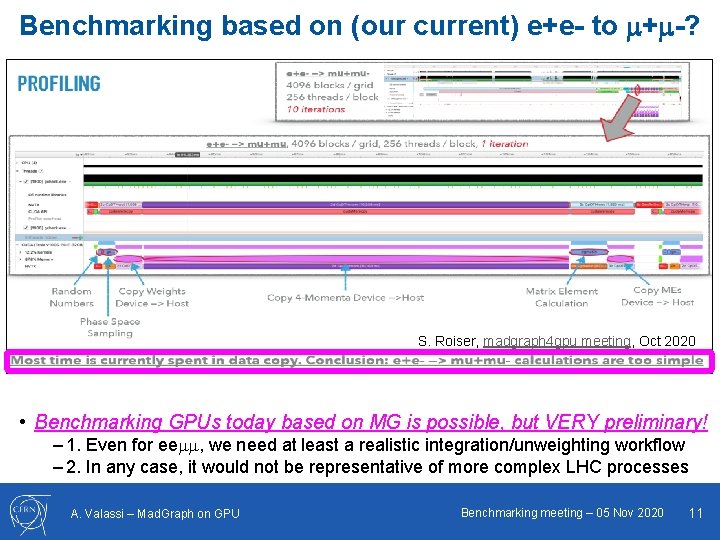
Benchmarking based on (our current) e+e- to + -? S. Roiser, madgraph 4 gpu meeting, Oct 2020 • Benchmarking GPUs today based on MG is possible, but VERY preliminary! – 1. Even for ee , we need at least a realistic integration/unweighting workflow – 2. In any case, it would not be representative of more complex LHC processes A. Valassi – Mad. Graph on GPU Benchmarking meeting – 05 Nov 2020 11
Hardware benchmarking, Software benchmarking • In the HEPi. X BMK WG we mainly deal with hardware benchmarking – Run the same frozen software on different CPUs/GPUs and compare them • Goals: accounting/pledging and procurement of compute resources (à la HS 06) – Reproducible applications, pre-built and containerized as docker images • In the madgraph 4 gpu effort we do a whole lot of software benchmarking – Change the software (or change build options) and compare old/new versions – We do more, but we also compare software performance on different GPUs • Software optimizations depend on hardware (professional/FP 64 vs consumer/FP 32) • Software languages and abstraction layers depend on hardware (Nvidia, AMD, Intel) • There is a lot in common, but also some important differences – Main similarity: we both need reproducible application workloads – Main difference: prebuilt library/executables vs source code to rebuild – It makes sense to keep these two efforts well synchronized A. Valassi – Mad. Graph on GPU Benchmarking meeting – 05 Nov 2020 12
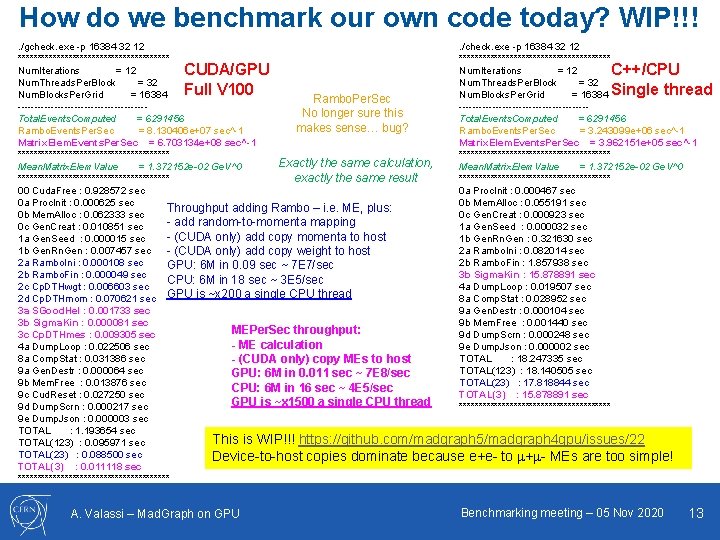
How do we benchmark our own code today? WIP!!!. /gcheck. exe -p 16384 32 12. /check. exe -p 16384 32 12 *************************************** Num. Iterations = 12 Num. Threads. Per. Block = 32 Num. Blocks. Per. Grid = 16384 Rambo. Per. Sec --------------------------------------No longer sure this Total. Events. Computed = 6291456 makes sense… bug? Rambo. Events. Per. Sec = 8. 130406 e+07 sec^-1 Rambo. Events. Per. Sec = 3. 243099 e+06 sec^-1 Matrix. Elem. Events. Per. Sec = 6. 703134 e+08 sec^-1 Matrix. Elem. Events. Per. Sec = 3. 962151 e+05 sec^-1 *************************************** Exactly the same calculation, Mean. Matrix. Elem. Value = 1. 372152 e-02 Ge. V^0 *************************************** exactly the same result 00 Cuda. Free : 0. 928572 sec 0 a Proc. Init : 0. 000467 sec 0 a Proc. Init : 0. 000625 sec 0 b Mem. Alloc : 0. 055191 sec Throughput adding Rambo – i. e. ME, plus: 0 b Mem. Alloc : 0. 062333 sec 0 c Gen. Creat : 0. 000923 sec - add random-to-momenta mapping 0 c Gen. Creat : 0. 010851 sec 1 a Gen. Seed : 0. 000032 sec - (CUDA only) add copy momenta to host 1 a Gen. Seed : 0. 000015 sec 1 b Gen. Rn. Gen : 0. 321630 sec 1 b Gen. Rn. Gen : 0. 007457 sec 2 a Rambo. Ini : 0. 082014 sec - (CUDA only) add copy weight to host 2 a Rambo. Ini : 0. 000108 sec 2 b Rambo. Fin : 1. 857938 sec GPU: 6 M in 0. 09 sec ~ 7 E 7/sec 2 b Rambo. Fin : 0. 000049 sec 3 b Sigma. Kin : 15. 878891 sec CPU: 6 M in 18 sec ~ 3 E 5/sec 2 c Cp. DTHwgt : 0. 006603 sec 4 a Dump. Loop : 0. 019507 sec 2 d Cp. DTHmom : 0. 070621 sec GPU is ~x 200 a single CPU thread 8 a Comp. Stat : 0. 028952 sec 3 a SGood. Hel : 0. 001733 sec 9 a Gen. Destr : 0. 000104 sec 3 b Sigma. Kin : 0. 000081 sec 9 b Mem. Free : 0. 001440 sec MEPer. Sec throughput: 3 c Cp. DTHmes : 0. 009305 sec 9 d Dump. Scrn : 0. 000248 sec - ME calculation 4 a Dump. Loop : 0. 022506 sec 9 e Dump. Json : 0. 000002 sec 8 a Comp. Stat : 0. 031386 sec TOTAL : 18. 247335 sec - (CUDA only) copy MEs to host 9 a Gen. Destr : 0. 000064 sec TOTAL(123) : 18. 140505 sec GPU: 6 M in 0. 011 sec ~ 7 E 8/sec 9 b Mem. Free : 0. 013876 sec TOTAL(23) : 17. 818844 sec CPU: 6 M in 16 sec ~ 4 E 5/sec 9 c Cud. Reset : 0. 027250 sec TOTAL(3) : 15. 878891 sec GPU is ~x 1500 a single CPU thread 9 d Dump. Scrn : 0. 000217 sec ******************** 9 e Dump. Json : 0. 000003 sec TOTAL : 1. 193654 sec This is WIP!!! https: //github. com/madgraph 5/madgraph 4 gpu/issues/22 TOTAL(123) : 0. 095971 sec TOTAL(23) : 0. 088500 sec Device-to-host copies dominate because e+e- to + - MEs are too simple! TOTAL(3) : 0. 011118 sec ******************** CUDA/GPU Full V 100 A. Valassi – Mad. Graph on GPU C++/CPU Single thread Benchmarking meeting – 05 Nov 2020 13
Nvidia GPUs – hackathons and profiling tools • Some of us attended the http: //gpuhackathons. org Sheffield event in July – Extremely beneficial for us, I highly recommend it for any CUDA developer! – Many thanks to our mentors at this specific event! https: //gpuhack. shef. ac. uk • This was useful also to understand performance in a benchmarking context – Which features of the GPU hardware relevant (e. g. registers, FP 32/64…) – Application profiling using two Nvidia tools, Nsight Systems and Nsight Compute • Most plots in these slides are from tools/concepts learnt at the hackathon – Some detailed studies in https: //github. com/madgraph 5/madgraph 4 gpu/issues A. Valassi – Mad. Graph on GPU Benchmarking meeting – 05 Nov 2020 14
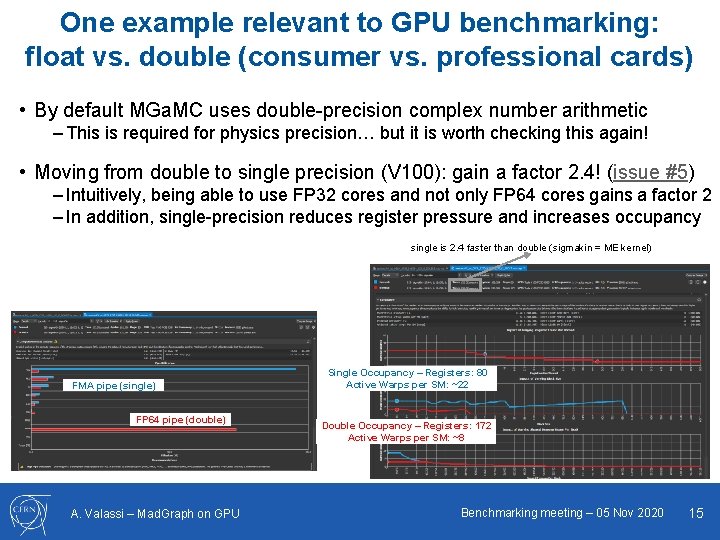
One example relevant to GPU benchmarking: float vs. double (consumer vs. professional cards) • By default MGa. MC uses double-precision complex number arithmetic – This is required for physics precision… but it is worth checking this again! • Moving from double to single precision (V 100): gain a factor 2. 4! (issue #5) – Intuitively, being able to use FP 32 cores and not only FP 64 cores gains a factor 2 – In addition, single-precision reduces register pressure and increases occupancy single is 2. 4 faster than double (sigmakin = ME kernel) FMA pipe (single) FP 64 pipe (double) A. Valassi – Mad. Graph on GPU Single Occupancy – Registers: 80 Active Warps per SM: ~22 Double Occupancy – Registers: 172 Active Warps per SM: ~8 Benchmarking meeting – 05 Nov 2020 15
Outlook: a BMK container for MGa. MC on GPU? • A. Valassi – Mad. Graph on GPU Benchmarking meeting – 05 Nov 2020 16
Backup slides A. Valassi – Mad. Graph on GPU Benchmarking meeting – 05 Nov 2020 17
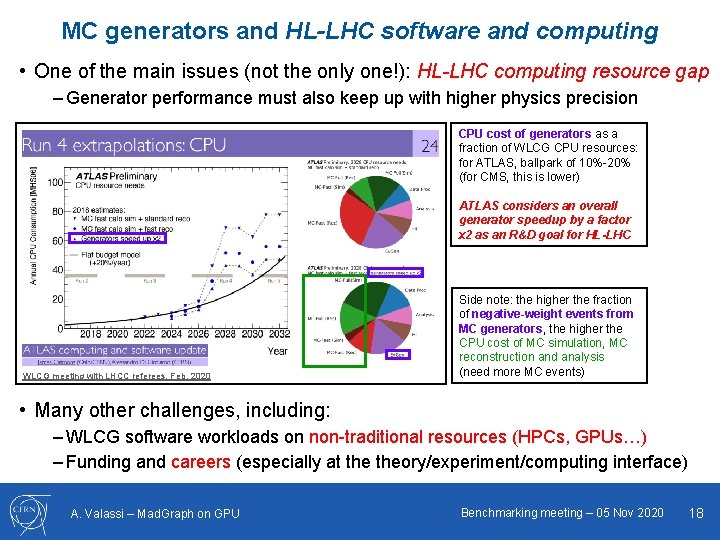
MC generators and HL-LHC software and computing • One of the main issues (not the only one!): HL-LHC computing resource gap – Generator performance must also keep up with higher physics precision CPU cost of generators as a fraction of WLCG CPU resources: for ATLAS, ballpark of 10%-20% (for CMS, this is lower) ATLAS considers an overall generator speedup by a factor x 2 as an R&D goal for HL-LHC WLCG meeting with LHCC referees, Feb. 2020 Side note: the higher the fraction of negative-weight events from MC generators, the higher the CPU cost of MC simulation, MC reconstruction and analysis (need more MC events) • Many other challenges, including: – WLCG software workloads on non-traditional resources (HPCs, GPUs…) – Funding and careers (especially at theory/experiment/computing interface) A. Valassi – Mad. Graph on GPU Benchmarking meeting – 05 Nov 2020 18
A few performance comparisons • A few studies from August 2020 (essentially the same code as today) – Measurements on lxbatch: sensitive to external load, reproducible within ~10% – Extensive discussion of numbers and Nsight Compute profiler plots on https: //github. com/madgraph 5/madgraph 4 gpu/issues – General approach: change a #define switch to a non-default value in the code • Now kept cu. Complex and float switches, but hardcoded AOSOA and “local” memory • From double precision to single precision: gain a factor 2. 4! (issue #5) – FMA (FP 32) used instead of FP 64 pipe; fewer registers hence higher occupancy • Memory layout for 4 -momenta (issue #16): study “requests” vs “sectors” – Default: AOSOA with 4 events per array (four 8 -byte doubles: 32 -byte cache line) • AOS ~7% slower: memory not coalesced, #sectors (transactions) factor 4 higher • SOA ~2% slower: slightly higher number of registers – Side result of this study: improve helicity filtering to reduce #requests (issue #24) • Memory for wavefunctions in ixxx/oxxx/FV_xx (issue #7): default is “local” – Lose 70% with “global” (become memory-bound!), also lose 35% with “shared” • From thrust: : complex to cu. Complex: lose ~5% (issue #6) – Require execution of higher number of instructions (something to fix? ) A. Valassi – Mad. Graph on GPU Benchmarking meeting – 05 Nov 2020 19
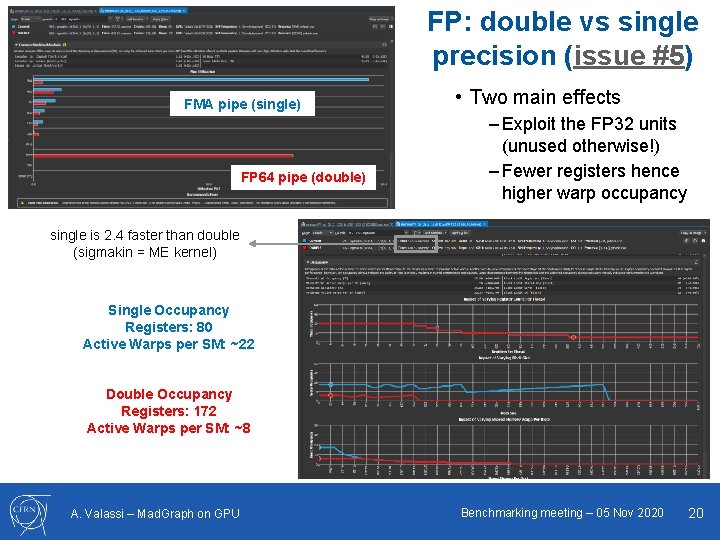
FP: double vs single precision (issue #5) FMA pipe (single) FP 64 pipe (double) • Two main effects – Exploit the FP 32 units (unused otherwise!) – Fewer registers hence higher warp occupancy single is 2. 4 faster than double (sigmakin = ME kernel) Single Occupancy Registers: 80 Active Warps per SM: ~22 Double Occupancy Registers: 172 Active Warps per SM: ~8 A. Valassi – Mad. Graph on GPU Benchmarking meeting – 05 Nov 2020 20
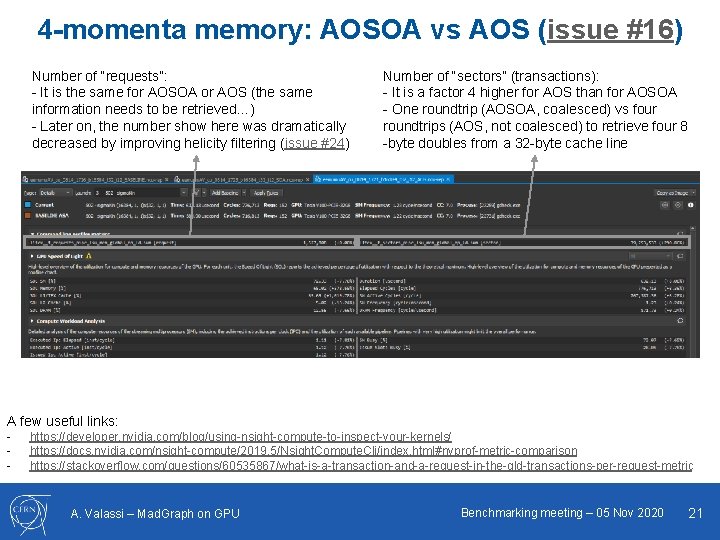
4 -momenta memory: AOSOA vs AOS (issue #16) Number of “requests”: - It is the same for AOSOA or AOS (the same information needs to be retrieved…) - Later on, the number show here was dramatically decreased by improving helicity filtering (issue #24) Number of “sectors” (transactions): - It is a factor 4 higher for AOS than for AOSOA - One roundtrip (AOSOA, coalesced) vs four roundtrips (AOS, not coalesced) to retrieve four 8 -byte doubles from a 32 -byte cache line A few useful links: - https: //developer. nvidia. com/blog/using-nsight-compute-to-inspect-your-kernels/ https: //docs. nvidia. com/nsight-compute/2019. 5/Nsight. Compute. Cli/index. html#nvprof-metric-comparison https: //stackoverflow. com/questions/60535867/what-is-a-transaction-and-a-request-in-the-gld-transactions-per-request-metric A. Valassi – Mad. Graph on GPU Benchmarking meeting – 05 Nov 2020 21
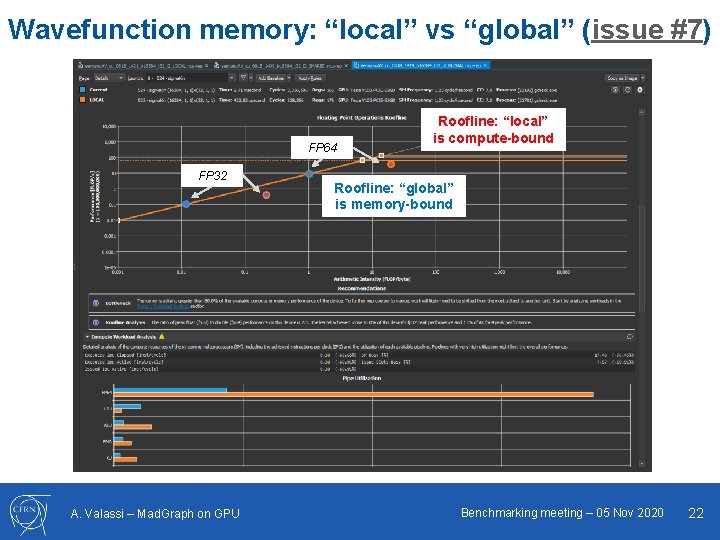
Wavefunction memory: “local” vs “global” (issue #7) FP 64 FP 32 A. Valassi – Mad. Graph on GPU Roofline: “local” is compute-bound Roofline: “global” is memory-bound Benchmarking meeting – 05 Nov 2020 22
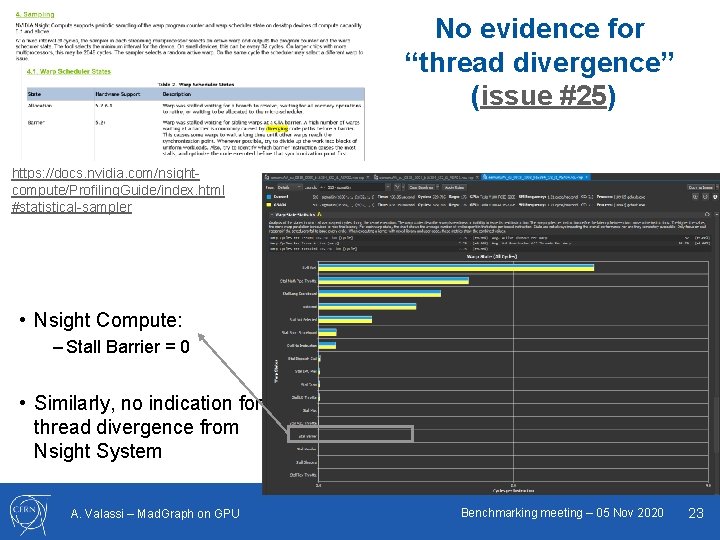
No evidence for “thread divergence” (issue #25) https: //docs. nvidia. com/nsightcompute/Profiling. Guide/index. html #statistical-sampler • Nsight Compute: – Stall Barrier = 0 • Similarly, no indication for thread divergence from Nsight System A. Valassi – Mad. Graph on GPU Benchmarking meeting – 05 Nov 2020 23
- Slides: 23