
Towards a conceptual design M de Jong Introduction

- Slides: 27
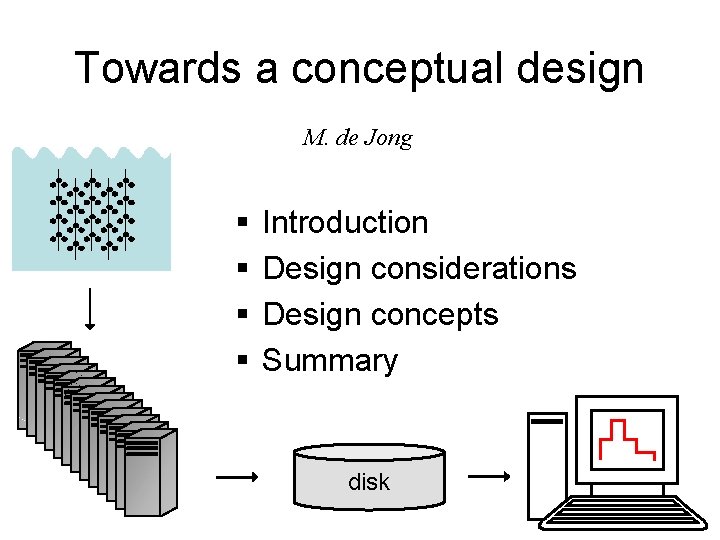
Towards a conceptual design M. de Jong § § Introduction Design considerations Design concepts Summary disk
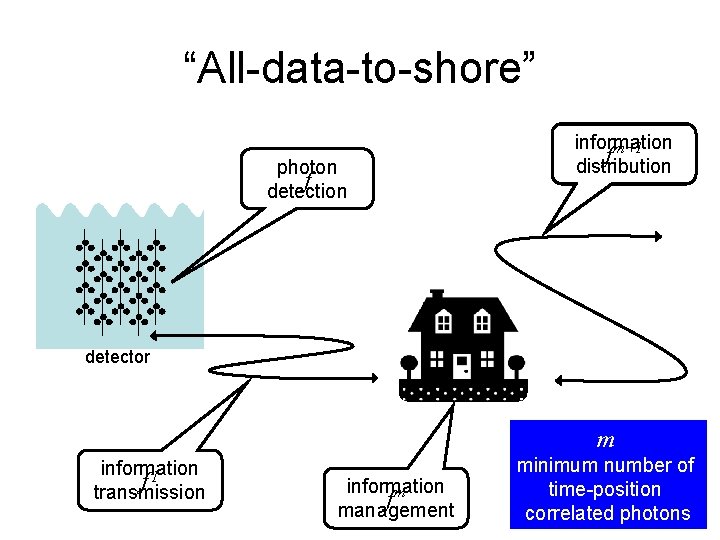
“All-data-to-shore” photon f detection information m+1 f distribution detector m information 1 f transmission information m f management minimum number of time-position correlated photons
“All-data-to-shore” § Scientifically – maximise neutrino detection efficiency – maintain flexibility (also after construction) – enable different physics (e. g. Magnetic Monopole) § Technically – reduce data transmission to a linear problem (scalability) – locate all complexity on shore (reliability) – optimisation of data filter (quality)
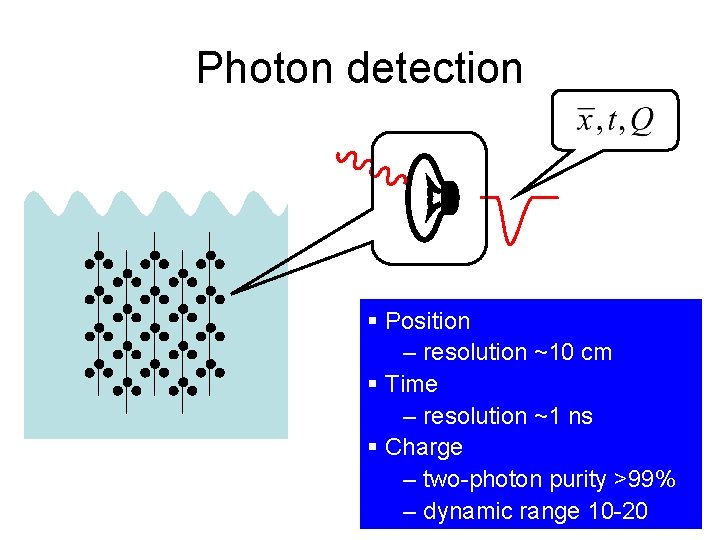
Photon detection § Position – resolution ~10 cm § Time – resolution ~1 ns § Charge – two-photon purity >99% – dynamic range 10 -20
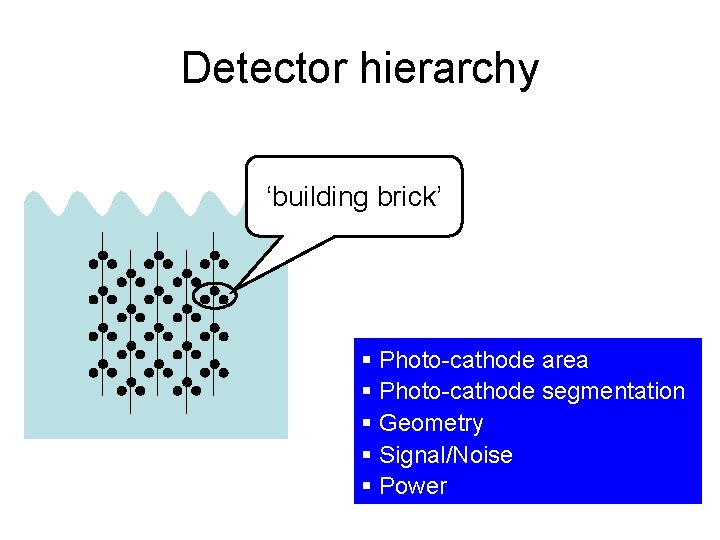
Detector hierarchy ‘building brick’ § Photo-cathode area § Photo-cathode segmentation § Geometry § Signal/Noise § Power
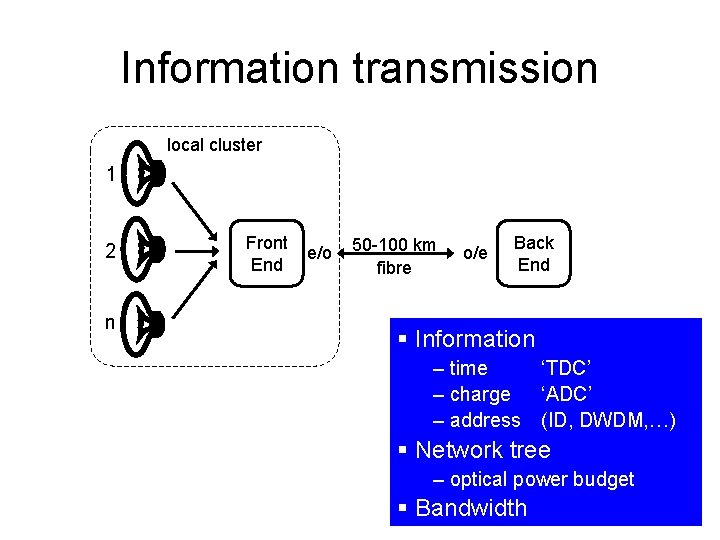
Information transmission local cluster 1 2 n Front End e/o 50 -100 km fibre o/e Back End § Information – time ‘TDC’ – charge ‘ADC’ – address (ID, DWDM, …) § Network tree – optical power budget § Bandwidth
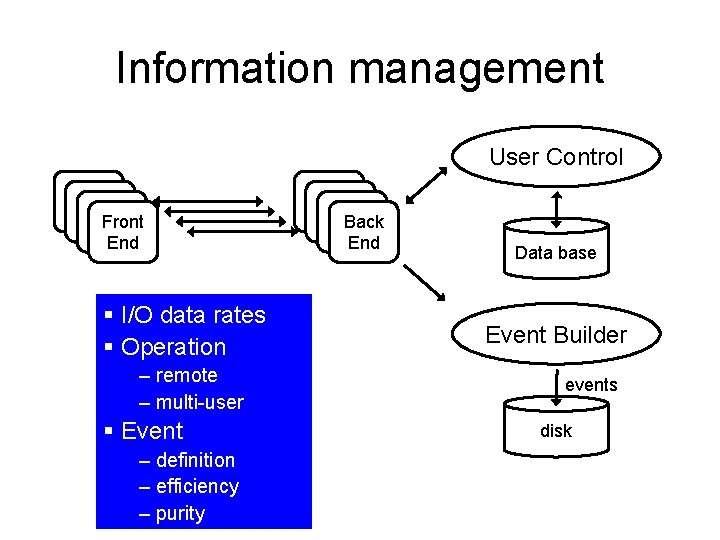
Information management User Control Front End § I/O data rates § Operation – remote – multi-user § Event – definition – efficiency – purity Back End Data base Event Builder events disk
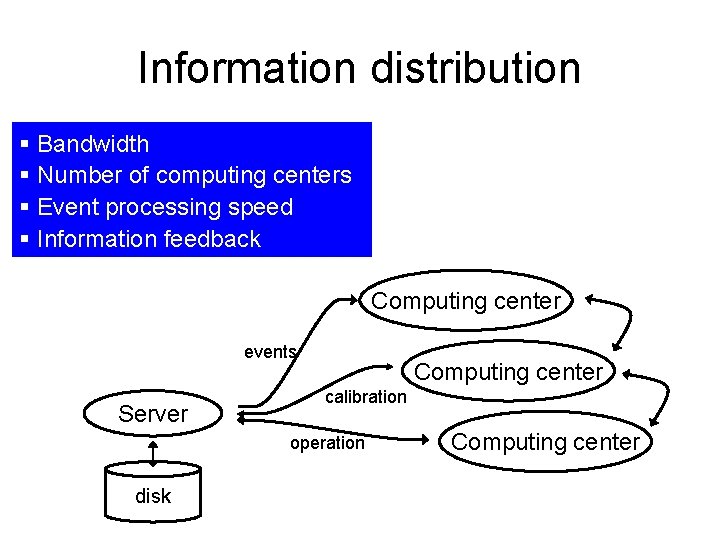
Information distribution § Bandwidth § Number of computing centers § Event processing speed § Information feedback Computing center events Server Computing center calibration operation disk Computing center
Design considerations
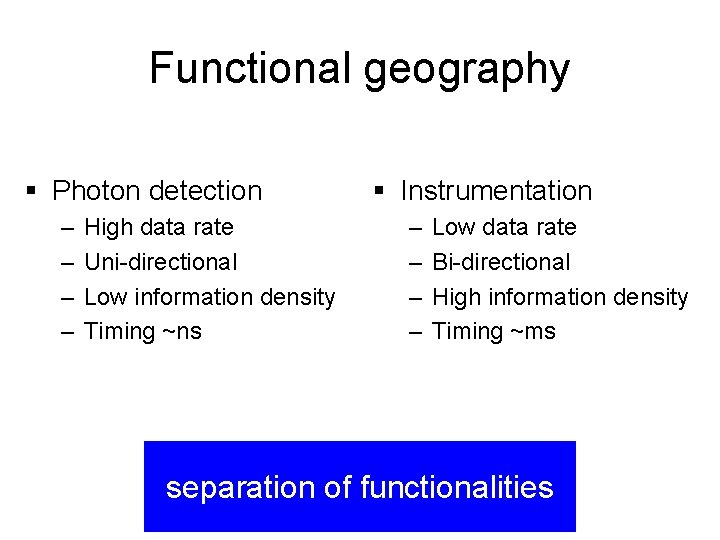
Functional geography § Photon detection – – High data rate Uni-directional Low information density Timing ~ns § Instrumentation – – Low data rate Bi-directional High information density Timing ~ms separation of functionalities
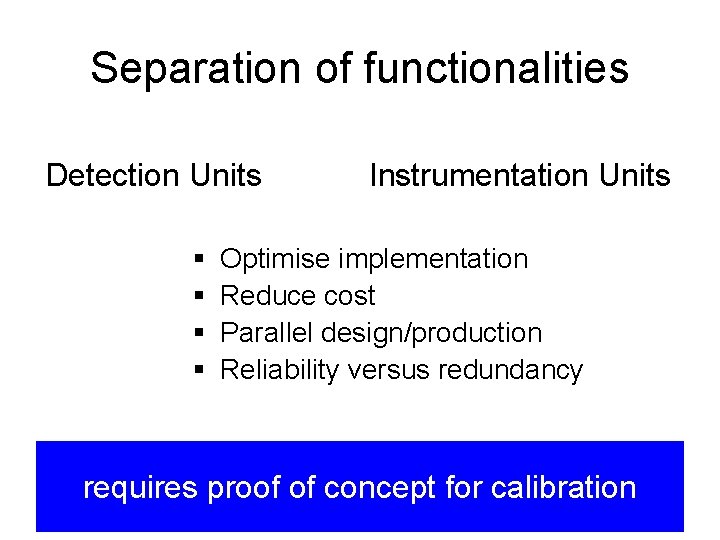
Separation of functionalities Detection Units § § Instrumentation Units Optimise implementation Reduce cost Parallel design/production Reliability versus redundancy requires proof of concept for calibration
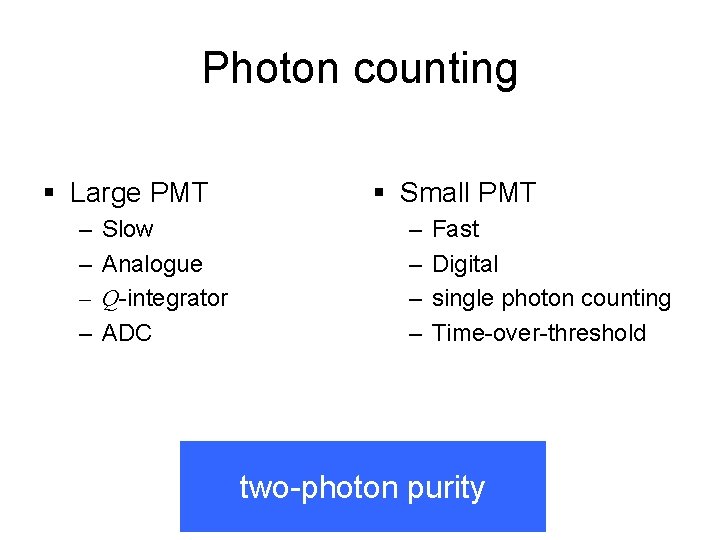
Photon counting § Large PMT – – Slow Analogue Q-integrator ADC § Small PMT – – Fast Digital single photon counting Time-over-threshold two-photon purity
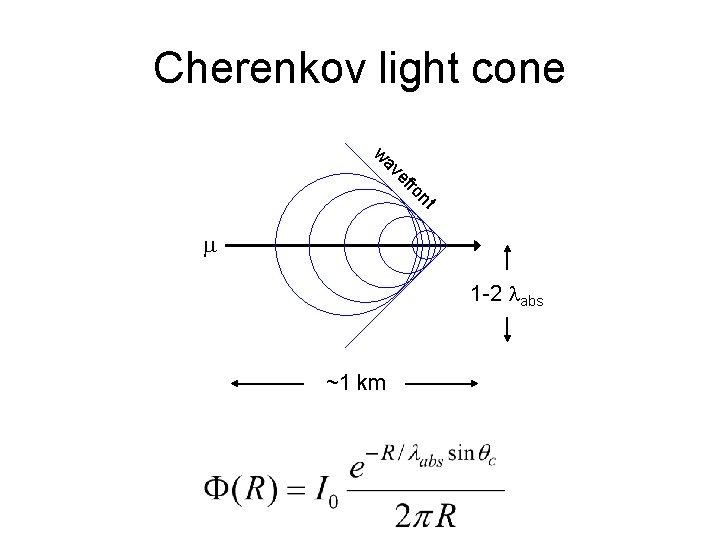
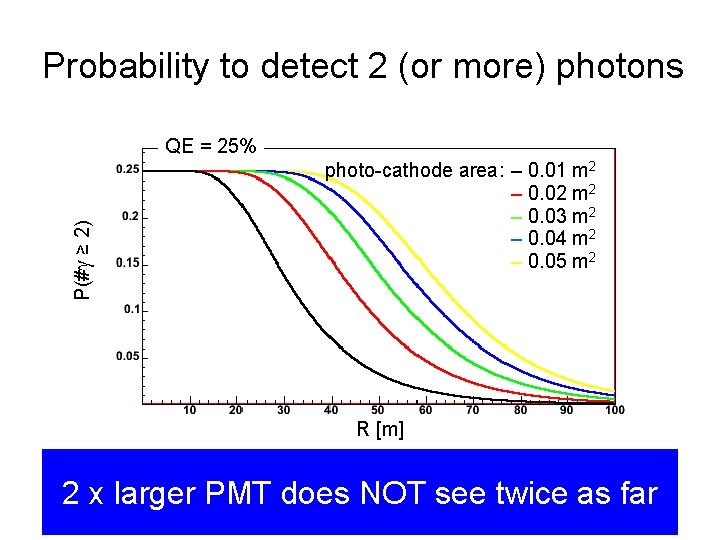
Probability to detect 2 (or more) photons as a function of § photo-cathode area § distance between muon and PMT
Cherenkov light cone w t n ro ef av m 1 -2 labs ~1 km
Probability to detect 2 (or more) photons P(#g ≥ 2) QE = 25% photo-cathode area: – 0. 01 m 2 – 0. 02 m 2 – 0. 03 m 2 – 0. 04 m 2 – 0. 05 m 2 R [m] 2 x larger PMT does NOT see twice as far
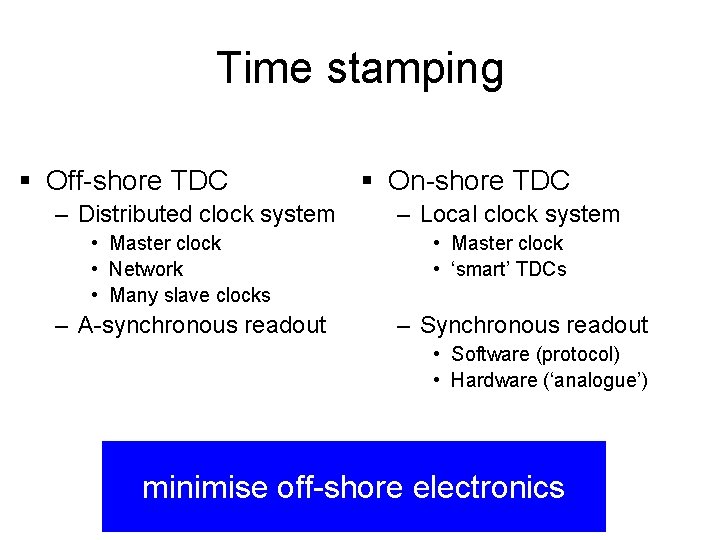
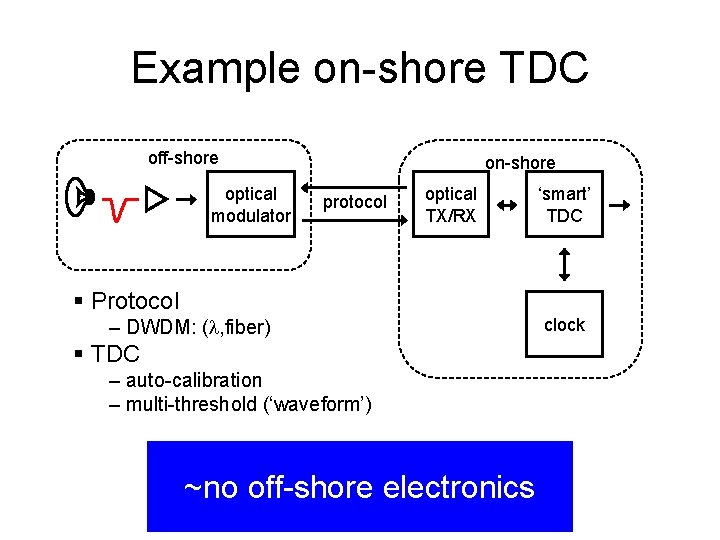
Time stamping § Off-shore TDC – Distributed clock system • Master clock • Network • Many slave clocks – A-synchronous readout § On-shore TDC – Local clock system • Master clock • ‘smart’ TDCs – Synchronous readout • Software (protocol) • Hardware (‘analogue’) minimise off-shore electronics
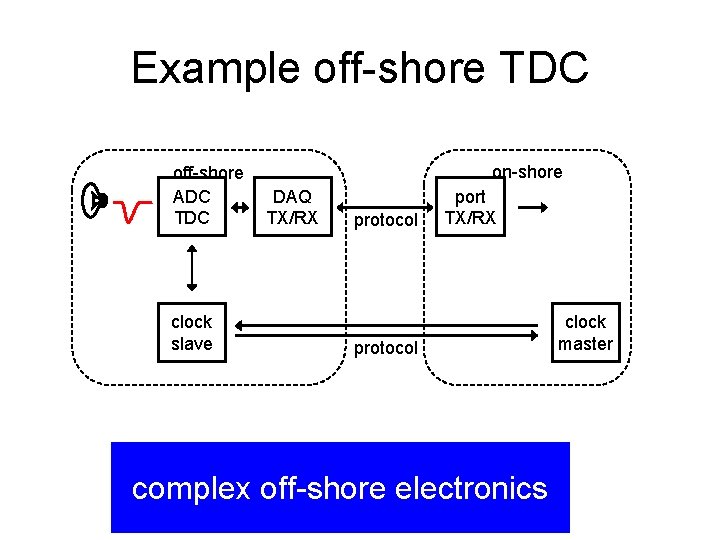
Example off-shore TDC off-shore ADC TDC clock slave on-shore DAQ TX/RX protocol port TX/RX protocol complex off-shore electronics clock master
Example on-shore TDC off-shore optical modulator on-shore protocol optical TX/RX ‘smart’ TDC § Protocol – DWDM: (l, fiber) § TDC – auto-calibration – multi-threshold (‘waveform’) ~no off-shore electronics clock
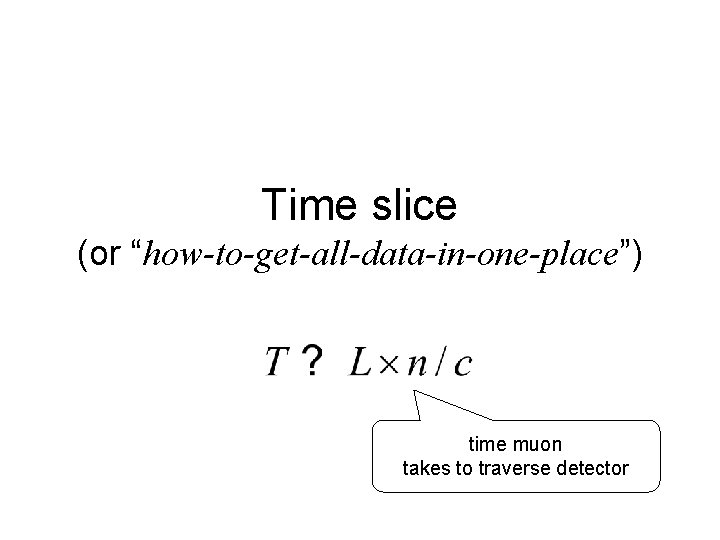
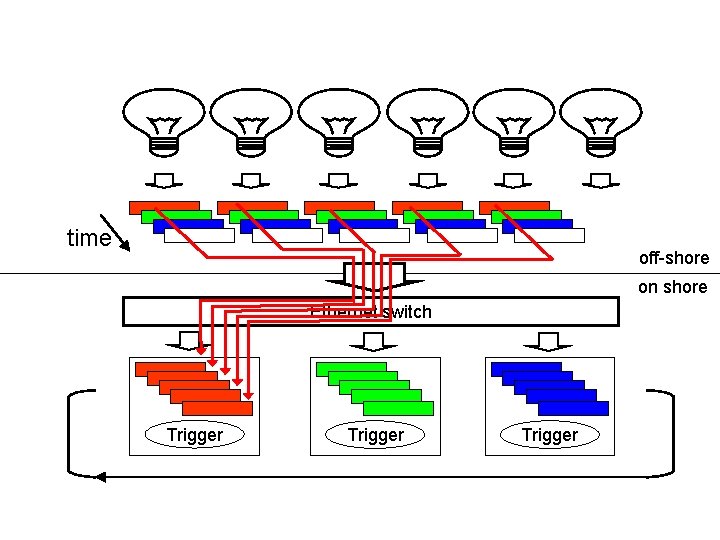
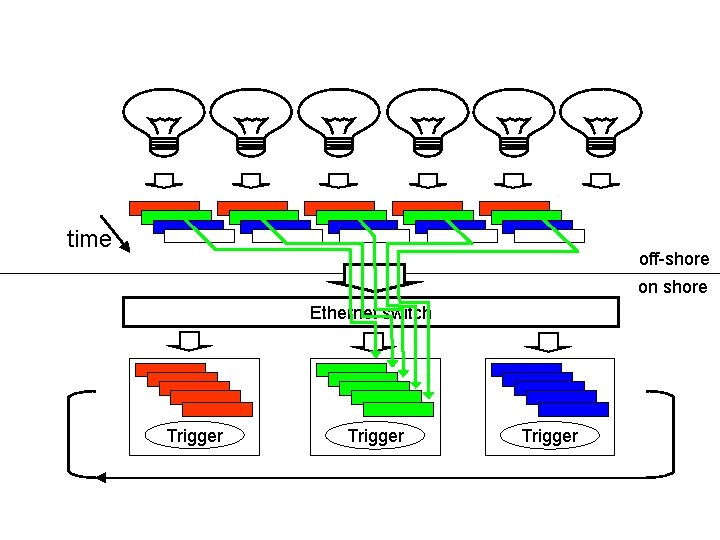
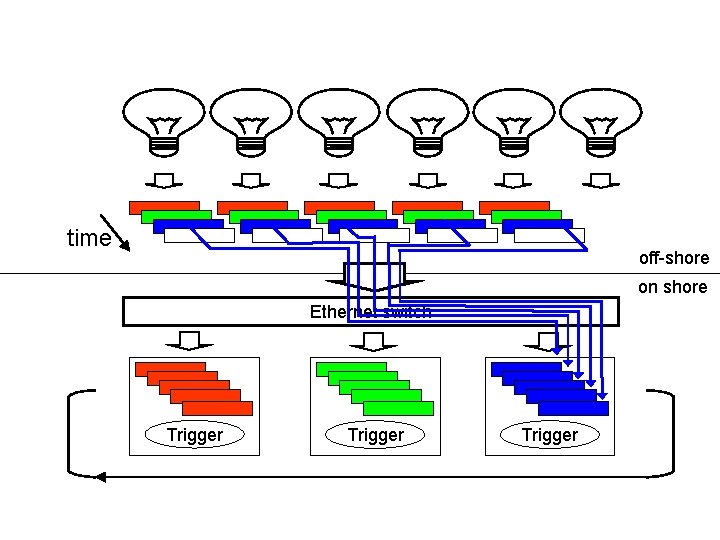
Time slice (or “how-to-get-all-data-in-one-place”) time muon takes to traverse detector
time off-shore on shore Ethernet switch Trigger
time off-shore on shore Ethernet switch Trigger
time off-shore on shore Ethernet switch Trigger
Design concepts (to be updated…) § à la Antares § 1 -1 mixed copper/fibre network § photonics based
à la Antares § § § Design of new front-end chip (Guilloux, Delagnes, Druillole) Design of new FPGA/CPU (Herve, Shebli, Louis) Design of data transmission (Jelle, Henk, Mar) New clock (? ) New slow control (Michel) Network optimisation – copper/fibre (Louis, Henk, ? ) – Ethernet switch (Louis) § Both slow control & data acquisition (mjg)
1 -1 mixed copper/fibre network § Design of multi-functional FPGA system – FPGA/CPU integration (Herve, Shebli) – Slow control (Michel? ) – Front end (Guilloux, Delagnes, Druillole) § Integration of clock & data transmission system – Time synchronisation & calibration (? , Herve, Henk) – Hardware/software (Nemo) § Network optimisation (Jelle, Nemo? , ? )
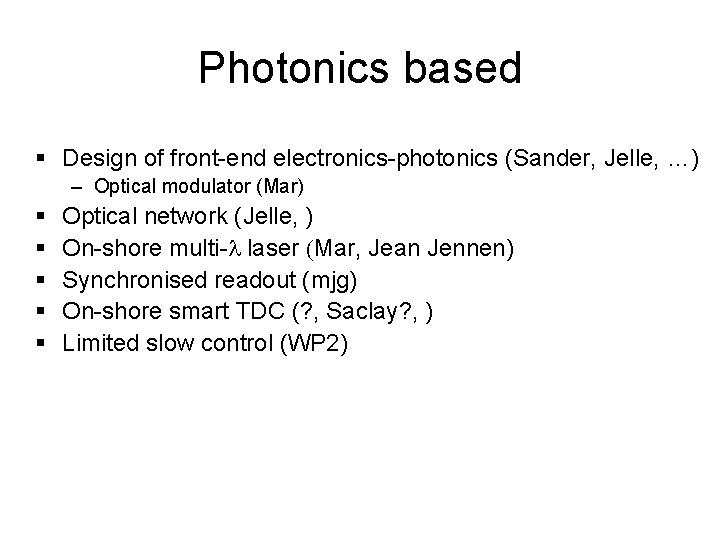
Photonics based § Design of front-end electronics-photonics (Sander, Jelle, …) – Optical modulator (Mar) § § § Optical network (Jelle, ) On-shore multi-l laser (Mar, Jean Jennen) Synchronised readout (mjg) On-shore smart TDC (? , Saclay? , ) Limited slow control (WP 2)
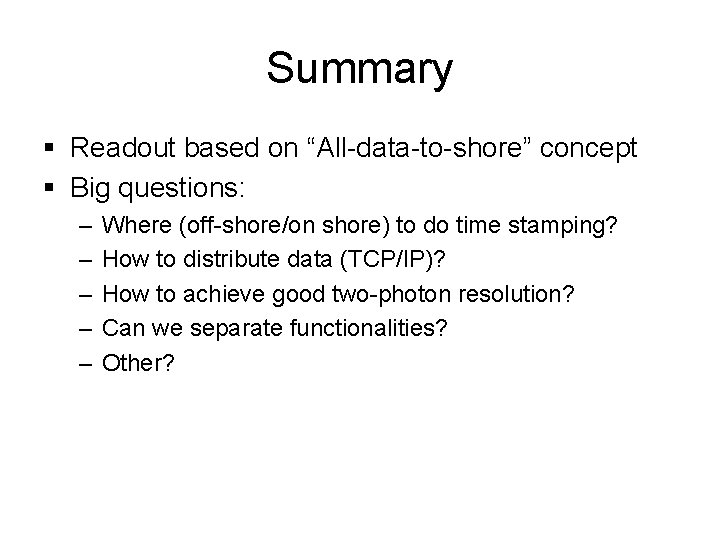
Summary § Readout based on “All-data-to-shore” concept § Big questions: – – – Where (off-shore/on shore) to do time stamping? How to distribute data (TCP/IP)? How to achieve good two-photon resolution? Can we separate functionalities? Other?