
Towards a Better Design of MicroCatchment Water Harvesting

Towards a Better Design of Micro-Catchment Water Harvesting Schemes. By Dave Best

Direct rainwater harvesting from microcatchment schemes (within field catchment systems) • Overland flow harvested from a short catchment. • • • 1 -30 metres. Concentration of surface runoff from a catchment into lower lying cropped area. Ratio of catchment to cultivated area- from 1: 1 to 20: 1. Offers a passive, low cost means of increasing the amount of water available to crops
Advantages over alternative irrigation schemes. • Systems relatively easy to maintain and operate. • Simple and easy to construct • Once constructed little maintenance is required. • Runoff water low salt content
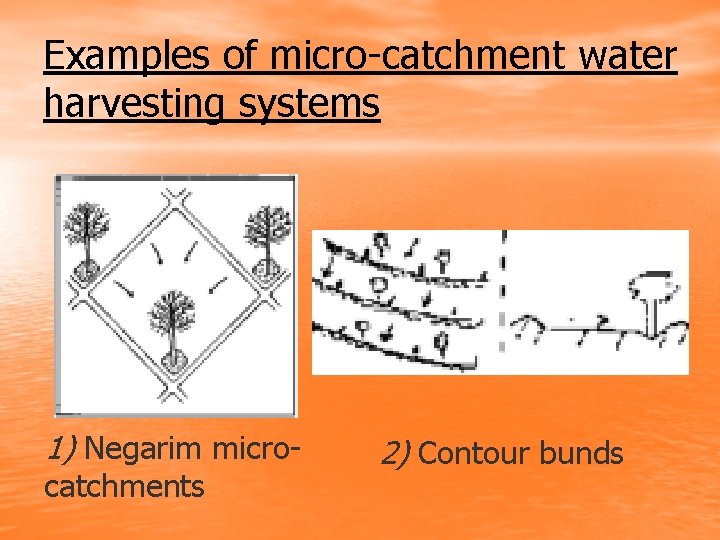
Examples of micro-catchment water harvesting systems 1) Negarim microcatchments 2) Contour bunds

3) Semi circular bunds 4). Contour ridges

Design Considerations • To improve catchment efficiency runoff can be • increased, and infiltration and interception reduced. Balance between the efficiency of a catchment in producing runoff and its susceptibility to erosion – Increasing runoff by clearing slopes of vegetation and compaction of surfaces may lead to greater erosion with longer slope lengths and steeper gradients.
Determination of Catchment yield. • Rainfall Characteristics. – average annual rainfall, peak rainfall intensity, and minimum expected annual precipitation. • Physiographic factors. • Infiltration Capacity.

Catchment : Cultivated area • Rainfall • Runoff • Crop water requirements.
Catchment : Cultivated area -calculations……. • Water Harvested = Catchment area x Design rainfall x Runoff coefficient x Efficiency factor.


Example. • • Crop Water Requirement = 525 mm Design Rainfall = 310 mm Runoff Coefficient == 0. 5 Efficiency Factor == 0. 75 C = 525 – 310 = 1. 85 Ca 310 x 0. 75 x 0. 5
Surface treatments • Mechanical treatments (smoothing and • • compacting). Colloidal dispersion methods (slaking, sodium). Hydrophobic applications (water repellents). Surface binding materials (cementing and sealing) Surface covering (asphalt, rubber and plastic)
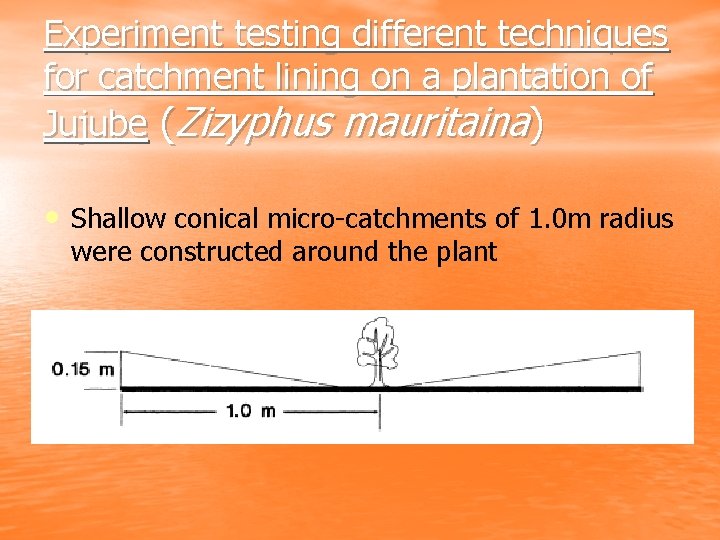
Experiment testing different techniques for catchment lining on a plantation of Jujube (Zizyphus mauritaina) • Shallow conical micro-catchments of 1. 0 m radius were constructed around the plant

The soil moisture depletion pattern in various treatments in a 90 cm profile
Jujube
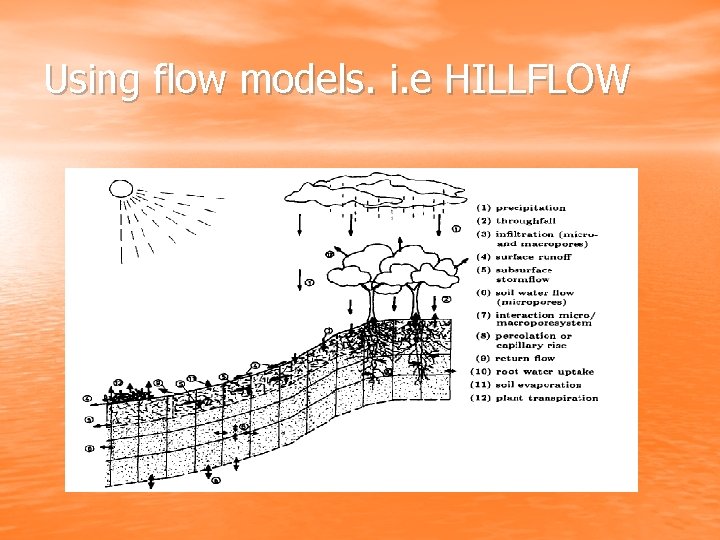
Using flow models. i. e HILLFLOW
- Slides: 16