
Towards a Best Practices Knowledge Management System Presentation
Towards a Best Practices Knowledge Management System Presentation by Vincent Kitio www. bestpractices. org
Best Practices’ Concept United Nations General Assembly defines best practices as initiatives which: Have a demonstrable and tangible impact on improving people’s quality of life; § Result from effective partnerships between public, private and civic sectors of society; § Are socially, culturally, economically and environmentally sustainable. §
Genesis of Best Practices The original call for Best Practices was launched in 1996 during Habitat II conference in Istanbul § The international community defined what constitutes a best practice and adopted guidelines for their documentation and dissemination. § The Habitat Agenda mandates that best practices be used to monitor and assess progress in achieving sustainable urbanization. § The Best Practices and Local Leadership Programme (BLP) was established as a global network of public, private and civil society organizations
Policy Relevance Best Practices are promoted by UN-HABITAT as a means of: § Improving public policy based on what works; § Raising awareness of decision-makers at all levels & of the general public of potential solutions to social, economic and environmental problems; § Assessing emerging issues, trends and policy responses; § Sharing & transferring expertise & experience through networking & peer-to-peer learning city to city collaboration.

Identification of Best Practices Identification is achieved through three principle means: § Targeted search by a global network of institutions; § Calls for best practices using the incentive of the biennial Dubai Award for Best Practices & collaboration with other award and recognition systems; § Ongoing research, operational activities and development project & program.

Documentation of Best Practices § Best Practices are documented by people, communities & organizations who are directly involved in their implementation. § Documentation process is intended as a capacity building exercise as well as an exercise in selfappraisal. § Standardized reporting format for the documentation process has evolved over time due to lessons learned & in response to emerging issues and trends.

Documentation of Best Practices The use of a common set of criteria and a standardized reporting format is useful in identifying and analyzing lessons learned on: § § § How people & communities perceive their problems & what empowers them to undertake or initiate change; What obstacles people & their communities face & approaches effective in overcoming them; What are the: roles, responsibilities & contributions of different social actors & partners; Contributing factors in sustaining an initiative; Promising policy options, effective institutional frameworks & governance systems.
Assessment of Best Practices The evaluation of BP involves a three-step process: validation; technical assessment; and normative assessment. Validation § Involves the global network of partners, ad hoc organizations, & individuals representing relevant geographic and/or thematic expertise and experience. § The aim is to verify that information submitted is an accurate reflection of reality. § The process is carried out through e-mail.
Assessment of Best Practices Technical appraisal: § Undertaken by independent technical advisory committee consisting of 15 experts with equal geographical distribution and gender balance. § The committee meets physically & its mandate is to differentiate between “best”, “good”, “promising” and “not qualifier”. § For each practice the following perspectives are considered: § three basic criteria: impact; partnerships and sustainability § additional criteria: leadership & community empowerment; innovation within the local context; gender equality and social inclusion; and transferability; § Absolute merit within a national and/or local context; § Relative merit in comparison to other practices from same region or in same thematic area.
Assessment of Best Practices Jury § Short-listed practices are forwarded to an Independent Jury made of seniors professional and formal ministers, policy makers, etc. § The Jury uses similar approach in deciding on award-winning practices. § An international press-conference is organized to announce the award-winners. § The short-listed practices are used extensively for research and analysis.
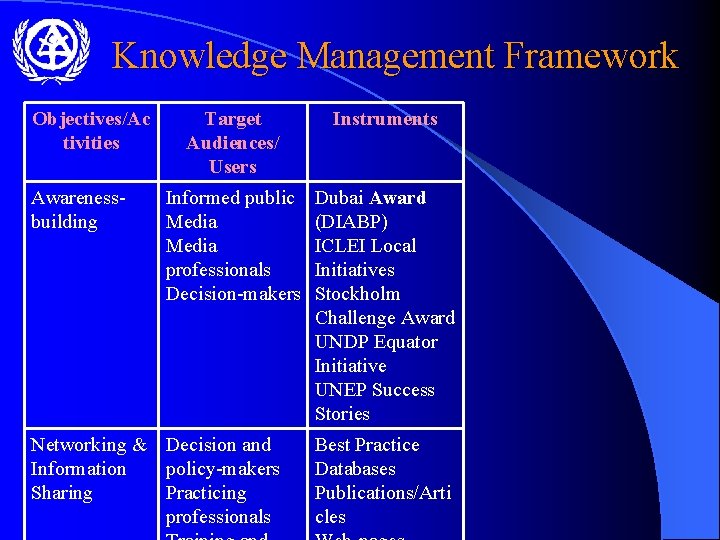
Knowledge Management Framework Objectives/Ac tivities Awarenessbuilding Target Audiences/ Users Instruments Informed public Media professionals Decision-makers Dubai Award (DIABP) ICLEI Local Initiatives Stockholm Challenge Award UNDP Equator Initiative UNEP Success Stories Networking & Decision and Information policy-makers Sharing Practicing professionals Best Practice Databases Publications/Arti cles
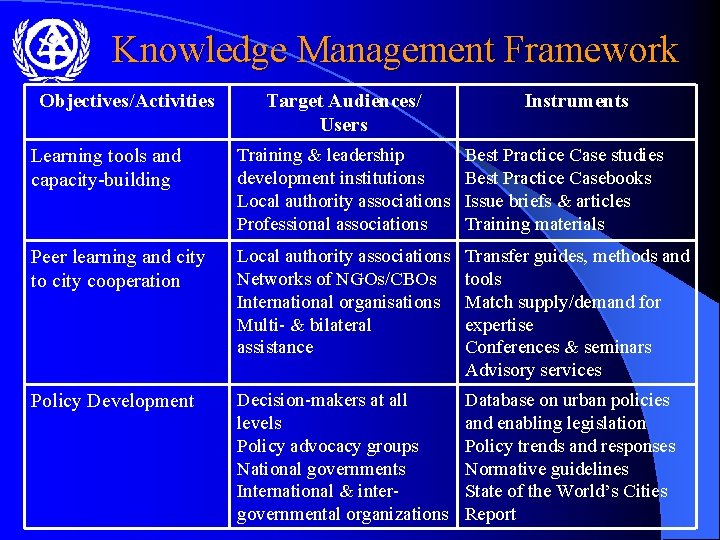
Knowledge Management Framework Objectives/Activities Target Audiences/ Users Instruments Learning tools and capacity-building Training & leadership development institutions Local authority associations Professional associations Best Practice Case studies Best Practice Casebooks Issue briefs & articles Training materials Peer learning and city to city cooperation Local authority associations Networks of NGOs/CBOs International organisations Multi- & bilateral assistance Transfer guides, methods and tools Match supply/demand for expertise Conferences & seminars Advisory services Policy Development Decision-makers at all levels Policy advocacy groups National governments International & intergovernmental organizations Database on urban policies and enabling legislation Policy trends and responses Normative guidelines State of the World’s Cities Report
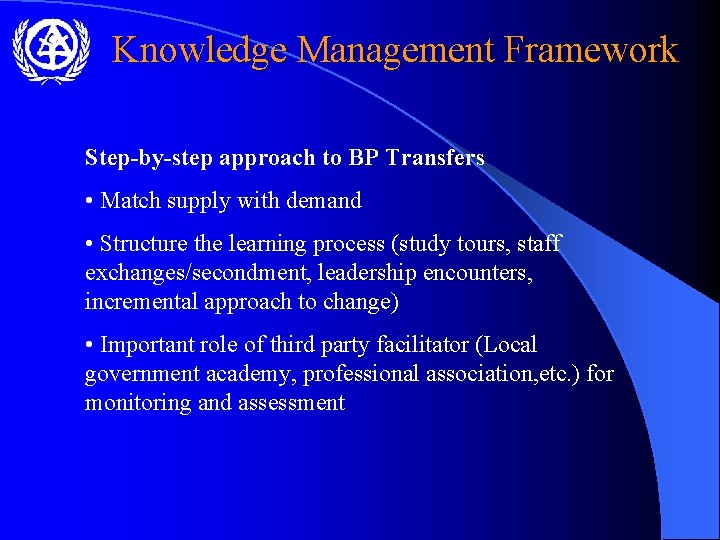
Knowledge Management Framework Step-by-step approach to BP Transfers • Match supply with demand • Structure the learning process (study tours, staff exchanges/secondment, leadership encounters, incremental approach to change) • Important role of third party facilitator (Local government academy, professional association, etc. ) for monitoring and assessment
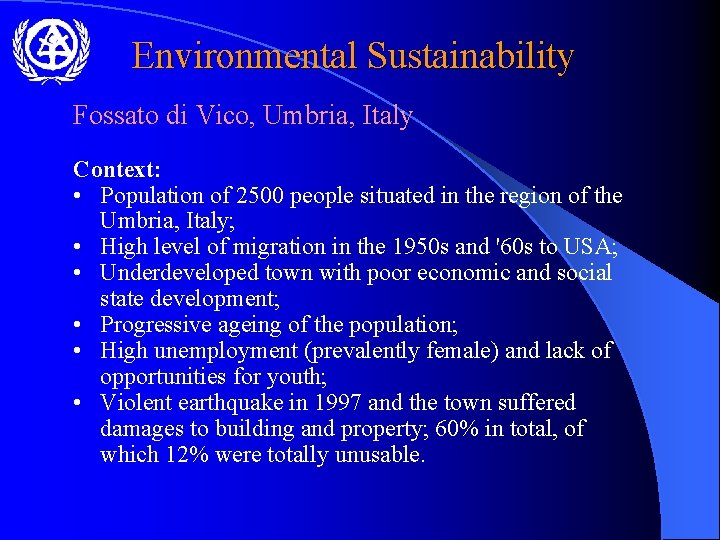
Environmental Sustainability Fossato di Vico, Umbria, Italy Context: • Population of 2500 people situated in the region of the Umbria, Italy; • High level of migration in the 1950 s and '60 s to USA; • Underdeveloped town with poor economic and social state development; • Progressive ageing of the population; • High unemployment (prevalently female) and lack of opportunities for youth; • Violent earthquake in 1997 and the town suffered damages to building and property; 60% in total, of which 12% were totally unusable.
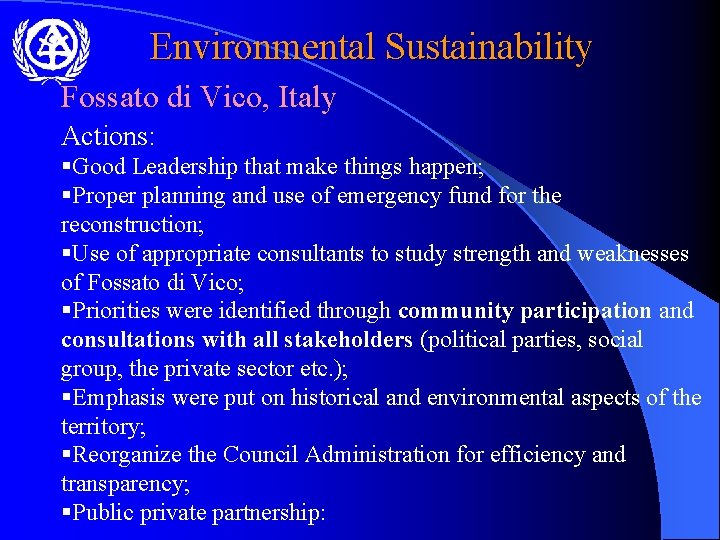
Environmental Sustainability Fossato di Vico, Italy Actions: §Good Leadership that make things happen; §Proper planning and use of emergency fund for the reconstruction; §Use of appropriate consultants to study strength and weaknesses of Fossato di Vico; §Priorities were identified through community participation and consultations with all stakeholders (political parties, social group, the private sector etc. ); §Emphasis were put on historical and environmental aspects of the territory; §Reorganize the Council Administration for efficiency and transparency; §Public private partnership:
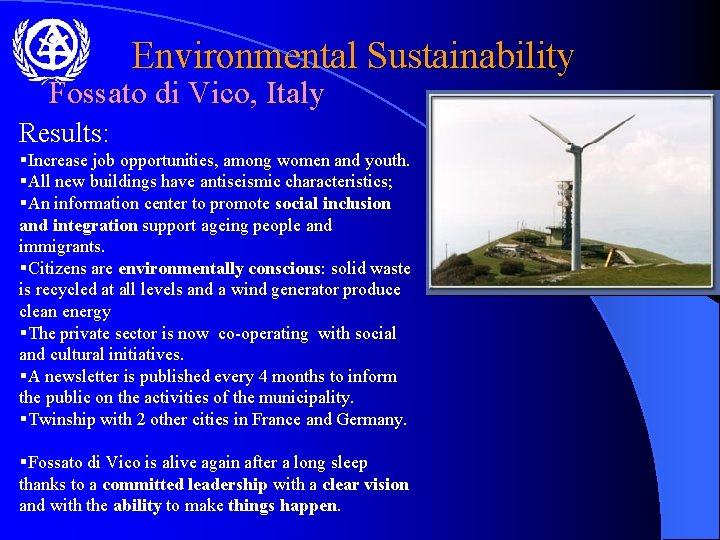
Environmental Sustainability Fossato di Vico, Italy Results: §Increase job opportunities, among women and youth. §All new buildings have antiseismic characteristics; §An information center to promote social inclusion and integration support ageing people and immigrants. §Citizens are environmentally conscious: solid waste is recycled at all levels and a wind generator produce clean energy §The private sector is now co-operating with social and cultural initiatives. §A newsletter is published every 4 months to inform the public on the activities of the municipality. §Twinship with 2 other cities in France and Germany. §Fossato di Vico is alive again after a long sleep thanks to a committed leadership with a clear vision and with the ability to make things happen.
Political Sustainability Porto Alegre, Brazil Context: § Pervasive slums and social exclusion § High levels of urban poverty and unemployment § Corrupt and unresponsive local government
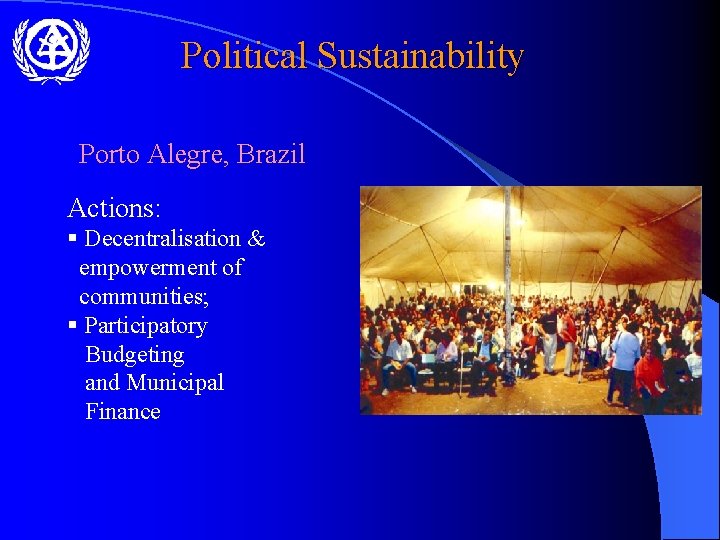
Political Sustainability Porto Alegre, Brazil Actions: § Decentralisation & empowerment of communities; § Participatory Budgeting and Municipal Finance
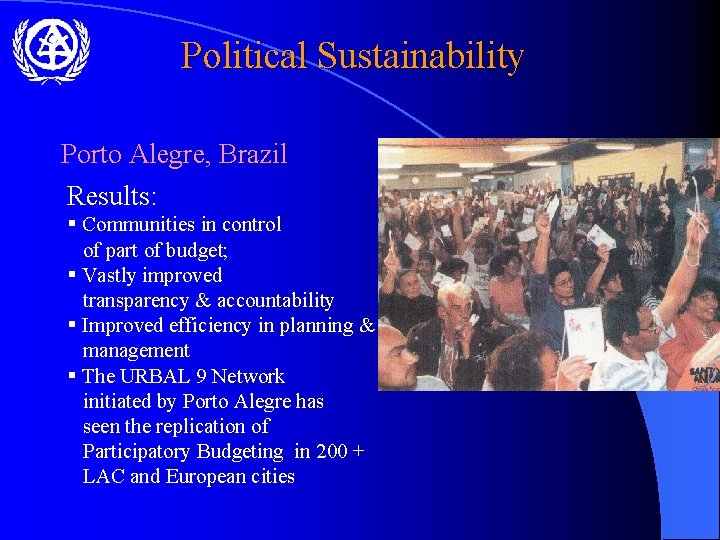
Political Sustainability Porto Alegre, Brazil Results: § Communities in control of part of budget; § Vastly improved transparency & accountability § Improved efficiency in planning & management § The URBAL 9 Network initiated by Porto Alegre has seen the replication of Participatory Budgeting in 200 + LAC and European cities
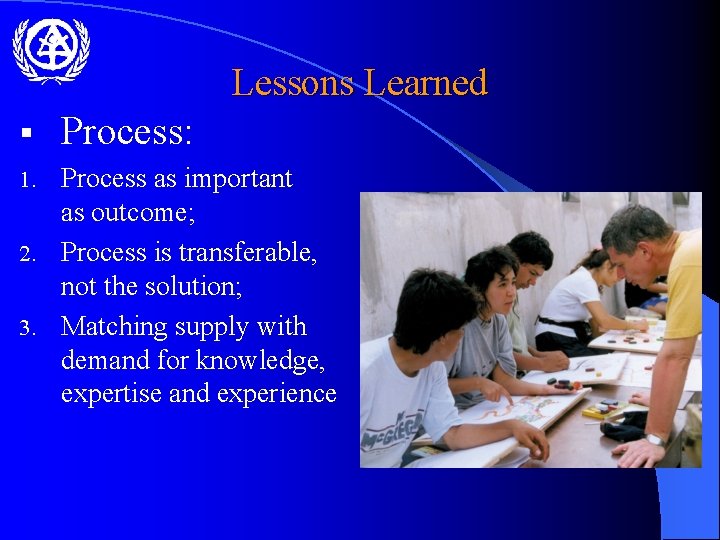
Lessons Learned § Process: Process as important as outcome; 2. Process is transferable, not the solution; 3. Matching supply with demand for knowledge, expertise and experience 1.
Lessons Learned Need to combine: Physical improvements and tangible economic benefits; z Awareness building and effective mechanisms for participation; z Partnerships and improved governance; z Decentralisation and capacity-building. z
Lessons Learned § § Need to focus more on up-scaling and transfer of BPs Need to combine BPs with good policies & legislation Need to promote the creation of national/regional best practices knowledge management system; Need to strengthen and mainstream national/regional BPKM systems as a policy tool.
Pointers for the future z Turn good practices into policies z Refocus debate on inclusive and equitable development z Eliminate competing jurisdictions and redefine the mandate of cities z Balance between participatory & representative democracy
- Slides: 23