
Toward the use of Rydberg states for stateselective
Toward the use of Rydberg states for state-selective production of molecular ions David Grimes, Timothy J Barnum, Stephen Coy, Robert Field Department of Chemistry, MIT
Outline • Why state selected ensembles of molecular ions would be useful • Brief introduction to Rydberg states and autoionization • Explanation of Multichannel Quantum Defect Theory (MQDT) • Results from experiments on Ca. F and resulting predictions • Description of a simpler, more general method 2
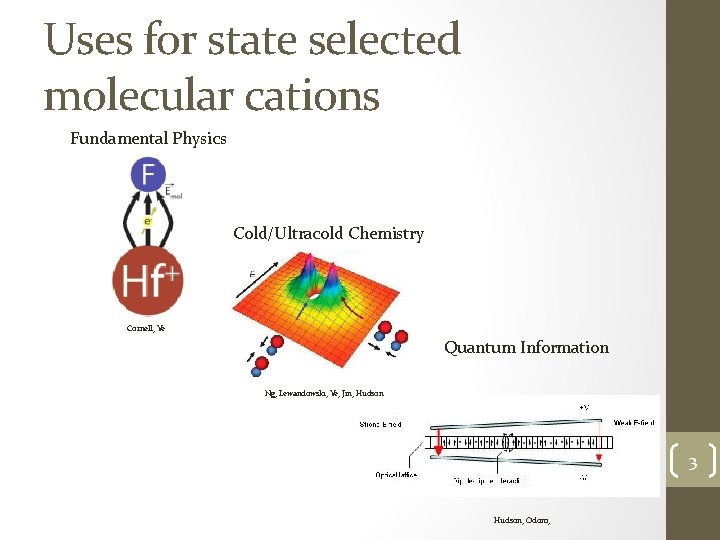
Uses for state selected molecular cations Fundamental Physics Cold/Ultracold Chemistry Cornell, Ye Quantum Information Ng, Lewandowski, Ye, Jin, Hudson 3 Hudson, Odom,
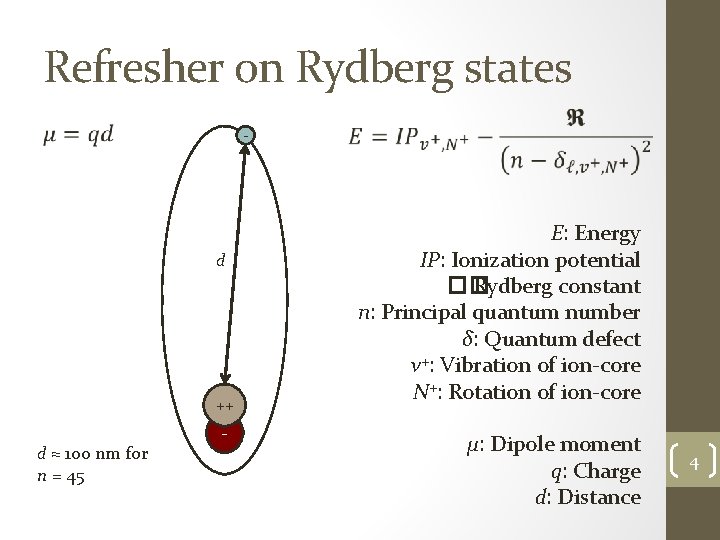
Refresher on Rydberg states - d ++ d ≈ 100 nm for n = 45 - E: Energy IP: Ionization potential �� : Rydberg constant n: Principal quantum number δ: Quantum defect v+: Vibration of ion-core N+: Rotation of ion-core μ: Dipole moment q: Charge d: Distance 4
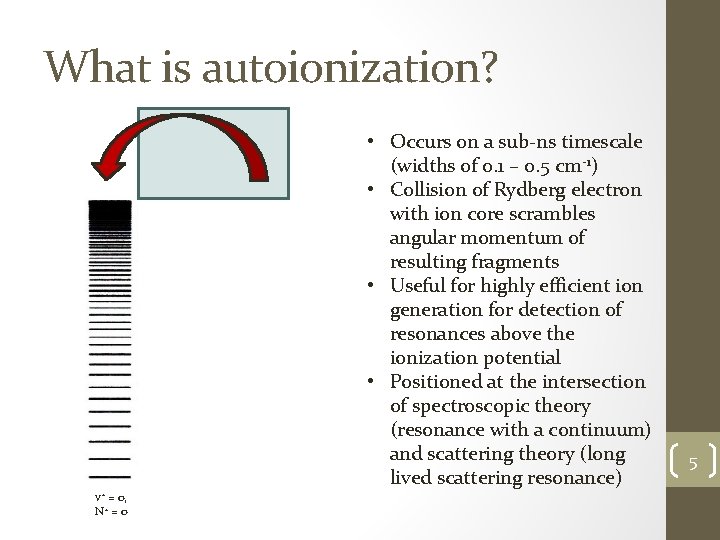
What is autoionization? v+ = 1, N+ = 0 v+ = 0, N+ = 2 v+ = 0, N+ = 0 v+ = 0, N+ = 1 • Occurs on a sub-ns timescale (widths of 0. 1 – 0. 5 cm-1) • Collision of Rydberg electron with ion core scrambles angular momentum of resulting fragments • Useful for highly efficient ion generation for detection of resonances above the ionization potential • Positioned at the intersection of spectroscopic theory (resonance with a continuum) and scattering theory (long lived scattering resonance) 5
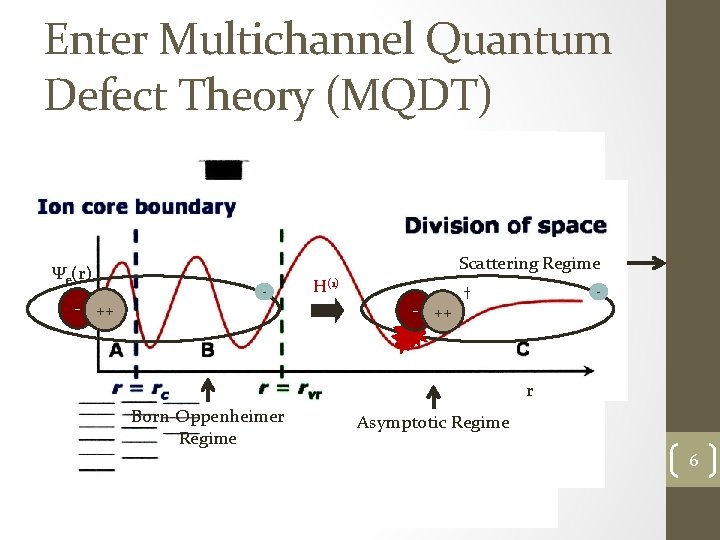
Enter Multichannel Quantum Defect Theory (MQDT) Ψe(r) - ++ Scattering Regime - H(1) - † - ++ r Born-Oppenheimer Regime Asymptotic Regime 6
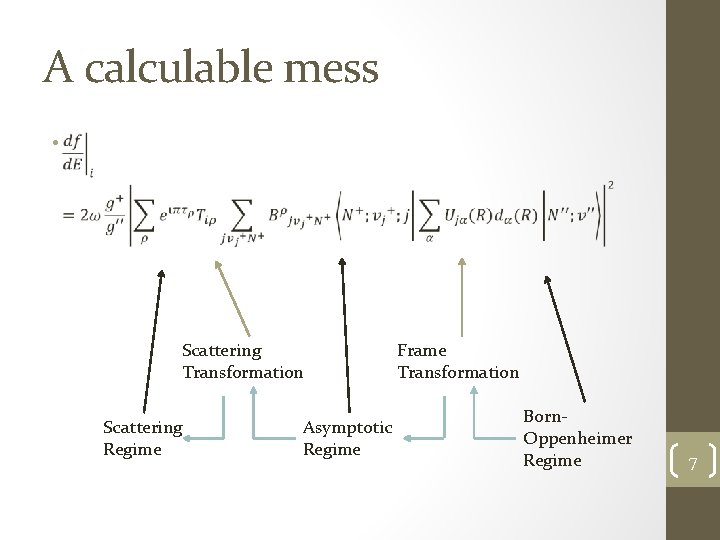
A calculable mess • Scattering Transformation Scattering Regime Asymptotic Regime Frame Transformation Born. Oppenheimer Regime 7
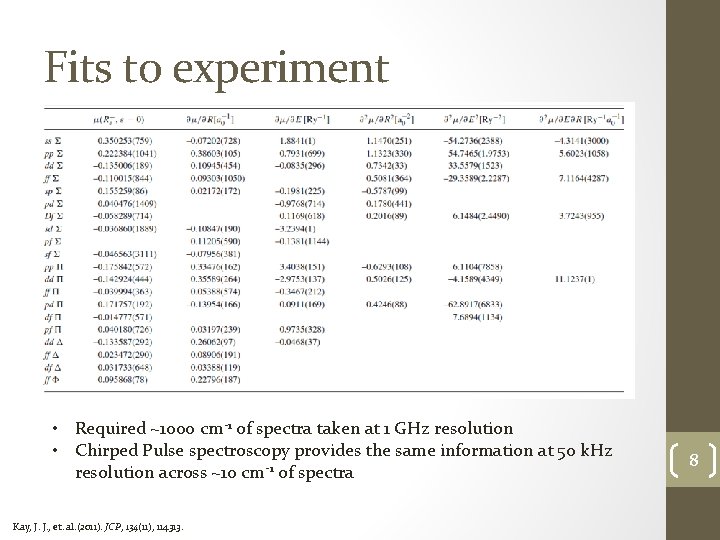
Fits to experiment • Required ~1000 cm-1 of spectra taken at 1 GHz resolution • Chirped Pulse spectroscopy provides the same information at 50 k. Hz resolution across ~10 cm-1 of spectra Kay, J. J. , et. al. (2011). JCP, 134(11), 114313. 8
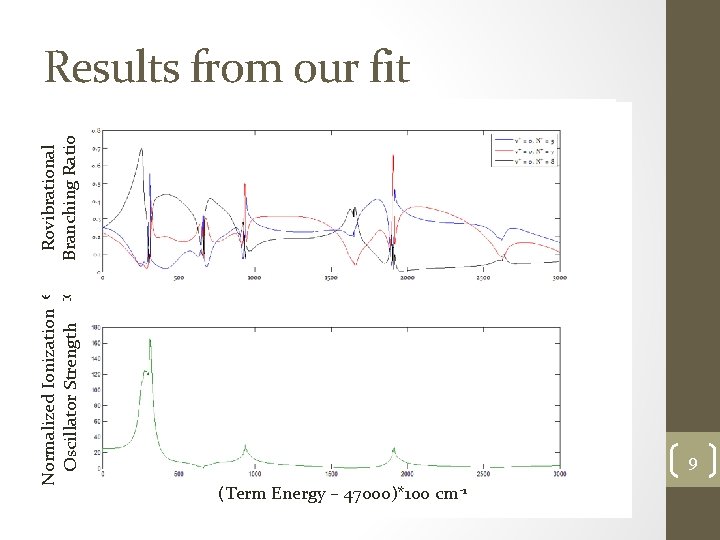
Normalized Ionization Rovibrational Normalized Ionization Oscillator Strength Branching Ratio Oscillator Strength Results from our fit 9 (Term Energy – 47000)*100 cm-1
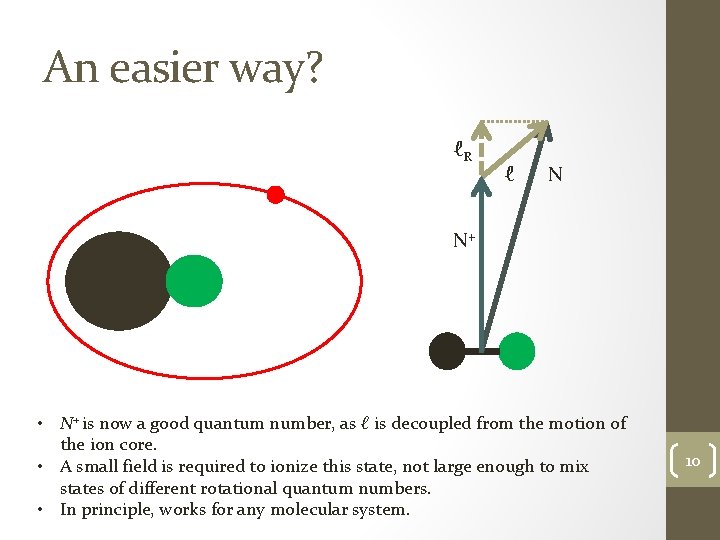
An easier way? ℓR ℓ N N+ • N+ is now a good quantum number, as ℓ is decoupled from the motion of the ion core. • A small field is required to ionize this state, not large enough to mix states of different rotational quantum numbers. • In principle, works for any molecular system. 10
Conclusions • Rydberg states are a promising avenue for gently preparing molecular ions in a single rovibrational state • MQDT is necessary for determining ionization branching ratios for easily accessible Rydberg states • Our CPmm. W spectrometer can provide significantly more accurate fit models. • Core nonpenetrating states (the topic of the next talk) are the easiest way to prepare molecular ions in a single rovibrational state. 11
Acknowledgements • Prof. Robert Field • • • Prof. John Doyle Yan Zhou • Dr. Dave Patterson Tim Barnum Dr. Steve Coy • Prof. Dave De. Mille Ethan Klein • Dr. John Berry Dr. Tony Colombo Dr. Jeff Kay Dr. Carrie Womack • Prof. Brooks Pate Barratt Park • Dr. Justin Neill Jun Jiang Dr. Josh Baraban • Prof. John Bryan Changala Muenter 12
- Slides: 12