
Toward Optimal Simulation Strategies for Understanding Model Biases
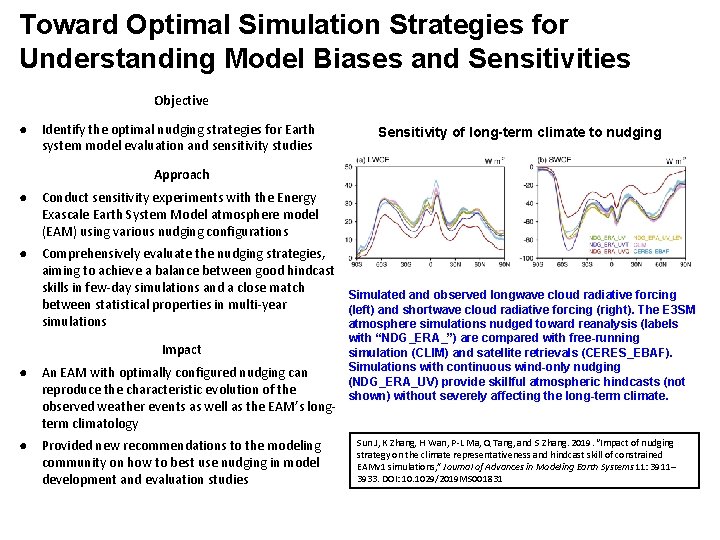
Toward Optimal Simulation Strategies for Understanding Model Biases and Sensitivities Objective ● Identify the optimal nudging strategies for Earth system model evaluation and sensitivity studies Sensitivity of long-term climate to nudging Approach ● Conduct sensitivity experiments with the Energy Exascale Earth System Model atmosphere model (EAM) using various nudging configurations ● Comprehensively evaluate the nudging strategies, aiming to achieve a balance between good hindcast skills in few‐day simulations and a close match Simulated and observed longwave cloud radiative forcing between statistical properties in multi‐year (left) and shortwave cloud radiative forcing (right). The E 3 SM simulations atmosphere simulations nudged toward reanalysis (labels Impact ● An EAM with optimally configured nudging can reproduce the characteristic evolution of the observed weather events as well as the EAM’s long‐ term climatology ● Provided new recommendations to the modeling community on how to best use nudging in model development and evaluation studies with “NDG_ERA_”) are compared with free-running simulation (CLIM) and satellite retrievals (CERES_EBAF). Simulations with continuous wind-only nudging (NDG_ERA_UV) provide skillful atmospheric hindcasts (not shown) without severely affecting the long-term climate. Sun J, K Zhang, H Wan, P‐L Ma, Q Tang, and S Zhang. 2019. “Impact of nudging strategy on the climate representativeness and hindcast skill of constrained EAMv 1 simulations, ” Journal of Advances in Modeling Earth Systems 11: 3911– 3933. DOI: 10. 1029/2019 MS 001831
- Slides: 1