
Toward Gender Focused Governance Reforms Bangkok Thailand Gender
Toward Gender Focused Governance Reforms Bangkok, Thailand Gender Gaps in Labor Market and Policy Responses in Korea 2018. 8. 16. Jongsoog Kim 0
Contents 1. Gender Gaps in Labor Market 2. The Problems 3. Policy Responses in. Korea 4. Remaining Things to do… 1
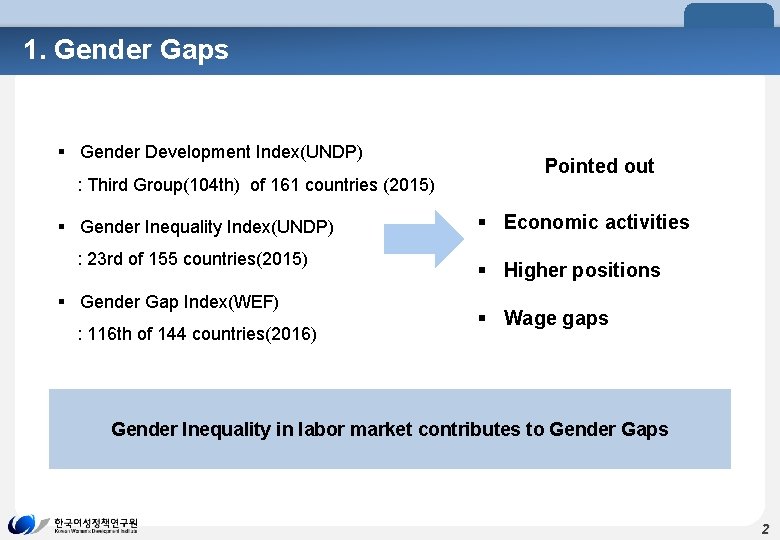
1. Gender Gaps § Gender Development Index(UNDP) : Third Group(104 th) of 161 countries (2015) § Gender Inequality Index(UNDP) : 23 rd of 155 countries(2015) § Gender Gap Index(WEF) : 116 th of 144 countries(2016) Pointed out § Economic activities § Higher positions § Wage gaps Gender Inequality in labor market contributes to Gender Gaps 2
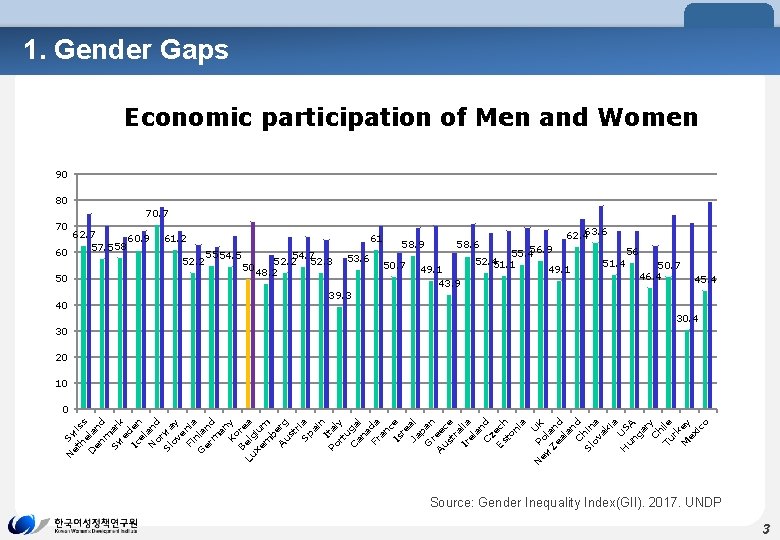
S et wi he ss D la en nd m Sw ar k ed Ic en el N and or Sl wa ov y e Fi nia n G la er nd m an Ko y B re Lu elg a xe iu m m b Au erg st r Sp ia ai n I Po ta rt ly u Ca ga na l Fr da an c Is e re Ja al p G an re Au ec st e ra Ir lia el an Cz d Es ech to ni a U N P K ew o Ze lan al d an Ch d Sl in ov a ak ia U H un SA ga r Ch y Tu ile rk M ey ex ic o N 1. Gender Gaps Economic participation of Men and Women 90 80 70 70. 7 62. 7 60. 9 58 57. 5 60 50 40 61. 2 52. 2 61 55 54. 7 52. 2 52. 3 50 48. 2 53. 6 39. 3 58. 9 50. 7 58. 6 49. 1 43. 9 62. 463. 6 55. 456. 9 52. 451. 1 49. 1 51. 4 56 50. 7 46. 4 45. 4 30 30. 4 20 10 0 Source: Gender Inequality Index(GII). 2017. UNDP 3
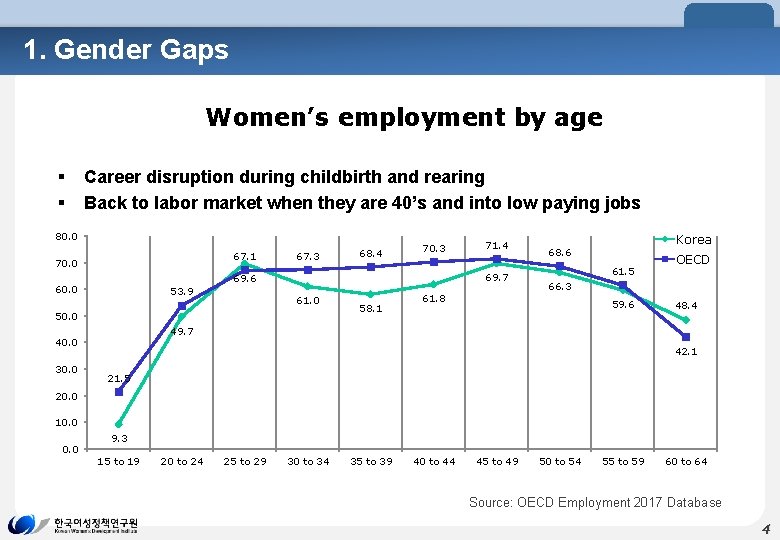
1. Gender Gaps Women’s employment by age § § Career disruption during childbirth and rearing Back to labor market when they are 40’s and into low paying jobs 80. 0 67. 1 70. 0 67. 3 53. 9 71. 4 69. 7 69. 6 60. 0 61. 0 50. 0 58. 1 61. 8 Korea 68. 6 61. 5 OECD 66. 3 59. 6 48. 4 49. 7 40. 0 30. 0 68. 4 70. 3 42. 1 21. 5 20. 0 10. 0 9. 3 15 to 19 20 to 24 25 to 29 30 to 34 35 to 39 40 to 44 45 to 49 50 to 54 55 to 59 60 to 64 Source: OECD Employment 2017 Database 4
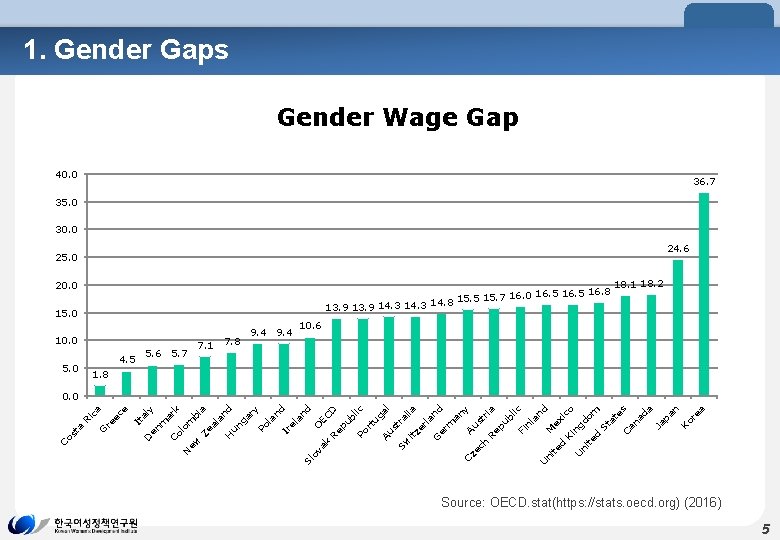
1. Gender Gaps Gender Wage Gap 40. 0 36. 7 35. 0 30. 0 24. 6 25. 0 20. 0 16. 5 16. 8 15. 5 15. 7 16. 0 14. 8 13. 9 14. 3 15. 0 10. 0 5. 6 5. 7 4. 5 7. 1 7. 8 9. 4 18. 1 18. 2 10. 6 1. 8 m Co ark lo N ew mb Ze ia al an d H un ga ry Po la nd Ir el an d Sl ov O EC ak D Re pu b Po lic rt ug al Au st ra Sw itz lia er la nd G er m an y Cz Au ec s tr h Re ia pu bl ic Fi nl an d U ni M te ex d Ki ico ng U ni do te m d St at e Ca s na da Ja pa n Ko re a y al en ec e re G It D Co st a Ri ca 0. 0 Source: OECD. stat(https: //stats. oecd. org) (2016) 5
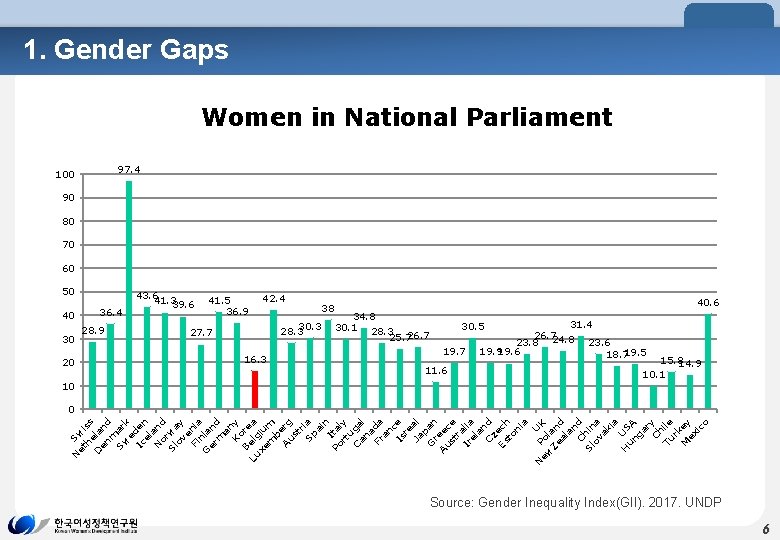
S et wi he ss D la en nd m Sw ar ed k Ic en el N and or Sl wa ov y e Fi nia n G la er nd m an Ko y B r Lu elg ea xe iu m m b Au erg st r Sp ia ai n I Po ta rt ly u Ca ga na l Fr da an c Is e re Ja al p G an re Au e st ce ra Ir lia el an Cz d Es ech to ni a N P UK ew o Ze lan al d an Ch d Sl in ov a ak ia H US un A ga r Ch y Tu ile rk M ey ex ic o N 1. Gender Gaps Women in National Parliament 100 40 30 20 10 97. 4 90 80 70 60 50 36. 4 28. 9 43. 6 41. 339. 6 41. 5 36. 9 42. 4 27. 7 28. 330. 3 16. 3 38 34. 8 30. 1 28. 3 25. 726. 7 40. 6 30. 5 19. 7 11. 6 31. 4 26. 724. 8 23. 6 19. 919. 6 18. 719. 5 15. 814. 9 10. 1 0 Source: Gender Inequality Index(GII). 2017. UNDP 6
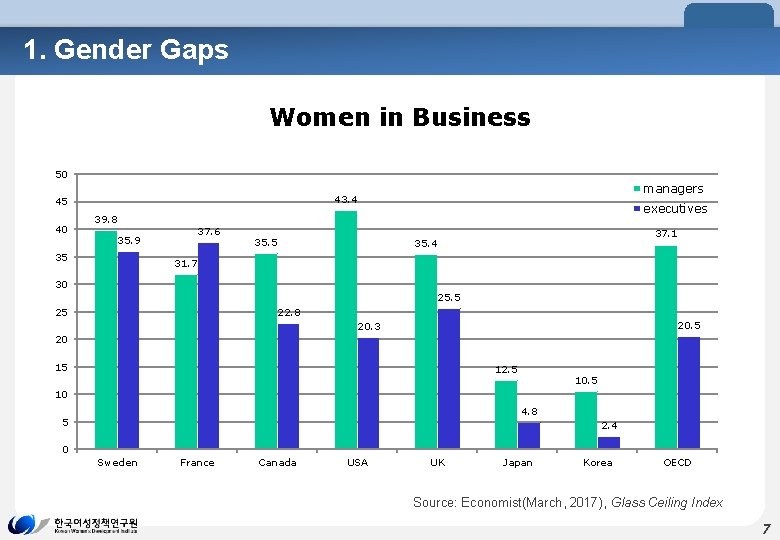
1. Gender Gaps Women in Business 50 40 managers 43. 4 45 39. 8 37. 6 35. 9 35 executives 35. 5 37. 1 35. 4 31. 7 30 25. 5 25 22. 8 20. 5 20. 3 20 15 12. 5 10 4. 8 5 2. 4 0 Sweden France Canada USA UK Japan Korea OECD Source: Economist(March, 2017), Glass Ceiling Index 7
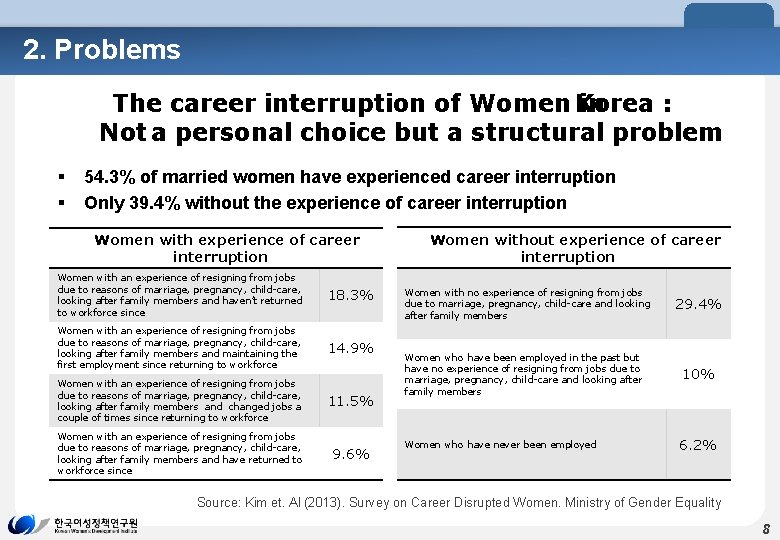
2. Problems The career interruption of Women Korea in : Not a personal choice but a structural problem § § 54. 3% of married women have experienced career interruption Only 39. 4% without the experience of career interruption Women with an experience of resigning from jobs due to reasons of marriage, pregnancy, child-care, looking after family members and haven’t returned to workforce since 18. 3% Women with an experience of resigning from jobs due to reasons of marriage, pregnancy, child-care, looking after family members and maintaining the first employment since returning to workforce 14. 9% Women with an experience of resigning from jobs due to reasons of marriage, pregnancy, child-care, looking after family members and changed jobs a couple of times since returning to workforce 11. 5% Women with an experience of resigning from jobs due to reasons of marriage, pregnancy, child-care, looking after family members and have returned to workforce since 9. 6% Women without experience of career interruption Women with no experience of resigning from jobs due to marriage, pregnancy, child-care and looking after family members 29. 4% Women who have been employed in the past but have no experience of resigning from jobs due to marriage, pregnancy, child-care and looking after family members 10% Women who have never been employed 6. 2% Source: Kim et. Al (2013). Survey on Career Disrupted Women. Ministry of Gender Equality 8
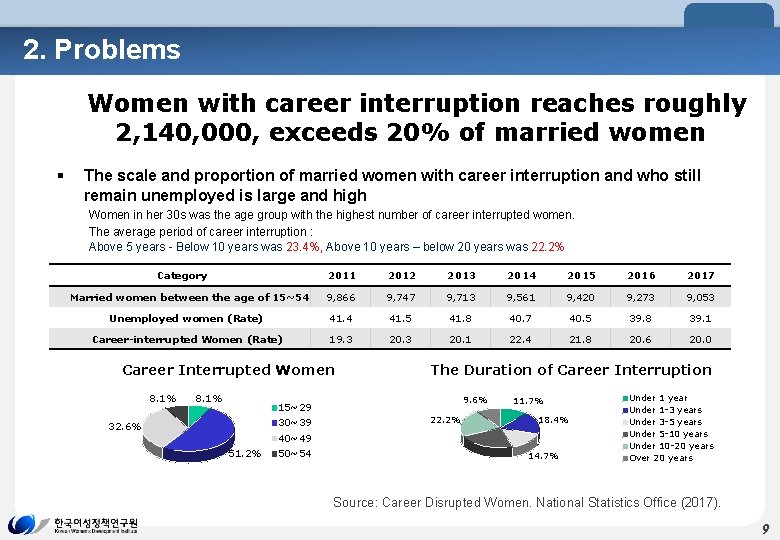
2. Problems Women with career interruption reaches roughly 2, 140, 000, exceeds 20% of married women § The scale and proportion of married women with career interruption and who still remain unemployed is large and high Women in her 30 s was the age group with the highest number of career interrupted women. The average period of career interruption : Above 5 years - Below 10 years was 23. 4%, Above 10 years – below 20 years was 22. 2% Category 2011 2012 2013 2014 2015 2016 2017 Married women between the age of 15~54 9, 866 9, 747 9, 713 9, 561 9, 420 9, 273 9, 053 Unemployed women (Rate) 41. 4 41. 5 41. 8 40. 7 40. 5 39. 8 39. 1 Career-interrupted Women (Rate) 19. 3 20. 1 22. 4 21. 8 20. 6 20. 0 Career Interrupted Women 8. 1% The Duration of Career Interruption 9. 6% 15~29 30~39 32. 6% 22. 2% 11. 7% 18. 4% 40~49 51. 2% 50~54 23. 4% 14. 7% Under 1 year Under 1 -3 years Under 3 -5 years Under 5 -10 years Under 10 -20 years Over 20 years Source: Career Disrupted Women. National Statistics Office (2017). 9
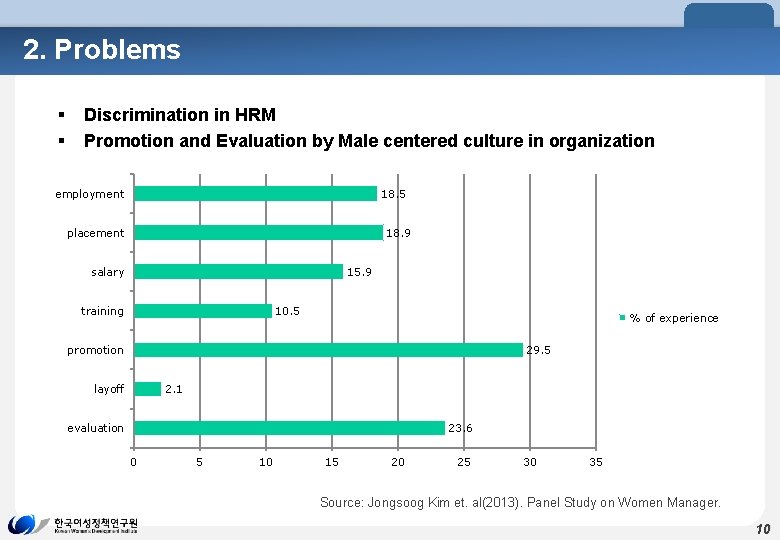
2. Problems § § Discrimination in HRM Promotion and Evaluation by Male centered culture in organization employment 18. 5 placement 18. 9 salary 15. 9 training 10. 5 % of experience promotion 29. 5 layoff 2. 1 evaluation 23. 6 0 5 10 15 20 25 30 35 Source: Jongsoog Kim et. al(2013). Panel Study on Women Manager. 10
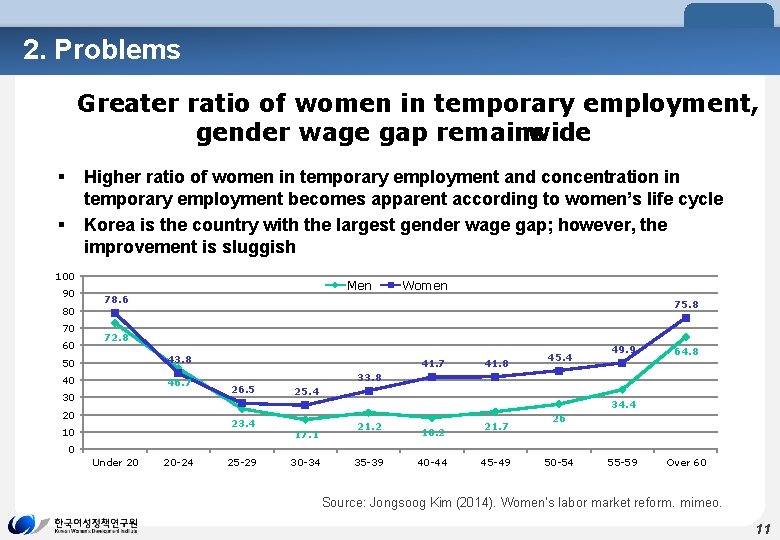
2. Problems Greater ratio of women in temporary employment, gender wage gap remains wide § Higher ratio of women in temporary employment and concentration in temporary employment becomes apparent according to women’s life cycle Korea is the country with the largest gender wage gap; however, the improvement is sluggish § 100 90 80 70 60 Men Women 78. 6 75. 8 72. 8 50 43. 8 40 46. 7 30 41. 7 41. 8 45. 4 49. 9 64. 8 33. 8 26. 5 25. 4 34. 4 20 23. 4 10 17. 1 21. 2 18. 2 21. 7 26 0 Under 20 20 -24 25 -29 30 -34 35 -39 40 -44 45 -49 50 -54 55 -59 Over 60 Source: Jongsoog Kim (2014). Women’s labor market reform. mimeo. 11
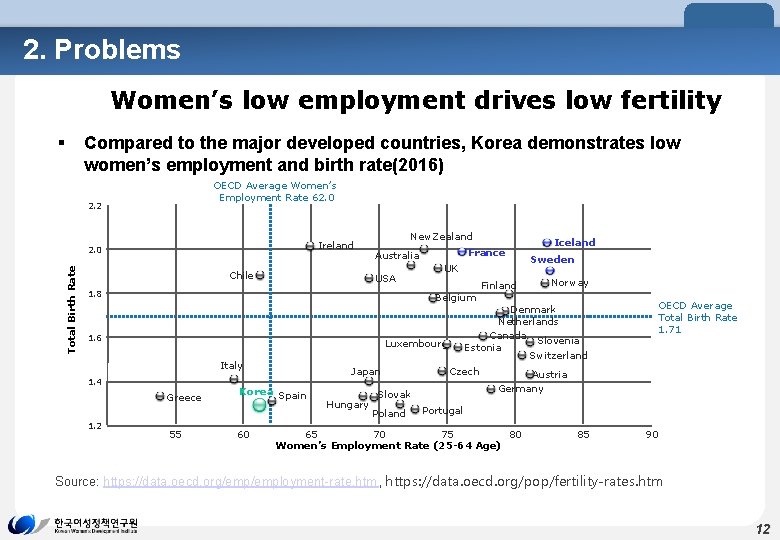
2. Problems Women’s low employment drives low fertility § Compared to the major developed countries, Korea demonstrates low women’s employment and birth rate(2016) OECD Average Women’s Employment Rate 62. 0 2. 2 Ireland Total Birth Rate 2. 0 Chile New. Zealand USA 1. 8 UK Finland Iceland Sweden Norway Belgium 1. 6 1. 4 Greece 55 Japan Korea Spain 60 Hungary Czech Slovak Poland OECD Average Total Birth Rate 1. 71 Denmark Netherlands Canada Slovenia Estonia Switzerland Luxembourg Italy 1. 2 France Australia Austria Germany Portugal 65 70 75 80 Women’s Employment Rate (25 -64 Age) 85 90 Source: https: //data. oecd. org/employment-rate. htm, https: //data. oecd. org/pop/fertility-rates. htm 12
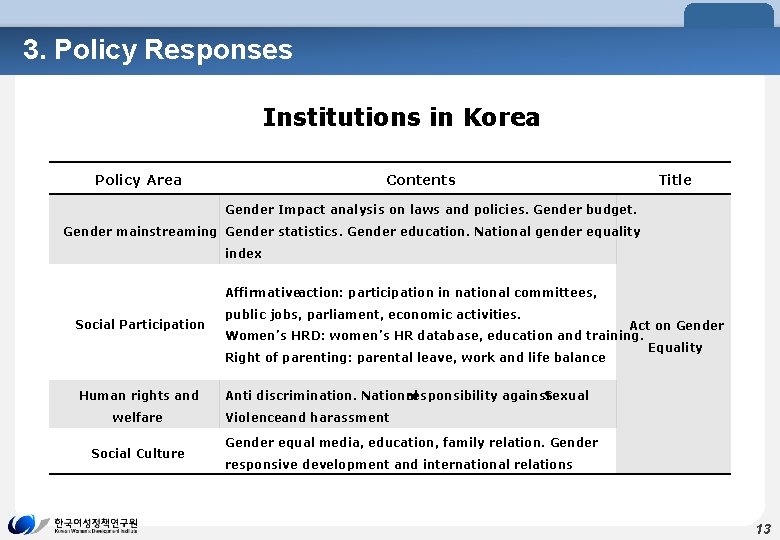
3. Policy Responses Institutions in Korea Policy Area Contents Title Gender Impact analysis on laws and policies. Gender budget. Gender mainstreaming Gender statistics. Gender education. National gender equality index Affirmativeaction: participation in national committees, Social Participation Human rights and welfare Social Culture public jobs, parliament, economic activities. Act on Gender Women’s HRD: women’s HR database, education and training. Equality Right of parenting: parental leave, work and life balance Anti discrimination. National responsibility against Sexual Violenceand harassment Gender equal media, education, family relation. Gender responsive development and international relations 13
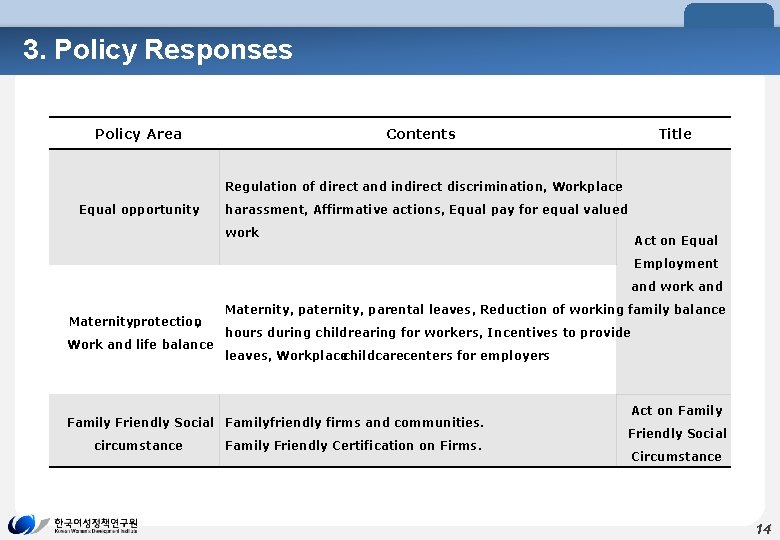
3. Policy Responses Policy Area Contents Title Regulation of direct and indirect discrimination, Workplace Equal opportunity harassment, Affirmative actions, Equal pay for equal valued work Act on Equal Employment and work and Maternityprotection , Work and life balance Maternity, parental leaves, Reduction of working family balance hours during childrearing for workers, Incentives to provide leaves, Workplacechildcarecenters for employers Family Friendly Social Family friendly firms and communities. circumstance Family Friendly Certification on Firms. Act on Family Friendly Social Circumstance 14
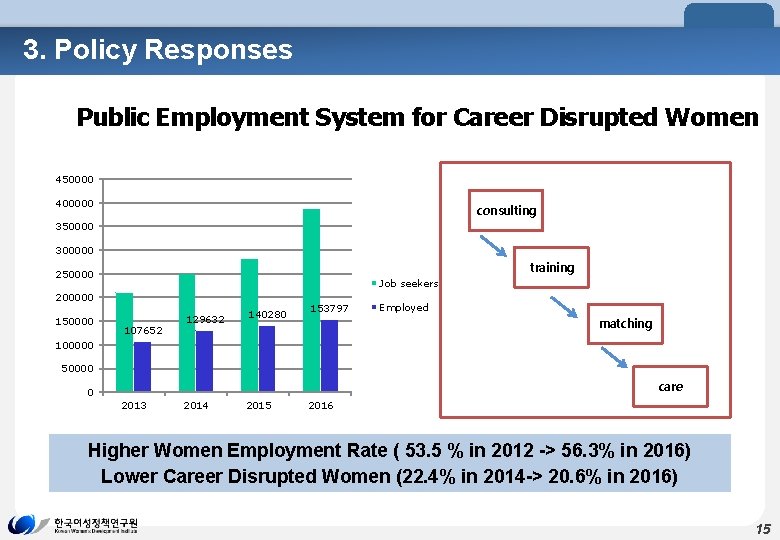
3. Policy Responses Public Employment System for Career Disrupted Women 450000 400000 consulting 350000 300000 training 250000 Job seekers 200000 150000 107652 129632 140280 153797 Employed matching 100000 50000 care 0 2013 2014 2015 2016 Higher Women Employment Rate ( 53. 5 % in 2012 -> 56. 3% in 2016) Lower Career Disrupted Women (22. 4% in 2014 -> 20. 6% in 2016) 15
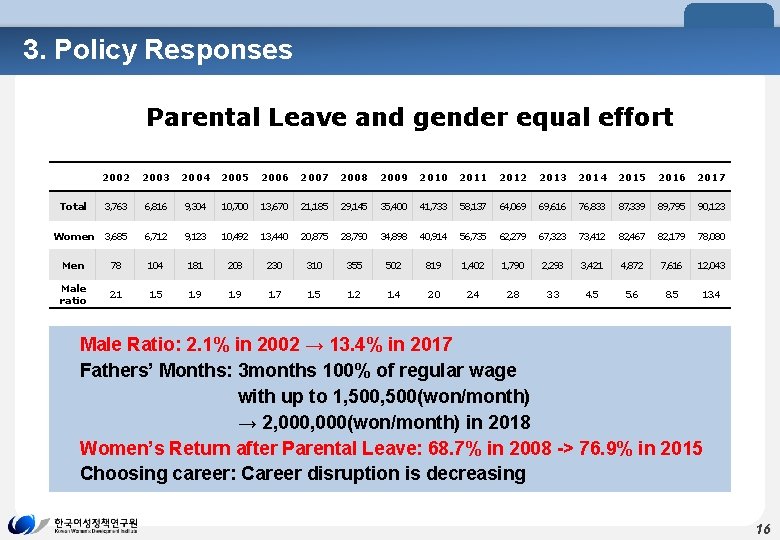
3. Policy Responses Parental Leave and gender equal effort 2002 2003 2004 2005 2006 2007 2008 2009 2010 2011 2012 2013 2014 2015 2016 2017 3, 763 6, 816 9, 304 10, 700 13, 670 21, 185 29, 145 35, 400 41, 733 58, 137 64, 069 69, 616 76, 833 87, 339 89, 795 90, 123 Women 3, 685 6, 712 9, 123 10, 492 13, 440 20, 875 28, 790 34, 898 40, 914 56, 735 62, 279 67, 323 73, 412 82, 467 82, 179 78, 080 Total Men 78 104 181 208 230 310 355 502 819 1, 402 1, 790 2, 293 3, 421 4, 872 7, 616 12, 043 Male ratio 2. 1 1. 5 1. 9 1. 7 1. 5 1. 2 1. 4 2. 0 2. 4 2. 8 3. 3 4. 5 5. 6 8. 5 13. 4 Male Ratio: 2. 1% in 2002 → 13. 4% in 2017 Fathers’ Months: 3 months 100% of regular wage with up to 1, 500(won/month) → 2, 000(won/month) in 2018 Women’s Return after Parental Leave: 68. 7% in 2008 -> 76. 9% in 2015 Choosing career: Career disruption is decreasing 16
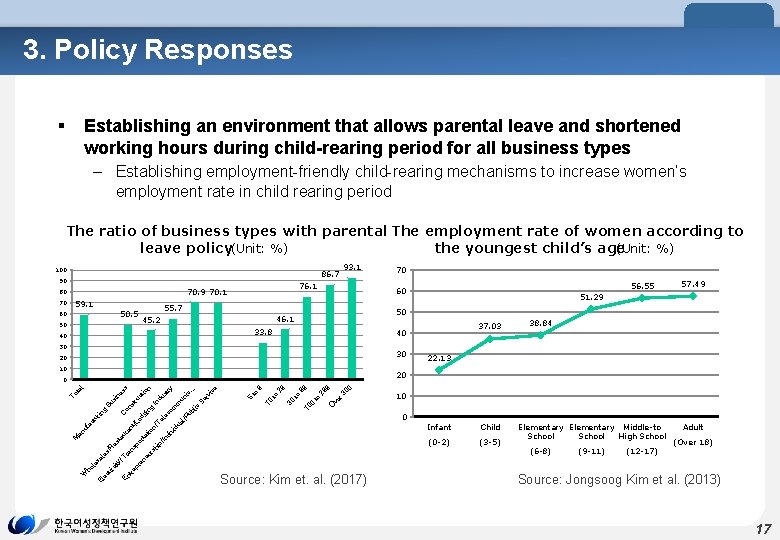
3. Policy Responses § Establishing an environment that allows parental leave and shortened working hours during child-rearing period for all business types – Establishing employment-friendly child-rearing mechanisms to increase women’s employment rate in child rearing period The ratio of business types with parental The employment rate of women according to leave policy(Unit: %) the youngest child’s age (Unit: %) 100 86. 7 90 70 76. 1 70. 9 70. 1 80 59. 1 50. 5 60 50 93. 1 57. 49 51. 29 50 46. 1 33. 8 40 56. 55 60 55. 7 45. 2 70 37. 03 40 30 30 20 10 38. 84 22. 13 20 ve r 3 00 29 9 O to to 99 0 10 29 30 9 to to 10 5 in es s on ns st t / ru Lo pr po ct en dg rta io eu in n tio g rs n I hi /T n du p/ e In le st di co ry vi m du m al u ni /P c. ub. . lic Se rv ic e ct an fa ur an u ra Child (0 -2) (3 -5) Elementary Middle-to School High School (6 -8) (9 -11) (12 -17) Adult (Over 18) En ci tri ec El tre ty sa le ho Infant /T le s/ R es ta M W 10 0 C ur in g Bu s To ta l 0 Source: Kim et. al. (2017) Source: Jongsoog Kim et al. (2013) 17
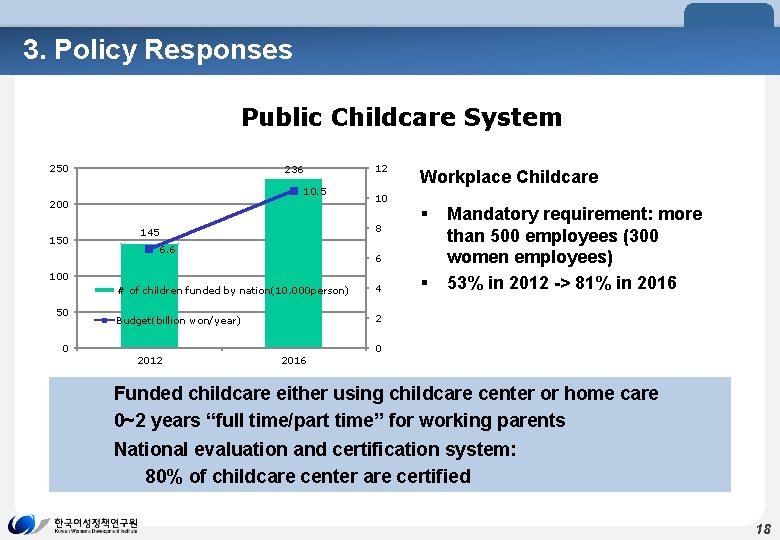
3. Policy Responses Public Childcare System 250 236 10. 5 200 150 10 8 145 6. 6 Workplace Childcare § 6 100 50 12 # of children funded by nation(10, 000 person) 4 Budget(billion won/year) 2 0 § Mandatory requirement: more than 500 employees (300 women employees) 53% in 2012 -> 81% in 2016 0 2012 2016 Funded childcare either using childcare center or home care 0~2 years “full time/part time” for working parents National evaluation and certification system: 80% of childcare center are certified 18
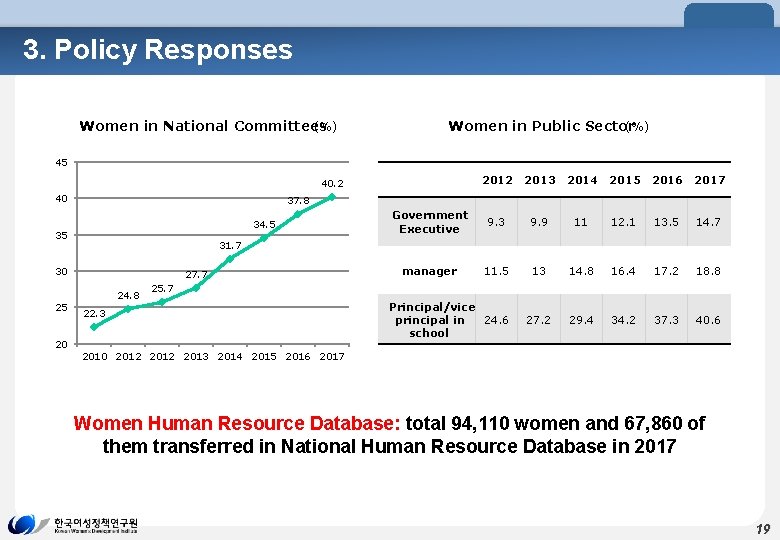
3. Policy Responses Women in National Committees (%) Women in Public Sector (%) 45 2012 2013 2014 2015 2016 2017 Government Executive 9. 3 9. 9 11 12. 1 13. 5 14. 7 manager 11. 5 13 14. 8 16. 4 17. 2 18. 8 27. 2 29. 4 34. 2 37. 3 40. 6 40. 2 40 37. 8 34. 5 35 31. 7 30 27. 7 24. 8 25 25. 7 22. 3 20 Principal/vice 24. 6 principal in school 2010 2012 2013 2014 2015 2016 2017 Women Human Resource Database: total 94, 110 women and 67, 860 of them transferred in National Human Resource Database in 2017 19
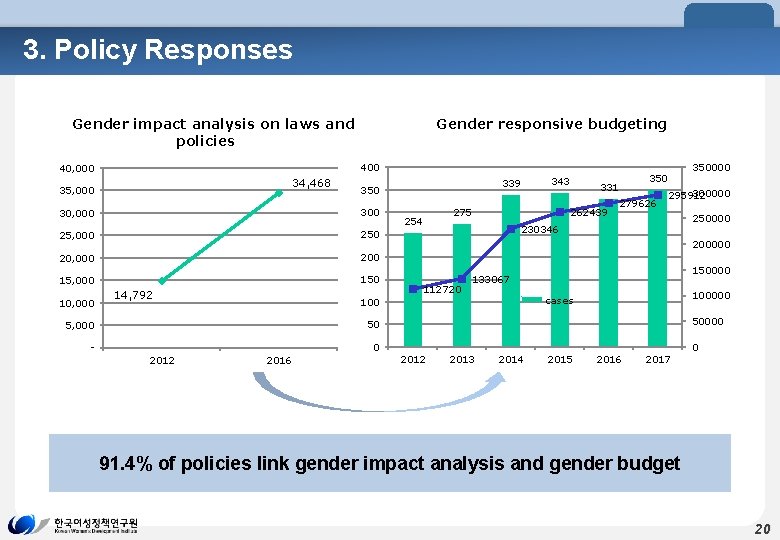
3. Policy Responses Gender impact analysis on laws and policies Gender responsive budgeting 400 40, 000 34, 468 35, 000 30, 000 250 20, 000 200 15, 000 150 10, 000 14, 792 339 350 254 343 275 331 262439 350 279626 300000 295912 250000 230346 200000 112720 150000 133067 100000 cases 100 50000 50 5, 000 0 2012 2016 350000 0 2012 2013 2014 2015 2016 2017 91. 4% of policies link gender impact analysis and gender budget 20
4. remaining things to do. . Improving Women’s Employment according to theirs life cycle § Enhancing fairness when entering into the labor market in youth employment : Promote women’s employment in quality jobs. § Strengthening maternity protection : Shortening working hours during pregnancy, expand maternity leave before and after giving birth, alleviate blind spot for maternity protection. § Establish work-family reconciliation and a gender-equal child-rearing environment : Alleviate long working-hours, stimulate parental leave. § Strengthening re-employment assistance mechanisms for women with career-interruption. 21
4. remaining things to do. . Establishing a Labor Market Environment § Increase flexibility : Proliferating Flexible Work System and Flextime. § Alleviating wage gap according to gender, strengthening assistance according to business and employment types to improve the working environment for female temporary employees. § Strengthening assistance mechanisms for female socially vulnerable group by linking employment and welfare. § Affirmative action to expand employment of women in diverse fields of work. 22
4. remaining things to do. . Establishing Social Infrastructure § Implementing employee-friendly care policy : Strengthening child-care assistance for working women (Expanding the accessibility of child-care service for double-income families, improving the quality of care policy, strengthening financial assistance policy to subsidize the cost of care without undermining potential employees’ desire to seek employment). § Double-income family friendly tax system, financial assistance, strengthening social policies. § Strengthening legal mechanism to overcome gender discrimination and glass ceiling: Eliminating gender discrimination in utilizing female human resources in companies, establish a proactive national policy on training middle managers, quota system to increase female executives. § Strengthening career guidance to increase diversification of women’s career paths. 23
THANK YOU Gender Gaps in Labor Market and Policy Responses in Korea 2018. 8. 16. Jongsoog Kim 24
- Slides: 25