
Toward Automated Identification of Functional Designations of Components


- Slides: 19
Toward Automated Identification of Functional Designations of Components Based on Geometric Analysis of a DMU Ahmad SHAHWAN, Gilles FOUCAULT, Jean-Claude LEON G-SCOP Laboratory & INRIA Grenoble University, France Laboratoire G-SCOP 46, av Félix Viallet 38031 Grenoble Cedex www. g-scop. inpg. fr � � Centre National de la Recherche Scientifique �� Institut National Polytechnique de Grenoble �� Université Joseph Fourier �
Overview • Introduction – Motivation and Problematic – Literature Overview • Theoretical Framework – Concepts – Reference States and Axioms • From DMU to Functional Designations – Overview – Geometric Analysis – Reasoning and Inference • Conclusions
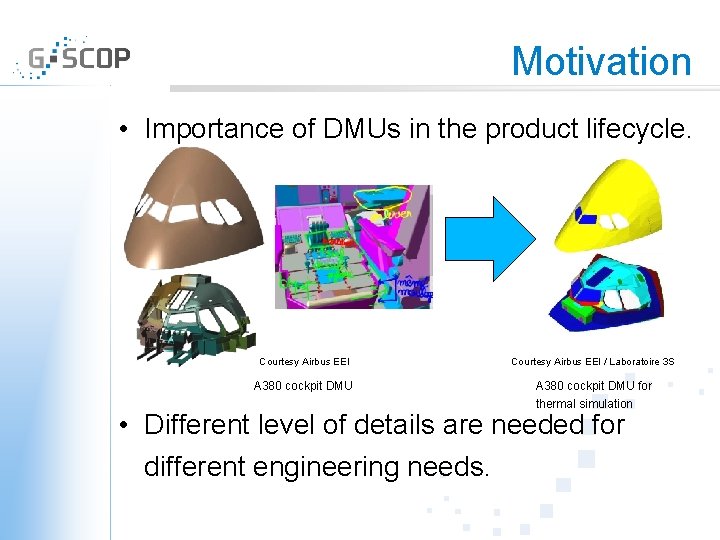
Motivation • Importance of DMUs in the product lifecycle. Courtesy Airbus EEI / Laboratoire 3 S A 380 cockpit DMU for thermal simulation • Different level of details are needed for different engineering needs.
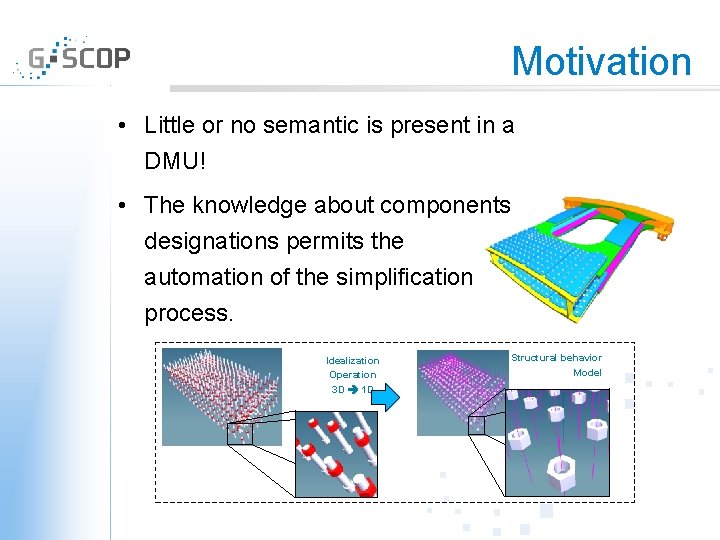
Motivation • Little or no semantic is present in a DMU! • The knowledge about components designations permits the automation of the simplification process. Idealization Operation 3 D 1 D Structural behavior Model
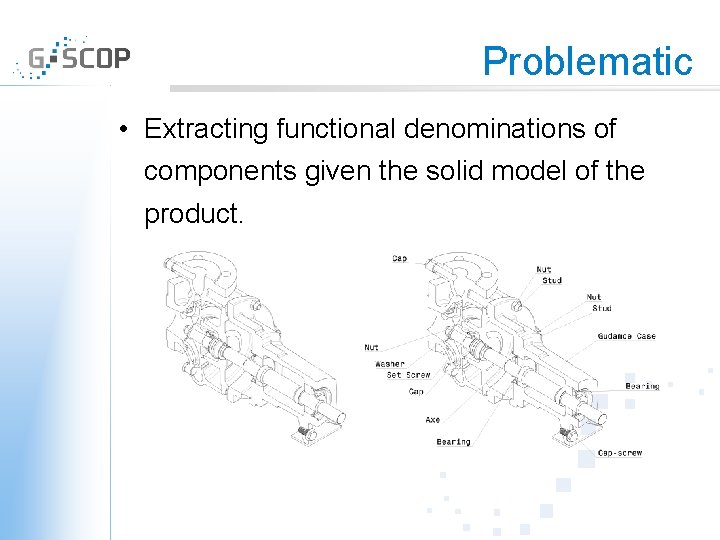
Problematic • Extracting functional denominations of components given the solid model of the product.
Literature Overview • Literature tackled the problem of form feature identification; CAD CAM, CAPP. • We address the problem of functional designations identification; CAD FEA, … • In both cases, geometric analysis of the CAD model is needed. • Existing approaches focus on component’s individual geometries. • We advocate the inference based on interaction between neighboring components.
Literature Overview • Intermediate graph representation (Joshi & Chang 1988, Gavankar & Henderson 1994, C. F. Yuen, Wong & Venuvinod 2003, Di Stefano el al. 2004). • Hierarchical structures of details (Falcidieno & Giannini 1989). • Expert Systems (Henderson & Anderson, 1984, Ames 1991, Bouzakis & Andreadis 2000, Sharma & Gao 2002, Sadaiah & Yadav 2002). • Syntactic Pattern Recognition (Jain & Kumar 1998, Bhandarkar & Nagi 2000).
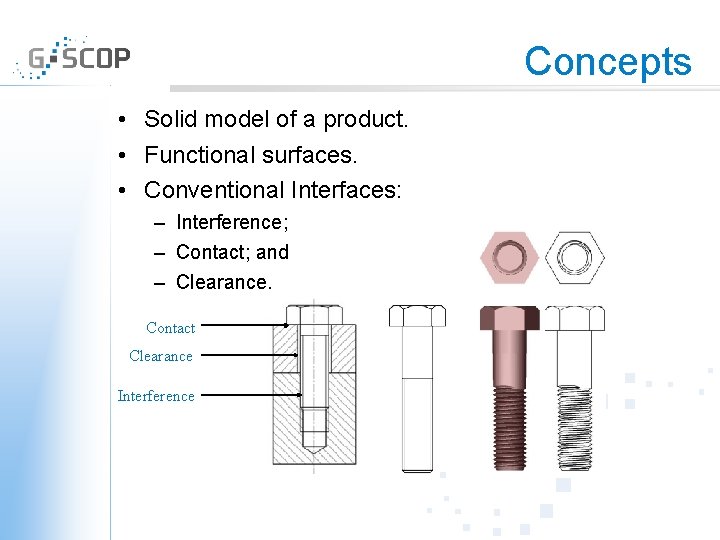
Concepts • Solid model of a product. • Functional surfaces. • Conventional Interfaces: – Interference; – Contact; and – Clearance. Contact Clearance Interference
Reference States and Dualities • Two reference states: 1. The product is mechanically isolated: no external forces. Model interactions between components to characterize internal forces. 2. The product is kinematically operational: user’s input of few kinematic constraints. • Relate to two dualities, respectively: 1. Geometry/Force duality. 2. Geometry/Mobility duality.
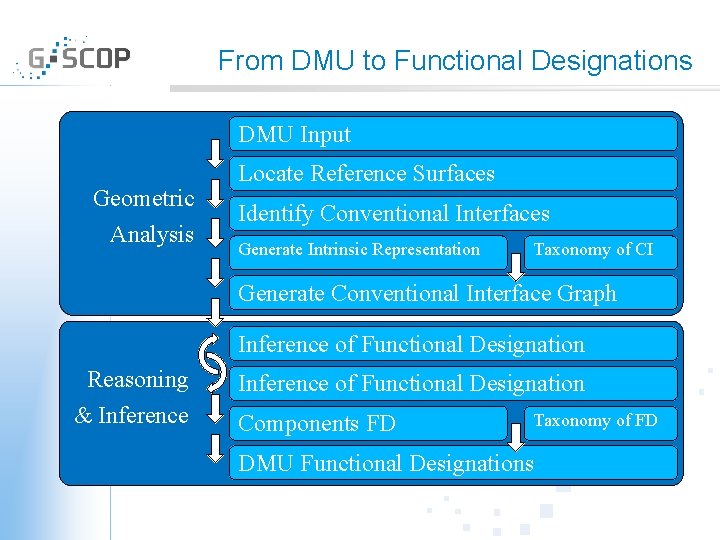
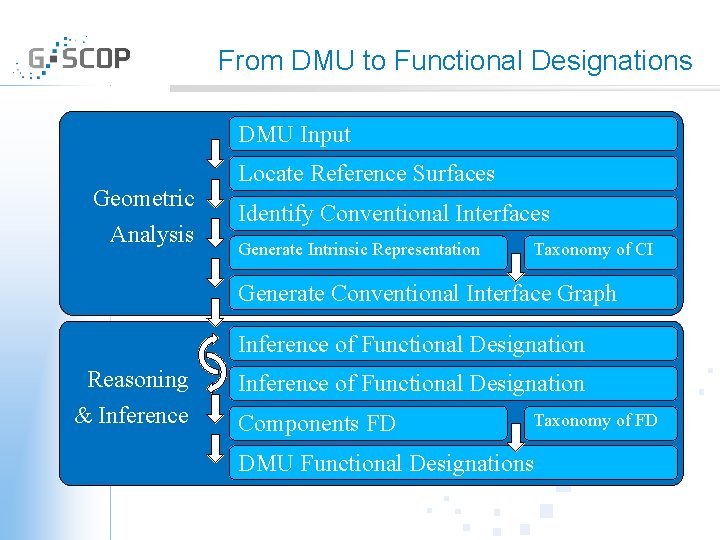
From DMU to Functional Designations DMU Input Geometric Analysis Locate Reference Surfaces Identify Conventional Interfaces Generate Intrinsic Representation Taxonomy of CI Generate Conventional Interface Graph Inference of Functional Designation Reasoning & Inference of Functional Designation Components FD Taxonomy of FD DMU Functional Designations
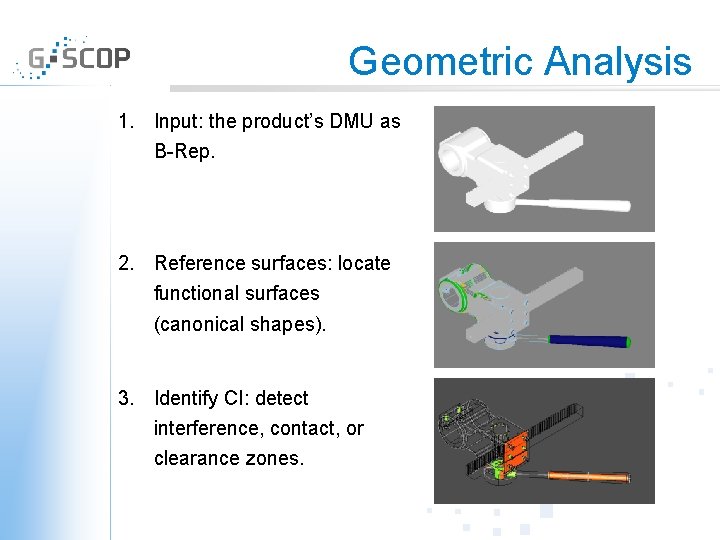
Geometric Analysis 1. Input: the product’s DMU as B-Rep. 2. Reference surfaces: locate functional surfaces (canonical shapes). 3. Identify CI: detect interference, contact, or clearance zones.
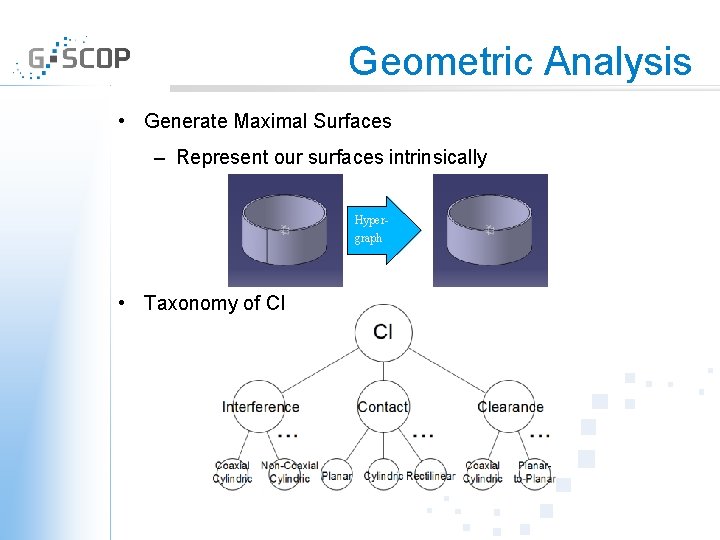
Geometric Analysis • Generate Maximal Surfaces – Represent our surfaces intrinsically Hypergraph • Taxonomy of CI
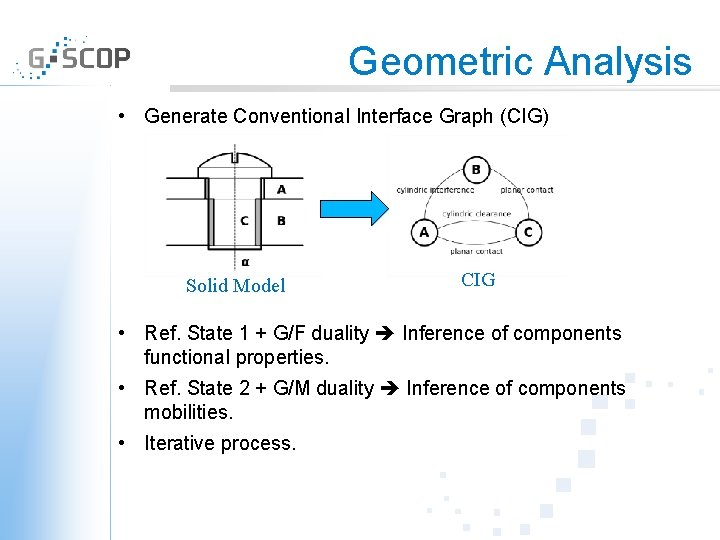
Geometric Analysis • Generate Conventional Interface Graph (CIG) Solid Model CIG • Ref. State 1 + G/F duality Inference of components functional properties. • Ref. State 2 + G/M duality Inference of components mobilities. • Iterative process.
From DMU to Functional Designations DMU Input Geometric Analysis Locate Reference Surfaces Identify Conventional Interfaces Generate Intrinsic Representation Taxonomy of CI Generate Conventional Interface Graph Inference of Functional Designation Reasoning & Inference of Functional Designation Components FD Taxonomy of FD DMU Functional Designations
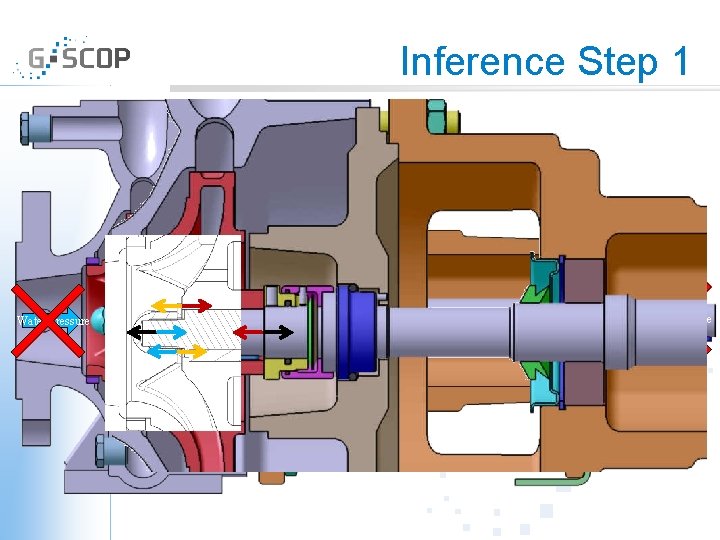
Inference Step 1 Water Pressure Engine Torque
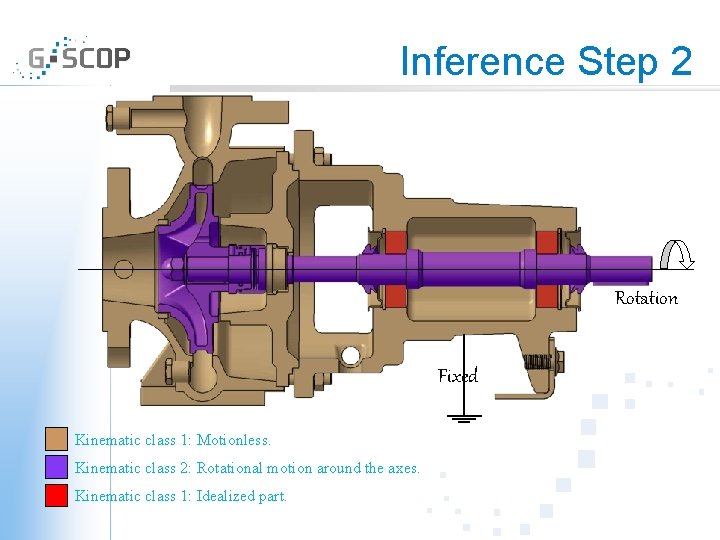
Inference Step 2 Rotation Fixed Kinematic class 1: Motionless. Kinematic class 2: Rotational motion around the axes. Kinematic class 1: Idealized part.
Reasoning and Inference • Interfaces may lead to more than one possible solution. • Criteria are needed to select the most meaningful option: – Mechanical state: minimize the amount of functions per component. – Kinematic state: No internal mobility in the general case.
Conclusions • Preliminary work towards automatic identification of functional designations. • Emphasis is put on the geometric interaction between objects (representing components) rather than the geometric properties of objects themselves. • Analysis of DMUs shows the merit of this approach.
Thanks