
TOUR 101 Introduction to Tourism Lecture 6 Tourism














- Slides: 37
TOUR 101: Introduction to Tourism Lecture 6: Tourism Growth Factors Michael Shone (Lincoln University, New Zealand) 2016
Readings • Course Text: – Weaver & Lawton (2014). Chapter 3 – The evolution and growth of tourism (pp. 49– 82). – Weaver & Lawton (2014). Chapter 4 – Destinations (pp. 83– 116).
Overview of lecture • Factors in the growth of tourism • Tourism Push factors (travel facilitators) • Tourism Pull factors
Factors associated with the growth of tourism The growth of tourism, & the shape of that growth, must be understood by exploring the factors that influence tourism demand: • • • Travel facilitators (‘push factors’ – external, extrinsic) – Factors at the societal or cultural level which predict whether or not a person might be able to travel Travel motivators (‘push factors’ – internal, intrinsic) – Psychological factors which explain why people travel (or not), their reasons for travelling Pull factors (see later in lecture)
Travel facilitators associated with increased tourism demand Technological • Development of tourism closely linked with transport technology – Romans- good roads – Seaside development- railway – Growth in domestic tourism- car ownership – Mass international tourism- Jumbo Jets (see later)
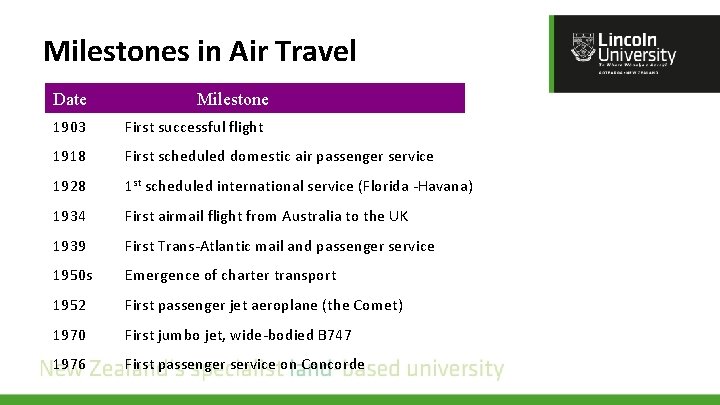
Milestones in Air Travel Date Milestone 1903 First successful flight 1918 First scheduled domestic air passenger service 1928 1 st scheduled international service (Florida -Havana) 1934 First airmail flight from Australia to the UK 1939 First Trans-Atlantic mail and passenger service 1950 s Emergence of charter transport 1952 First passenger jet aeroplane (the Comet) 1970 First jumbo jet, wide-bodied B 747 1976 First passenger service on Concorde
Take Fiji for example… Source: http: //www. ourpacific. co. nz/destinations. aspx • It is often said that the history of tourism in the South Pacific is the history of aviation • Fiji’s strategic position mid-Pacific was a direct contribution to its development as a tourist destination • Re-fuelling stop (1940 s) • Tourism industry grew to accommodate (1950 s) • Further expansion in the 1960 s – Nadi became the centre for regional and trans. Pacific services • The introduction of long-haul aircraft has introduced opportunities and constraints
Or: Aitutaki, Cook Islands Was once home to the international airport of the Cook Islands, well before Rarotonga International Airport Source: http: //www. airliners. net/aviation-forums/trip_reports/read. main/166676/
Travel facilitators associated with increased tourism demand (con’t) Transport technology must be not only available, but affordable
Travel facilitators associated with increased tourism demand (con’t) • Developments in IT – TV, Internet • Economic (see later in lecture)
Factors associated with increased tourism demand Economic • Increase in wealth at a societal & individual level • Individual- greater discretionary income • smaller family size – more married women working • Growth in multinationals – Increase in business travel • Decline in traditional industries – government’s recognise the need for tourism
Factors associated with increased tourism demand Social /Demographic • Greater discretionary leisure time – Early retirement – Shorter working week – Paid annual holidays – Increased life expectancy • Urbanisation – Desire to escape the city (e. g. , Romans) • Decline in physical labour – More energy on holidays? More desire for active holidays?
Factors associated with increased tourism demand Cultural • Changing attitudes and values change the shape of tourism – Awareness of other places/cultures – People want new experiences, to explore the world • As attitudes change, attractions that appeal also change – eg 1800 s - changing view of landscape – 1920 s – view of a suntan positive = sunbathing – 1990 s – view of the sun as a killer = no tan ?
Factors associated with increased tourism demand Political • Freedom to travel – eg China, former Soviet states • Access to visas, passports etc • Political stability – wars reduce stability – Terrorism & terrorist risks limit tourism • Resistance factors – Factors which inhibit or restrict the ability to travel – Reverse of the facilitators (eg no time, no money)
China, for example: • Social/demographic – Emergence of newly wealthy middle class – Urbanisation – Smaller families (one child policy) • Economic – Strong economic growth • Cultural – “Only 10 or 15 years ago, most Chinese would neither have expected nor perhaps even wanted an annual vacation. Now they do…The Chinese are on the move. In search of their history, their spiritual traditions, their temples, the places of natural beauty celebrated by their poets and painters, and of fun, pleasure and good food, they are criss-crossing their own country as tourists in a way they have never done before. ” – For example, in 2009, the State Council designated tourism a "pillar industry“; in October's Golden Week in 2011 (one of the country's semi-annual seven-day national holidays), 302 million tourist trips were recorded. Source: http: //www. guardian. co. uk/travel/2012/nov/16/china-tourism-domestic-chinese-staycation
China, for example: • Political – Easing of movement (domestic and international) by Chinese authorities • Technological – Expansion of domestic & international airline traffic and other transportation facilities have made travel easier and convenient
China, for example: And tourism has been embraced by the masses… Sources: http: //world. time. com/2012/10/17/ chinas-economy-what-the-touristboom-tells-us/ http: //english. peopledaily. com. cn/ 200607/31/eng 20060731_288451. html http: //www. hardrainproject. com/hr pl? n=334
Tourism ‘pull factors’ • Supply side factors associated with increased tourism demand • ‘Push’ factors encourage tourists to leave their homes • ‘Pull’ factors are supply side factors relating to travel facilitation – i. e. , what makes a destination attractive to tourists?
Where do you want to go? …and what makes you want to go there (both push and pull factors)?
Question You have $5000 available to spend on 3 week holiday: – Which would be your first choice destination – Which destination would you least like to visit? • • • Vanuatu Ethiopia Scotland Estonia Thailand Ø Why? (How do we explain our answers? )
Pull factors – what do you need? • The Five A’s: 1. Attractions 2. Access 3. Accommodation 4. Amenities 5. And a possible fifth…Awareness
Pull factors influencing a destination: attractions Availability of attractions – Attractions are the most important ‘pull’ factors in tourism? – The iconic attractions in a place are often a reason to visit – HOWEVER: many other factors are equally important…
Pull factors influencing a destination: access Accessibility to markets • Infrastructural accessibility – availability, frequency & quality of transportation links (highways, air routes, bridges etc. ) • Political accessibility – Generally due to government policy (e. g. , visa requirements etc. )
Pull factors influencing a destination: access Geographic proximity to markets • There is an inverse relationship between volume of tourists & distance between generating & destination region – Distance decay- the further away a place, the less likely to visit • Why is the case? – More expensive to visit – Time involved travelling – Knowledge of the destination may be limited
Pull factors influencing a destination: accommodation Ø Definition-constrained condition: overnight stays require some form of accommodation. Ø A necessary condition of being a tourists: a temporal component to travel behaviour.
Pull factors influencing a destination: amenities Availability of supporting services/facilities – People are unlikely to visit if restaurants, toilets, accommodation facilities are unavailable or poor – People are unlikely to visit if the service from staff is poor
Pull factors influencing a destination: awareness Ø Definition-constrained condition: without market awareness there is no visitation (and therefore no ‘tourism’) Ø [Potential] visitors require information about a range of items relating to their intended travel experience
(Other) Pull factors: cultural links Cultural links – People more likely to visit places which are similar in culture, language & religion – VFR market - people migrate to culturally similar places – More experienced travellers greater desire & confidence for different cultures Ø Compare to geographic proximity… (a question of cultural ‘distance’? )
Example: Where do Chinese tourists go?
(Other) Pull factors • Affordability – Exchange rate • Peace and Stability – Tourists are very sensitive to social or political instability (war, crime rates, terrorism etc. ) • Positive destination image – The image of a place in tourists’ mind is more important in the decision to visit a destination than the reality
Another example: Fiji…
Military instability (coups…)
A ‘textbook’ tourism response “The Fijian tourism industry and its tourism authorities revealed an outstanding level of professionalism and coordination in their response to the crises of 1987 and 2000…represents on of the world’s most outstanding examples of post-crisis tourism marketing management. Fiji’s approach…is a role model which many other national tourism authorities would do well to emulate” (Beirman, 2003).
Arrivals: Ups and downs About 2 – 3 years to recover in terms of arrival numbers
More lessons… “Despite the reason’s for tourism’s recovery…the short-term negative effects are quite large and have a deleterious impact on Fiji’s economy…after a coup in Fiji, the time taken for tourist expenditure to return to equilibrium could have been used for growth…the full potential of the industry is not realised” (Narayan, 2005).
End of lecture