
TOULMIN METHOD BACKGROUND British philosopher Stephen Toulmin 1922

TOULMIN METHOD
BACKGROUND � British philosopher Stephen Toulmin (1922 -) � method for critical reading & writing � more than initial, emotional response to an argument � analyzing the argument ◦ breaking down the argument into its key components ◦ raising questions of the text 2
BACKGROUND � PURPOSE: ◦ to identify thesis ◦ to analyze the evidence ◦ to determine the relationship between thesis and each piece of evidence (reason) 3
CLAIMS � identify and evaluate the authors’ ◦ thesis ◦ main point ◦ central argument � the Thesis Statement � the Topic Sentences ◦ typically conveys the “Claim” ◦ relate the supportive “Sub-Claims” 4
CLAIMS � types of claims: ◦ arguments for/against laws & policies �(“there oughta be a law ’gainst that!”) ◦ arguments on reality, facts �(argue what’s real, true, historical) �(CSI: scenario, hypothesis) ◦ arguments on values, morals, taste �(art, aesthetics, beauty, religion, behaviors, beliefs) 5
CLAIMS � as writers: ◦ you will clearly state your Claim in a Thesis Statement (or Thesis Question) �at the end of the Introduction ◦ and state your Sub-Claims in the Topic Sentence �at the start of each paragraph 6
GROUNDS � evaluate their support, proof, evidence � analyze the sources they rely upon for that evidence � note authorial credentials, qualifications � note if they have included rebuttals, refutations ◦ the opposing side ◦ Rogerian Method 7
GROUNDS � types ◦ ◦ ◦ 8 of proof: reasons, facts, witnesses (expert, first-hand) examples, anecdotes, illustrations, data, evidence, statistics historical, medical, legal records and documents
GROUNDS � as writers: ◦ you will utilize evidence that is �relevant, germane �timely �unequivocal �accurate ◦ you will rely on authors that are �dependable �credentialed �qualified 9
WARRANTS � determine relationship between each piece of evidence and thesis ◦ between the Grounds and the Claim �(relevance, justification) 10
WARRANTS make sure that writers do more than merely supply evidence � They make sure that the Grounds are related to the Claim AND that the Claim is justified by the Grounds � Warrants � It may be useful to consider the term’s antonym, with which we are more familiar 11
WARRANTS � “UNWARRANTED” ◦ ◦ ◦ ◦ ◦ 12 unjustified unprovoked unsubstantiated unproven unsupported uncalled-for unreasonable indefensible unnecessary
WARRANTS � questions to ask: ◦ Is the evidence -? �relevant, germane, on-point �to the current argument, issue �to the author’s Claim �reliable �accurate �based on assumptions or inferences OR precedent, fact, proof �ample, sufficient, adequate 13
WARRANTS � questions to ask: ◦ Do the Grounds support this Claim? ◦ Is the reasoning sound or fallacious? ◦ By the evidence given, is the point being made �warranted �justified �merited �proven 14
WARRANTS � as readers: ◦ ascertain if the authors support their claims �with ample, accurate, and relevant evidence �via reliable sources ◦ they should put the evidence into some context ◦ justify the Grounds, relate the evidence to the Claim ◦ determine if they take their ideas to the next level �in the Conclusion �they should make recommendations and/or suggestions �fodder for future essays �they should do more than just gripe 15
WARRANTS � as writers: ◦ answer the above questions for the readers ◦ support your claims �with ample, accurate, and relevant evidence �using reliable sources ◦ justify your Grounds ◦ relate your evidence to your Thesis ◦ take your ideas to the next level in the Conclusion �that is, you should make recommendations and/or suggestions—fodder for the next essay 16
WARRANT STATEMENTS � What ◦ ◦ this usually entails is a “Warrant Statement” if not after each supporting detail then at the end of each paragraph as a way to bring the paragraph to a close as a way to bring us full-circle to the paragraph's opening point �a “Clincher Sentence" for the paragraph 17
WARRANT STATEMENTS � Thus, these Warrant Statements usually begin with a transition such as ◦ "thus" or "therefore" ◦ even a transitional phrase such as "As the previous examples clearly illustrate, " followed by the paragraph's main point. 18
WARRANT STATEMENTS � “THUS, ” “THEREFORE”: ◦ After using some evidence (such as a quote), answer: �SO WHAT? ! ◦ reiterate your main point ◦ relate the evidence to your main point ◦ draw conclusions, put it into context, tie it all together, spell it out ◦ make suggestions, recommendations, conclusions, inferences, policies, ◦ formulate principles, generalizations �(INDUCTION = from specific general) ◦ more than just griping 19
WARRANT STATEMENTS � “THUS, ” “THEREFORE”: ◦ NEVER end a paragraph with someone else’s words or ideas �your essay = your analysis �add your proverbial “ 2 cents” �(1) �(2) �(3) �(4) 20 name your point explain it illustrate it justify it
TOULMIN METHOD � You see how its "claims" & "grounds" are synonymous with "thesis" & "support. " ◦ Pot-ay-to, po-tah-to. ◦ He's got to call them something new, different. � As critical readers, we look for the main point ("gist") of a source & see how well or poorly that stance is supported. � As critical writers, we need to make clear our claim/thesis and support it with ample, relevant, unambiguous proof. � The trickiest part of Toulmin's method is the "warrant" part. Think relevance & justification. 21
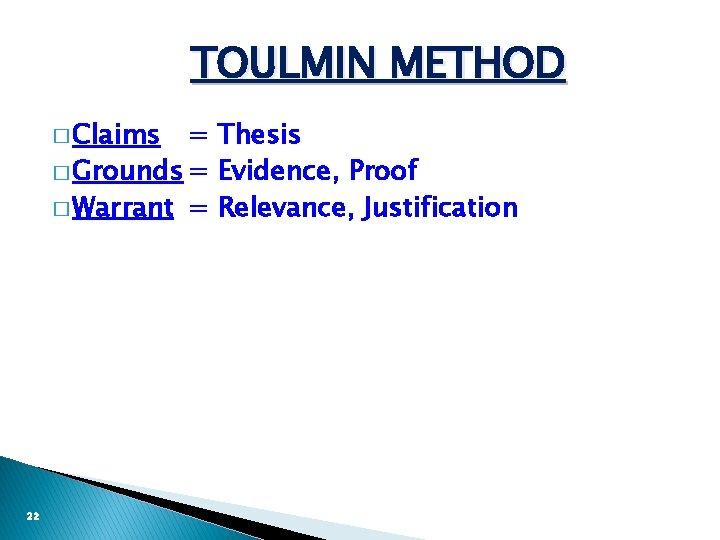
TOULMIN METHOD � Claims = Thesis � Grounds = Evidence, Proof � Warrant = Relevance, Justification 22
- Slides: 22