
TOUGHREACT A Reactive Transport Simulator for CO 2
- Slides: 1
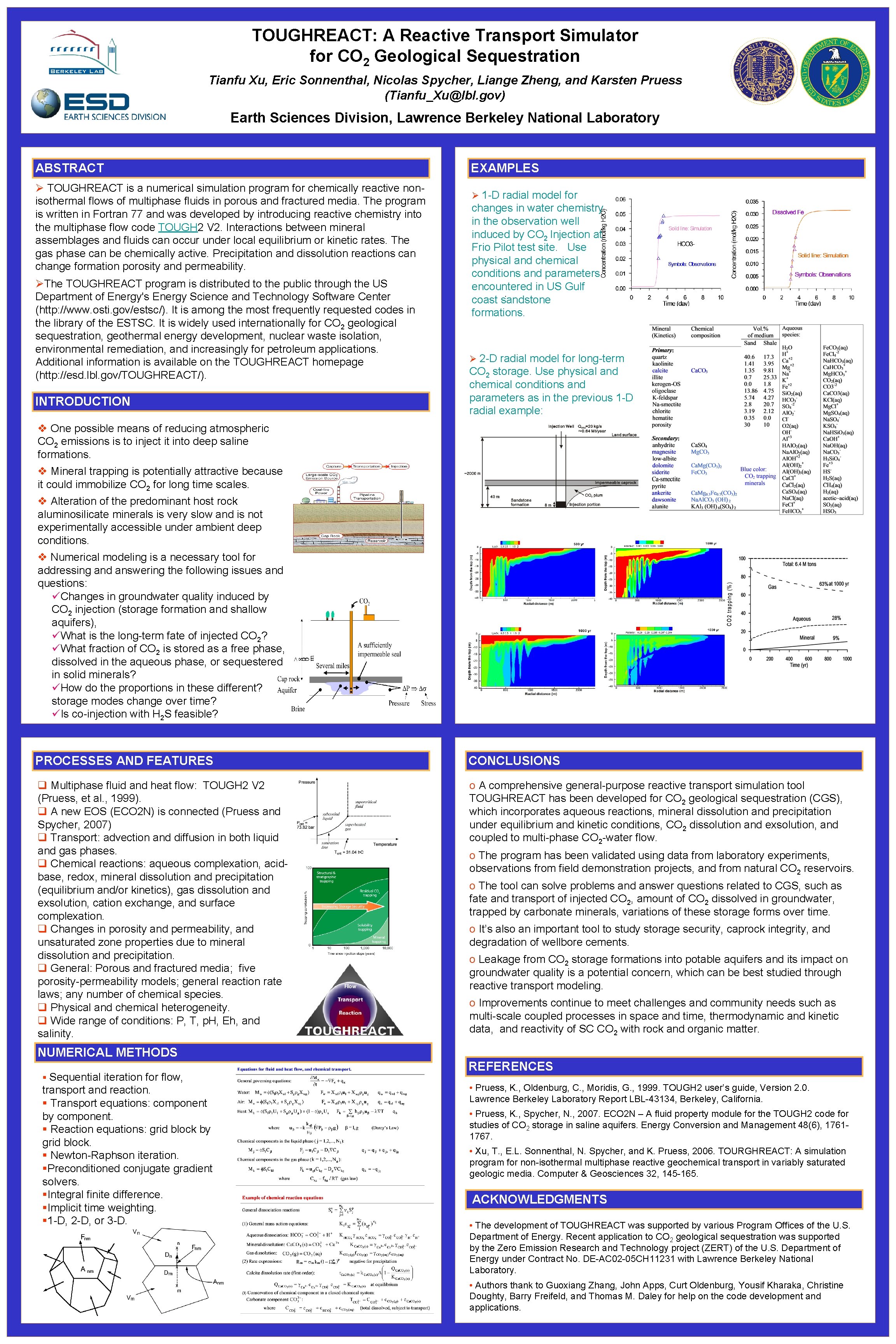
TOUGHREACT: A Reactive Transport Simulator for CO 2 Geological Sequestration Tianfu Xu, Eric Sonnenthal, Nicolas Spycher, Liange Zheng, and Karsten Pruess (Tianfu_Xu@lbl. gov) Earth Sciences Division, Lawrence Berkeley National Laboratory ABSTRACT Ø TOUGHREACT is a numerical simulation program for chemically reactive nonisothermal flows of multiphase fluids in porous and fractured media. The program is written in Fortran 77 and was developed by introducing reactive chemistry into the multiphase flow code TOUGH 2 V 2. Interactions between mineral assemblages and fluids can occur under local equilibrium or kinetic rates. The gas phase can be chemically active. Precipitation and dissolution reactions can change formation porosity and permeability. ØThe TOUGHREACT program is distributed to the public through the US Department of Energy's Energy Science and Technology Software Center (http: //www. osti. gov/estsc/). It is among the most frequently requested codes in the library of the ESTSC. It is widely used internationally for CO 2 geological sequestration, geothermal energy development, nuclear waste isolation, environmental remediation, and increasingly for petroleum applications. Additional information is available on the TOUGHREACT homepage (http: //esd. lbl. gov/TOUGHREACT/). INTRODUCTION EXAMPLES Ø 1 -D radial model for changes in water chemistry in the observation well induced by CO 2 Injection at Frio Pilot test site. Use physical and chemical conditions and parameters encountered in US Gulf. coast sandstone formations. Ø 2 -D radial model for long-term CO 2 storage. Use physical and chemical conditions and parameters as in the previous 1 -D radial example: v One possible means of reducing atmospheric CO 2 emissions is to inject it into deep saline formations. v Mineral trapping is potentially attractive because it could immobilize CO 2 for long time scales. v Alteration of the predominant host rock aluminosilicate minerals is very slow and is not experimentally accessible under ambient deep conditions. v Numerical modeling is a necessary tool for addressing and answering the following issues and questions: üChanges in groundwater quality induced by CO 2 injection (storage formation and shallow aquifers), üWhat is the long-term fate of injected CO 2? üWhat fraction of CO 2 is stored as a free phase, dissolved in the aqueous phase, or sequestered in solid minerals? üHow do the proportions in these different? storage modes change over time? üIs co-injection with H 2 S feasible? PROCESSES AND FEATURES CONCLUSIONS q Multiphase fluid and heat flow: TOUGH 2 V 2 (Pruess, et al. , 1999). q A new EOS (ECO 2 N) is connected (Pruess and Spycher, 2007) q Transport: advection and diffusion in both liquid and gas phases. q Chemical reactions: aqueous complexation, acidbase, redox, mineral dissolution and precipitation (equilibrium and/or kinetics), gas dissolution and exsolution, cation exchange, and surface complexation. q Changes in porosity and permeability, and unsaturated zone properties due to mineral dissolution and precipitation. q General: Porous and fractured media; five porosity-permeability models; general reaction rate laws; any number of chemical species. q Physical and chemical heterogeneity. q Wide range of conditions: P, T, p. H, Eh, and salinity. o A comprehensive general-purpose reactive transport simulation tool TOUGHREACT has been developed for CO 2 geological sequestration (CGS), which incorporates aqueous reactions, mineral dissolution and precipitation under equilibrium and kinetic conditions, CO 2 dissolution and exsolution, and coupled to multi-phase CO 2 -water flow. o The program has been validated using data from laboratory experiments, observations from field demonstration projects, and from natural CO 2 reservoirs. o The tool can solve problems and answer questions related to CGS, such as fate and transport of injected CO 2, amount of CO 2 dissolved in groundwater, trapped by carbonate minerals, variations of these storage forms over time. o It’s also an important tool to study storage security, caprock integrity, and degradation of wellbore cements. o Leakage from CO 2 storage formations into potable aquifers and its impact on groundwater quality is a potential concern, which can be best studied through reactive transport modeling. o Improvements continue to meet challenges and community needs such as multi-scale coupled processes in space and time, thermodynamic and kinetic data, and reactivity of SC CO 2 with rock and organic matter. NUMERICAL METHODS § Sequential iteration for flow, transport and reaction. § Transport equations: component by component. § Reaction equations: grid block by grid block. § Newton-Raphson iteration. §Preconditioned conjugate gradient solvers. §Integral finite difference. §Implicit time weighting. § 1 -D, 2 -D, or 3 -D. REFERENCES • Pruess, K. , Oldenburg, C. , Moridis, G. , 1999. TOUGH 2 user’s guide, Version 2. 0. Lawrence Berkeley Laboratory Report LBL-43134, Berkeley, California. • Pruess, K. , Spycher, N. , 2007. ECO 2 N – A fluid property module for the TOUGH 2 code for studies of CO 2 storage in saline aquifers. Energy Conversion and Management 48(6), 17611767. • Xu, T. , E. L. Sonnenthal, N. Spycher, and K. Pruess, 2006. TOURGHREACT: A simulation program for non-isothermal multiphase reactive geochemical transport in variably saturated geologic media. Computer & Geosciences 32, 145 -165. ACKNOWLEDGMENTS • The development of TOUGHREACT was supported by various Program Offices of the U. S. Department of Energy. Recent application to CO 2 geological sequestration was supported by the Zero Emission Research and Technology project (ZERT) of the U. S. Department of Energy under Contract No. DE-AC 02 -05 CH 11231 with Lawrence Berkeley National Laboratory. • Authors thank to Guoxiang Zhang, John Apps, Curt Oldenburg, Yousif Kharaka, Christine Doughty, Barry Freifeld, and Thomas M. Daley for help on the code development and applications.