
Total School Cluster Grouping Model Analysis of the
- Slides: 12
Total School Cluster Grouping Model Analysis of the model by: Katelyn Mc. Donnell
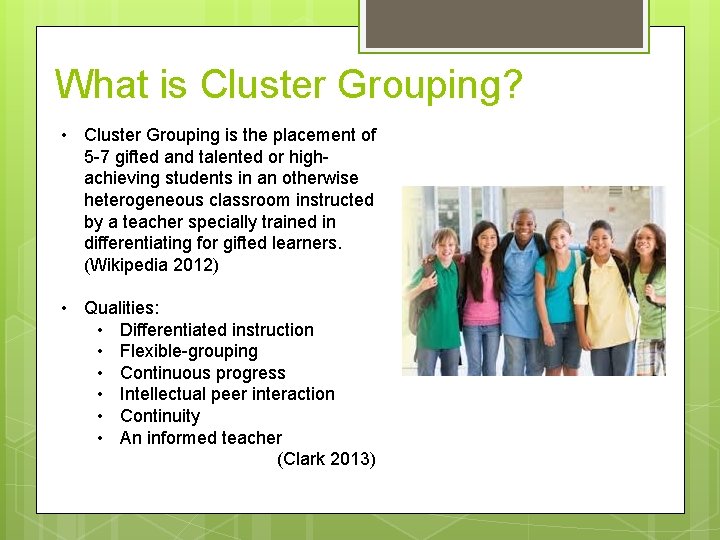
What is Cluster Grouping? • Cluster Grouping is the placement of 5 -7 gifted and talented or highachieving students in an otherwise heterogeneous classroom instructed by a teacher specially trained in differentiating for gifted learners. (Wikipedia 2012) • Qualities: • Differentiated instruction • Flexible-grouping • Continuous progress • Intellectual peer interaction • Continuity • An informed teacher (Clark 2013)
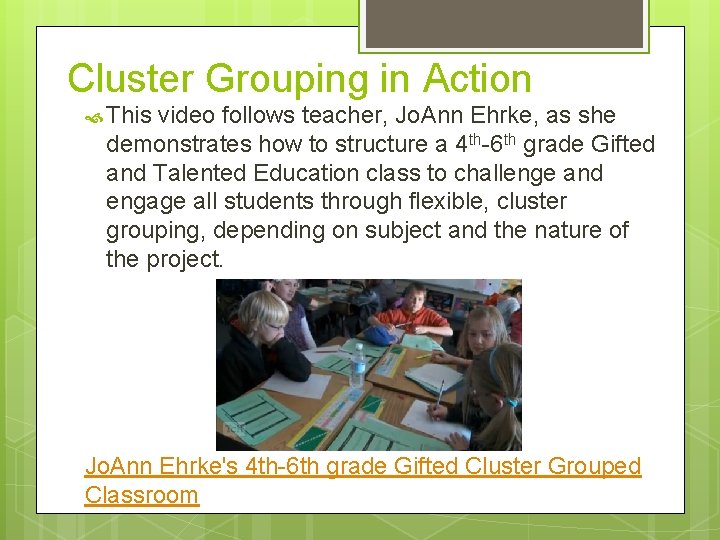
Cluster Grouping in Action This video follows teacher, Jo. Ann Ehrke, as she demonstrates how to structure a 4 th-6 th grade Gifted and Talented Education class to challenge and engage all students through flexible, cluster grouping, depending on subject and the nature of the project. Jo. Ann Ehrke's 4 th-6 th grade Gifted Cluster Grouped Classroom
Schoolwide Cluster Grouping Director of Gifted Education, Dina Brulles and classroom teacher’s of Paradise Valley School District provide insights into the struggles and advantages to implementing a Schoolwide Cluster Grouping program. Paradise Valley SD on SCGM
Implementing the Schoolwide Cluster Grouping Model All Students in a grade level are grouped according to their abilities and achievement levels. See SCGM Handbook by Brulles and Winebrenner for guidance for grouping students using grouping categories 1 -5. Placement process: 1. 2. 3. 4. Placement teams assign students to classrooms starting by clustering gifted students into designated gifted cluster classrooms (no more than 10 per classroom) with a specially trained teacher to differentiate for gifted and talented students. Next, place high-average students in classrooms without gifted clusters. Then average and low-average students are placed evenly in all classrooms. Finally far-below-average students are placed evenly in all classrooms except the gifted cluster classrooms. (Winebrenner & Brulles, 2011)
Enrichment Clusters in a Multiage School Harriet Bishop (HB) Elementary School Students learn through an integrated curriculum using strategies such as differentiated instruction, curriculum compacting, and multiage learning. Students are assigned to grades K-2, K-4, 1 -3, 1 -4, 36, or 5 -6 communities. Harriet Bishop has adopted the Schoolwide Enrichment Model using Enrichment Clusters to provide challenging, self-directed, real-world learning for all students. (Reed & Westberg, 2003)
Enrichment Clusters Allow multiage groups of students who share common interests to select courses of study from an extensive list of offerings. Enrichment Clusters are provided by teachers, parents, or community members with special talents or budding interests. Work within clusters is directed toward the production of a product or service, therefore lesson plans or unit plans are not prepared in advance, rather, students and the facilitator collaboratively create plans for exploring the topic as the cluster unfolds. (Reed & Westberg, 2003)
Implications for Teaching More professional development in the area of differentiation, curriculum compacting, acceleration and general teaching of gifted and talented students. Student buy-in with challenging, engaging, within abilitylevel learning, and collaboration with like-ability peers Parent and community buy-in when involved in enrichment clusters Teacher buy-in when able to teach an enrichment cluster within an interest area Although classes are still heterogeneous, the achievement range in each class is slightly narrowed with aids in effective teaching (Winebrenner & Brulles, 2011)
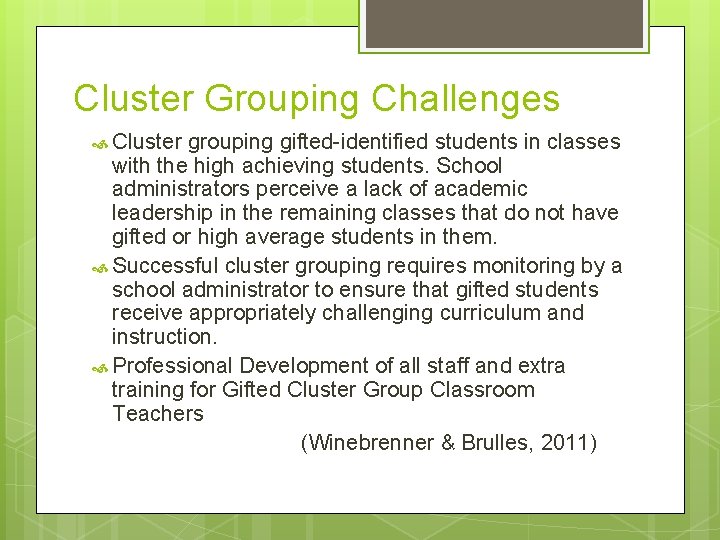
Cluster Grouping Challenges Cluster grouping gifted-identified students in classes with the high achieving students. School administrators perceive a lack of academic leadership in the remaining classes that do not have gifted or high average students in them. Successful cluster grouping requires monitoring by a school administrator to ensure that gifted students receive appropriately challenging curriculum and instruction. Professional Development of all staff and extra training for Gifted Cluster Group Classroom Teachers (Winebrenner & Brulles, 2011)
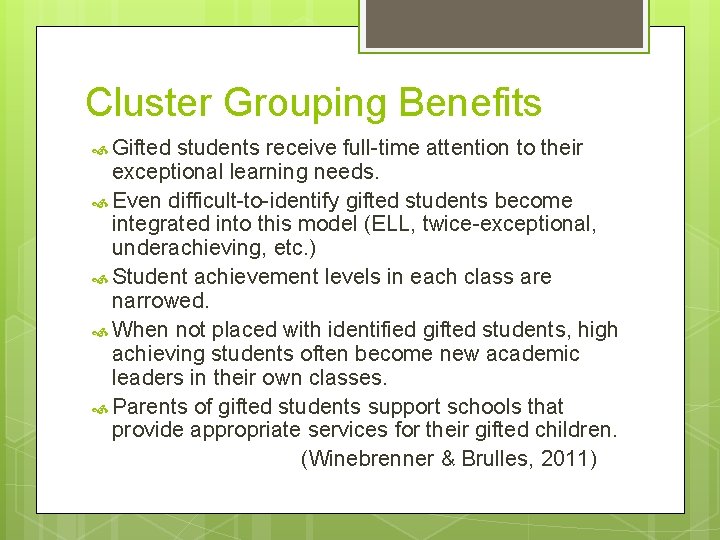
Cluster Grouping Benefits Gifted students receive full-time attention to their exceptional learning needs. Even difficult-to-identify gifted students become integrated into this model (ELL, twice-exceptional, underachieving, etc. ) Student achievement levels in each class are narrowed. When not placed with identified gifted students, high achieving students often become new academic leaders in their own classes. Parents of gifted students support schools that provide appropriate services for their gifted children. (Winebrenner & Brulles, 2011)
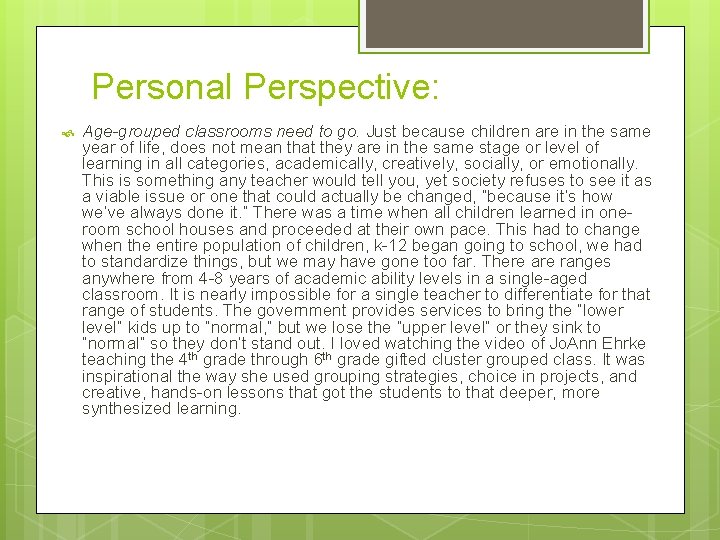
Personal Perspective: Age-grouped classrooms need to go. Just because children are in the same year of life, does not mean that they are in the same stage or level of learning in all categories, academically, creatively, socially, or emotionally. This is something any teacher would tell you, yet society refuses to see it as a viable issue or one that could actually be changed, “because it’s how we’ve always done it. ” There was a time when all children learned in oneroom school houses and proceeded at their own pace. This had to change when the entire population of children, k-12 began going to school, we had to standardize things, but we may have gone too far. There are ranges anywhere from 4 -8 years of academic ability levels in a single-aged classroom. It is nearly impossible for a single teacher to differentiate for that range of students. The government provides services to bring the “lower level” kids up to “normal, ” but we lose the “upper level” or they sink to “normal” so they don’t stand out. I loved watching the video of Jo. Ann Ehrke teaching the 4 th grade through 6 th grade gifted cluster grouped class. It was inspirational the way she used grouping strategies, choice in projects, and creative, hands-on lessons that got the students to that deeper, more synthesized learning.
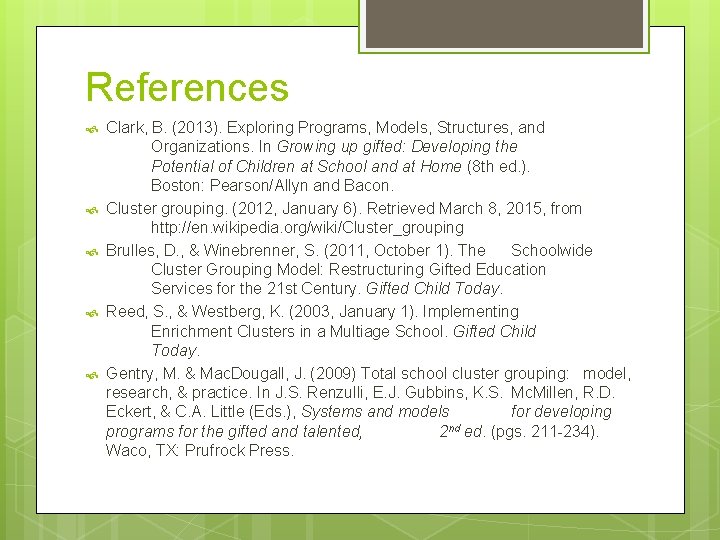
References Clark, B. (2013). Exploring Programs, Models, Structures, and Organizations. In Growing up gifted: Developing the Potential of Children at School and at Home (8 th ed. ). Boston: Pearson/Allyn and Bacon. Cluster grouping. (2012, January 6). Retrieved March 8, 2015, from http: //en. wikipedia. org/wiki/Cluster_grouping Brulles, D. , & Winebrenner, S. (2011, October 1). The Schoolwide Cluster Grouping Model: Restructuring Gifted Education Services for the 21 st Century. Gifted Child Today. Reed, S. , & Westberg, K. (2003, January 1). Implementing Enrichment Clusters in a Multiage School. Gifted Child Today. Gentry, M. & Mac. Dougall, J. (2009) Total school cluster grouping: model, research, & practice. In J. S. Renzulli, E. J. Gubbins, K. S. Mc. Millen, R. D. Eckert, & C. A. Little (Eds. ), Systems and models for developing nd programs for the gifted and talented, 2 ed. (pgs. 211 -234). Waco, TX: Prufrock Press.