
Total School Cluster Grouping Model Analysis Implementation Plan
- Slides: 15
Total School Cluster Grouping Model Analysis & Implementation Plan Quincy School District Camille Jones
Why? How? What? Why? Every student should make at least a year’s growth in a year’s time. How? • Differentiation • Support Staff • Professional Development What? Total School Cluster Grouping!
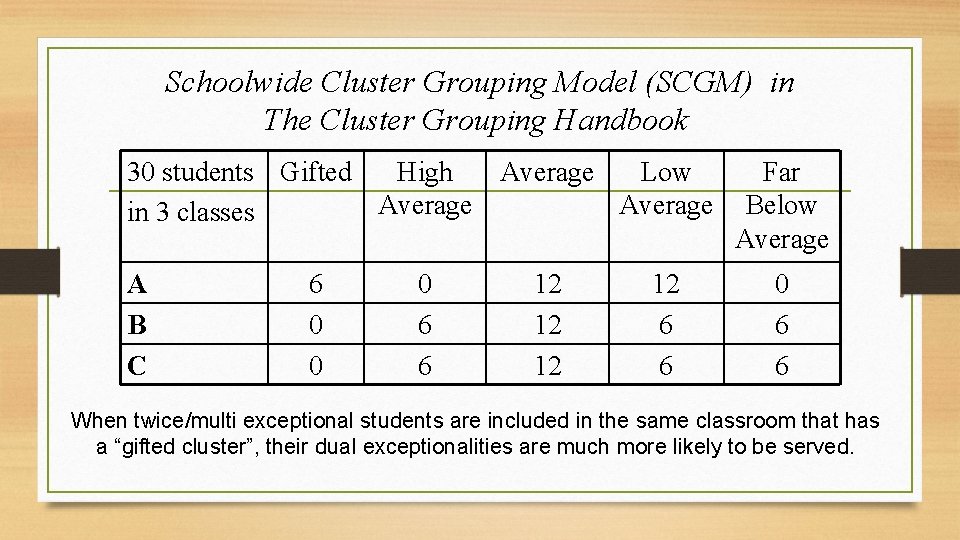
What is Total School Cluster Grouping? • Students Identified Annually in Five Areas: • High Achieving (great at math & reading, also includes 2 x exceptional) • Above Average Achieving (great at math OR reading, or pretty good at both) • Average Achieving (average compared to students in school peer group, may or may not be on grade level) • Low Average Achieving (struggle with math OR reading, or slightly below average all around, can succeed with support) • Low Achieving (struggle a lot, high risk for failure) • Special Needs (may or may not be separate cluster)
What is Total School Cluster Grouping? • 3 Tiers of Differentiation within Each Classroom • Lessens range of differentiation within each classroom • Allows for full time services for high-achieving and other clusters • High achieving clusters and above average clusters do not overlap in a classroom • Teachers stay with assigned differentiation level for 3+ years
Schoolwide Cluster Grouping Model (SCGM) in The Cluster Grouping Handbook 30 students Gifted High Average Low Average in 3 classes A B C 6 0 0 0 6 6 12 12 6 6 Far Below Average 0 6 6 When twice/multi exceptional students are included in the same classroom that has a “gifted cluster”, their dual exceptionalities are much more likely to be served.
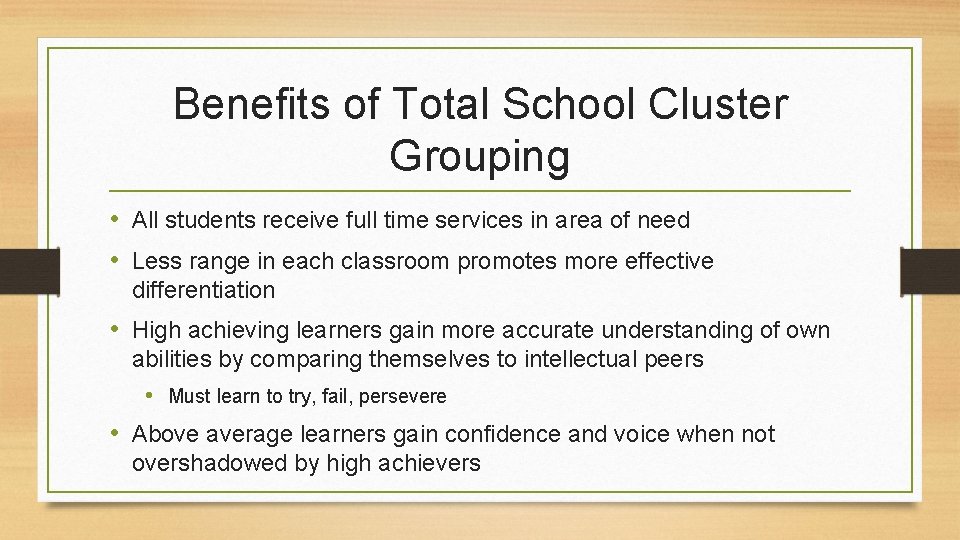
Benefits of Total School Cluster Grouping • All students receive full time services in area of need • Less range in each classroom promotes more effective differentiation • High achieving learners gain more accurate understanding of own abilities by comparing themselves to intellectual peers • Must learn to try, fail, persevere • Above average learners gain confidence and voice when not overshadowed by high achievers
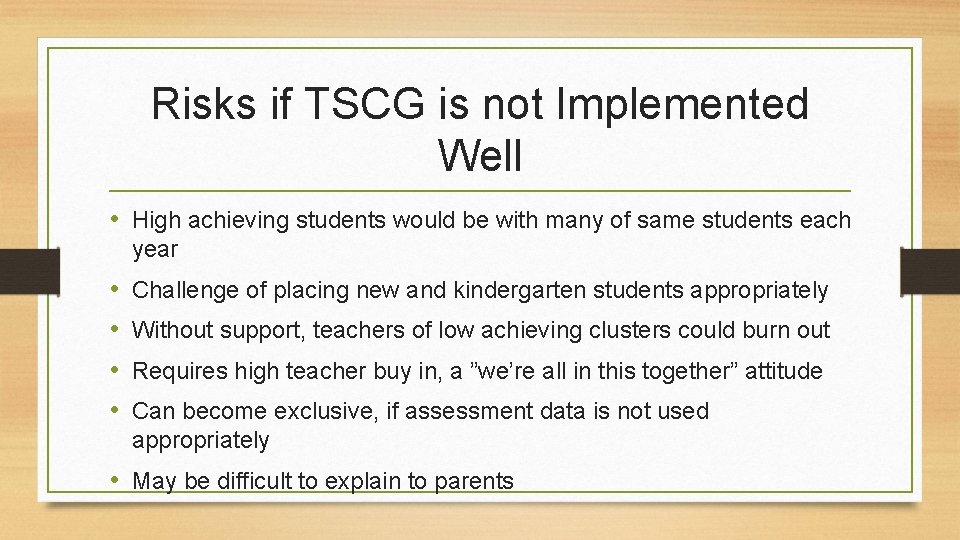
Risks if TSCG is not Implemented Well • High achieving students would be with many of same students each year • • Challenge of placing new and kindergarten students appropriately Without support, teachers of low achieving clusters could burn out Requires high teacher buy in, a ”we’re all in this together” attitude Can become exclusive, if assessment data is not used appropriately • May be difficult to explain to parents
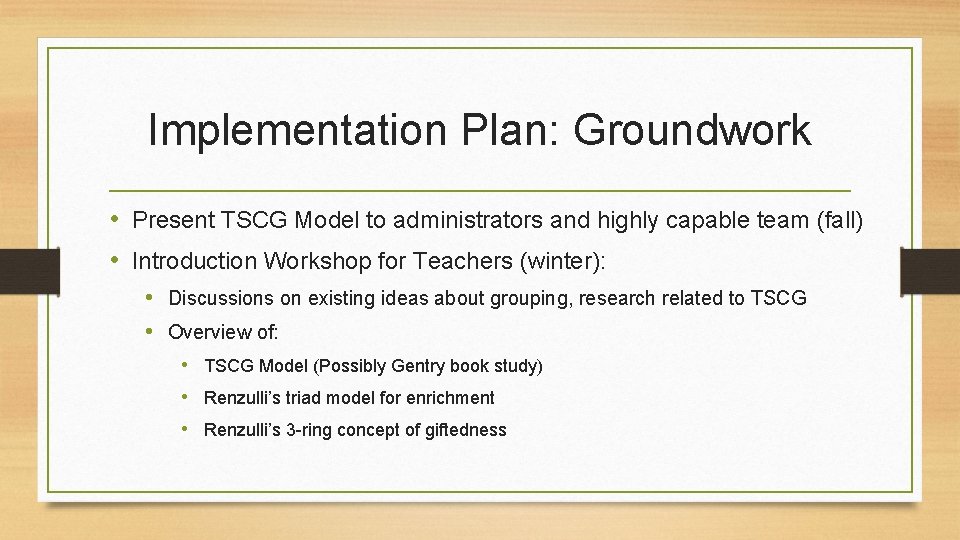
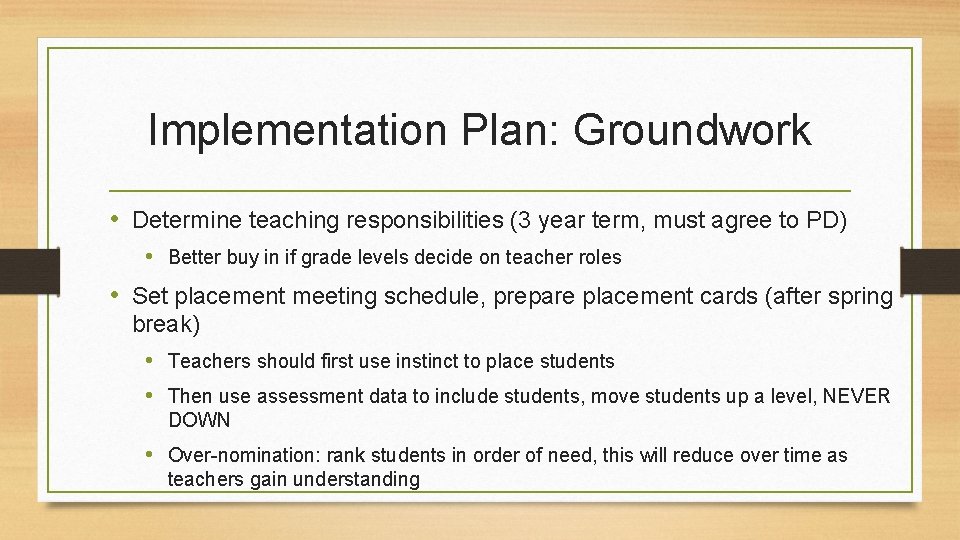
Implementation Plan: Groundwork • Present TSCG Model to administrators and highly capable team (fall) • Introduction Workshop for Teachers (winter): • Discussions on existing ideas about grouping, research related to TSCG • Overview of: • TSCG Model (Possibly Gentry book study) • Renzulli’s triad model for enrichment • Renzulli’s 3 -ring concept of giftedness
Implementation Plan: Groundwork • Determine teaching responsibilities (3 year term, must agree to PD) • Better buy in if grade levels decide on teacher roles • Set placement meeting schedule, prepare placement cards (after spring break) • Teachers should first use instinct to place students • Then use assessment data to include students, move students up a level, NEVER DOWN • Over-nomination: rank students in order of need, this will reduce over time as teachers gain understanding
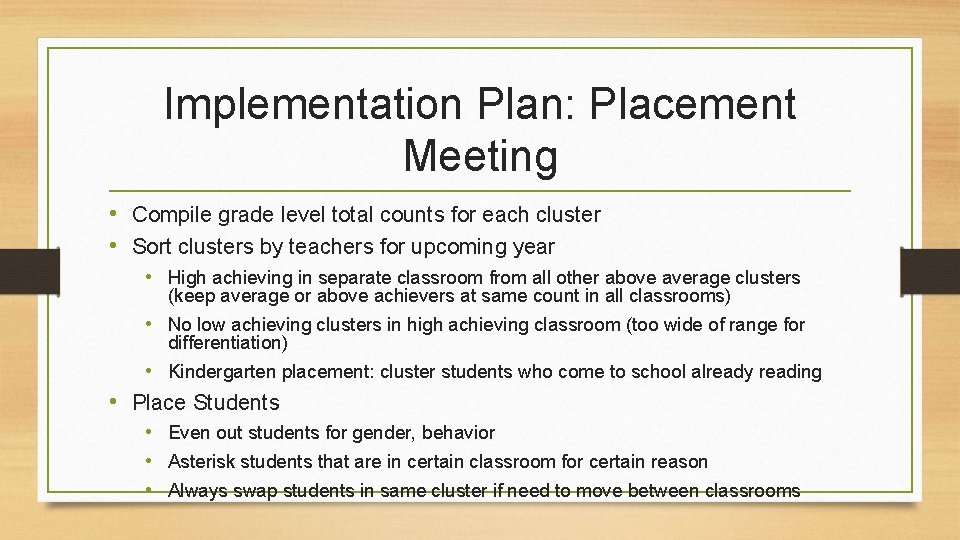
Implementation Plan: Placement Meeting • Compile grade level total counts for each cluster • Sort clusters by teachers for upcoming year • High achieving in separate classroom from all other above average clusters (keep average or above achievers at same count in all classrooms) • No low achieving clusters in high achieving classroom (too wide of range for differentiation) • Kindergarten placement: cluster students who come to school already reading • Place Students • Even out students for gender, behavior • Asterisk students that are in certain classroom for certain reason • Always swap students in same cluster if need to move between classrooms
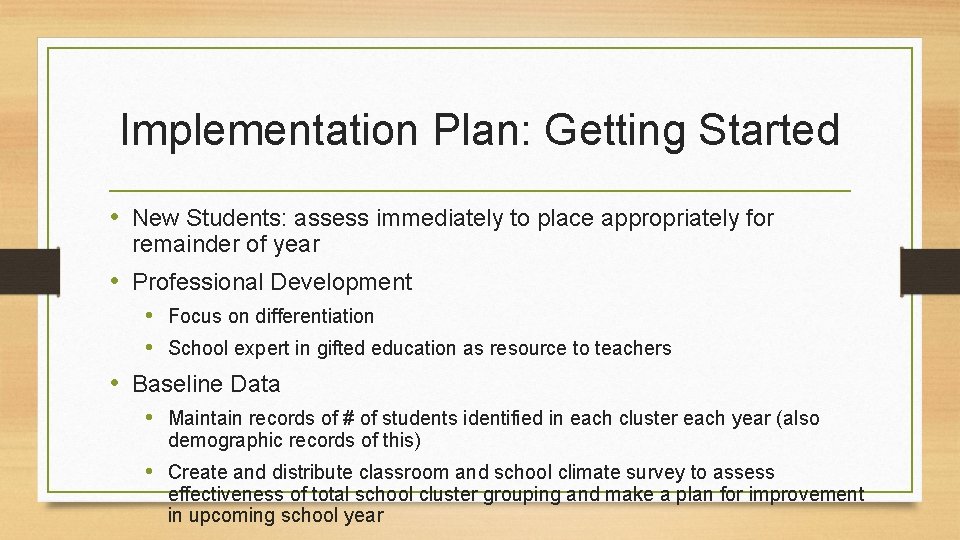
Implementation Plan: Getting Started • New Students: assess immediately to place appropriately for remainder of year • Professional Development • Focus on differentiation • School expert in gifted education as resource to teachers • Baseline Data • Maintain records of # of students identified in each cluster each year (also demographic records of this) • Create and distribute classroom and school climate survey to assess effectiveness of total school cluster grouping and make a plan for improvement in upcoming school year
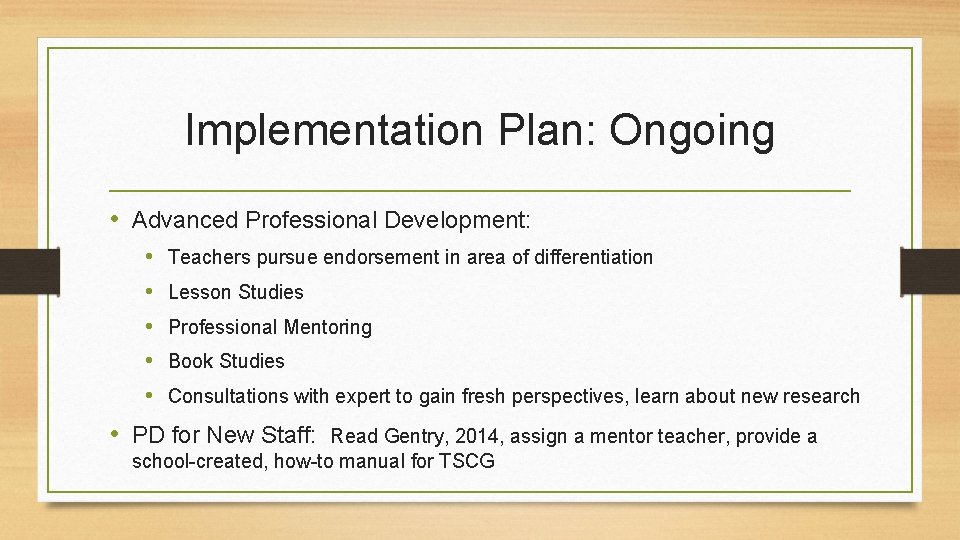
Implementation Plan: Ongoing • Advanced Professional Development: • • • Teachers pursue endorsement in area of differentiation Lesson Studies Professional Mentoring Book Studies Consultations with expert to gain fresh perspectives, learn about new research • PD for New Staff: Read Gentry, 2014, assign a mentor teacher, provide a school-created, how-to manual for TSCG
Implementation Plan: Service Integration • Cluster grouping is used alongside enrichment pull out program • Pull out services would disrupt less classrooms • Speech, SPED students could be clustered into one classroom • Push in services could spend more time in one classroom, instead of scheduling very small amounts of time for each classroom • Language and reading intervention could be push in instead of pull out
Implementation Plan: Program Review • Should be a collaborative process focused on program improvement • Form a task force representing all stakeholders, ask to serve 2 -3 year term for consistency • Design Program Monitoring Plan • Specific questions guide each review cycle • Identify relevant data sources: anything related to stakeholders who have impact on guiding question - triangulation of data is critical! • Interpret Results: watch for areas to celebrate and areas to improve • Develop Action Plan: (including who is responsible for action, progress, communication)
Want to learn more? Check my sources… • Read: Gentry, M. (2014). Chapters 1 -4 in Total school cluster grouping and differentiation: A comprehensive, research-based plan for raising student achievement and improving teacher practices (pp. 3 -96) (2 nd ed. ). Waco, TX: Prufrock Press. • Read: “Schoolwide Cluster Grouping Model” from Paradise Valley Unified School District: http: //www. pvschools. net/Page/4377 • Watch: The Schoolwide Cluster Grouping Model http: //www. youtube. com/watch? v=JESnt-CFX 1 Q