
Total Quality Management Benchmarking Prepared by Nusrat Ali
Total Quality Management Benchmarking Prepared by: Nusrat Ali Noon Business School University of Sargodha 1
Benchmarking is the process of continually searching for the best methods, practices and processes, and either adopting or adapting their good features and implementing them to become the “best of the best. ” Measuring your performance against that of the best-in-class companies, determining how the best-in-class achieve those performance levels, and using the information as a basis for your own company’s targets, strategies, and implementation. • Compare performance of an existing process against other companies’ best-in-class practices • Determine how those companies achieve their performance levels • Improve internal performance levels 2
Benchmarking o Benchmarking considers the experience of others and uses it. o It is the common sense proportion to learn from others what they do right and then imitate it to avoid reinventing the wheel. o Benchmarking is an ongoing outreach activity; the goal of the outreach is identification of the best operating practices that, when implemented, produce superior performance” 3
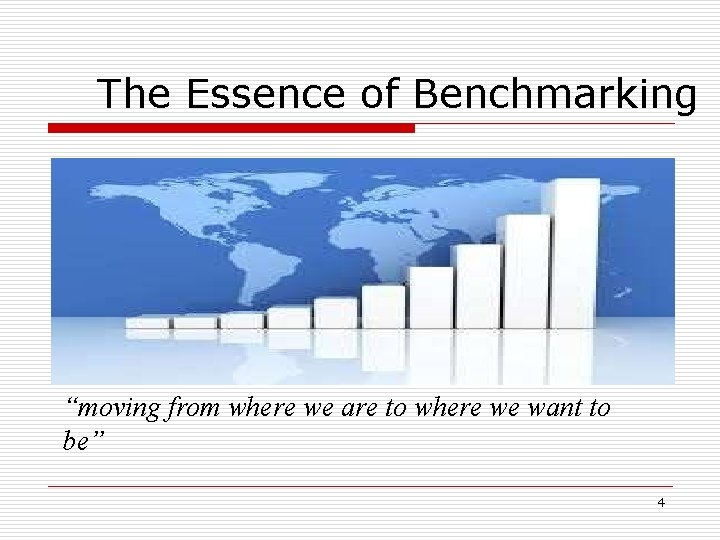
The Essence of Benchmarking “moving from where we are to where we want to be” 4
Introduction and use o. Benchmarking is an increasingly effective popular tool. o. It is used extensively both manufacturing and service organizations. o. Bench marking stipulate that quality goals and objectives be based on competitive products 5
Introduction and use o Malcolm Baldridge National Quality Award requires applicants benchmark external organizations. 6
THE EVOLUTION OF BENCHMARKING o. The benchmarking processes may have evolved in the 1950 s when W. EDWARDS DEMING taught the idea of quality control to the Japanese. o The method was rarely used in the United States until the early 1980 s, when IBM, Motorola and Xerox became the best known example for using benchmarking processes. 7
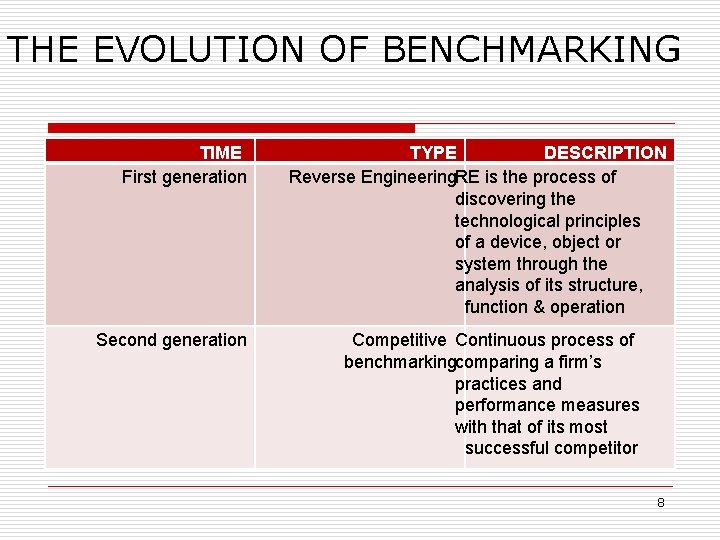
THE EVOLUTION OF BENCHMARKING TIME First generation Second generation TYPE DESCRIPTION Reverse Engineering. RE is the process of discovering the technological principles of a device, object or system through the analysis of its structure, function & operation Competitive Continuous process of benchmarkingcomparing a firm’s practices and performance measures with that of its most successful competitor 8
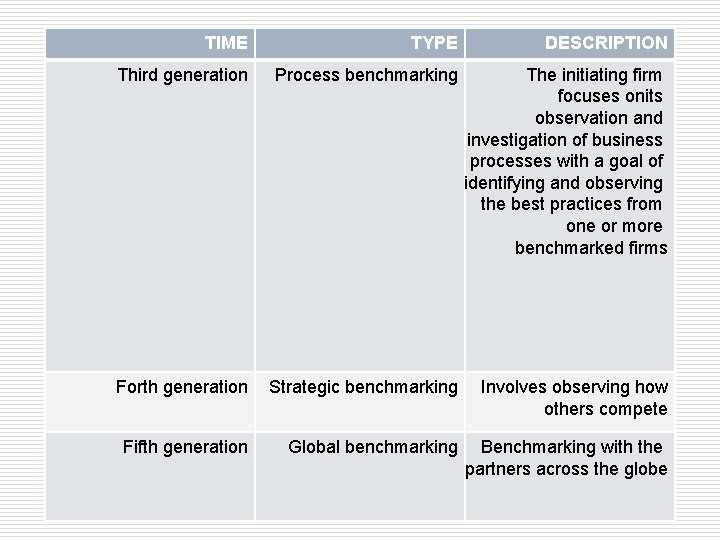
TIME TYPE DESCRIPTION Third generation Process benchmarking The initiating firm focuses onits observation and investigation of business processes with a goal of identifying and observing the best practices from one or more benchmarked firms Forth generation Strategic benchmarking Involves observing how others compete Fifth generation Global benchmarking Benchmarking with the partners across the globe Total Quality Management Spring 2010 IUG 9
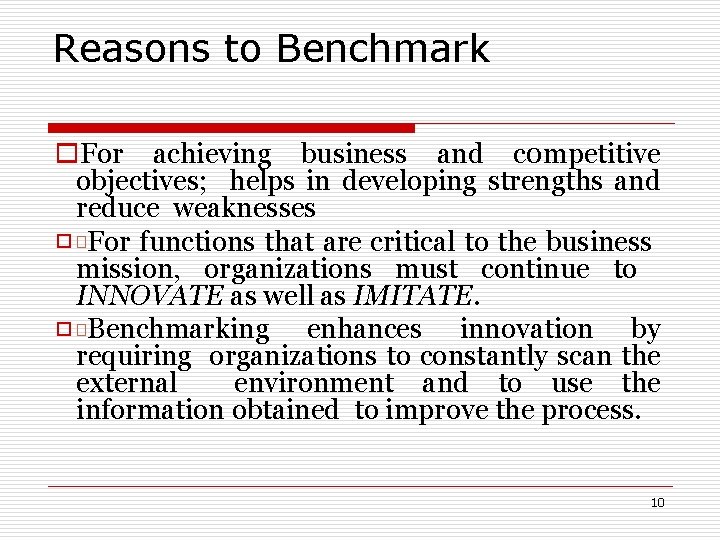
Reasons to Benchmark o. For achieving business and c 0 mpetitive objectives; helps in developing strengths and reduce weaknesses o �For functions that are critical to the business mission, organizations must continue to INNOVATE as well as IMITATE. o �Benchmarking enhances innovation by requiring organizations to constantly scan the external environment and to use the information obtained to improve the process. 10
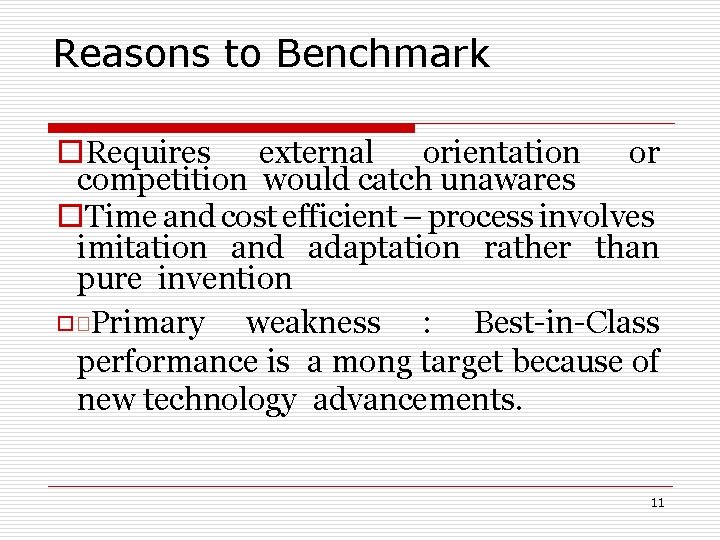
Reasons to Benchmark o. Requires external orientation or competition would catch unawares o. Time and cost efficient – process involves imitation and adaptation rather than pure invention o �Primary weakness : Best-in-Class performance is a mong target because of new technology advancements. 11
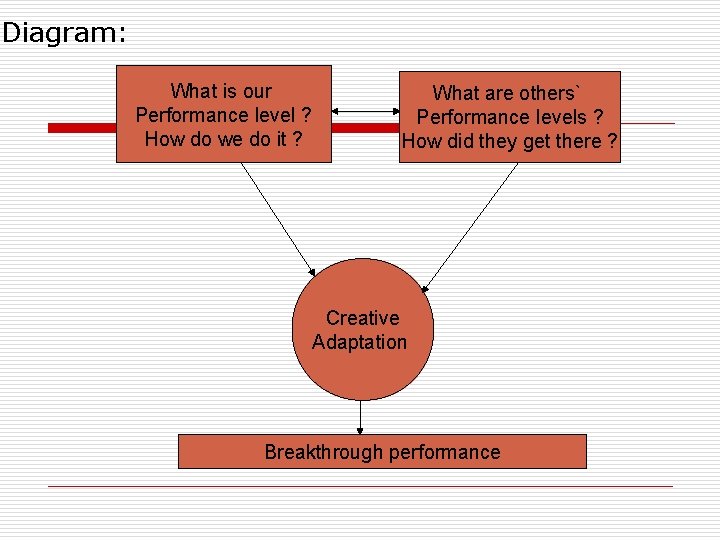
Diagram: What is our Performance level ? How do we do it ? What are others` Performance levels ? How did they get there ? Creative Adaptation Breakthrough performance
Why Benchmark? To To To Obtain an External Perspective of What Is Possible Assist in Setting Strategic Targets Promote Improvements in Performance Establish a Competitive Edge Enhance Customer Satisfaction Reduce Costs Improve Employee Morale Achieve Quality Awards Survive 13
When Benchmarking? If the company’s QMS is not properly developed, documented and implemented. If company’s great strength areas are not measured. If company’s great weakness areas are not measured. If company’s great opportunities are not measured. If customer needs are not assessed and rectified. 14
Benchmarking in the Context of TQM Key principles include: Comparisons with best practice A Strong emphasis on meeting the needs of the customer (internal and external) The importance of efficient, effective business processes The need for continuous improvement Enhances a TQM program 15
Levels Of Benchmarking In Competitive Environment Internal benchmarking - Within one’s org. Competitive benchmarking - Analysis the performance and practices of best in class companies. Non-competitive benchmarking - Is learning something about a process a company wants to improve by benchmarking. World class benchmarking - Ambitious and looking towards recognized leader. 16
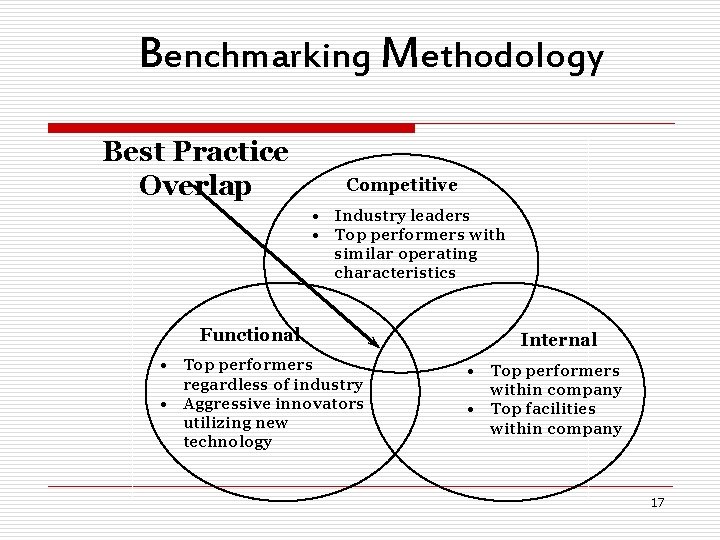
Benchmarking Methodology Best Practice Overlap Competitive • Industry leaders • Top performers with similar operating characteristics Functional • Top performers regardless of industry • Aggressive innovators utilizing new technology Internal • Top performers within company • Top facilities within company 17
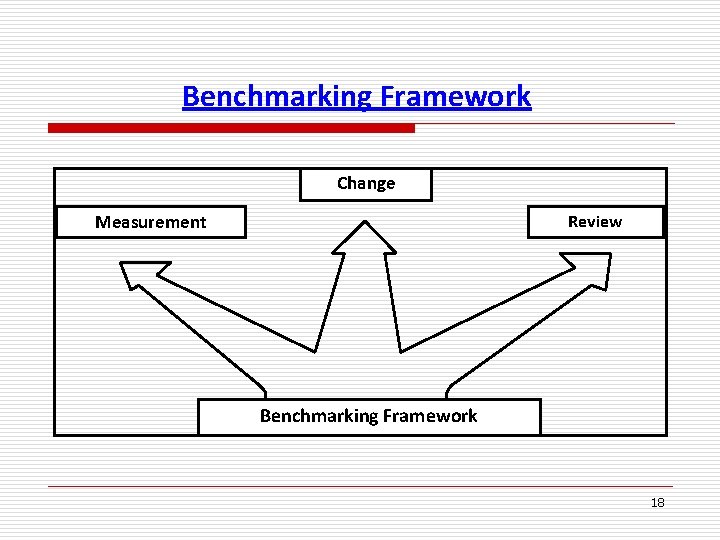
Benchmarking Framework Change Measurement Review Benchmarking Framework 18
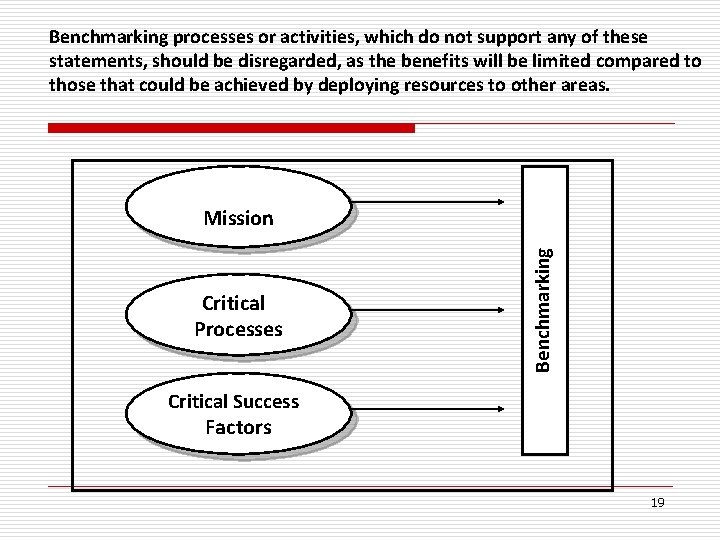
Benchmarking processes or activities, which do not support any of these statements, should be disregarded, as the benefits will be limited compared to those that could be achieved by deploying resources to other areas. Critical Processes Benchmarking Mission Critical Success Factors 19
Types Of Benchmarking Performance or operational benchmarking: o. It involves – pricing, technical quality, features and other quality. Process or functional benchmarking: o. It involves processes such as billing, order entry or employee training. Strategic benchmarking: o. Examines how companies compute and seeks the winning strategies that have led to competitive advantage and market success. 20
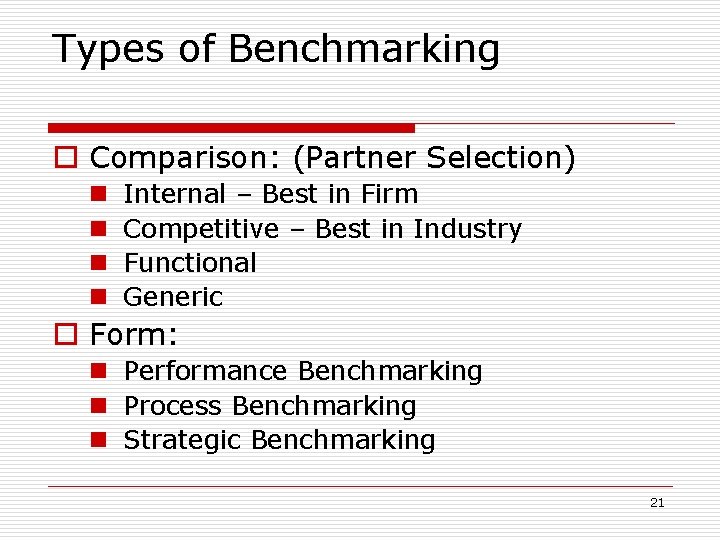
Types of Benchmarking o Comparison: (Partner Selection) n n Internal – Best in Firm Competitive – Best in Industry Functional Generic o Form: n Performance Benchmarking n Process Benchmarking n Strategic Benchmarking 21
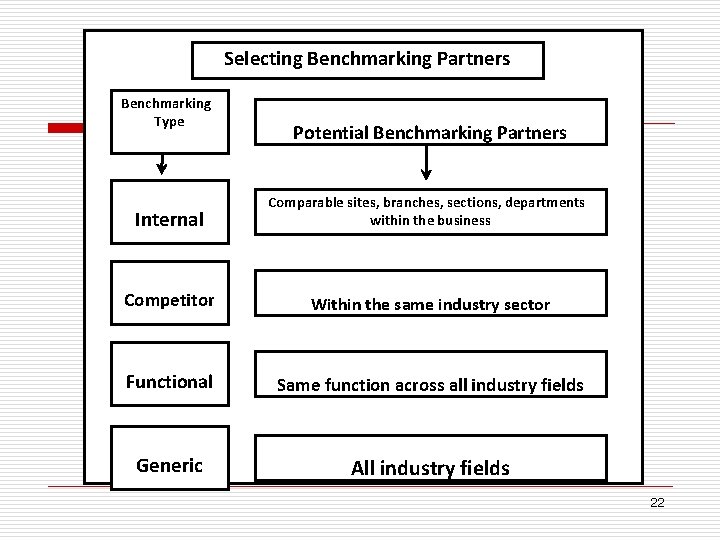
Selecting Benchmarking Partners Benchmarking Type Potential Benchmarking Partners Internal Comparable sites, branches, sections, departments within the business Competitor Within the same industry sector Functional Same function across all industry fields Generic All industry fields 22
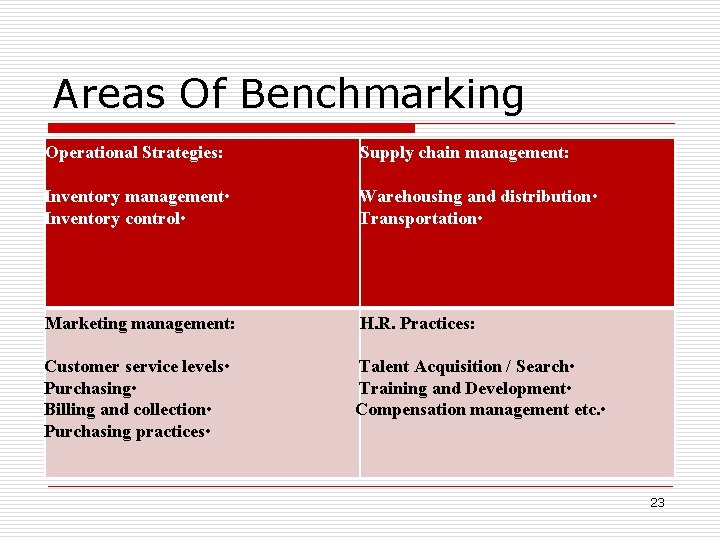
Areas Of Benchmarking Operational Strategies: Supply chain management: Inventory management • Inventory control • Warehousing and distribution • Transportation • Marketing management: H. R. Practices: Customer service levels • Purchasing • Billing and collection • Purchasing practices • Talent Acquisition / Search • Training and Development • Compensation management etc. • 23
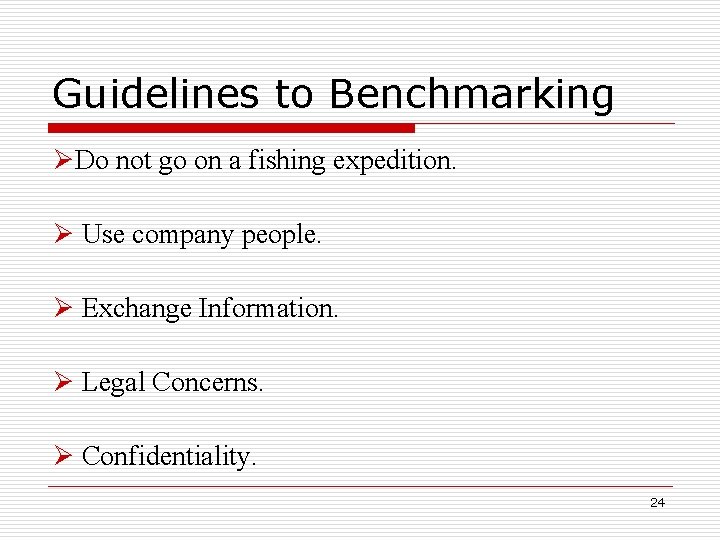
Guidelines to Benchmarking Do not go on a fishing expedition. Use company people. Exchange Information. Legal Concerns. Confidentiality. 24
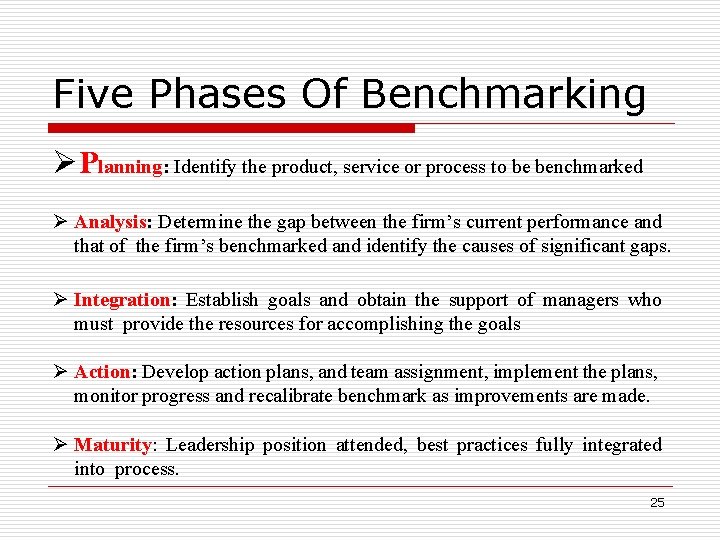
Five Phases Of Benchmarking Planning: Identify the product, service or process to be benchmarked Analysis: Determine the gap between the firm’s current performance and that of the firm’s benchmarked and identify the causes of significant gaps. Integration: Establish goals and obtain the support of managers who must provide the resources for accomplishing the goals Action: Develop action plans, and team assignment, implement the plans, monitor progress and recalibrate benchmark as improvements are made. Maturity: Leadership position attended, best practices fully integrated into process. 25
8
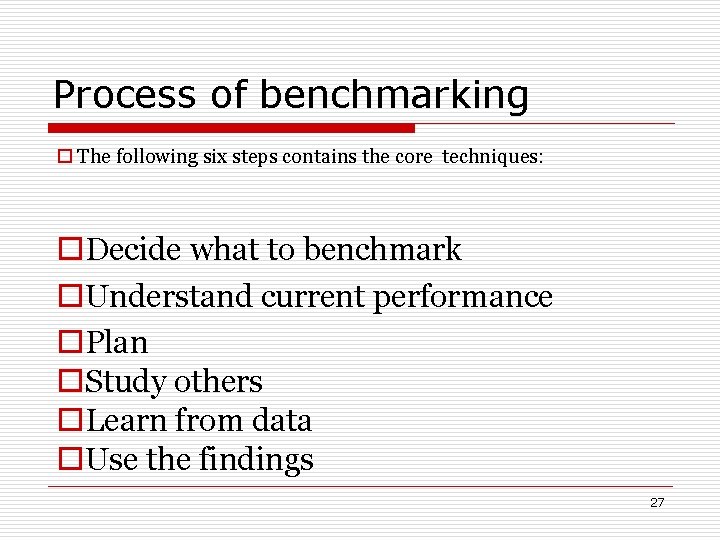
Process of benchmarking o The following six steps contains the core techniques: o. Decide what to benchmark o. Understand current performance o. Plan o. Study others o. Learn from data o. Use the findings 27
Decide what to benchmark ? o Benchmarking can be applied to the any business or production process 28
Understanding current performance o To compare practices to outside benchmarks, it is first necessary to thoroughly understand documents the current process of your organization that where you stand. 29
Planning o Once internal process is understood and documented, it is possible to make decisions about how to conduct the study. o The team should be decided that what type of benchmarking to be preformed. o Benchmarking planning is a learning process. 30
Studying others o. Benchmarking studies look for two types information: o. A description of how best in class processes are practices and othe measurable results of these practices 31
Learn from the data o. Learning from the data collected in a benchmarking study involves answering a series of questions: o. Is there a gap between the organizations performance and the performance of the bestin-class organizations ? o. What is the gap ? How much is it ? o. Why is there a gap ? What does the best-inclass do differently that is better ? o. If best-in-class practices were adopted, what would be the resulting improvement ? 32
Learn from the data o Its main objective is to determine from overall effect on the internal operation of adapting the best-in-class practice. o In other words, what is the size of the gap and what are the appropriate benchmark metrics and objectives ? 33
Using the findings o Benchmarking is the waste of time if change does not occurs as a result. To effect the change, the findings must be communicated to the people within the organization who can enable improvement. o The findings must be translated to GOALS and OBJECTIVES and ACTION PLANS must be developed to implement new process. 34
Using the findings o. The generic steps for the development and execution of action plans are: o. Specify tasks o. Sequence tasks o. Determine resource needs o. Establish task schedule o. Assign responsibility for each task o. Describe expected results o. Specify methods for monitoring results. 35
Using the findings o Goals and objectives should be consistent with the execution of the action plan so that the end result is process superiority. The best results are obtained when process owners fully participate in the design and execution of the plan. 36
Performance Benchmarking • Performance benchmarking enables managers to assess their competitive positions through product and service comparisons. • Performance benchmarking usually focuses on elements of price, technical quality, product or service features, speed, reliability, and other performance characteristics. • Reverse engineering, direct product or service comparisons, and analysis of operating statistics are the primary techniques applied during performance benchmarking. 37
Process Benchmarking • Process benchmarking focuses on discrete work processes and operating systems, such as the customer complaint process, the order-and-fulfillment process, or the strategic planning process. • Process benchmarking seeks to identify the most effective operating practices from many companies that perform similar work functions. • Its power lies in its ability to produce bottom-line results. If an organization improves a core process, for instance, it can then quickly deliver process improvement 38
Critical Success Factors (CSFs) Are the Key Indicators That Inform Us That a Particular Task, Activity, Process, Event, Function, Service or Endeavour Is Successful CSF’s Are a Feature of All Levels of Business Activity; From the Company As a Whole Down to the Activities of Individuals in It How Will Success Feel? 42
Benchmarking Critical Success Factors v. Adopt, Adapt, and Advance: A well-designed performance measurement and benchmark system is essential, but there are other critical success factors: § § § Senior management support; Benchmarking training for the project team; Useful information technology systems; Cultural practices that encourage learning; Resource dedication - especially in the form of time, funding, and useful equipment. 43
Strategic Benchmarking • Strategic benchmarking examines how companies compete and is seldom industry-focused. It roves across industries seeking to identify the winning strategies that have enable highperforming companies to be successful in their marketplaces. • Strategic benchmarking influences the longerterm competitive patterns of a company. Consequently, the benefits may accrue slowly. 44
Planning a Benchmarking Exercise Principal Requirements for Success o Strong Commitment From Senior Management o Willingness to Act on Any Major Opportunities for Improvement Revealed by Benchmarking o Resources o Staff Capable of Running a Benchmarking Project o Time for Employees to Spend on Benchmarking Activities 45
THE BENEFITS OF BENCHMARKING Cultural Change Benchmarking allows organizations to set realistic, rigorous new performance targets, and this process helps convince people of the credibility of these targets. This tends to overcome the “not invented here” syndrome and the “we’re different” justification for the status quo. 46
THE BENEFITS OF BENCHMARKING Performance Improvement Benchmarking allows the organization to define specific gaps in performance and to select the processes to improve. It provides a vehicle whereby products and services are redesigned to achieve outcomes that meet or exceed customer expectations. The gaps in performance that are discovered can provide objectives and action plans for improvement at all levels of the organization and promote improved performance for individual and group participants. 47
THE BENEFITS OF BENCHMARKING Human Resources Benchmarking provides a basis for training. Employees begin to see the gap between what they are doing and what best in class are doing. Closing the gap points out the need for personnel to be involved in techniques of problem solving and process improvement. Moreover, the synergy between organization activities is improved through cross functional coop eration. 48
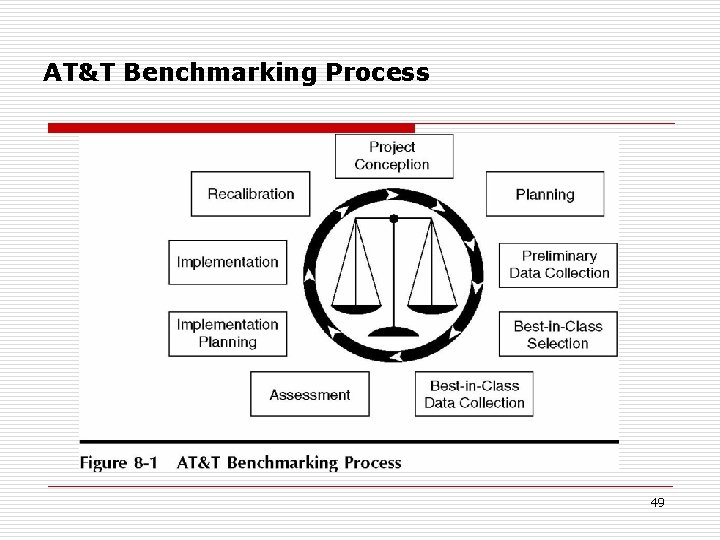
AT&T Benchmarking Process 49
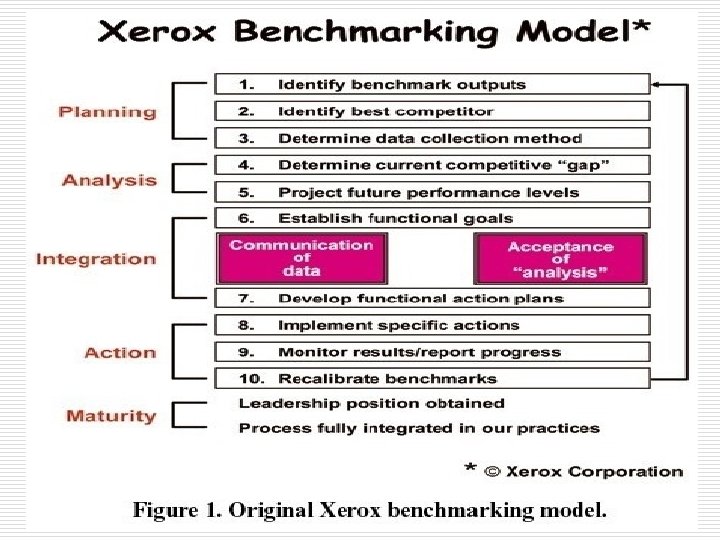
Xerox 12 -Step Benchmarking Process v Phase 1: Planning 1. Identify what to benchmark; 2. Identify comparative companies; 3. Determine data collection method & collect data. v Phase 2: Analysis 4. Determine current performance gap; 5. Project future performance levels. v Phase 3: Integration 6. Communicate finding and gain acceptance; 7. Establish functional goals. 50
The Xerox 12 -Step Benchmarking Process (continued) v Phase 4: Action 8. Develop action plans; 9. Implement specific actions & monitor progress; 10. Recalibrate benchmarks. v Phase 5: Maturity 11. Attain leadership position ; 12. Fully integrate practices into processes. 51
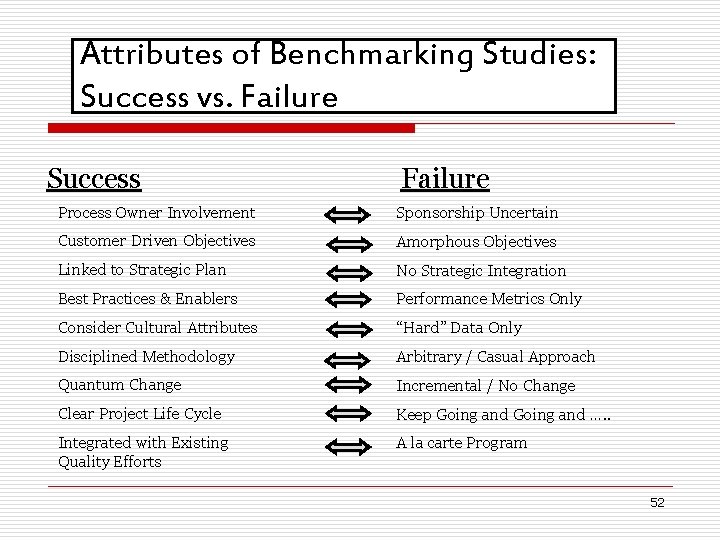
Attributes of Benchmarking Studies: Success vs. Failure Success Failure Process Owner Involvement Sponsorship Uncertain Customer Driven Objectives Amorphous Objectives Linked to Strategic Plan No Strategic Integration Best Practices & Enablers Performance Metrics Only Consider Cultural Attributes “Hard” Data Only Disciplined Methodology Arbitrary / Casual Approach Quantum Change Incremental / No Change Clear Project Life Cycle Keep Going and …. . Integrated with Existing Quality Efforts A la carte Program 52
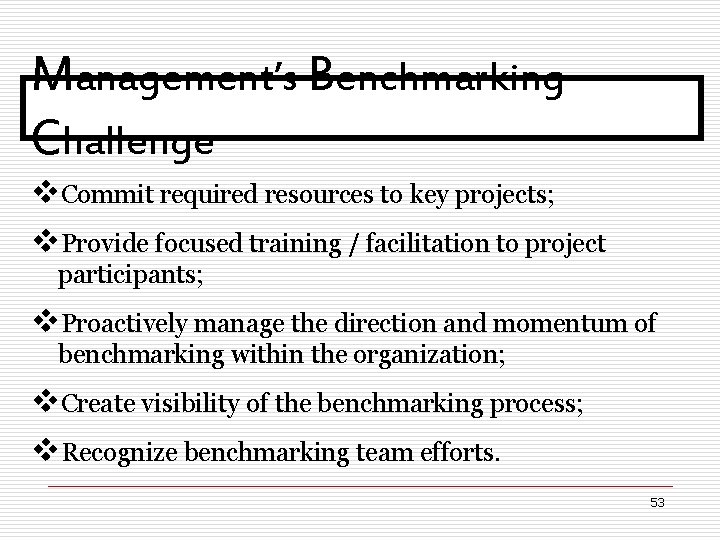
Management’s Benchmarking Challenge v. Commit required resources to key projects; v. Provide focused training / facilitation to project participants; v. Proactively manage the direction and momentum of benchmarking within the organization; v. Create visibility of the benchmarking process; v. Recognize benchmarking team efforts. 53
- Slides: 50